Author: Sean Brightman

  • Fractional CMO vs Full-Time CMO for Startups: The Brutal 2026 Guide

    Fractional CMO vs Full-Time CMO for Startups: The Brutal 2026 Guide

    Hiring a full-time CMO in 2026 feels like the “safe” move for a UK scale-up. It isn’t. For most, it is a £250,000 anchor that drags your runway into the dirt. When weighing up a fractional cmo vs full time cmo for startups, the traditional choice often leads to a messy department with no clear direction. You are likely feeling the burn rate anxiety whilst fearing a “bad” expensive hire that you cannot afford to get wrong. It is a high-stakes gamble with your company’s future.

    This guide will prove why a full-time hire might be your biggest strategic mistake. We will show you how fractional leadership drives faster growth through tactical precision and AI-powered engines. We will strip away the corporate fluff to compare the true costs and outcomes of both models. You will learn how to install senior accountability, implement a clear marketing roadmap, and build scalable systems designed for a clean exit. It is time to stop hiring for ego and start hiring for impact.

    Key Takeaways

    • Stop draining your runway on a £150,000+ “heavy hitter” before you have a proven, repeatable marketing system in place.
    • Compare the cost-to-impact ratio of a fractional cmo vs full time cmo for startups to ensure you are buying strategic velocity, not corporate baggage.
    • Leverage AI-powered growth engines to transform your marketing from a series of manual tasks into a scalable, high-output machine.
    • Identify the four specific triggers that prove your scale-up needs senior leadership to fix messy departments and a lack of direction.
    • Execute a 30-day strategic sprint to ensure your new leadership delivers immediate accountability and a clear roadmap for growth.

    The Full-Time CMO Trap: Why Startups Overhire Too Early

    Hiring a heavy-hitter too early is a classic scale-up blunder. It is the £150,000 mistake. You bring in a full-time Chief Marketing Officer (CMO) before you have a repeatable growth engine or even a basic product-market fit. The result? You pay a “patience tax” whilst they spend six months “learning the culture.” By the time they produce their first meaningful strategy deck, your runway is half-gone. You have traded your survival capital for corporate seniority.

    The choice between a fractional cmo vs full time cmo for startups comes down to one thing: velocity. A full-time hire often defaults to “expensive activity.” They want a team of six, a massive tech stack, and a £20,000-a-month agency retainer to do the heavy lifting. They build a kingdom; you need a machine. A Fractional CMO is different. They focus on outcomes, not hours. They provide senior strategy injected exactly where the friction is highest, without the baggage of a permanent C-suite salary.

    The hidden costs of a full-time hire are brutal. It isn’t just the base pay. It is the 25% recruitment fee. It is the equity dilution that haunts you during your exit. It is the benefits package and the employer National Insurance contributions. These are fixed costs that don’t care if your lead volume drops or the market shifts. A fractional model converts these fixed liabilities into variable strategic investments. You get the brain without the overhead.

    The ‘Messy Marketing’ Syndrome

    Founders often hire a full-time CMO because they are tired of managing agencies they don’t understand. They want the marketing problem to “go away.” It won’t. If your marketing department is a chaotic mix of disjointed tactics, a full-time hire won’t magically fix the system. They often inherit the mess and add another layer of bureaucracy. Without a clear roadmap, you just have an expensive executive watching a broken engine. You need accountability, not just a warm body in a chair.

    Seniority on Tap vs. Overhead on the Books

    There is a pervasive myth that “full-time” equals “more committed.” It is nonsense. A full-time CMO is often insulated by their contract. A fractional leader survives on results. They bring cross-industry insights that a single-company executive simply misses. In 2026, the competitive edge is being “plug-and-play.” You don’t need someone to sit in meetings for 40 hours a week. You need someone to build a growth engine. This involves high-level AI consulting to automate the mundane and focus on the strategic. Fractional advisory gives you the strategic seniority you need, exactly when you need it.

    Fractional CMO vs Full-Time: A Brutal Comparison for 2026

    The debate between a fractional cmo vs full time cmo for startups isn’t about preference. It is about physics. A full-time hire provides corporate stability. They are there for the 9-to-5, the watercooler chats, and the internal politics. A fractional leader provides strategic velocity. They exist to solve a specific problem, build a specific engine, and then get out of the way. You aren’t paying for a bum on a seat; you are paying for a battle-hardened brain that has seen your exact mess ten times before.

    Accountability is baked into the fractional model. A full-time executive has a notice period and a golden parachute. They can coast for months before the board notices a lack of progress. A fractional CMO is only as good as their last deliverable. If the needle doesn’t move, the contract ends. This creates a relentless focus on high-impact wins rather than “busy work” or empire building. You get the intensity of a founder with the expertise of a veteran.

    The Cost-Benefit Breakdown

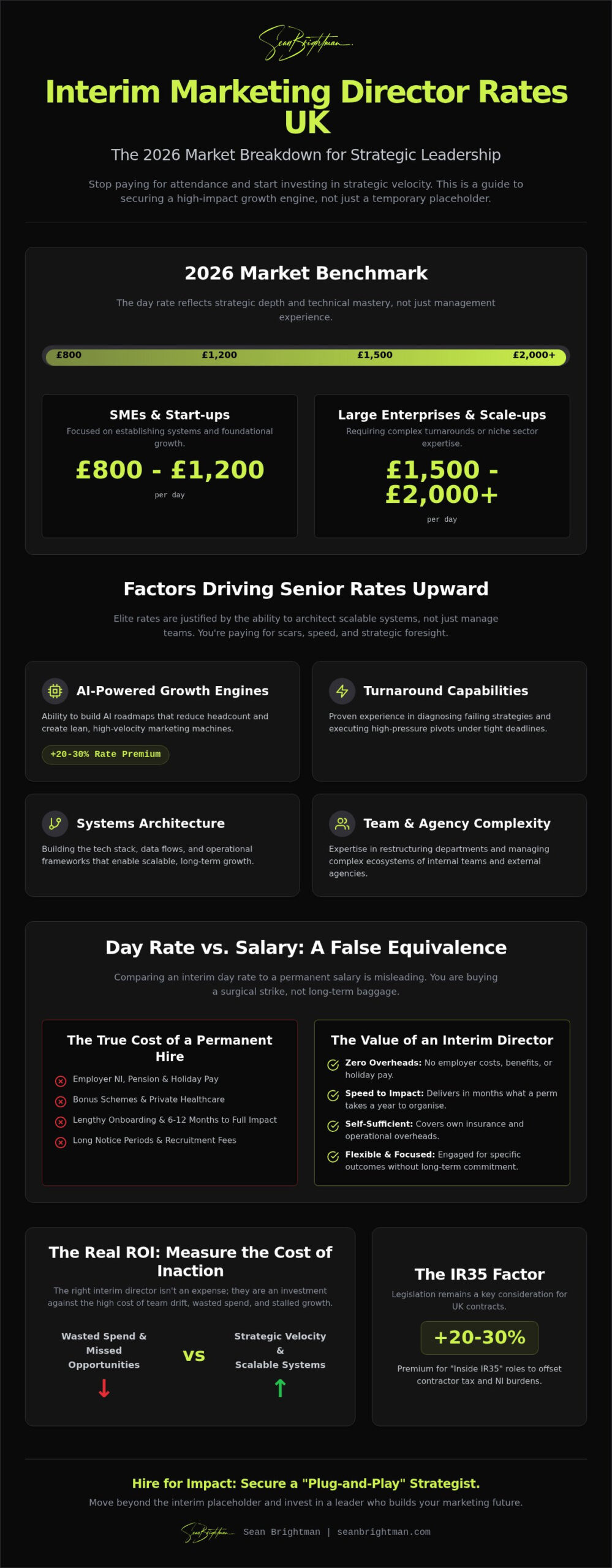
    Let’s talk numbers. A senior CMO nationally commands £150,000 to £200,000. Once you add bonuses, NI, and recruitment fees, you are looking at £15,000 to £20,000 every month. A fractional leader typically costs a fraction of that for the same strategic output. The opportunity cost is even higher. It takes months to find a permanent hire. A fractional partner starts on Monday. This speed is critical when you are preparing for an exit or a fresh funding round. Buyers don’t want to see a department that relies on one person’s charisma. They want a documented, scalable growth engine.

    Scope of Work: Strategy vs Execution

    Full-time CMOs often fall into the trap of “hiring their way out” of problems. They build massive teams and bloated budgets to justify their seniority. A fractional leader does the opposite. They build lean, automated systems that require fewer people, not more. Everything starts with strategic brand roadmapping. This document is the blueprint for your growth. It defines the “what” and the “how” so your internal team or agencies can execute with precision. If you are tired of guessing, an advisory retainer provides the ongoing oversight to ensure that roadmap stays on track.

    When to Pull the Trigger: 4 Signs You Need a Fractional CMO

    Deciding between a fractional cmo vs full time cmo for startups isn’t about your budget. It is about your stage. If you wait until your marketing is a dumpster fire, you have already lost. You need to recognise the friction points before they stall your growth. Here are the four non-negotiable signs that it is time to bring in senior leadership on a fractional basis.

    • Sign 1: You have product-market fit but no engine. You have customers, but you can’t explain exactly how you got them. Your growth is accidental, not intentional.
    • Sign 2: Your team is “busy” but the needle isn’t moving. Activity is not progress. If your Slack is full of updates but your CAC is climbing and your LTV is stagnant, your execution lacks a strategic north star.
    • Sign 3: You are preparing for a Series A or an exit. Investors don’t buy “hustle.” They buy repeatable systems. You need a documented strategy that exists outside of your head.
    • Sign 4: You are the de facto CMO. If you are still approving ad copy and managing agency calls at 10 PM, you aren’t the CEO. You are a bottleneck.

    A fractional leader doesn’t just “help out.” They install the machinery you lack. They take the weight off the founder’s shoulders and replace chaos with a clinical, results-oriented framework.

    Sign 1: The ‘Agency Management’ Headache

    Founders often become the frustrated middleman between the business and its external partners. You spend your day translating your vision to an ad agency that doesn’t “get” your brand. A fractional leader stops this cycle. They organise your external partners, set clear KPIs, and hold them accountable to results, not just “brand awareness.” Founder-led marketing fails the moment you spend more time managing tools than steering the ship.

    Sign 2: Preparing for a Scalable Exit

    Building a marketing strategy for business exit requires senior-level documentation. Buyers discount businesses where the marketing knowledge sits solely with the founder. They want to see a plug-and-play growth engine that survives your departure. A marketing advisory retainer ensures this documentation is built in real-time. It provides the ongoing senior oversight needed to keep the engine running whilst you focus on the deal. Don’t let a lack of systems shave 20% off your valuation.

    Fractional CMO vs Full-Time CMO for Startups: The Brutal 2026 Guide

    The 2026 Differentiator: AI-Powered Growth Engines

    In 2026, a CMO who doesn’t understand agentic AI is a liability. The debate of fractional cmo vs full time cmo for startups usually focuses on cost. That is a mistake. The real divide is between those who build manual teams and those who build AI-powered growth engines. A full-time hire often brings an outdated playbook to a modern market. Whilst 96% of CMOs admit AI is transforming the function, only about one-third have actually implemented the change. A fractional leader uses AI consulting to build systems that solve problems whilst you sleep.

    We move beyond basic prompts. Integrating AI into your core operations means automating the entire lead-to-revenue lifecycle. It involves an “AI Efficiency Audit” to gut your current tech stack of redundant, expensive software. You stop paying for “seats” and start paying for outcomes. This is how you find hidden profit in your current marketing spend. It is the difference between having a “tool” and having a functional component of your business machinery that doesn’t require constant manual management.

    Building a Marketing Operations Consultant level system

    A fractional partner acts as a high-level Marketing Operations Consultant. They don’t just suggest tools; they architect strategic workflows. This replaces expensive manual labour with automated precision. Industry data as of August 2026 indicates that marketing automation is projected to increase from 16% to 36% by 2028. If you are still hiring full-time staff for tasks that an AI agent can handle, you are burning cash. The fractional CMO is the architect of your AI roadmap, ensuring your team is lean and your output is massive.

    Data-Driven Accountability

    Board reports are often full of “fluff” like brand sentiment and social engagement. Full-time CMOs use these metrics to play corporate politics and justify their tenure. Fractional leaders don’t have that luxury. They rely on AI to track real-time marketing ROI across every channel, from top-of-funnel discovery to final conversion. This provides a clinical, unbiased view of what is actually working. You get senior accountability without the ego-driven narratives. It is about hard data, not polished presentations that hide a lack of progress.

    Build a scalable growth engine that doesn’t require a massive headcount by hiring a Fractional CMO who specialises in AI integration.

    How to Onboard a Fractional CMO for Maximum Impact

    Corporate onboarding is a slow-motion car crash. A full-time executive typically spends their first 90 days “absorbing the culture” and “meeting stakeholders.” You don’t have 90 days. When you weigh up a fractional cmo vs full time cmo for startups, you are choosing tactical speed over corporate ceremony. Onboarding a fractional leader is about a 30-day strategic sprint. You identify the friction, fix the leaks, and install the machinery. It is leadership without the ego.

    A fractional CMO doesn’t need a desk or a parking space. They need access to your data, your tech stack, and your team. The goal is to move from chaos to clarity before the first month is out. You define what “winning” looks like in 90 days, not three years. This isn’t about building a career; it’s about building a growth engine. We establish a rhythm: weekly accountability to keep the team focused and monthly strategic reviews to pivot as the market demands.

    The First 30 Days: From Chaos to Clarity

    The sprint begins with a marketing operations consultant audit. You stop guessing and start measuring. We look for “quick wins”-tactical adjustments that can often pay for the fractional retainer within the first six weeks. This might involve gutting a bloated ad account or automating a manual lead-nurture sequence. You fix the immediate leaks whilst setting the long-term vision. It is tactical surgery followed by strategic architecture.

    Long-term Advisory: The Retainer Model

    Once the engine is built, you don’t let it rust. An advisory retainer provides ongoing strategic velocity. It gives you a “battle-hardened” perspective in your corner. This keeps you from making a £50,000 mistake on a trend that won’t last. In the fractional cmo vs full time cmo for startups debate, the retainer model is the clear winner for flexibility. You get the brain of a veteran without the weight of a permanent C-suite salary. It is a scalable asset, not a fixed liability.

    Stop hiring CVs and start building systems. Book a roadmapping session with Sean Brightman to turn your marketing from a cost centre into a high-output growth engine.

    Build the Engine, Not the Empire

    The decision between a fractional cmo vs full time cmo for startups is ultimately a choice between agility and baggage. You don’t need a £200,000 anchor dragging your runway into the dirt. You need a high-velocity strategic partner who installs the machinery required for a scalable exit. Stop hiring for corporate stability that your business hasn’t earned yet. Focus on building an AI-powered growth engine that delivers senior accountability without the ego.

    By opting for fractional leadership, you secure a battle-hardened perspective and a clinical roadmap for growth. You replace messy, disjointed tactics with automated strategic workflows that drive real-time ROI. It is about impact, not headcount. It is about outcomes, not hours. The future of your scale-up depends on how fast you can turn chaos into a repeatable, documented system.

    Stop wasting money on the wrong hires. Build your growth engine with Sean Brightman.

    Your marketing department should be your greatest asset, not your biggest headache. Take the first step toward a leaner, more profitable future today.

    Frequently Asked Questions

    What is the difference between a fractional CMO and a marketing consultant?

    A consultant gives advice whilst a fractional CMO takes ownership. Consultants deliver reports and leave you to execute the findings. A fractional CMO builds the engine, manages the team, and stays accountable for the results. It is the difference between a spectator and a player-coach who is active in your business machinery.

    Is a fractional CMO worth it for a pre-seed startup?

    Usually, it is not. At the pre-seed stage, you need a founder who can sell, not an executive who can strategise. Hiring a fractional leader before you have basic product-market fit is a distraction. Wait until you have enough data to build a repeatable growth engine. Focus on survival and initial traction first.

    How many hours a week does a fractional CMO typically work?

    Most fractional CMOs work between 5 and 15 hours per week. It is about strategic impact, not desk time. They attend key meetings, steer the roadmap, and unblock the internal team. If you are counting hours, you are missing the point of the fractional cmo vs full time cmo for startups debate. You pay for the brain, not the clock.

    Can a fractional CMO manage my existing marketing agency?

    Yes, this is a core responsibility. A fractional CMO acts as your translator and enforcer. They set the KPIs, audit the output, and fire agencies that underperform. You stop being the middleman and start seeing real accountability from your external partners. They ensure your agencies are functional components, not just cost centres.

    What is the typical cost of a fractional CMO in the UK for 2026?

    Costs vary based on the complexity of your engine and the frequency of advisory sessions. Whilst specific retainers are bespoke, they are significantly lower than the £15,000 monthly cost of a full-time, heavy-hitter executive. Some industry professionals report that retainers often reflect the level of strategic velocity required to hit your next funding milestone.

    Do fractional CMOs take equity in startups?

    Some do, but it shouldn’t be the primary motivator. Equity is often used as a performance kicker rather than a salary replacement. It aligns the leader with your long-term exit goals. However, most professional fractional partners prioritise their retainer to ensure they remain a variable, scalable asset that you can dial up or down.

    How do I know if my startup is ready for a full-time CMO?

    You are ready when your marketing engine is so complex that it requires 40 hours of senior oversight every week. If your growth is predictable and you have a team of 10 people to lead, the transition makes sense. Until then, the fractional cmo vs full time cmo for startups comparison favours the leaner, more flexible model.

    What should I look for in a fractional CMO’s track record?

    Look for battle-hardened experience in your specific sector or stage. They should have a history of building engines, not just managing big budgets. Ask for proof of AI integration and scalable systems they have built for previous exits. Avoid anyone who only talks about brand awareness and “vibes” without mentioning hard ROI.

  • Professional Marketing Advisory: Senior Strategic Velocity for UK Scale-ups

    Professional Marketing Advisory: Senior Strategic Velocity for UK Scale-ups

    Hiring a full-time CMO for £150,000 is often a vanity metric that UK scale-ups simply cannot afford. You don’t need a massive salary on the payroll. You need a professional marketing advisory that builds systems instead of just filling seats. Right now, your marketing department is likely a mess of disjointed tactics and agency fees that don’t translate to actual growth. It’s activity without velocity. It’s motion without progress.

    We know the frustration of watching junior teams spin their wheels because there’s no senior leadership to point the way. You’re likely uncertain about how to integrate AI, tired of babysitting agencies, and desperate for a roadmap that actually leads to a profitable exit. This guide reveals how to secure senior-level direction and AI-powered systems for a fraction of the cost of a traditional executive hire.

    We’ll explore how to transform your chaotic marketing into a high-output engine. You’ll learn how to implement strategic accountability and modernise your operations to ensure every pound spent drives you closer to your scaling goals. We’re stripping away the fluff to focus on the machinery of growth.

    Key Takeaways

    • Eliminate the £150k overhead of a full-time hire by prioritising strategic velocity over permanent headcount.
    • Understand how a professional marketing advisory provides the objective direction and accountability that agencies often fail to deliver.
    • Convert manual, disjointed processes into a scalable, AI-powered growth engine through structured systems architecture.
    • Implement a Marketing Efficiency Audit to strip away waste and hold your internal teams to a higher standard of performance.
    • Leverage a plug-and-play retainer model to inject senior-level leadership into your business exactly when and where it’s needed.

    What is Professional Marketing Advisory in 2026?

    Most CEOs think they need a new hire. They’re usually wrong. They need a system. A professional marketing advisory is the surgical alternative to a bloated executive payroll. It isn’t about filling a chair; it’s about installing a brain. In 2026, this role has moved beyond the passive “board advisor” stereotype. It is now a high-impact, functional component of the business machinery that prioritises results over presence.

    There is a sharp distinction between advisory and consultancy. Consultants deliver a slide deck and an invoice; they provide one-off projects that often gather dust. Advisors provide direction and, more importantly, accountability. They stay in the trenches to ensure the strategy is actually executed. It’s the difference between buying a map and hiring a navigator who won’t let you drive off a cliff.

    This model thrives on Strategic Velocity. This isn’t about doing more work. It’s about doing fewer, better things to move faster. You achieve velocity by stripping away the tactical noise and returning to marketing strategy fundamentals that build long-term value. You stop chasing every shiny new platform and start perfecting the systems that convert. You don’t need more activity. You need more impact.

    The trigger points for seeking an advisor are usually painful and obvious. You’re scaling toward an exit but your marketing data is a mess. Your junior team is working hard but achieving nothing. Or, perhaps most common in 2026, you’ve hit AI tool fatigue. You have the software, but you have no idea how to turn those tools into a scalable growth engine.

    The Core Difference: Advisory vs. Execution

    Advisors build the engine. Agencies and junior teams fuel it. If you’re asking your digital agency for your overall business strategy, you’ve already lost. Their goal is to sell you more billable hours or higher ad spend. An advisor’s goal is efficiency. They focus on systems architecture and positioning, acting as an objective external force. They challenge internal assumptions that have become “truth” simply because nobody has dared to question them for three years.

    Why UK Scale-ups Are Moving to Fractional Leadership

    The £120,000 salary trap is real. Once you add National Insurance, benefits, and recruitment fees, a full-time CMO becomes a massive financial liability for a growing firm. UK scale-ups are ditching the overhead in favour of on-demand expertise. You get the “battle-hardened” strategist who has seen your specific problems ten times before. You pay for the solution, not the person’s pension. It’s senior leadership without the ego or the permanent desk space.

    Advisory vs. Agency vs. Full-time CMO: A Brutal Comparison

    Scaling a business between £2m and £20m turnover requires surgical precision. Most founders default to hiring an agency or a full-time executive. Both are often expensive mistakes. You need senior leadership, not just tactical execution. A professional marketing advisory acts as the architect. Agencies and junior staff are the bricklayers. If you don’t have a blueprint, you’re just paying people to move bricks around in the dark.

    The “Agency Trap” is a primary cause of stagnant growth. Agencies are built to sell services, not to grow your business. They’re incentivised to increase your ad spend or billable hours. They cannot provide objective strategy because their revenue depends on the tactics they recommend. This creates a massive conflict of interest. An advisor has no skin in the tactical game. Their only metric is your growth.

    Internal marketing departments often suffer from a lack of direction. Junior teams mark their own homework. Without a senior partner to hold them accountable, activity replaces results. A professional marketing advisory closes this gap by installing rigorous reporting and clear KPIs that align with your business objectives.

    When to Hire an Advisor Instead of an Agency

    Hire an agency when you have a proven system that needs more fuel. Hire an advisor when the system is broken or non-existent. Advisors specialise in the role of fractional CMOs, providing the agility to pivot without the friction of long-term agency contracts. They vet your external partners to ensure you’re getting value for every pound spent. If your current setup feels like a black hole for cash, it’s time to examine the fractional CMO model more closely.

    The Full-time CMO Myth

    The median salary for a UK CMO is £147,000. For a scale-up, that’s a massive overhead that kills cash flow. Worse, “CMO churn” is rampant. Senior leaders often fail in messy environments because they’re used to large budgets and established teams. They aren’t built for the “get-your-hands-dirty” reality of a scale-up. Advisory serves as a bridge. It stabilises the department and builds the systems first. This ensures that when you finally do hire a permanent director, they’re stepping into a well-oiled machine rather than a burning building. You can book a strategy call to see if your current structure is actually fit for purpose.

    The Mechanism: AI Roadmapping and Systems Architecture

    Strategy without a mechanism is just a wish list. A professional marketing advisory doesn’t just hand you a document; it installs an AI-Powered Growth Engine. This is the structural difference between a business that reacts to the market and one that dictates it. We move beyond the “tool fatigue” that plagues most UK scale-ups. You don’t need more software subscriptions. You need a unified system that converts data into predictable revenue.

    Most businesses treat AI as a shortcut for content creation. This is a tactical error. Effective AI consulting focuses on scalable output and operational efficiency. It’s about automating the mundane to liberate your team for high-level creative problem-solving. Research into AI in marketing strategy confirms that the real value lies in strategic implementation, not just prompt engineering. If your AI isn’t directly connected to your lead flow, it’s just a toy.

    However, technology is secondary to brand positioning. Systems can amplify a message, but they cannot fix a weak one. We start by sharpening your core value proposition. Once the positioning is bulletproof, we build the technical architecture to deliver it at scale. This ensures your growth is built on granite, not sand.

    Building Your Marketing Systems Architecture

    Tools are the plumbing; strategy is the water. A professional marketing advisory designs a bespoke Marketing Systems Architecture that ensures data transparency across your entire funnel. We strip away redundant platforms that drain your budget. We replace them with a lean, integrated stack designed for strategic velocity. You gain a dashboard that actually tells the truth about your acquisition costs and customer lifetime value. No more guessing. Just clinical, data-driven decisions.

    Strategic Brand Roadmapping for 2026

    Reactive marketing is the enemy of the scale-up. You cannot build a £50m business by deciding what to do on Monday morning. Strategic roadmapping defines your next 12 months in a single, concentrated blueprint. This proactive roadmap aligns your team, your agencies, and your budget toward a singular objective. Whether you are aiming for a series B round or a final exit, the roadmap provides the proof of scalability that investors demand. It converts your marketing from a cost centre into a measurable business asset.

    Professional Marketing Advisory: Senior Strategic Velocity for UK Scale-ups

    Measuring Success: Accountability and the Efficiency Audit

    Activity is not achievement. In a high-stakes scale-up, busy teams often mask stagnant growth with colourful charts and irrelevant data points. You need a professional marketing advisory to strip away the vanity metrics and focus on the cold, hard numbers that drive your valuation. Accountability isn’t a quarterly meeting. It’s a constant, clinical pressure applied to every campaign, channel, and hire. We measure success by net output, not hours logged or emails sent.

    The first step in this process is the Marketing Efficiency Audit. Most businesses are wasting at least 20 per cent of their budget on legacy tactics that no longer deliver. This audit identifies those hidden profit leaks. It cuts the fluff by ruthlessly removing any activity that doesn’t align with your strategic roadmap. The audit serves as a clinical 90-day diagnostic designed specifically for high-growth scale-ups to reset their operational baseline and reclaim wasted capital.

    Once the waste is removed, we address the structural flaws in your department. A professional marketing advisory provides the senior oversight necessary to fix a broken marketing team structure. We often find that departments are top-heavy with administrators but light on strategists. We restructure the hierarchy to prioritise strategic velocity. This moves your junior staff from being simple order-takers to becoming high-value strategic contributors who understand the “why” behind the “what”.

    The advisor acts as your External CMO, providing a level of accountability that internal hires often avoid. They set KPIs that actually matter to the CEO and the Board, such as customer acquisition cost (CAC) efficiency and lifetime value (LTV) growth. They mentor your high-potential staff to increase their strategic value whilst identifying the underperformers who are slowing the engine down. This oversight ensures your marketing remains a lean, high-performing asset rather than a growing liability. You can request a marketing efficiency audit to find the hidden growth in your current spend.

    Implementation: The Marketing Advisory Retainer Model

    A strategy that sits in a drawer is a waste of capital. Most consultancies leave you with a thick slide deck and no way to execute it. A professional marketing advisory works differently. We use a retainer model because growth is a continuous process, not a one-off event. It provides the ongoing direction your team needs to stay on track. You aren’t buying a document. You’re buying a result.

    The Marketing Advisory Retainer offers senior leadership on a plug-and-play basis. You get the expertise of a battle-hardened strategist without the friction of a 12-month contract or a six-month notice period. This model ensures the strategy is actually implemented. It provides a partner who has seen your specific bottlenecks before and knows exactly which lever to pull to fix them. It’s about maintaining momentum whilst your competitors are still stuck in committee meetings.

    This isn’t a passive relationship. It’s a high-impact partnership designed to keep your internal teams and external agencies honest. When an agency tells you they need more budget, your advisor is there to vet the claim. When your junior team hits a technical wall with AI integration, your advisor provides the solution. We focus on the machinery of growth so you can focus on leading the business.

    Getting Unstuck in 90 Days

    The first 90 days of an advisory engagement are transformative. We move your department from reactive chaos to a structured, scalable growth engine. Month one focuses on the diagnostic audit and immediate waste reduction. Month two is about building the systems architecture and AI-powered workflows. By month three, your business is operating with strategic velocity. This structured approach is vital if you’re preparing for a sale or seeking investment. Investors don’t just buy revenue; they buy predictable systems. We ensure your marketing department is a primary asset during due diligence rather than a red flag.

    Next Steps for CEOs

    You need to decide if you want a permanent overhead or an on-demand expert. If your marketing is currently a “black box” that you don’t fully understand, a full-time hire will likely fail. You need to fix the system before you fill the seat. The initial roadmapping session is the most effective, low-risk entry point. It defines your path for the next 12 months and gives you a clear view of your growth potential. It’s time to stop guessing and start building with precision. You can book a diagnostic call today to assess your current strategic velocity and identify the fastest route to scale.

    Stop Hiring for Presence; Start Building for Velocity

    Your business doesn’t need another expensive executive sitting in a chair. It needs a professional marketing advisory that converts chaotic activity into a clinical, AI-powered growth engine. We’ve established that the £150,000 full-time salary is often a liability for scale-ups. You can achieve higher strategic velocity by stripping away tactical waste and installing systems that actually scale. Efficiency isn’t an accident. It’s the result of rigorous accountability and a battle-hardened roadmap.

    As a published author on marketing strategy and a specialist in AI-powered growth engines, I provide the senior leadership your team lacks. We don’t just talk about strategy; we engineer it. This is about building a predictable asset that increases your business valuation. We move from reactive fire-fighting to proactive scaling by focusing on net output rather than vanity metrics.

    It’s time to stop the guesswork and start building for your exit. You can book your Strategic Roadmap session with Sean Brightman to begin the transition from a messy marketing department to a high-output engine. Let’s get to work and build the machinery your business deserves.

    Frequently Asked Questions

    What exactly does a professional marketing advisor do?

    An advisor installs the strategic engine of your business. They don’t just manage ads; they design the systems that make those ads work. A professional marketing advisory focuses on systems architecture, brand positioning, and team accountability. They act as an objective partner who challenges internal assumptions. They ensure your marketing spend aligns with your exit goals. It’s about senior direction without the permanent executive overhead.

    How much does a marketing advisory retainer cost in the UK?

    UK retainers vary based on the scale of the business and the depth of involvement. Industry data suggests fractional CMO retainers typically range from £3,000 to £20,000 per month. This is significantly more efficient than a full-time hire costing £150,000 plus benefits. You pay for the impact and the senior leadership, not the desk space. It’s a scalable investment that adjusts to your growth phase.

    What is the difference between a marketing consultant and an advisor?

    Consultants deliver a project; advisors deliver a result. A consultant might give you a slide deck or a one-off audit. An advisor stays in the trenches to ensure the strategy is executed. They provide ongoing direction and hold your team accountable for the KPIs. It’s the difference between a one-time mechanic and a full-time navigator. Advisors focus on long-term velocity, not just short-term fixes.

    Can an advisor help with AI implementation in my marketing team?

    Yes, modern advisory is built on AI systems architecture. An advisor moves your team from tool fatigue to a scalable growth engine. They identify where AI can automate mundane tasks to liberate your creative staff. This isn’t about using chatbots for social posts. It’s about integrating AI into your lead flow and data analysis. It creates a leaner, faster, and more predictable marketing operation.

    How long does it take to see results from a marketing advisory engagement?

    You should see structural clarity within the first 30 days. Most advisory engagements follow a 90-day diagnostic trajectory. Month one identifies waste. Month two builds the systems. By month three, the engine is running with strategic velocity. Financial ROI follows the systemisation. If you’re looking for an overnight miracle, you’re looking for a lottery ticket, not a strategy. Real growth requires a solid foundation.

    Do I still need a marketing agency if I hire an advisor?

    Yes, but the relationship changes. The advisor is the architect; the agency is the bricklayer. You still need people to execute the tactics, but the advisor ensures they are doing the right things. They vet your agencies and cut the fluff from their reports. They hold external partners to the same high standards as your internal team. It stops the agency from marking its own homework.

    Is a professional marketing advisor suitable for B2B scale-ups?

    B2B scale-ups are the primary beneficiaries of this model. Complex sales cycles and high-value contracts require precise positioning and robust lead-nurturing systems. A professional marketing advisory ensures your messaging resonates with senior decision-makers. It builds the data transparency needed to track long-term ROI. In B2B, the cost of a wrong strategic turn is massive. An advisor provides the expertise to avoid those traps.

    What happens during a strategic roadmapping session?

    This is a concentrated diagnostic session that defines your next 12 months. We strip away the tactical noise to focus on your core growth levers. You leave with a clear, actionable blueprint for scale. It identifies your positioning gaps and technical bottlenecks. It isn’t a brainstorming session; it’s a systems design workshop. It provides the clarity needed to move from reactive chaos to proactive growth.

  • AI Consulting Services: A CEO’s Guide to Building Growth Engines in 2026

    AI Consulting Services: A CEO’s Guide to Building Growth Engines in 2026

    Eighty per cent of AI projects fail. This isn’t a technical glitch; it’s a leadership failure. Most CEOs are currently building “toy boxes” full of shiny apps rather than actual growth engines. You’ve likely felt the tool fatigue already. Your marketing department is a mess of disconnected prompts and your budget is leaking into experiments that don’t scale. You’re paying for ai consulting services that deliver abstract theories instead of functional machinery.

    It’s time to stop playing with tools and start building a scalable, AI-powered system that delivers actual ROI. You need a strategist, not a coder. This guide provides the blueprint to move from chaotic experiments to a clinical, automated growth engine that runs without you. We will break down the 2026 roadmap for fractional leadership, the shift towards agentic AI workflows, and how to slash overheads whilst your competitors are still stuck in the “prompt engineering” phase. We’re building a system, not a hobby.

    Key Takeaways

    • Stop collecting apps and start building infrastructure. Strategic AI integration prioritises functional systems over shiny new chatbots.
    • Senior leadership is the variable that determines success. Most implementations fail because they lack strategic ownership rather than technical capability.
    • Vet your partners based on marketing results, not technical jargon. Avoid firms that lead with “AI-first” but lack the battle-hardened experience to drive actual growth.
    • Deploy a clinical 90-day roadmap to transform your marketing department. Professional ai consulting services should audit your current mess and install a scalable growth engine.
    • Opt for fractional AI leadership to secure senior-level expertise without the full-time overhead. It is a plug-and-play solution that brings order to internal complexity.

    What are AI Consulting Services in 2026? Beyond the Chatbot Hype

    In 2026, the UK market is flooded with “AI experts” who are little more than prompt engineers in expensive suits. Real ai consulting services aren’t about teaching your team how to use a chatbot. They are about the strategic integration of intelligence into every gear of your business machinery. Think of it as the difference between buying a bag of random car parts and commissioning a high-performance engine. One is a technical capability; the other is a commercial outcome.

    Effective ai consulting services replace chaotic experimentation with clinical systems. Most CEOs are currently suffering from “toy box” syndrome. They have a collection of shiny apps that don’t talk to each other and don’t drive revenue. A strategy-first approach ignores the hype and focuses on the architecture. It treats Artificial intelligence as a functional component of your growth engine, not a magic wand. Ultimately, AI consulting is the bridge between raw technology and business profit.

    The Evolution of AI Advisory

    The phase of “let’s see what this does” is over. For serious UK businesses, experimentation has been replaced by the need for scalable growth engines. In 2021, you might have automated a few emails. In 2026, you’re using predictive engines to anticipate market shifts before they happen. This requires senior leadership. If the CEO isn’t steering the AI, the technology is just accelerating your existing inefficiencies. The “AI toy box” is a distraction; a growth engine is an asset.

    Core Components of Modern AI Consulting

    Professional advisory isn’t a vague chat over coffee. It is a clinical process designed to find the hidden profit in your current mess. It involves stripping away the fluff and installing components that actually move the needle. A modern framework focuses on three pillars:

    • Strategic Roadmapping: Identifying the high-impact opportunities where AI can actually drive ROI, rather than just looking “cool.”
    • Operational Efficiency Audits: Mapping your current marketing workflows to see where human hours are being wasted on low-value tasks.
    • Data Governance: Ensuring your systems are compliant with evolving regulations whilst maintaining the integrity of your proprietary data.

    This isn’t about adding more work to your plate. It’s about building a system that runs with less manual intervention and higher precision. You aren’t hiring a coder to build an app; you’re hiring a strategist to build a business that scales without you.

    The Strategic Gap: Why Most AI Implementations Fail

    Between 70% and 90% of enterprise AI projects fail to deliver their intended value. This isn’t a technical glitch or a coding error. It is a leadership vacuum. When you outsource your intelligence to a junior team or an external agency without a clear directive, you get a “toy box” of expensive gadgets rather than a commercial result. Professional ai consulting services recognise that technology is only 20% of the solution; the rest is senior strategic ownership. If the CEO isn’t steering the machine, the machine is just wasting money at a faster rate.

    CEOs are currently drowning in tool fatigue. Your marketing department is likely a bloated mess of disconnected subscriptions that don’t communicate with each other. This is the “plug-and-play” myth in action. True integration is mechanical. It requires stripping the engine down and rebuilding it around a central logic. An agency will happily bill you for “content creation” prompts. A consultant will tell you why your current process is broken and how to fix the underlying architecture. Agencies sell hours; consultants sell outcomes.

    The “Toy Box” vs. The “Growth Engine”

    Many UK businesses waste thousands of pounds every month on uncoordinated AI subscriptions. They have one tool for copy, another for images, and a third for data analysis, yet nothing is integrated. This is a hobby, not a business strategy. To survive 2026, you must stop playing with apps and start building a scalable growth engine. Whilst global initiatives like the National Artificial Intelligence Initiative focus on macro-level strategy, your focus must be on the micro-level architecture of your marketing operations. Professional ai consulting services move you from tactical prompts to strategic systems that protect your margins.

    Overcoming Internal Resistance

    Your staff are likely terrified. They see AI as a replacement for their livelihoods rather than an augmentation of their skills. This fear creates friction that can stall even the best implementation. You cannot install a high-performance system if your team is quietly sabotaging the gears. Overcoming this requires a culture of AI-powered accountability. They need to see that the machine handles the drudgery so they can handle the strategy. Before you buy a single new tool, you must establish a Marketing Strategy Roadmap. This provides the clarity your team needs to stop worrying about displacement and start focusing on high-value output.

    If you are tired of the fluff and ready for a clinical audit of your operations, it might be time for a Fractional CMO roadmapping session to identify your specific gaps.

    Evaluating AI Consulting Firms: Strategy Amongst the Fluff

    Most “AI consultants” are simply tech enthusiasts with a subscription and a LinkedIn premium account. They lead with tools because they don’t understand business. Choosing the right ai consulting services requires you to look past the technical jargon and focus on commercial experience. If a consultant cannot explain how their implementation protects your gross margin or shortens your sales cycle, they are a hobbyist, not a strategist. You need someone who understands Building an AI Business Strategy, not just someone who can write a clever prompt.

    A massive red flag is the “AI-first” agency with zero marketing background. These firms often suggest “60+ use cases” for AI in your business. This is a recipe for chaos. A battle-hardened expert knows that 57 of those use cases are distractions. You only need the three that drive revenue and lower overheads. This is why a Fractional CMO who owns the AI strategy is often more valuable than a dedicated technical firm. They prioritise brand positioning and customer behaviour whilst using AI as the mechanical lever to scale those efforts.

    Corporate Giants vs. Strategic Partners

    The “Big Four” firms offer safety and massive reports, but they move at a glacial pace. You’ll pay for a 200-page slide deck that is obsolete by the time it’s delivered. Boutique ai consulting services provide direct access to senior minds and rapid, clinical implementation. For a UK scale-up, the choice is clear. You don’t need a corporate safety net; you need a strategic partner who isn’t afraid to be blunt about your current inefficiencies and fix them in weeks, not years.

    The Interview Checklist for CEOs

    When interviewing potential partners, ignore their tech stack. Focus on their operational logic. Ask these questions to separate the theorists from the practitioners:

    • “How does this system integrate with our existing CRM without creating more manual data entry?”
    • “What is the projected ROI over the first 90 days, and how do we measure it?”
    • “Can you show me a growth engine you’ve built that runs without the founder’s daily input?”

    The wrong first question is “What tools do you use?” The right question is “How will this change our unit economics?” If they start talking about specific apps before they’ve audited your workflow, end the meeting. They are trying to sell you a tool, not a solution. You are looking for a architect who can design the machinery of your future growth.

    AI Consulting Services: A CEO’s Guide to Building Growth Engines in 2026

    The AI Roadmap: A 90-Day Implementation Framework

    Strategic transformation doesn’t happen by accident. It happens through clinical execution. Most ai consulting services fail because they lack a structured delivery model. You don’t need a year-long project plan; you need a 90-day sprint to replace manual friction with automated precision. This framework is designed to strip away the “toy box” mentality and install a functional growth engine that delivers measurable ROI. We move from audit to advisory in three distinct phases.

    Step 1: The 30-Day Audit

    The first month is about finding the hidden profit in your current mess. We map every marketing workflow to identify where your team is wasting hours on low-value drudgery. This isn’t a vague observation; it’s a mechanical teardown of your operations. We evaluate your existing tech stack for redundancy, often finding that businesses are paying for multiple subscriptions that perform the same task. By setting a baseline for AI-driven ROI early, we ensure every subsequent move is commercially justified. You aren’t just buying tech; you’re buying back time.

    Step 2: Building the Engine

    Once the audit is complete, we move into the AI implementation for marketing phase. This is the architectural design of your future growth. We integrate Large Language Models (LLMs) into your lead generation and customer journeys to create a seamless, automated experience. This involves developing custom GPTs or internal intelligence hubs that store your brand’s unique logic. Crucially, every output must align with strategic brand roadmapping. If the AI doesn’t sound like your brand, it’s a liability, not an asset.

    The final phases focus on tactical execution and ongoing advisory. We deploy high-impact tools with clear KPIs, ensuring your team knows exactly what success looks like in a post-AI landscape. This isn’t a “set and forget” solution. It requires iterative growth and senior-level accountability to ensure the system remains efficient as the market shifts. You need a partner who stays in the trenches with you, adjusting the gears as your business scales and the technology evolves. We don’t just hand over a manual; we manage the machine.

    If you’re ready to stop the budget leak and start building, book a Fractional CMO roadmapping session to begin your 30-day audit.

    Fractional AI Leadership: The High-Impact Alternative

    Hiring a full-time AI Director in 2026 is a commercial mistake for most UK scale-ups. You will likely pay upwards of £150,000 per year plus benefits for a role that might be obsolete in twenty-four months. This is the old way of thinking. High-impact ai consulting services now operate on a fractional basis. It is a plug-and-play model. You get senior-level strategic authority without the deadweight of a permanent executive salary. It is about precision, not presence. You are buying an outcome, not an employee.

    A fractional consultant acts as an external force for internal order. Your team is busy with the daily grind and lacks the headspace to re-engineer their own workflows. They need a strategist to step in, identify the bottlenecks, and enforce the new architecture. The Advisory Retainer is the ultimate accountability tool. It ensures the strategy doesn’t just sit in a slide deck. It ensures the engine actually gets built and remains efficient as the technology shifts.

    Why Fractional Leadership Wins in 2026

    Speed is the only currency that matters in a post-AI market. Fractional leadership allows you to fix the engine whilst it is running. You aren’t waiting for a six-month recruitment cycle or a three-month notice period. You get immediate access to battle-hardened expertise. This model focuses on strategic direction and team accountability. It is about moving the needle now, not eventually. You pay for results, not hours spent in meetings. It is a lean, clinical approach to business growth that scales with your needs.

    Getting Started with Sean Brightman

    Transformation doesn’t require a leap of faith. It starts with a one-off Roadmapping session. This is a low-risk entry point designed to audit your current mess and provide a clinical plan for ai consulting services. From there, the advisory retainer ensures the strategy actually sticks. You get direct, blunt honesty. I will tell you what you need to hear, not what you want to hear. If your current marketing operations are a bloated liability, we strip them back. If your team is resisting the shift, we address it. Order from chaos. Precision over fluff. Let’s build your growth engine.

    Stop Collecting Tools and Start Building Assets

    The “toy box” phase of AI is over. Successful UK scale-ups in 2026 don’t win by having the most apps; they win by having the most efficient machinery. You’ve seen why senior-level strategy is the only variable that prevents implementation failure. You know that a 90-day roadmap is the difference between a budget leak and a scalable asset. Professional ai consulting services should deliver order, not just more options.

    It’s time to move from tactical prompts to a clinical growth engine that runs without your daily input. As a Fractional CMO and author of “The Book” on marketing strategy, I specialise in building profit-driven systems for leaders who have no patience for bureaucracy. We strip away the fluff and install the components that actually drive revenue. We build engines, not hobbies.

    Don’t let your marketing operations remain a chaotic liability whilst your competitors automate their advantage. Book your AI Roadmapping session with Sean Brightman today and start building a system that scales. The future belongs to the architects, not the experimenters. Let’s get to work.

    Frequently Asked Questions

    What exactly do AI consulting services include for small to medium businesses?

    ai consulting services for SMEs focus on identifying high-impact automation opportunities and building custom internal intelligence hubs. It includes a clinical audit of your current marketing tech stack to eliminate redundancy. Instead of just suggesting tools, a consultant designs a bespoke architecture that connects your CRM, content production, and lead generation into a single, automated growth engine. It is about building functional machinery, not just offering advice.

    How much should a UK scale-up expect to pay for AI consulting?

    UK scale-ups can expect a wide range of pricing depending on the firm’s seniority. Boutique firms often charge between £150 and £300 per hour, whilst comprehensive diagnostic assessments can range from £8,000 to £20,000. Monthly retainers for fractional leadership usually fall between £2,000 and £7,000 depending on the complexity of the implementation. You are paying for strategic velocity and the avoidance of expensive project failures.

    What is the typical ROI timeframe for an AI marketing implementation?

    You should expect to see measurable efficiency gains within the first 30 to 60 days. This typically manifests as a significant reduction in manual human hours spent on drudgery like data entry or first-draft content creation. Full commercial ROI, including lower customer acquisition costs and higher lead conversion rates, usually takes 90 to 180 days as the system gathers data and the automated growth engine begins to reach peak performance.

    Do I need to hire an AI specialist internally if I have a consultant?

    No, you don’t need to hire a full-time specialist if your consultant builds the system correctly. The goal of professional ai consulting services is to create a “plug-and-play” infrastructure that your current marketing team can operate. A consultant provides the senior-level architecture and oversight, whilst your internal staff focus on high-value strategic output. This prevents the £150,000+ overhead of a permanent AI Director.

    Can AI consulting help with brand positioning or just automation?

    AI consulting is a powerful tool for brand positioning. Beyond simple automation, consultants use predictive engines and sentiment analysis to identify exactly where your brand sits in the market. This data allows you to refine your messaging with clinical precision. Automation then ensures that this refined positioning is deployed consistently across every touchpoint in the customer journey, from initial ad copy to long-form nurturing sequences.

    What is the difference between an AI agency and an AI consultant?

    An AI agency usually sells execution and billable hours for specific tasks like prompt engineering or video generation. An AI consultant sells strategy, architecture, and commercial outcomes. Agencies focus on doing the work; consultants focus on building the system so the work happens automatically. You hire an agency when you need a pair of hands; you hire a consultant when you need a brain to design the machine.

    How long does it take to see results from an AI marketing roadmap?

    You get immediate clarity from the moment the roadmapping session concludes. You will have a clinical list of exactly what is broken and how to fix it. Physical results, such as automated lead nurturing or predictive analytics, typically take 90 days to fully integrate and test. This timeframe ensures the system is robust, compliant with UK regulations, and aligned with your proprietary brand voice before it goes live.

    Is AI consulting suitable for B2B companies with long sales cycles?

    It is arguably more critical for B2B firms with long sales cycles. AI consulting helps these businesses implement sophisticated lead scoring and automated “always-on” nurturing sequences that stay in front of prospects for months without human intervention. This ensures no lead is dropped during a six-month decision process. It turns a manual, leaky sales funnel into a precise, automated pipeline that prioritises high-value accounts.

  • How to Build a Marketing Strategy Roadmap That Actually Drives Exit-Ready Growth

    How to Build a Marketing Strategy Roadmap That Actually Drives Exit-Ready Growth

    Most marketing roadmaps are little more than expensive works of fiction designed to make stakeholders feel safe whilst the budget burns. You don’t need another colourful Gantt chart; you need a functional blueprint for a high-velocity growth engine. If your current marketing strategy roadmap feels like a list of disconnected tactics rather than a path to enterprise value, you aren’t alone.

    It’s exhausting to deal with tool fatigue and a lack of alignment whilst watching your marketing spend disappear into a black hole. You want a department that runs like a machine, delivering predictable lead generation instead of monthly surprises. We agree that marketing should be a profit centre, not a line-item expense.

    Stop drawing timelines and start building for an exit. This battle-tested guide shows you how to construct a 12-month strategy that actually drives growth. We will explore the exact steps to bridge the gap between business goals and daily activity, ensuring your marketing is ready for the scrutiny of any future buyer.

    Key Takeaways

    • Build systems, not just timelines. Treat your roadmap as the architectural blueprint for a growth engine rather than a simple list of tasks.
    • Shift to AI infrastructure. Map AI implementation across the customer journey to move from playing with tools to building a high-velocity machine.
    • Maximise enterprise value. A documented marketing strategy roadmap is a critical asset that proves your growth is repeatable and scalable for future buyers.
    • Audit the mess. Use our 5-step execution guide to strip away tactical noise and align every activity with your commercial North Star.
    • Bridge the accountability gap. Understand why senior advisory is the key to turning a static plan into a functional revenue engine.

    Beyond the Gantt Chart: What a Marketing Strategy Roadmap Really Is

    Most roadmaps are decorative. They live in colourful spreadsheets and die in quarterly meetings. A real marketing strategy roadmap isn’t a schedule of events; it’s an architectural blueprint for a growth engine. It defines exactly how you will build enterprise value whilst your competitors are still arguing over font sizes.

    We work in a binary: you are either building systems or you are chasing tactics. Tactics are “playing” with LinkedIn ads. Systems are the integrated machinery that turns an impression into a predictable lead. A roadmap is the cure for messy marketing. It ends the department silos and stops the endless cycle of tool fatigue by forcing every activity to justify its existence against a commercial goal.

    Static 12-month plans are dead. In 2026, market shifts happen in weeks, not years. If your plan can’t survive a sudden algorithm change or an AI breakthrough, it’s a liability. You need a framework that is dynamic, precise, and focused on building a machine that runs without you.

    The Difference Between a Plan and an Engine

    A plan is a checklist of tasks. It’s passive. An engine is a repeatable process designed to produce a specific result. Most CEOs ask their teams “what are we doing this month?” That is a tactical trap. Instead, you should be asking “what are we building?”

    When you focus on building, you create assets. When you focus on doing, you only create expenses. You can read more about shifting from cost centres to growth engines in our guide on Strategic marketing for CEOs. A roadmap ensures that every pound spent is an investment in the engine’s long-term horsepower.

    The Three Pillars of a Modern Roadmap

    Your marketing strategy roadmap must rest on three non-negotiable pillars to be effective. Without these, you’re just guessing.

    • Brand Positioning: This is the foundation of your authority. If you don’t own a specific category in the buyer’s mind, your marketing will always be more expensive than it needs to be.
    • Marketing Operations: This is the machinery. Whilst a standard marketing plan might list goals, operations define the plumbing that makes those goals possible. It’s the “how” behind the “what.”
    • AI Integration: This is the fuel. In 2026, AI is no longer a set of separate tools. It is the core infrastructure that allows you to scale efficiency and output without bloating your headcount.

    When these pillars are aligned, your marketing department stops feeling like a black hole for cash. It starts feeling like a predictable, high-velocity asset that is ready for an exit at any moment.

    The Architecture of an AI-Powered Marketing Roadmap

    Most marketing teams are currently distracted by shiny objects. They collect AI tools like they’re trading cards but fail to integrate them into a functional system. This is a waste of time and capital. An effective marketing strategy roadmap treats AI as core infrastructure, not an accessory. AI Roadmapping is the strategic application of intelligence to marketing operations.

    Moving from “playing” with tools to building an engine requires an AI Efficiency Audit. You must identify every manual bottleneck in your current process. If your team spends twenty hours a week on manual data entry or basic content tweaks, your engine is stalled. You need to map implementation across the entire customer journey: Attract, Convert, and Retain. This ensures AI handles the volume whilst your people handle the strategy.

    In 2026, this isn’t just about chatbots. It involves Answer Engine Optimisation (AEO) for discovery and autonomous budget reallocation for performance. This is the transition from tool fatigue to scalable growth. You can explore how we manage this shift in our approach to AI consulting, where we focus on engines rather than individual platforms.

    Automating the Mundane to Prioritise the Strategic

    Data analysis is the first major win for an AI-powered roadmap. AI can map customer sentiment across thousands of touchpoints in seconds, a task that previously took weeks of manual labour. Your 2026 marketing strategy roadmap must include a dedicated “System Architecture” phase. This is where you build the pipes that allow data to flow between your CRM and your AI agents. When the machinery handles the mundane analysis, your team is free to focus on high-level creative and commercial positioning.

    The Human Element: Who Manages the AI?

    Who manages the machine? Many CEOs make the mistake of handing AI tasks to junior staff. This is backwards. Junior staff understand the “how,” but they lack the “why.” You need senior leadership to oversee the integration of these systems to ensure they align with business goals. It’s about redefining roles within the organisation to focus on oversight and strategic direction. If you want to stop guessing and start building a machine that drives value, it might be time to look at a professional AI-driven strategic reset for your department.

    Strategic Trade-offs: Mapping for Exit vs. Mapping for Scale

    Your destination dictates your design. Most leaders build for next month; smart leaders build for the buyer. If you’re aiming for a 24-month exit, your marketing strategy roadmap is no longer just a growth plan. It’s a due diligence document. You are building an asset that must prove its worth under the microscope of an acquisition team.

    Buyers don’t pay for your hard work or your “potential.” They pay for repeatable systems that function without the founder. A documented roadmap increases enterprise worth because it removes the “key man” risk. It proves that your lead generation is a deliberate choice, not a lucky streak. You can read more about the specific valuation drivers in our guide on marketing strategy for business exit.

    To be exit-ready, your marketing systems must pass a specific checklist:

    • Clean Data: Fully compliant, first-party data with a clear audit trail.
    • Documented SOPs: Standard Operating Procedures for every tactical move.
    • Scalable CAC: Proof that you can acquire customers at a predictable cost.
    • Independence: A marketing engine that runs whilst the CEO is out of the room.

    Scaling for Growth: The Aggressive Roadmap

    When you’re mapping for raw scale, market share is your primary target. You prioritise aggressive customer acquisition. Your Customer Acquisition Cost (CAC) might be higher as you push into new territories or block competitors. This is the “land grab” phase. You move from scrappy, founder-led experiments to systematic, high-volume growth. Every pound is spent on visibility and volume.

    Scaling for Exit: The Efficiency Roadmap

    Mapping for an exit requires a pivot toward margins. You focus on Lifetime Value (LTV) and operational efficiency. Buyers want to see a lean, high-output machine with minimal waste. You optimise the machinery you’ve built rather than just adding more fuel. This roadmap emphasises retention, upsells, and the automation of the customer journey. You are building a machine that works independently, making it a “plug-and-play” asset for a potential acquirer.

    How to Build a Marketing Strategy Roadmap That Actually Drives Exit-Ready Growth

    How to Build Your Growth Engine: A 5-Step Execution Guide

    Roadmapping isn’t about picking a template or a pretty colour scheme. It’s about engineering. Most roadmaps fail because they are built on assumptions rather than audits. A high-impact marketing strategy roadmap requires a clinical approach to your existing infrastructure before you ever touch a timeline. If you start by choosing a format, you’ve already lost.

    Step 1 & 2: The Strategic Foundation

    You can’t build a roadmap if you don’t know where the leaks are. Step 1 is the Diagnostic. You must audit your current “messy” marketing systems to see what’s actually converting and what’s just noise. Most SMEs discover that 80% of their activity is wasted effort. You need to find those gaps and close them before you add more fuel to the fire.

    Step 2 is Positioning. This isn’t about a new logo or a fresh coat of paint. It’s your North Star. Positioning defines exactly why you win in your category and why a buyer should care. Without it, your tactics are just expensive guesses. If you are struggling to define your edge, hiring a marketing strategy consultant can help you build a growth engine that actually scales instead of just a plan that sits on a shelf.

    Step 3 & 4: From Theory to Machinery

    Step 3 is Systems Design. You need a tech and AI stack that powers the engine, not a collection of tools that don’t talk to each other. Your “Marketing Stack” should be integrated, automated, and lean. Every tool must serve a specific purpose in the customer journey. If it doesn’t contribute to the machinery, get rid of it.

    Step 4 is the 90-Day Sprint. Planning in detail beyond three months is a fantasy. Market conditions shift too fast for static 12-month task lists. Use your marketing strategy roadmap to set the high-level direction, but execute in 90-day bursts of high-velocity action. This keeps your team focused on immediate results rather than abstract long-term goals. It forces a rhythm of delivery that prevents stagnation.

    Step 5 is the Feedback Loop. This is where most roadmaps die. You must build accountability and measurement into the process. This isn’t about being “agile” in the corporate sense; it’s about being effective. If a tactic isn’t driving the engine forward, kill it. If it is, double down. This loop ensures your strategy remains a living, breathing asset that builds enterprise value every single day.

    Stop guessing and start building your growth machine. Get a professional roadmapping reset to align your marketing with your business goals.

    From Roadmap to Revenue: The Accountability Gap

    A marketing strategy roadmap is just a document. It is not a result. The number one reason these plans fail is simple: no one is driving the bus. You can have the most sophisticated AI-powered growth engine in the UK, but without senior oversight, the machinery will seize up. Accountability is the bridge between a static plan and actual revenue.

    Most SMEs mistake activity for progress. They tick boxes but don’t move the needle. You need a mechanism that provides external perspective and blunt honesty. This is where a Marketing advisory retainer becomes essential. It’s about maintaining strategic velocity whilst your internal team handles the day-to-day execution.

    Why Your First Hire Shouldn’t Be a Full-Time CMO

    Hiring a full-time CMO too early is often a £120k mistake. You are paying for a high-level general when you don’t even have a functioning army or a proven system. It’s an expensive way to find out your foundation is cracked. A full-time hire often brings their own favourite tools and “corporate politeness,” which is exactly what a lean scale-up doesn’t need. You don’t need a manager; you need a builder.

    A fractional cmo is different. They build the marketing strategy roadmap and then build the team required to execute it. It’s about building the engine before you hire the full-time driver. You get senior-level authority and “get-your-hands-dirty” expertise without the overhead of a permanent C-suite salary. It is about impact, not attendance.

    Maintaining Strategic Velocity

    Strategy is not a “one and done” event. It’s a process of constant adjustment. Monthly reviews are the heartbeat of a successful roadmap. You need to look at real-world data and course-correct immediately. If the market shifts or a specific tactic fails, you pivot. You don’t wait for the next quarterly board meeting. Speed is useless if you are heading in the wrong direction.

    We operate with a “plug-and-play” mindset. This means high impact and low ceremony. We don’t care about long reports or bureaucratic sign-offs. We care about maximum ROI and building enterprise value. The goal is a marketing department that runs like a machine, delivering predictable growth that makes your business ready for an exit. Stop drawing timelines. Start driving revenue.

    Build the Engine, Don’t Just Draw the Map

    You’ve seen the difference between a static plan and a functional growth machine. A real marketing strategy roadmap is about engineering enterprise value, not just filling a calendar with tasks. By integrating AI as core infrastructure and shifting your focus from raw scale to exit-ready efficiency, you transform marketing from a cost centre into a high-velocity profit engine.

    Your roadmap is a due diligence document. It must prove that your growth is repeatable, scalable, and independent of the founder’s daily input. Without senior oversight to bridge the accountability gap, even the most sophisticated plan will eventually stall. You need a driver who understands the machinery and can provide direct, results-oriented advisory.

    Stop guessing and start building. Leverage senior Fractional CMO expertise and battle-hardened AI strategy to turn your marketing department into a genuine commercial asset. Build your growth engine: Book a strategic roadmapping session with Sean Brightman. It is time to stop chasing tactics and start building a legacy. You have the blueprint; now it’s time to execute.

    Frequently Asked Questions

    What should a marketing strategy roadmap include for a UK tech company?

    A roadmap for a UK tech firm must include brand positioning, marketing operations architecture, and a clear AI integration plan. It is about building an engine, not just a list of tasks. You need a system that handles lead generation whilst ensuring your data remains fully GDPR compliant and scalable for future acquisition.

    How long should a marketing roadmap be?

    Your roadmap should provide a 12-month strategic vision, but execution must happen in 90-day sprints. Planning in detail beyond three months is guesswork in a fast-moving market. A long-term vision keeps the business on course; short-term sprints keep your team moving at high velocity without getting bogged down in bureaucracy.

    What is the difference between a marketing plan and a marketing roadmap?

    A marketing plan is a checklist of activities; a marketing strategy roadmap is the architectural blueprint for your growth machinery. Plans focus on what you are doing. Roadmaps focus on what you are building. One is a list of expenses; the other is the design of a commercial asset.

    Do I need a Fractional CMO to create my marketing roadmap?

    You need a Fractional CMO if you want a roadmap that functions as a high-velocity growth engine. Junior staff can execute tactics, but they lack the senior authority to design complex systems. A Fractional CMO provides the battle-hardened expertise required to build a machine that runs without the founder’s constant input.

    How do I integrate AI into my existing marketing strategy?

    Stop collecting tools and start building infrastructure. Integrate AI by identifying manual bottlenecks in your customer journey and automating them. Your marketing strategy roadmap should treat AI as the core infrastructure of your operations, not a separate set of toys to play with in your spare time.

    How often should a marketing strategy roadmap be updated?

    Update your roadmap monthly to reflect real-world data and sudden market shifts. Static plans die because they cannot adapt to algorithm changes or competitor moves. Monthly course-corrections ensure your strategy remains relevant whilst maintaining the high-impact rhythm needed for scalable, exit-ready growth.

    Why do most marketing roadmaps fail to deliver ROI?

    Most roadmaps fail because there is no one driving the bus. They become decorative documents that lack accountability and clinical measurement. Without a clear owner and a focus on building systems over chasing the latest tactics, your marketing spend will continue to feel like a black hole for cash.

    Can a marketing strategy roadmap help with a business exit?

    A marketing strategy roadmap is a critical asset during a business exit. It serves as a due diligence document that proves your lead generation is a repeatable, scalable system. Buyers pay a premium for businesses where the growth engine is documented and doesn’t rely on the founder’s presence.

  • Marketing Strategy for Business Exit: Building a Growth Engine That Buyers Covet

    Marketing Strategy for Business Exit: Building a Growth Engine That Buyers Covet

    Buyers don’t care about your past trophies. They care about how much work they’ll have to do once you’ve cashed the cheque. If your lead generation relies on your personal network or your “gut feeling,” your business is a liability. A robust marketing strategy for business exit isn’t about polishing your logo. It’s about removing yourself from the equation. Acquirers want a machine, not a personality. If you’re the secret sauce, your valuation multiplier will suffer.

    You’ve spent years building this company. Don’t let founder-dependency cap your exit at a lower SDE multiple when you could be chasing a 4.0x EBITDA valuation. You need a system that delivers predictable results without your daily intervention. This is the shift from owning a “job” to owning a “product” that’s ready for acquisition. It’s about building a growth engine that buyers can trust.

    You’ll learn how to transform your marketing from a cost centre into a scalable, de-risked asset that maximises your valuation. We’ll break down the steps to systemise your lead generation, clarify your ROI, and prepare your operations for the most rigorous due diligence. Let’s build the engine that buyers covet.

    Key Takeaways

    • Kill the “Founder Trap.” A business dependent on your personal brand is a liability; a systemised marketing strategy for business exit transforms your operations into a scalable asset.
    • Build a machine, not a series of campaigns. Construct a “Growth Engine” that functions without your daily input to ensure a seamless due diligence process for any buyer.
    • Sell the future, not the past. Align your brand narrative with the strategic goals of your ideal acquirer to push for a higher valuation multiplier.
    • Future-proof your operations with AI. Use automated systems to reduce headcount and increase output, demonstrating the operational maturity that modern buyers demand.
    • Deploy an exit architect. Utilise a fractional CMO to build your growth engine without the friction or long-term overhead of a full-time executive hire.

    Why Your Marketing Strategy is the ‘Hidden Multiplier’ for Business Exit

    A buyer isn’t paying for your past success. They’re paying for the certainty of their future revenue. In the context of exit planning, your marketing department is either a fragile cost centre or a robust growth engine. A professional marketing strategy for business exit is the process of turning the former into the latter. It’s a systemised approach to de-risking growth so the next owner doesn’t have to guess where the next lead is coming from. Buyers want your systems, not your charisma.

    The “Founder Trap” is the ultimate valuation killer. If you are the primary reason the business grows, the business has no value without you. Charisma doesn’t scale. Systems do. When you step away, the leads shouldn’t stop. Buyers in 2026 are looking for institutionalised knowledge, not a hero founder. They want to see that your marketing is an asset that lives on the balance sheet, not just a series of ad-hoc activities. Your marketing strategy for business exit must focus on building a machine that operates independently of your personal input.

    De-risking the Deal: What Buyers Actually Look For

    Due diligence is a forensic audit of your growth engine’s reliability. Buyers look for three specific markers. First, they want 24 months of predictable lead generation. Spikes are useless; consistency is gold. Second, they demand full documentation of marketing processes. If it’s not in a manual, it doesn’t exist. Finally, they look for channel diversification. Relying solely on one platform is a single point of failure that invites platform risk. A diversified acquisition strategy proves the business can survive a change in the digital landscape.

    The Multiplier Effect: Brand vs. Performance

    Performance marketing is rented attention. Brand equity is owned influence. Whilst performance marketing delivers immediate sales, it’s the brand that reduces the perceived risk of future revenue. Buyers pay higher EBITDA multipliers for companies that have a moat. In 2026, businesses in the $2M to $50M range often command a 4.0x EBITDA multiplier if they can prove their growth is systemised. Brand equity is the quantifiable financial de-risking tool that guarantees future revenue by securing customer loyalty before a single penny is spent on advertising.

    Building the Growth Engine: Systemising Marketing for Acquirers

    Ad-hoc campaigns are for amateurs. When you’re preparing for a sale, you don’t need “creative ideas”; you need a documented machine. A buyer wants to see a Growth Engine that produces a predictable volume of leads at a defined cost. This is the core of a marketing strategy for business exit. It’s the difference between a business that survives on hustle and one that thrives on infrastructure. To build this architecture, most founders need a marketing strategy consultant to strip away the noise and install a repeatable system.

    The goal is simple. Your marketing department must function without your daily input. If you’re still approving email copy or micromanaging ad spend, you’re a bottleneck. A buyer sees that bottleneck as a risk. They’ll wonder what happens when you’re gone. You need to move from being the conductor to being the owner of the orchestra. This transition is a key component of any comprehensive business exit strategy, ensuring the value remains when the founder exits the building.

    Marketing Operations as a Scalable Asset

    Systems are your most valuable asset. You need Standard Operating Procedures (SOPs) for every marketing function, from lead scoring to content distribution. This creates a “Plug-and-Play” team. If a marketing manager leaves, the system remains. The new hire simply follows the manual. Before you even think about listing the business, audit your current efficiency. Are your customer acquisition costs (CAC) stable? Is your lead-to-close ratio documented? If you can’t measure it, you can’t sell the certainty of it. A strategic roadmap can help identify these operational gaps before they’re exposed in due diligence.

    Tech Stack Consolidation: Tools vs. Architecture

    Technical debt is a deal-breaker. A buyer doesn’t want a messy sprawl of 50 unconnected software tools. They want a consolidated MarTech stack where data flows seamlessly. Data portability is non-negotiable. Can the buyer take over your CRM tomorrow without a six-month migration project? This is particularly vital in marketing strategy for tech companies, where the integrity of the data engine often dictates the final price. Clean data isn’t just a preference; it’s a transparency tool that builds trust during the most intense phases of due diligence.

    Positioning for Exit: Crafting a Narrative That Sells

    Your marketing has two distinct audiences. The first is your customer. The second is your future acquirer. Most founders focus exclusively on the former and wonder why their exit valuation feels flat. A sophisticated marketing strategy for business exit requires you to market the business as much as the product. You aren’t just selling a balance sheet; you’re selling a narrative of future dominance. If your brand positioning doesn’t scream “category leader,” you’re leaving money on the table.

    Category leadership isn’t about size. It’s about ownership. Buyers pay a premium for companies that define their space. When you own a category, you own the customer’s mindshare and the industry’s pricing power. This is why strategic marketing for CEOs must pivot toward the big-picture narrative at least 18 months before an exit. You need to show that you haven’t just captured a market; you’ve created a moat that competitors can’t easily cross.

    Strategic vs. Financial Buyers: Different Marketing Needs

    Your ideal exit profile should dictate your current marketing roadmap. Strategic buyers are looking for synergy. They want to know if your audience access and brand equity will accelerate their own growth. They’ll pay more for a brand that fits their ecosystem like a missing puzzle piece. Financial buyers, such as Private Equity firms, have a different lens. They prioritise high efficiency and a low Customer Acquisition Cost (CAC). They want to see a lean, mean machine they can scale with capital. Your marketing strategy for business exit must be tailored to the specific appetites of these different groups.

    The Proof is in the Pipeline

    The Information Memorandum (IM) is where your marketing narrative meets reality. You need to present your funnel as a “revenue machine” rather than a series of lucky breaks. Use case studies to prove market fit and demonstrate that your growth is scalable across different segments. A transaction-ready marketing funnel is a fully documented, data-validated sequence that converts cold traffic into profitable customers with zero manual intervention from the founder. If you can’t prove the pipeline is predictable, the buyer will discount your future earnings. Don’t just tell them you can grow; show them the blueprints of the engine that does it. A well-constructed marketing strategy roadmap is the functional blueprint that transforms these disconnected tactics into a documented path to enterprise value.

    Marketing Strategy for Business Exit: Building a Growth Engine That Buyers Covet

    Future-Proofing Value: AI-Powered Marketing Systems in 2026

    Manual marketing is a liability. In 2026, buyers will discount businesses that rely on legacy, human-heavy processes. They want lean, automated growth engines. If your marketing requires a small army to maintain, you’re carrying unnecessary overhead that eats into your EBITDA. A modern marketing strategy for business exit must prove that growth is decoupled from headcount. AI isn’t a novelty; it’s the mechanical advantage that makes your business a premium asset. Manual is a liability; AI-powered is an asset.

    Efficiency is the new currency of M&A. With 88% of marketers reporting daily AI tool usage in 2026, buyers expect your systems to be automated. Implementing AI growth engines allows you to increase output whilst slashing operational costs. This isn’t about replacing every human; it’s about making every human ten times more productive. Buyers want this operational maturity. They want to see that your lead generation and nurturing systems are built on scalable tech, not fragile manual workflows. Moving from tool fatigue to functional systems is the primary goal of AI consulting during the exit preparation phase.

    AI and Marketing Efficiency Audits

    Buyers scrutinise your margins. AI reduces the cost of content production and customer service, turning high-cost activities into low-cost background processes. Automated lead scoring is another critical value-add. It proves to the buyer that you know your best customers and how to find more of them without human guesswork. By integrating these tools into your marketing roadmap, you demonstrate a level of sophistication that justifies a higher multiplier. You’re selling a future-proofed machine, not a relic.

    The ‘Clean Data’ Premium

    Data is the fuel for your growth engine. However, messy data is a friction point in due diligence. Use AI to clean and segment your customer database before the sale process begins. In a world of commoditised AI tools, your proprietary data is your most valuable asset. It’s the unique intelligence that your competitors can’t buy. Document your AI workflows as part of your standard operations. This transparency gives buyers the confidence that they can take the keys and maintain momentum from day one. A data-driven marketing strategy for business exit ensures your valuation reflects your true potential.

    If you want to build a growth engine that buyers covet, you need to audit your current systems for AI readiness. Start your transition today with AI consulting to de-risk your exit and maximise your sale price.

    The Fractional Bridge: Senior Leadership Without the Exit Friction

    Hiring a full-time CMO 12 months before an exit is a tactical blunder. It’s expensive, slow, and creates unnecessary friction. Buyers don’t want to inherit a massive executive salary they might not need post-acquisition. A fractional CMO acts as an objective “Exit Architect” instead. They build the engine, document the manual, and prepare to hand over the keys. This is about strategic velocity, not long-term payroll. You’re buying the results, not the headcount.

    An Advisory Retainer provides senior-level oversight without the baggage of a traditional employment contract. It allows you to maintain strategic velocity whilst you’re buried in the legal and financial grind of a sale. The core of your marketing strategy for business exit is to make the transition invisible to the customer but obvious to the buyer. You need a leader who can manage the transition to the new owner’s team without ego-driven friction. They ensure the machine keeps humming whilst the ownership changes hands.

    Objectivity Over Ego: The Fractional Advantage

    Ego kills deals. Systems close them. A full-time executive often fears for their role post-acquisition, which can lead to defensive behaviour during due diligence. A fractional leader has no such conflict. They aren’t fighting for their job; they’re fighting for the sale. This objectivity allows them to maintain team morale and high-level accountability during the high-stress exit period. They act as the objective bridge between your founder’s vision and the buyer’s pragmatic requirements. They’re there to finish the job, not to nest.

    Your 90-Day Exit-Ready Roadmap

    Preparation beats luck. Your 90-day roadmap starts with a radical audit of your current systems. You then move to positioning your brand as a category leader and systemising every lead-gen workflow. The final step is creating a “marketing data room.” This is a curated repository of your SOPs, AI workflows, and performance data. It makes the due diligence process frictionless and proves you’ve built a growth engine, not just a business. It’s the ultimate proof of operational maturity. To ensure every element of this roadmap is aligned to your exit goals, follow a structured marketing strategy roadmap that drives exit-ready growth rather than a disconnected list of tactics.

    Ready to build an engine that buyers covet? Start with a Strategic Brand Roadmapping session to define your marketing strategy for business exit and maximise your enterprise value.

    Secure Your Legacy: Build a Machine That Lasts

    A successful exit isn’t an accident. It’s the result of deliberate engineering. Your marketing strategy for business exit isn’t a final polish; it’s a structural overhaul. You must replace founder-dependency with systemised accountability. Buyers want systems, not charisma. They want predictability, not luck. By implementing AI-powered growth engines and documenting every SOP, you transform a fragile cost centre into a de-risked asset that commands a premium multiplier. Don’t leave your valuation to chance by clinging to legacy processes.

    Stop fighting the “Founder Trap” alone. I am a Fractional CMO for UK tech scale-ups and the author of ‘The Book’ on marketing strategy. I specialise in building the AI-powered growth engines that acquirers covet. Whether you’re 12 or 36 months from a sale, the time to de-risk your operations is now. Build your exit-ready growth engine with Sean Brightman and turn your business into the most attractive deal on the market. You’ve done the hard work of building the company. Now, it’s time to ensure you get paid what it’s truly worth.

    Frequently Asked Questions

    What is a marketing strategy for business exit?

    A marketing strategy for business exit is a systemised framework designed to de-risk your growth and prove to buyers that revenue is predictable. It isn’t about short-term campaigns. It’s about building a documented “Growth Engine” that functions independently of the founder. You’re moving from ad-hoc tactics to a scalable asset that lives on the balance sheet and justifies a higher valuation multiplier during due diligence.

    How long before an exit should I start systemising my marketing?

    You should start systemising your marketing at least 18 to 24 months before your target exit date. Buyers look for at least two years of consistent, data-backed performance to verify that your lead generation isn’t a fluke. Starting early allows you to identify technical debt, clean your customer data, and prove that your acquisition costs are stable. Waiting until the sale process begins is a tactical error that leads to lower offers.

    Does brand awareness actually increase my business valuation?

    Brand awareness increases valuation by acting as a financial de-risking tool. Whilst performance marketing buys immediate sales, a strong brand secures future revenue through customer loyalty and category leadership. Strategic buyers pay a premium for “moats” that competitors can’t easily cross. If your brand is the default choice in your niche, the buyer sees less risk and more certainty, which directly pushes your EBITDA multiplier higher.

    Can I prepare for an exit without a full-time CMO?

    You absolutely can prepare for an exit without a full-time CMO; in fact, hiring a permanent executive 12 months before a sale is often a mistake. A fractional CMO provides the same senior-level architecture without the long-term overhead or exit friction. They act as an objective “Exit Architect,” focusing on building a “Plug-and-Play” system that the buyer’s team can easily inherit. This model keeps your operations lean and your margins high.

    What marketing metrics do buyers look for during due diligence?

    Buyers focus on Customer Acquisition Cost (CAC), Lifetime Value (LTV), and the predictability of your lead-to-close ratios. They want to see that your marketing spend has a clear, documented ROI over a sustained period. Beyond the numbers, they’ll audit your “marketing data room” for documented SOPs and evidence of channel diversification. If all your leads come from one source, they’ll discount the business due to platform risk.

    How does AI integration affect my business exit valuation?

    AI integration boosts your valuation by proving your business is lean and future-proofed. In 2026, buyers discount companies that rely on manual, human-heavy marketing processes that eat into margins. An AI-powered growth engine shows that you can increase output whilst reducing headcount. It demonstrates operational maturity and suggests that the new owner can scale the business with less friction and lower overhead than a legacy competitor.

    Is a marketing agency or a consultant better for exit preparation?

    A consultant is superior for exit preparation because they focus on the architecture and valuation, whereas agencies focus on execution and spending. You need a strategist to build the “Growth Engine” and document the systems that a buyer will actually purchase. An agency might deliver great ads, but a consultant ensures those ads are part of a de-risked, systemised asset that survives the founder’s departure.

    How do I de-risk my marketing department if I am the face of the business?

    You de-risk a founder-led brand by institutionalising your knowledge into documented SOPs and AI-driven workflows. Your marketing strategy for business exit must pivot the narrative from your personal charisma to the company’s proprietary methodology. Start by removing yourself from daily approvals and customer interactions. If the machine keeps humming when you take a month off, the buyer will believe it can survive without you.

  • Fractional CMO for Hire: The CEO’s Guide to Senior Marketing Leadership in 2026

    Fractional CMO for Hire: The CEO’s Guide to Senior Marketing Leadership in 2026

    Your £250,000 CMO hire is likely a strategic mistake. In 2026, a full-time executive is often a heavy anchor rather than a motor for growth. You’re probably exhausted by agencies that refuse to own the strategy and a marketing team that lacks genuine accountability. It’s painful to watch your budget vanish into AI hype whilst your competitors seem to have a clearer, more tactical roadmap. You need senior leadership; you don’t need the permanent overhead. Searching for a fractional CMO for hire is the shift that separates stagnant firms from those engineered for a high-value exit.

    You want a scalable growth engine, not a bloated payroll. This guide will show you how to stop wasting six figures on recruitment and start building a high-impact marketing system. We’ll break down how a fractional leader provides the brand positioning and strategic velocity required to dominate your sector. We’ll move past the corporate fluff and focus on the mechanics of a roadmap that delivers. It’s about results, not activity.

    Key Takeaways

    • Build systems, not campaigns. Learn how a fractional leader constructs the machinery of growth whilst eliminating the waste of expensive noise.
    • Secure senior leadership without the overhead. Discover why a Fractional CMO for hire provides strategic velocity by prioritising impact over attendance.
    • Master brand positioning. Understand how to differentiate your business amongst “me-too” competitors and prepare your marketing roadmap for a high-value exit.
    • Hire for battle-hardened experience, not corporate polish. Use our blueprint to vet and onboard talent who can navigate chaos without hand-holding.

    The Case for a Fractional CMO for Hire: Why Senior Leadership is Non-Negotiable

    Activity is not progress. Most scale-ups are currently drowning in “messy marketing”, a chaotic blur of LinkedIn posts, half-baked email sequences, and agency reports that mean absolutely nothing. This is expensive noise. You don’t need more tasks; you need a strategic architect. A Fractional executive, specifically a fractional CMO, provides senior-level leadership on a part-time, high-impact basis. They don’t just “do” marketing. They build the machinery that makes marketing work.

    Finding a Fractional CMO for hire isn’t about filling a seat; it’s about plugging in a battle-hardened growth engine. You get the grey hair and the tactical precision of a veteran without the corporate friction of a traditional hire. It’s about systems, not campaigns. Strategy, not activity. You are hiring a partner to build a scalable growth engine, ensuring every pound spent is an investment in your eventual exit, not just another line item on the P&L.

    The Problem with the Full-Time “Safe” Bet

    The traditional C-suite hire is often a £120,000 mistake for mid-market firms. Beyond the eye-watering salary, you’re looking at National Insurance, pension contributions, and private health cover. Then there’s the risk. If they fail, you’re stuck with a six-month notice period and a toxic cultural legacy. It’s a massive bet on a single point of failure. High-impact leadership shouldn’t require a permanent ball and chain. For a deeper dive into the numbers, read our guide on Fractional CMO vs Full-Time: The Brutal Cost-Benefit Analysis for 2026. Modern businesses need agility, not a bloated payroll that restricts movement.

    When to Hire: The Warning Signs Your Business is Stuck

    If your lead generation has plateaued and your brand voice feels fragmented across different channels, you’re stuck. You might be suffering from “tool fatigue”, buying every AI shiny object without a clear implementation plan. These aren’t just minor glitches; they are systemic failures. When your marketing team is busy but the needle isn’t moving, you lack a navigator.

    The most dangerous symptom is the CEO bottleneck. If you, the founder, are still the de facto marketing lead, you aren’t a CEO; you’re a stressed marketing manager. Waiting for a “perfect” full-time hire whilst your growth stalls is a strategic failure. You need velocity now. A fractional leader steps in, audits the chaos, and provides the strategic clarity needed to move forward. They remove the weight from your shoulders so you can actually lead the company.

    Defining the Remit: What a Fractional CMO Actually Builds

    A Fractional CMO is a systems architect, not a campaign manager. They don’t just “do” marketing; they build the machinery that makes marketing autonomous and accountable. Most CEOs are trapped in a cycle of approving social media posts or tweaking ad copy. This is a waste of your time. When you search for a Fractional CMO for hire, you’re looking for someone to own the P&L of your growth department and engineer a system that functions without constant founder intervention.

    The Benefits of Hiring a Fractional CMO centre on this shift from activity to architecture. This leader builds the infrastructure required to scale, focusing on brand positioning that actually differentiates you amongst a sea of “me-too” competitors. They provide the adult supervision your existing team or external agencies often lack. It’s about driving results through accountability. If an agency is hiding behind vanity metrics, the fractional CMO is the one who cuts through the noise and demands a return on investment.

    Ultimately, this role is about preparation. Whether you are aiming for a future permanent hire or a high-value exit, the fractional leader ensures the business is ready. They document the processes, refine the tech stack, and prove the model. They build the value so you can eventually hand over the keys to a turnkey operation. If you want to stop guessing and start scaling, a strategic advisory approach is the only way to build lasting equity.

    AI-Powered Growth Engines

    In 2026, “using AI” is no longer a strategy; it’s a baseline requirement for survival. A fractional leader moves you past tool fatigue and into the realm of scalable growth engines. This involves top-down AI consulting to transform marketing efficiency, using automation for demand generation and pipeline velocity. We don’t just add more tools to your stack. We integrate AI into the core of your workflow to reduce friction and accelerate output. To understand how to move from scattered experiments to a unified system, see our guide on AI Consulting in 2026: From Tool Fatigue to Scalable Growth Engines.

    Strategic Brand Roadmapping

    The foundation of any successful engagement is the roadmap. This isn’t a vague “to-do” list; it’s a clear, 12-24 month strategic direction for growth. It defines exactly where the business is going and how marketing will get it there. This document creates vital alignment between the board and the marketing team, ensuring everyone is pulling in the same direction. Without a roadmap, you are just spending money and hoping for the best. With it, you have a blueprint for strategic velocity that turns abstract goals into clinical execution.

    Fractional CMO vs. Full-Time Hire: The Brutal Financial Reality

    Hiring a Fractional CMO for hire is a risk management strategy, not just a line-item saving. A full-time CMO expects a heavy salary, benefits, and equity. You pay for their attendance. With a fractional leader, you pay for impact. True fractional experts operate as independent businesses, typically falling outside IR35. This removes the tax headaches and administrative burden of a disguised employee. You get senior-level machinery without the permanent liability on your balance sheet.

    The flexibility factor is the real winner for scale-ups. A full-time executive often demands a six-month notice period and a complex severance package. A fractional engagement usually operates on a one-month rolling basis. It is built on results, not tenure. Driving strategic growth requires this level of agility. If the strategy isn’t working, you pivot. You aren’t handcuffed to a failing leader by a contract that protects them more than the business.

    The Recruitment Cost Trap

    Recruitment agencies typically charge between 20% and 30% of the first-year salary. On a £150,000 CMO role, you are handing over up to £45,000 just to get someone in the door. Then the clock starts. A full-time hire usually takes six months to “burn-in” before they deliver genuine value. They spend the first quarter “learning the culture” and the second quarter “building a team”.

    A fractional leader delivers a strategic audit and a 90-day roadmap within the first 30 days. Research suggests a fractional model can be 40% to 60% less expensive than a full-time hire whilst delivering results in half the time. It is the low-risk, high-reward entry point for companies that need senior leadership but can’t justify the dead weight of a massive permanent salary.

    Comparing Fractional CMO Services

    Not all fractional offerings are equal. You have a binary choice: the individual practitioner or the “fractional agency”. Many agencies sell you on a senior name but hand the work to a junior account manager. This is just an outsourced marketing department with a better haircut. You want the straight-shooting strategist who remains active in the field. Avoid the polished corporate reports that hide a lack of tactical depth. You need a partner who builds the machinery, not someone who just reports on its failure. To understand how to vet these different models, see our guide on Fractional CMO Services: The CEO’s Guide to Senior Marketing Leadership in 2026.

    Fractional CMO for Hire: The CEO’s Guide to Senior Marketing Leadership in 2026

    The Hiring Blueprint: How to Vet and Onboard Fractional Talent

    Vetting a Fractional CMO for hire requires a different lens than a standard recruitment drive. You aren’t looking for a “cultural fit” who smiles in the boardroom; you need a mechanic who can fix the engine whilst the car is moving. If you can’t define the problem, you can’t hire the solution. Start by defining a specific mandate. Are you repositioning the brand for an exit? Are you building a demand engine from scratch? Clarity on the outcome dictates the profile of the leader you need.

    Follow this clinical five-step process to secure the right partner:

    • Step 1: Define the Mandate. Identify the core bottleneck. Don’t settle for vague promises of “better brand awareness”.
    • Step 2: Seek Battle-Hardened Experience. Look for someone who has seen your specific chaos before. They should have a track record of dismantling the exact problems you face.
    • Step 3: Test for Blunt Honesty. Avoid anyone promising “magic bullets”. If they don’t challenge your current assumptions during the interview, they won’t provide the accountability you need.
    • Step 4: Establish the Cadence. High-impact leadership usually requires 1 to 2 days a week. This is about strategic concentration, not clocking in for 40 hours of fluff.
    • Step 5: Set Clinical KPIs. Focus on pipeline velocity, conversion rates, and team accountability. If the needle isn’t moving, the engagement isn’t working.

    Vetting for Strategic Velocity

    Ask the hard questions. Have they built a growth engine from scratch, or did they just manage a large budget at a global firm? Evaluate their approach to AI and marketing technology architecture. You need a leader who understands how to integrate these tools into a functional system, not someone who just buys more software. They must be able to challenge the CEO whilst maintaining board alignment. If they are too polite to tell you your current strategy is failing, they are a waste of your capital.

    The Onboarding Phase

    Effective onboarding for a Fractional CMO for hire is a compressed process. The first 30 days must focus on a clinical audit, a strategic roadmap, and securing quick wins to build momentum. Grant the “mandate” immediately. If the fractional leader doesn’t have the authority to change the system, they are merely an expensive observer. They should integrate with your existing team through mentorship, providing the senior guidance your junior staff currently lack. This isn’t about micro-management; it is about providing a blueprint for execution.

    If you are ready to move from marketing chaos to clinical execution, book a strategic roadmapping session to define your growth engine.

    The Sean Brightman Methodology: From AI Roadmapping to Strategic Velocity

    Sean Brightman doesn’t do corporate politeness. Bureaucracy is a parasite on growth. This methodology is designed for the CEO who is finished with “marketing as usual” and needs a Fractional CMO for hire who acts as a strategic architect. It is high-energy, results-oriented, and unapologetically direct. We don’t produce reports to justify our existence; we build machinery that delivers revenue. It’s about tactical precision, not abstract theory.

    The process starts with roadmapping. You don’t turn a screwdriver until the blueprint is verified. Most businesses fail because they execute before they strategise. We audit the chaos, identify the leaks, and create a 12 to 24-month plan that aligns your board with your marketing team. This creates immediate strategic velocity. We move past the “messy marketing” phase discussed earlier and move into clinical, documented execution.

    AI consulting is the second pillar. In 2026, if your marketing system isn’t intelligent, it’s obsolete. We move your business beyond tool fatigue. We don’t just suggest software; we integrate AI into the core of your demand generation and pipeline. This isn’t about replacing people; it’s about augmenting your growth engine so it scales without a proportional increase in headcount or cost. It is about building a system that is faster, leaner, and more predictable.

    Advisory Retainer: The CEO’s Secret Weapon

    High-impact leadership shouldn’t be a permanent weight on your payroll. Once the growth machinery is built and the team is aligned, the role shifts. The transition from a fractional CMO to a strategic advisor allows you to maintain momentum without the six-figure overhead. You keep the accountability and the senior-level direction, but you pay for the impact, not the attendance. This is the “plug-and-play” model at its most efficient. To understand how to sustain this momentum, see The Marketing Advisory Retainer: A CEO’s Guide to Strategic Velocity.

    Building a Scalable Growth Engine

    The final goal is an exit-ready marketing system. Your business value increases when your growth doesn’t depend on a single person or a founder’s intuition. Sean Brightman’s approach provides the architecture for long-term success, ensuring every process is documented and every tool is optimised. You aren’t just buying marketing; you are building equity. If you are ready to stop wasting budget on activity and start investing in a system, it is time to act. Book a strategy session to fix your messy marketing today and start building your scalable growth engine.

    Stop Guessing and Start Engineering Growth

    The choice is binary. You can continue burning capital on “messy marketing” activity, or you can build a scalable growth engine that adds genuine equity to your business. We have dismantled the myth of the “safe” full-time hire and shown why a Fractional CMO for hire provides the strategic velocity you actually need. It is about clinical execution, not corporate politeness. You need a systems architect, not a task manager.

    By prioritising architecture over activity and leveraging AI-powered growth engines, you remove the CEO bottleneck. You gain the battle-hardened expertise of a published strategy author without the long-term liability of a permanent contract. The roadmap is your blueprint. The results are your reality. Don’t let another quarter slip away in a fog of tool fatigue and fragmented brand voice. Secure the senior leadership your business demands today.

    Book your Marketing Strategy Roadmap session with Sean Brightman and fix your marketing machinery now. Your exit-ready growth engine is just one strategic decision away.

    Frequently Asked Questions

    What is the difference between a fractional CMO and a marketing consultant?

    Consultants provide advice; fractional CMOs provide leadership. A consultant usually delivers a report or a specific project and then exits the business. A fractional CMO owns the marketing strategy, manages your team, and is directly accountable for growth results. It is a functional leadership role, not a temporary advisory project.

    How much does a fractional CMO for hire typically cost in the UK?

    You pay for strategic impact, not attendance. Whilst rates vary based on the specialist’s experience, a Fractional CMO for hire is typically 40% to 60% less expensive than a full-time permanent executive. You avoid the heavy costs of National Insurance, bonuses, and private benefits whilst securing senior-level expertise that drives revenue.

    How many days a week does a fractional CMO usually work?

    Most engagements require 1 to 2 days per week. This isn’t about filling a seat for 40 hours; it’s about high-concentration strategic direction. The goal is to build the growth machinery and provide senior guidance to your existing staff. Efficient leadership doesn’t require a full-time presence to deliver maximum velocity.

    Can a fractional CMO manage my existing marketing agency?

    Yes, and they should. Most agencies operate without senior-level accountability, often hiding behind vanity metrics. A fractional leader provides the necessary “adult supervision”, ensuring your agency’s output aligns with the strategic roadmap. They demand a genuine return on investment and cut through the fluff that often plagues agency reports.

    Is a fractional CMO engagement outside IR35?

    Yes, provided the leader is a genuine independent specialist. True fractional experts operate as separate business entities with multiple clients and no mutuality of obligation. This structure keeps the engagement outside IR35. It reduces your tax risk and eliminates the administrative burden of traditional employment contracts.

    What happens after the fractional CMO engagement ends?

    You are left with a turnkey growth engine. The objective is to document every process and build a system that functions without the fractional leader. Once the machinery is stable, you can transition to a strategic advisory retainer or hire a permanent lead into a department that is already high-performing.

    Does a fractional CMO hire the rest of the marketing team?

    They design the structure and vet the talent. Whilst they aren’t a recruitment agency, they identify the specific skills gaps in your business. A Fractional CMO for hire ensures you don’t make expensive recruitment mistakes by hiring for the wrong roles. They build a team capable of executing the long-term roadmap.

  • Strategic Brand Roadmapping: Building a High-Impact Growth Engine for 2026

    Strategic Brand Roadmapping: Building a High-Impact Growth Engine for 2026

    Most marketing plans for 2026 are already obsolete because they focus on activity rather than architecture. You are likely exhausted by a marketing department that feels like a chaotic collection of expensive tools and agencies delivering “reach” reports instead of actual revenue. It is a frustrating reality. With customer trust in businesses using AI falling to 42% this year, the old playbooks of mass noise and uncoordinated tactics are failing. You need a system, not just a schedule.

    Strategic brand roadmapping is the process of transforming that messy marketing department into a clinical growth engine. You deserve a clear, executable plan that provides commercial accountability for your team and a scalable system that doesn’t require the CEO’s constant intervention. This isn’t about abstract theory; it’s about building a mechanical blueprint for your business. It is about choosing precision over volume.

    In this article, we will explore how to re-engineer your marketing function to navigate the 2026 regulatory landscape whilst ensuring every action translates into measurable growth. We will move beyond vanity metrics to focus on the high-impact strategies that build lasting brand equity and drive predictable results.

    Key Takeaways

    • Identify why your current marketing function feels chaotic and why static planning is a liability in the 2026 market.
    • Discover how Strategic brand roadmapping replaces messy activity with a clinical growth engine built on positioning and systems.
    • Learn to bin vanity metrics and align your team around a commercial North Star that creates genuine accountability.
    • Uncover the two-phase diagnostic process for auditing funnel leaks and realigning your brand with high-value market gaps.
    • Understand why senior-level advisory provides the strategic precision that standard agencies and full-time hires often lack.

    The Messy Marketing Trap: Why Traditional Planning Fails in 2026

    Your marketing team is exhausted. They are running faster than ever, yet your revenue line remains stubbornly flat. This is the “Activity Trap.” It is the result of mistaking movement for progress. In 2026, being busy is easy. Being effective is rare. Most businesses treat their marketing like a series of disconnected experiments. They throw money at social media, pay for PPC, and hope the dots eventually connect. They don’t. Without a unified system, you aren’t building an engine; you are just buying parts.

    Traditional planning is dead. Competitors might suggest a five year vision, but in a market where AI and consumer behaviour shift monthly, a long range static plan is just a very expensive piece of fiction. It is shelfware. It sits in a drawer gathering dust whilst your competitors eat your lunch. You don’t need a static map. You need a dynamic blueprint. Strategic brand roadmapping provides the clinical precision required to turn abstract goals into operational reality. It is about building a system that adapts, not a document that expires.

    The cost of hiring without this blueprint is staggering. Many CEOs rush to hire a senior marketing lead or a high priced agency before they have defined the machine those people are supposed to run. You spend six figures on a salary only to find the new hire spends six months “finding their feet” while your burn rate climbs. You are paying for leadership but receiving admin. You are subsidising their learning curve because you lacked a foundational strategy.

    The Symptoms of a Strategy-Free Business

    Look for the red flags in your current setup. Fragmented messaging is the first sign; your brand sounds like three different companies across your website, sales decks, and social channels. Then comes tool fatigue. You buy another SaaS subscription to fix a problem that is actually strategic, not technical. You have the latest stack but the same old results. Agency dependency is the final symptom. You are paying for monthly reports full of “impressions” and “clicks” that don’t pay the bills. If your agency owns the strategy, they own your growth. You become a passenger in your own business.

    The 2026 Commercial Reality

    In 2026, “good enough” marketing is a liability. Customer trust has eroded, and the market is deaf to generic noise. People don’t want more awareness; they want authority. They want to know you understand their specific pain better than they do. This requires a shift from shouting at everyone to solving for someone. Messy marketing is not a creative hurdle; it is a mechanical failure in your growth engine that leaks capital at every joint. Through strategic brand roadmapping, you stop the leaks and start the engine.

    What is Strategic Brand Roadmapping? The Growth Engine Blueprint

    A strategic brand roadmap is not a creative exercise. It is a clinical diagnostic and an operational plan for growth. Forget mood boards, colour palettes, and font choices. If your strategy doesn’t result in a mechanical blueprint for revenue, it’s just a hobby. Strategic brand roadmapping identifies the friction in your current model and builds the machinery to bypass it. It is the difference between hoping for growth and engineering it. We move beyond how a brand looks to how a brand performs.

    This process is diagnostic. You wouldn’t allow a surgeon to operate without an X-ray; you shouldn’t allow an agency to spend your budget without a roadmap. It provides the “why” before the “how,” ensuring every pound spent is an investment in a specific commercial outcome. This is about function and result. It is about transforming your marketing from a cost centre into a high-impact growth engine that delivers predictable returns.

    Positioning: Your Commercial Foundation

    In the crowded UK market, being “better” is a losing game. You must be different. Your positioning is your “only-ness.” It is the specific, uncopyable reason a customer chooses you over a cheaper, louder competitor. This isn’t about catchy slogans. It is about aligning your brand promise directly with the visceral pain points of your market. When your message hits a nerve, the sales cycle shrinks. If you are struggling to articulate this, working with a Brand Positioning Consultant UK can provide the external perspective needed to find your commercial edge.

    Systems: The Mechanics of Scale

    A growth engine that relies on the CEO’s constant input is a bottleneck, not a business. True scale requires systems that function independently. We design marketing operations that act as a self-sustaining machine. This involves integrating AI into the core of your machinery to handle high-volume analysis and execution tasks that previously drained your team’s time. You build for stability to protect your floor, whilst maintaining the agility to chase the ceiling. The goal is a system that produces results whether you are in the room or not.

    The final pillar is accountability. A roadmap defines who does what, when they do it, and what the commercial consequence of failure is. It replaces “we tried our best” with “we met the target.” If you are ready to stop the guesswork, a structured strategic brand roadmapping project is the fastest way to gain clarity. You can explore how this fits into a wider Fractional CMO engagement to ensure the strategy is actually executed.

    Commercial Outcomes vs. Meaningless Activity: The Strategic Shift

    Stop celebrating likes. Impressions don’t pay the payroll. If your marketing team is reporting on reach whilst your sales team is starving for leads, you have a structural failure in your strategy. Traditional KPIs are often vanity metrics that disguise a lack of direction. You need a North Star metric that aligns with your specific growth stage. Whether it is Customer Acquisition Cost (CAC) or Lifetime Value (LTV), every action must move that needle. Strategic brand roadmapping shifts the focus from what people are doing to what they are achieving. It identifies the specific levers that, when pulled, result in revenue.

    It is time to install a culture of ‘done’ over ‘doing’. It isn’t enough to be busy; you must be effective. This is where the ‘Fractional’ mindset becomes your greatest asset. By bringing in senior leadership through a fractional model, you introduce a level of commercial accountability that internal teams often lack. It is about seniority that gets its hands dirty, focusing entirely on the outcomes that drive valuation. You aren’t paying for hours. You are paying for the removal of obstacles. You are buying the result, not the attempt.

    Driving Team Accountability

    Setting outcomes your team actually owns requires a move away from the traditional task-list. A task-list is a set of chores; a strategic objective is a mission. Your team shouldn’t be proud of ‘posting three times a week’. They should be proud of ‘increasing inbound enquiries by 20%’. This shift is the core of Marketing Team Accountability: How to Drive Commercial Outcomes, Not Just Activity. It is the difference between managing a department and leading a growth engine. When everyone knows the score, the game changes.

    The ROI of Strategic Clarity

    Precision reduces waste. When your brand narrative is coherent, your sales cycle shrinks because the market already understands your value before the first call. You stop subsidising the platform owners with inefficient ad spend. You stop guessing. Strategic misalignment is a silent tax on your P&L; whilst companies leading in personalisation are three times more likely to exceed revenue goals, those with fragmented strategies remain trapped in a cycle of high spend and low trust. Through strategic brand roadmapping, you ensure every penny of your budget is working toward a clinical, commercial end. Clarity is the ultimate competitive advantage.

    Strategic Brand Roadmapping: Building a High-Impact Growth Engine for 2026

    The Roadmapping Process: From Diagnostic to Scalable Operations

    Execution without a diagnostic is just expensive guesswork. Strategic brand roadmapping is a five-phase engineering project designed to strip away the fluff and install a high-performance system. We don’t start with “vision”; we start with the pipes. Phase 1 is The Brutal Audit. We uncover the hidden leaks in your funnel where capital is escaping through poor conversion or misaligned messaging. We look at the data, not the intentions. Phase 2 follows with Market Realignment. This is where we find the commercial gap your competitors missed, ensuring your brand isn’t just better, but different.

    Phase 3 builds The AI-Powered Growth Engine. We identify the manual frictions that are slowing your team down and replace them with automated, scalable systems. In Phase 4, we move to Operational Design. We map the specific people, skills, and tools required to run the machine. Finally, Phase 5 delivers The Execution Roadmap. This is the transition from theory to reality, broken down into 90-day sprints for immediate, measurable impact. This is a blueprint for a business that runs itself.

    The 90-Day Sprint Framework

    Twelve-month plans are a liability for scale-ups. In a market that shifts every few weeks, a year-long strategy is usually wrong by month three. We work in 90-day cycles. This framework allows you to set “Big Rocks” for each quarter; the three or four critical objectives that actually move the needle. You maintain momentum whilst retaining the ability to course-correct based on real-world feedback. It is about being agile without being aimless. You get the speed of a startup with the discipline of a mature corporate.

    Integrating AI into the Roadmap

    AI is not a feature; it is the new standard for operational efficiency. We identify exactly where AI can replace manual friction in your content and lead-generation systems. With 63% of marketers currently using generative AI in their workflows, simply “using” the tools is no longer a competitive advantage. You must integrate them into the core of your machinery. This shift moves your team from being “creators” to being “editors” and “strategists.” If you are feeling overwhelmed by the options, our AI Consulting in 2026: From Tool Fatigue to Scalable Growth Engines provides the framework for selection. We build systems that scale your output without scaling your headcount.

    Stop managing chaos and start building a machine. If you are ready to install a clinical process for growth, you can book a roadmapping session to begin the audit of your current marketing function.

    Executing the Roadmap: Why Senior Advisory Beats Agency Execution

    Handing your budget to an agency before you have a roadmap is like hiring a construction crew without an architect. They will keep busy, but you won’t get a house. Most agencies are incentivised by activity, not outcomes. They want to sell you more content or campaigns because that is how their model scales. They aren’t there to challenge your business model or fix your internal silos. Strategic brand roadmapping solves this by creating the blueprint first. You define the machine; then you decide who operates the controls.

    Finding the “Goldilocks” zone of leadership is critical for scale-ups. A full-time CMO often carries a heavy salary and a desire to build a massive department you might not need yet. Conversely, junior hires lack the battle-hardened experience to navigate the 2026 market. A Fractional CMO provides the senior-level authority required to drive the roadmap without the long-term liability of a permanent executive hire. It is about precision leadership. You get the expertise you need for the phase you are in.

    This approach also secures your path to a successful exit. Investors don’t buy chaos. They buy predictable growth engines. A roadmap proves that your marketing isn’t dependent on the CEO’s intuition or a lucky streak. It demonstrates a documented, repeatable system for customer acquisition. It turns your brand from an abstract concept into a tangible asset. For founders planning ahead, a well-structured marketing strategy for business exit ensures that the growth engine you build today becomes the asset buyers compete to acquire tomorrow. An Advisory Retainer ensures this strategic velocity is maintained, preventing the team from sliding back into old, inefficient habits.

    Leadership Without the Overhead

    Scale-ups often face a dilemma: they need senior strategic thinking but cannot justify a £150k+ base salary plus benefits. You shouldn’t have to choose between growth and your runway. For a detailed breakdown of how these models compare, see our guide on Fractional CMO Pricing UK: The 2026 Guide to Senior Marketing Costs. An external advisor brings an objective perspective that internal teams lose. They see the bottlenecks you have grown used to. They provide the clinical distance needed to make hard commercial calls.

    Your Next Step: The Roadmapping Session

    The transition from “messy” to “methodical” happens in a single day. In a high-impact strategic brand roadmapping session, we strip your marketing function down to its core components. We audit your funnel, realign your positioning, and map out your next 90 days of execution. No fluff. No corporate politeness. Just a clear, executable plan that provides the accountability your business is currently missing. Stop guessing and start building.

    If you are ready to transform your marketing department into a clinical growth engine, book your Strategic Brand Roadmapping session with Sean Brightman today.

    Stop Managing Chaos. Start Engineering Growth.

    The marketing landscape of 2026 has no room for activity for activity’s sake. You have seen how traditional planning fails because it lacks the mechanical precision of a true growth engine. By shifting your focus from vanity metrics to clinical commercial outcomes, you reclaim control over your revenue. You don’t need more tools or more reports; you need a system that functions independently of your constant input. It is the difference between owning a business and owning a job.

    Strategic brand roadmapping is the foundational step that ensures every pound of your budget is an investment, not a gamble. As a published author on marketing strategy and a specialist in AI-powered growth engines, I have spent years re-engineering marketing departments for UK scale-ups. I provide the battle-hardened Fractional CMO expertise required to turn your messy marketing into a high-performance asset. It is time to stop subsidising agency learning curves and start building your own competitive advantage.

    Build Your Growth Engine: Book a Strategic Brand Roadmapping Session

    Your business deserves a blueprint that works as hard as you do. The clarity you need is only one session away. Let’s get to work.

    Frequently Asked Questions

    What is the difference between a brand roadmap and a marketing plan?

    A marketing plan is a schedule of tasks; a brand roadmap is the mechanical blueprint of your growth engine. Plans focus on what you’ll do next month, whilst strategic brand roadmapping defines the systems and positioning required to make those actions effective. One is a list of chores; the other is a clinical architecture for revenue.

    How long does a strategic brand roadmapping project take?

    A high-impact roadmapping project typically takes between two to four weeks from the initial audit to the final execution blueprint. We start with a clinical diagnostic session to identify funnel leaks and positioning gaps. This isn’t a drawn-out consulting engagement; it’s a rapid-fire delivery of a 90-day sprint plan designed for immediate momentum.

    Do I need a roadmap if I already have a marketing agency?

    You need a roadmap specifically because you have an agency. Agencies are execution specialists, but they shouldn’t own your strategy. Without a roadmap, you are paying for activity that might not align with your commercial goals. A roadmap provides the accountability framework your agency needs to deliver revenue instead of just “reach” reports.

    Can a strategic roadmap help me prepare for a business sale or exit?

    A strategic roadmap is essential for a successful exit because investors buy systems, not luck. It proves that your growth is predictable and documented rather than dependent on the CEO’s intuition. By showing a scalable, mechanical approach to customer acquisition, you significantly increase the valuation of your business and reduce the perceived risk for buyers. Learn how to build a marketing strategy for business exit that removes founder-dependency and maximises your valuation multiple.

    How often should a brand roadmap be updated?

    Your roadmap should be reviewed and adjusted every 90 days. Whilst the core positioning remains stable, the tactical execution must adapt to market shifts and performance data. We use 90-day sprints to maintain strategic velocity, ensuring the engine remains tuned for the current commercial environment and doesn’t slide into stagnation.

    Is strategic roadmapping suitable for small B2B businesses?

    Small B2B businesses benefit most from roadmapping because they cannot afford to waste budget on trial and error. When resources are tight, precision is your only competitive advantage. Strategic brand roadmapping ensures your limited spend is focused on the highest-impact levers for growth, preventing the “scattergun” approach that drains capital in smaller firms.

    What is the main benefit of a Fractional CMO leading the roadmapping process?

    The main benefit is gaining senior-level authority without the £150k+ salary overhead. You get a battle-hardened expert who has seen these problems before and knows exactly how to fix them. They provide the objective, external perspective needed to make difficult commercial calls that internal teams often avoid due to office politics or lack of experience.

    How does AI impact brand roadmapping in 2026?

    In 2026, AI is the mechanical core of the growth engine, handling high-volume tasks like data analysis and content scaling. It moves your team from manual execution to strategic oversight. We integrate AI into the roadmap to remove operational friction and ensure your systems can scale without a linear increase in headcount or cost.

  • Fractional CMO Services: The CEO’s Guide to Senior Marketing Leadership in 2026

    Fractional CMO Services: The CEO’s Guide to Senior Marketing Leadership in 2026

    Hiring a full-time CMO in 2026 is a £120,000 mistake that most mid-market CEOs simply don’t need to make. It is a legacy solution for a modern, fast-moving problem. You are likely exhausted by the cycle of wasted ad spend, a total lack of marketing accountability, and the crushing weight of AI tool fatigue. You know your business needs senior-level direction; you just do not want the permanent executive overhead or the six-month recruitment slog.

    Strategy should not be a luxury reserved for the FTSE 100. You deserve a marketing system that actually works, not just a list of expensive experiments. This guide will show you how to leverage fractional cmo services to deploy senior strategy and AI-powered growth engines for a fraction of the cost. We will explore how to move from chaotic execution to clinical precision. You will learn how to install a scalable marketing architecture that prioritises measurable ROI over corporate fluff. It is time to stop hiring for a role and start investing in a result.

    Key Takeaways

    • Stop burning cash on full-time executive overhead. Learn why a fractional leader provides senior-level velocity without the £120k recruitment mistake.
    • Deploy fractional cmo services as a strategic reset to build a scalable growth engine instead of just managing isolated digital adverts.
    • Implement a 90-day roadmapping system that integrates AI-powered efficiency and creates total marketing accountability across your organisation.
    • Learn how to audit external leadership for “battle scars” and AI literacy to ensure they can actually scale a business in 2026.
    • Move from chaotic execution to clinical precision by installing an external leader who prioritises system architecture over corporate fluff.

    Beyond the Job Title: Why Fractional CMO Services are the Strategic Reset You Need

    Most CEOs think they need a person in a seat. They don’t. They need a system that functions. Fractional cmo services provide senior-level clarity without the corporate baggage. It is about strategic velocity; it is not just filling a vacancy. A Fractional executive brings the architectural blueprint your business lacks. They don’t just ‘do marketing’. They build the machine that does it for you. This is a strategic reset that moves you away from hope-based marketing and toward a predictable, scalable growth engine.

    Hiring a full-time CMO too early is the quickest way to kill scale-up cash flow. In 2026, a seasoned CMO commands a base salary upwards of £120,000. When you add national insurance, pension contributions, and recruitment fees, the cost is astronomical. It is a massive bet on a single hire. That capital should be funding growth engines and AI-powered automation, not executive benefits. This is the ‘£120k Mistake’. It is the difference between buying a luxury car you cannot afford to fuel and building a high-performance fleet that actually delivers a return.

    Don’t confuse these services with traditional consulting. A consultant tells you what is wrong and leaves a 50-page slide deck on your desk. They disappear before the hard work starts. A Fractional CMO leads. They own the commercial outcome. They manage the internal team and hold external agencies to account. It is the difference between a spectator and a player-coach. One offers interesting advice; the other provides tactical accountability and clinical execution. You need a leader who gets their hands dirty, not a theorist who stays in the clouds.

    The Symptoms of a Leadership Gap

    Marketing activity is often high whilst commercial results remain stagnant. You see the social posts. You see the ad spend leaving the account. But the needle isn’t moving. This is ‘Messy Marketing’. It happens when you have executors but no architect. Usually, the CEO becomes the de facto Marketing Director. You become the bottleneck. You are signing off on copy whilst you should be steering the ship. Agencies cannot solve this alone. An agency is a specialist tool; they need a skilled hand to wield them. Without senior leadership, you are just paying for expensive noise that fails to convert into revenue.

    Leadership Without the Overhead

    The fractional model is lean. It typically involves 2 to 8 days a month of high-impact direction. It is a ‘Plug-and-Play’ solution for businesses that have outgrown their current setup but aren’t ready for a C-suite salary. You get the brain of a veteran for a fraction of the cost. This is the Fractional CMO revolution. It replaces chaotic experimentation with a structured, accountable growth engine. You get the leadership you need, exactly when you need it, and none of the executive baggage that slows your organisation down.

    The Architecture of Growth: Core Components of Modern Fractional Services

    Growth is not an accident. It is an engineered outcome. Modern fractional cmo services focus on the mechanics of your business, not just the aesthetics of your brand. Tools are useless without a strategy. You can buy the most expensive CRM on the market, but if you don’t have a system to feed it, you are just burning cash. This is about building a functional component for your business, not an abstract theory. We don’t just talk about growth; we architect the machinery that makes it inevitable.

    Strategy is the fuel. Systems are the engine. Without both, your marketing is just a series of expensive experiments that lead nowhere. We move away from the “try everything” approach to a model of tactical precision. It is the difference between a loose collection of tools and a unified battle plan. This architecture ensures that every pound spent on marketing is an investment in a permanent asset, not just a temporary spike in traffic. We build for movement and results, not for bureaucracy or slide decks.

    Strategic Roadmapping and Direction

    Most marketing plans are bloated documents that gather dust. We build a 90-day and 12-month growth engine in a single, high-intensity session. This is about defining your “North Star” metric. If the whole team isn’t pulling toward one measurable number, you are drifting. A marketing roadmap is a tactical hunt for revenue, not a leisurely tourist ride through vanity metrics. It defines exactly what we build, what we kill, and what we scale. It provides the clear strategic direction that takes the weight off the CEO’s shoulders.

    AI-Powered Growth Engines

    In 2026, AI consulting is no longer an optional add-on; it is a non-negotiable CMO skill. We move beyond basic ChatGPT prompts to build scalable growth engines. This isn’t about replacing humans. It’s about automating the mundane so your team can focus on high-level creative strategy. We build systems that learn from your data and adapt to market changes in real-time. This is about machinery, not magic. If you are overwhelmed by tool fatigue, you don’t need more software; you need a senior leader to integrate the right technology into your workflow.

    Systems are the connective tissue between your brand and your bank account. We specialise in distilling why you matter in a crowded market and then automating the delivery of that message. It is binary: you are either the obvious choice or you are invisible. By deploying fractional cmo services, you install a seasoned professional who knows how to cut through the noise. We focus on movement, machinery, and tactical precision to ensure your marketing system is a high-performance asset that delivers a measurable ROI every single month.

    Strategic Alternatives: Comparing Fractional CMOs, Full-time Hires, and Agencies

    Choosing how to lead your marketing is a binary decision. You either pay for presence or you pay for performance. Most CEOs default to the traditional full-time hire because it feels safe. It isn’t. In the current market, fractional cmo services offer a high-velocity alternative that prioritises strategic output over office attendance. You need to decide if you want a permanent executive sitting in meetings or a seasoned strategist building your revenue engine. One is a static cost; the other is a functional investment in your business architecture.

    The choice often comes down to accountability. Who actually owns the revenue number? An agency owns their specific channel. A junior manager owns the task list. Only a CMO owns the commercial outcome. Whether you need a long-term strategic partner or an interim bridge whilst you search for a permanent hire, the model must focus on movement. We don’t just provide advice. We provide the leadership required to turn marketing spend into a measurable, scalable asset.

    The Full-Time Trap

    A full-time executive is a heavy, static asset that many scale-ups simply cannot afford to carry. The £120,000 base salary is just the tip of the iceberg. Once you factor in National Insurance, performance bonuses, equity grants, and recruitment fees, the true cost often exceeds £160,000. It is a massive financial commitment with a high risk of a “bad fit”. If the hire fails, you’ve lost six months of momentum and a six-figure sum. You can find a deeper breakdown in this Fractional vs Full-time analysis. High-growth businesses need agility, not the inertia of a bloated C-suite.

    Why Agencies Aren’t Strategists

    Agencies are execution engines. They are the builders, not the architects. They excel at specific tasks like SEO or paid media, but they rarely see the whole map. There is also a fundamental conflict of interest: agencies usually want you to spend more because their fees or results depend on volume. A Fractional CMO wants you to grow more. By deploying fractional cmo services, you install an architect who tells the builders exactly what to do. The CMO manages the agencies, cuts the waste, and ensures every external partner is aligned with your North Star metric. You stop being a client to be managed and start being a business to be built.

    Fractional CMO Services: The CEO’s Guide to Senior Marketing Leadership in 2026

    Due Diligence: How to Audit and Hire Fractional Marketing Leadership

    Hiring for fractional cmo services is not like hiring a junior manager. You are looking for a partner to build your machinery. Check the battle scars. Have they actually scaled a business, or do they just have a collection of logos on a slide? In 2026, the market is flooded with “consultants” who have never owned a P&L. You need someone who has felt the pressure of a stagnant lead gen engine and fixed it. This is about tactical precision, not professional attendance. If you are actively searching for a fractional CMO for hire, understanding what separates a genuine strategist from a polished presenter is the most important due diligence you can perform.

    Ask the AI literacy test. If they cannot explain how AI changes your specific business model beyond just using ChatGPT for copy, they are already obsolete. They should be talking about data pipelines, automated lead scoring, and predictive customer behaviour. If they can’t map AI to your unit economics, they can’t lead your growth. You are paying for a strategist who understands the tools of the future, not a legacy marketer clinging to the past.

    Demand a 30-day value test. A real leader doesn’t need three months of “discovery” to find your biggest leaks. They should identify and fix one major bottleneck in the first month. This proves they are a plug-and-play asset, not a bureaucratic drain. Cultural fit matters too. You need someone who can challenge the CEO without being a corporate bureaucrat. If they agree with everything you say, they aren’t leading; they are just expensive yes-men.

    Vetting for Strategic Depth

    Ask for a Marketing Efficiency Audit framework. You want to see how they deconstruct a funnel. Look for a Marketing Operations Consultant mindset. They should be obsessed with systems, not just stories. Red flags are easy to spot. If they start talking about “social media likes” or “brand awareness” without mentioning customer acquisition cost (CAC) or lifetime value (LTV), end the interview. You are hiring an architect, not a decorator.

    The Advisory Retainer Model

    Understand the Marketing Advisory Retainer. This is about direction and accountability. It is not a “help desk” for your marketing team. It is a senior leader holding your internal and external teams to high standards. Set KPIs that the Fractional CMO is actually responsible for. The value lies in an external perspective that isn’t afraid to say “no” to your bad ideas. You need a strategist who prioritises your growth over your ego.

    Ready to stop the guesswork and install a battle-hardened expert? Book a Roadmapping session to see how clinical strategy can transform your growth engine.

    The Sean Brightman Framework: Senior Advisory for High-Growth UK Scale-ups

    You don’t need another agency account manager. You need a battle-hardened expert who understands that fractional cmo services are about mechanical integration, not abstract ideas. My framework is built for CEOs who are tired of the polite, slow-moving world of traditional consulting. We strip away the corporate fluff to focus on what actually moves the needle: high-energy leadership and tactical precision. This is senior advisory for UK scale-ups that refuse to settle for stagnant growth.

    The “Plug-and-Play” AI Growth Engine is a core component of this framework. It is the practical application of technology to your specific commercial challenges. We don’t just talk about AI; we install it into your marketing systems architecture. This ensures your brand positioning isn’t just a pretty slide deck, but a functional asset that powers your lead generation. It is a system designed for movement and results, delivered with the blunt honesty you need to hear.

    A Strategy Built on Machinery, Not Magic

    My methodology is visceral and direct. It is grounded in the strategic principles outlined in my published book, which serves as a testament to this no-nonsense approach. Whilst faceless networks offer a franchise model of generic advice, I provide independent expertise tailored to your unique friction points. We focus on the machinery of your business. This means looking at the data, refining the systems, and ensuring every part of your marketing engine is synchronised for maximum output. It is about clinical execution, not magic tricks.

    • Visceral language that demystifies complex strategy.
    • Tactical precision in every growth initiative.
    • Blunt honesty that prioritises results over ego.
    • Mechanical integration of AI and marketing operations.

    Next Steps to Strategic Velocity

    Getting started is simple. We begin with a high-intensity Roadmapping session. This is designed to get your business unstuck and provide a clear, actionable plan for the next 90 days. We identify the leaks, define the North Star metric, and map out the tactical hunt for revenue. This is the entry point for those who need immediate direction without a long-term commitment.

    Once the foundation is solid, we transition to a monthly Advisory Retainer. This provides the ongoing direction and accountability required to maintain momentum. By securing expert fractional cmo services through a retainer, you ensure your strategy remains sharp and your team stays focused on commercial outcomes. It is time to stop playing with tools and start growing with Sean Brightman. Let’s build the machinery your business deserves.

    Stop Managing Ads and Start Building a Growth Engine

    The choice for your business is binary. You can continue with the slow, expensive tradition of full-time executive recruitment or you can install a battle-hardened expert who prioritises movement over bureaucracy. Fractional cmo services provide the architectural blueprint you need without the £120,000 overhead. You get a system that functions, an AI-powered growth engine that scales, and the clinical strategic direction required to dominate your market in 2026.

    I don’t offer corporate fluff or vague promises. As the author of the definitive guide to marketing strategy, I provide direct, high-energy advisory for UK CEOs who are ready to stop playing with tools and start driving revenue. We replace messy experimentation with tactical precision. It’s time to treat your marketing as a functional component of your business machinery, not a series of disconnected experiments.

    Don’t let another quarter slip away in a cycle of stagnant results and wasted spend. Book a Strategic Roadmapping Session with Sean Brightman today. Let’s build the growth engine your business deserves.

    Frequently Asked Questions

    What exactly do fractional CMO services include?

    Modern fractional cmo services focus on strategic architecture, brand positioning, and the design of marketing systems. It is the senior leadership required to build a growth engine, not just a set of hands to run social media accounts. You get a veteran strategist who owns the commercial outcome, manages your external agencies, and ensures every marketing pound spent is an investment in a scalable asset.

    How much time does a Fractional CMO spend in my business?

    A typical engagement involves 2 to 8 days per month of high-impact direction. This is about strategic velocity, not office attendance. We focus on concentrated bursts of leadership that clear bottlenecks and set the team’s trajectory. You don’t pay for desk time; you pay for the senior-level clarity that moves the needle in a fraction of the time a full-time hire would take.

    Is a Fractional CMO better than a marketing agency?

    They are different tools for different jobs. An agency is a builder; a Fractional CMO is the architect. Agencies excel at execution in specific channels like SEO or paid media, but they often lack the internal strategic vision your business needs. The CMO manages the agency, holds them accountable to your North Star metric, and ensures their work aligns with your broader commercial goals.

    Can a Fractional CMO help with AI implementation?

    AI integration is now a non-negotiable skill for any senior marketing leader. We move your business beyond basic tool usage to build scalable, AI-powered growth engines. This includes automating mundane workflows, improving lead scoring, and using predictive data to drive creative strategy. It is about installing machinery that learns and adapts to your market, giving your team more time for high-level thinking.

    What is the typical cost of Fractional CMO services in the UK?

    The cost is a fraction of the £120,000 base salary required for a full-time UK executive in 2026. Because you aren’t paying for benefits, national insurance, or recruitment fees, you save significant capital that can be reinvested into your growth engine. Most fractional cmo services are delivered via a monthly retainer, allowing you to access C-suite expertise without the permanent executive overhead.

    How long does a typical Fractional CMO engagement last?

    Engagements range from a 90-day strategic roadmap to multi-year advisory partnerships. Some businesses use a fractional leader as a bridge whilst searching for a permanent hire, whilst others prefer the long-term agility of the fractional model. The duration depends entirely on the complexity of your growth engine and the level of ongoing accountability your team requires to stay on track.

    Will a Fractional CMO manage my existing marketing team?

    Yes, a Fractional CMO provides the leadership layer between the CEO and the marketing team. They mentor internal staff, manage external vendors, and ensure everyone is pulling in the same direction. This removes the CEO as the marketing bottleneck and replaces chaotic execution with a structured, accountable system. You get a leader who owns the results and manages the people who deliver them.

  • Marketing Transformation Consultant: Re-engineering Your Growth Engine for 2026

    Marketing Transformation Consultant: Re-engineering Your Growth Engine for 2026

    Your marketing department isn’t a growth engine; it’s an expensive black box of busywork. You’re pouring budget into campaigns that feel like guesswork, whilst your team remains overwhelmed by a stack of AI tools they don’t know how to use effectively. It’s frustrating to watch competitors scale whilst you’re stuck in endless meetings about “brand awareness” that never seems to hit the bottom line. You need a functional system, not more abstract theory. Engaging a marketing transformation consultant is the quickest way to stop the bleeding and start building a high-performance commercial machine.

    I understand the pressure to deliver measurable results in a landscape that shifts every week. You’re tired of the corporate fluff and ready for hard accountability. This article will show you exactly how to strip away the bloat to create a lean, AI-powered system that delivers predictable growth. We’ll explore a clear, executable roadmap that replaces internal chaos with tactical precision. By the end, you’ll know how to re-engineer your operations to ensure every marketing pound spent aligns directly with your commercial outcomes for 2026.

    Key Takeaways

    • Stop treating marketing as a creative experiment. Learn how to re-engineer your department into a predictable commercial machine that focuses on revenue, not just activity.
    • Discover why an independent marketing transformation consultant is the key to stripping away corporate fluff and building an accountable system that actually scales.
    • Avoid the “Junior-Shuffle” common in large agencies. Understand the difference between firms that sell you more work and consultants who fix your underlying strategy.
    • Implement an AI-powered growth engine that serves as your new operating system. Move beyond simple tools to integrate strategic intelligence into every part of your workflow.
    • Shift your team’s focus from vanity metrics to commercial outcomes. Replace vague brand awareness goals with a clear, executable roadmap that delivers measurable lead quality.

    Why Your Marketing Department Feels Like a Black Box (And How a Consultant Fixes It)

    Marketing shouldn’t be a mystery. It’s a predictable commercial system that either works or it doesn’t. If you cannot see how every pound invested converts into a measurable outcome, your system is broken. Most leaders feel like they are staring into a black box. They see the budget going in, they see the team looking busy, but the revenue line remains stubbornly flat. This is the “Activity Trap.” It’s the result of a team focused on output rather than impact, running a series of disjointed tactics that never quite coalesce into a strategy.

    A true market transformation requires a fundamental shift in how you view your growth engine. You aren’t just “doing marketing” anymore; you’re building a functional piece of machinery. Internal teams often struggle with this because they lack the objective distance to see where the gears are grinding. They are too close to the daily fires to notice the systemic flaws. Engaging a marketing transformation consultant provides the external pressure and senior-level perspective needed to stop the busywork and start the engineering.

    Symptoms of a Broken Marketing Strategy

    If your marketing feels chaotic, it’s usually because of three specific failures. First, inconsistent messaging. If your sales team is pitching one value proposition whilst your website screams another, you’re creating market friction that kills conversion. Second, a total lack of marketing team accountability. If your department measures success by “likes” or “impressions” whilst the CEO is worried about pipeline, there’s a fatal disconnect. Finally, many firms suffer from a “tool-first” approach. They buy expensive AI software and complex CRMs before they have a strategy to run through them. This adds complexity without adding value, turning your marketing stack into a graveyard of expensive subscriptions.

    The Role of the Marketing Transformation Consultant

    A marketing transformation consultant acts as a battle-hardened expert who enters the fray to provide order. They don’t care about internal politics or “the way things have always been done.” Instead, they act as a high-impact external force that breaks through bureaucracy. By providing the strategic depth of a Fractional CMO, they offer senior leadership without the overhead of a full-time executive hire. The goal is clinical precision. They identify the 20% of activities driving 80% of your commercial results, then they ruthlessly cut the noise. It’s about stripping away the corporate fluff to build a system that prioritises accountability and commercial outcomes over aesthetic preferences.

    The 2026 Marketing Transformation Framework: Systems, Not Just Stories

    Marketing transformation is a structured alignment of brand, team, and technology with commercial reality. It isn’t a vague evolution. It’s a high-stakes engineering project. For a marketing transformation consultant, the success of this project is binary. Your system either delivers measurable growth, or it’s a liability. Most businesses operate on random acts of marketing. They try a new tool here, a social post there, and hope for the best. 2026 demands a documented, scalable roadmap that replaces hope with logic. If the system doesn’t produce revenue, it’s irrelevant.

    This process starts with clarity. You cannot fix a machine if you don’t know where the friction is. This is where the expertise of a brand positioning consultant UK becomes vital. If your position in the market is weak, no amount of automation will save you. You need a foundation that resonates before you build the engine. We ensure your brand’s voice isn’t just noise, but a strategic tool that drives commercial interest. A disciplined approach to strategic brand roadmapping is what separates businesses that scale predictably from those that remain trapped in the activity cycle.

    Phase 1: The Strategic Audit

    We start by deconstructing your current funnel with clinical precision. We look for the leaks where leads vanish and budget is wasted. We evaluate your team’s current capabilities against your 2026 objectives. Do they have the skills to run an AI-powered system? Or are they stuck in 2019 tactics? During this phase, many leaders find it helpful to benchmark fractional cmo pricing UK against the bloated costs of a full-time senior hire. It’s often the first step in moving toward a leaner, more efficient operation that prioritises results over headcount.

    Phase 2: Building the Growth Engine

    Once the audit is complete, we build the actual machinery. We define the One Metric That Matters. This isn’t a vanity metric like impressions or reach. It’s the core commercial outcome that proves the system is working. We then organise the team around outcomes rather than specific channels. A Social Media Manager becomes a Demand Generation Specialist. We design a plug-and-play infrastructure that allows for rapid scaling without adding unnecessary complexity. This is about building a system that runs itself. If you’re ready to stop guessing and start building, you can book a roadmapping session to see how this framework applies to your specific challenges.

    Big Agency vs Independent Marketing Transformation Consultant: The Brutal Truth

    Choosing between a global consultancy and an independent marketing transformation consultant isn’t just about budget. It’s a choice between buying a process or buying a result. Big agencies are designed to sell you “doing.” They want to manage your social media, run your ads, and write your blogs. Their business model relies on billable hours and massive execution contracts. They have little incentive to fix your underlying system because a broken system often requires more of their “doing” to stay afloat. They want to be your vendor; a consultant wants to fix your thinking.

    Then there is the “Junior-Shuffle.” You’ve seen it before. The Managing Director and a senior partner show up for the pitch, dazzle you with high-level strategy, and promise the world. Two weeks later, your account is handed to a junior who is learning the ropes on your dime. You’re paying senior rates for entry-level execution. An independent expert doesn’t have a junior bench to hide behind. The person you hire is the person doing the work. There’s no dilution of expertise and no layers of account management to navigate before you get an answer.

    Agencies deliberate whilst consultants move. A massive firm needs three internal meetings just to decide on the agenda for your next call. They are bogged down by their own internal bureaucracy and “alignment” sessions that serve their own structure more than your growth. An independent marketing transformation consultant operates with tactical precision. They have seen the chaos before and know exactly where to cut. You’re paying for strategic outcomes, not agency office space, flashy receptions, and corporate overheads.

    When to Hire a Massive Consultancy

    There are times when the big firms make sense. If you lead a 10,000-person organisation and your primary goal is “safety” in numbers, a global consultancy provides board-level validation. If you need 50 people to execute a global rollout across twelve time zones simultaneously, you need the sheer headcount they provide. In these scenarios, budget is secondary to corporate optics. You aren’t just buying a strategy; you’re buying a shield against internal criticism if things go wrong.

    When an Independent Expert is the Only Logical Choice

    If you’re a scale-up or a mid-market firm, you don’t need a shield; you need a sword. You need a battle-hardened strategist who has actually built growth engines, not just presented slides about them. You want a direct line to the expert, ensuring that every strategic decision is made by someone with senior-level skin in the game. This is where you need a fractional cmo who acts as a true partner. They provide the high-level leadership required to re-engineer your operations without the bloated costs or the junior-heavy delivery of a traditional agency.

    Marketing Transformation Consultant: Re-engineering Your Growth Engine for 2026

    Case Study: From Strategic Slump to Scalable Engine

    Last year, I walked into a UK tech scale-up where the CEO was ready to fire the entire marketing department. On paper, the team was winning. Impressions were up. Their social presence was polished. But lead quality had dropped for three consecutive quarters. The sales team was starving whilst the marketing team celebrated “engagement.” It was a classic case of the Activity Trap. As their marketing transformation consultant, my diagnosis was blunt: they were optimised for ego, not revenue. We needed to stop the bleeding and re-engineer the entire operation from the ground up.

    The intervention wasn’t about a new logo or a bigger ad budget. It was about structural re-engineering. We implemented a 90-day transformation roadmap designed to move the needle on commercial outcomes. We stopped guessing and started measuring. The goal was to turn a bloated cost centre into a lean, high-performance growth engine that the CEO could actually trust. By the end of the project, we had achieved a 40% reduction in Customer Acquisition Cost (CAC) and established a culture of total accountability.

    Step 1: Killing the Fluff

    We started by ruthlessly auditing every campaign and channel. If an activity couldn’t be tracked directly to a commercial outcome, we killed it. No exceptions. We re-aligned the budget away from broad-reach “awareness” and towards high-intent channels and sharp brand positioning. We established a weekly accountability rhythm. Every Monday, the team had to prove their impact on the pipeline. This shift in focus ensured that every marketing pound spent was working toward a sale, not just a “like.”

    Step 2: Automating the Pipeline

    Once we had a clean strategy, we integrated AI to handle the repetitive heavy lifting. We used automated systems to qualify leads and handle initial outreach, which freed the team to focus on high-level strategy and creative execution. We built a real-time dashboard that gave the CEO total visibility into the health of the funnel. No more waiting for monthly reports that hide the truth. The “transformation” moment happened on day 75. Marketing was no longer a black box of spending; it had become a predictable profit centre. If you’re ready to stop the waste and start scaling, you can apply for a growth engine audit to see where your leaks are.

    Implementing Your AI-Powered Growth Engine: The Road Ahead

    AI isn’t a “nice-to-have” tool or a creative playground. It’s the new operating system for your entire marketing transformation. By 2026, the gap between businesses that “use” AI and those that are “powered” by it will be an unbridgeable chasm. A marketing transformation consultant doesn’t just suggest a few prompts; they re-architect your team to function with strategic intelligence at its core. This is about building a “Lean Marketing” structure. You don’t need a bloated 20-person department if five people and a well-tuned AI stack can deliver superior commercial outcomes. Headcount is a cost; strategic intelligence is an asset.

    The biggest threat to your progress is “Tool Fatigue.” Most companies are drowning in subscriptions, buying the latest SaaS product whilst hoping it fixes a broken process. It won’t. Complexity is the enemy of execution. This is why you need a specific ai consulting lens. You must view your technology through the prism of ROI and operational efficiency. If a tool doesn’t directly accelerate your growth engine or reduce manual labour, it has no place in your stack. We strip away the noise so your team can focus on what actually moves the needle.

    The AI Transformation Checklist

    Your transformation begins with a ruthless audit of your current stack. Identify what can be automated and, more importantly, what should be eliminated entirely. Next, you must focus on upskilling. Your team needs to move from being “creatives” or “executors” to becoming “AI-orchestrators.” They should be managing the machine, not doing the manual heavy lifting. Finally, you must set up a data architecture that allows for real-time, data-driven decisions. If your systems don’t talk to each other, you aren’t running an engine; you’re running a collection of disconnected parts.

    Your First 30 Days of Transformation

    Don’t try to boil the ocean in week one. Identify the “Quick Wins” that plug immediate leaks and fund the rest of the transformation. Once you’ve secured these early victories, book a strategy roadmapping session to define your long-term direction. This roadmap serves as your blueprint for 2026. To maintain velocity and ensure the gears keep turning, establish a marketing advisory retainer. This provides the ongoing senior-level accountability needed to prevent your organisation from sliding back into old, ineffective habits. The road ahead is clinical and fast-paced. It’s time to stop talking about change and start engineering it.

    Stop Guessing and Start Engineering Your Growth

    You’ve seen the cost of operational chaos. Marketing shouldn’t be a gamble; it’s a structural necessity. By stripping away the corporate fluff and building a lean, AI-powered system, you move from a cost centre to a predictable profit engine. A marketing transformation consultant provides the senior-level perspective needed to turn this vision into a documented, executable roadmap. It’s about moving from random acts of marketing to tactical precision.

    As a Fractional CMO for UK scale-ups, I bring battle-hardened strategic expertise and a direct, no-fluff approach to your commercial growth. We don’t waste time on vanity metrics that don’t hit the bottom line. Instead, we focus on the systems and accountability that drive real revenue. If you’re ready to fix the engine and outpace the competition in 2026, it’s time to act.

    Book your 90-minute Marketing Strategy Roadmap session with Sean Brightman today. Your high-performance growth engine is only a few strategic decisions away. Let’s get to work.

    Frequently Asked Questions

    What does a marketing transformation consultant actually do?

    A marketing transformation consultant re-engineers your marketing department into a predictable growth engine. They audit your current funnel, strip away ineffective tactics, and install a system focused on commercial outcomes. It isn’t about creative tweaks; it’s about structural alignment. They provide the senior leadership needed to ensure every pound spent correlates with revenue growth.

    How long does a typical marketing transformation take?

    Most high-impact transformations follow a 90-day roadmap to deliver measurable results. The first 30 days focus on diagnostic audits and killing the “fluff” that wastes your budget. The following 60 days involve building the growth engine architecture and upskilling your team. Whilst the initial overhaul is rapid, ongoing refinement ensures the system doesn’t slide back into chaos.

    Is a transformation consultant different from a marketing agency?

    Yes, the difference is between fixing the “thinking” and selling the “doing.” Agencies are built on billable hours and execution contracts; they want to manage your social media or run ads. A marketing transformation consultant is a strategic partner who fixes the underlying machinery. They provide high-level leadership and accountability rather than just adding more tasks to your to-do list.

    Do I need to fire my current marketing team for a transformation?

    No, you don’t need to fire your team, but you must evolve their roles. A transformation focuses on moving your staff from “creatives” to “AI-orchestrators” who manage the machine. We install a culture of accountability where everyone understands their impact on the bottom line. It’s about making your current team more effective by removing friction and busywork.

    How much does a marketing transformation consultant cost in the UK?

    Costs vary based on the complexity of your organisation and the scope of the re-engineering required. Engaging a fractional expert is a lean alternative to hiring a full-time CMO at a six-figure salary. You are paying for senior-level strategic outcomes and speed of execution rather than just headcount. Most firms view this as a strategic investment that pays for itself through reduced waste.

    Can a consultant help with AI implementation for my marketing?

    Absolutely, AI is the core operating system of a modern growth engine. A marketing transformation consultant helps you move past “tool fatigue” to integrate AI into your actual workflow. This involves automating repetitive lead-gen tasks and using data for predictive decision-making. It’s about using strategic intelligence to scale your operations without increasing your headcount.

    What is the ROI of a marketing transformation project?

    The ROI is measured in commercial outcomes like reduced Customer Acquisition Cost (CAC) and increased pipeline velocity. By removing the 80% of activity that doesn’t drive results, you immediately improve your margins. A successful transformation turns your marketing department from a black-box cost centre into a predictable profit centre. You gain total clarity on your revenue drivers.

    How do I know if my business is ready for a transformation?

    You are ready if your marketing feels like a mystery and your revenue line is flatlining. If your team is busy but your sales department is starving for quality leads, your system is broken. Other signs include a lack of data-driven decisions or feeling overwhelmed by AI tools without a strategy. If you’re tired of “random acts of marketing,” you’re ready for a consultant.

  • Strategic Marketing for CEOs: Building Growth Engines, Not Cost Centres

    Strategic Marketing for CEOs: Building Growth Engines, Not Cost Centres

    Marketing is not a creative department. It is a mechanical growth engine that requires strategic engineering, not just tactical activity. Most leaders treat their marketing budget like a black hole of expenditure where cash disappears and “brand awareness” is the only return. You know the frustration of seeing a high Customer Acquisition Cost whilst lacking the senior leadership to fix it. Strategic marketing for CEOs shouldn’t feel like a gamble. It should feel like a well-oiled machine that functions without your constant intervention.

    You are right to be sceptical of the £120,000 salary commitment for a full-time hire. You don’t need another expensive head on the payroll; you need a system that scales. This guide will show you how to transform fragmented tactics into a scalable, AI-powered growth engine that delivers predictable revenue. We will dismantle the confusion surrounding AI implementation and provide a clear roadmap for a marketing function that actually builds equity. We are moving away from “doing more” and focusing on the strategic architecture that facilitates a clear exit strategy.

    Key Takeaways

    • Stop the “tactic-first” trap by aligning brand, systems, and AI into a unified revenue engine.
    • Discover why strategic marketing for CEOs requires prioritising scalable lead-nurture systems over shiny new software tools.
    • Integrate machine learning into your customer acquisition strategy to move beyond tool fatigue and drive predictable growth.
    • Ditch vanity metrics and focus on leading indicators like pipeline velocity to ensure your marketing function builds real commercial value.
    • Implement senior-level leadership and a 90-day roadmap through a fractional model to fix fragmented departments without the full-time overhead.

    Why Strategic Marketing for CEOs is Often a Financial Black Hole

    Marketing is frequently treated as a necessary evil. It is a line item on a spreadsheet that never seems to justify its own existence. This happens because most businesses confuse activity with progress. They hire agencies to “do SEO” or “run ads” without a foundational marketing strategy. It is tactical chaos. Strategic marketing for CEOs is the opposite. It is the deliberate alignment of brand, systems, and AI to drive predictable revenue. If these three pillars aren’t locked together, you aren’t building an engine. You’re just burning cash.

    Jumping into LinkedIn ads or expensive content plays because a competitor did it is a recipe for failure. Without a roadmap, you’re just buying traffic for a leaky bucket. This “Tactic-First” trap leads to high Customer Acquisition Costs and zero scalability. You end up with a collection of fragmented tools that don’t talk to each other and a team that doesn’t know which lever to pull.

    Your team might be busy. They are posting on social media and “optimising” campaigns. But if the revenue isn’t moving, the activity is worthless. A messy marketing department costs more than just the salaries. It costs wasted capital and lost market share. Recognising when your team is “busy” but the needle isn’t moving is the first step toward fixing the machine.

    The Symptoms of a Strategy-Free Business

    Look for the red flags. Inconsistent messaging that leaves your prospects confused. Agencies that send monthly reports filled with “impressions” and “clicks” whilst your pipeline remains stagnant. These are vanity metrics. Perhaps the clearest sign of a failing system is the CEO acting as the de facto Marketing Director. If you are the one approving every LinkedIn post or tweaking ad copy, your system is broken. You have become a bottleneck, not a leader.

    Marketing as an Engine, Not a Department

    Stop viewing marketing as a cost centre. Start viewing it as a mechanical system. A growth engine. The logic is simple: Input (Capital and Strategy) goes into the Process (Systems and AI), which produces the Output (Revenue). Building a scalable growth engine is the core of strategic marketing for CEOs who want to exit or scale without being tethered to daily operations. If the engine is built correctly, it runs without your constant intervention. You own the “Why” and the vision. You delegate the “How” to senior-level experts. This isn’t about spending money. It’s about investing in a functional component of your business that delivers a measurable return.

    The CEO’s Framework: Building a Scalable Growth Engine

    Most leaders buy tools to solve problems. It is a mistake. A tool is a static object. A system is a process. Strategic marketing for CEOs prioritises the latter. A CRM is a tool; a lead-nurture sequence is a system. One is a database; the other is a revenue generator. If you are focused on the software rather than the sequence, you are building a collection of parts, not an engine. You need a framework that connects these parts into a predictable machine.

    This framework relies on three pillars: positioning, systems architecture, and accountability. Without all three, your marketing will remain a fragmented expense. Accountability is the lubricant that keeps the engine running. It requires a “rhythm of business” where reports focus on commercial outcomes rather than activity logs. If your marketing lead isn’t showing you how their work impacts the bottom line, they aren’t managing a growth engine. They are managing a cost centre.

    Positioning: The Foundation of Strategy

    In a crowded market, “being better” is a losing strategy. It is subjective and expensive to prove. “Being different” is the only win. You must define a “Category of One” where competition becomes irrelevant because your offering is incomparable. This is the difference between fighting for scraps and owning the table. Brand positioning is the mechanical blueprint that dictates every tactical action, campaign, and customer interaction within your growth engine. You can learn more about turning these assets into profit in this guide on strategic marketing for CEOs.

    Systems Architecture: Engineering Predictability

    Engineering a system means designing operations that scale without breaking. This is vital for Marketing Strategy for Tech Companies where high-growth targets often outpace internal capabilities. You need to eliminate the friction in the sales-marketing handoff. If your sales team is ignoring leads, your system is broken. In 2026, this architecture must include a clear AI marketing roadmap to automate repetitive tasks and optimise your acquisition costs.

    Building this level of precision takes more than just a few meetings. It requires a battle-hardened expert who knows where the bottlenecks hide. If you are ready to stop guessing and start building, a strategic roadmapping session can provide the clarity you need to move forward.

    AI Strategy for CEOs: Strategy Over Tool Fatigue

    Stop playing with tools. If your marketing team is “experimenting” with ChatGPT without a commercial objective, they are wasting your time and capital. Strategic marketing for CEOs isn’t about having the most subscriptions; it’s about having the most effective systems. By March 2026, 80% of marketing professionals reported using AI and automation in their workflows. The novelty has evaporated. AI is now a functional component of the growth engine, not a laboratory experiment. It should be used to optimise customer acquisition through machine learning, not just to generate mediocre blog posts.

    The trap is focusing on efficiency over effectiveness. AI can help you do things faster, but doing the wrong things faster just accelerates your failure. You don’t need “more” content; you need better conversion. You don’t need “more” leads; you need higher pipeline velocity. Your role as CEO is oversight. You must ensure that AI integration respects brand integrity and ethical standards. A bot hallucinating your value proposition is a liability, not an asset. You own the “Why” and the brand’s soul; the AI handles the mechanical “How”.

    Integrating Intelligence into Operations

    Intelligence belongs in your operations, not just your copy. Moving from manual workflows to automated, intelligent systems is how you scale without linear head-count growth. Specific AI consulting can identify the “low-hanging fruit” where automation provides immediate ROI. This might be lead scoring, predictive churn analysis, or hyper-precision segmentation. AI-driven data analysis reduces the cost of experimentation by identifying winning patterns in days rather than months. It turns your marketing from a series of guesses into a sequence of calculated moves.

    The AI Roadmap: A 2026 Necessity

    You cannot wing it. A structured AI roadmap is a 2026 necessity for any business serious about growth. This plan ensures every tool you adopt is tied directly to a commercial KPI. It prevents “Shiny Object Syndrome” by forcing every new technology to justify its place in the engine. Strategic marketing for CEOs requires future-proofing the organisation against rapid technological shifts. By building a flexible, AI-powered architecture now, you ensure that your business remains a leader whilst competitors are still trying to figure out their login details. It is about building a system that runs on data, not just hope.

    Strategic Marketing for CEOs: Building Growth Engines, Not Cost Centres

    Accountability: The Metrics That Actually Move the Needle

    Marketing reports are often a collection of polite fictions. They focus on impressions, likes, and “engagement” because these numbers are easy to inflate. For a leader, these are vanity metrics. They don’t pay the bills. Strategic marketing for CEOs requires a radical shift in focus toward data that actually drives commercial value. You need to distinguish between lagging and leading indicators. Revenue is a lag indicator; it tells you what happened last month. Pipeline velocity is a leading indicator; it tells you if you’ll hit your targets next quarter.

    Marketing Efficiency Ratio (MER) should be your favourite metric for assessing overall engine health. This is simply your total revenue divided by your total marketing spend. It provides a high-level view of how hard your capital is working. Within the UK scale-up context, you must also master the relationship between Customer Acquisition Cost (CAC) and Lifetime Value (LTV). A healthy benchmark for this ratio is 3:1 or 4:1. If your ratio is lower, your engine is inefficient. If it is significantly higher, you are likely under-investing and leaving growth on the table. Kill the reports that don’t show this commercial reality.

    The £120k Marketing Hire Mistake

    Many CEOs rush to hire a full-time CMO with a £120,000+ salary commitment before they have a proven roadmap. This is a tactical error. You end up hiring a “doer” who executes fragmented tasks, when you actually needed an “architect” to design the system. Until the engine is built and the metrics are predictable, a full-time executive is an unnecessary overhead. You don’t need a permanent head; you need a blueprint. You can find more on this in my analysis of a Marketing Strategy Consultant vs Agency.

    The Advisory Retainer: Ongoing Accountability

    A Marketing Advisory Retainer provides the senior-level oversight that most scale-ups lack. It establishes a “rhythm of business” where strategy is reviewed and refined constantly. We set quarterly “Big Rocks”, which are high-impact objectives that move the needle, and ignore the noise. This creates a culture of radical honesty. There is no hiding behind vague reports. If a tactic isn’t working, we kill it and reallocate the capital. It is about maintaining strategic velocity whilst keeping the team accountable to the commercial vision. You get the expertise without the ego or the excessive salary.

    Ready to stop guessing and start measuring what matters? Let’s build your growth engine today.

    Executing the Vision: Fractional Leadership and Roadmapping

    You have the vision. Your team has the tasks. But there is a disconnect. This gap is where growth dies. Bridging it requires more than just “better communication”. It requires an architect. Strategic marketing for CEOs is about moving from tactical chaos to strategic velocity. It is about building a functional system that actually executes your commercial goals instead of just checking boxes. You need a bridge between high-level ambition and ground-level activity.

    A Fractional CMO is the mechanical solution to this problem. This is senior leadership without the full-time overhead. You get the battle-hardened expertise of a veteran strategist on a part-time basis. It is a plug-and-play model. You don’t need to manage them; they manage the engine for you. This is about results, not recruitment. You aren’t buying a person; you are buying a process that delivers predictable revenue.

    Your 90-Day Strategic Roadmap

    We don’t guess. We engineer. A 90-day roadmap provides the clinical clarity needed to fix the mess and start growing. It is a time-boxed intervention designed for maximum impact. It replaces the “hope and pray” method with a mechanical sequence of events. If you want to understand how a marketing strategy roadmap built for exit-ready growth differs from a standard plan, the principles below will make that distinction clear.

    • Phase 1: Audit and Diagnostics. We find the leaks in your engine. We strip back the reports to find where capital is being wasted and where the real opportunities for growth hide.
    • Phase 2: Positioning and Architecture. We build the blueprint. We define your “Category of One” to eliminate competition and design the lead-flow machinery that supports it.
    • Phase 3: Execution and Optimisation. We turn the key. We launch the systems, integrate the AI, and refine the process based on real-world revenue performance.

    This isn’t a theoretical exercise. It is a functional plan. You move from wondering what your marketing team does all day to knowing exactly how the machine works. It provides the order needed to scale without the usual friction of expansion.

    The Fractional Revolution

    UK scale-ups are changing their behaviour. They are realising that the old model of hiring a full-time executive is slow, expensive, and risky. You should Stop Hiring Full-Time CMOs until your growth engine is fully built and tested. In 2026, the smart move is to access high-level AI and strategic expertise through fractional leadership.

    This model allows you to scale your leadership as you scale your business. You get a seasoned professional who focuses on commercial outcomes, not office politics. It is about impact, not attendance. Strategic marketing for CEOs is finally becoming accessible to businesses that aren’t yet ready for a £120,000+ hire but are desperate for those results. Stop managing a department. Start leading an engine.

    From Tactical Chaos to Strategic Velocity

    Your marketing budget is either a cost or an investment. If it feels like a black hole, the engine is broken. We’ve established that strategic marketing for CEOs requires a shift from fragmented tactics to a connected system of brand, AI, and accountability. You don’t need another expensive hire to manage the mess. You need a blueprint that delivers predictable revenue and a clear path to exit. If you are planning that exit, understanding how to build a marketing strategy for business exit that acquirers will trust is the difference between a mediocre multiple and a premium valuation.

    I provide battle-hardened UK strategic expertise to help you stop the guesswork. As an AI-powered growth specialist and the author of the definitive book on marketing strategy, I focus on building functional systems that run without your constant intervention. It is time to strip away the fluff. It is time to engineer a department that actually moves the needle and builds real equity in your business.

    Ready to take the next step? Build your growth engine with a Fractional CMO Roadmap and turn your vision into a scalable commercial reality. You have the ambition. Now, get the machine to match it.

    Frequently Asked Questions

    What is the difference between marketing tactics and marketing strategy?

    Strategy is the blueprint; tactics are the hammers. Strategy defines your “Category of One” and the commercial destination of your business. Tactics are the individual actions like running a LinkedIn ad or writing a blog post. Jumping into tactics without a strategy is just expensive guesswork that leads to a financial black hole.

    How much should a CEO be involved in marketing strategy?

    Own the vision; delegate the execution. You must define the commercial goals and the brand’s soul. You shouldn’t be approving social media posts or tweaking SEO keywords. Your involvement ends at setting the “Why” and demanding absolute accountability for the commercial “What”.

    What are the most important marketing KPIs for a CEO to track?

    Track the metrics that impact equity and cash flow. Focus on Marketing Efficiency Ratio (MER) and pipeline velocity. These tell you how hard your capital is working. Ignore vanity metrics like impressions or likes. If a metric doesn’t move the commercial needle, it doesn’t belong in your report.

    Why do most marketing agencies fail to deliver strategic results?

    Agencies sell hammers; they don’t build houses. Most agencies are tactical specialists in a single area. They aren’t incentivised to look at your broader business model or unit economics. They focus on their own activity reports rather than your bottom-line growth and long-term equity.

    When should a CEO hire a Fractional CMO instead of a full-time leader?

    Hire a Fractional CMO when you need senior leadership without the £120,000+ overhead. It is a plug-and-play model for scale-ups. Use them to build the growth engine and the roadmap before you commit to the risk and cost of a permanent executive hire.

    How can AI improve the ROI of my marketing strategy in 2026?

    AI drives ROI through mechanical precision and predictive analysis. It optimises customer acquisition by identifying winning patterns in data that human teams miss. In 2026, strategic marketing for CEOs uses AI as a functional component for hyper-personalisation. It turns your marketing from a series of guesses into a data-driven science.

    What is a marketing strategy roadmap and why do I need one?

    A roadmap is a 90-day execution blueprint. It provides the order needed to scale without the usual friction of expansion. You need one to stop tactical chaos and ensure every action your team takes is tied directly to a commercial KPI or a revenue milestone. For a deeper breakdown of how to construct one that drives enterprise value, explore this guide on building a marketing strategy roadmap that drives exit-ready growth.

    How do I hold my marketing team accountable for revenue, not just activity?

    Demand leading indicators, not activity logs. Stop asking what the team did; ask what the team achieved in terms of pipeline growth. Establish a culture of radical honesty where underperforming campaigns are killed immediately and capital is reallocated to systems that actually work.