Category: Fractional CMO

  • Stop Hiring Full-Time CMOs: The Fractional Revolution in 2026

    Stop Hiring Full-Time CMOs: The Fractional Revolution in 2026

    Hiring a full-time CMO in 2026 is a £120,000 mistake that stalls your business. Most founders think a permanent executive is the cure for stagnant growth. Usually, they just end up with expensive activity instead of a revenue engine. You see a team that’s busy but ineffective. You want results, not just a full calendar. It’s time to stop paying for corporate politeness and start investing in tactical precision.

    We agree that your marketing should be a functional machine, not a black hole for cash. You need clarity, not more confusion about how to implement AI strategically. This article shows you how a fractional cmo provides the strategic intervention necessary to build a scalable, AI-powered growth engine. You’ll discover how to get senior-level accountability without the executive overhead. We are moving from bloated payrolls to plug-and-play systems that deliver results and let the founder step back from the daily grind.

    Key Takeaways

    • Understand why hiring a senior leader into a broken marketing system is a guaranteed six-month exit strategy.
    • Learn how a fractional cmo provides board-level expertise and high-impact strategy without the weight of a full-time contract.
    • Discover why strategy ownership must sit inside your business rather than with an agency that prioritises its own execution.
    • Map out the transition from manual, disjointed marketing tasks to a data-driven, AI-powered growth engine.
    • Use advisory retainers to maintain high-level direction and finally stop the founder from being the primary bottleneck for growth.

    The Full-Time CMO Trap: Why Your First Hire Is Often a £120k Mistake

    Most SMEs hit a predictable wall. Growth stalls. The founder is exhausted from managing a junior marketing assistant who produces “content” but no revenue. The knee-jerk reaction is to find a heavy-hitter. You look for a full-time Chief Marketing Officer with a shiny CV and a £120,000 price tag. It is a massive mistake. You are hiring for seat filling whilst you should be hiring for system building.

    A full-time executive often arrives with an “expectation of empire.” They don’t just want a desk; they want a team, a bloated software stack, and a six-month “onboarding” period to “understand the brand.” You end up with a high-salaried leader sitting on top of a broken engine. The result is the Messy Marketing Department syndrome. You see plenty of activity and colourful slide decks, but the bottom line hasn’t moved. This leads to a frustrated founder and a senior leader exit within two quarters.

    The Real Cost of Executive Failure

    Think £120,000 is the total cost? Think again. In the UK market, you must factor in 13.8% Employers’ National Insurance, pension contributions, and performance bonuses. Add a standard 20% recruitment fee and you are looking at a £170,000 commitment before they even start. If they fail and leave after six months, you’ve wasted nearly £100,000 and half a year of growth. SMEs often outgrow their first marketing manager but aren’t ready for the dead weight of a full-timer. You are paying for a pilot when you haven’t even finished building the plane. The opportunity cost of stagnant growth is the real killer.

    Strategy First, Staff Later

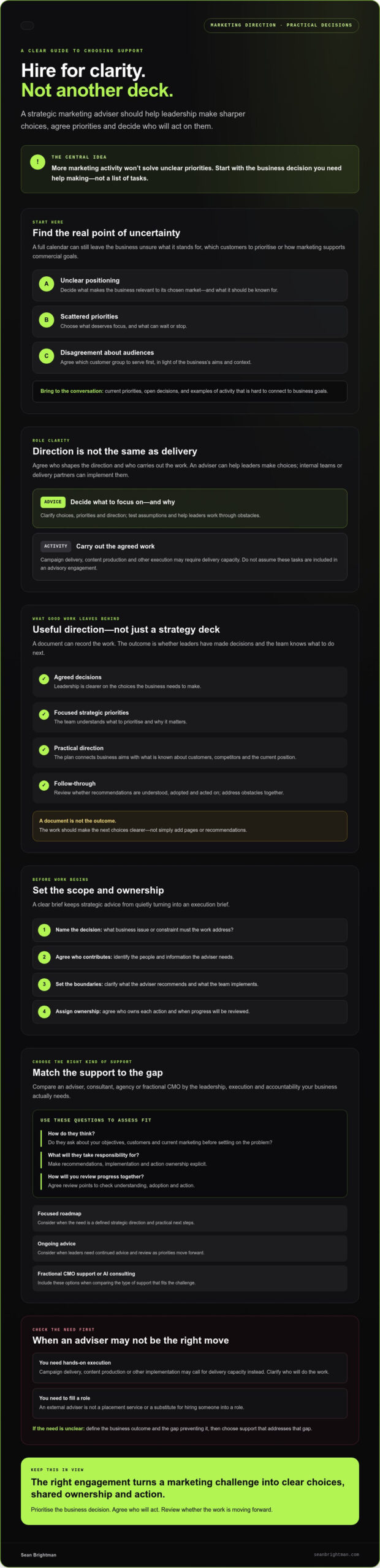
    You cannot delegate strategy to a junior team or a generalist agency. They are doers, not architects. A What is a Fractional Executive? model allows you to bring in the architect first. A fractional cmo doesn’t care about building an internal empire or protecting their seat. They care about the machinery of growth.

    This role acts as the strategic intervention your business needs. They draw the plans, audit the tech stack, and implement an AI-powered growth engine before you hire the builders. It is about tactical precision over corporate politeness. By choosing a fractional cmo, you get board-level leadership that focuses on results rather than bureaucracy. You get the roadmap first. You hire the executioners only when the system is ready to scale.

    What is a Fractional CMO? Leadership Without the Corporate Overhead

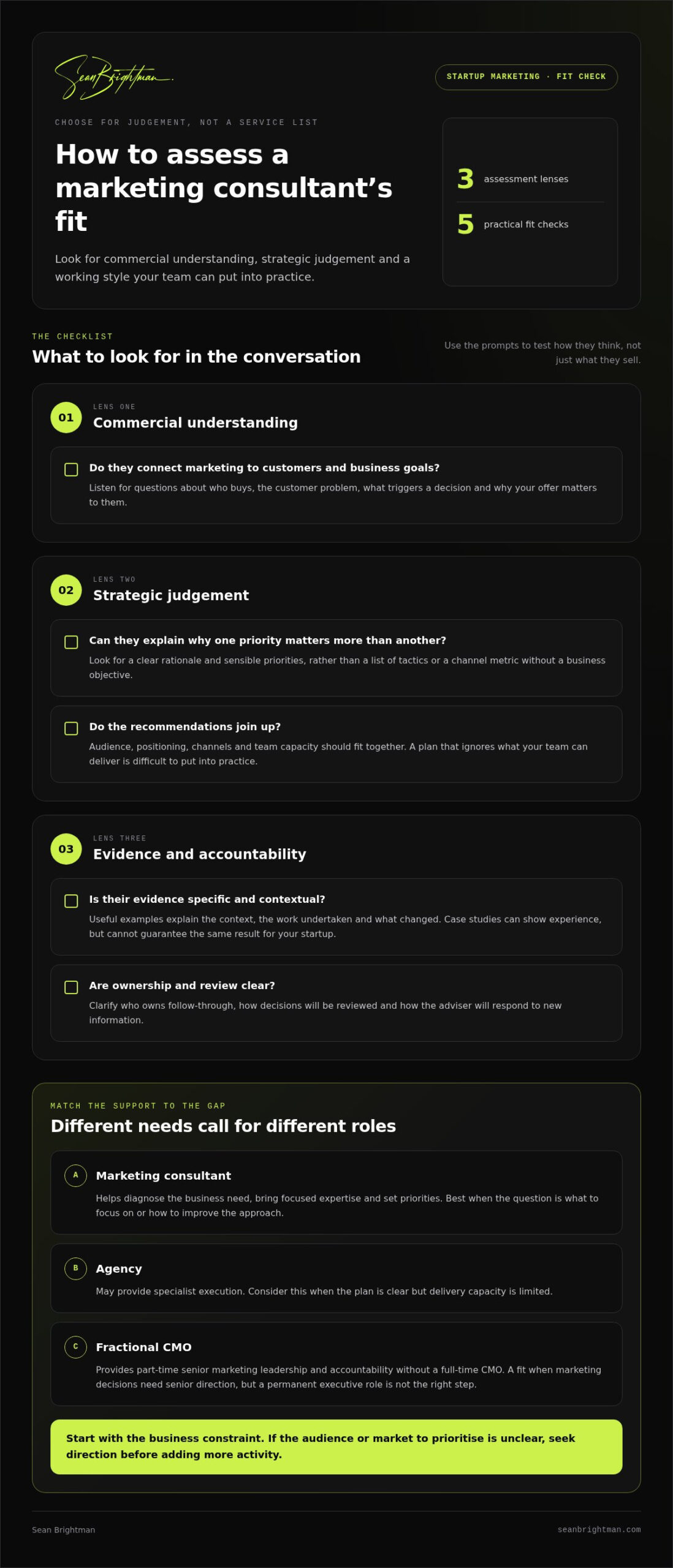
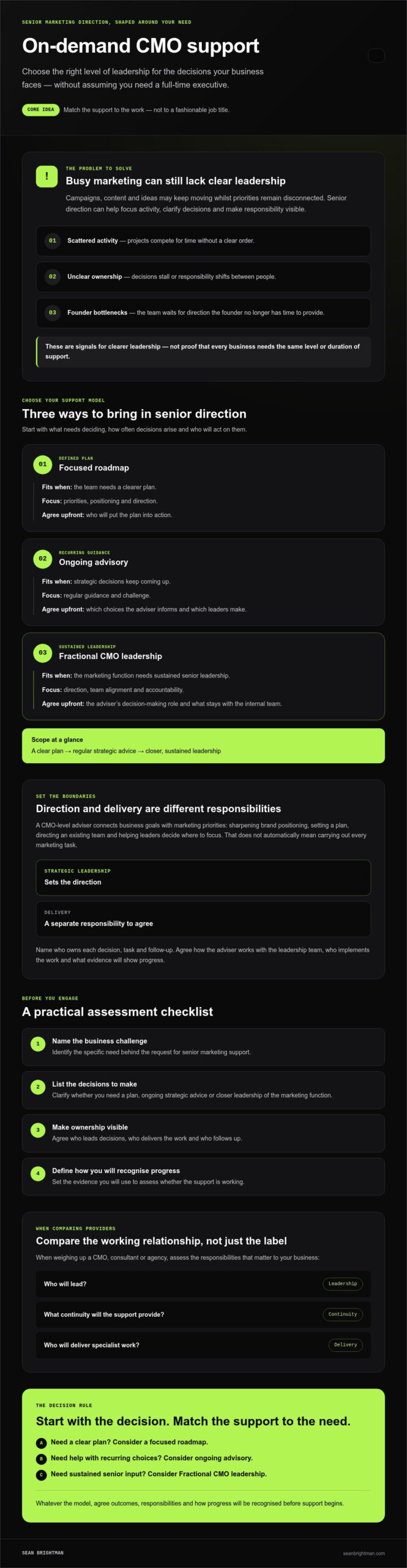
    A fractional cmo is not a part-time employee. They are a senior marketing executive providing board-level leadership on a concentrated, part-time basis. Think of it as high-octane fuel for your growth engine. You get the same calibre of talent that global brands pay £250,000 for, but you only pay for the strategic heavy lifting. This isn’t about filling a seat. It’s about deploying a “Plug-and-Play” leader who can audit your mess, fix the leaks, and build a scalable system in weeks, not years.

    Unlike a consultant who drops a 50-page PDF and disappears, a fractional cmo owns the outcome. Consultants give advice. Fractionals provide execution and accountability. They focus on commercial ROI, brand positioning, and mechanical marketing systems that don’t rely on the founder’s intuition. If you need a clear path forward, a structured roadmapping session can help define that initial strategy before the first pound is spent on ads.

    Fractional CMO vs Interim CMO

    Interim leaders are bridge-builders. They fill a gap whilst you look for a permanent hire. They keep the lights on. A fractional leader builds the future. Whilst an interim role suggests a temporary fix, a fractional partnership is a long-term strategic commitment to growth. Choose an interim if you just need to maintain the status quo. Choose a fractional if you need to disrupt it. It is about driving strategic growth with a fractional CMO to ensure your business stage matches your leadership model.

    The “Battle-Hardened” Expert Persona

    The best leaders aren’t specialists in one narrow niche. They are experts in growth. A Fractional CMO brings a perspective forged in the fires of multiple industries. They aren’t blinded by “how we’ve always done it” in your specific sector. They see patterns. They know what works in SaaS that will crush it in professional services. They bring a “get-your-hands-dirty” attitude that corporate executives often lose.

    Their secret weapons are directness and blunt honesty. They don’t have time for corporate politics or ego-stroking. They are there to fix the machinery. This external perspective allows them to identify bottlenecks you’ve become blind to. They cut through the noise with tactical precision. You aren’t paying for their time. You are paying for the decades of mistakes they’ve already made and learned from elsewhere.

    Fractional CMO vs Marketing Agency: Who Actually Owns Your Strategy?

    Agencies are incentivised to sell you more work. It is a fundamental conflict of interest. If you hire an SEO agency, the solution to every problem is more content. If you hire a PPC agency, the answer is always more spend. They are built to sell execution, not to own your commercial outcomes. They provide the parts, but they don’t care if the machine actually runs.

    Agencies provide the labour. A fractional cmo provides the logic. One is a service provider; the other is a strategic partner who sits on your side of the table. The fractional leader doesn’t care which channel wins as long as the revenue engine works. They own the strategy, the budget, and the result. They ensure your marketing spend is an investment in scalable machinery, not just a recurring monthly expense that vanishes when the contract ends.

    The Execution Trap

    Many founders fall into the trap of starting with tactics. They jump into Facebook ads or LinkedIn outreach before they have a solid positioning strategy. This is just burning cash. Running ads without a roadmap is efficient waste. You are simply scaling confusion. A fractional cmo stops the bleeding by identifying which levers to pull amongst the noise. They build a growth engine that works across all channels, ensuring every pound of labour serves the strategic logic of the business.

    Accountability and Oversight

    Who marks the agency’s homework? Most CEOs don’t have the technical depth to know if their agency is performing or just hiding behind vanity metrics. You need senior oversight to keep them honest. Without it, you are at the mercy of colourful reports that don’t translate to bank balances. It’s about accountability, not just activity.

    The fractional leader bridges the gap between the CEO’s vision and the agency’s technical output. They translate high-level business goals into specific, measurable requirements. They integrate your internal team and external partners into a cohesive unit. This senior-level intervention ensures that every external partner is aligned with your long-term roadmap. You get the benefit of agency execution without the risk of strategic drift. You finally get someone who knows what “good” looks like and isn’t afraid to call out underperformance.

    Stop Hiring Full-Time CMOs: The Fractional Revolution in 2026

    Building the AI-Powered Growth Engine: A 2026 Roadmap

    By 2026, simply “using AI” isn’t a competitive advantage. It is the baseline. Most UK businesses are still playing with tools like hobbyists. They generate a few social posts or draft an email. This is not a strategy. It is a distraction. You need a growth engine, not a toy box. If your marketing department is just “playing with tools,” you are falling behind competitors who are building integrated machinery.

    A fractional cmo acts as the architect of this machinery. They move your team beyond experimentation into strategic implementation. The goal is tactical precision. We use AI to improve marketing efficiency and data-driven decision-making. It is about automating the mundane so your expensive human talent can focus on the creative logic that actually moves the needle. This is how you scale without ballooning your payroll.

    The AI Marketing Roadmap

    Building this engine requires a clinical approach. It doesn’t happen by accident. A fractional cmo provides the senior-level AI Consulting needed to ensure your tech stack delivers ROI rather than just adding complexity. We follow a three-step process to build your engine.

    • Step 1: System Audit. We check for AI readiness. Is your data siloed? Are your current workflows redundant? We strip away the fluff to find the functional core of your operations.
    • Step 2: High-Impact Use Cases. We focus on positioning, personalisation, and prediction. We use AI to analyse market gaps and personalise customer journeys at a scale that was previously impossible. This isn’t about more content; it’s about better conversion.
    • Step 3: Scalable Integration. We implement a growth engine that learns. This isn’t a static plan. It is a living system that adapts to market shifts in real-time, providing the strategic accountability you’ve been missing.

    Strategic Roadmapping Sessions

    Most marketing plans sit in a drawer. They are too long, too vague, and too polite. You need a clear, actionable roadmap that defines your brand direction without the corporate fluff. This starts with a one-off strategy session. We identify the bottlenecks and draw the blueprints for your growth engine. This is about getting the plans right before you hire the builders.

    Creating a clear plan ensures your marketing doesn’t rely on the founder’s intuition. It builds a system that works whilst you sleep. Learn more about Strategic Roadmapping to see how we turn chaos into a clinical plan of attack. If you are ready to stop burning cash on disjointed tactics, you can book a roadmapping session to build your engine today. Let’s stop playing with tools and start building the machinery of 2026.

    Implementing Fractional Leadership: From Chaos to Strategic Accountability

    Implementing a fractional cmo is the fastest way to shift from operational chaos to strategic accountability. You don’t need another manager to supervise the mess. You need a partner who owns the outcome. Most marketing departments produce activity. We produce results. It is about building a functional component of your business that operates with tactical precision.

    The Advisory Retainer is the mechanism that makes this possible. It provides ongoing direction and a direct line of accountability for the CEO. This isn’t about corporate hand-holding. It is about expert oversight. Advisory beats management because it focuses on high-level logic rather than getting bogged down in daily tasks. It is the secret weapon for founders who have outgrown their own marketing knowledge but aren’t ready for the dead weight of a full-time executive.

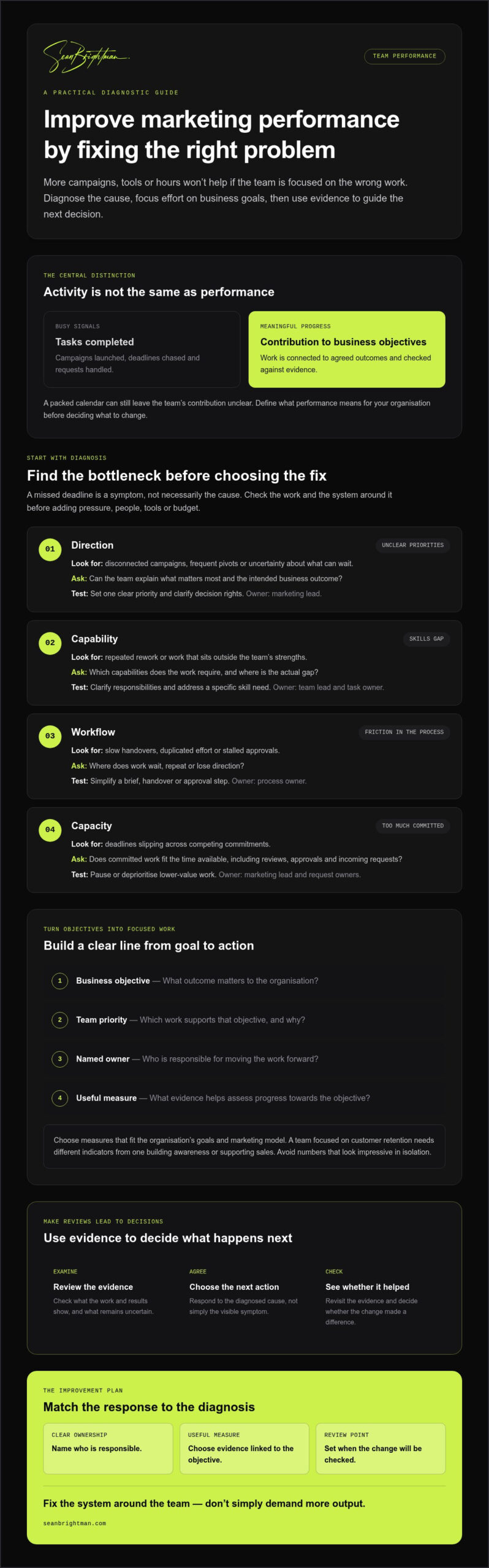
    Measuring success requires a clinical focus on KPIs that actually hit the bottom line. We ignore vanity metrics. We don’t care about “likes” or “brand awareness” unless they translate to revenue. We track Customer Acquisition Cost (CAC), Lifetime Value (LTV), and sales velocity. This is the difference between a marketing department that feels like an expense and one that functions as a growth engine. You finally get a clear marketing roadmap that doesn’t rely on the founder’s intuition.

    Eventually, your business will scale to a point where a full-time hire makes sense. This usually happens when your revenue hits the £25 million threshold and the machinery is so predictable that you simply need someone to maintain it. Until then, a fractional leader is the more efficient choice. You get the expertise without the £120,000 overhead.

    The Advisory Retainer Model

    High-growth founders are often the primary bottleneck. You make every strategic decision because you don’t trust the team to get it right. An advisory retainer removes that burden. It ensures your strategies are executed effectively with expert oversight. You get a mentor who has seen your specific problems before and knows the shortcut to the solution. It is about strategic accountability, not just filling a seat.

    Getting Started in 90 Days

    We don’t spend months “onboarding” or “finding our feet.” We hit the ground running with a clear 90-day plan.

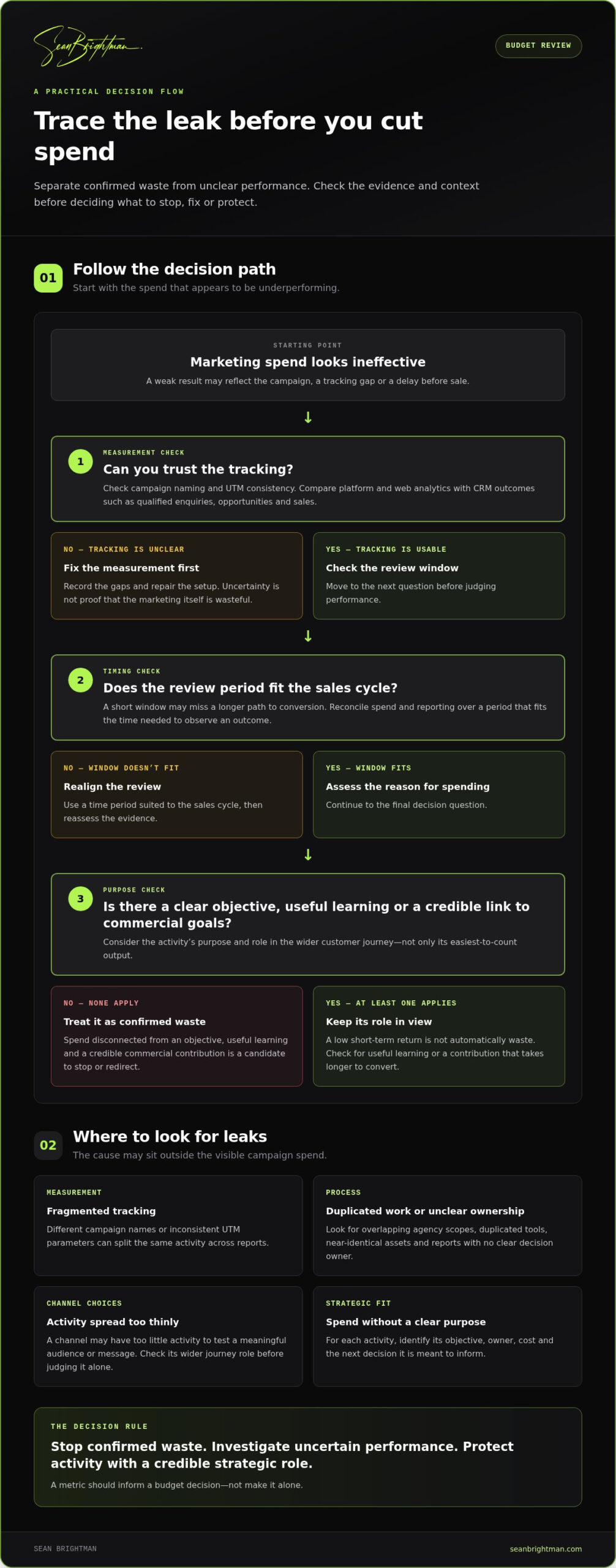
    • The first 30 days: We audit current systems. We listen. We find the “mess” and identify the immediate leaks in your funnel.
    • The next 60 days: We build the foundation. We implement the AI-powered growth engine and align your existing team with the new roadmap.
    • The result: By day 90, you have a scalable, predictable marketing machine that doesn’t rely on the founder.

    Ready to turn your marketing into a functional machine? Book a Strategic Advisory session with Sean Brightman to start your 90-day transition today. Let’s stop the activity and start the growth.

    Stop Managing Chaos and Start Building Machinery

    Hiring for seat filling is a legacy move. You need a marketing system that delivers results without the £120k overhead. We have defined the difference between logic and labour. You now understand why a fractional cmo is the strategic intervention required to fix a broken engine. It is about tactical precision, not corporate politeness. You don’t need more activity; you need a revenue engine that scales.

    Sean Brightman, author of “The Strategy Book”, specialises in AI-powered marketing systems for UK scale-ups. He provides the high-impact advisory needed to turn your vision into a clinical roadmap. Stop being the bottleneck in your own business. It is time to implement the strategic accountability that moves the needle. You have the blueprint. Now you need the architect.

    Build your AI-powered growth engine with Sean Brightman.

    The future of your growth depends on the systems you build today. Let’s get to work and build something that lasts.

    Frequently Asked Questions

    What is the typical day rate for a Fractional CMO in the UK?

    UK day rates for senior marketing leadership usually range from £1,000 to £2,500 depending on the expert’s track record. You aren’t paying for a full-time salary; you are paying for concentrated strategic impact. This reflects the “fractional” nature of the role. It is a tactical investment in a battle-hardened leader who has already made the expensive mistakes elsewhere so you don’t have to.

    How many days a week does a Fractional CMO usually work?

    A fractional cmo typically commits between two and four days per month. This isn’t about clock-watching. It is about high-impact strategic interventions. Some businesses require one day a week for deep integration, whilst others prefer a concentrated burst of two days a month for board-level direction. The model is flexible. It scales based on the complexity of your growth engine and the speed of execution.

    What is the difference between a Marketing Consultant and a Fractional CMO?

    Consultants give you a map; a fractional cmo drives the car. Consultants produce reports and slide decks that often end up in a drawer. A fractional leader owns the commercial outcome, the team, and the budget. They are embedded in your leadership team. They don’t just tell you what’s wrong. They fix the machinery and stay to ensure the results actually hit your bank balance.

    Can a Fractional CMO help with AI implementation?

    Yes, they act as the architects of your AI-powered growth engine. Most teams play with AI tools like hobbyists without a clear plan. A fractional leader implements AI strategically to automate mundane tasks and improve data-driven decision-making. They ensure your tech stack isn’t just a collection of toys. It becomes a functional component of your machinery that learns and adapts to market shifts in real-time.

    Does a Fractional CMO manage my existing marketing team?

    They absolutely manage your internal team and external agencies. You need someone to mark the homework. Without senior oversight, marketing departments often produce “activity” instead of results. The fractional leader bridges the gap between the CEO’s vision and the team’s technical output. They provide the strategic logic that ensures every pound of labour serves a specific commercial goal. It is about accountability, not just management.

    When is a business ready for a Fractional CMO?

    You are ready when your revenue is between £2m and £10m and growth has stalled. If the founder is still the primary marketing bottleneck, you need an intervention. You have outgrown your junior “doers” but aren’t ready for the £120k overhead of a full-time executive. If your marketing feels like a black hole for cash rather than a predictable engine, it is time for fractional leadership.

    How long do Fractional CMO engagements typically last?

    Engagements usually last between six and eighteen months. This isn’t a temporary fix. It is a long-term strategic partnership. The goal is to build a scalable system and eventually hire a permanent team to maintain it. Some founders retain a fractional leader on an advisory basis for years to maintain high-level direction and accountability without the bloat of a permanent executive payroll.

    Will a Fractional CMO help me hire a permanent marketing team?

    Yes, they often help you hire your eventual full-time replacement. A fractional cmo builds the machinery first. Once the growth engine is predictable and the roadmap is clear, they help you find the right permanent lead to run it. This ensures you hire for system maintenance rather than system building. It prevents the common mistake of hiring a senior leader into a broken, messy department.

  • Founders Hire a Fractional CMO Expecting Strategy Decks. Here’s What Real Traction Looks Like in 30 Days

    Founders Hire a Fractional CMO Expecting Strategy Decks. Here’s What Real Traction Looks Like in 30 Days

    TL;DR: Founders hiring a Fractional CMO often expect polished strategy decks. What they actually need is someone who fixes the operational leaks, captures missed leads, and delivers measurable results within the first 30 days.

    • Most businesses are losing real money through missed leads and broken follow-up processes.

    • A Fractional CMO’s first job is to stop the bleeding, not write a beautiful strategy document.

    • Real traction in 30 days means fewer missed leads, faster response times, and time saved.

    • Systems beat strategy every time. Consistent execution beats a brilliant plan gathering dust.

    • If they’re still building PowerPoints in week four, you’ve hired the wrong person.

    I’ve watched this pattern play out more times than I can count.

    A founder brings in a Fractional CMO. They’re expecting polished PowerPoint presentations. Market analysis. Competitor research. A comprehensive 90-day roadmap with colour-coded phases.

    What they actually need is someone to stop the bleeding.

    The hardest part isn’t the marketing strategy. It’s the business you’re plugging it into.

    The Messy Reality Behind Most Businesses

    Most businesses are messy behind the scenes. Inconsistent pricing. Unclear processes. Weak follow-up. Poor sales skills. Lack of structure. Missed opportunities everywhere.

    You can respond to leads instantly with the fanciest tools in the world, but if your operations are broken, you’re just exposing bigger problems faster.

    I’ve seen businesses missing just a handful of leads a week. Sounds minor until you calculate the annual revenue sitting in that gap. If you’re missing 10 to 20 leads monthly, that’s real money disappearing.

    A strategy deck won’t fix that.

    But capturing those leads will. Immediately.

    Bottom line: operational chaos eats marketing strategy for breakfast. Fix the foundations first.

    What Founders Actually Expect vs. What They Need

    Founders expect quick wins but resist the consistency required to achieve them. They want the marketing magic without the operational discipline.

    This creates a tension that kills most Fractional CMO engagements before they start delivering value.

    You’re not just installing a marketing function. You’re fixing operations, managing expectations, and proving value in ways that aren’t always immediately visible.

    The value proof extends beyond what shows up in your analytics dashboard in week one.

    Bottom line: the expectation gap between founders and Fractional CMOs is where engagements go to die. Closing it early is everything.

    The First 30 Days: What Traction Actually Looks Like

    Real traction in the first month isn’t a beautiful brand strategy presentation.

    It’s identifying where leads are falling through the cracks and plugging those holes. Fast.

    Here’s what I focus on:

    Week 1: Audit the Chaos

    I don’t start with market research. I start with your current reality.

    How many leads are you getting? What happens to them? Where do they disappear? What’s a new customer actually worth to you? What percentage do you win?

    Most businesses can’t answer these questions with any precision. That’s the problem.

    Week 2: Stop the Leaks

    Once a website is built, it just sits there. It doesn’t bring leads on its own.

    I implement the basics that should already exist but don’t. Lead capture forms that actually work. Follow-up sequences that run automatically. A system to track what’s happening to every enquiry.

    This isn’t glamorous work. But it’s where money gets made or lost.

    Week 3: Create the System

    You don’t need just a website. You need the marketing engine behind it.

    I build the whole system to get leads and the tools to nurture them to close. Not isolated tactics. Not random campaigns. A system that works together.

    This means integrating your CRM properly. Setting up automation that actually saves time instead of creating more work. Making sure your team knows what to do when a lead comes in.

    Week 4: Prove It Works

    By week four, you should see measurable changes.

    Fewer missed leads. Faster response times. More appointments booked. Less time spent on manual admin.

    I worked with a founder who was managing every new enquiry manually, chasing leads through email threads and spreadsheets, deep into the evening. After we put the system in place, everything was tracked, followed up automatically, and visible at a glance. The late-night chaos stopped.

    That’s traction. That’s value you can feel.

    Bottom line: 30 days is enough time to plug the leaks, build the engine, and show real results. No deck required.

    Why Strategy Decks Fail Founders

    Strategy decks make everyone feel productive. They look impressive in board meetings. They give the illusion of progress.

    But they don’t capture leads. They don’t book appointments. They don’t free up your time.

    The gap between a beautiful strategy and actual implementation is where most marketing efforts die.

    Founders don’t need another person telling them what could work in theory. They need someone who makes things work in practice, with the messy business they actually have, not the idealised version in the strategy deck.

    Bottom line: a strategy deck is a comfort blanket. What moves the needle is implementation.

    The Operations Overhaul Nobody Talks About

    In reality, you’re not just installing a marketing tool.

    You’re fixing operations. Managing expectations. Proving value in ways that aren’t always immediately visible.

    This is the part that transforms a Fractional CMO engagement from “nice to have” to “how did we survive without this?”

    When I interview clients, I record the conversation, transcribe it, and break down what needs to happen. What the system should do. What it shouldn’t do. What frequently asked questions need answers.

    Then I build it. Test it. Refine it.

    Some clients start out sceptical. They wonder why they need this kind of thing. But once they see a demo presented as if it’s on their own website, they see the benefit.

    They’re surprised how natural it sounds. How it keeps up with conversations. How it actually works.

    Bottom line: the operations overhaul is unglamorous, often invisible, and completely non-negotiable.

    What Gets Measured Gets Fixed

    You can’t improve what you don’t measure.

    In the first 30 days, I establish the metrics that matter:

    • Lead volume and source

    • Response time to enquiries

    • Conversion rate from enquiry to appointment

    • Time saved on manual processes

    • Revenue per lead

    These aren’t vanity metrics. They’re the numbers that tell you whether your marketing is actually working or just making noise.

    Most businesses don’t track these properly. They have a vague sense that “things are going okay” or “we’re busy” but no hard data.

    That changes in month one.

    Bottom line: if you’re not measuring it, you’re guessing. And guessing is expensive.

    The Technology Shift Nobody Expected

    Here’s something that’s changed the game: technology that used to be exclusive to big companies is now accessible to small businesses.

    AI tools. Marketing automation. CRM systems that don’t require a dedicated IT team.

    This shift means a Fractional CMO can implement enterprise-level systems for founders and SMEs in weeks, not months.

    The barrier isn’t the technology anymore. It’s the willingness to actually use it consistently.

    Bottom line: the tools are there. The only thing standing between you and a proper system is the decision to use it.

    Why Consistency Beats Strategy Every Time

    Owners expect quick wins but resist the consistency that makes those wins sustainable.

    A brilliant strategy executed inconsistently loses to a mediocre strategy executed relentlessly.

    In the first 30 days, I don’t just set up systems. I make sure your team understands them. I make sure they’re simple enough to actually use. I make sure adoption happens, not just installation.

    The best system in the world is worthless if it sits unused after the initial excitement wears off.

    Bottom line: installation is easy. Adoption is the hard part. That’s where real Fractional CMO value lives.

    What Founders Should Demand in Month One

    If you’re hiring a Fractional CMO, here’s what you should see in the first 30 days:

    Immediate lead capture improvements. Fewer enquiries falling through the cracks. Faster response times. Better tracking of where leads come from and what happens to them.

    Time savings for you and your team. Less manual admin. Fewer late nights trying to organise appointments. More time to actually run your business.

    Clear metrics and reporting. You should know exactly how many leads you’re getting, what they’re worth, and what percentage you’re converting. No more guessing.

    A system that works without you. The goal isn’t to create more work for you. It’s to build something that runs smoothly whether you’re there or not.

    Proof of concept, not promises. You should see evidence that things are working. Real appointments booked. Real leads captured. Real time saved.

    If your Fractional CMO is still building PowerPoint presentations in week four, you’ve hired the wrong person.

    Bottom line: demand results, not reports. Traction is visible. Excuses aren’t.

    The Real Value of a Fractional CMO

    The value of a Fractional CMO isn’t in their ability to create impressive strategy documents.

    It’s in their ability to diagnose what’s broken, fix it quickly, and prove the value through measurable results.

    It’s in understanding that most businesses don’t need a rebrand or a new positioning statement. They need to stop losing leads. They need to respond faster. They need systems that work.

    It’s in recognising that you’re not just installing a marketing function. You’re fixing operations, managing expectations, and building something sustainable.

    The first 30 days set the tone for everything that follows. Get them right, and you build trust, momentum, and results. Get them wrong, and you’re just another consultant who promised transformation and delivered presentations.

    What Happens After Month One

    Once the foundations are solid, then you can think about strategy.

    Once leads are being captured and followed up properly, then you can optimise the messaging.

    Once the system is working, then you can scale it.

    But you have to earn the right to think strategically by proving you can execute tactically first.

    That’s what real traction looks like in 30 days. Not a strategy deck. Not a roadmap. Not a vision statement.

    Fewer missed leads. More appointments booked. Time saved. Money made.

    Everything else is just noise.

    Frequently Asked Questions

    What should a Fractional CMO deliver in the first 30 days?

    Tangible results: fewer missed leads, faster response times, working lead capture systems, and clear metrics. Not PowerPoint presentations.

    Why do founders expect strategy decks from a Fractional CMO?

    Because strategy decks look like progress. They’re polished, comprehensive, and impressive in meetings. They just don’t capture leads or book appointments.

    How does a Fractional CMO prove value quickly?

    By auditing what’s broken in week one, fixing the obvious leaks in week two, building the system in week three, and showing measurable results by week four.

    What metrics should a Fractional CMO track in the first month?

    Lead volume and source, response time to enquiries, conversion rate from enquiry to appointment, time saved on manual processes, and revenue per lead.

    Why do Fractional CMO engagements fail?

    Usually because of the expectation gap: founders want quick wins but resist operational discipline. The CMO spends too long on strategy and not enough time on implementation.

    Do small businesses need enterprise-level marketing tools?

    The tools are now accessible and affordable for small businesses. The barrier isn’t cost or complexity. It’s consistent use.

    When is the right time to focus on strategy?

    After the foundations are solid. Once leads are captured, followed up, and the system is working, then you optimise messaging and scale. Strategy before foundations is just noise.

    What’s the difference between a good and bad Fractional CMO?

    A good one fixes your operations and shows measurable results within 30 days. A bad one is still building presentation slides in week four.

    Key Takeaways

    • Founders expect strategy decks. What they need is someone to stop the operational bleeding first.

    • Real traction in 30 days means fewer missed leads, faster responses, and time saved, not a polished deck.

    • A Fractional CMO’s first job is to audit the chaos, plug the leaks, and build a system that works.

    • Consistent execution of a simple system beats a brilliant strategy that never gets implemented.

    • The right metrics (lead volume, response time, conversion rate, revenue per lead) tell you whether marketing is working or just making noise.

    • Technology barriers are gone. The only thing left is the discipline to use the tools consistently.

    • Earn the right to think strategically by proving you can execute tactically first.

  • I Built My Client a Brilliant Website and Got Sacked for It.

    I Built My Client a Brilliant Website and Got Sacked for It.

    TL;DR: I built a client a technically brilliant website, got them ranking, and still got sacked two years later. Why? Because the strategy was never sorted. No positioning. No market prioritisation. No clear direction. They’ve since repeated the same mistake with two more agencies. This is what happens when you commission execution before you’ve done the strategic thinking.

    At a Glance

    • A website without a strategy is just a well-designed brochure.

    • Clients asking for a website usually need something deeper: positioning, market focus, and a proper go-to-market plan.

    • Delivering exactly what a client asks for can still end in failure if the underlying strategy is missing.

    • The discovery phase isn’t optional. It’s the part that makes everything else work.

    • Without someone owning the strategy, businesses repeat the same expensive cycle, agency after agency.

    The Story

    Let me tell you about a client I worked with years ago. Great product. Real potential. Multiple industries they could sell into, each one a genuine opportunity.

    I built them a website that did everything they wanted. And more.

    Clean. Fast. Well-structured. I even got them ranking for several important phrases. By every technical measure, it was a success.

    Two years later, they sacked me.

    Here’s the part that stings: they hired another agency, went through the whole thing again, and sacked them too. Last I heard, they’d done it a third time. Same cycle. Same outcome. Same frustration.

    Years of spinning their wheels because nobody, including me early on, sat down and asked the right strategic questions before anyone touched a brief.

    I’d given them precisely what they asked for. The problem was, neither of us had properly figured out what they actually needed.

    When “I Need a Website” Doesn’t Mean “I Need a Website”

    Here’s what I’ve learned working with clients across a range of sectors: when someone says they need a website, they rarely mean they need a website.

    What they actually need is growth. New markets. A clear story that resonates with the right buyers. A way to turn a strong product into consistent, scalable revenue.

    The website is the solution they’ve landed on because it’s visible. Tangible. Something they can point to and say “we’re doing something.”

    But a website without strategy behind it is just a brochure. A well-designed, fast-loading, SEO-optimised brochure, but a brochure nonetheless. It doesn’t position the business. It doesn’t choose which markets to prioritise. It doesn’t tell a compelling enough story to make the right buyers take notice.

    This client had a product that could serve several different industries. That sounds like an advantage, and it is, but only if you’re strategic about it. Without a clear positioning decision, you end up with a website that tries to speak to everyone and connects with no one.

    They didn’t need a better website. They needed a strategy that decided who they were for, what made them different, and which channels would actually reach their best-fit buyers.

    Bottom line: A website is a tactic. Growth is the goal. Don’t confuse the two.

    The Real Problem Hiding Behind the Brief

    Most businesses, even ones with strong products, are operating without a clearly defined marketing strategy. No documented positioning. No deliberate channel mix. No decision about which market segment to go after first, and why.

    Delivering the website they asked for doesn’t solve any of these problems. You’re building a front door for a house where nobody’s agreed on the address yet.

    The hardest part of my job as a fractional CMO isn’t the marketing. It’s diagnosing what’s actually holding the business back before we spend a single penny on execution.

    In this client’s case, the underlying issue was a lack of strategic confidence. They had options: multiple industries, genuine product strengths, real differentiation. But no framework for deciding which direction to commit to. So they defaulted to the safest-feeling request: “just build us a website.”

    And I, not yet confident enough to push back hard enough, largely obliged. I tried to steer them. I raised the strategic questions. But I didn’t hold the line firmly enough when they resisted the harder conversations.

    Bottom line: When the brief is missing the strategy, the brief is wrong. Full stop.

    What I Should Have Done Differently

    After losing that client, and watching them repeat the same pattern with agency after agency, I changed how I approach every engagement.

    Now, before anyone talks about deliverables, I ask different questions:

    • Which market are we actually targeting first, and why?

    • What does this product do that nothing else does quite as well?

    • Who is the most valuable buyer, and what do they actually care about?

    • What does success look like in 12 months, in business outcomes, not deliverables?

    The answers shape everything else. The messaging. The channel mix. The content strategy. Even the website, which suddenly becomes a much more purposeful tool once there’s a strategy sitting behind it.

    With this client, there were multiple industries they could have targeted. Some were higher value. Some were easier to penetrate. Some had longer sales cycles. The strategic work would have been to map those out, score them, and make a deliberate call about where to focus first.

    That decision alone would have changed every piece of marketing we produced.

    Instead, we tried to be relevant to all of them simultaneously. The website reflected that ambiguity. Ambiguous marketing, no matter how well executed, doesn’t drive growth.

    The SEO work I did got them ranking. But ranking for what, and for whom? Without a clear positioning strategy, even good visibility doesn’t convert the way it should.

    Strategy first. Always.

    Bottom line: The questions you ask before the project starts are more important than anything you build during it.

    The Discovery Phase Nobody Wants to Pay For

    Proper strategic discovery takes time. It requires deep conversations, market analysis, and an honest assessment of where the business actually stands versus where the leadership team thinks it stands.

    Most clients want to skip it. They’ve already decided they need a website, or a campaign, or a rebrand. The strategic work feels like delay. It feels like paying for something invisible.

    But the businesses that get the strategy right before they invest in execution get dramatically better results from the same budget. Because every pound spent on marketing is pointed at the right target, with the right message, through the right channels.

    This client had budget. They had appetite. They had a strong product. What they lacked was a strategic framework to channel all of that effectively. Without someone holding that line firmly, the budget got spent on execution that looked impressive but didn’t move the needle.

    That’s on me, partly. I knew the strategy wasn’t solid. I raised it. But I didn’t push hard enough. I let the client’s urgency override my better judgement, and we both paid the price.

    Bottom line: Skipping discovery doesn’t save time. It just moves the problem further down the road, where it costs more to fix.

    Why Clients Resist What They Actually Need

    Clients want momentum. They want to feel like things are happening. Strategic thinking requires slowing down before you speed up, and that feels deeply counterintuitive when there’s commercial pressure to show results.

    They want the new website but resist committing to a clear positioning. They want leads but won’t make the tough call about which market to prioritise. They want growth but push back on the foundational work required to sustain it.

    This is especially common in businesses with multiple potential markets. The fear of narrowing focus feels like the fear of leaving money on the table. But trying to serve everyone with equal energy is usually how you end up resonating with no one particularly well.

    A fractional CMO’s job isn’t to produce marketing. It’s to hold the strategic line even when the client is pushing for shortcuts. To be the voice in the room that says: “Before we brief the agency, let’s make sure we’ve answered these questions.”

    Giving clients exactly what they ask for often fails, because what they ask for is a tactic. What they need is the strategy that makes the tactic work.

    Bottom line: Narrowing focus isn’t losing opportunity. It’s how you actually win.

    The Questions That Uncover What’s Really Going On

    Before any work begins, here’s what I now make sure to explore:

    • What problem are you actually trying to solve? Not what deliverable do you want, but what business challenge is keeping you up at night?

    • Who is your most valuable customer, and why? Not just demographics. Motivations, triggers, objections.

    • If you could only target one market this year, which would it be? Forces prioritisation and reveals how clearly the leadership team has thought this through.

    • What have you tried before, and why didn’t it work? Tells you where the real gaps are.

    • What does success look like in 12 months? In revenue terms, not deliverables.

    These questions make clients uncomfortable. They force a level of clarity that many businesses haven’t done the work to achieve. But they’re the foundation of everything. Skip them and you’re executing in the dark.

    Bottom line: Uncomfortable questions upfront beat uncomfortable conversations six months in.

    What a Proper Strategic Foundation Actually Looks Like

    When I work with clients now, the strategy comes before everything else. Not as a theoretical exercise, but as a practical decision-making framework that shapes every piece of marketing that follows.

    That means getting clear on:

    • Positioning: Who you’re for, what you do better than anyone else, and why that matters to your best-fit buyer. Not a generic value proposition. A clear, defensible point of difference.

    • Market prioritisation: Which segment to focus on first, based on value, accessibility, and strategic fit. Especially important for businesses with multiple potential markets.

    • Channel mix: Where your buyers spend their time and attention, and how to reach them there effectively. Not “let’s do social media.” A deliberate, evidence-based decision.

    • Messaging architecture: How the brand story is told consistently across every touchpoint, from the website to sales conversations to thought leadership content.

    • Measurement framework: What success looks like, how it’s tracked, and how quickly the strategy needs to adapt based on what the data tells you.

    The website, the campaign, the content strategy: these come after all of this. They’re the expression of the strategy, not a substitute for it.

    Bottom line: Strategy isn’t the overhead before the real work starts. Strategy is the real work.

    What This Means If You’re Working Without a CMO

    If you’re a growing business making marketing decisions without senior strategic input, there’s a reasonable chance you’re doing what my old client did: commissioning executional work before the strategic questions have been properly answered.

    It’s not the agency’s fault. Most agencies are briefed on deliverables, not on strategy. They build what they’re asked to build. They can’t be held responsible for a brief that was missing the foundational thinking.

    That strategic layer, the thinking that happens before the brief, is exactly what a fractional CMO brings. It’s:

    • The person who asks the uncomfortable questions before any budget is committed

    • The voice who pushes back when the stated request won’t solve the actual problem

    • The framework that ensures every piece of marketing is pointed at the right target, with the right message

    • The experience to recognise when a business is about to repeat a cycle it’s already been through before

    Without that, you can hire the best agency in the country, spend a significant budget, and still end up exactly where you started, wondering why the website isn’t working.

    My old client has now done this multiple times. Great product. Real potential. Genuinely capable team. And yet they keep arriving at the same destination because the strategic foundation was never properly built.

    That’s not a marketing problem. That’s a strategy problem. And strategy is no one’s responsibility if there’s no one in the room whose job it is to own it.

    Bottom line: A great agency with a bad brief will still deliver the wrong thing. Brilliantly.

    The Uncomfortable Reality

    The client who sacked me taught me the most valuable lesson of my career. Not about marketing, but about what marketing actually requires to work.

    Execution without strategy is just expensive activity.

    A brilliant website with no clear positioning is a brochure for a business that hasn’t decided who it’s talking to. A well-run SEO campaign without a defined target market is traffic without intent. A strong product without a go-to-market strategy is potential, indefinitely deferred.

    This client had all the ingredients. What they were missing was someone to hold the strategic line. Someone to sit across the table from the leadership team and say: “Before we talk about the website, let’s talk about the strategy. And let’s not move forward until we’ve got that right.”

    I tried. But I wasn’t yet confident enough to push hard enough when they resisted. That’s a mistake I don’t make anymore.

    Now, I tell clients upfront: the strategy isn’t optional. It’s not a nice-to-have. It’s the foundation everything else is built on. Skip it and we’re both wasting our time.

    Some clients don’t want to hear that. They’ll find someone who’ll just crack on with the brief.

    And a few years from now, they’ll be sacking that person too, starting again, still wondering why nothing ever quite works.

    I’ve seen it happen. More than once. With the same client.

    Don’t let that be you.

    Frequently Asked Questions

    Why do clients get sacked even when they deliver exactly what was asked for?

    Because the stated request is usually a tactic, not a strategy. Delivering a website, a campaign, or a rebrand without a clear strategic foundation means the work can’t generate the outcomes the client actually needs. The deliverable is correct. The direction isn’t.

    What is a fractional CMO and why does strategy matter so much to them?

    A fractional CMO is a senior marketing leader who works with a business on a part-time or project basis. Their primary role isn’t to produce marketing output. It’s to ensure that every marketing decision is grounded in a clear strategy, so that the execution, whoever does it, actually moves the business forward.

    What should happen before a website brief is written?

    Before any brief, a business should have clear answers to: who their primary target market is, what their positioning is, what makes them genuinely different, which channels their buyers use, and what success looks like in measurable business terms.

    Why do businesses skip the strategic discovery phase?

    Because it feels slow and intangible. There’s commercial pressure to show visible progress, and a website feels like progress. Strategic thinking feels like delay. In reality, skipping it just pushes the problem further down the road, where it costs more to fix.

    What happens when a business tries to target multiple markets at once without a strategy?

    The marketing becomes diluted. Messaging tries to speak to everyone and ends up resonating with no one. Even technically strong work, including good SEO, won’t convert well because there’s no clarity about who the business is actually for.

    What does a proper marketing strategy include?

    At minimum: clear positioning, a prioritised target market, a deliberate channel mix, a consistent messaging architecture, and a measurement framework. The website and campaigns come after these decisions, not before.

    How do you know when a client is about to repeat the same mistake?

    They ask for a specific deliverable without being able to clearly articulate the underlying business problem. They resist questions about positioning and market focus. They want to move quickly to execution and treat strategy as an optional extra.

    Key Takeaways

    • A website without a strategy is a brochure. A well-made one, but a brochure all the same.

    • Clients asking for executional deliverables usually have an unanswered strategic question sitting underneath.

    • The discovery phase is the most important part of any marketing engagement. Most clients want to skip it. Don’t let them.

    • Trying to market to multiple industries simultaneously, without prioritisation, produces ambiguous marketing that converts poorly.

    • A fractional CMO’s core value is holding the strategic line before, during, and after execution begins.

    • Execution without strategy is expensive activity with unpredictable outcomes.

    • If no one in the room owns the strategy, the same expensive cycle will repeat, agency after agency.

  • Your Funnel Design Isn’t The Problem. Your Response Time Is.

    Your Funnel Design Isn’t The Problem. Your Response Time Is.

    TL;DR: You’re losing customers between enquiry and response, not because your funnel is broken, but because you’re too slow. Responding within five minutes makes you 100x more likely to make contact. Most businesses take 42 hours. Fix that, and your conversion rate climbs without touching a single landing page.

    At A Glance

    • Responding within 5 minutes makes you 100x more likely to reach a lead and 21x more likely to qualify them.

    • Calling within 1 minute of an enquiry boosts conversions by 391%.

    • 78% of customers buy from the first company that responds.

    • The average business response time is 42 hours. Customers expect a reply in under 10 minutes.

    • Clients who fix their response time close 8-24% more customers, with zero changes to their offer or pitch.

    Sound Familiar?

    You’ve spent months perfecting your marketing funnel.

    The landing pages are optimised. The copy is sharp. The lead magnets are compelling. You’re driving traffic, generating enquiries, and watching the numbers tick up in your CRM.

    Then you check your conversion rate and wonder what went wrong.

    Here’s what most founders miss: the gap between enquiry and response is where your revenue disappears.

    Whilst you’re obsessing over funnel architecture, your competitors are winning customers simply by responding faster. The data proves it, and the gap between what businesses know and what they actually do is staggering.

    What Is The Five-Minute Window?

    Research from Harvard Business Review and MIT reveals something that should stop you in your tracks: responding to a new lead within five minutes makes you 100 times more likely to make contact and 21 times more likely to qualify the lead.

    Read that again.

    100 times more likely to make contact.

    The original research, conducted by Dr James Oldroyd at MIT, analysed over 15,000 leads. The findings weren’t subtle. After just five minutes, the odds of qualifying a lead plummet by 80%. Conversion rates drop by eight times when follow-up is delayed by a mere five minutes.

    This isn’t about being slightly better. The deterioration of prospect interest is exponential. Every minute that passes after initial contact has a disproportionate impact on your probability of conversion.

    Bottom line: The five-minute window isn’t a nice-to-have. It’s the difference between a paying customer and a lead that goes cold before you’ve finished your coffee.

    What Is The One-Minute Rule?

    Research from Velocify found that calling a lead within one minute of their enquiry boosts conversion rates by 391%. That’s not a typo.

    There’s a 391% increase in actual sales conversions, not just bookings, when inbound leads are contacted within the same minute they submit a demo request.

    The principle is blunt: 78% of customers buy from the first company that responds. Being first often matters more than being best.

    Your funnel design doesn’t matter if someone else answers the phone first.

    Bottom line: Speed isn’t a sales tactic. It’s the sales tactic.

    How Bad Is The Response Time Problem?

    The average response time across industries is 42 hours. Meanwhile, 82% of consumers consider an “immediate response” to their marketing, sales, and customer service concerns to be important or very important. Most define immediate as within 10 minutes.

    Let that sink in.

    Customers expect a response in 10 minutes. Businesses respond in 42 hours.

    • Only 0.1% of inbound leads are engaged in under five minutes.

    • Only 23% of companies responded within five minutes.

    • 42% took more than 24 hours.

    If you respond quickly, you’re already ahead of 99.9% of your competition. That’s not a small edge. That’s a chasm.

    Bottom line: The execution gap is enormous. Closing it doesn’t require genius. It requires urgency.

    Why Response Time Is The Highest-Impact Operational Lever

    Moving a lead from the 24-hour bucket into the under-five-minute bucket roughly 2.6x’s the close rate, from 12% to 32%. No change to the offer. No change to the rep. No change to the pitch.

    The lever is purely operational.

    You’re not redesigning your entire marketing strategy. You’re not rebuilding your product. You’re not hiring a new sales team.

    You’re fixing a process problem that’s costing you customers right now.

    Real-world result: clients closing between 8% and 24% more customers simply by getting back to leads faster. That’s it. Nothing fancy.

    Bottom line: This is the most unsexy, high-return fix in your entire business. You’re welcome.

    How Much Budget Is Being Wasted On Slow Follow-Up?

    Last year, B2B marketers spent over $4.6 billion on advertising. Nearly $2.7 billion of that investment was wasted due to slow or no follow-up.

    More than 30% of leads are never contacted.

    You’re paying to generate leads, then ignoring them. It’s like filling a bucket with a hole in the bottom and wondering why it’s empty.

    The problem isn’t your funnel. The problem is what happens after someone enters it.

    Bottom line: Slow follow-up doesn’t just lose customers. It sets fire to your ad spend.

    Why Does This Keep Happening?

    Most trade businesses are messy behind the scenes. Inconsistent pricing. Unclear processes. Weak follow-up.

    AI tools respond instantly, but they often expose bigger problems underneath: poor sales skills, lack of structure, missed opportunities. The hardest part isn’t the technology. It’s the business you’re plugging it into.

    Response time isn’t just about speed. It’s about having systems that work when a lead comes in. Knowing what to say. How to qualify. What happens next.

    Businesses that excel at response time have done the unglamorous work: mapping processes, training teams, eliminating bottlenecks.

    If you can’t respond quickly, it usually means your operations are broken. Response time is one of the best diagnostics in the business.

    Bottom line: Speed is a symptom of operational health. If you’re slow, something deeper needs fixing.

    What Do Customers Actually Expect?

    83% of customers expect to interact with someone immediately upon contact, according to Salesforce. Almost 66% of buyers expect a response within 10 minutes to any marketing, sales, or customer service enquiry.

    More than half of your customers say slow responses are their biggest frustration.

    Not product issues. Not pricing. Response speed.

    Customer expectations are rising. The companies that meet them win. The companies that don’t lose to someone who will.

    Bottom line: Your customers have already set the bar. The question is whether you’re clearing it.

    How To Actually Fix Your Response Time

    Step 1: Measure Where You Are

    Start by tracking how long it takes from enquiry to first contact. Most businesses don’t know this number, which is exactly why they can’t improve it.

    Step 2: Set A Target

    Five minutes is the gold standard. Even getting to 30 minutes puts you ahead of most competitors.

    Step 3: Build Systems That Enable Speed

    • AI receptionists that respond within 60 seconds.

    • Alerts that notify your team the moment a lead comes in.

    • Restructured sales processes that remove delay at every step.

    The specific solution matters less than the commitment to speed.

    Step 4: Train Your Team On The First Five Minutes

    The goal isn’t to close the deal immediately. It’s to make contact, qualify the lead, and lock in the next step.

    Step 5: Remove Friction Ruthlessly

    Every step between enquiry and response is a chance for delay. Simplify until it hurts.

    Bottom line: Speed to lead isn’t a culture shift. It’s a process shift. Map it, build it, stick to it.

    Why Response Time Is Your Biggest Competitive Advantage

    Response time is one of the few competitive advantages that’s both high-impact and widely available.

    You don’t need a bigger budget. You don’t need better technology. You don’t need a revolutionary product.

    You need to answer faster than your competitors.

    The data is clear. The opportunity is massive. The execution gap is real.

    Whilst everyone else is redesigning their funnels, you can win by simply picking up the phone.

    Bottom line: The competitive advantage hiding in plain sight isn’t a secret. It’s just a phone call you haven’t made fast enough yet.

    Frequently Asked Questions

    What is the ideal lead response time?

    Five minutes or under. Research shows that responding within five minutes makes you 100x more likely to reach a lead and 21x more likely to qualify them. Even hitting 30 minutes puts you ahead of most businesses.

    Why does response speed affect conversion rates so much?

    Because buyer intent is at its peak the moment someone enquires. The longer you wait, the more that intent fades. Interest drops off exponentially, not gradually.

    How does response time compare to funnel design in driving conversions?

    In most cases, response time has a bigger impact. Moving a lead from a 24-hour response to under five minutes roughly 2.6x’s your close rate, with no changes to your offer or pitch.

    What percentage of companies respond to leads within five minutes?

    Only 23%. And just 0.1% of inbound leads are engaged in under five minutes. Most businesses take over 24 hours.

    What do customers consider an “immediate” response?

    The majority define it as within 10 minutes. Yet the average business response time is 42 hours. That gap is your opportunity.

    Can AI tools fix slow response times?

    AI can respond instantly, but it often exposes deeper issues like weak sales processes and poor qualification. Technology speeds up the response. You still need a solid system behind it.

    How much revenue is lost from slow follow-up?

    In B2B alone, nearly $2.7 billion in ad spend was wasted last year due to slow or no follow-up. More than 30% of leads are never contacted at all.

    What’s the first step to improving lead response time?

    Measure it. Most businesses have no idea how long their current response time is. You can’t fix what you don’t track.

    Key Takeaways

    • Responding within five minutes makes you 100x more likely to reach a lead and 21x more likely to qualify them.

    • 78% of customers buy from the first company that responds. Speed beats quality in the race to conversion.

    • The average business takes 42 hours to respond. Customers expect a reply in 10 minutes. That gap is your opportunity.

    • Moving from 24-hour to five-minute responses roughly 2.6x’s your close rate, with zero changes to your offer.

    • Poor response time is usually a symptom of broken operations, not just a scheduling problem.

    • $2.7 billion in B2B ad spend is wasted annually on leads that never get followed up. Don’t add to that number.

    • You don’t need a fancier funnel. You need to answer faster than the person next to you.