
What if your lead-generation problem isn’t a lack of leads, but a system that keeps producing the wrong ones? AI for B2B lead generation can help teams spot buying signals, prioritise accounts and personalise outreach. But automate a disconnected process and you’ll create more noise, not more qualified opportunities.
If marketing is filling the CRM whilst sales is chasing its own signals, the first step is to find where the process breaks down. The right AI approach depends on your ideal customer profile, sales process and the quality of the data already in your tools. More platforms won’t fix a weak hand-off or unclear qualification criteria.
This guide compares AI approaches by lead quality, workflow fit and measurable impact, then sets out how to build a practical system with clear ownership, human review and performance measures. You’ll see where AI can strengthen targeting and follow-up, where people need to stay involved, and why a clear roadmap should come before another platform. The aim is to create relevant opportunities your sales team can act on, not just a bigger list.
Key Takeaways
- Separate lead volume from qualified, sales-accepted leads and pipeline so your team measures progress that matters.
- Map where AI can assist across targeting, engagement and qualification, while keeping key decisions and approvals with people.
- Compare outbound agents, intent and ABM platforms, and AI-enabled marketing workflows against your data, CRM and sales process.
- Build ai for b2b lead generation around a defined bottleneck, a baseline and a focused pilot before scaling.
- Connect your ideal customer profile, data, team ownership and revenue measures to make AI part of a working growth system.
AI for B2B lead generation: what it can improve, and what it cannot fix
AI for B2B lead generation means using software to support research, prioritisation, personalisation and measurement as you find and develop potential customers. It can help a team process information faster and focus its effort. It can’t make a weak offer compelling or turn an unclear audience into a well-defined one.
That distinction matters because “lead” can mean very different things. Lead generation is the process of attracting and identifying potential customers, as outlined in this lead generation overview. But volume alone says little about business value:
- Lead volume: the number of people or organisations captured.
- Qualified leads: contacts that match agreed criteria, such as your target market and buyer needs.
- Sales-accepted leads: qualified leads that sales has reviewed and agreed to pursue.
- Pipeline: potential revenue represented by active sales opportunities.
An AI-generated lead is a contact identified or engaged with AI assistance; a qualified sales opportunity is a prospect that fits your criteria, has a relevant business need and is accepted into the sales process. Keep those labels separate, or impressive activity figures can disguise a pipeline that isn’t moving.
Where AI fits in a B2B lead-generation system
AI can research audiences, flag accounts for attention, help shape relevant content, personalise outreach, summarise qualification signals and report on performance. Give each task a defined purpose: connect a buyer problem to an audience, a message and a next step in the sales process. Without that connection, automation simply speeds up disconnected work.
Start with assistance, not unchecked autonomy. AI might suggest accounts or draft an email for a person to review. An autonomous workflow might send messages or change lead status without approval. Human review is especially important when a system’s judgement affects prioritisation, buyer experience or the hand-off to sales. People still own the criteria, decisions and relationships.
Why more automated activity does not automatically mean more pipeline
Automation amplifies what you give it. A broad audience and generic message can produce more irrelevant outreach, not more useful conversations. A weak offer remains weak at scale. If CRM records are incomplete, inconsistent or out of date, lead scoring may elevate the wrong accounts and bury better-fit prospects.
Agree on measures before switching on a workflow. Track quality and sales outcomes, such as the proportion of leads accepted by sales, progression to opportunity and pipeline contribution. Use message counts to diagnose workload, not to declare success. The test is whether AI helps the right prospects move through your sales process, not whether it helps the team send more.
How AI supports each stage of the B2B lead-generation workflow
AI for B2B lead generation works best as a connected workflow, not a collection of clever shortcuts. Each stage should use shared information and clear criteria, with people accountable for decisions that affect targeting, buyer experience and sales priorities. IBM’s overview of AI for lead generation explores how techniques such as machine learning and predictive analytics can support this work.
Use AI to find and prioritise the right accounts
Begin with a documented ideal customer profile (ICP): the organisations your business can serve well and the roles involved in buying. Use relevant firmographic details, such as industry or company size, alongside behavioural and engagement signals to prioritise accounts. Intent signals, such as repeated interest in relevant topics, can suggest that a need is emerging. They don’t prove a buyer is ready to purchase.
Prioritisation must also reflect sales capacity. A long list of high-scoring accounts is no use if the team can’t follow up properly. AI can surface patterns and recommend where to focus; the team owns the ICP, the thresholds and decisions about where to spend its time.
Turn research into relevant engagement and sales hand-offs
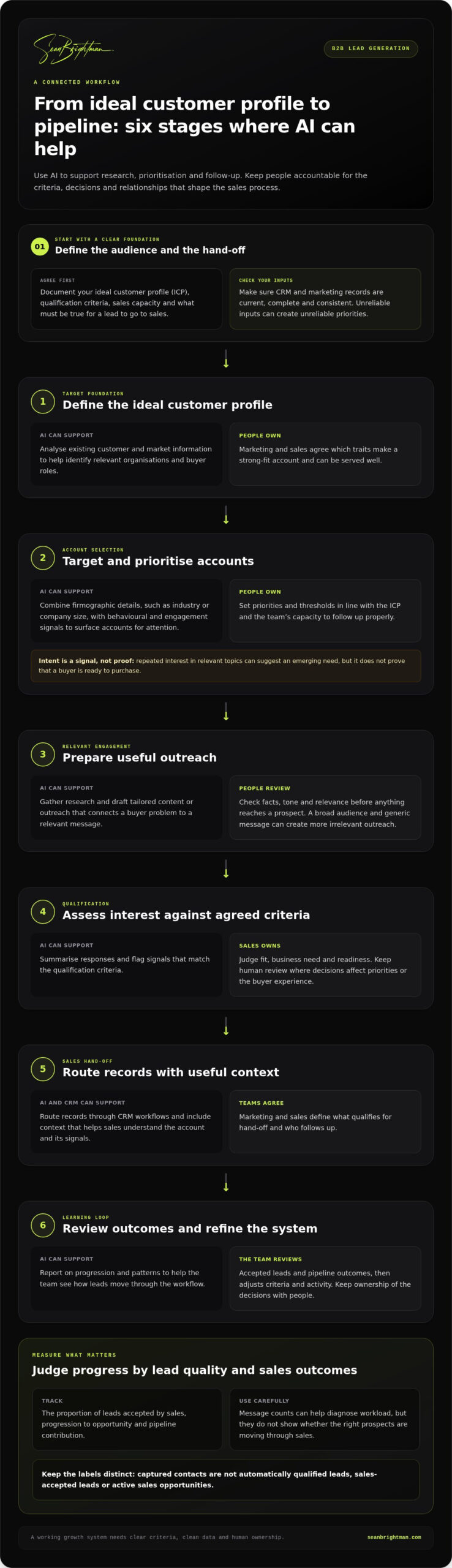
Connect each AI task to a buyer problem and a clear next step in the workflow:
- 1. Define the ICP: AI can help analyse existing customer and market information. Marketing and sales agree which traits make a strong-fit account.
- 2. Target accounts: AI can combine firmographic, behavioural and engagement signals. The team sets priorities in line with sales capacity.
- 3. Prepare engagement: AI can gather research and draft tailored content or outreach. A person checks facts, tone and relevance before anything reaches a prospect.
- 4. Qualify interest: AI can summarise responses and flag signals against agreed criteria. Sales owns the judgement on fit, need and readiness.
- 5. Hand off to sales: CRM workflows can route records and include useful context. Marketing and sales agree what qualifies for hand-off and who follows up.
- 6. Learn and improve: AI can help report on progression and patterns. The team reviews accepted leads and pipeline outcomes, then adjusts criteria and activity.
AI lead scoring is only as useful as the data behind it: inaccurate, incomplete or disconnected inputs produce unreliable priorities. CRM and marketing data provide useful context when fields mean the same thing across tools, records stay current and engagement can be linked to the right account. Otherwise, a score can look precise whilst pointing sales in the wrong direction.
For a wider view of how AI choices fit into a growth system, read this AI consulting and scalable growth systems guide. A clear roadmap can align data, marketing and sales around shared priorities instead of adding another isolated workflow.
Which AI lead-generation approach fits your B2B business?
The right choice depends on the bottleneck you need to fix. Outbound agents, intent and account-based marketing (ABM) platforms, and AI-enabled marketing workflows solve different problems. None is automatically the best option. Match the tool to your sales motion, available data and capacity to follow up, then assess it by qualified opportunities and pipeline contribution.
AI outbound agents versus intent and ABM platforms
Outbound agents help research prospects and prioritise or personalise outreach. Intent and ABM platforms focus on account-level signals and activating campaigns around selected organisations. The first needs usable prospect data, a clear channel strategy and timely sales follow-up. The second needs a defined target-account list, reliable engagement data and coordination across marketing and sales. More channels or a larger contact database don’t prove that either approach will produce better-fit leads.
AI-enabled marketing workflows connect tasks such as segmentation, content personalisation, lead routing and reporting across existing systems. They can suit teams whose main problem is a fragmented process, rather than a lack of outbound activity or account insight. For a wider view of workflow and systems fit, see the marketing operations growth-system guide.
| Approach | Best-fit use case | Data needed | Human oversight | CRM fit | Success measures |
|---|---|---|---|---|---|
| Outbound agents | Scaling targeted prospect research and outreach | Accurate contact and account records, ICP criteria, relevant buying context | Review targeting, messages and replies; sales handles meaningful conversations | Records activity and replies against the right contacts and accounts | Sales-accepted leads, qualified meetings and opportunity progression |
| Intent and ABM platforms | Prioritising named accounts showing relevant engagement | Target-account lists, account attributes and trustworthy intent or engagement signals | Interpret signals, select accounts and coordinate campaign and sales action | Connects account activity with marketing and sales records | Target-account engagement, accepted opportunities and pipeline contribution |
| AI-enabled marketing workflows | Improving connected processes across segmentation, content, routing and reporting | Consistent CRM and marketing data, shared definitions and process rules | Approve important content and routing logic; review performance and refine the workflow | Fits best when it works with existing records and hand-offs | Lead quality, hand-off performance and progression through the pipeline |
Questions to use when comparing AI lead-generation tools
Use these questions to test whether a platform fits how your team sells, not just how many features it offers:
- Can it connect with your CRM, marketing data and reporting process without creating duplicate or disconnected records?
- Can your team understand why it prioritises an account or recommends an action, then review and improve that output?
- Does it measure sales-accepted leads and qualified opportunities, or mainly activity such as messages sent and contacts reached?
- Is there a clear owner for follow-up, and can sales act on the signals the tool provides?
For ai for b2b lead generation, choose the approach that closes a specific gap in your system. If your data, workflow and ownership aren’t ready, a platform may add complexity before it adds value.
How to implement AI for B2B lead generation without creating more noise
A successful AI pilot starts with a business problem, not a platform demo. For ai for b2b lead generation, the aim is to improve a defined part of the process and show whether it helps create better opportunities. Use a staged rollout so the team can identify weak data, unclear ownership or poor fit before scaling activity.
Choose a narrow pilot with a measurable business outcome
Pick one audience segment, one bottleneck and one repeatable workflow. For example, test whether AI-supported account research helps sales identify more suitable prospects within a chosen segment. Before launch, record a baseline using the same definitions and time period you’ll use to review the pilot.
Work through the sequence:
- 1. Diagnose the bottleneck: Find where relevant prospects are being missed, delayed or poorly qualified.
- 2. Define the use case: Set a clear outcome, such as improving the share of leads accepted by sales.
- 3. Map the data: Identify the inputs, CRM destination and fields the workflow depends on.
- 4. Assign ownership: Name the marketing, sales or operations owner responsible for review, follow-up and measurement.
- 5. Pilot and review: Set the human approval point, compare results with the baseline and record what needs adjusting.
- 6. Scale selectively: Expand only when the workflow improves quality or progression without creating new hand-off problems.
Keep measurement focused. Agree on a small set of indicators, such as sales acceptance, progression to qualified opportunity and pipeline contribution. Message volume or time saved can help explain what changed, but neither proves the pilot created better sales outcomes.
Protect data quality, relevance and trust
Before relying on AI outputs, review the records and rules that feed them. Check for duplicate or outdated contacts, inconsistent account details and conflicting definitions of a qualified lead. Document what the system should use and what it should ignore. Assign someone to correct recurring data issues, not just report them.
Build human review into the workflow for factual claims, personalisation and generated communications. A person should be able to catch a wrong assumption or irrelevant message before it reaches a prospect. Before deploying AI-assisted outreach in the UK, have the writer verify current UK GDPR and PECR guidance rather than relying on assumptions about what is permitted.
Implementation means aligning people and processes as well as connecting software. Sean Brightman’s AI consulting and roadmapping help businesses set direction for AI-powered marketing systems and build accountability around implementation. Explore the AI consulting service as part of planning a practical growth system.
Make AI lead generation a growth system, not another disconnected tool
AI creates value when it connects the parts of lead generation that teams often manage separately: the ideal customer profile, targeting, engagement, data, sales follow-up and revenue measurement. Add a tool without joining up those pieces and you risk creating another stream of activity nobody owns.
What a joined-up AI lead-generation system needs
Start with a shared operating model. Marketing and sales should agree who the business is trying to reach, what makes a lead qualified, when sales accepts it and how pipeline contribution is measured. AI can support research, prioritisation and repetitive work, but people need clear responsibility for approving important actions and following up on useful signals.
Then review performance regularly. If targeting is off, qualification criteria are vague or hand-offs stall, fix the process before adding more automation. The goal of ai for b2b lead generation isn’t to connect every available platform. It’s to make the right work easier to repeat and improve.
When strategic AI guidance is the right next move
Strategic oversight can help when your team is dealing with tool sprawl, inconsistent targeting, unclear ownership or plenty of activity but little insight into pipeline impact. These are system problems, not always platform problems. A roadmap helps prioritise use cases, data and operating changes, then assigns measures and accountability so marketing, operations and sales work towards the same outcomes.
Sean Brightman’s AI consulting and roadmapping help businesses set direction for AI-powered marketing systems and build accountability around implementation. Strategic brand roadmapping can connect growth activity to broader business direction. The focus is practical alignment, not a promise of guaranteed results.
When scattered AI activity needs a clearer plan, explore strategic AI consulting and roadmapping.
Turn AI activity into a stronger growth system
AI won’t fix an unclear offer, poor targeting or disconnected sales processes. It can help your team work smarter when it supports a defined ideal customer profile, reliable data and a sales workflow people own.
The right approach to ai for b2b lead generation depends on your bottleneck. Compare tools by their fit with your data, CRM and sales process, then test one focused use case against measures that show lead quality and pipeline progress. Scale what works and leave the noise behind.
Sean Brightman’s AI consulting focuses on practical AI-powered growth engines and marketing efficiency. Strategic roadmapping creates direction, whilst advisory retainers provide ongoing accountability as priorities move into action.
Ready to connect your AI choices to business goals? Build a practical AI lead-generation roadmap and give your team a clearer path from targeting to qualified opportunities. Start with the right foundations and build from there.
Frequently Asked Questions
How is AI used for B2B lead generation?
AI supports B2B lead generation by helping teams research accounts, prioritise prospects, personalise content, assess qualification signals and report on results. For example, it can flag a target account showing relevant engagement or summarise a prospect’s needs for a sales hand-off. The team still defines the ideal customer profile, checks important outputs and decides which opportunities need human follow-up. AI works best when its tasks connect to a clear sales process.
Can AI generate qualified B2B leads automatically?
AI can identify and score potential leads automatically, but a score alone doesn’t make someone qualified. Qualification depends on criteria the business sets, such as fit with its target market, a relevant need and readiness for a sales conversation. Automated systems can miss context or rely on inaccurate data. Keep a human review point before important hand-offs, and track whether sales accepts and progresses the leads the system surfaces.
Which AI tools are best for B2B lead generation?
The best tool depends on the bottleneck. Outbound agents support prospect research and personalised outreach; intent and account-based marketing platforms help prioritise target accounts using engagement signals; AI-enabled marketing workflows connect tasks such as segmentation, routing and reporting. Compare options by the data they need, fit with your CRM, human review controls and ability to measure qualified opportunities. A larger feature set isn’t useful if the tool doesn’t fit your sales process.
How can AI personalise B2B outreach without making it sound generic?
Give AI specific, relevant context, such as the prospect’s role, organisation and a genuine business issue connected to your offer. Use it to prepare a draft, not to manufacture familiarity or make unsupported claims. A person should check the research, tone and relevance before sending. Keep the message focused on one useful reason to start a conversation. If the personalisation could apply to any organisation, it isn’t personal enough.
How do you measure AI lead-generation performance?
Measure whether AI improves lead quality and sales progression, not just how much activity it produces. Agree definitions for qualified leads, sales-accepted leads and pipeline opportunities before testing. Then compare results with a baseline, using a focused set of measures such as sales acceptance, progression to opportunity and pipeline contribution. Message volume and time saved can provide context, but they don’t show whether the system is creating valuable opportunities.
Is AI-generated B2B outreach compliant in the UK?
Using AI doesn’t remove the need to consider UK data-protection and electronic-marketing rules. The relevant requirements can depend on the personal data used, recipient and communication channel. Before launching outreach, check current Information Commissioner’s Office guidance on UK GDPR and PECR for your specific activity, and seek specialist advice where needed. Build review into the process so people can check data use, message content and the handling of objections or requests to stop contact.
How should a B2B company start using AI for lead generation?
Start by identifying one lead-generation bottleneck, then define the audience, workflow and business outcome you want to improve. Check that the data is usable, assign owners across marketing and sales, and set a baseline before running a focused pilot. Include a human review point and measure lead acceptance or pipeline progression. Sean Brightman’s AI consulting and roadmapping help businesses set direction for practical AI-powered growth systems and ongoing accountability.