
Tag: agency management

  • My Marketing Agency Is Not Strategic Enough: What to Do Next

    My Marketing Agency Is Not Strategic Enough: What to Do Next

    What if your agency isn’t the first thing that needs replacing? If you’re thinking, “my marketing agency is not strategic enough,” you’re probably seeing plenty of campaigns and deliverables, but little connection to business priorities. The agency waits for instructions. You’re left wondering what success actually looks like.

    That frustration is real. But a tactical relationship doesn’t always mean the agency can’t think strategically. Sometimes the brief lacks clear goals, a defined audience or meaningful measures of success. Sometimes the agency is executing poorly. Those are different problems, and they need different fixes.

    This article will help you diagnose which one you’re dealing with, reset the brief around commercial priorities and decide whether your business needs senior marketing direction beyond agency delivery. You’ll see what to ask of your agency, how to set clearer measures of progress and when a roadmap or Fractional CMO leadership can align marketing activity with business goals, without requiring a full-time hire.

    Key Takeaways

    • If you’re thinking “my marketing agency is not strategic enough”, separate weak strategy from poor execution before deciding what to change.
    • Use a sharper brief to connect marketing priorities with commercial goals, audience needs and clear measures of progress.
    • Choose the right next step: reset the relationship, add senior strategic leadership or replace the agency.
    • Record key assumptions, constraints and decisions so your agency has a clear direction to work from.
    • A Fractional CMO can provide part-time senior leadership to set priorities and align agency activity with business goals.

    My marketing agency is not strategic enough: what does that actually mean?

    Campaigns are going live. Content is being produced. Reports arrive on schedule. Yet you’re still unsure which business priority all that work is meant to move. That frustration is real: plenty of output can keep a marketing team busy without giving the business a clear direction.

    Strategy is the set of choices behind the activity: what the business wants to achieve, which audiences matter, how the brand should stand out, what to prioritise and where to commit resources. A useful overview of marketing strategy can help frame the distinction. A campaign calendar shows what’s planned. It doesn’t explain why those activities deserve time and budget, or how they support business goals.

    Strategy connects marketing choices to business outcomes. That’s the diagnostic sentence to keep in view. If an agency can list deliverables but can’t explain the objective, audience or intended commercial contribution behind them, the work may be tactical rather than strategic.

    Signs your agency is delivering activity without direction

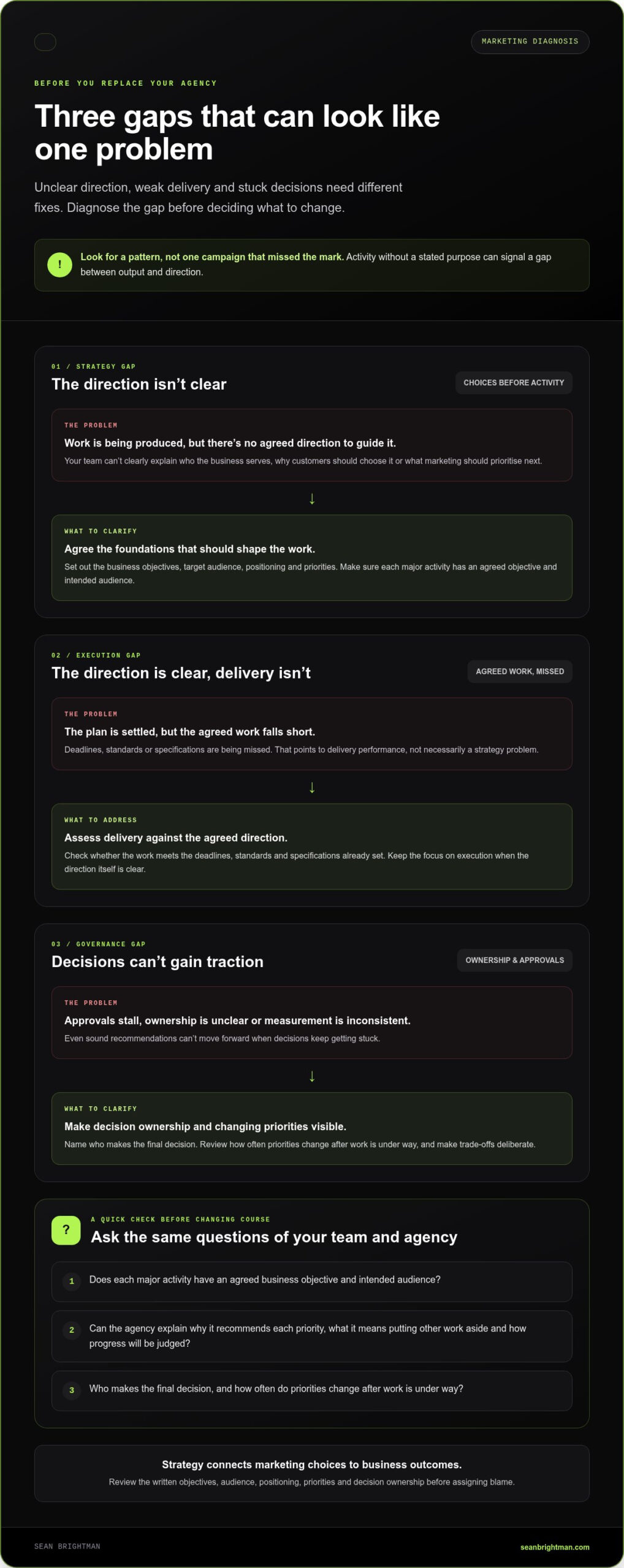
    Look for a pattern, not one campaign that missed the mark. Recurring activity without a stated purpose can signal a gap between output and direction:

    • Campaigns repeat because they’re on the calendar, not because there’s a clear business objective or audience rationale.
    • Reports count posts, clicks or completed tasks but don’t explain what the results mean for the business or what should change next.
    • Urgent requests keep taking over, pushing agreed priorities aside without a deliberate decision about the trade-off.

    These signs don’t prove the agency is incapable. They do show that the work isn’t being tied clearly enough to choices and outcomes.

    What a strategic agency relationship should give you

    A strategic partner uses your objectives, positioning and understanding of customers to shape recommendations. Channel choices should follow the goal and audience, not habit or whatever happens to be easiest to produce.

    Good recommendations also come with a rationale: why this activity, why now, what it asks you to deprioritise and how you’ll judge progress. You should hear a clear point of view, not automatic agreement with every request. For example, if a new campaign would pull resource away from a priority already in motion, the agency should flag the conflict and help you make an informed choice.

    Strategic direction doesn’t mean every recommendation will be right. It means the thinking is visible, the trade-offs are discussed and the work has a reason to exist. That gives you something concrete to assess before deciding whether the issue sits with the agency, the brief or the way decisions are made inside the business.

    Is the agency the problem or is your strategy unclear?

    If you’re thinking “my marketing agency is not strategic enough”, pause before deciding who’s at fault. The problem could sit in the strategy, the agency’s capability, the quality of delivery or the way decisions get made inside your business. These gaps can look similar from the outside, but each needs a different fix.

    Start by checking the foundations: are your objectives, target audience, positioning and priorities clear? Does everyone know who has authority to approve work and change direction? If those answers shift between meetings, the agency may be responding to mixed signals rather than ignoring a settled plan.

    A quick diagnostic: strategy gap or execution gap?

    • Strategy gap: Your team can’t explain who the business serves, why customers should choose it or what marketing should prioritise next. The agency may be producing work, but there’s no agreed direction to guide it.
    • Execution gap: The direction is clear, yet agreed work misses deadlines, standards or specifications. That points to delivery performance, not necessarily a strategy problem.
    • Governance gap: Approvals stall, ownership is unclear or measurement is inconsistent. Even sound recommendations can’t gain traction if decisions keep getting stuck.

    These gaps can overlap. A brief that asks for more leads, greater brand awareness and a new audience all at once, without ranking those goals, gives the agency no clear basis for trade-offs. If different people then give conflicting feedback, the next version may swing in another direction. Before assigning blame, review the written objectives, audience, positioning, priorities and decision ownership.

    Questions that expose the real source of the problem

    Use the same questions with your team and agency. The answers, and where they differ, will show what needs attention:

    • Does each major activity have an agreed business objective and intended audience?
    • Can the agency explain why it recommends each priority, what it means putting other work aside and how progress will be judged?
    • Who makes the final decision, and how often do priorities change after work is under way?

    The U.S. Bureau of Labor Statistics outlines marketing managers’ responsibilities, including assessing trends and choosing strategies, in its Duties of Marketing Managers overview. That’s a useful reference point: strategic direction involves judgement and choices, not simply carrying out a list of requests.

    If the answers point to a wider disconnect between planning, people and processes, examine your marketing operations growth engine. A structured roadmap can help turn the diagnosis into clear priorities, owners and decisions. Explore senior marketing leadership if you need an experienced lead to align that direction with agency activity.

    Should you replace your marketing agency or reset the relationship?

    Changing agencies can feel like a clean break. But a new supplier won’t solve unclear goals, shifting priorities or missing decision ownership. If you’re thinking “my marketing agency is not strategic enough”, base the decision on evidence: what the agency can do, what it has actually delivered, what your business needs next and how both sides behave when problems surface.

    There are three routes. Choose the one that addresses the real gap, not simply the one that promises a fresh start.

    Route Best fit when What to establish
    Reset the brief The agency delivers competently, but objectives, priorities or success measures are vague. Clear goals, audiences, responsibilities, recommendations and review measures.
    Add strategic leadership The business needs someone to set direction and coordinate internal teams or multiple specialists. Who owns the strategy, makes trade-offs and keeps activity aligned with business priorities.
    Replace the agency There’s evidence of a capability or delivery gap, or agreed direction repeatedly fails to shape the agency’s work. The requirements for the next relationship, including scope, ownership and measures of progress.

    When a reset is worth trying

    Try a reset when the agency can deliver the work but hasn’t had a clear enough operating brief. Put the commercial objective, target audience, priority activity and success measures in writing. Then agree a defined review period with specific outcomes, rather than accepting open-ended promises to “be more strategic”.

    Make the expectations two-sided. Set out what the agency will recommend, what it will deliver and what its reporting should explain. The reset is also a test: can the agency turn clearer direction into relevant proposals and consistent work? If yes, you may have fixed the brief, not needed a new supplier.

    When a change or senior leadership is justified

    Consider a change if clear, agreed direction still doesn’t influence recommendations or delivery. Repeatedly missing standards, deadlines or agreed priorities points to a problem the brief alone may not fix. Look at the pattern, not one disappointing result.

    If the business uses several specialists or agencies, the missing piece may be someone on your side to set priorities, make trade-offs and keep everyone moving in the same direction. A Fractional CMO provides part-time senior marketing leadership; it’s a strategic lead, not another delivery supplier. And before bringing in anyone new, settle unresolved choices about positioning and commercial priorities. Otherwise, the same uncertainty follows you into the next relationship.
    My Marketing Agency Is Not Strategic Enough: What to Do Next

    How to reset an under-strategic agency with a sharper brief

    If you’ve concluded that “my marketing agency is not strategic enough”, don’t send another vague request to “think bigger”. Give the agency a brief it can use to make decisions, then judge the recommendations and work against it.

    Build the reset in sequence:

    1. Set the commercial goal. State the business outcome marketing needs to support and how you’ll recognise progress.
    2. Clarify the audience. Describe the customers you need to reach and the problem they need solved.
    3. Choose priorities. Rank what matters now. Make clear what should pause or stop if new work takes its place.
    4. Assign owners. Name who leads the work, who approves it and who makes the final call if priorities conflict.
    5. Review the evidence. Agree which measures you’ll use, how often you’ll discuss them and what decisions the results should inform.

    Build a brief that gives the agency strategic context

    Put the business objective, customer problem and target audience in plain language. Add your positioning, the proof points that support it, commercial constraints and decisions already made. Record assumptions too, such as an untested belief about why customers choose you. Mark it as an assumption, not a fact.

    This stops the agency from treating every request as a fresh instruction. A strategic brand roadmapping approach can help turn those choices into a usable plan, with priorities and accountable decisions rather than a disconnected task list.

    Create accountability without measuring activity alone

    Agree an outcome measure that reflects the goal, alongside leading indicators that show whether the work is moving in the right direction. The right measures depend on the objective. Don’t judge a positioning project by the same measures as a lead-generation campaign.

    Ask the agency to explain what the evidence suggests, what it recommends doing next and what the team expects to learn. Keep a regular review rhythm focused on progress, learning and decisions, not just a tour through completed tasks. Results can move alongside a campaign without proving that the campaign caused them, so treat performance data as evidence to interpret, not automatic proof.

    Capture changes to assumptions, constraints and priorities as they happen. That record makes it easier to understand why the plan shifted and whether the shift was deliberate. For senior support turning a diagnosis into priorities and an accountable roadmap, explore strategic roadmapping support.

    When strategic marketing leadership is the missing piece

    An agency can deliver strong work and still lack the authority to decide what the business should prioritise. That isn’t necessarily an agency failure. Agencies work within the direction they’re given; someone on the business side needs to connect marketing choices to commercial goals, make trade-offs and keep the whole system aligned.

    If you’re still thinking “my marketing agency is not strategic enough” after clarifying the brief, ask a different question: who owns marketing direction across the business? Without that senior ownership, internal teams and external specialists can each do their part whilst pulling towards different goals.

    What senior strategic direction changes

    A senior marketing leader turns business objectives into practical choices. They connect positioning and customer priorities to channel decisions, resource allocation and the work agencies are asked to deliver. They also give the agency a clear strategic brief and a decision-maker who can maintain focus when new requests compete for attention.

    That leadership doesn’t stop at campaign delivery. It creates accountability for what the business is learning, whether the direction still makes sense and what should change next. A Fractional CMO provides this senior marketing leadership on a part-time basis. They lead strategy and align agency and internal activity, rather than acting as another delivery supplier or requiring a full-time hire.

    Choose the right next step for your situation

    The right support depends on the gap you’ve identified:

    • Use a roadmap when the business needs clear priorities, direction and accountable decisions. It gives the team and agency a shared plan to work from.
    • Use ongoing advisory when leaders have a direction but need continued challenge, guidance and accountability as decisions arise.
    • Consider Fractional CMO leadership when marketing needs senior ownership across teams, agency partners and business priorities.

    These options solve different problems. A roadmap sets out the direction; an advisory retainer provides ongoing input; a Fractional CMO takes part-time senior leadership across marketing. The point isn’t to add another layer of activity. It’s to put clear ownership above delivery, so specialists know what they’re working towards and leaders can make decisions with the wider business in view.

    If you’ve identified a need for that direction, explore strategic marketing direction as a practical next step.

    Give your marketing a clearer direction

    If you’re thinking “my marketing agency is not strategic enough”, don’t jump straight to replacing it. First work out whether the gap is unclear goals, weak execution or missing senior ownership. A sharper brief can reveal whether the agency can respond to clear commercial priorities.

    Set out what the business needs marketing to achieve, who it needs to reach and how you’ll assess progress. If activity still lacks direction, the business may need someone to own strategy across internal teams and agency partners. A Fractional CMO provides part-time senior marketing leadership, whilst roadmapping and advisory support bring structure, direction and accountability.

    You don’t need to solve everything at once. Make the next decision based on evidence, then give the team a clear route forward. Explore senior marketing direction with Sean Brightman and take the next step towards marketing that works in service of your business goals.

    Frequently Asked Questions

    How do I know if my marketing agency is not strategic enough?

    Look for repeated activity without a clear link to business goals, audiences or positioning. If you’re asking “my marketing agency is not strategic enough”, check whether recommendations explain why a campaign or channel matters, what it means prioritising it and how success will be judged. One missed report isn’t proof of a strategy problem. A persistent inability to explain the direction behind the work is a stronger warning sign.

    Should I fire my marketing agency if it is not strategic enough?

    Not automatically. First check whether the agency has a clear brief, access to the right information and a decision-maker who can maintain priorities. Reset the objectives, responsibilities and review measures, then assess the agency’s response over an agreed period. Consider changing providers if strategic gaps persist despite clear direction, or if the agency can’t meet the capabilities your business needs. A new agency won’t fix unclear goals or ownership by itself.

    Can a marketing agency be good at execution but weak at strategy?

    Yes. Campaign production and channel management are different capabilities from setting strategic direction. An agency may deliver work competently whilst relying on you to define the audience, positioning, priorities and measures of success. The useful question isn’t whether the agency is good or bad overall. It’s whether its strengths match the role you expect it to play, and whether someone in the business owns the decisions around that work.

    What should I ask my marketing agency to improve its strategy?

    Ask how each recommendation connects to a business objective, target audience and positioning. Request the evidence behind its priorities, the trade-offs involved and the measures it will use to learn. Clarify what should stop, who owns final decisions and when you’ll review the plan. These questions help create a sharper working brief. They won’t replace clear leadership, so make sure someone in your business can set priorities and make decisions.

    How long should I give a marketing agency to improve?

    Set a review period that fits the work and the decisions involved, rather than relying on an arbitrary industry-wide timeframe. Agree the changes you expect to see, such as clearer recommendations, aligned priorities, defined measures or improved delivery. Use regular checkpoints to assess evidence and decide what happens next. Make the reset time-bound and observable, but don’t demand guaranteed commercial results by a fixed date.

    Do I need a Fractional CMO or a new marketing agency?

    A new agency may help if your current provider lacks the capabilities or working approach your business needs. A Fractional CMO may be more relevant when you lack senior marketing ownership to set direction, coordinate suppliers and connect activity to commercial goals. The role provides part-time senior marketing leadership, not another delivery supplier. Diagnose the gap first: replacing execution without addressing missing leadership can reproduce the same problem with a different agency.

    What should a strategic marketing agency report include?

    A useful report connects performance to agreed objectives, explains what the evidence does and doesn’t show, and recommends what to do next. It should make priorities and trade-offs clear, not just list posts, clicks or completed tasks. Choose measures that fit the goal, then use them to guide decisions and learning. Treat results as evidence to interpret, not proof that a campaign caused an outcome unless the analysis supports that conclusion.

  • How to Structure a Modern Marketing Team in 2026

    How to Structure a Modern Marketing Team in 2026

    More marketers won’t fix a team where nobody owns the outcome. When responsibilities overlap, important work falls through the cracks and activity doesn’t connect to pipeline or revenue, the issue may be the structure, not the headcount. Learning how to structure a modern marketing team starts with the work that drives growth, then gives each part a clear owner.

    Marketing needs a mix of skills, but the harder question is whether to hire, outsource or bring in fractional expertise, and how to combine those choices without creating confusion. Adding people without clear responsibilities and decision rights can make work harder to manage, not easier.

    This guide shows how to build a structure that fits your company’s stage, goals and workload. You’ll learn how roles can evolve as the team grows, how to combine employees with specialist partners and senior advisory support, and how to set measures tied to business outcomes. The aim isn’t a complicated org chart. It’s a team with clear accountability and the capacity to deliver.

    Key Takeaways

    • Learn how to structure a modern marketing team by starting with the business outcomes it needs to deliver, not a list of job titles.
    • Map the capabilities and recurring work your goals require, then make ownership and decision rights explicit.
    • Compare in-house, agency, freelance and fractional support to find the right balance of control, expertise and coordination.
    • Check workload and dependencies before changing reporting lines or creating new roles.
    • Review outcomes, campaign learning and capacity regularly to identify what the team needs next.

    How to structure a modern marketing team around business outcomes

    A modern marketing team isn’t defined by its org chart. It’s a group with the capabilities and decision rights to influence the business outcomes that matter. The right structure depends on your goals, customers and workload, not a template copied from another business.

    An org chart shows who reports to whom, but it can’t resolve competing priorities, duplicated tasks or work nobody owns. Marketing management covers strategy, planning and implementation. Team design needs to connect those disciplines to clear priorities and responsibility.

    Start with the outcomes marketing must influence

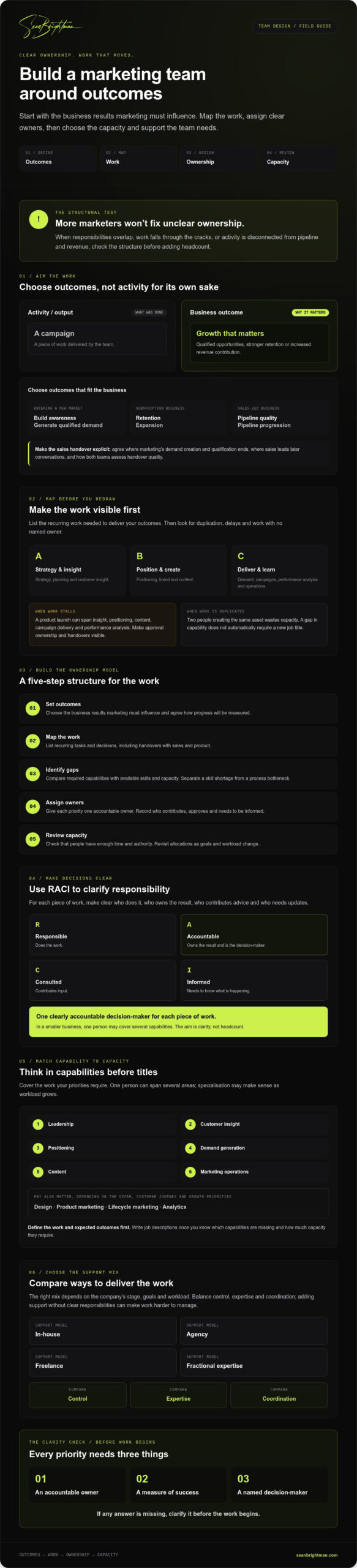
    Translate company goals into a small set of marketing outcomes. Choose measures that reflect how your business grows, rather than tracking activity for its own sake. A campaign is an output; qualified opportunities, stronger retention or increased revenue contribution are outcomes.

    The emphasis depends on your business. A company entering a new market may need to build awareness and generate qualified demand. A subscription business might focus on retention and expansion, whilst a sales-led business may prioritise pipeline quality and progression. Choose outcomes that fit your model and stage, then agree how marketing and sales will share responsibility. For example, marketing may create and qualify demand while sales leads later conversations. Define the handover and how both teams will assess its quality.

    Use this test for every priority: Does it have an accountable owner, a measure of success and a named decision-maker? If any answer is missing, clarify it before the work begins.

    Map work before drawing reporting lines

    Before deciding who reports to whom, list the work needed to deliver your outcomes. Include recurring activities across strategy, insight, demand, brand, content and operations. Mark what’s duplicated, where work gets stuck and what has no named owner. A gap may call for a new capability, but it doesn’t automatically mean you need a new job title.

    Make handovers visible. A product launch, for example, may involve product insight, positioning, content, campaign delivery and performance analysis. If everyone assumes someone else owns approval, the work stalls. If two people create the same asset, capacity is wasted.

    The RACI concept can clarify responsibilities. Identify who is Responsible for doing the work, who is Accountable for the result, who should be Consulted and who needs to be Informed. Give each piece of work one clearly accountable decision-maker. In a smaller business, one person may cover several capabilities. The goal is clarity, not headcount.

    That’s the practical starting point for how to structure a modern marketing team: define the outcomes, map the work and assign ownership before redrawing the org chart.

    How to design marketing roles, responsibilities and decision rights

    Turn your priorities into a working ownership model. This five-step sequence shows how to structure a modern marketing team without assuming every capability needs its own hire or job title.

    1. Set outcomes. Choose the business results marketing must influence and agree how you’ll measure progress.
    2. Map the work. List the recurring tasks and decisions needed to deliver those results, including handovers with sales and product.
    3. Identify gaps. Compare required capabilities with the skills and capacity available. Separate a genuine skill shortage from a process bottleneck.
    4. Assign owners. Give each priority one accountable owner. Record who contributes, who approves and who needs to be informed.
    5. Review capacity. Check whether people have enough time and authority to meet their responsibilities. Revisit the allocation as goals and workload change.

    Which marketing roles and capabilities should a team cover?

    Think in capabilities before titles. Most teams need some form of leadership, customer insight, positioning, demand generation, content and marketing operations. Design, product marketing, lifecycle marketing or analytics may also be important, depending on the offer, customer journey and growth priorities.

    One person might cover several areas in a smaller business. As workload grows, specialisation may make sense. Define the work and expected outcomes first. Write job descriptions once you know which capabilities are missing and how much capacity they require.

    How should a marketing team assign ownership?

    Separate three responsibilities that are often muddled: strategic ownership sets direction and is accountable for the result; specialist contribution brings the skills needed to deliver; approval authority makes the final call. These may sit with different people, but everyone should know who holds each responsibility.

    For example, a marketing lead could be accountable for a product launch outcome, with specialists contributing positioning and content and a named decision-maker approving claims or investment. Document handovers and dependencies with product and sales. Shared delivery should not mean unclear accountability.

    Set measures that match each person’s remit. Assess a content specialist on whether content reaches the intended audience and supports qualified demand, not simply on the number of pieces published. A marketing operations owner might focus on data quality, useful reporting and reliable handovers. Activity counts can help diagnose workload, but on their own they’re weak measures of impact.

    Clear processes help responsibilities hold up as work scales. Explore marketing operations and scalable growth systems for more on building the supporting structure. If priorities or accountability remain unclear, Fractional CMO leadership can provide senior direction without a full-time appointment.

    In-house, agency or fractional support: compare marketing team models

    There’s no prize for building the biggest team. Choose a resourcing model that matches the work: how often it’s needed, the expertise it requires and how closely it must connect to your customers and product. A smaller team can cover more ground when priorities are clear and external support is chosen selectively.

    Model Control Continuity Specialist depth Coordination load Best suited to
    In-house hire High High Depends on the hire Internal management and onboarding Steady work needing product or customer context
    Agency Shared Set by the engagement Can span several specialisms Briefing, feedback and approvals Defined delivery needs or capacity gaps
    Freelancer Shared Varies by arrangement Focused expertise Scoping and coordination Specific tasks or short-term specialist input
    Fractional senior leadership Strategic direction with internal delivery Ongoing or agreed support Senior marketing perspective Works best with a clear internal point of contact Setting priorities and accountability without a full-time CMO

    When does in-house marketing capacity make sense?

    Bring work in-house when it’s steady, central to growth and relies on close knowledge of your product, customers or internal teams. Before creating a permanent role, check whether the workload is likely to remain consistent and who will manage, onboard and support the person. A specialist can add capability, but the role needs a clear remit and enough work to justify it.

    When should a business use agency or fractional support?

    Agency support can suit a defined specialist delivery need or a temporary capacity gap. Freelancers can add focused expertise without creating a permanent role. Fractional leadership is different: it provides senior direction when the business needs sharper priorities and accountability, but not a full-time CMO. It doesn’t replace the people responsible for day-to-day delivery.

    Mixed models work best when one internal owner joins the pieces together. Without that person, briefs, approvals and handovers can create more coordination work than the external support removes. Before work begins, agree the scope, decision rights, dependencies and measures of success.

    If the gap is senior direction rather than hands-on capacity, consider fractional CMO leadership without a full-time role. The right answer to how to structure a modern marketing team isn’t choosing one model for everything. It’s keeping ownership inside the business and matching specialist support to the work that needs it.

    How to Structure a Modern Marketing Team in 2026

    How to build a marketing team structure step by step

    Don’t start with new job titles or reporting lines. First check what the business needs, what work already happens and where it gets stuck. This sequence turns those findings into a structure you can test, rather than a permanent reorganisation based on assumptions.

    1. Start with business goals. Choose the outcomes marketing must support and identify the work needed to influence them.
    2. Audit capabilities and capacity. Compare that work with current skills, available time and competing priorities.
    3. Map ownership. Name an accountable owner for each priority, then document contributors, decision-makers and dependencies.
    4. Choose how to resource gaps. Decide whether to build internal capability, adjust existing responsibilities or use specialist external support.
    5. Pilot and review. Test the proposed responsibilities against agreed measures before making lasting changes to roles or reporting lines.

    How can you identify capability gaps before hiring?

    Not every gap calls for a new hire. Separate three problems: a skills gap means the team lacks a capability; a capacity gap means the skill exists but there isn’t enough time; a decision-making problem means work is stalled by unclear authority or approvals. Each requires a different response.

    Rank gaps by business impact, urgency and the cost of leaving them unresolved. A simple capability matrix can make the trade-offs visible:

    • Capability: Customer insight. Current coverage: occasional input. Gap: no regular customer research. Urgency: medium. Proposed owner: assign an existing lead, then review capacity.
    • Capability: Marketing operations. Current coverage: reporting assembled manually. Gap: process and ownership are unclear. Urgency: high if it delays decisions. Proposed owner: name a process lead before adding resource.

    Use these examples as prompts, not assumptions. Fill the matrix with your own evidence: workload, skills, bottlenecks and links to priority outcomes. Check dependencies too. A new role won’t solve a delay caused by missing product input or slow approvals.

    How should you phase changes and measure progress?

    Before changing responsibilities, record a baseline: which priorities have owners, where handovers break down and how current work performs against its intended outcomes. Set a review date once the new arrangement has had enough time to operate. Check results, workload and decision delays, not just completed tasks.

    If ownership is clearer but outcomes haven’t shifted, investigate the work, dependencies and measures before adding another role. A pilot lets you adjust the structure while the change is still manageable. For help turning priorities into a practical sequence, read building a marketing strategy roadmap that works.

    Need a structured way to assess priorities and capability gaps? Explore strategic roadmapping support before committing to a new team design.

    How to lead a modern marketing team as it grows

    As the team changes, the leader’s job shifts from personally pushing every task forward to keeping the system clear. Strategy, priorities and decision rights must remain visible, especially when employees and external specialists share the work. That’s how you stop new capacity creating new confusion.

    Knowing how to structure a modern marketing team is only part of the work. The structure also needs a management rhythm that checks whether priorities still fit the business, responsibilities remain clear and the team has capacity to deliver.

    What management rhythm keeps the team aligned?

    Use planning sessions to choose priorities for the next working period and state what the team will not do. That trade-off protects focus. Then review progress against business outcomes, what campaigns have taught you, where work is blocked and whether workload is manageable.

    Involve sales, product or senior leadership when their decisions or customer insight affect delivery. Keep a simple decision log with the decision, who made it and what happens next. This helps prevent teams reopening settled questions or guessing who has approval.

    Review four things together:

    • Outcomes: Are marketing priorities influencing the results they were designed to support?
    • Learning: What did campaign and customer evidence reveal, and what should change?
    • Capacity: Is priority work progressing, or are people overloaded or waiting on others?
    • Capability: Has a new gap emerged, or would clearer ownership solve the problem?

    Where does AI fit as the team grows?

    AI may help with repeatable tasks such as organising information, supporting analysis or speeding up early content drafts. Treat it as a capability within a managed workflow, not a replacement for strategy or accountability. Assign someone to check accuracy, context, brand fit and approval before AI-assisted work reaches customers or informs a decision. For practical guidance, explore practical AI consulting for scalable marketing growth.

    When can fractional leadership support the team?

    If the team can deliver but lacks senior direction, a fractional CMO or adviser can help set priorities, clarify accountability and maintain focus without a full-time CMO. This support guides the operating model; it doesn’t replace every specialist or remove the need for internal owners.

    Need to connect team responsibilities with business priorities? Discuss a practical team and marketing roadmap to define what the structure needs to deliver next.

    Build a team that can grow with the business

    The strongest marketing structure isn’t the most elaborate. It connects business goals to clear ownership, gives people decision-making authority and matches in-house capacity with the specialist support the work requires. That’s the practical answer to how to structure a modern marketing team.

    Start with outcomes, map the capabilities and workload needed to influence them, then review whether the structure is working. Keep priorities visible as the team grows, and adjust roles when evidence shows a genuine gap, not just because the org chart looks untidy.

    If senior direction is the missing piece, fractional CMO and advisory support can provide strategic guidance on a part-time basis. Roadmapping can help turn business goals into a structured marketing and brand direction, with clearer priorities and next steps.

    Talk through your marketing team structure and next steps. A clear plan can help your team focus its effort, own the work and build momentum with confidence.

    Frequently Asked Questions

    How do you structure a modern marketing team?

    Structure it around the business outcomes marketing needs to influence, then assign clear owners to the work and decisions required. To decide how to structure a modern marketing team, map the necessary capabilities, check current skills and capacity, and identify gaps before creating roles. Give each priority an accountable owner, a measure of success and a named decision-maker. Review the arrangement as business goals and workload change.

    What roles should a modern marketing team include?

    Cover the capabilities your priorities require, which may include marketing leadership, customer insight, positioning, demand generation, content and marketing operations. Add design, product marketing, lifecycle marketing or analytics when the business needs them. These are capability areas, not a mandatory list of job titles. In a smaller team, one person may cover several. Define the responsibilities and expected outcomes first, then decide whether they need dedicated roles.

    How should a small business structure its marketing team?

    A small business should keep the structure lean: name an owner for each priority, make responsibilities explicit and avoid creating roles before confirming the work and capacity required. One marketer may cover several capabilities, while specialist or senior external support can fill specific gaps. Keep decision-making simple. For each priority, clarify who leads, who contributes and who approves, then review whether the arrangement is delivering against business goals.

    Should marketing teams be organised by channel or by function?

    Neither model fits every business. Organising by function, such as content or demand generation, can build specialist expertise. Organising around outcomes or customer journeys can help teams connect work across channels. Avoid creating channel silos where each team optimises its own activity without shared goals. Start with the outcomes and recurring work, then choose the arrangement that gives each priority clear ownership and makes cross-team decisions straightforward.

    When should a business hire in-house rather than use an agency?

    Consider an in-house hire when the work is ongoing, the capability is consistently needed and close product or customer knowledge matters. Check that there’s enough sustained workload, as well as management and onboarding capacity to support the role. An agency may suit a defined specialist requirement or a delivery gap. Compare the options by control, continuity, expertise and coordination effort, then set scope and measures before work begins.

    Can a fractional CMO lead an existing marketing team?

    Yes. A fractional CMO can provide senior marketing leadership on a part-time basis, helping an existing team clarify priorities, direction and accountability. This is strategic leadership, not a replacement for every specialist or a promise to take over all delivery. Agree decision rights with the business and team, including who owns execution and approvals. It can suit a company that needs senior direction but not a full-time CMO.

    How should AI change the structure of a marketing team?

    AI should influence how work gets done, not remove the need for clear roles or accountable decisions. Identify suitable workflows, such as organising information or supporting early analysis, then name who checks the output for accuracy, relevance and brand fit. Assign responsibility for approving work before it informs decisions or reaches customers. Build practical AI capability into existing roles or add specialist support where needed, without treating tools as a substitute for strategy.