
Tag: AI implementation

  • Common AI Implementation Challenges: What Goes Wrong and How to Fix It in 2026

    Common AI Implementation Challenges: What Goes Wrong and How to Fix It in 2026

    Only 41% of AI projects make it from prototype to deployment, according to Gartner. The problem often isn’t the technology. It’s the gap between a promising experiment and the leadership, workflows and controls needed to make it useful. Common AI implementation challenges often start in this gap.

    If your pilot sits outside commercial priorities, relies on messy data or leaves teams unsure how to use it, buying another tool won’t fix the blockage. These challenges can create risk, rework and wasted spend before AI delivers a measurable result.

    A stalled initiative is a signal to diagnose the system, not rush into another investment. This guide will help you identify the root cause, prioritise practical fixes and decide what needs to be in place before scaling.

    We’ll break down the real barriers, from unclear ownership and governance to skills gaps and workflows that haven’t changed. You’ll also see how to connect AI adoption to measurable business and marketing outcomes, so experiments have a clear route to value.

    Key Takeaways

    • Turn common AI implementation challenges into specific questions about goals, workflows, data and ownership, so you can find the actual blocker.
    • Prioritise issues by business impact, risk, dependencies and how readily your team can address them.
    • Before testing a use case, set a baseline, define a measurable outcome, assign an accountable owner and plan for human review.
    • Evaluate a pilot against its intended outcome before deciding whether to adjust, stop or expand it.
    • Use strategic roadmapping to connect AI use cases with marketing priorities, workflow changes and accountable owners.

    Common AI implementation challenges: why promising initiatives stall

    An AI demonstration can look impressive: a prompt produces a polished campaign draft, a chatbot answers a sample query, or an assistant summarises a report in seconds. Then everyday work starts. The output needs checking, staff return to familiar tools, and nobody can say whether the experiment improved a business result. The gap isn’t mysterious. A convincing demo proves a task can be done. It doesn’t prove the task fits the workflow or creates dependable value.

    That distinction sits at the heart of common AI implementation challenges. Implementation means embedding AI into real decisions and routines, with clear responsibility for how people use and assess it. Buying access to a tool, connecting a model or completing a pilot is only a starting point. The process around the technology has to change too.

    Experimentation asks, “Can this work?” Operational implementation asks, “Does it reliably improve a defined business outcome as part of everyday work?”

    What does successful AI implementation actually mean?

    Success needs three things: a specific business outcome, an accountable owner and routine use by the people whose work is meant to improve. For a marketing team, that might mean reducing avoidable drafting effort whilst maintaining agreed quality, rather than simply generating more copy. The measure should reflect the intended benefit, not just how often someone opens the tool.

    A model can perform well in a controlled test and still fail in practice. The process may lack suitable review, staff may not trust the output, or the tool may not fit how work moves between colleagues. Technical performance matters, but so do adoption, usefulness and safeguards. Clear human oversight also helps teams consider AI safety in the context of their use case.

    Which warning signs appear before an AI initiative stalls?

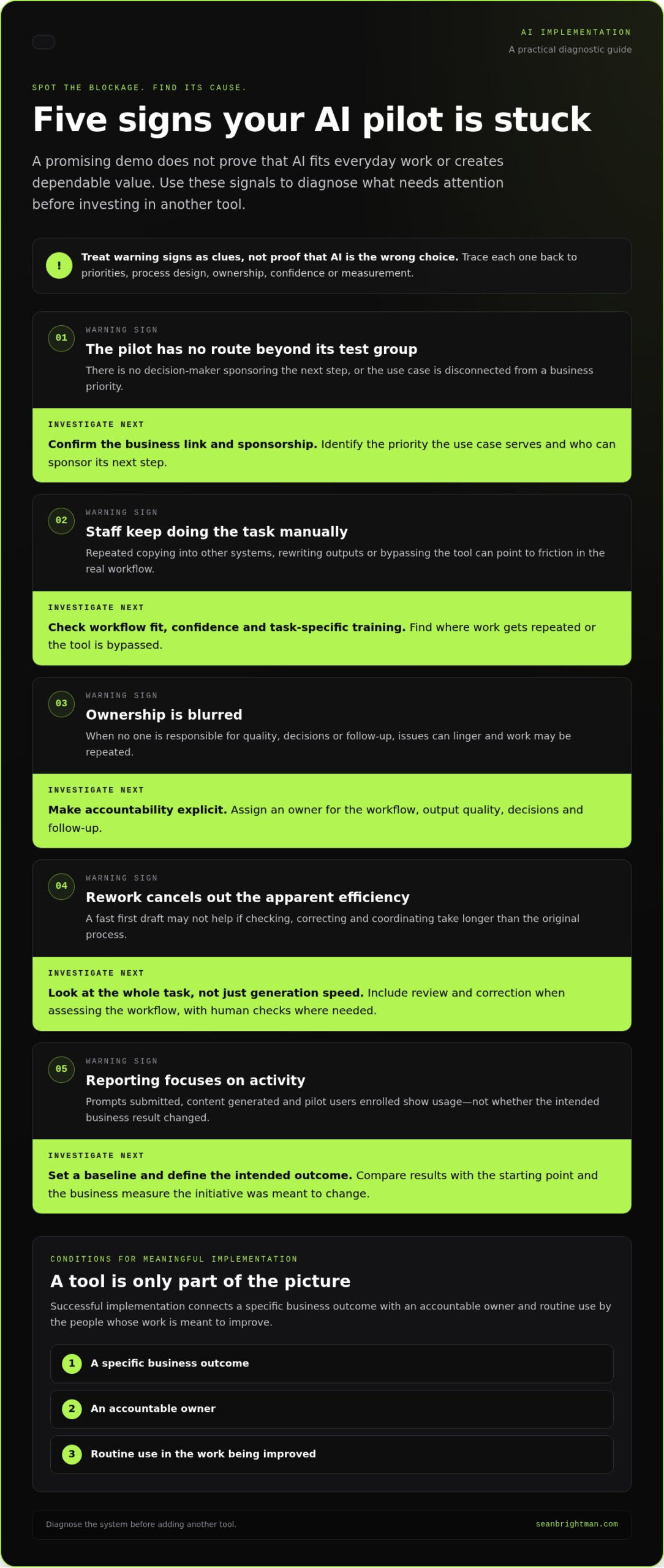
    Look for patterns in the work, not just status updates. An initiative may appear active whilst the conditions for real adoption are missing:

    • The pilot has no route beyond its test group. If nobody with decision-making authority is sponsoring the next step, or the use case doesn’t connect to a business priority, the pilot may be exploration without a path to operational use.
    • Staff keep doing the task manually. Repeatedly copying outputs into other systems, rewriting results or bypassing the tool can signal poor workflow fit, low confidence or training that hasn’t addressed the actual task.
    • Ownership is blurred. If no one is responsible for quality, decisions or follow-up, issues linger and teams may redo work to compensate.
    • Rework cancels out the apparent efficiency. Fast first drafts mean little if checking, correcting and coordinating take longer than the original process.
    • Reporting focuses on activity. Prompts submitted, content generated or pilot users enrolled show usage, not business impact. Compare results with a baseline and the outcome the initiative was meant to change.

    These signs are diagnostic clues, not proof that AI itself is the wrong choice. Trace each one back to its cause: priorities, process design, ownership, confidence or measurement. That gives you a sharper starting point than adding another tool or declaring the pilot a success because it produced a polished demo.

    The root causes behind common AI implementation challenges

    Teams often choose a tool before agreeing what needs to improve. A request to “use AI in marketing” sounds like a plan, but it doesn’t define the problem, the intended outcome or who will own the result. Without those decisions, tool selection becomes guesswork. The team may build a capable solution that answers the wrong question.

    Data can expose the same gap. Useful outputs depend on information that’s relevant, accessible and managed with care. If customer records are incomplete, definitions differ between teams, or nobody owns updates, the output may be inconsistent. Staff then lose confidence, even if the underlying model performs as expected. Access matters too: information that can’t be used appropriately in the workflow can’t support the intended task.

    Data, governance and security: the foundations teams overlook

    Before a use case moves into routine work, decide which data it needs, who is responsible for its quality and who can access it. Set practical rules for handling sensitive information, reviewing outputs and escalating errors. For a marketing workflow, that could mean defining which source material staff may use and requiring human checks before AI-assisted content is shared.

    In the UK, organisations using personal data need to consider their responsibilities under UK GDPR. The Information Commissioner’s Office (ICO) publishes guidance on data protection and AI. The appropriate steps depend on the use case, so this is an operational prompt, not legal advice. Clear governance gives people a usable framework; vague warnings often leave them guessing.

    People, leadership and workflow integration

    Leadership sponsorship must translate into decisions: which problem matters, what teams should prioritise, who owns the workflow and how success will be assessed. Without that direction, departments can run disconnected experiments or wait for approval whilst the initiative loses momentum. Research into AI’s impact on work and organizations reflects why implementation needs attention to organisational conditions as well as the technology.

    Low adoption isn’t automatically a sign that employees are unwilling to change. Staff may lack practice with the specific task, know the output needs too much correction, or be unsure where human judgement is essential. Generic tool demonstrations won’t resolve those issues. Role-specific learning should show people how AI fits their work, what to check and when to take over.

    AI readiness is a leadership and operating-model challenge: leaders must align priorities, data, responsibilities and workflows before teams can use AI with confidence.

    That alignment matters because the causes compound. An unclear objective leads to a poor use case; weak ownership leaves data and review rules unresolved; awkward workflow design creates workarounds; and workarounds make benefits harder to measure. Redesign the task around both AI assistance and human judgement, then equip the people doing it. Strategic AI roadmapping can help teams connect those decisions to marketing priorities before they scale.

    How to diagnose and prioritise AI implementation challenges

    Don’t label every setback a tool failure. Start with what people can observe, then test the cause. Is the output unreliable, is usage low, or has the pilot stopped moving? Each symptom points towards different questions. This approach turns common AI implementation challenges from a broad list into a diagnosis your team can act on.

    Use the comparison below as a first pass. A symptom is a clue, not a verdict. Check the process before changing technology.

    Match the symptom to the implementation blocker

    Symptom: outputs vary in quality.
    Likely blockers: unsuitable or inconsistent data, a task that’s too broad, or unclear review requirements.
    Ask: Does the system have relevant source material? Have we defined what a useful answer looks like, and who checks it?

    Symptom: people rarely use the tool.
    Likely blockers: the tool doesn’t fit the workflow, leaders haven’t made its purpose clear, or staff lack confidence with the specific task.
    Ask: Where does the tool sit in the existing process? What makes people return to the old method?

    Symptom: a pilot has stopped progressing.
    Likely blockers: success criteria were never set, no one owns the next decision, or expansion depends on assumptions that haven’t been tested.
    Ask: What evidence would justify continuing, who decides, and what must change before wider use?

    These questions help separate a genuine tool limitation from a data, workflow, ownership or adoption problem. If a process is unclear or the desired outcome keeps shifting, AI may not be the right fix. Clarify the task first. A tool can speed up a sound process, but it won’t decide what the process should achieve.

    Decide what to fix first

    Once you’ve identified possible blockers, rank them against four factors: business impact, risk, dependency and your ability to address them. A useful order is:

    1. Set aside use cases with no meaningful outcome. If the team can’t explain what should improve, stop or redesign the idea before spending more effort on it.
    2. Resolve critical risks and ownership gaps. Privacy, security and accountability concerns are gates to wider use, not details to tidy up after scaling.
    3. Fix dependencies that block other work. For example, resolve access to reliable source information before comparing output quality across teams.
    4. Address adoption issues with a clear route to change. Improve workflow fit, role-specific guidance or leadership decisions where those are holding up useful progress.

    When priorities compete, favour the blocker that affects the most important outcome, creates the greatest risk or prevents several other fixes. Keep the decision visible: record the symptom, evidence, owner and next action. That makes it harder for an initiative to drift back into activity without progress.
    Common AI Implementation Challenges: What Goes Wrong and How to Fix It in 2026

    A practical sequence for overcoming AI implementation challenges

    Don’t start by rolling a tool out across the business. Start with one real problem and a test that can show whether AI helps. A disciplined sequence gives the team clear evidence, limits avoidable risk and makes the next decision straightforward: continue, change the use case, pause or scale.

    Design a pilot around a real business problem

    Choose a bounded, recurring task with a clear user and business consequence. Before testing, record the current baseline, define the outcome you want to improve and agree what unacceptable output looks like. Assign a business owner who can make decisions, involve the people who will use the workflow, and set out when a human must review or override AI output.

    For example, a marketing team might test AI assistance on a defined part of content preparation, not “transform marketing” all at once. The task, quality bar and review responsibility should be clear before the pilot begins.

    Move from pilot to responsible adoption

    Run the test in the workflow it’s meant to support, then compare results with the baseline. Review output quality, actual usage, friction in the process and any risks, not just whether the tool produced an answer. If the evidence points to a training, governance or process issue, fix that before exposing more people or work to the use case.

    1. Select the problem. Name the recurring task, its users and the business outcome it affects. If there’s no meaningful outcome, don’t build a pilot around it.
    2. Set the baseline and measures. Record how the task works now, then choose an outcome measure that reflects the intended benefit. Track activity separately; usage alone isn’t proof of value.
    3. Assign ownership and controls. Name the person accountable for the result. Agree who reviews outputs, what errors require escalation and how the team will handle sensitive or unsuitable results.
    4. Test with the intended users. Keep the pilot focused. Give participants task-specific guidance and capture where the tool helps, creates extra work or fails to fit the process.
    5. Evaluate against the baseline. Use a simple scorecard covering value, adoption, quality, risk and workflow fit. Note evidence and unresolved issues for each measure.
    6. Make a decision, then act. Continue if the test shows useful, repeatable value with accountable oversight. Change the use case if the task or measure was wrong. Pause if risks or dependencies remain unresolved. Scale only when the evidence supports wider use.

    Keep the scorecard practical. For value, compare the intended business outcome with the baseline. For adoption, check whether intended users rely on the workflow. For quality, assess outputs against the agreed standard. For risk, record outstanding concerns and controls. For workflow fit, identify workarounds and extra steps. A weak score is a signal to investigate, not a reason to hide the result.

    AI roadmapping can help connect these pilot decisions to business priorities and a measured path to expansion. Plan your AI adoption roadmap before committing to wider rollout.

    Turn AI implementation into a managed growth system

    A pilot can show whether a use case has potential. A managed growth system makes sure the right use cases get selected, owned and reviewed as business needs change. That takes strategic direction, not a growing catalogue of tools. Connect each initiative to a marketing priority, the workflow it affects, the people responsible and a business outcome worth tracking.

    Connect AI use cases to marketing and business priorities

    Start with the constraint, not the technology. Is the team struggling to keep customer communications consistent, or spending too much effort on repetitive work that limits higher-value activity? Define the business or customer-facing need first. Then assess possible uses by strategic relevance, feasibility and measurable value. A use case that looks impressive but doesn’t address a real priority belongs lower on the roadmap.

    This is how teams move beyond disconnected experiments. A roadmap can show which decisions need to come first, what depends on reliable information or a redesigned workflow, and how each use case supports wider marketing aims. For the broader strategic context, explore this AI consulting guide.

    Build the leadership and operating rhythm to keep progress on track

    Priorities need a regular review, not a one-off launch meeting. Set points to assess adoption, outcomes, risks and shifts in business needs. Record who owns each decision and what happens if the use case stops delivering value. This rhythm keeps teams accountable and helps leaders adjust direction before an underperforming initiative gathers more effort behind it.

    Marketing leadership can connect business priorities to the people doing the work, clarify ownership and keep measures visible. It works alongside specialist technical teams, aligning technical work with a defined purpose and ensuring business and technical colleagues agree on scope, dependencies and review.

    That coordination sits alongside sound marketing operations: roles, processes and hand-offs need to support the intended outcome. As priorities evolve, strategic brand roadmapping can help keep AI activity connected to how the business wants to grow and communicate.

    Common AI implementation challenges rarely sit in one place. They emerge when priorities, workflows and accountability pull in different directions. Strategic roadmapping and ongoing advisory support bring those decisions together, maintain direction and keep marketing teams focused on measurable outcomes.

    If your AI plans need a clearer connection to growth priorities, explore strategic AI guidance to help shape the next decisions.

    Make your next AI decision count

    The real test of common AI implementation challenges isn’t whether you can remove every obstacle. It’s whether your next decision makes the work clearer, safer and more valuable. Treat each use case as a learning loop: what it changes, what your team learns and where that insight should shape the next priority.

    That shift turns AI from a string of disconnected projects into a capability the business can strengthen over time. AI consulting focused on AI-powered growth engines, supported by strategic roadmapping and ongoing advisory, can help leaders keep that direction tied to business priorities and team accountability.

    If you’re ready to give your AI plans a clearer strategic path, explore strategic AI consulting and roadmapping.

    You don’t need to scale everything. You need a purposeful next step, and the confidence to build from what you learn.

    Frequently Asked Questions

    What are the most common AI implementation challenges?

    Common AI implementation challenges include unclear business goals, unsuitable or inaccessible data, weak governance, skills gaps, low adoption and poor workflow fit. They can overlap: for example, inconsistent customer records may produce unreliable campaign suggestions, whilst no named owner leaves the team unsure who should correct them. Trace the problem from the visible result back through the task, information and decisions behind it before blaming the tool.

    Why do AI implementation projects fail?

    Projects often lose momentum because teams choose technology before agreeing which business problem it should solve. Without an owner, usable information or a measure of success, a pilot can generate activity but no clear decision about what comes next. For instance, a team might produce AI-assisted content but never define who approves it or whether it improves the publishing process. The missing link is often the operating plan, not the demonstration.

    How can a business overcome AI implementation challenges?

    Start with one task that causes a clear business issue, such as repeated manual sorting of incoming enquiries. Map who handles it now, what information they need and where a person must make a judgement. Then test a limited change with the people doing the work. Their feedback can reveal whether the obstacle is data, training or process design, and help you adjust before extending the approach to other tasks.

    What happens if a business scales an AI pilot too early?

    Early expansion can multiply the pilot’s weaknesses. If a sales team adopts an unreliable lead summary across several teams, for instance, staff may act on poor information and spend time correcting it. Wider use also makes it harder to pinpoint whether the cause is the source data, the task design or inconsistent review. Set a decision gate before expansion and require evidence of dependable outputs, appropriate oversight and genuine user uptake.

    Can small businesses implement AI successfully?

    Yes. A small business can focus on one frequent, low-complexity task rather than launching a broad programme. For example, it could trial AI to organise meeting notes, with a colleague checking important actions before they enter a project plan. Keep the test manageable, agree what information can be used and review whether it saves effort without adding corrections. A small, well-understood use case can give the business useful evidence for its next decision.

    How do you measure the ROI of AI implementation?

    Measure a business outcome against the process before AI was introduced. If the aim is to reduce time spent preparing reports, record the time involved beforehand and compare it with the time needed after adoption, including checking and correction. Also consider quality, staff uptake and any extra oversight effort. The right measure depends on the task; counting prompts or generated documents alone says little about whether the business gained value.

    Is AI implementation mainly a technology challenge?

    No. Technology is one part of the work, alongside leadership, information quality, governance, skills and process design. A tool may work as intended but still create little value if nobody has decided how its output enters a customer-facing decision. Involve the people accountable for the business outcome and those who will use the process. Their input helps distinguish a technical fault from an unclear task or a workflow that needs redesign.

  • AI Marketing Strategy Consultant: Building Scalable Growth Engines in 2026

    AI Marketing Strategy Consultant: Building Scalable Growth Engines in 2026

    Most companies treat AI like a shiny new toy, but in 2026, a toy won’t save your margins. You’ve likely fallen into the trap of tool fatigue, paying for a dozen subscriptions whilst your marketing department remains a fragmented, uncoordinated mess. Hiring an ai marketing strategy consultant isn’t about adding another line to your software budget. It’s about fixing the chaos. You see the potential for growth, yet the path to a scalable system feels blocked by technical noise and the fear of falling behind competitors who seem to have cracked the code.

    We’re moving beyond tactical experiments to create integrated systems that drive measurable brand value and business valuation. It’s not about “using” AI; it’s about building an engine. You don’t need more software. You need a roadmap and senior-level direction that provides accountability without the bloated overhead of a full-time executive. This article outlines how to transition from messy implementation to a high-impact growth engine that actually delivers. We’ll strip away the corporate fluff and focus on the mechanics of strategic AI integration that builds real business value.

    Key Takeaways

    • Discover why an ai marketing strategy consultant focuses on system architecture over mere activity to turn fragmented tools into a unified growth engine.
    • Learn how to sanitise your data fuel and automate manual tasks to remove operational friction whilst increasing your overall business valuation.
    • Identify the inherent conflict of interest in traditional agency models and why strategic efficiency must always come before execution.
    • Follow a 90-day transformation roadmap that begins with a ruthless efficiency audit to uncover hidden profit within your current marketing mess.
    • Understand why hiring a full-time CMO in 2026 is often a strategic error and how fractional leadership provides senior-level accountability without the overhead.

    What is an AI Marketing Strategy Consultant and Why Do You Need One?

    An ai marketing strategy consultant is a senior-level architect who designs the systems required to turn raw data into scalable revenue. They aren’t software resellers or prompt engineers. They are strategists who build the machinery that makes marketing work. Most businesses today are drowning in software whilst starving for a cohesive plan. They possess the components but lack the blueprint. This role bridges the gap between high-level brand objectives and the technical execution of Artificial Intelligence in Marketing.

    The distinction is simple: strategy, not software. Architecture, not activity. A consultant doesn’t care about your favourite tool; they care about your business valuation. They focus on the integration of systems that drive measurable growth. If your marketing feels like a collection of disjointed experiments, you’re likely suffering from the ‘messy’ department syndrome. This is the number one enemy of AI ROI. Without a central nervous system, AI just creates more noise at a faster rate. You don’t need more activity. You need a growth engine.

    The Shift from Tactical to Agentic Marketing

    By 2026, the industry has moved beyond basic generative tasks. We’ve entered the era of the ‘Agentic OS’. Marketing operations no longer rely on human-triggered prompts for every action. Instead, they run on autonomous growth loops. This shift represents a move from tactical execution to systemic intelligence. It’s the difference between asking an LLM to write a blog post and building a system that identifies market trends, produces content, and optimises distribution automatically. The ai marketing strategy consultant serves as the lead architect of this modern marketing machine.

    Identifying the ‘Messy Department’ Symptoms

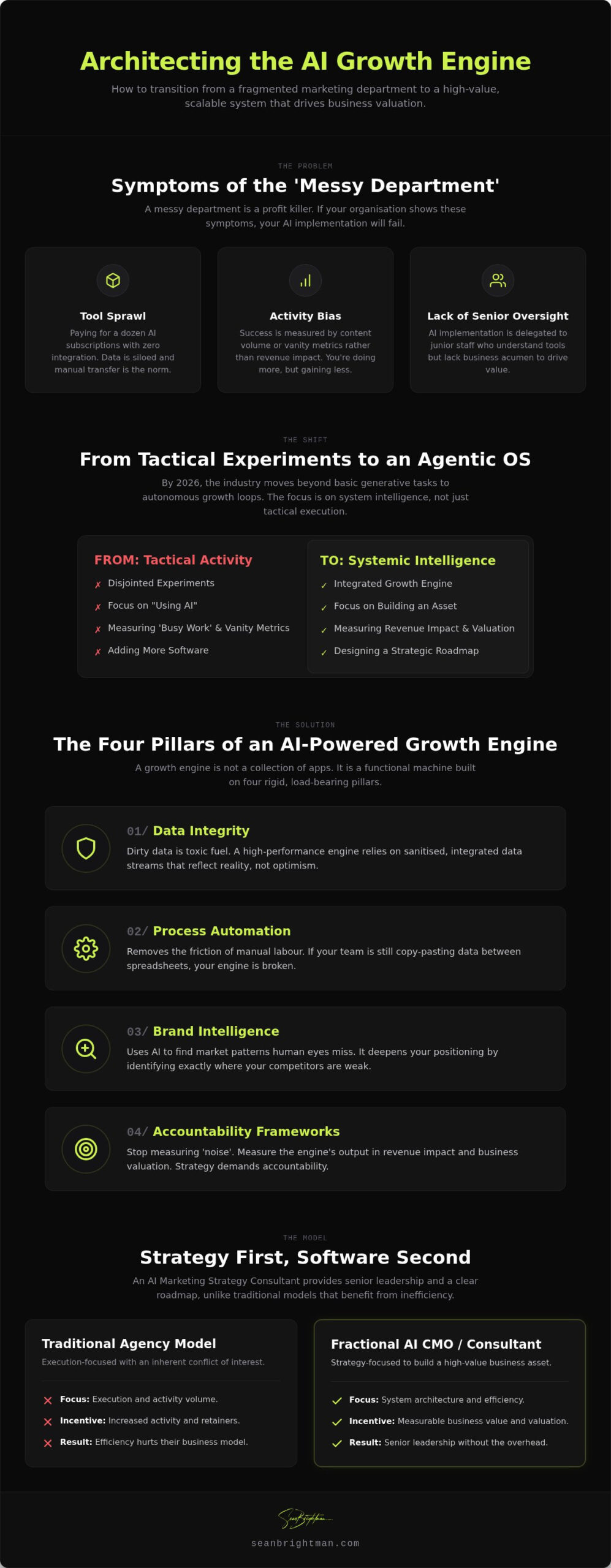
    A messy department is a profit killer. It hides behind ‘busy work’ and avoids accountability. You don’t need more tools; you need to sanitise your process. If your organisation shows these symptoms, your AI implementation will fail:

    • Tool sprawl: You are paying for a dozen AI subscriptions with zero integration. Data is siloed and manual transfer is still the norm.
    • Activity bias: Success is measured by content volume or vanity metrics rather than revenue impact. You’re doing more, but gaining less.
    • Lack of senior oversight: AI implementation is often delegated to junior staff who understand the tools but lack the business acumen to drive value.

    You need a fractional CMO or a dedicated consultant to bring order to this chaos. They provide the senior-level direction required to turn messy activity into a scalable growth engine. Stop playing with tools. Start building an engine.

    The Anatomy of an AI-Powered Growth Engine

    A growth engine is not a collection of apps. It is a functional machine built on four rigid pillars. Without these, your AI efforts are just expensive hobbies. First, you need data integrity. Dirty data is toxic fuel. It causes the engine to seize and produces hallucinations that lead to bad business decisions. A high-performance AI-Powered Marketing Plan relies on sanitised, integrated data streams that reflect reality, not optimism.

    Second, process automation removes the friction of manual labour. If your team is still copy-pasting data between spreadsheets, your engine is broken. Third, brand intelligence uses AI to find market patterns that human eyes miss. It deepens your positioning by identifying exactly where your competitors are weak. Finally, you need accountability frameworks. Stop measuring “noise” like impressions or AI-generated content volume. Measure the engine’s output in revenue impact and business valuation. An ai marketing strategy consultant ensures these pillars are load-bearing, not decorative.

    Systems Over Tools: The Consultant’s Methodology

    A tech stack is a pile of software receipts. A marketing systems architecture is a blueprint for profit. One is a cost centre; the other is an asset. The consultant’s job is to design a system that scales without increasing headcount. This involves mapping every tool to a specific strategic outcome. We build for scale so the business works whilst you sleep. This isn’t about “using AI” to do the same old things. It is about re-engineering the entire operation to favour efficiency over activity. If your current setup requires constant manual intervention, it isn’t a system. It’s a job.

    The Integration of Human Intuition

    AI is a force multiplier, not a replacement for senior leadership. The machine ends where the strategist begins. You have a binary choice: use AI to copy your competitors faster, or use AI to out-think them. The machine handles the logic, the pattern recognition, and the heavy lifting. The human brings the battle-hardened perspective that no LLM can replicate. This is the “plug-and-play” value of an ai marketing strategy consultant. They provide the steering wheel for the engine. They know when to push the machine and when to rely on gut instinct forged in the field. If you want to move from messy implementation to a structured roadmap, an advisory retainer provides the senior oversight you’re currently missing.

    Strategy First, Software Second: Why Agencies Fail at AI

    Agencies are built to scale headcount. AI is built to scale output whilst reducing headcount. This is a fundamental conflict of interest that most businesses ignore until it’s too late. Agencies sell execution because that’s where the margin lives. They want to bill you for the “doing.” A strategic ai marketing strategy consultant sells efficiency because that’s where the value lives. They want to build the “being.” If your agency is pitching AI, ask yourself: are they trying to make themselves more profitable, or are they trying to make you more independent?

    Most agencies offer “black box” solutions. They hide the prompts, the data flows, and the logic behind a proprietary curtain. This is a strategic risk. If you don’t own the logic, you don’t own the engine. You are simply renting a temporary advantage. Real growth requires ownership. You must own the systems, the data, and the intellectual property that your AI generates. A consultant ensures that the architecture is yours, providing the roadmap whilst leaving the “hands” to whoever is best suited for the task.

    The ‘Agency Trap’ in 2026

    Outsourcing your entire AI strategy to a traditional agency is a move towards obsolescence. In 2026, marketing is a technical discipline. If you don’t build internal capability, you are building a house on rented land. True AI consulting isn’t about doing the work for you; it’s about empowering your internal team to run the machine. It involves a transfer of knowledge, not a permanent dependency. You need a partner who helps you sanitise your processes and integrate tools into a unified system that your staff actually understands.

    Objectivity as a Competitive Advantage

    A consultant provides the neutral oversight that agencies cannot. They don’t have a creative department to keep busy or a preferred software vendor providing kickbacks. Their only metric is your business valuation. This objectivity allows you to design an AI marketing strategy that prioritises long-term exit value over short-term campaign noise. Senior leadership must own this roadmap. Delegating your strategic core to a third party is an abdication of duty. You need a battle-hardened advisor who tells you what you need to hear, not what keeps the retainer active. This is about building a functional component for your business, not just another marketing campaign.

    AI Marketing Strategy Consultant: Building Scalable Growth Engines in 2026

    Building the AI Marketing Roadmap: A 90-Day Transformation

    Transformation isn’t a vague aspiration; it’s a scheduled delivery. A 90-day roadmap turns a messy marketing department into a precision-engineered growth engine. This isn’t a slow-burn evolution. It is a rapid-fire overhaul in four distinct phases. Phase 1 starts with the efficiency audit, where we find the hidden profit trapped in redundant processes. Phase 2 moves into architecture design. Here, an ai marketing strategy consultant maps specific tools to your overarching business strategy. We don’t buy software because it’s clever; we buy it because it fits the blueprint.

    Phase 3 is the pilot implementation. We prove the engine works using your real-world data in a controlled environment. We don’t gamble with your brand; we validate the mechanics. Finally, Phase 4 is the scale-up. We integrate these validated AI systems across the entire department. This transition replaces manual friction with automated flow. By day 90, you aren’t “trying AI.” You are running a machine that generates measurable business value and increases your overall valuation.

    The Audit: Identifying the £120k Mistakes

    Most marketing departments are bleeding cash through “zombie” software subscriptions and redundant roles. An audit reveals exactly where AI should have replaced manual labour months ago. We look for the £120k mistakes: the salaries spent on tasks a machine does better and the tools you pay for but never use. This process exposes the brutal gap between activity and impact. If a task doesn’t move the needle on revenue, it’s waste. We cut the waste to fund the engine.

    The Roadmap: A Strategic Brand Roadmapping approach

    A roadmap without clear KPIs is just a wish list. Our approach aligns every AI integration with your long-term business exit strategy. We build for the future buyer, not just the current quarter. This requires a shift from tactical fixes to systemic excellence. An ai marketing strategy consultant establishes the Advisory Retainer to ensure ongoing accountability. This isn’t a “set and forget” project. It’s a continuous refinement of your competitive advantage. You need senior-level oversight to ensure the engine doesn’t drift back into chaos. If you’re ready to stop the bleed and start the build, it’s time to book your AI roadmapping session.

    The Fractional AI CMO: Senior Leadership Without the Overhead

    Hiring a full-time CMO in 2026 is a legacy solution to a modern problem. For most scale-ups, it is a strategic error. You end up paying for forty hours of “presence” when you actually require four hours of high-impact, senior-level direction. This is why the fractional CMO model is the superior choice for the AI era. It offers the senior authority you need at a fraction of the cost. You get the plug-and-play expertise of an ai marketing strategy consultant who focuses on building your engine rather than managing internal bureaucracy. It is about strategic output, not corporate politeness.

    The Advisory Retainer is the vehicle for this ongoing direction. It provides a steady hand on the tiller whilst your internal team executes the roadmap we’ve built together. You aren’t hiring a manager to sit in meetings; you’re hiring a strategist to oversee the machine’s performance. This distinction is critical. One adds layers of complexity; the other adds layers of efficiency. By choosing a fractional leader, you gain access to a battle-hardened expert who has seen your specific chaos before and knows the exact mechanics required to fix it. This approach keeps your organisation lean and your growth scalable.

    Maximising Impact in Concentrated Timeframes

    Founders don’t have time for corporate politicians. They need a straight-shooting strategist who gets their hands dirty in the data. The fractional leader operates with a sense of urgency that full-time hires often lose over time. We focus on building a smarter marketing system that doesn’t rely on a massive headcount to function. In 2026, business success is defined by the intelligence of your systems, not the number of desks in your marketing department. We prioritise high-leverage actions that move the needle on revenue immediately. This is about maximum impact in a concentrated timeframe. It is lean, efficient, and designed to deliver results without the friction of traditional management structures.

    Preparing for the Business Exit

    An AI-powered growth engine is more than a marketing tool. It is a significant business asset that directly impacts your valuation. When you prepare for a business exit, potential buyers look for turn-key operations that don’t fall apart when the founder leaves. They want a marketing department that runs on logic, automated processes, and clean data. A robust AI architecture increases buyer interest by de-risking the entire marketing function. It transforms your marketing from a messy cost centre into a predictable revenue asset. This makes your business far more attractive to investors and acquirers. If you are ready to stop managing a messy department and start building a high-value machine, book a strategy session to build your growth engine and secure your future valuation.

    Own Your Machine: The Shift to Systemic Growth

    Marketing in 2026 is a binary choice. You either own a precision-engineered machine or you remain a victim of tool fatigue. We’ve seen why agencies fail. We’ve seen how a 90-day roadmap replaces chaos with accountability. Moving from a messy department to a scalable growth engine requires senior-level intervention. It prioritises your business valuation over software subscriptions. It’s about building an asset, not just running ads.

    An ai marketing strategy consultant provides the objective architecture your internal team needs to thrive. As a published author on marketing strategy and a senior Fractional CMO for UK scale-ups, I deliver no-fluff advisory retainers that focus on results. This isn’t about adding more activity. It’s about building a turn-key system that increases buyer interest. Stop renting your competitive advantage. It’s time to sanitise your data, automate your friction, and lead your market with a machine that works whilst you sleep.

    Build your scalable growth engine with Sean Brightman and take control of your trajectory.

    Frequently Asked Questions

    What exactly does an AI marketing strategy consultant do?

    An ai marketing strategy consultant acts as the lead architect for your marketing machine. They design integrated systems that automate manual friction and turn raw data into scalable revenue. Unlike a tool specialist, they focus on your business valuation and long-term roadmap. Their role involves conducting efficiency audits, designing system architecture, and providing senior-level accountability through an advisory retainer. They ensure your AI implementation aligns with your brand positioning and growth targets.

    How is an AI consultant different from a digital marketing agency?

    The difference lies in the conflict of interest between efficiency and execution. Agencies often sell “doing” because they rely on billing for manual tasks and high headcounts. A consultant sells “being” by building autonomous systems that reduce the need for external hands. While agencies provide the execution, a consultant provides the objective roadmap. They act as a neutral advisor, ensuring you own your data and systems instead of renting them from a third party.

    Does my business need to be a certain size to benefit from AI strategy?

    Scale-ups benefit most when their internal operations begin to feel fragmented. You don’t need a massive headcount, but you do need enough complexity to justify automation. If you’re paying for multiple software subscriptions or have a messy department, you’re ready. The goal is to build a growth engine that scales without a proportional increase in costs. AI strategy is about preparing your infrastructure for the next stage of business valuation.

    What is the typical ROI on an AI marketing roadmap?

    ROI is measured through increased operational efficiency and business valuation rather than just campaign clicks. By removing manual friction, you recapture wasted salary spend and eliminate redundant software costs. A structured roadmap identifies the “£120k mistakes” where human labour is being misapplied. The long-term return comes from building a turn-key asset that is attractive to future buyers. It’s about moving from a cost centre to a predictable revenue machine.

    Can an AI consultant help with my existing marketing team?

    Yes, the primary goal is to empower your internal team to run the machine. A consultant doesn’t replace your staff; they provide the senior-level direction and technical blueprint they lack. Through a transfer of knowledge, your team learns how to manage AI-powered growth loops effectively. This reduces dependency on expensive external agencies whilst increasing the high-value output of your existing employees. It turns your team from “doers” into “directors.”

    How much does a Fractional CMO with AI expertise cost in the UK?

    A Fractional CMO provides senior leadership at a fraction of the cost of a full-time executive. In the UK, this is typically delivered via a day rate or a monthly advisory retainer. You avoid the bloated overhead of a high salary whilst gaining battle-hardened expertise. This model allows scale-ups to access high-level strategy without the long-term commitment of a permanent hire. It is a plug-and-play solution for businesses that value impact over presence.

    What happens if I already have a messy marketing department?

    A messy department is the perfect starting point for an efficiency audit. We begin by ruthlessly identifying “zombie” software and redundant processes that drain your budget. The 90-day transformation roadmap is designed to bring order to this complexity by sanitising your data fuel and integrating your tools. We strip away the corporate fluff and activity bias. The result is a clean, automated system that provides clear accountability and measurable brand growth.

    How do I know if I’m ready for an AI-powered growth engine?

    You’re ready when tool fatigue sets in and your marketing feels uncoordinated. If you’re paying for AI subscriptions but haven’t seen a shift in your margins, your architecture is broken. Readiness is defined by a desire to move beyond tactical experiments toward a systemic growth engine. If you’re looking for senior-level direction and a clear roadmap to increase your business valuation, you’re ready for an ai marketing strategy consultant.