Tag: AI Integration

  • AI for Competitive Advantage in Marketing: Building Your 2026 Growth Engine

    AI for Competitive Advantage in Marketing: Building Your 2026 Growth Engine

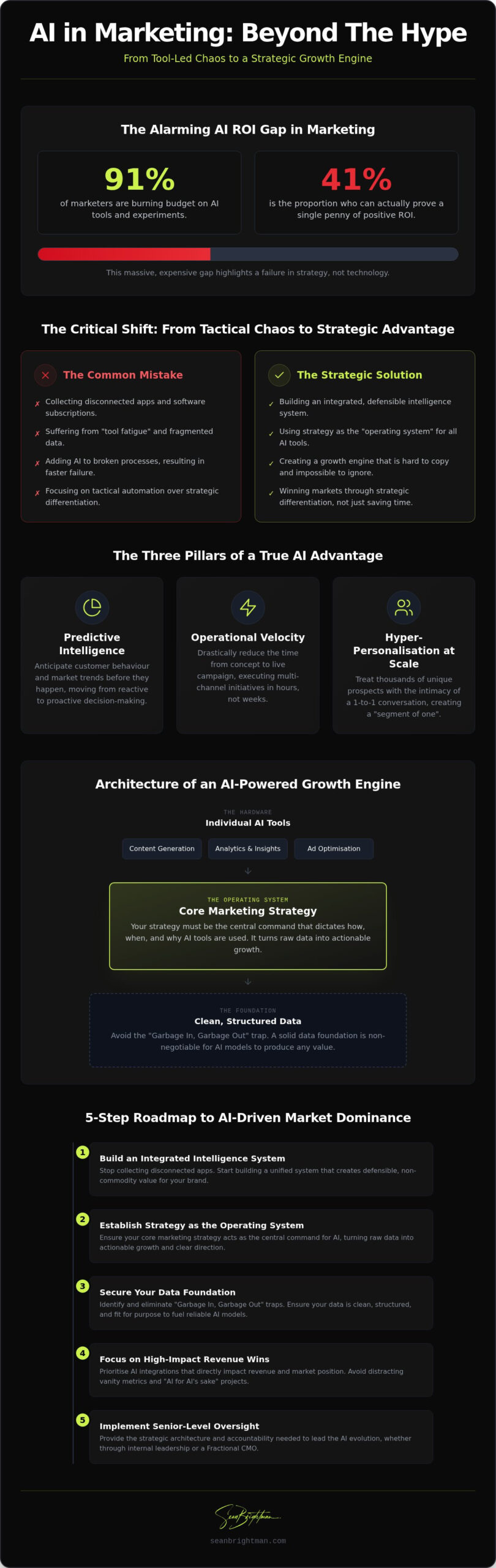
    91% of marketers are currently burning budget on AI, yet only 41% can prove a single penny of ROI. That is a massive, expensive gap. Using ai for competitive advantage in marketing is not about collecting software subscriptions. It is about building a system. Most leaders are drowning in tool fatigue whilst their competitors claim to be moving faster. You feel the pressure to innovate, but you lack the senior strategic direction to make it stick. You want results, not more research projects.

    It is time to stop playing with prompts and start building a growth engine. You need a defensible edge, not a longer list of logins. Strategy, not software. This guide moves beyond the hype to deliver a pragmatic framework for AI integration that actually scales. We will explore how to transition from tool-led chaos to a strategic, intelligence-led marketing system that secures your market position for 2026 and beyond. This is about tactical precision, not abstract theory.

    Key Takeaways

    • Stop collecting disconnected apps and start building an integrated intelligence system that creates defensible, non-commodity value for your brand.
    • Learn why your core marketing strategy must act as the operating system for ai for competitive advantage in marketing, turning raw data into actionable growth.
    • Identify the “Garbage In, Garbage Out” traps that cause most AI implementations to fail and how to ensure your data foundation is actually fit for purpose.
    • Discover a battle-hardened 5-step roadmap to integrate AI into your operations, focusing on high-impact revenue wins rather than distracting vanity metrics.
    • Understand how a Fractional CMO provides the senior-level architecture and accountability needed to lead your AI evolution whilst avoiding the overhead of a full-time hire.

    What is AI for Competitive Advantage in Marketing?

    AI for competitive advantage in marketing is not a collection of ChatGPT prompts. It is the use of machine intelligence to build a defensible, non-commodity market position whilst stripping away operational friction. Most businesses treat AI as a bolt-on. They are wrong. In 2026, the era of experimental AI is dead. We have entered the age of strategic AI. If your AI usage doesn’t create a gap between you and your rivals that they cannot easily close, you are just spending money to stay in the same place.

    Strategic differentiation is the goal. Tactical automation saves time; strategic differentiation wins markets. Artificial intelligence in marketing has evolved from simple algorithms to complex systems that shift the centre of gravity from creative execution to strategic oversight. You aren’t just making content faster. You are making better decisions. With 91% of marketers now using AI, the “early adopter” advantage is gone. Now, the winner is the one with the best architecture.

    The Three Pillars of AI Advantage

    Successful systems rely on three specific mechanics that turn raw technology into a market edge:

    • Predictive Intelligence: You aren’t reacting to trends. You are anticipating customer behaviour before the customer even knows they want to buy.
    • Operational Velocity: This is the machinery of speed. Moving from a raw concept to a live, multi-channel campaign in hours, not weeks.
    • Hyper-Personalisation at Scale: This is the “segment of one.” It is the ability to treat 10,000 unique prospects with the intimacy of a 1-to-1 conversation without hiring 10,000 staff.

    Moving Beyond ‘Tool Fatigue’

    A messy marketing department cannot be fixed with more software. Adding AI to a broken process only results in faster failure. Many leaders suffer from “shiny object syndrome,” buying every new app that promises a silver bullet. This is a tactical error that leads to fragmented data and wasted budget.

    Advantage comes from systems architecture, not individual app subscriptions. You need an engine, not a pile of parts. Stop looking for the next tool. Start looking for the strategic framework that integrates intelligence into your core operations. This is about building a growth engine that is hard to copy and impossible to ignore. It requires senior oversight to ensure your tech stack serves your strategy, not the other way around.

    The Architecture of an AI-Powered Marketing Growth Engine

    Your marketing strategy is the operating system. AI is just the hardware. If your OS is buggy, the hardware is useless. To build a 2026 growth engine, you must stop treating AI as a series of disconnected apps. You need a unified architecture. This starts with a data foundation that AI can actually use to generate value. Most businesses have data siloes that make machine learning models hallucinate or fail. You need clean, structured inputs. Without them, you are just guessing at high speed. Strategy first, tech second.

    Integration must span the entire customer journey. From the moment of discovery to long-term retention, AI should be the connective tissue. It manages the hand-off between awareness and conversion. It predicts churn before it happens. This is how you use the future of AI in marketing to create a seamless, high-velocity experience. Your team must organise around these intelligence-led workflows. Shift their focus from manual execution to strategic oversight. They shouldn’t be writing every individual email; they should be training the engine that writes them.

    Designing Your Marketing Systems Architecture

    Start by mapping your current engine. Identify the friction points where human effort is high but value is low. These are your AI-ready targets. Build a “plug-and-play” infrastructure that allows you to swap out specific AI models as the technology evolves without breaking your entire system. Consistency is non-negotiable. Use generative tools to scale, but keep your brand voice under tight human control. If you need a blueprint for this transition, an AI roadmapping session can provide the tactical clarity you lack.

    AI for Brand Positioning

    AI excels at finding “white space” in crowded markets. It can process thousands of competitor reviews and social signals to find the gaps your rivals missed. Use these insights to refine your Strategic brand roadmapping. This isn’t about gut feeling; it is about data-backed positioning. Validating your value proposition through AI-driven sentiment analysis ensures your message hits the mark every time. This is the core of leveraging ai for competitive advantage in marketing. You aren’t just shouting louder; you are speaking more precisely to a market that is already looking for your solution. Precision is the new scale.

    Strategy vs. Software: Why Most AI Implementations Fail

    AI is a mirror, not a miracle worker. If your marketing data is messy, AI simply multiplies that mess at a speed your team cannot manage. This is the “Garbage In, Garbage Out” reality that most leaders ignore. They expect a tool to fix a broken process. It won’t. In fact, by September 2026, the gap between AI activity and actual accountability has widened, with only 41% of marketers able to prove the ROI of their initiatives. You don’t need more software; you need a better engine.

    Hiring an agency to “do AI” for you is a tactical mistake. Agencies are built for execution, not for re-architecting your business model. When you outsource your AI strategy, you outsource your core intelligence. This leads directly to the commoditisation trap. If you use the same tools as your competitors to produce the same type of content, you end up looking exactly like them. You become a commodity. To use ai for competitive advantage in marketing, you must own the roadmap and the senior accountability that comes with it. Someone in the boardroom must own the machine.

    The Difference Between Tools and Strategy

    Tools are tactical; strategy is direction. A tool tells you how to automate a task, but strategy tells you why that task matters to your bottom line. Buying a ChatGPT Plus subscription is an expense, but building an AI marketing roadmap is an investment in a defensible asset. Stop focusing on becoming a “content factory” that churns out 42% more volume just because the technology allows it. Focus on building a growth engine that uses intelligence to find higher-quality leads and convert them faster. Strategy is the operating system; the tools are just the peripherals.

    Common Pitfalls for UK Scale-ups

    Many businesses over-invest in execution tools before they have defined their strategic goals. This is a recipe for tool fatigue and wasted budget. Avoid these common errors:

    • Staff Stagnation: Failing to train your team on AI-first behaviour. Using AI tools does not inherently make a marketer more skilful; judgment is still the primary value.
    • Regulatory Blindness: Ignoring the legal implications of 2026. With the EU AI Act transparency rules and FTC penalties of up to $53,088 per violation for undisclosed AI content, “moving fast” can be expensive.
    • The Trust Gap: 74% of new webpages now include AI-generated content, but consumer comfort with AI-using brands is dropping. If you sacrifice trust for volume, you lose the market.
    AI for Competitive Advantage in Marketing: Building Your 2026 Growth Engine

    The 5-Step Roadmap to AI-Driven Market Dominance

    Market leadership is not accidental. It is engineered. To achieve ai for competitive advantage in marketing, you need a battle-hardened framework that moves from theory to revenue. Most organisations stall because they treat AI as a series of disconnected experiments. You must treat it as a factory. This roadmap is designed to strip away the fluff and build a system that delivers a genuine market edge whilst your competitors are still struggling with their logins.

    Step 1: The Strategic Audit

    You cannot build on a swamp. You need a marketing operations consultant style audit of your existing tech stack and workflows. Identify exactly where human effort is being wasted on low-value repetition. Benchmark your current efficiency against 2026 industry standards. This isn’t about finding tools you like; it is about identifying the friction points where AI can reduce costs or increase output immediately. If a tool doesn’t move the needle, it doesn’t stay.

    Step 2: Defining the AI Growth Engine

    Do not try to automate everything at once. Select two or three core use cases that will drive a measurable gap between you and your rivals. Create a clear ROI framework for each initiative. Every AI project must align with your overall business exit or growth targets. If you are aiming for the 22% higher ROI typical of AI-driven campaigns, your engine must be specifically tuned for that outcome. This is about revenue, not vanity metrics. Precision beats volume every single time.

    Step 3: Implementation and Accountability

    Execution is where most plans die. You must roll out your AI tools whilst maintaining strict brand guidelines to avoid the trust erosion seen across the market. Use an Advisory Retainer to ensure the roadmap stays on track and your team remains accountable. Accountability is the lubricant that keeps your growth engine running. It ensures that “moving fast” doesn’t mean “moving recklessly.”

    The final stages of the roadmap involve scaling your validated workflows across the entire organisation and continuously optimising for strategic velocity. This is how you move from a pilot project to a total market takeover. You don’t just use AI; you become an AI-first marketing operation. Ready to stop guessing and start winning? Book an AI roadmapping session to build your defensible growth engine today.

    Scaling Intelligence: The Fractional CMO’s Role in Your AI Evolution

    AI is a force multiplier, but it requires a hand on the throttle. You don’t need a technician to lead your transformation; you need a strategist who understands the machinery of growth. To achieve ai for competitive advantage in marketing, senior-level direction is mandatory. However, most scale-ups cannot justify the £150k+ overhead of a full-time hire who spends half their day in internal meetings. You need high-impact intervention, not a permanent seat in the office. A Fractional CMO acts as the architect of your intelligence system, building a legacy of structured data and automated workflows that increases your business valuation.

    Leadership Without the Overhead

    The “Fractional Revolution” is here because it delivers senior-level AI consulting at a fraction of the cost. Hiring a fractional CMO gives you access to a battle-hardened expert who has seen these systems fail and knows exactly how to make them succeed. This is the role of the “straight-shooting strategist.” Whilst internal teams are often bogged down by legacy processes and a fear of being replaced by algorithms, an external strategist cuts through the noise. They provide the accountability that internal teams often lack. They don’t care about internal politics; they care about the velocity of the growth engine. It is about tactical precision, not corporate politeness.

    The 90-Day AI Transformation

    A clinical growth machine is built in ninety days, not nine months. In the first three months of an AI-led strategy, the focus shifts from experimental chaos to operational order. You move from a messy marketing department to a streamlined operation where every intelligence tool serves a documented, revenue-driving purpose. This transformation directly impacts your business valuation. In 2026, investors and buyers don’t just look at your current revenue; they look at the defensibility of your systems. A business powered by a proprietary, intelligence-led architecture is worth significantly more than one relying on manual, non-scalable labour. You are building a defensible asset, not just a marketing department. This is how you prepare for a high-value exit whilst securing ai for competitive advantage in marketing today. Structure creates value. Speed creates dominance.

    Build Your 2026 Growth Engine Today

    The gap between the leaders and the laggards is widening. Using ai for competitive advantage in marketing isn’t about the size of your tech stack; it’s about the precision of your architecture. You’ve seen the roadmap. You understand that strategy must be the operating system for your intelligence. Now, you have a choice. You can continue drowning in tool fatigue, or you can build a defensible system that rivals cannot copy. Success requires movement.

    Advantage comes from senior accountability and a clinical focus on revenue. Stop treating AI as a side project and start treating it as your core infrastructure. Through direct strategic advisory and battle-hardened expertise, you can strip away the corporate fluff and move from experimental chaos to a high-velocity growth machine. The technology is ready. The question is whether your leadership is prepared to execute.

    Stop playing with tools and start building your growth engine—book an AI roadmapping session today.

    The market waits for no one. Start building your future now.

    Frequently Asked Questions

    How can AI provide a competitive advantage in a crowded market?

    AI creates a gap by automating the mundane and supercharging the strategic. It allows for hyper-personalisation at a scale that manual teams cannot match. By using ai for competitive advantage in marketing, you move from reactive tactics to predictive intelligence. You aren’t just shouting louder; you are speaking more precisely. This creates a defensible position that rivals, who are likely just using AI for basic content generation, cannot replicate.

    What are the biggest risks of using AI in marketing strategy?

    The primary risk is the “Garbage In, Garbage Out” trap. If your data foundation is messy, your AI outputs will be flawed. There are also significant legal risks in 2026, such as FTC penalties of up to $53,088 per violation for undisclosed AI content and new EU transparency rules. Relying on tools without senior strategic oversight leads to brand commoditisation. You end up sounding like everyone else whilst potentially alienating customers.

    Do I need a large budget to start using AI for marketing?

    No, you need a strategy, not a massive war chest. Many high-impact AI tools operate on hybrid or usage-based pricing models that scale with your business. The real cost isn’t the software; it’s the wasted time spent on tools that don’t serve a clear purpose. A focused roadmapping session can identify the 20% of AI initiatives that will drive 80% of your revenue growth. Start small, validate the ROI, and then scale.

    How does a Fractional CMO help with AI implementation?

    A Fractional CMO acts as the architect of your growth engine. They provide the senior leadership and accountability required to integrate AI into your core operations without the £150k+ overhead of a full-time hire. They cut through the hype to identify which technologies actually drive market share. By focusing on strategic advisory, they ensure your team stays focused on high-value tasks whilst the machine handles the heavy lifting and repetition.

    What is the difference between AI automation and AI strategy?

    Automation is about doing things faster; strategy is about doing the right things. Automation might help you publish 42% more content each month, but without strategy, that content might not convert. Strategy defines the “why” and the “how” of your system. It ensures that every tool in your stack is working toward a specific business goal. Automation is the engine, but strategy is the GPS that ensures you don’t drive off a cliff.

    Can AI help with brand positioning and messaging?

    Absolutely. AI excels at processing vast amounts of competitor data and customer sentiment to find “white space” in the market. It can validate your value proposition against thousands of social signals in minutes. This data-backed approach removes the guesswork from your strategic brand roadmapping. You can refine your messaging to hit exactly what the market is missing, giving you a sharp, defensible edge that gut feeling alone cannot produce.

    How long does it take to see results from an AI marketing roadmap?

    Expect to see operational shifts within the first 30 days and measurable revenue impact within 90 days. A clinical 90-day transformation moves your department from tool-led chaos to a structured growth machine. Initial wins usually come from stripping away friction in your content and lead-generation workflows. Once these systems are validated, the compounding effect of scaled intelligence begins to drive significant market dominance and increased business valuation.

    Is AI only for large enterprises, or can SMEs benefit too?

    SMEs actually have the most to gain from ai for competitive advantage in marketing. Large enterprises are often bogged down by bureaucracy and legacy tech that makes AI integration slow and painful. SMEs are agile. They can implement a strategic roadmap and pivot their workflows in weeks. Machine intelligence levels the playing field, allowing smaller teams to produce the output and impact of a much larger organisation without the massive headcount.

  • Fractional CMO for AI Integration: Building Your 2026 Growth Engine

    Fractional CMO for AI Integration: Building Your 2026 Growth Engine

    Your current AI tech stack isn’t a strategy. It’s a graveyard of expensive subscriptions and half-baked automations that solve nothing. Most businesses are currently drowning in tool fatigue, throwing money at ‘revolutionary’ software whilst their actual growth remains stagnant. Securing a fractional cmo for ai integration is the only way to turn this chaotic noise into a high-precision growth engine.

    It’s a common frustration. You know AI is the future of your industry, yet you lack the senior leadership to actually organise the machinery into a functional system. This is about building a scalable architecture, not just buying more shiny objects. You need to stop the wasteful spending and start building for 2026.

    In this article, you’ll learn how to architect a clear marketing system that drives efficiency and reduces costs. We’ll explore the transition from tool-led distraction to strategy-led execution. You’ll see how senior-level accountability turns AI from a cost centre into a high-impact growth driver.

    Key Takeaways

    • Bridge the ‘AI Integration Gap’ by prioritising strategic systems architecture over the endless cycle of software subscriptions.
    • Discover how a fractional cmo for ai integration builds a scalable growth engine that turns tool fatigue into measurable profit.
    • Learn to distinguish between agency-led execution and senior strategic leadership to avoid the common pitfalls of the AI minefield.
    • Implement a 90-day roadmap that moves your marketing from operational chaos to a high-efficiency, AI-powered reality.
    • Secure senior-level accountability and strategic velocity without the burden of a £150k full-time executive salary.

    The AI Integration Gap: Why Tools Aren’t a Strategy

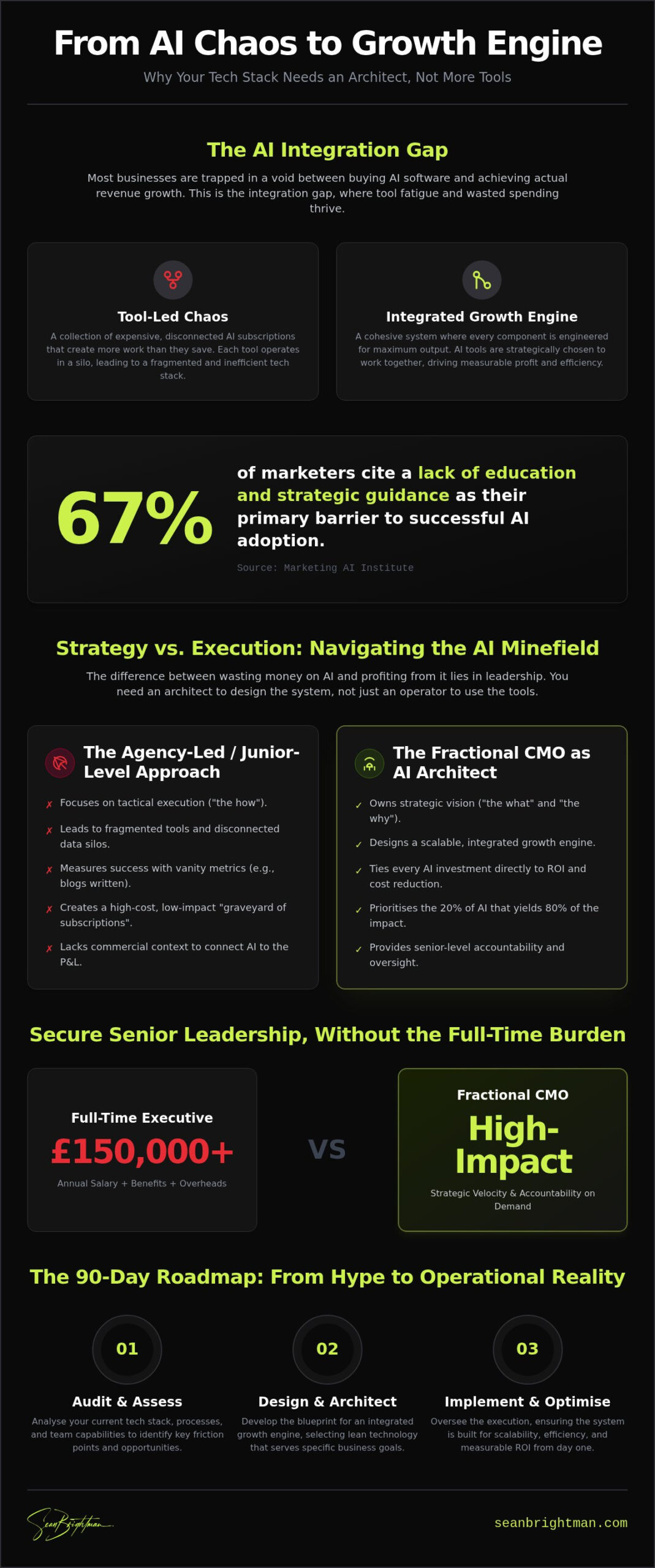
    Buying a tool is easy. Extracting ROI is where most businesses fail. This void is the AI Integration Gap. It’s the distance between your latest software subscription and actual revenue growth. Right now, your marketing department is likely a collection of disconnected silos. You have a CRM that doesn’t talk to your content tool, and a team that uses AI to draft emails but has no idea how it impacts the customer journey.

    According to the Marketing AI Institute, 67% of marketers cite a lack of education as their primary barrier to AI adoption. They aren’t lazy. They’re unguided. A ChatGPT Plus subscription is not a marketing strategy. It’s a tactical band-aid. True growth requires a fractional cmo for ai integration to treat marketing as a singular, cohesive machine. We call this the Growth Engine. It’s a system where every component, from lead gen to retention, is engineered for maximum output with minimum friction.

    The Tool Fatigue Trap

    SMEs are currently haemorrhaging cash on redundant AI subscriptions. Every department head buys a different “game-changer” tool, leading to a fragmented tech stack that creates more work than it saves. There’s a massive difference between playing with AI and integrating it. Playing is asking a bot to write a blog post. Integrating is hardwiring AI into your lead qualification process to double your conversion rate. Tool fatigue is the inevitable result of tactical execution without strategic architecture.

    The Need for Senior AI Oversight

    You cannot expect a junior executive to architect your entire AI infrastructure. They lack the commercial context to see how a prompt affects the P&L. Without senior oversight, you risk brand dilution and massive compliance failures. The foundational role of a Chief Marketing Officer is to provide high-level vision and strategic alignment, ensuring that technology serves the business goals rather than the other way around.

    A fractional cmo for ai integration acts as the “adult in the room” for tech adoption. They ensure that every piece of software serves the bottom line. They bring order to the chaos. This isn’t about being a consultant who drops a report and leaves. It’s about senior-level accountability that ensures your AI investments actually pay off. You need a leader who knows how to strip away the fluff and focus on the mechanics of growth.

    The Fractional CMO as AI Architect: Building Your Growth Engine

    A builder doesn’t start by buying a truckload of bricks. They start with a blueprint. Most marketing leaders are currently doing the opposite. They buy the bricks (the tools) and hope a house appears. A fractional cmo acts as your architect. They design the system before a single subscription is authorised. This mindset shift is the difference between a messy department and a high-impact growth engine.

    AI is only as good as the infrastructure it sits on. If your data is siloed and your processes are broken, AI will only help you fail faster. Top-performing leaders are succeeding in the AI era by focusing on insights and enterprise-wide integration rather than just task automation. You don’t need more tasks. You need a fractional cmo for ai integration who treats data as the fuel for your growth engine. It’s a binary choice: you either build a scalable machine or you continue managing a collection of expensive accidents.

    Designing the AI-Powered Marketing Stack

    Building a stack isn’t about following trends. It’s about mapping the customer journey to specific AI intervention points. Where does the friction exist? Where can AI reduce the time-to-value? A strategic architect selects tools based on interoperability. If your tools don’t talk to each other, they aren’t part of an engine; they’re just noise. We prioritise efficiency by identifying the 20% of AI applications that deliver 80% of the commercial impact. This ensures your tech stack remains lean, integrated, and focused on revenue.

    Accountability and Leadership

    Leadership in 2026 is about owning the “What” and the “Why”. Anyone can figure out the “How” with a YouTube tutorial. A fractional cmo for ai integration provides the senior-level accountability that CEOs actually care about. Instead of vanity metrics like “number of AI-generated emails,” we set KPIs tied to strategic velocity and cost reduction. The plug-and-play nature of this role means you get high-impact leadership without the £150k overhead. It’s about bringing order to internal complexity through a battle-hardened perspective. If you’re ready to stop guessing and start building, a marketing strategy audit is the logical first step.

    Strategy vs Execution: Navigating the AI Minefield

    Execution is a commodity. Strategy is the moat. Right now, most businesses are mistaking AI-generated output for marketing progress. It isn’t. It’s just noise. A fractional cmo for ai integration ensures that your technology serves a specific commercial objective rather than just populating a spreadsheet. You need a leader who understands that more activity does not equal more growth. This is the “this, not that” reality of 2026: you need a system that thinks, not just a system that does.

    The numbers don’t lie. Hiring a full-time senior executive is often a £120k mistake. You end up paying for forty hours of “management” when you actually only need ten hours of high-octane strategic architecture. It is a waste of capital. Fractional efficiency gives you the same battle-hardened expertise focused purely on the high-value tasks that AI cannot touch: vision, empathy, and complex problem-solving. It’s about buying the brain, not the body.

    The Agency Trap

    Most agencies are currently in a defensive crouch. Their business model relies on billable hours and manual execution. AI threatens to slash those hours by 80%, which creates a conflict of interest. They will sell you execution because that is what they are built to deliver. A Fractional CMO acts as an unbiased filter for agency performance. They don’t care about billable hours; they care about output. They help you build internal AI capability so you stop being held hostage by external partners who are incentivised to keep things slow and manual.

    Human-Led Brand Positioning

    AI is a world-class mimic, but it is a terrible innovator. It can follow a pattern, but it cannot “feel” your brand’s unique positioning amongst a sea of competitors. It cannot understand the nuance of a founder’s vision or the specific emotional triggers of your target audience. This is where the human strategist becomes indispensable. We use AI to amplify the message, but the message itself must be born from strategic brand roadmapping. This is how you win: use the machine for volume, but keep the human in charge of the value. AI should be the engine, but a human must always be the navigator.

    Fractional CMO for AI Integration: Building Your 2026 Growth Engine

    The 90-Day AI Roadmap: From Hype to Operational Reality

    Most AI strategies are just expensive wish lists. They lack a timeline, a budget, and a pulse. A real roadmap is a tactical sequence designed to strip away inefficiency and replace it with high-precision machinery. Securing a fractional cmo for ai integration provides the strategic velocity needed to move from concept to cashflow in under three months. This isn’t a five-year transformation. It’s a 90-day sprint to operational excellence.

    We follow a clinical five-step process to ensure your investment delivers a measurable return:

    • Step 1: The Marketing Efficiency Audit. We find the hidden profit buried under layers of manual labour.
    • Step 2: Architecture Design. We map the AI growth engine and define the data flows.
    • Step 3: Tool Selection. We consolidate the stack to ensure every component talks to the others.
    • Step 4: Team Upskilling. We build internal capability whilst establishing accountability frameworks.
    • Step 5: Rapid Execution. We launch, measure, and iterate at high speed.

    The Marketing Efficiency Audit

    Efficiency is the foundation of growth. You cannot build a high-performance engine on top of a leaky bucket. The Marketing Efficiency Audit is a clinical assessment of marketing waste. We identify the “busy work” that your team should have automated months ago. We find the leaks in your lead generation funnel where potential revenue is simply evaporating. It’s about stripping the department back to its most functional parts before adding the AI layer. If a task doesn’t contribute to the bottom line, we kill it or automate it.

    Building the Roadmap

    A static plan is a liability in a fast-moving market. You need a dynamic roadmap that evolves as the technology does. This process defines how to organise a marketing department for rapid growth by aligning human talent with machine efficiency. The 90-day vision focuses on immediate ROI, ensuring that every AI implementation justifies its existence within the first quarter. A fractional cmo for ai integration doesn’t just give you a PDF; they give you a functioning system. To start building your own 2026 growth engine, you should book a strategic roadmapping session today.

    Sean Brightman: Senior AI Marketing Leadership on Demand

    Sean Brightman doesn’t do corporate politeness. He builds engines. As a fractional cmo for ai integration, he strips away the fluff to reveal the raw mechanics of growth. You don’t need another consultant with a 50-page slide deck. You need a senior leader who remains active in the field. Sean specialises in “plug-and-play” systems architecture. He enters your business, identifies the friction, and installs the AI machinery required to win in 2026. His published book on marketing strategy serves as the foundational resource for this high-impact, no-nonsense approach.

    The current market is chaotic. Most business owners are drowning in tactical noise whilst their competitors are quietly building automated moats. Sean provides the senior-level authority required to cut through that noise. He isn’t interested in your internal bureaucracy or your favourite vanity metrics. He’s interested in the P&L. This is senior leadership on demand. It’s about high-level thinking combined with visceral, practical execution. It’s the expertise of a £150k executive delivered with fractional efficiency.

    The Advisory Retainer

    Direction is useless without accountability. The Marketing Advisory Retainer is designed for CEOs who are tired of being stuck. It provides a monthly cadence of strategic velocity. No fluff. No pointless updates. Just high-impact direction to ensure your AI strategies are actually moving from the roadmap into operational reality. Sean acts as the external force that brings order to your internal complexity. It’s the “adult in the room” oversight your team needs to stop playing with tools and start driving revenue.

    One-Off Roadmapping Sessions

    Sometimes you just need a reset before a major push. A single strategic roadmapping session provides the clarity that months of internal debate cannot reach. These sessions are perfect for businesses preparing for a major growth phase or positioning themselves for a successful exit. Securing a fractional cmo for ai integration for this session ensures your roadmap isn’t just a wish list. Potential buyers don’t want to buy a collection of tasks; they want to buy a functioning growth engine. By architecting your AI integration today, you create an asset that is scalable and highly covetable. You stop being the bottleneck and start being the owner of a machine.

    Architect Your 2026 Growth Engine Today

    The window for “playing” with AI is closed. You either build a high-precision marketing machine now or you get left behind by those who do. We’ve seen that the gap between tool fatigue and actual ROI is bridged by strategic architecture, not more subscriptions. You need a system that prioritises commercial impact over tactical noise.

    Securing a fractional cmo for ai integration gives you the senior-level accountability required to turn these concepts into operational reality. You get the expertise of a battle-hardened strategist and published author without the £150k+ overhead of a full-time hire. This is about building a functional asset that drives growth whilst reducing wasteful activity.

    Stop managing chaos and start building an engine. It’s time to install the leadership your business deserves to win in the next era of marketing. Book a Strategic AI Roadmapping Session with Sean Brightman and take control of your growth.

    Frequently Asked Questions

    What exactly does a Fractional CMO for AI integration do?

    A fractional cmo for ai integration acts as the architect of your marketing systems. They don’t just recommend tools; they design a cohesive growth engine where AI automates execution whilst humans drive strategy. This role involves auditing your current tech stack, mapping the customer journey to AI intervention points, and providing senior-level accountability. It’s about building a scalable machine that delivers measurable ROI rather than just managing a collection of disconnected software subscriptions.

    How much does a Fractional CMO cost compared to a full-time hire in the UK?

    A full-time CMO in the UK currently commands a salary often exceeding £150,000 per year plus benefits and bonuses. In contrast, a fractional retainer typically costs a fraction of that amount whilst delivering the same senior-level expertise. You pay for high-impact strategic direction rather than forty hours of administrative presence. It’s a binary choice between paying for a full-time body or investing in a battle-hardened brain that focuses purely on growth.

    Can our existing marketing team handle AI integration themselves?

    Most marketing teams lack the senior strategic context to architect a full AI infrastructure. Whilst they can certainly use tools like ChatGPT for specific tasks, they often struggle with interoperability and data consolidation. They are usually focused on execution, not the overarching systems architecture. Without senior oversight, you risk brand dilution and tool fatigue. A fractional leader provides the “adult in the room” perspective needed to ensure technology serves the business goals.

    How long does it take to see results from an AI marketing roadmap?

    You should expect to see measurable operational improvements within 90 days. The initial audit and architecture design happen in the first month, followed by rapid tool integration and team upskilling. By the third month, your growth engine should be operational, reducing manual “busy work” and improving lead generation efficiency. This isn’t a multi-year corporate transformation; it’s a tactical sprint designed to deliver strategic velocity and immediate commercial value to your P&L.

    Is AI integration only for large tech companies or can SMEs benefit?

    SMEs actually stand to benefit the most from AI integration because it levels the playing field. Large corporations are often slowed down by legacy systems and internal bureaucracy. Smaller businesses can move faster, using AI to achieve the output of a much larger team without the associated headcount costs. For an SME, AI is a force multiplier that turns a lean marketing department into a high-powered growth engine through sheer operational efficiency.

    What is the “£120k mistake” in marketing recruitment?

    The “£120k mistake” is hiring a full-time senior executive when you only need ten hours of high-level strategy per week. Most SMEs don’t have enough strategic work to occupy a £150k hire, so that person ends up doing junior-level tasks or creating unnecessary bureaucracy. You end up wasting over £120,000 on “management” that doesn’t drive growth. Fractional leadership solves this by providing the exact amount of senior direction required to win without the bloated overhead.

    Does Sean Brightman work with our existing marketing agency?

    Yes, Sean often acts as an unbiased filter for agency performance. Most agencies are incentivised to protect their billable hours, which can lead to a resistance to AI-driven efficiency. Sean provides the senior oversight to ensure your agency is actually delivering value rather than just billing for manual tasks that should be automated. He holds them accountable to the growth engine’s KPIs, ensuring your external partners align with your strategic 2026 vision.

    How do I know if my business is ready for a Fractional CMO?

    If you are experiencing tool fatigue, wasteful marketing spend, or a lack of clear strategic direction, you are ready. Common signs include a marketing team that is constantly “busy” but failing to hit revenue targets, or a CEO who feels they have to micromanage the marketing department. If you need senior-level accountability but cannot justify a £150k+ salary, a fractional cmo for ai integration is the logical next step for your growth.

  • Complete Guide to Sean Brightman: The Fractional CMO & AI Strategist (2026)

    Complete Guide to Sean Brightman: The Fractional CMO & AI Strategist (2026)

    Your marketing budget is likely a black hole. It swallows capital, produces “brand awareness” fluff, and lacks a shred of accountability. You’ve probably tried to fix the mess with a few AI prompts, but those just created more clutter. This Complete guide to Sean Brightman strips away the corporate politeness to show you how a battle-hardened strategist actually builds a growth engine.

    It’s exhausting to lead a department that feels like a collection of disjointed tactics rather than a calibrated machine. You need results, not reports. You want growth, not more meetings. Sean Brightman doesn’t offer abstract theories; he provides mechanical precision through fractional leadership and AI consulting. You’ll discover how his roadmapping and advisory retainers turn chaotic marketing teams into high-growth assets whilst cutting out the noise.

    We’re moving past the “ChatGPT for everything” hype. This guide previews the exact systems Sean uses to organise brand positioning and integrate practical AI that saves both time and money. He is the plug-and-play partner who brings order to internal complexity. By the end, you’ll understand how to replace bloat with a scalable, documented strategy that finally moves the needle.

    Key Takeaways

    • Stop overpaying for full-time executive overhead and discover why fractional leadership provides the senior-level direction high-growth firms actually require.
    • This complete guide to Sean Brightman details how to build a functional AI-powered growth engine that moves beyond basic prompts into real-world integration.
    • Learn to replace departmental chaos with mechanical precision through a strategic roadmap designed to organise brand positioning and drive accountability.
    • Understand how an advisory retainer provides the external force needed to maintain momentum and fix messy, underperforming marketing departments.
    • Identify the plug-and-play entry points, including “The Book” and roadmapping sessions, that allow you to start scaling without the corporate fluff.

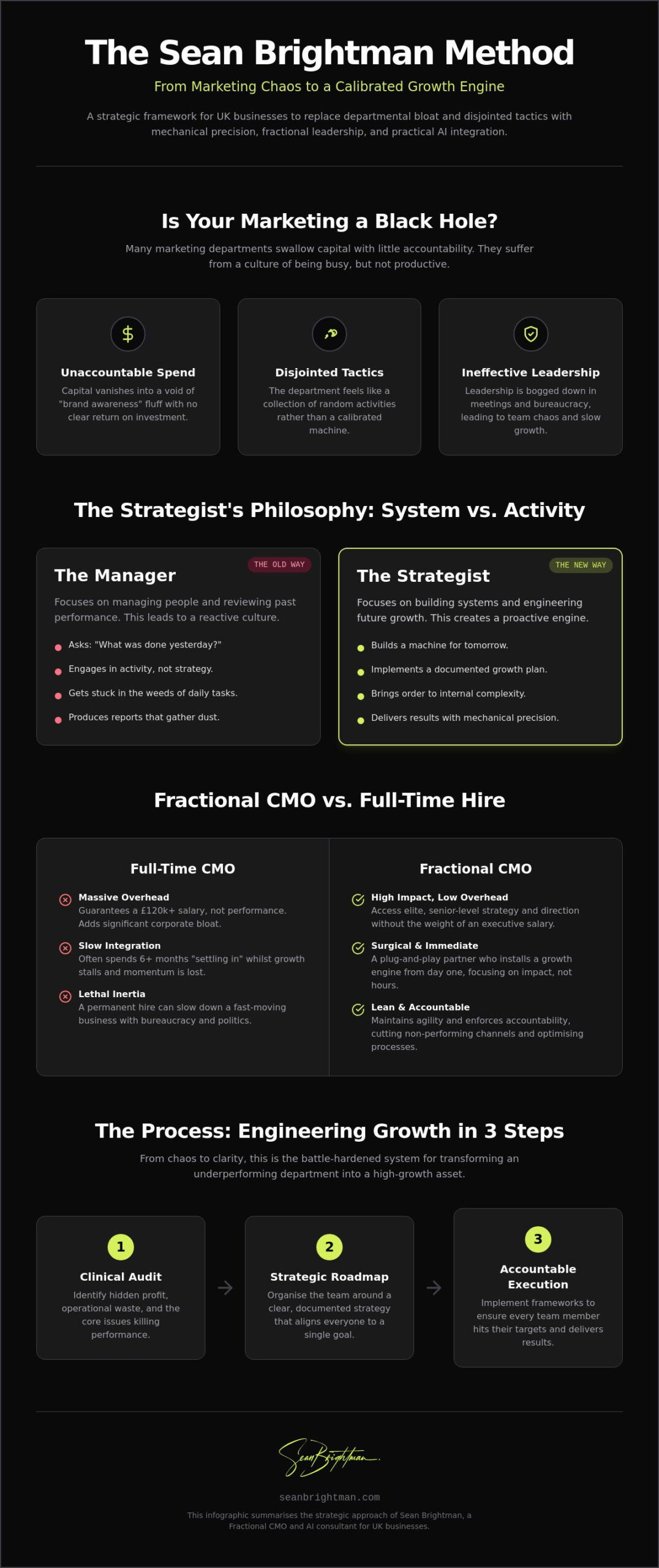
    Who is Sean Brightman? The Strategist Behind the Systems

    If you search for Sean Brightman, you might find a comedian or a corporate suit. This Complete guide to Sean Brightman is about the strategist who fixes broken marketing departments. He is a senior marketing leader and Fractional CMO for UK businesses who prioritises movement over meetings. Whilst traditional consultants deliver 50-page slide decks that gather dust, Sean builds functional systems. He is a battle-hardened expert who has seen every version of a messy department and knows exactly where to apply the pressure to make it grow.

    As a published author, Sean has documented the strategic methodology that high-growth firms rely on. He doesn’t deal in abstract theories. His focus is visceral: brand positioning that cuts through noise, AI integration that actually saves money, and marketing accountability that justifies every penny spent. He is the external force that brings order to internal complexity.

    The Fractional CMO Philosophy

    Sean’s approach is built on high impact and low overhead. Most CEOs think they need a full-time executive to sit in the office and manage the culture. They don’t. They need senior-level direction without the corporate bloat. Sean focuses on building systems, not just managing people. A manager looks at what was done yesterday; a strategist builds a machine for tomorrow.

    This philosophy requires straight-shooting honesty. There is no room for bureaucracy or ego in a high-growth environment. If your current marketing plan is a collection of disjointed tactics, Sean will say so. He strips away the fluff to reveal the core mechanics of your business growth. It’s about building a scalable engine whilst cutting out the noise of traditional consulting.

    The Strategic Advantage for Founders

    Most founders are stuck in the weeds of their own marketing. They’re approving social media posts whilst their brand positioning is invisible. Sean acts as a plug-and-play partner who takes that weight off the CEO’s shoulders. He transforms messy, reactive marketing into a clinical, results-oriented engine. This Complete guide to Sean Brightman highlights why having an active expert in the field is better than a passive advisor.

    The distinction is binary: you are either engaging in strategy or you are just performing activity. Most businesses are busy, but they aren’t strategic. Sean defines the roadmap so the team knows exactly what to execute. It’s about tactical precision. It’s about moving from chaos to a documented growth plan that scales. He provides the accountability that ensures the marketing department finally delivers on its promises.

    The Fractional CMO Model: Leadership Without the £120k Overhead

    Most scale-ups rush to hire a full-time CMO because they believe a high salary guarantees high performance. It doesn’t. Often, it just guarantees a massive overhead and a leader who spends six months “settling in” whilst your growth stalls. This Complete guide to Sean Brightman highlights a more surgical approach: senior-level leadership delivered on a part-time basis. You get the strategic brain of a veteran without the weight of a permanent executive salary.

    Sean focuses on building marketing systems that function like a calibrated machine. This isn’t about filling a seat; it’s about installing a growth engine. Fractional leadership allows high-growth firms to access elite strategy whilst remaining lean. It is about impact, not hours. It is about results, not recruitment fees.

    Fixing the Messy Marketing Department

    Messy marketing departments are profit killers. They lack a documented strategy and suffer from a “busy but unproductive” culture. Sean’s process starts with a clinical audit to identify hidden profit and operational waste. He organises the team around a clear, documented strategy that everyone understands. No more guessing. No more disjointed tactics.

    Accountability is the backbone of this model. Sean implements frameworks that ensure every team member knows their targets and the mechanics required to hit them. If a channel isn’t performing, it’s cut. If a process is slow, it’s optimised. This level of oversight turns a chaotic cost centre into a high-growth asset. It’s the difference between hoping for growth and engineering it.

    Fractional CMO vs. Full-Time: The Brutal Reality

    The inertia of a permanent hire can be lethal for a fast-moving business. Full-time executives often become bogged down in internal politics and bureaucracy. In contrast, a fractional leader maintains an external perspective and an urgent focus on delivery. You should stop hiring full-time CMOs if you want agility and senior-level advisory without the £120k+ price tag.

    Recruitment agency fees alone can cost more than a three-month fractional engagement. Why pay a headhunter when you can plug in a battle-hardened expert immediately? This Complete guide to Sean Brightman shows that the fractional revolution is about efficiency. It provides the high-level direction you need to scale without the corporate fluff that slows you down. If your department feels stuck, it might be time to review your leadership structure and consider a more tactical approach.

    AI Consulting: Building Practical Growth Engines

    Most founders are currently playing with tools whilst their competitors are building machinery. AI consulting isn’t about finding the newest app or writing better prompts. It’s about executing a real strategy that actually moves the needle. This Complete guide to Sean Brightman focuses on the transition from curiosity to capability. You don’t need more software; you need a system that works.

    An AI-powered growth engine is a functional component of your business. It isn’t a side project or a hobby for your marketing team. It’s an integrated system that improves marketing efficiency and increases output density. Sean cuts through the noise of AI hype to deliver practical integration that saves time and capital. He builds the infrastructure so your team can focus on high-level strategy rather than repetitive manual labour. This is the shift from “playing with AI” to “profiting from AI.”

    The AI Roadmapping Session

    A one-off AI strategy session is the antidote to departmental confusion. It provides a clinical look at your current operations to identify high-leverage areas for automation and augmentation. You don’t need AI implemented in every corner of your office. You need it where it creates the most force. Sean identifies these pressure points and maps out a clear direction for your marketing systems. This roadmap ensures that every technical implementation serves a specific business goal. It’s about strategic intent, not just technical novelty. You leave the session with a documented plan to turn abstract AI potential into a functional growth asset.

    From Tools to Machinery

    Your business needs an AI architecture, not just a ChatGPT subscription. Individual tools are useful, but they don’t scale. Sean demystified complex technical concepts for CEOs who have no time for jargon or fluff. He translates technical capabilities into functional business outcomes. He doesn’t just suggest tools; he helps you build the machinery that connects them. This Complete guide to Sean Brightman highlights how his approach removes the ego from technology. The goal is simple: doing more with less whilst maintaining high-level output. By integrating AI into the core of your marketing, you create a system that doesn’t rely on brute force or bloated headcounts. It’s about mechanical precision and tactical advantage in a market that is increasingly crowded and noisy.

    Complete Guide to Sean Brightman: The Fractional CMO & AI Strategist (2026)

    Strategic Roadmapping and the Advisory Retainer

    Marketing failure usually stems from a lack of clarity. Your department is likely a collection of expensive guesses and disjointed tactics. This Complete guide to Sean Brightman outlines the process of moving from that chaos to a structured growth plan. A roadmap provides clinical resolution to internal complexity. It isn’t a suggestion; it’s an instruction manual for growth. You need a battle-hardened external force to challenge the status quo and strip away the corporate politeness that hides inefficiency.

    The Advisory Retainer is the tool for ongoing direction. Whilst most consultants want to talk about brand vibes, Sean focuses on the mechanical precision of execution. He provides the accountability that internal teams often lack. It’s easy to get distracted by the next shiny object. It’s harder to stick to a calibrated strategy that actually moves the needle. This section explains how Sean’s structured approach turns abstract goals into functional outcomes.

    The 90-Day Strategy Roadmap

    Sean’s 90-day roadmap is a functional blueprint for your marketing engine. It breaks down into three distinct phases:

    • The Efficiency Audit: We identify where your budget is being set on fire. This phase is about finding hidden profit and cutting out operational waste.
    • Brand Positioning: We define your value through contrast. This is a binary “this, not that” exercise. If your brand is for everyone, it’s for no one.
    • Mechanical Systems: We build the framework for execution. This ensures the team knows exactly what to do and how to measure success.

    By the end of the 90 days, your marketing is no longer a mystery. It’s a documented system. You move from reactive activity to strategic movement.

    Monthly Advisory: Direction and Accountability

    A roadmap is useless if it sits in a drawer. The Advisory Retainer ensures your marketing strategies are actually executed. Sean acts as a sharp-minded partner for the CEO, providing high-level briefings without the ceremony of traditional consulting. He doesn’t join your internal politics; he provides an external force that keeps the team focused on results. It’s about maintaining momentum and fixing messy departments before they stall your growth.

    This Complete guide to Sean Brightman highlights the importance of this ongoing partnership. The CEO gets a plug-and-play strategist who understands the difference between being busy and being productive. There is no ego, no fluff, and no patience for bureaucracy. You get a clinical look at your data and a clear set of tactical moves for the month ahead. If you’re ready to stop guessing and start engineering growth, you can book a roadmapping session to begin the transition.

    How to Engage: The Book, The Roadmap, and The Retainer

    Engagement is about momentum, not bureaucracy. This Complete guide to Sean Brightman has detailed the “why” and the “what” of fractional leadership. Now, we address the “how”. You don’t need a six-month procurement cycle to start fixing your marketing. Sean’s model is designed for speed and tactical impact. Whether you are self-implementing or require senior-level direction, there is a clear entry point. Broken systems don’t fix themselves; they just get more expensive over time. Every day you spend without a documented strategy is a day your budget is being wasted on disjointed tactics. It is a binary choice: you either have a growth engine or you have a cost centre.

    Educational Resources: The Book

    Before you commit to a full advisory retainer, you can access the core strategic methodology. “The Book” serves as a visceral manual for brand positioning and AI integration. It isn’t a collection of abstract theories or corporate buzzwords. It is a practical, get-your-hands-dirty guide to building the growth engines discussed earlier. You’ll learn how to organise your department whilst cutting out the noise that slows down most UK scale-ups. It is the perfect starting point for CEOs who want to understand the mechanics of output density before they plug in a strategist. You can find it on Amazon or order it direct to get a head start on your strategic transformation. It provides the clarity you need to stop playing with tools and start building machinery.

    Taking the First Step

    If you’re stuck in the weeds of daily execution, you need a clinical resolution. Booking a strategic roadmap session is the fastest way to get unstuck in 90 days. We don’t start with a year-long contract and a bloated proposal. We start with a surgical audit of your current efficiency and a clear plan for your brand positioning. This session allows you to evaluate the fit for a Fractional CMO retainer without a massive upfront commitment. It’s about movement. It’s about results. It’s about proving the value of fractional leadership in a concentrated timeframe. We identify the hidden profit in your current setup and build the systems to extract it.

    The transition from chaos to a scalable engine requires a decisive leader who isn’t afraid to be blunt. You can continue to tolerate messy marketing and bloated budgets, or you can choose mechanical precision. The Complete guide to Sean Brightman concludes with a simple choice: maintain the status quo or build a machine that scales. Don’t wait for the next quarterly slump or a failed campaign to address your leadership gap. The cost of inaction is always higher than the cost of strategy. Work with Sean Brightman to build your growth engine and finally bring accountability to your marketing department.

    Engineer Your Marketing Growth Engine

    Marketing is either a calibrated growth engine or a bloated cost centre. There is no middle ground. You’ve seen how fractional leadership removes the executive overhead whilst delivering senior-level precision. You understand that AI integration is a functional component of your business machinery, not just a toy for basic prompts. This Complete guide to Sean Brightman has mapped the clinical route from departmental chaos to documented accountability. It’s about movement, not meetings.

    Sean Brightman is the battle-hardened strategist high-growth UK firms trust to fix messy departments. As the author of the definitive marketing strategy guide and an expert in AI-powered marketing systems, he provides the external force required to challenge your status quo. Stop guessing. Start engineering. It’s time to replace corporate fluff with tactical movement and a roadmap that actually scales. Your marketing department doesn’t need more activity; it needs a strategy that moves the needle whilst you focus on leading.

    Build your AI-powered growth engine with Sean Brightman today and take control of your results. Your business is ready for the next level of mechanical precision. Let’s build the machine together.

    Frequently Asked Questions

    Who is Sean Brightman in the marketing world?

    Sean Brightman is a senior marketing leader and Fractional CMO specialising in high-growth UK firms. He is a battle-hardened strategist who builds functional marketing systems rather than just managing people. As a published author, he has documented the strategic methodology that turns chaotic departments into high-performing growth engines. He is the external force CEOs hire when they need blunt honesty and tactical precision.

    What is a Fractional CMO and do I need one?

    A Fractional CMO provides senior-level strategic direction on a part-time basis. You need one if your marketing department feels messy, lacks a documented strategy, or has a bloated budget with zero accountability. It is the tactical alternative to hiring a full-time executive with a £120k overhead. You get the strategic brain of a veteran whilst maintaining the agility of a lean operation.

    How does Sean Brightman’s AI consulting differ from other firms?

    Sean focuses on building machinery, not just playing with tools. Most firms suggest a few prompts or a ChatGPT subscription; Sean integrates AI as a functional component of your business architecture. This Complete guide to Sean Brightman highlights how he demystifies technical concepts to create practical growth engines. It’s about increasing output density and efficiency, not chasing the latest technical hype.

    What is included in a Strategic Marketing Roadmap?

    A Strategic Marketing Roadmap is a 90-day blueprint that moves your business from chaos to order. It includes a clinical efficiency audit to find hidden profit, a “this, not that” brand positioning exercise, and the construction of mechanical execution systems. You get a documented plan that ensures every team member knows exactly what to do. It replaces disjointed tactics with a calibrated growth engine.

    How much does a Fractional CMO retainer cost?

    Retainer costs depend on the specific scale and requirements of your business. This model is designed to be a high-impact investment that avoids the recruitment fees and massive overheads of a permanent hire. Every engagement is bespoke to ensure maximum force is applied to your specific growth levers. You should contact Sean directly to discuss a structure that fits your current operational needs.

    Can Sean Brightman help with brand positioning for my UK scale-up?

    Yes, brand positioning is a core pillar of Sean’s strategic methodology. He helps founders define their value through contrast, ensuring their brand cuts through the noise of a crowded market. If your positioning is vague, your marketing will fail. Sean strips away the corporate fluff to reveal a sharp, decisive message that resonates with your target audience and drives movement.

    Is Sean Brightman the same person as the comedian?

    No, he is not. This Complete guide to Sean Brightman focuses exclusively on the business strategist, author, and AI consultant. Whilst there is a comedian with the same name, this Sean Brightman builds marketing systems for high-growth firms. He prioritises results and mechanical precision over entertainment. If you need to fix a broken marketing department, you’ve found the right person.

    How do I book an AI roadmapping session?

    You can book an AI roadmapping session directly through Sean’s website to get started immediately. This session is the fastest way to identify high-leverage areas for automation and augmentation within your business. It provides a clinical look at your operations and a clear set of tactical moves for the next 90 days. Stop guessing and start engineering your growth by securing a session today.