
Tag: arr growth

  • Marketing Attribution for B2B SaaS: 2026 Executive Guide

    Marketing Attribution for B2B SaaS: 2026 Executive Guide

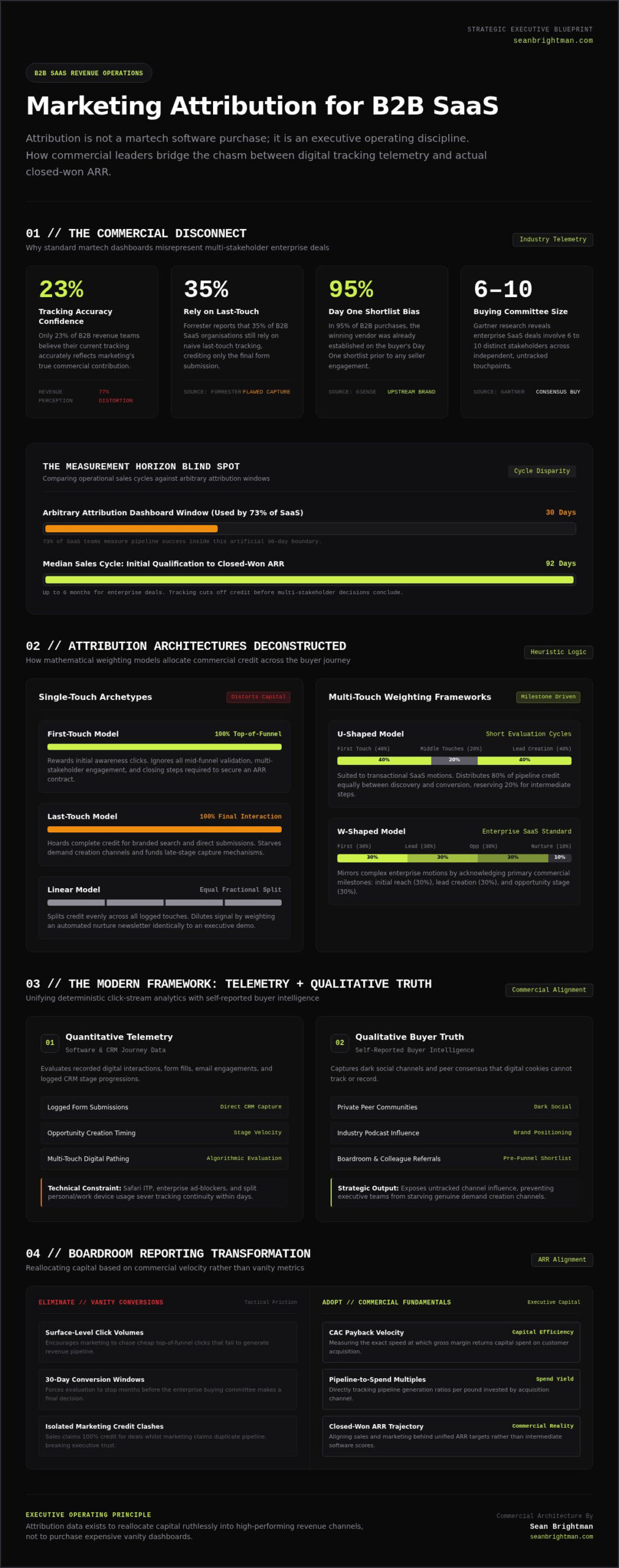
    Attribution is not a martech purchase; it is an executive operating discipline. Yet research shows that only 23% of B2B revenue teams believe their tracking accurately reflects marketing’s true commercial contribution. If you are wrestling with marketing attribution for b2b saas across a protracted buying cycle, buying another software tool will not fix your pipeline blind spots.

    You already know the internal friction. Your board demands ruthless CAC payback transparency, whilst marketing presents surface-level click volume and sales claims sole credit for every inbound contract. When an enterprise purchase involves six to ten decision-makers navigating a six-month sales cycle, basic dashboards end up claiming 100% credit for deals that were closing anyway.

    You do not need more software bloat. You need a pragmatic system that connects marketing spend directly to qualified pipeline and closed-won ARR. In this guide, you will discover how to select the right attribution framework for your specific ARR stage, cut wasted channel spend through clean data visibility, and establish undeniable commercial alignment between sales and marketing.

    Key Takeaways

    • Single-touch tracking models distort commercial reality by over-crediting surface interactions across multi-stakeholder enterprise deals.
    • Effective marketing attribution for b2b saas pairs quantitative telemetry with qualitative, self-reported buyer insights to expose dark social influence.
    • Match your attribution architecture strictly to your ARR maturity rather than deploying complex, over-engineered software stacks prematurely.
    • Shift board reporting away from vanity conversion volumes toward commercial fundamentals like CAC payback velocity and pipeline-to-spend multiples.
    • Treat attribution data as an executive decision framework designed to reallocate capital ruthlessly into high-performing revenue channels.

    Why Traditional Marketing Attribution Fails B2B SaaS

    Most attribution frameworks treat enterprise software procurement like a direct-to-consumer checkout. That premise is broken. Applying transactional tracking logic to marketing attribution for b2b saas creates expensive blind spots, skewing capital toward bottom-of-funnel capture whilst starving genuine demand generation.

    According to Forrester, 35% of B2B SaaS organisations still rely on last-touch attribution. Even worse, 73% measure pipeline success within an arbitrary 30-day window, despite the median sales cycle running 92 days from initial qualification to closed-won ARR. When standard software tracking attempts to evaluate commercial influence, it credits the final form submission rather than the months of upstream positioning that created the buyer’s intent. Understanding the mathematical limitations of both single-touch and multi-touch attribution models prevents your leadership team from mistaking digital activity for commercial momentum.

    The Reality of Modern B2B Buying Committees

    Enterprise SaaS deals are committee decisions, not individual impulses. Gartner research indicates that the average enterprise purchase involves six to ten distinct stakeholders, each conducting self-directed research across independent touchpoints.

    These buyers do not click neat tracking links in sequence. They evaluate solutions in private peer communities, listen to industry podcasts, and compare operational notes long before speaking to sales. Research from 6sense reveals that in 95% of B2B purchases, the winning vendor was already established on the buyer’s Day One shortlist before any direct seller engagement began. A standard analytics cookie cannot track boardroom consensus.

    The Death of Cookie-Based Linear Tracking

    Client-side tracking is crumbling under modern technical constraints. Safari’s Intelligent Tracking Prevention, enterprise ad blockers, and split personal-work device usage sever tracking continuity within days.

    When linear tracking fails, revenue teams default to funding what remains measurable: paid brand search and late-stage retargeting. This creates a dangerous feedback loop. Attribution software claims complete credit for prospects who were already navigating directly to your domain, whilst the channels building genuine market awareness receive zero capital. The business ends up buying expensive vanity dashboards instead of driving incremental ARR.

    Core Attribution Models Deconstructed: Choosing Your Approach

    Every attribution model forces a specific mathematical bias onto your commercial strategy. That bias directly dictates where marketing leadership allocates capital. Pick the wrong model, and you incentivise your team to chase low-value activities that fail to generate revenue.

    First-touch attribution rewards top-of-funnel reach. It assigns complete revenue credit to initial awareness clicks, ignoring the complex mid-funnel education required to sign a contract. Last-touch does the exact opposite. It hoards credit for branded search queries and direct submissions, starving foundational brand work. Neither framework works for complex sales cycles. Getting marketing attribution for b2b saas right requires understanding how multi-touch architectures weight pipeline influence across an established customer journey mapping framework.

    Linear, U-Shaped, and W-Shaped Frameworks

    Heuristic multi-touch models use rule-based logic to distribute pipeline credit across recorded buyer touchpoints. Each framework reflects a fundamentally different go-to-market philosophy:

    • Linear: Splits fractional credit evenly across every logged touchpoint. It sounds fair on paper, but it dilutes signal by treating an automated nurture email the same as an in-depth product demo.
    • U-Shaped: Allocates 40% of credit to first touch, 40% to lead creation, and splits the remaining 20% across intermediate interactions. It suits transactional sales motions with brief evaluation phases.
    • W-Shaped: Dedicates 30% each to first touch, lead conversion, and opportunity creation, reserving the final 10% for nurturing steps. This model mirrors complex enterprise motions far better by acknowledging key pipeline milestones.

    Algorithmic and Full-Path Machine Learning Attribution

    Full-path and data-driven models remove static weighting rules entirely. They deploy machine learning to evaluate historical CRM journeys, assigning dynamic weightings based on how specific touchpoint combinations accelerate deal velocity or drive post-sale expansion.

    They are powerful, but they require substantial operational maturity. Feeding algorithmic engines with low conversion volume generates statistical noise rather than strategic clarity. If you lack hundreds of closed-won deals each quarter, an over-engineered algorithmic model will mislead your leadership team. When internal reporting fractures across competing methodologies, bringing in independent Fractional CMO guidance helps leadership install a clean commercial measurement framework before committing to bloated software tiers.

    The Modern Framework: Blending Quantitative Telemetry with Qualitative Truth

    Relying solely on digital tagging creates a distorted view of your pipeline. Software telemetry tracks the physical mechanics of a visit, but it cannot explain the buyer’s underlying motivation. Effective marketing attribution for b2b saas demands a hybrid framework: marry hard technical telemetry with direct, qualitative customer truth.

    Software logs UTM parameters, referral paths, and device metadata. Qualitative attribution captures the untracked interactions that actually convinced the executive committee to evaluate your platform. When you run both streams simultaneously, the gaps disappear. Establishing rigorous marketing operations systems gives your revenue team the operational discipline needed to unify these signals instead of drowning in disconnected dashboard views.

    Implementing High-Impact Self-Reported Attribution

    Stop forcing buyers through restrictive dropdown menus on your demo request forms. Dropdowns force prospects into arbitrary boxes like “Search Engine” or “Social Media”, hiding the real catalysts behind their visit.

    Install a mandatory, blank text field: “How did you first hear about us?”

    When buyers type freely, patterns emerge immediately. A prospect whose UTM parameters read “Direct” or “Organic Search” will write: “Recommended by our VP of Eng after hearing you on the SaaS podcast,” or “Mentioned in a private CMO community.” You can also audit initial sales call recordings to capture offline influence mentioned during discovery discussions. Compare those direct admissions against your tracking parameters to identify the dark social channels actively fueling your pipeline.

    Reconciling Software Telemetry with Sales Pipeline Stages

    Attribution data must map to commercial milestones, not web conversions. Tracking isolated ebook downloads or generic form submissions produces vanity volume. Your measurement engine must tie directly into your CRM opportunity stages.

    • Aggregate at the Account Level: Track aggregate interactions across entire company domains rather than individual leads. Enterprise deals move forward when multiple committee members interact across different channels.
    • Track Milestone Acceleration: Measure which marketing touchpoints move accounts from Stage 1 discovery calls to Stage 3 technical validation.
    • Standardise Internal Definitions: RevOps, sales, and marketing must share an identical taxonomy for pipeline stages, lead sources, and qualification criteria.

    Aligning quantitative web interactions with qualitative pipeline milestones turns attribution from a defensive reporting exercise into an offensive growth lever.
    Marketing Attribution for B2B SaaS: 2026 Executive Guide

    A 5-Stage Selection Blueprint: Matching Attribution to SaaS Maturity

    Most attribution failures stem from premature technical optimisation. Deploying an enterprise intelligence suite when you have fifty customers is operational madness. Effective marketing attribution for b2b saas requires matching your measurement framework strictly to your revenue scale and data density.

    Follow this five-stage maturity blueprint to avoid over-engineering your tech stack:

    • Stage 1 (Under £1M ARR): Rely on manual self-reported attribution and direct founder interviews. Keep tooling minimal.
    • Stage 2 (£1M to £5M ARR): Implement basic U-shaped multi-touch tracking inside your CRM. Focus on source-to-pipeline velocity.
    • Stage 3 (£5M to £20M ARR): Upgrade to W-shaped position tracking backed by dedicated RevOps governance.
    • Stage 4 (£20M to £50M ARR): Deploy full-path algorithmic attribution that incorporates post-sale expansion and renewal telemetry.
    • Stage 5 (£50M+ ARR): Run continuous strategic roadmapping, blending econometric marketing mix modelling (MMM) with deterministic account-level graphs.

    Stages 1 to 3: From Manual Discovery to Multi-Touch Precision

    Premature software purchases drain capital without delivering clarity. Research reveals that the median implementation and calibration period for a dedicated attribution platform is 14.2 weeks. Early-stage startups simply cannot afford three months of operational drag.

    When deal volume is low, statistical models break down. Focus entirely on qualitative discovery, native CRM campaign tagging, and clean UTM governance. Tie every marketing metric directly to qualified opportunities rather than digital interactions. Do not waste capital on dedicated platforms until your transaction volume provides genuine mathematical significance.

    Stages 4 to 5: Enterprise Multi-Path and Expansion Attribution

    Scaling past £20M ARR changes the commercial equation completely. Growth now relies as heavily on net revenue retention and account expansion as it does on new customer acquisition.

    At this tier, attribution must track cross-functional account engagement, product usage data, and multi-buyer interactions across complex corporate structures. G2 reports that 51% of B2B software buyers now initiate vendor discovery in AI chatbots like ChatGPT and Perplexity rather than search engines, with 71% using AI tools during their evaluation. Tracking these non-linear journeys demands sophisticated data warehousing rather than basic point solutions.

    Managing this architectural shift requires seasoned commercial leadership. Rather than rushing into expensive permanent hires, you can deploy a fractional CMO to build your enterprise revenue architecture and enforce data governance. To audit your measurement systems and establish board-level pipeline visibility, book a strategic consultation today.

    Turning Attribution Data into Board-Level Commercial Traction

    An attribution dashboard is useless if it sits in isolation. Dashboards do not generate revenue; decisive capital reallocation does. If your leadership team reviews attribution reports merely to debate internal credit, you are burning executive time. Board members do not care which campaign claimed the final click. They care about CAC payback velocity, pipeline yield, and commercial capital efficiency.

    Mastering marketing attribution for b2b saas means turning telemetry into commercial action. It gives you the operational clarity required to starve underperforming initiatives and pour capital into proven pipeline drivers.

    Translating Attribution into Ruthless Capital Allocation

    High-performing revenue teams use attribution data to reallocate budget without sentimentality. When data shows that expensive paid search campaigns capture low-intent leads whilst unmeasurable organic channels generate enterprise pipeline, move the budget immediately.

    Present this reality to your board in their financial language:

    • CAC Payback Period: Track months to recover acquisition investment by channel, not cost-per-lead.
    • Pipeline-to-Spend Ratio: Measure qualified pipeline value generated per pound spent across each core acquisition motion.
    • Net Revenue Velocity: Calculate the exact speed at which attributed accounts move from initial qualification to closed-won ARR.

    Maintaining this operational discipline requires constant oversight. Establishing a structured marketing advisory retainer gives executive teams continuous strategic accountability, ensuring marketing spend aligns directly with enterprise ARR targets.

    The Executive Solution: Senior Strategy Over Software Sprawl

    Attribution breakdowns are rarely technical problems. They are strategic leadership deficits. Purchasing another enterprise tracking subscription will not solve misaligned commercial incentives, broken CRM hygiene, or conflicting pipeline definitions.

    Software provides raw telemetry; experienced leadership extracts commercial truth. An authoritative strategist strips out redundant tooling, unifies sales and marketing taxonomies, and bridges the gap between digital spend and boardroom metrics. You do not need more dashboards. You need seasoned executive direction to turn your marketing attribution for b2b saas into a repeatable, scalable growth engine.

    Take Command of Your Commercial Architecture

    Attribution is not a tool you purchase; it is an executive operating discipline. Solving marketing attribution for b2b saas does not require another bloated software stack. It requires strategic clarity. By pairing quantitative telemetry with qualitative, self-reported buyer insights, your leadership team uncovers what truly drives qualified pipeline across complex buying committees.

    Match your measurement framework directly to your ARR maturity stage. Reallocate budget ruthlessly away from vanity clicks and into channels with proven CAC payback velocity. When your data reflects commercial reality, marketing ceases to be an unpredictable cost centre and becomes an undeniable revenue driver.

    Gain absolute clarity over your pipeline with independent strategic marketing advisory without agency markup. Benefit from bespoke AI roadmapping and commercial marketing architecture designed by a published author on strategic marketing and brand methodology. Build your scalable revenue engine with Fractional CMO advisory and turn your attribution data into sustainable enterprise traction.

    Frequently Asked Questions

    What is the difference between single-touch and multi-touch marketing attribution for B2B SaaS?

    Single-touch models assign 100% of pipeline revenue credit to an isolated moment, either the initial prospect visit or the final conversion event. Multi-touch attribution distributes fractional credit across multiple documented interactions throughout the buyer journey. Single-touch models reward transactional volume, whilst multi-touch models reflect the reality of marketing attribution for b2b saas by measuring how content, campaigns, and sales touches collaborate to close enterprise accounts.

    Why is self-reported attribution essential alongside automated software tracking?

    Automated software tracking only captures digital mechanics like clicks, referrer headers, and UTM tags. It is blind to word-of-mouth recommendations, peer communities, private Slack groups, and podcast mentions. Asking buyers a simple, open-ended question on demo forms uncovers the true catalyst behind their search. Blending self-reported narrative truth with technical telemetry exposes the invisible touchpoints that actually generate qualified commercial demand.

    How do long B2B enterprise sales cycles distort standard attribution models?

    Standard attribution setups default to a 30-day tracking window. Enterprise software deals, however, routinely take several months to negotiate across multi-stakeholder buying groups. Because browser cookies expire and prospects switch between hardware, earlier foundational touchpoints get wiped clean. Standard tracking ends up crediting the final branded search click, falsely presenting late-stage navigation as the primary driver of pipeline value.

    Which attribution model is best suited for an early-stage SaaS startup?

    Early-stage startups under £1M ARR should avoid complex algorithmic models entirely. When conversion volume is low, algorithmic weighting produces statistical noise rather than strategic clarity. Instead, use a basic first-touch or U-shaped model inside your CRM, paired with mandatory qualitative self-reported fields on inbound forms. Direct founder discovery interviews will tell you far more about deal creation than a bloated attribution platform.

    How does dark social affect the accuracy of B2B SaaS attribution data?

    Dark social describes untracked peer-to-peer influence occurring across channels like WhatsApp, direct messages, private communities, and offline industry gatherings. Because tracking pixels cannot access these private exchanges, standard software attributes the subsequent inbound visit as direct traffic or organic search. This systematically starves demand generation channels of marketing budget while over-crediting capturing mechanisms that merely harvested demand created elsewhere.

    Can a B2B SaaS company track marketing attribution effectively inside a standard CRM?

    Yes. For companies scaling toward £5M ARR, standard CRMs handle marketing attribution for b2b saas effectively if data discipline is enforced. By capturing UTM parameters on lead creation, custom opportunity fields, and mandatory self-reported text responses, revenue teams can build functional first-touch and U-shaped reports without adding third-party tracking overhead. Tooling is rarely the bottleneck; standardising your commercial definitions and pipeline governance is.

    When does an enterprise SaaS business need dedicated attribution software instead of spreadsheets?

    Dedicated attribution software becomes necessary when deal flow exceeds manual spreadsheet reconciliation, usually past £10M to £20M ARR. At this volume, enterprise accounts involve dozens of concurrent touchpoints across multiple decision-makers. Dedicated tools aggregate account-level domain activity, integrate server-side data warehouses, and stitch fractured buying signals together. Buying these tools before reaching this threshold simply creates expensive martech bloat without commercial utility.

  • Fractional CMO for SaaS UK: Building AI-Powered Growth Engines in 2026

    Fractional CMO for SaaS UK: Building AI-Powered Growth Engines in 2026

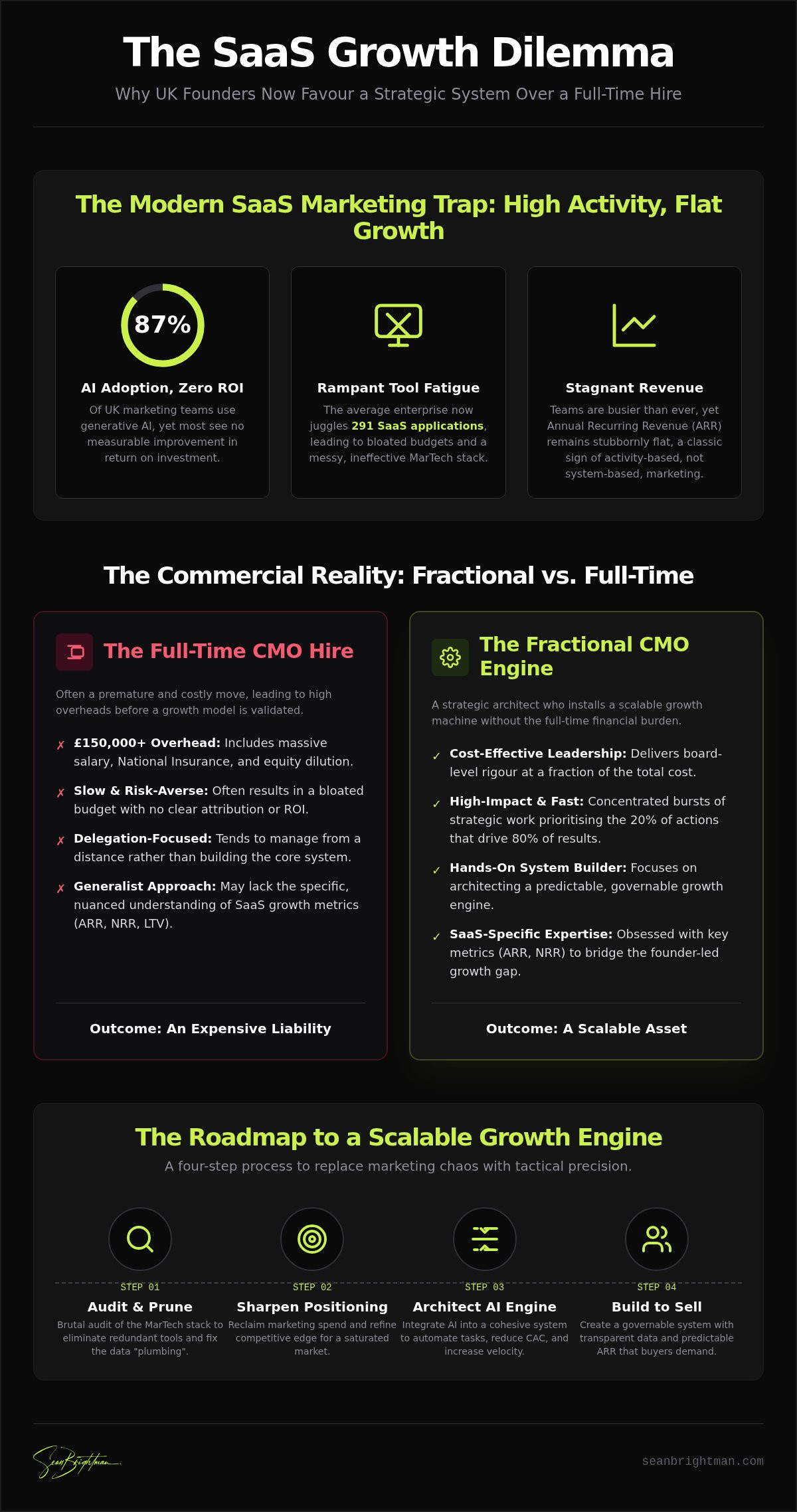
    Why is your marketing team busier than ever whilst your ARR remains stubbornly flat? By 2026, simply “using AI” has stopped being a competitive advantage. It’s now the baseline. Most UK SaaS founders are currently trapped in a cycle of tool fatigue and bloated budgets, watching 87 per cent of their team use generative AI without seeing a single percentage point of improvement in ROI. You have a messy MarTech stack, not a strategy.

    You know the feeling. It’s the frustration of seeing high activity but low impact. You want a predictable system that drives ARR, not another list of vanity metrics. Hiring a fractional cmo for saas uk is the decisive move to bridge this gap. This isn’t about recruitment. It’s about senior, battle-hardened leadership that installs a scalable growth engine into your business without the £150,000 overhead of a full-time hire.

    This article provides the blueprint to replace marketing chaos with tactical precision. We will outline how to build an AI-driven roadmap that ensures clear accountability for every pound spent. You will discover how to transition from a busy team to an effective one, creating a clear path toward a successful business exit.

    Key Takeaways

    • Stop rewarding “busy” work. Learn how to transition from chaotic activity-based marketing to a scalable, system-driven growth architecture.
    • Tool fatigue is a choice. Discover how to build a legitimate AI-powered growth engine rather than just adding more subscriptions to a messy stack.
    • Cut the overhead. See why a fractional cmo for saas uk delivers faster strategic results at a fraction of the total loaded cost of a full-time executive.
    • Fix the leaks. Follow a brutal four-step audit and positioning process to reclaim your marketing spend and sharpen your competitive edge.
    • Build to sell. Architect a governable marketing system that provides the transparent data and predictable ARR buyers demand during a business exit.

    What is a Fractional CMO for SaaS and Why Does it Matter Now?

    Stop viewing a Fractional CMO as a part-time manager who keeps the lights on. They aren’t. A true fractional cmo for saas uk is a strategic architect. They don’t just “do” marketing; they build the machinery that makes growth predictable. In 2026, the UK SaaS market is saturated. Tool fatigue is a genuine threat. The average enterprise now manages 291 SaaS applications, up from 254 in 2023. You don’t need more tools. You need a system that integrates them into a high-yield growth engine. This is about building a machine, not just buying more software.

    Most UK scale-ups make a £120,000 mistake by hiring a full-time CMO too early. This usually results in a bloated budget with no clear attribution. You’re paying for a massive salary, National Insurance, and equity before you even have a validated growth model. It’s expensive. It’s slow. It’s often a failure. Contrast this with system-based marketing. Instead of “Activity-Based Marketing”, where teams are busy but ARR is flat, system-based marketing focuses on the mechanics of scale. It’s about building a governable asset, not just running campaigns. You need a strategist who gets their hands dirty, not a corporate executive who delegates from a distance.

    The SaaS-Specific Leadership Gap

    Generalist consultants often fail because they don’t understand the nuance of SaaS. They talk about “brand awareness” whilst your NRR (Net Revenue Retention) is plummeting. SaaS growth is a unique beast. It requires an obsession with ARR, NRR, and LTV. A fractional leader bridges the gap between founder-led growth and a professional GTM engine. They bring board-level rigour without the permanent executive overhead. It is high-impact leadership delivered in concentrated bursts. This isn’t about giving advice. It’s about installing accountability.

    Strategy vs. Execution: Knowing the Difference

    Your team doesn’t need more foot soldiers. They need a commander. Most marketing teams are busy executing tactics that don’t move the needle. A battle-hardened strategist cuts through the noise. They prioritise the 20 per cent of actions that drive 80 per cent of the results. This role acts as a bridge. They translate the CEO’s high-level vision into a concrete roadmap for agencies to follow. It’s about accountability, not just activity. You don’t need more busy people. You need an effective system.

    The AI-Powered Growth Engine: Beyond Tool Implementation

    In 2026, 87 per cent of marketers use generative AI in their workflows. If you think your advantage comes from writing better prompts, you’ve already lost. A high-performing fractional cmo for saas uk doesn’t just suggest tools; they architect systems. This is about building an AI-powered growth engine that functions as a cohesive unit. It’s the difference between a collection of spare parts and a precision-tuned machine. You don’t need more “features” in your stack. You need a functional architecture that delivers results.

    True AI consulting focuses on systems architecture. It integrates intelligence into every layer of your Strategic Brand Roadmapping. When done correctly, this reduces your Customer Acquisition Cost (CAC) by automating the heavy lifting of lead qualification and content distribution. It increases velocity without increasing headcount. You aren’t just “using ChatGPT”; you’re building a proprietary asset that your competitors can’t replicate. With 79 per cent of B2B buyers now using AI-powered search like Perplexity for research, your engine must be built for retrieval, not just traditional keywords.

    Architecting the SaaS AI Stack

    The average enterprise manages 291 SaaS applications. That isn’t efficiency; it’s a graveyard of wasted budget. My role as a strategist involves a brutal audit of your current MarTech. We prune the redundant and integrate the essential. We move from tool fatigue to a streamlined, automated marketing machine. This requires a data-first culture. AI is only as good as the data it consumes. If your CRM is a mess, your AI engine will just produce high-velocity garbage. We fix the plumbing before we turn on the power. This is where AI consulting moves from theory to tangible infrastructure.

    AI Marketing Roadmapping: The First 90 Days

    The first three months focus on identifying “low-hanging fruit.” We look for high-friction, low-creativity tasks that drain your team’s time. By automating these, we create immediate breathing room for high-level strategy. This creates a clear direction for the team whilst maintaining strict accountability. We shift from manual campaign execution to “Agentic AI” where autonomous agents qualify leads in real-time. The AI Marketing Roadmap is the definitive blueprint for scalable operations that transforms abstract potential into measurable ARR.

    Fractional CMO vs. Full-Time Hire: A Brutal Commercial Reality Check

    Hiring a full-time CMO is a high-stakes gamble most UK SaaS scale-ups can’t afford to lose. The median base salary for a CMO in the UK is now £147,000. Once you factor in National Insurance, pension contributions, bonuses, and equity, the total loaded cost easily clears £200,000. This is a massive financial commitment for a role that often takes six months to find and another six months to prove. If the hire fails, you’ve lost a year of growth and a quarter of a million pounds. This is the catalyst for the Fractional Revolution. It is a shift toward efficiency over ego.

    Choosing a fractional cmo for saas uk provides higher strategic velocity. You get board-level expertise immediately. There’s no recruitment lag. No long-term equity dilution. Just high-impact leadership designed to fix the system and then scale it. It’s about buying results, not paying for a presence. You need a strategist who focuses on your ARR, not their own career progression within your hierarchy.

    The True Cost of a £150k Hire

    Recruiting a senior executive is a slow, expensive process. It often involves heavy headhunter fees and multiple rounds of interviews that distract the CEO. Even then, the risk of a “mismatched” hire is high. A corporate CMO might struggle in a lean scale-up environment where they have to be tactical as well as strategic. A fractional model is “plug-and-play.” It offers zero friction and immediate accountability. You aren’t tied to a multi-year contract. You’re tied to performance.

    Agencies vs. Fractional Leadership

    Many founders fall into the “Agency Trap.” They hire a lead generation or SEO agency without having a senior strategist in-house to manage them. Agencies prioritise their own retainers. They focus on the specific tasks they are paid to do, not your overall business growth. You need a neutral advisor to hold these agencies accountable to ARR targets. A fractional cmo for saas uk acts as that filter. They ensure your spend isn’t being wasted on vanity metrics. They also focus on building your internal capability, mentoring your existing team to become more effective rather than just more busy. It’s about creating a self-sustaining engine, not a permanent dependency on external execution.

    Fractional CMO for SaaS UK: Building AI-Powered Growth Engines in 2026

    The Roadmap to Scalable SaaS Growth: A 4-Step Process

    Growth is an engineering challenge, not a creative one. You don’t need “more ideas.” You need a repeatable process. A fractional cmo for saas uk installs this process through a structured four-step roadmap. This isn’t a vague suggestion. It’s a technical blueprint designed to turn your marketing from a cost centre into a profit engine. We move from guesswork to precision.

    • Step 1: The Brutal Audit. We identify where your growth engine is leaking cash. If you are amongst the 69 per cent of UK organisations failing to see a positive ROI from AI investment, we find out why. We stop the bleeding before we start the building.
    • Step 2: Brand Positioning. Standing out in the crowded UK SaaS market requires more than a “better” product. It requires a distinct category. We refine your message until it cuts through the noise of 2026 competition.
    • Step 3: Systems Architecture. We integrate your AI and MarTech stack. This is where we build the “Agentic AI” workflows that execute campaigns whilst your team focuses on high-level strategy.
    • Step 4: Continuous Direction. Strategy is useless without execution. The Advisory Retainer provides the ongoing accountability needed to ensure the roadmap stays on track and hits ARR targets.

    Audit and Positioning: The Strategic Foundation

    We start by reviewing your Ideal Customer Profile (ICP). If your messaging doesn’t resonate with the 5 to 16 decision-makers in a modern B2B buying committee, your funnel will stall. We analyse the bottlenecks in your ARR growth. Is it lead volume, or is it lead quality? Brand positioning is the mechanical advantage that allows your message to lift more weight with less effort. It’s about being the obvious choice for a specific problem. If you want to fix your foundation, you can book a strategic roadmapping session to get started.

    Operations and Accountability

    Scaling a SaaS business in 2026 requires Marketing Operations that don’t rely on increasing headcount. We design your department for high-growth velocity. This involves establishing a “Single Source of Truth” for all reporting. You need to know exactly which pound is driving which result. No more guessing. No more vanity metrics. Just clear, governable data that provides a roadmap to a successful business exit. A fractional cmo for saas uk ensures that every component of your machine is measured, managed, and optimised for maximum impact.

    Preparing for Exit: Making Your Growth Engine “Governable”

    You’ve spent years building your SaaS. Now you want to sell. But if your growth relies on your personal involvement, it isn’t a business; it’s a high-stress job. Acquirers pay for systems, not personalities. A fractional cmo for saas uk ensures your marketing is “exit-ready” long before the first offer arrives. This involves moving from chaotic experimentation to a Marketing Strategy for Business Exit. It is the difference between a messy handover and a premium valuation. You need an asset, not an activity log.

    Due diligence is where deals go to die. If your data is fragmented across various tools, the buyer sees risk. Risk equals a lower multiple. We build “Governable Growth.” This is a state where every marketing activity has a clear, documented path to ARR. It’s about transparency. It’s about precision. Buyers want to see an automated engine they can take over on day one without missing a beat. They want the machine, not the mechanic. We ensure your growth is a mathematical certainty, not a lucky streak.

    Investor-Grade Marketing Reporting

    Stop talking about clicks and impressions. Start talking about cohorts and payback periods. We move beyond vanity metrics to hard commercial data that investors actually care about. You need to demonstrate a predictable CAC:LTV ratio that holds up under the most brutal scrutiny. My role often involves sitting in board meetings and managing investor relations during the late stages of a scale-up’s journey. We show potential acquirers a machine that is already tuned for their level of scale. This reporting proves that your growth is repeatable and scalable under new ownership.

    Building a Legacy Growth Engine

    A business is worth significantly more when the founder is redundant. If you are still the one approving every headline or managing the agency relationship, your valuation is capped. We build a legacy growth engine that runs whilst you are not in the room. This system is documented, automated, and governed by clear KPIs that any buyer can read. As your strategist, I act as the guardian of the brand and the engine during the high-pressure exit process. I ensure the transition is seamless and the value is protected. Ready to build a growth engine that buyers covet? Book a Roadmapping session.

    Architect Your Exit-Ready Growth Engine Today

    The time for “playing” with marketing tools is over. In 2026, the gap between the market leaders and the laggards is defined by systems architecture, not simple tool adoption. You’ve seen the brutal reality of the £150,000 full-time hire and the common trap of agency mismanagement. Now it’s time to choose a different path. By installing a fractional cmo for saas uk, you move from founder-led chaos to a governable, AI-powered growth engine that buyers actually covet. This is about building a scalable asset, not just running more campaigns.

    I bring battle-hardened expertise in UK SaaS scale-ups and direct advisory with zero corporate fluff. As the author of “The Book” on strategic marketing, my focus is entirely on the mechanics of ARR, not vanity metrics. We build the machine. We fix the leaks. We prepare your business for a high-multiple exit. You get board-level rigour without the executive overhead. It’s a plug-and-play solution for complex growth problems.

    Stop playing with tools and start growing: Book your AI Marketing Roadmap.

    Your business deserves a predictable growth system that functions whilst you’re not in the room. Let’s build it together.

    Frequently Asked Questions

    What is the typical cost of a Fractional CMO for a UK SaaS?

    Costs for a fractional cmo for saas uk vary based on the intensity of the engagement. Market data suggests day rates between £700 and £2,000, whilst monthly retainers typically sit between £3,000 and £10,000. This is significantly lower than the total loaded cost of a full-time hire, which averages over £147,000 base salary. You pay for strategic impact and results rather than desk time or corporate overhead. It’s a high-impact investment in your growth engine.

    How many days a week does a Fractional CMO actually work?

    Most engagements involve one to two days per week. This isn’t a part-time job; it is a concentrated burst of senior leadership. The focus is on high-level strategy and removing bottlenecks rather than daily task execution. Some founders prefer a more intensive start followed by an Advisory Retainer to maintain momentum. The goal is strategic velocity, not filling a seat for 40 hours. You get the impact without the fluff.

    Can a Fractional CMO help with my AI implementation strategy?

    Yes, this is a core component of my AI Consulting service. I specialise in architecting AI-powered growth engines that move beyond simple tool usage. This involves auditing your existing stack and implementing automated workflows that reduce CAC and increase lead velocity. We focus on “Agentic AI” that can autonomously execute campaigns and qualify leads. It is about building a scalable system that functions as a proprietary asset for your business.

    Will a Fractional CMO manage my existing marketing agency?

    Managing your existing agencies is a critical part of the role. Many SaaS founders fall into the “Agency Trap,” paying for activity rather than ARR. I act as a neutral advisor to hold your agencies accountable to hard commercial targets. We establish a “Single Source of Truth” for reporting to ensure every pound spent is justified. This removes the friction between your vision and their execution. We prioritise results over retainers.

    What is the difference between a Marketing Consultant and a Fractional CMO?

    A consultant gives advice; a Fractional CMO takes ownership. Consultants often provide a report and leave. A fractional cmo for saas uk integrates into your leadership team to drive execution and accountability. It is the difference between being a spectator and a commander. This role involves making decisive moves, managing teams, and being responsible for the growth engine’s performance over the long term. It is a partnership, not a project.

    How do I know if my SaaS is ready for fractional leadership?

    Your SaaS is ready when you have product-market fit but lack a repeatable growth system. If your marketing is currently “founder-led” or relies on a messy collection of tools with no clear attribution, you need senior leadership. You should have enough revenue to support a marketing budget but not yet enough to justify a £200,000 full-time executive hire. It is about bridging the gap to scale with tactical precision.

    Does a Fractional CMO help with marketing team recruitment?

    I do not provide recruitment agency services or full-time CMO placement. My focus is on strategic leadership and building the growth machinery itself. Whilst I can help define the skills needed for your internal team or mentor existing staff to improve their effectiveness, I am not a recruiter. The goal is to build a governable system that remains effective regardless of individual staff changes. I focus on the engine, not the hiring process.

    What results should I expect in the first 90 days of hiring a Fractional CMO?

    The first 90 days are about identifying and fixing “leaks” in your growth engine. Expect a brutal audit of your current stack and the delivery of a clear AI Marketing Roadmap. We prioritise “low-hanging fruit” to create immediate breathing room for the team. By the end of three months, you will have a documented strategy, clear accountability for spend, and the first automated workflows delivering measurable impact on your ARR and growth.