
A positioning statement that lives in a slide deck isn’t a strategy. It’s wallpaper. A practical b2b brand positioning framework should help your business make sharper choices, not just describe itself more elegantly.
If your company sounds interchangeable with competitors, or marketing and sales give different answers about who you serve and why you’re different, the issue isn’t a shortage of clever copy. It’s a lack of shared decisions. If positioning work hasn’t changed what your team says or does, the document hasn’t done its job.
This framework connects four essentials: your market, your buyer, your difference and the proof that makes your claims credible. Use them to shape a clear position, then turn it into practical guidance for messaging, offers, website content and customer journeys. The goal isn’t a statement that sounds impressive in a workshop. It’s a position your team can apply consistently, test in the market and use to decide what comes next.
Key Takeaways
- Use a b2b brand positioning framework to connect your buyer, their problem, the alternatives they consider, your difference and the evidence behind it.
- Separate positioning from visual identity, campaign messaging and feature lists so each has a clear purpose.
- Prioritise buyers without assuming you must reject every other opportunity. Make your differentiation specific, relevant and supportable.
- Build and test your position through practical steps that produce decisions and useful artefacts, not another document to file away.
- Turn the strategy into consistent choices for messaging, offers, website content and customer journeys.
What a B2B brand positioning framework should actually clarify
Positioning is the place your business deliberately earns in a buyer’s mind. It’s based on who you serve, the problem you solve and why your approach is worth considering. It isn’t a slogan chosen in a workshop. It’s a strategic choice about the buyers you prioritise and the difference you can credibly defend.
That distinction matters because positioning is often confused with the things people can see. A logo and colour palette belong to visual identity. A campaign line is messaging. A feature list describes what a product does. Each can express or support a position, but none defines it. The core principles of brand positioning centre on how buyers perceive an offer in relation to alternatives. In practice, that perception needs to be grounded in evidence, not just a clever claim.
Positioning is the strategic choice of who you serve and why you’re meaningfully different; messaging is how you express that choice to buyers. Keep that distinction in view. It stops teams treating new copy as a substitute for hard decisions.
Positioning strategy versus messaging: where is the difference?
Positioning sits beneath the words. It clarifies the audience, the need you address and why a buyer might choose you over doing nothing or taking another route. Messaging translates those choices into language buyers can understand and remember.
Imagine a hypothetical B2B software firm serving finance teams. “Make work simpler” could be polished copy, but it doesn’t say which finance teams matter, what friction the product addresses or what makes its approach distinct. If those choices are unclear, sharper headlines won’t fix the strategy. And if the difference has no evidence behind it, confident wording only makes the gap more obvious.
What does a strong B2B position help a business decide?
A useful b2b brand positioning framework turns strategy into decisions people can apply. It helps leaders choose which buyers to prioritise and which problems deserve attention. That focus can guide:
- Offers: which services or product options best address the priority buyer’s problem.
- Customer journey: what a buyer needs to understand, compare and trust at each stage.
- Website structure: which pages, proof points and calls to action deserve prominence.
- Sales conversations: which needs to explore and which claims the team can support.
These decisions create useful trade-offs. A company that prioritises established firms with complex reporting needs may shape its offer and website differently from one targeting small teams seeking a quick, simple tool. Neither choice is automatically right. The point is to make the choice explicit, then align activity around it.
Positioning is a guide, not a growth guarantee. It can make decisions more coherent, but it can’t promise demand, remove competitors or prove a claim on its own. Its practical value is a shared basis for marketing, sales and leadership to decide what to say, build and prioritise next.
The five connected choices inside a B2B brand positioning framework
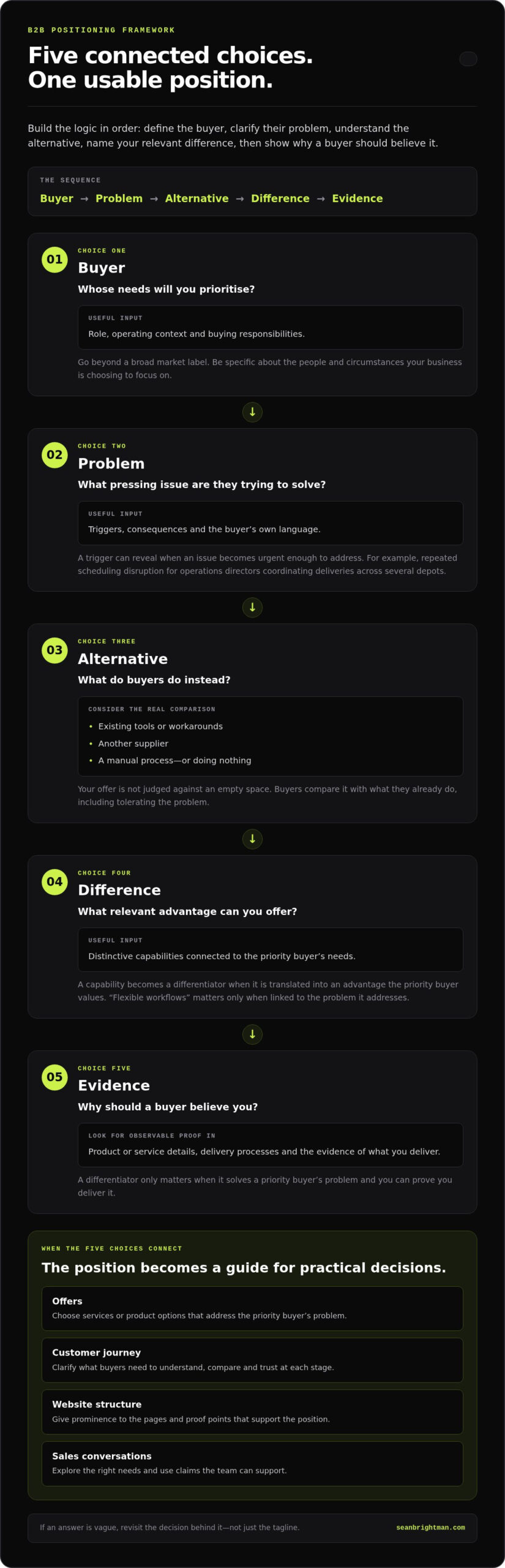
A useful b2b brand positioning framework is a sequence of connected decisions, not five prompts answered in separate workshop rooms. Start with the buyer. Define their problem, the alternative they use, the difference you can offer and the evidence that makes that difference believable. Each answer sets the boundaries for the next.
Use this table to build the logic in order. If an answer is vague, don’t paper over it with a sharper tagline. Revisit the decision behind it.
| Choice | Key question | Useful input |
|---|---|---|
| Buyer | Whose needs will we prioritise? | Role, operating context and buying responsibilities |
| Problem | What pressing issue are they trying to solve? | Triggers, consequences and buyer language |
| Alternative | What do they do instead? | Existing tools, workarounds, competitors or inaction |
| Difference | What relevant advantage can we offer? | Distinctive capabilities connected to buyer needs |
| Evidence | Why should a buyer believe us? | Observable product, service or delivery proof |
Start with the buyer, problem and alternative
“Mid-sized businesses” is a market description, not a usable buyer choice. Get specific about the role, context and problem. For example, a hypothetical logistics software provider might prioritise operations directors at firms coordinating deliveries across several depots. A trigger, such as repeated scheduling disruption, helps show when the issue becomes urgent enough to address.
Then name the alternative honestly. Buyers might use spreadsheets, rely on a manual process, choose another supplier or tolerate the problem. Your offer isn’t judged against an empty space. It’s compared with what the buyer already does, including doing nothing.
Make the difference credible with evidence
A capability is something your organisation can do. A differentiator is that capability translated into an advantage a priority buyer values. “Flexible workflows” means little until you explain which buyer problem that flexibility addresses. A differentiator only matters when it solves a priority buyer’s problem and you can prove you deliver it.
Look for evidence in product or service details, delivery processes and the experience buyers actually receive. Test the logic against buyer interviews, sales conversations and customer feedback. The Harvard Business School’s brand positioning framework also highlights the role of target audiences, competitive context and reasons to believe in shaping a positioning statement. Treat those reasons as a test, not decoration.
Finally, read the five choices together. If the evidence doesn’t support the difference, revise the claim. If the alternative isn’t what buyers actually use, revisit the problem. For support turning these decisions into practical brand and marketing priorities, explore brand strategy support.
B2B positioning objections: differentiation without narrowing too far
“If we focus, won’t we lose customers?” It’s a fair concern, but focus doesn’t mean refusing every buyer outside a chosen segment. It means deciding who your position is built for first, based on where your offer fits and where you can support your value with evidence. Other buyers may still choose you. They simply don’t dictate every message, offer or priority.
A useful b2b brand positioning framework helps you make that choice without pretending the market is smaller than it is. Treat your primary audience as a strategic priority, not a fence around the whole business. Compare the value of focus with the risk of over-narrowing:
- Useful focus: gives marketing and sales a clear buyer, need and reason to lead with your offer. It makes decisions easier to test and refine.
- Unnecessary narrowing: defines the audience so tightly that the position depends on a narrow label rather than a shared need, or excludes buyers who have the same problem and fit the offer.
How focused should a B2B brand position be?
Prioritise buyers whose needs match what you can deliver and demonstrate. Test that fit against actual buying conversations, customer feedback and the commercial realities of serving that audience. Can buyers recognise the problem? Does it matter enough to prompt action? Can your offer address it credibly? If the answers are weak, the focus may look neat on paper but be useless in practice.
Keep the primary positioning audience distinct from every possible future customer. Your position should make today’s choices clearer, not forecast every market you might enter later. Focus can evolve as buyer needs, capabilities and evidence change.
How to avoid claims that sound like every competitor
“Best-in-class”, “innovative” and “customer-focused” aren’t differentiators by themselves. They’re claims. AI isn’t automatically distinctive either. Explain what a capability changes for a particular buyer, then point to observable evidence that supports the claim. A faster process, for instance, matters only if speed addresses a real buyer need and you can show how your delivery makes it possible.
Compare alternatives using capabilities buyers care about, not insults or assumptions about competitors. Another supplier may solve the same problem differently; an internal workaround or inaction may be the real alternative. Strategic approaches to brand differentiation can help prompt options, but a strategy label doesn’t prove your position fits your buyers.
Competitive maps can clarify perceptions when they use attributes buyers care about and reliable input from the market. They can show how buyers see options across dimensions such as specialist support or ease of adoption. But a neat chart can create false precision if the axes are chosen for convenience, the evidence is thin or the differences don’t affect buyer choices. Use the map to ask better questions, not to declare a winner.
How to build, test and activate your B2B positioning framework
A positioning framework earns its keep when it changes what the team does. Build it in stages. Each stage should leave you with a decision or working artefact, not just workshop notes. This process takes the five connected choices from discovery to buyer testing, then into the places where buyers meet your business.
From buyer research to a testable positioning statement
Collect evidence before polishing language. Bring together customer feedback, sales conversations and the knowledge of people who deliver the offer. Look for repeated buyer terms, triggers and objections. Internal opinions can point to useful questions, but they’re no substitute for buyer language.
- Set the audience and research question. Agree which buyer group you’re investigating and what you need to learn about its needs, alternatives and decision triggers. Artefact: a short research brief with the audience and questions to explore.
- Gather and sort the evidence. Review relevant buyer conversations and feedback alongside internal delivery knowledge. Separate observed facts from assumptions. Artefact: a findings summary showing recurring needs, alternatives and proof you can substantiate.
- Draft the positioning statement. Write a concise working statement that names the priority audience, its problem, the alternative and your credible difference. Treat it as a hypothesis, not finished copy. Artefact: one draft statement with supporting evidence for its central claim.
- Test it with target buyers. Ask buyers to explain what they think the offer is, who it’s for and what makes it distinct. Check whether they recognise the problem and whether the claimed difference matters. Avoid leading questions that invite polite agreement. Artefact: a test log capturing confusion, relevance and credibility.
Put the position to work across the business
Validation isn’t a vote on which phrase sounds nicest. Use what buyers understand, recognise and believe to refine the underlying choices. If buyers understand the offer but don’t value the difference, revisit the evidence or claim before rollout.
- Activate and assign ownership. Translate the position into homepage hierarchy, sales language, offer explanations and internal guidance. Give each customer-facing update a named owner and a clear next action. Artefact: an activation plan that records touchpoint, owner and status.
To connect positioning decisions to ranked priorities and a practical action plan, use this strategic brand roadmapping guide. For repeatable execution across teams and touchpoints, the marketing operations growth engine guide explores how to build the operating rhythm around the work.
Include a review point so the team can revisit buyer feedback, sales objections and changes to the offer. A b2b brand positioning framework should remain useful as the business learns, not become a statement no one is allowed to question. If you want strategic support turning positioning into action, explore brand strategy support.
Make B2B brand positioning a working strategy, not a workshop document
A positioning document is useful only if it changes decisions after the workshop ends. If leaders can’t agree which buyers matter, marketing and sales describe the offer differently, or agreed changes never reach the website and sales materials, the strategy is stuck. More copy won’t fix it. The team needs clearer choices, ownership and a route from strategy to action.
A b2b brand positioning framework should guide decisions about positioning, messaging, offers, customer journeys and website strategy. Brand Strategist support can connect these parts, so the position shapes how the business communicates and what it prioritises. This is strategic direction focused on aligning choices and putting them to work.
When is outside strategic direction useful?
An external perspective can challenge assumptions that have become hard to question internally. It can help the team separate buyer evidence from familiar opinions, resolve conflicting descriptions of the offer and focus on what needs to happen next. The value is practical: clearer direction, priorities ranked by impact and accountability for moving decisions into action, without promising a particular commercial result.
Look for a pattern, not one awkward meeting. If the same positioning debate keeps returning, teams are making different promises or activation has stalled because no one owns the next move, strategic support can bring the work back into focus. The aim isn’t another polished deck. It’s a shared basis for decisions people can act on.
Choose a clear next step for your positioning work
If the central choices need sharpening and the team needs a usable plan, Roadmapping is a focused next step. It’s a one-off strategy session that sharpens positioning and messaging, then ranks priorities by impact in a 90-day action roadmap. The roadmap is yours to run, giving the team a clear sequence rather than a vague instruction to “get aligned”.
If positioning decisions need continued direction and accountability as the business acts on them, ongoing strategic leadership through Fractional CMO or Advisory CMO support may be a better fit. Choose the level of support around the work ahead: one focused roadmap, or ongoing guidance to keep decisions and priorities moving.
For a practical way to connect positioning choices to ranked actions, use this strategic brand roadmapping guide. As the team turns strategy into repeatable activity, the marketing operations growth engine guide offers a useful perspective on execution.
If your position needs to move from discussion into decisions your team can use, explore strategic support with Sean Brightman.
Turn the position into your next business decision
Your position shouldn’t sit outside the work. Use it to decide what to strengthen, what to stop saying and where the team should focus next. A b2b brand positioning framework becomes valuable when it helps people make those calls with confidence, even as the business changes.
That takes more than a statement. Brand Strategist support connects positioning with messaging, offers, customer journeys and website strategy, so those choices carry through to how buyers experience the business. If the challenge is deciding what to act on first, Roadmapping sharpens positioning and messaging, then ranks priorities by impact in a 90-day action roadmap.
You don’t need to solve every question at once. Start with the decision currently slowing the team down, then build from there. Explore strategic support with Sean Brightman and take the next step towards a position your team can put to work.
Frequently Asked Questions
Is B2B brand positioning the same as a value proposition?
No. A value proposition explains the value a buyer can expect from a particular offer; positioning establishes the wider context that makes that value distinctive and relevant. For example, a data consultancy’s value proposition might focus on helping finance teams bring reporting data together. Its position would also clarify which finance teams it prioritises and how its approach stands apart from their other options. The value proposition supports the position, but doesn’t replace it.
Can a B2B company have more than one brand position?
It can tailor its emphasis for different audiences or offers, but several competing positions under one brand can confuse buyers and staff. Keep a clear central idea, then adapt examples, proof and language for distinct buying situations. A cybersecurity firm, for instance, might speak differently to a technical lead and a finance director whilst staying consistent about the problem it solves. Create separate positions only when the audiences or offers genuinely require different strategic choices.
How do you test whether B2B positioning is clear to buyers?
Show the draft to buyers who fit your intended audience, without explaining what you mean first. Ask them to describe the offer in their own words, say who they think it is for and identify what stands out. Then explore whether that distinction matters to their work and what evidence they would need to trust it. Note misunderstandings and recurring questions. If buyers interpret the offer differently from your team, revise the underlying choices before polishing the wording.
Should a B2B positioning statement mention competitors?
Usually, no. A statement should make the buyer, need and relevant difference clear without becoming a rival comparison or naming a competitor that may change. However, the thinking behind the statement should account for alternatives, including other suppliers, internal workarounds and doing nothing. Mention a competitor in outward-facing copy only if the comparison is accurate, useful to the buyer and supported by evidence. Otherwise, describe the distinction in terms of what your business does.
How often should a business revisit its brand positioning?
Revisit it when there’s a meaningful reason, not simply because a calendar reminder says so. Triggers might include a major change to the offer, a new audience, repeated buyer confusion or evidence that the claimed distinction no longer reflects delivery. Keep a record of the assumptions behind the position and review them against sales conversations and customer feedback. If those inputs still support the choices, maintain the direction and refine execution rather than starting over.
What is the difference between B2B positioning and a positioning map?
B2B positioning is the strategic choice a business makes about the place it wants to earn with priority buyers. A positioning map is a visual tool that plots perceived options against selected attributes, such as specialist depth and ease of implementation. The map can help a team explore buyer perceptions, but it isn’t the strategy itself. Its value depends on using attributes buyers care about and evidence that reflects their views, rather than assumptions.