
What if the cost of a bad marketing hire isn’t the salary, but the growth your business missed while the wrong setup stayed in place? For UK businesses, the cost of a bad marketing hire can include recruitment and onboarding, management time, stalled activity and opportunities that never become commercial progress.
If you’ve invested time and money in someone whose work isn’t moving the business forward, it’s natural to question the hire. But the person may not be the only problem. An unclear role, weak leadership or a marketing system without priorities and accountability can produce the same frustrating result.
This article shows you how to calculate direct and hidden costs using your own figures, without relying on broad averages that may not fit your business. You’ll also learn how to distinguish a capability gap from a role-design or leadership problem before deciding what needs to change.
The next step may be a different hire. Or it may be to reset the strategy, roadmap and accountability first. That distinction matters: replacing someone without fixing the conditions around the role can leave the same costly problems in place.
Key Takeaways
- Define a bad marketing hire by missed role outcomes, not one disappointing campaign or a personality clash.
- Trace how unclear ownership and weak measurement can turn scattered activity into delayed decisions and missed learning.
- Use evidence such as agreed objectives, decision rights and delivery against priorities to identify what’s actually failing.
- Calculate the cost of a bad marketing hire uk using business records, separating confirmed cash costs from time estimates and uncertain opportunity costs.
- Before hiring again, decide whether the business needs a clearer role, stronger senior direction or a reset of its marketing priorities and accountability.
What is the real cost of a bad marketing hire in the UK?
A bad marketing hire isn’t simply someone you find difficult to work with. It’s someone who consistently misses the outcomes the role was designed to deliver, after taking the brief, resources and support into account. One weak campaign doesn’t prove the hire was wrong. A sustained gap between agreed priorities and actual delivery is stronger evidence.
The cost of a bad marketing hire uk businesses need to assess depends on more than the individual. Salary, role scope, time in post, replacement needs and the wider business all affect the calculation. A specialist responsible for one channel creates a different operational impact from a senior hire expected to set direction across the whole marketing function.
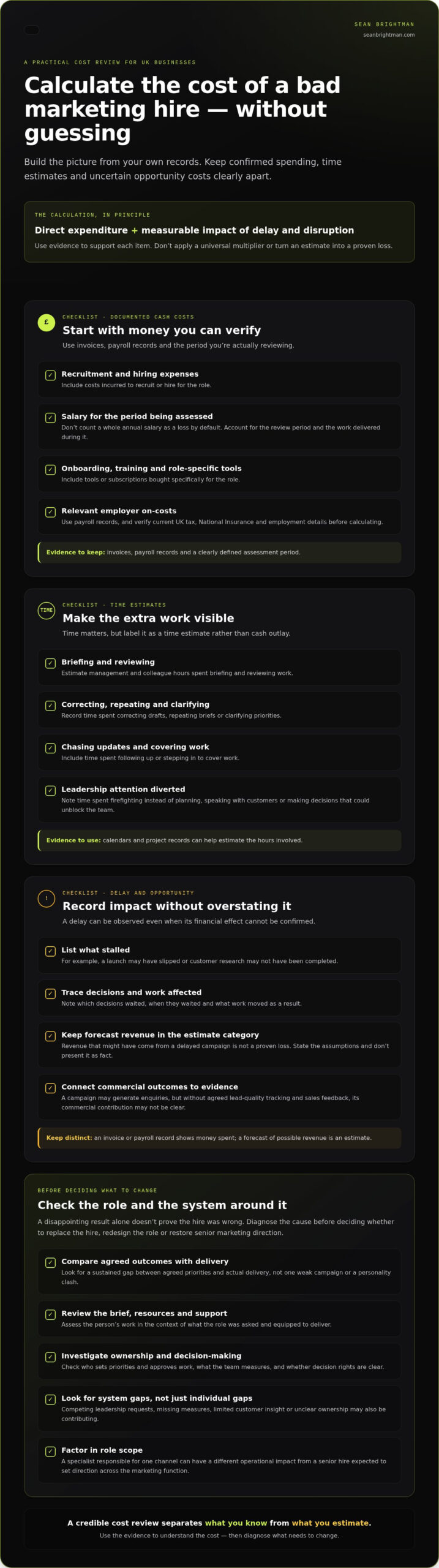
The cost is direct expenditure plus the measurable impact of delay and disruption. Count the cash already spent, then assess what stalled, who had to step in and what the disruption affected. Keep facts separate from estimates. A credible figure comes from your records, not a universal multiplier applied to every business.
Which direct costs belong in the calculation?
Start with costs you can document. Include recruitment or hiring expenses, salary paid during the period you’re reviewing, onboarding and training, and any tools or subscriptions bought specifically for the role. Add management and colleague time spent briefing, reviewing, correcting or covering work. Where possible, estimate those hours from calendars and project records, and label them as time estimates rather than cash outlay.
Include relevant employer on-costs using your payroll records. UK tax, National Insurance and employment details can change, so verify current figures before using them in a calculation. Don’t count an entire annual salary as a loss by default: identify the period being assessed and the work delivered during it.
Why salary alone hides the bigger picture
A salary-only calculation misses the work that waited while priorities stayed unclear. A launch may have slipped, customer research may not have been completed, or senior leaders may have spent time managing activity instead of making decisions. These impacts matter, but they aren’t automatically cash losses. Record what happened, when it happened and what evidence connects the delay to the hire or role.
Separate confirmed expenses from opportunity costs. An invoice or payroll record shows money spent. A forecast of revenue that might have come from a delayed campaign is an estimate, not a proven loss. State the assumptions behind it and avoid presenting it as fact. Broader employee turnover costs can offer useful context, but turnover alone doesn’t show what a particular marketing role cost your business.
This distinction keeps the calculation from becoming a blame exercise. It also leads to a more useful question: did the person lack capability, or did unclear outcomes, limited decision-making authority or missing support make success unlikely? Establish the cost, then diagnose the cause before deciding whether to replace the hire, redesign the role or restore senior marketing direction.
How a bad marketing hire can compound across growth and operations
A marketing role rarely operates in isolation. When ownership is unclear, work can spread across channels without a shared priority. Decisions wait for approval, reporting becomes inconsistent and the team learns less from each campaign. An unclear marketing mandate can turn activity into delay rather than learning.
That chain can weaken growth without proving that one person caused every problem. For example, a campaign might generate enquiries, but if nobody agrees how to track lead quality or pass feedback to sales, the business can’t confidently tell what contributed to a commercial outcome. The activity happened. The learning didn’t.
The hidden cost of time, attention and delayed decisions
Look beyond the work delivered and record the extra work it created: time spent correcting drafts, repeating briefs, clarifying priorities or chasing updates. Leadership attention has an opportunity cost too. Every hour spent firefighting is an hour not spent planning, speaking with customers or making decisions that could unblock the wider team.
Consider a business preparing a product launch. If the marketing lead and sales team disagree about the audience, a leader may need to revisit the brief, resolve ownership and delay approval. The delay is observable; its financial effect may not be. Note which decisions waited and what work moved as a result, but don’t claim lost revenue unless business records support that link.
UK employment conditions can help frame the hiring environment, but they don’t establish the cause or cost of a particular marketing problem. UK labour market statistics from GOV.UK provide wider labour-market context, not a ready-made estimate of the impact on your business.
The marketing system can suffer as well as the hire
Fragmented priorities, inconsistent reporting and unclear ownership may point to an underperforming hire. They may also expose gaps in the system around them: competing leadership requests, no agreed measures, limited access to customer insight or decision rights that were never clear. Treat these as symptoms to investigate, not automatic proof of individual failure.
Trace the process. Who sets priorities? Who approves work? What does the team measure, and how does that information shape the next decision? If colleagues give different answers, the role may be operating without a reliable structure. A marketing operations growth engine depends on clear ownership and connected workflows, not activity alone.
This is where the cost of a bad marketing hire uk can spread: beyond one person’s output, through repeated rework and weaker organisational learning. Separate what you can show from what you suspect. A documented delay is evidence; the revenue it might have produced is an estimate unless you can substantiate it. If the diagnosis points to missing senior direction, Fractional CMO support can bring priorities, systems and accountability into focus.
Bad marketing hire or broken role design? Diagnose the difference
A missed target doesn’t tell you, on its own, whether the person failed or the setup did. Before deciding what to fix, assess five factors: role clarity, capability, leadership, resources and measurement. A marketer can’t deliver against priorities that keep changing, or be held accountable for outcomes they can’t influence.
Use records, not impressions. Compare the original role brief with agreed objectives, decision rights, available budget, stakeholder input and actual delivery. One weak result may reflect timing, an unsuitable test or a wider commercial constraint. Look for repeated patterns and check whether expectations and support stayed consistent.
Signals that point towards a capability or fit issue
A capability gap becomes more plausible when responsibilities and priorities were clear, reasonable support was available, and the same role-specific issues kept recurring. Review dated examples: missed agreed deadlines, work that repeatedly needed substantial correction, or decisions that ignored relevant evidence. Look for patterns in delivery, communication and judgement. An isolated mistake or a vague sense that someone “isn’t proactive” isn’t enough.
Signals that point towards a leadership or system issue
Look for shifting goals, unclear budget ownership, slow approvals or competing instructions from different leaders. Check whether the marketer could access customer and performance data, speak with relevant teams and make decisions within agreed boundaries. If the business expected independent strategic direction but provided no clear mandate, the role may have been built on an unsupported assumption.
Use this quick diagnostic to turn frustration into questions you can test:
Signal: Priorities changed repeatedly. Likely cause: Weak leadership alignment or unclear planning. Evidence to review: Briefs, planning notes and changes to approved work. Next question: Who had authority to set and protect priorities?
Signal: Similar delivery gaps continued after clear feedback. Likely cause: Possible capability or role-fit issue. Evidence to review: Agreed objectives, work samples and feedback records. Next question: Was the expectation specific, achievable and within the person’s control?
Signal: Activity was delivered, but results couldn’t be assessed. Likely cause: Measurement or system weakness. Evidence to review: Reporting definitions, data access and ownership of follow-up. Next question: Could the team connect activity to a meaningful business outcome?
These patterns can overlap. A skilled marketer may struggle in a role with no decision rights, while a well-designed role won’t erase a genuine skills gap. Separate what’s documented from what’s inferred, then test one cause at a time. That gives you a stronger basis for deciding whether the cost of a bad marketing hire uk came from capability, role design or the conditions around the work.
How to calculate the cost and contain the damage before hiring again
Build the estimate from records, not a headline figure. The cost of a bad marketing hire uk businesses face varies with the role, time in post and what needs to happen next. Keep confirmed cash costs, time estimates and uncertain opportunity costs in separate totals, so decision-makers can see what’s known and what still needs testing.
A business-specific calculation in five steps
Use one consistent review period, such as the time since the hire started or since concerns first became clear. Keep evidence beside each figure and record your assumptions. This makes the calculation easier to challenge, update and use when comparing options.
- 1. Gather hiring costs. Record recruitment expenses, onboarding and training costs, and any role-specific tools or subscriptions. Use invoices and internal records rather than broad estimates.
- 2. Total salary and relevant employer costs. Calculate salary for the period being reviewed, not automatically for a full year. Add applicable employer costs using current payroll records, and verify current UK tax and employment details before relying on them.
- 3. Estimate time diverted. Use calendars, project notes or timesheets to estimate hours spent managing, correcting, re-briefing or covering work. State how you valued those hours and mark the result as an estimate.
- 4. Log delayed work separately. Note deliverables that slipped, decisions that waited and work that had to be repeated. Record dates and evidence. Don’t count the same delay as both staff time and a separate cash expense.
- 5. List possible opportunity costs. Describe missed or delayed opportunities separately from confirmed spend. Assign a monetary value only where you have a defensible basis, such as relevant business records, and explain your assumptions.
The result isn’t a verdict on one person. It’s a working estimate that helps you compare what to do next.
Contain the impact before repeating the hiring decision
First, pause activity that doesn’t support the immediate commercial objective. Give essential work a clear owner, define who can approve decisions and set measurable review points. This reduces drift while you assess whether the problem calls for corrective support, a redesigned role or a replacement.
Compare the options with the evidence. Corrective action may fit when expectations were clear and there’s a specific gap to address. Redesign may be the better route if the remit mixed incompatible responsibilities or lacked authority. Replacement may make sense when the role is sound, support was reasonable and recurring gaps remain. There’s no universal answer.
A fractional CMO leadership model provides senior strategic direction on a part-time basis, helping establish priorities, systems and accountability without rushing into another full-time leadership hire. If your initial calculation is clear but the diagnosis or next decision isn’t, get strategic marketing diagnosis before reopening the role.
Restore Marketing Leadership Before Your Next Hire
A cost review is useful only if it changes the next decision. Use what you found to choose between resetting the role, strengthening marketing leadership or recruiting against a clearer brief. Don’t reopen the same vacancy with the same expectations and hope for a different result.
Start with the diagnosis. If outcomes were vague, redesign the role around a defined business need. If the person lacked a specific capability, decide whether that skill is essential in the next hire or can be covered another way. If priorities, ownership or measurement were missing, fix those conditions before judging the next person’s performance.
When fractional marketing leadership may be the right next move
Fractional marketing leadership may suit a business that needs senior direction but isn’t ready to appoint a full-time marketing leader. A Fractional CMO provides senior marketing leadership on a part-time basis, helping set positioning, shape priorities and establish the systems and accountability that support consistent decisions.
This is strategic leadership, not recruitment placement or advertising execution. The aim is to give the team clearer direction and a workable structure, so marketing activity connects to agreed business priorities. It can also help leaders determine whether the longer-term need is a different hire, a better-defined role or ongoing senior guidance.
Choose a practical first step for your business
If your main challenge is deciding what to do and in what order, a roadmap can set out a structured marketing and brand direction. It turns broad ambitions into priorities the team can organise around, rather than another list of disconnected tasks.
If the direction is broadly clear but leaders need continued challenge, decision support and accountability, ongoing advisory can provide a steady source of strategic support. A marketing advisory retainer helps maintain that focus as priorities and business needs evolve.
The right choice depends on what your review uncovered, not on a standard recovery plan. The cost of a bad marketing hire uk businesses calculate should lead to a more deliberate setup, whether that means clarifying the brief, strengthening leadership or hiring again with sharper expectations.
Choose your next step: define the role’s outcomes, set decision rights and identify who will keep priorities on track. If the missing piece is senior strategic direction, consider whether Fractional CMO support fits the gap before committing to another full-time leadership hire.
Make your next marketing decision with confidence
The cost of a bad marketing hire uk businesses face isn’t a reason to rush into another appointment. It’s a prompt to make the next decision with sharper evidence. Define the outcome the business needs, the authority the role requires and the support that will make delivery possible. Then choose the structure that fits.
That may mean a clearer brief for a new hire. Or it may mean putting senior direction in place first. Fractional CMO support provides part-time marketing leadership, while roadmapping and advisory support can bring structure to priorities and accountability to the decisions that follow.
You don’t need to solve every marketing problem at once. Start with the gap that’s blocking progress, then build a plan around it. Get strategic clarity before making your next marketing decision, and take the next step with clearer direction and firmer footing.
Frequently Asked Questions
How much does a bad marketing hire cost a UK business?
There isn’t one reliable figure for every business. The cost of a bad marketing hire uk businesses face depends on the role, how long it lasted and what the business must do next. A useful estimate separates money already spent from time diverted and potential commercial impact. Compare the total with the cost and likely disruption of corrective support, role redesign or replacement, rather than relying on a generic multiplier.
What are the hidden costs of a bad marketing hire?
Hidden costs can include colleagues repeating work, sales teams receiving inconsistent materials and customer insight going unused. There may also be a handover cost if campaign knowledge, supplier context or access to key accounts sits with one person and hasn’t been documented. These effects won’t always have a defensible cash value. Record what changed operationally, who was affected and whether the impact is ongoing.
How can I tell if my marketing hire is underperforming?
Check whether agreed responsibilities are being delivered consistently, and look for repeated, specific gaps rather than judging one campaign in isolation. For example, compare the marketing plan with completed work, deadlines and reporting quality. Then check whether the person had the information, authority and support needed to do the job. If expectations weren’t clear, reset them before treating the gap as proof of poor performance.
Should I replace a bad marketing hire straight away?
Not necessarily. First establish whether the problem is a skills gap, a badly scoped role or a lack of direction. If the job’s priorities were unclear, replacing the person without changing the brief may recreate the same problem. Where expectations and support were clear but important gaps continue, replacement may be appropriate. Document the evidence and follow your organisation’s usual employment processes before making a decision.
Can a fractional CMO help after a bad marketing hire?
Yes. A Fractional CMO can bring senior marketing direction on a part-time basis while you assess what the business needs next. This can help clarify priorities, strengthen decision-making and establish accountability without immediately appointing a full-time marketing leader. The focus is strategic leadership, not recruitment placement or advertising execution. It can be useful when the team needs clearer direction before a permanent role can be properly defined.
What should I include when calculating the cost of a failed hire?
Use a defined review period and gather records such as recruitment invoices, payroll, onboarding expenses, role-specific software costs and project logs. Include documented hours spent on additional supervision or rework, but label time valuations as estimates. Keep possible lost opportunities separate unless business evidence supports a monetary value. This makes the calculation easier to update and helps prevent the same impact being counted twice.
Can a bad marketing hire damage growth even if they are busy?
Yes. A full calendar doesn’t show whether activity is advancing a business priority. For instance, a marketer might publish regularly while sales teams lack agreed follow-up information or leaders can’t tell which audience the work targets. Check whether outputs connect to a defined objective and whether the business learns from the results. Busy work without those links can consume capacity while leaving important decisions unresolved.