
Outsource when you need specialist skills or extra capacity without building a larger team. Keep marketing in-house when brand knowledge, close collaboration and fast decisions matter most. The in-house marketing vs outsourced strategy choice is not automatically one or the other: a hybrid model can keep direction and brand stewardship inside the business while bringing in external expertise for specific work.
It makes sense to weigh an external partner’s visible cost against salaries and the less obvious overheads of employing someone. But a fair comparison also considers hiring time, the skills you need and how closely the work must connect with your customers and operations.
This guide explains where each model fits, what drives its cost and when a hybrid approach makes sense. You’ll get a practical way to assess your needs, protect valuable brand knowledge and choose a structure that can keep pace with the business.
Key Takeaways
- Outsource when specialist expertise or extra capacity is the bottleneck; keep work in-house when close brand and customer knowledge drives better decisions.
- Factor UK employment costs beyond salary, including employer National Insurance and holiday entitlement, before comparing team models.
- Use a hybrid structure to retain internal ownership of marketing priorities while bringing in external support for defined specialist work.
- Choose the model against your growth plans, required skills and pace of decision-making, then set clear measures for judging its value.
When is it best to outsource your marketing?
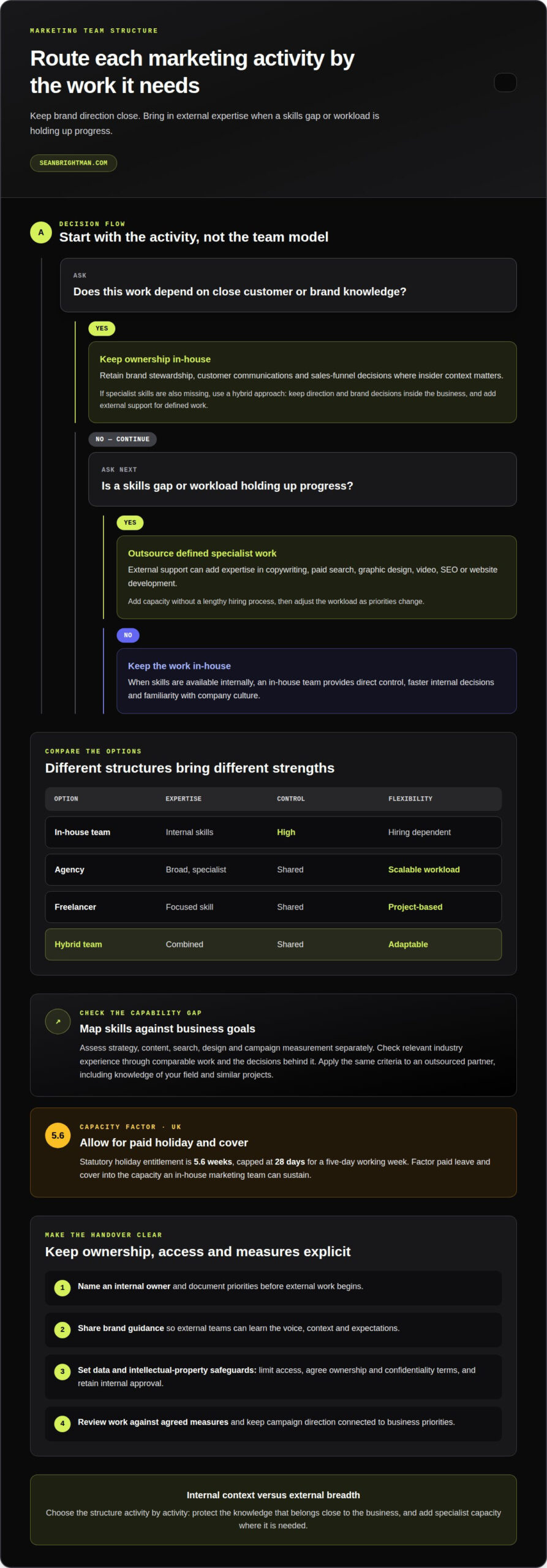
Outsource when a skills gap or workload is holding up progress; keep control of work that depends on close customer and brand knowledge.
UK statutory holiday entitlement is 5.6 weeks, capped at 28 days for a five-day working week, according to UK Government (GOV.UK). Factor paid leave and cover into the capacity an in-house marketing team can sustain.
In-house limitations
An in-house team offers direct control, faster internal decisions and familiarity with company culture. Its drawbacks include a narrower perspective, ongoing employment costs and gaps when specialist skills are missing. Agencies can bring fresh ideas and broader expertise, but need time to learn the brand. The trade-off is internal context versus external breadth.
Assessing in-house talent
Map current skills against business goals, assessing strategy, content, search, design and campaign measurement separately. Then evaluate relevant industry experience through examples of comparable work and the decisions behind it. Use the same criteria for an outsourced partner, including knowledge of your field and similar projects. This makes it clearer whether the gap calls for a hire or external support.
Outsourced expertise and scalability
An agency can bring specialist skills in areas such as copywriting, paid search, graphic design and video. That breadth helps when a project needs expertise the internal team does not use every day. Outsourcing also lets a business add capacity without a lengthy hiring process, then adjust the workload as priorities change. Internal staff retain closer control; external teams offer more flexibility across skills.
| Option | Expertise | Control | Flexibility |
|---|---|---|---|
| In-house team | Internal skills | High | Hiring dependent |
| Agency | Broad, specialist | Shared | Scalable workload |
| Freelancer | Focused skill | Shared | Project-based |
| Hybrid team | Combined | Shared | Adaptable |
Choosing marketing activities to outsource
Keep brand stewardship, customer communications and sales-funnel decisions in-house when they depend on insider knowledge. Outsource defined specialist work, such as SEO, website development or paid search, when the internal team lacks those skills. Manage data and intellectual-property risks by setting access limits, agreeing ownership and confidentiality terms, and retaining internal approval. For a smooth transition, name an internal owner, document priorities, share brand guidance, then review work against agreed measures.
Choose by matching each activity to its required expertise, brand knowledge and decision speed.
In-house marketing benefits: culture, brand knowledge, and speed
An internal marketing team can keep campaigns close to company decisions and customer conversations. Established brands often benefit when their messaging depends on detailed product knowledge, consistent values and fast internal approvals.
Culture and brand knowledge
An in-house team sees how colleagues talk about the brand, handle customer concerns and make decisions. That daily contact helps marketers turn internal knowledge into authentic messaging instead of relying on a brief. For example, a retailer’s in-house marketers can hear recurring questions from sales staff and shape campaign language around them.
That closeness also helps an established brand protect its voice across channels. Marketers can check a new campaign against past promises, product details and customer expectations before it goes live. The advantage is strongest when brand decisions depend on context that changes through regular conversations, rather than a static style guide.
Consistency and alignment
An in-house marketing team can build knowledge over time, keeping campaign decisions and brand history within the business. This supports continuity when priorities shift: an internal marketer can connect a new product launch with existing customer communications and sales activity. It also gives the business direct control over campaign direction and day-to-day work.
Internal access can speed up responses to a customer issue or social media query, because a dedicated team member can raise it directly. But proximity alone does not guarantee alignment. Set a clear approval route: identify the decision-maker, agree who supplies product or sales updates, then define who signs off each campaign. This helps prevent conflicting instructions across departments.
To maintain brand consistency, record practical guidance that survives staff changes: approved messages, audience needs, product language and examples of on-brand work. Review it when the offer or customer expectations change. If the team lacks time to cover every specialist channel, retain internal ownership of brand decisions and add external capacity where needed. This keeps brand knowledge close without expecting one team to cover every skill.
In-house marketing salaries and overhead costs
A salary is only the starting point when budgeting for an in-house marketing department. Add employment costs, recruitment, equipment, software and training before comparing it with an agency retainer.
Agency and employee costs
The average UK marketing manager salary is roughly £44,500.
Employer National Insurance is part of the calculation: UK employers pay 15% on earnings above the £5,000 secondary threshold, according to HM Revenue & Customs. The Pensions Regulator says employers must contribute a minimum 3% of qualifying earnings to a worker’s auto-enrolment pension. A marketing agency retainer, by contrast, is a service cost rather than a salary with employment overheads. Compare the support and work covered, not just the headline figure.
Total cost of ownership
Build a like-for-like comparison over the same period. For a hire, include salary, employer National Insurance, pension contributions, recruitment, software, equipment, training and management time. For an agency, include its retainer or project fees, internal time spent briefing and reviewing work, and any tools the business still pays for.
Then connect each model’s total cost to the outcomes it supports. Track attributable revenue or qualified leads against the full cost, using the same attribution window and conversion definitions. ROI compares the return generated with the total investment; do not credit one team alone for results produced jointly.
Hiring creates an ongoing commitment, even when campaign demand changes. An agency can work to a defined scope or project arrangement, while an employee builds knowledge inside the business. The right comparison depends on whether the business needs ongoing capacity, specialist input or both.
For a sound decision, calculate the in-house cost for the period you expect to need the role, then compare it with the external support and internal management time required for the same priorities. Separate fixed employment costs from those that vary with workload.
Comparing the affordability of in-house and outsourced marketing
The cheaper model depends on how consistently you can use its capacity. An in-house marketer’s cost continues between campaigns, while external support can be scoped around specific demand. Compare the work delivered and its business impact, not just the invoice or salary.
Map upcoming campaigns against the skills already available internally. If social media needs steady attention every week, an employee may provide continuity and faster access to product knowledge. If demand rises mainly for a launch or seasonal push, external specialists can add targeted capacity without creating a permanent role around a temporary workload.
Separate recurring work from occasional projects. List ongoing tasks such as planning, customer communications and reporting, then identify specialist work such as a website redesign or paid-search campaign. This shows whether there is enough consistent work to justify more in-house capacity, or whether defined external projects better match the workload.
Next, compare the full resources each option requires. Include internal briefing and approval time for an agency, alongside the tools, management and training needed to support an employee. For example, a social media campaign may look affordable externally, but repeated revisions can consume internal time. A clear brief, named approver and agreed measures help make that hidden workload visible.
Finally, judge affordability against useful outcomes. Set a baseline for each campaign, then track relevant results such as qualified enquiries, conversion rate or cost per lead. Compare those results with the complete investment over the same measurement period. This avoids treating activity, such as posts published, as proof of commercial value.
Choose the structure that fits your demand pattern: keep recurring, brand-critical work close; bring in external support for defined gaps or peaks. To pressure-test that decision against your priorities, use an advisory retainer.
Sean Brightman
Sean Brightman helps business leaders bring structure to marketing decisions when costs, capabilities and growth priorities point in different directions. Use Roadmapping to clarify priorities, sequence the work and identify where internal ownership or external expertise fits. An Advisory Retainer provides ongoing strategic guidance as needs evolve, while AI Consulting can help assess where AI fits into marketing operations.
The next step is to clarify the work your business needs, the skills it already has and the gaps holding back progress. That gives you a practical basis for choosing a model, rather than defaulting to a hire or outsourcing everything.
For a direct conversation about your marketing structure, contact Sean Brightman.
Turn your choice into a working plan
The in-house marketing vs outsourced strategy decision matters only if it changes how work gets done. Set a clear owner for priorities, agree who approves campaigns and define how internal and external contributors share information. That operating rhythm keeps decisions moving after the team structure is settled.
Next, turn business direction into a practical sequence of marketing decisions. Sean Brightman offers Roadmapping to shape that sequence, alongside Fractional CMO support for strategic leadership and AI Consulting where AI fits the operating picture. The right starting point depends on the gap you need to close, not a template.
Bring the decision, current priorities and biggest obstacle into a conversation. Contact Sean Brightman to discuss your options, then move forward with a structure your team can actually run. You don’t need a perfect organisation chart before you start; you need a clear next move.
Frequently Asked Questions
Is in-house marketing a financial risk?
Yes, if you commit to a permanent role before confirming there is enough ongoing work. Payroll continues during quieter periods, while campaign demand can rise and fall. Before hiring, map the responsibilities that need regular attention and consider what would happen if priorities changed. A role with clear, continuing ownership is easier to justify than one built around a single launch.
What challenges could you face?
Common challenges include slow decisions, competing internal priorities and over-reliance on one marketer. For example, a product launch can stall if the marketer is waiting for several teams to approve basic claims. Set one decision owner, agree response expectations and document the latest product information. This gives the team a clear approval route without adding another layer of meetings.
When does it make sense to hire in-house marketing help instead?
Hire in-house when marketing needs frequent involvement in everyday business decisions, not just occasional campaign delivery. A changing product range, regular customer feedback and close work with sales can create a steady stream of tasks that benefit from an embedded marketer. Define the role around those recurring responsibilities, then judge its contribution by business priorities rather than the number of activities completed.
Which should you choose?
The in-house marketing vs outsourced strategy choice depends on whether your main constraint is continuity, specialist capability or variable demand. Choose in-house support for sustained work that needs regular access to colleagues and customers; choose outsourced help for a defined skills gap or project. A hybrid arrangement can split ownership, with internal leaders setting direction and external specialists handling selected tasks.
What is the difference between in-house marketing and outsourced marketing?
In-house marketing is carried out by people employed within the business; outsourced marketing is commissioned from an external agency or specialist. An employee is part of internal workflows and leadership structures. An external partner works to an agreed scope. For example, a business might employ someone to coordinate ongoing customer insight, then commission a specialist for a one-off website project.
How much does it cost to hire an in-house marketing team in the UK?
The average UK marketing manager salary is roughly £44,500. That figure is a salary benchmark, not the full cost of employing a team. The final budget depends on the number and seniority of roles, the breadth of responsibilities and the support each person needs. A single manager and a multi-role department are different staffing decisions, so scope the work before setting a budget.