
Scaling marketing on a limited budget means backing channels that keep customer acquisition costs stable or improving as spend rises. Use 30-60 days of cost data as an early signal, then look for 60-90 days of positive returns at channel level before committing more budget.
A tight budget makes every weak conversion costly. More spend won’t fix a channel that is already losing efficiency; it will only increase the waste.
This guide explains how to assess whether a channel is ready to scale, set a conversion-cost target that works for your business, and raise spend in measured steps. You’ll also learn how to link those decisions to revenue and growth goals, so every budget increase has a clear commercial rationale. No guesswork: just a practical way to decide what deserves more investment, what needs adjustment, and when to hold back.
Key Takeaways
- Balance channels that can produce quicker returns with SEO and content that can keep attracting prospects over time.
- Work backwards from revenue goals to set a sensible ceiling for customer acquisition costs and track which channels convert.
- Increase spend in controlled steps, and investigate when rising lead costs suggest a channel is losing efficiency.
- Build a budget around your growth ambition, then make room to test and adjust the mix as results come in.
How Do You Know If a Marketing Channel Can Scale?
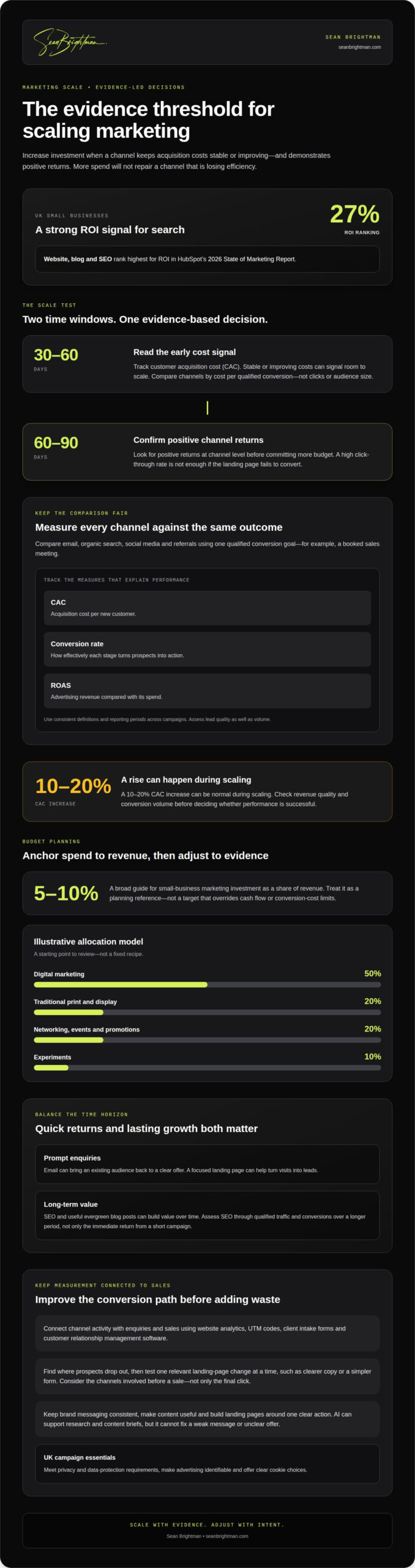
For UK small businesses, HubSpot’s 2026 State of Marketing Report ranks website, blog and SEO highest for ROI, at 27%. Email can nurture prospects through relevant follow-ups; weigh platform costs and staff time for creating and maintaining messages against the conversions they drive.
-
Compare low-cost channel returns
Compare channels by cost per qualified conversion, not clicks or audience size. Review email, organic search, social media and referrals against the same outcome, such as a booked sales meeting. Track customer acquisition cost over 30-60 days; stable or improving costs can signal room to scale. Look for 60-90 days of positive channel-level returns before committing more spend. A high click-through rate means little if your landing page fails to convert.
-
Balance quick returns with long-term growth
Combine channels that can generate prompt enquiries with SEO and useful content that builds value over time. Email can bring an existing audience back to a clear offer, while a focused landing page can turn visits into leads. Keep publishing evergreen blog posts, which can remain useful for months or years. Don’t judge SEO by the immediate return from a short campaign; assess its contribution to qualified traffic and conversions over a longer period.
-
Plan brand, content and technology investment
Improve the elements that help each channel convert: consistent brand messaging, useful content and a landing page built around one clear action. Use analytics and customer relationship management software to connect channel activity with enquiries and sales. AI tools can support audience research and content briefs, but their value depends on the right skills and a clear strategy. Check each brief against real customer needs before creating content; automation can’t fix a weak message or an unclear offer.
Defining goals and working backwards from conversion costs
Start with the commercial outcome, then work out what each conversion can afford to cost. That gives campaigns a clear target instead of a vague instruction to deliver more.
-
Define conversion goals
Choose one measurable outcome for each campaign, such as qualified enquiries, purchases or demo requests. Make the target specific, time-bound and tied to a channel. For example, set a goal to increase demo requests by 30% through LinkedIn ads. Then work backwards: estimate the revenue each conversion can generate, the share available for acquisition, and the maximum acceptable cost per conversion. Avoid optimising for form fills that never become sales.
-
Set baseline performance measures
Record current customer acquisition cost (CAC), conversion rate and return on ad spend (ROAS) before changing budgets. CAC shows the acquisition cost per new customer; conversion rate shows how effectively each stage turns prospects into action; ROAS compares advertising revenue with its spend. Use the same definitions and reporting period across campaigns. A 10-20% CAC increase can be normal during scaling, but compare it with revenue quality and conversion volume before calling it success.
-
Optimise conversions and measurement
Use website analytics, UTM codes and client intake forms to trace conversions to their sources. Find where prospects drop out, then test one change at a time on the relevant landing page, such as clearer copy or a simpler form. Attribution should consider the channels involved before a sale, not just the final click. In early and mid-stage growth, max-conversion bidding can let the platform explore placements and conversion opportunities. Assess lead quality as well as volume.
Turn those measures into a decision rhythm: compare performance with the goal, identify the bottleneck, then adjust one campaign variable. If you need a sharper plan for those choices, review your marketing priorities.
How Much Should a Startup Increase Marketing Budget When Scaling?
Set your allocation against revenue, then increase spend in controlled steps. UK campaigns should meet privacy and data-protection requirements, make advertising identifiable and offer clear cookie choices.
-
Allocate budget by revenue
Start with a revenue-based planning range, then adjust it for growth ambition and competitive pressure. One broad guide puts small-business marketing investment at 5-10% of revenue. Treat that as a planning reference, not a target that overrides cash flow or your conversion-cost limits. Separate committed spending from test budgets, and revisit the split as revenue and sales priorities change.
-
Split spend across marketing approaches
Build an initial allocation across digital, traditional and experimental activity. One illustrative plan assigns 50% to digital marketing, 20% to traditional print and display, 20% to networking, events and promotions, and 10% to experiments. Use it as a starting model, not a fixed recipe. Compare each approach by its role and results; keep experiments small enough to learn without starving effective marketing.
-
Bring in budget allocation expertise
Use experienced marketing judgement when channel results conflict or growth targets exceed your team’s planning capacity. An adviser can connect revenue goals, conversion costs and available resources, then identify where an allocation relies on weak assumptions. Keep decisions evidence-based: experiments should generate useful insights, and established channels should have clear performance measures. Don’t spend more simply because budget remains.
-
Use low-cost strategies for retention and referrals
Build retention into customer communications: share useful guidance, follow up after a purchase and invite satisfied customers to refer others. Monitor churn and use customer feedback to shape relevant offers or service improvements. In emails, explain why people receive messages and make preferences easy to manage. Follow applicable UK privacy requirements and use cookie controls that give people clear choices about tracking.
Budget planning based on revenue and growth targets
Use revenue targets to set an affordable budget, then link each increase to a KPI and target CPA. Review the plan monthly or quarterly, as Nettl recommends, and adjust allocations when results change.
-
Set growth goals and KPIs
Translate the growth target into a measurable outcome, then assign a KPI to each channel. For example, track qualified leads, conversion rates and revenue generated, rather than impressions alone. A growth-stage business may use an 8-15% revenue allocation as a planning reference, adjusting for its ambition and sales cycle. Keep each measure linked to a decision: continue, refine or reduce spending.
-
Plan budget against revenue targets
Work backwards from the revenue target and the customers needed to reach it. In one example, 200 new customers at a blended acquisition cost of £1,000 imply £200,000 in acquisition investment. Treat this as a model, not a universal budget. Check that the forecast accounts for sales capacity, conversion performance and the time required to turn prospects into customers before approving the allocation.
-
Scale spend against target CPA
Set a target cost per acquisition (CPA) based on customer value and the margin available for acquisition. Increase spend only while conversion volume and CPA stay within agreed limits. When a campaign reaches a saturation plateau, identify its Maximum Efficient Daily Spend: the highest spend at which CPA stability and conversion volume remain optimal. If CPA rises sharply beyond that point, reduce the budget and reassess before scaling further.
For a structured plan connecting growth targets, KPIs and budget allocation, build a revenue-led marketing roadmap.
Sean Brightman
Sean Brightman helps businesses turn marketing results into a clearer growth plan. If channel data is difficult to translate into budget decisions, Roadmapping can connect priorities, conversion costs and revenue targets. An Advisory Retainer provides ongoing strategic direction as results change, while AI Consulting helps assess where practical AI systems fit into your marketing.
Bring your current channel mix, performance measures and growth priorities to the discussion. The aim is to identify what deserves more investment, what needs a sharper test, and where the plan is wasting effort. Contact Sean Brightman to discuss your marketing priorities.
Turn your marketing plan into the next move
Scaling marketing on a limited budget takes more than choosing where to spend. It means building a disciplined decision-making habit: keep evidence visible, challenge assumptions when results change, and make each new investment serve a clear business need. This helps a growing business stay focused instead of chasing every new channel or tool.
When the next step is unclear, strategic input can help connect marketing activity to commercial priorities. Sean Brightman offers Fractional CMO support, AI Consulting and Roadmapping to help businesses make those decisions and set a workable direction. The right focus depends on your goals, current capabilities and the questions your plan hasn’t yet answered.
Discuss your marketing budget with Sean Brightman and decide what to tackle next. A clear plan gives your next investment a purpose. Keep learning, keep adjusting, and build growth one sound decision at a time.
Frequently Asked Questions
Looking to get more from your limited marketing budget?
Start by identifying which spending supports a clear business outcome. Review recent enquiries and sales, then look for avoidable friction, such as slow follow-up or an unclear offer. Fixing those hand-offs may help existing activity perform better before you add another channel. Record what changed and what happened next, so budget decisions follow evidence rather than habit.
What Does It Mean to Scale a Marketing Budget Strategically?
Scaling means increasing investment deliberately, with a clear reason for each change. Decide which growth outcome matters, what resources can support it, and what results would prompt you to continue or change direction. For example, a business could extend a proven campaign to a related audience before launching a new channel. Strategic scaling is controlled expansion, not simply spending more.
What Happens to CAC When You Scale Marketing Spend?
Customer acquisition cost can rise as a campaign reaches people who are less ready to buy. It can also change when sales follow-up slows or a landing page no longer matches the advert. Look beyond headline CAC: assess lead quality, sales conversion and customer value together. If those measures weaken, find where the customer journey changed before deciding whether to reduce spend or refine the campaign.
How can a small business scale marketing on a limited budget?
Choose one audience and one offer, then focus on the channel best suited to reaching that audience. Reuse useful material across formats, such as turning a customer question into an email and a short social post. Keep the message consistent and make follow-up part of the process. This helps a small team build on existing work rather than scatter effort across disconnected campaigns.
How much should a small business spend on marketing in the UK?
There is no single UK marketing budget that suits every small business. Set yours according to revenue, cash flow, growth ambition, competition and the resources needed to deliver the work. A business protecting its cash position may favour a smaller, focused plan; one pursuing faster growth may invest more. Review the budget against sales performance instead of setting it once and leaving it unchanged.
How do you prioritise marketing channels with a limited budget?
Rank channels by audience fit, ability to reach likely buyers, measurement quality and the work needed to maintain them. A channel that brings relevant enquiries and useful feedback may deserve priority over one that generates attention without sales conversations. Consider your team’s capacity too: a channel is practical only if someone can create its content, follow up leads and act on the results.