Tag: business goals

  • Reasons to Fire Your Marketing Agency When Goals and Results Fall Short

    Reasons to Fire Your Marketing Agency When Goals and Results Fall Short

    A bigger marketing budget won’t fix a strategy aimed at the wrong business goal. The reasons to fire your marketing agency include persistent underperformance, poor reporting and a strategy that no longer fits your business. Assess whether the problem has lasted several months, not just one poor month, then set clear benchmarks and a defined timeline for improvement.

    You’re right to expect more than busywork, impressive-looking charts or a steady push to spend more. Your agency should connect its work to your goals, explain what the results mean and set out a credible plan to improve.

    This guide explains how to assess alignment, reporting and strategic progress, then review contract terms before deciding whether to stay or move on. You’ll also learn how to manage the decision with less disruption, so changing agencies doesn’t leave a gap in your marketing.

    Key Takeaways

    • Judge the partnership by how well the agency’s priorities connect to your business goals, not by activity or spend alone.
    • Use clear, outcome-focused reporting to spot weak performance and decide whether the strategy needs to change.
    • Review notice periods, renewal clauses and ownership of accounts and assets before ending the relationship.
    • Look for a pattern of warning signs, gather feedback from the teams affected and agree a practical improvement window before making your decision.

    1. Alignment between agency and business goals

    An agency relationship works when its priorities support your commercial goals, not simply its own activity. If you want qualified enquiries, for example, a plan focused on increasing advertising spend needs a clear rationale. Ask how each campaign supports sales, customer retention or another agreed business outcome.

    Fit matters more than a low fee. An agency should use evidence about your audience before recommending a social platform, and explain who manages the account and whether execution is outsourced. Salesforce or HubSpot CRM records can show purchase histories and customer interactions, helping you shape more relevant campaigns.

    Changing agencies can disrupt active campaigns, access to advertising accounts, analytics, creative files and customer data. A rushed exit may leave your team without the information or permissions needed to keep marketing moving.

    Manage the transfer with a documented handover. Request data exports, campaign details, creative files and written confirmation of account ownership. Keep administrator access under your control, transfer permissions deliberately, and remove the outgoing agency’s access once the handover is complete.

    To replace an agency with less disruption, map active projects, dependencies and deadlines before giving notice. Arrange a transition meeting, agree who owns each open deliverable and keep essential marketing activity running throughout the change.

    Start with a candid performance discussion, internal feedback and a clear account of unmet expectations. Set specific benchmarks and an improvement timeline, then assess progress against those measures rather than one disappointing month. If the agency still pushes spend without connecting its work to your goals, the relationship may be misaligned.

    Plan the transition early. Overlap the incoming team with the outgoing agency’s final two weeks where practical. Request exports and ownership confirmations on day one of the notice period, rather than waiting until day 25. Agree a 90-day performance baseline with the incoming team before its first invoice. Those steps give the new team a usable starting point and reduce avoidable gaps.

    2. Assessing reporting accuracy and strategic stagnation

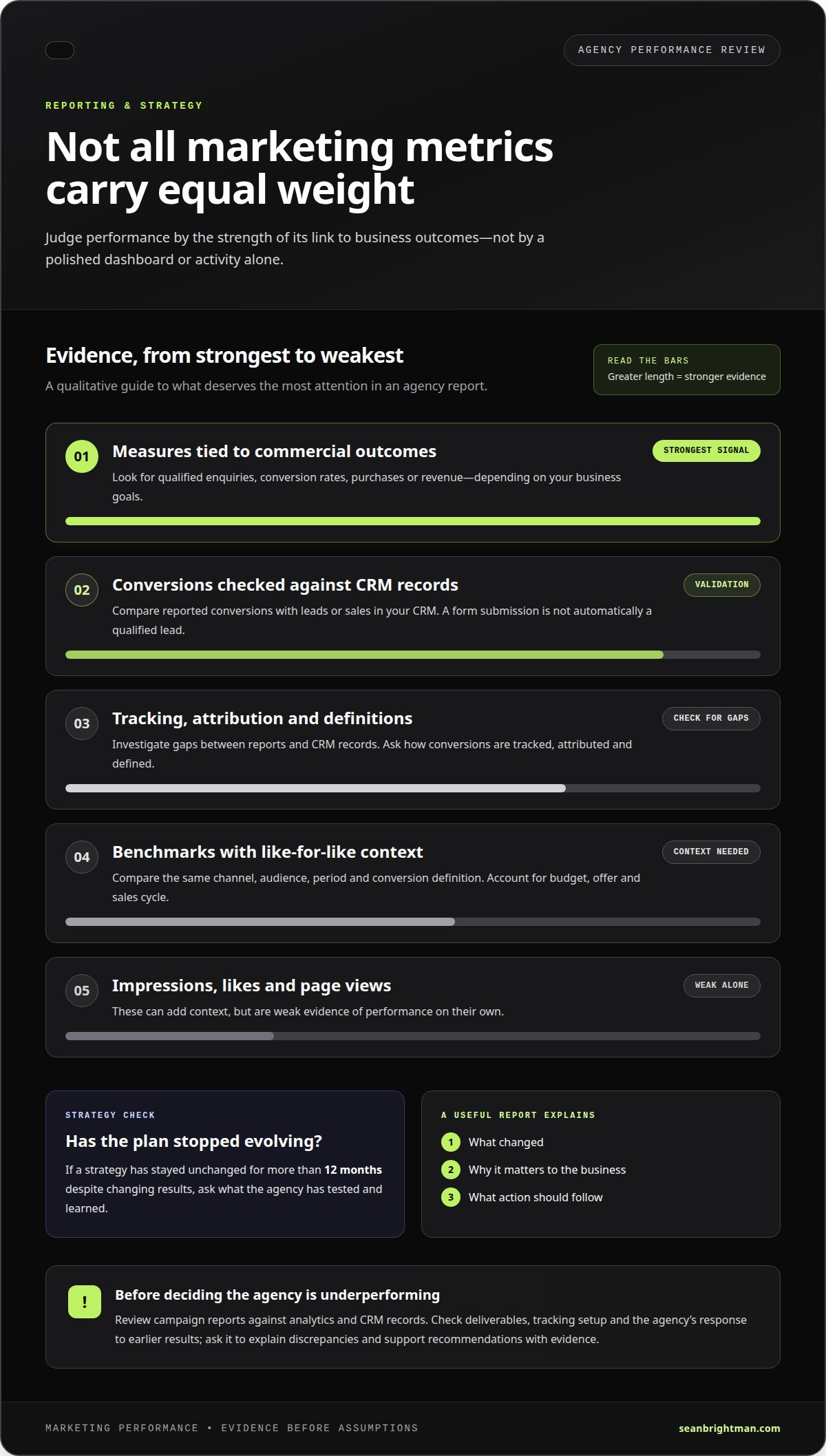
    A polished dashboard proves little if it cannot explain business outcomes. Compare reported conversions with leads or sales recorded in your CRM, and investigate gaps in tracking, attribution or definitions. A form submission, for example, is not automatically a qualified lead.

    Useful reporting links campaign activity to conversions, lead generation and return on investment. Impressions, likes and page views can add context, but they are weak evidence on their own. Ask for regular reports explaining what changed, why it matters and what action should follow.

    When comparing performance with industry benchmarks or competitors, use like-for-like measures: the same channel, audience, period and conversion definition. Account for differences in budget, offer and sales cycle, too. Broad comparisons can raise useful questions, but without that context they cannot prove an agency is underperforming.

    For a UK business, relevant KPIs depend on its goals and marketing activity. Lead generation may focus on qualified enquiries and conversion rates; an online retailer may track purchases and revenue. Ask the agency to show how each measure relates to agreed commercial outcomes.

    Audit the work before deciding to end the relationship. Compare campaign reports with analytics and CRM records, then review deliverables, tracking setup and what the agency did in response to earlier results. Ask it to explain discrepancies and support its recommendations with evidence.

    Strategy should evolve when evidence or business conditions change. If a plan remains unchanged for more than 12 months despite changing results, ask what the agency has tested and learned. A capable partner should challenge assumptions constructively, not recycle the same activity without a reason.

    Record the gaps, share them with the agency and set clear measures for improvement. A strategic review can help clarify priorities when reporting and direction need a sharper assessment.
    Reasons to Fire Your Marketing Agency When Goals and Results Fall Short

    3. Contract details and renewal clauses

    Before ending an agency relationship, read the signed agreement, not just the latest invoice. Check the notice period, renewal date, termination process and any fees for ending early. Most marketing agency contracts have notice periods of 30 days, so leaving notice too late can extend the commitment or delay a planned change.

    Review the contract’s terms for deliverables, payment dates and outstanding work. If your budget covers a defined campaign or monthly activity, compare that scope with the agency’s obligations. Look for automatic renewal wording and note the deadline for giving notice. A calendar reminder can help you avoid an unintended renewal.

    Ownership terms matter as much as the exit clause. Identify who owns creative files, strategy documents, website content, advertising accounts and analytics data. Check how the agreement says those assets will be transferred and whether the agency can retain copies. Before giving notice, map each asset to its owner and record the access needed to keep the business running.

    Review intellectual property provisions, confidentiality terms, unpaid invoices and other obligations, too. Ask legal counsel to review unclear termination clauses, fees, ownership rights and responsibilities before making a final decision. This can clarify the contract’s wording and flag issues that could affect the handover.

    For a prospective agency, ask what happens if performance does not improve in the first 30 days. Get agreed outcomes and responsibilities in writing before funds change hands. Clear commitments make accountability easier to assess than a vague promise of growth. They also give both sides a shared reference point for later reviews.

    Use a concise exit plan: confirm the notice deadline, settle outstanding obligations, document asset ownership and list work in progress. Agree on handover dates and access changes in writing. The signed contract sets the boundaries, while a practical transition plan protects campaigns, data and your team’s time.

    4. What are the warning signs of an underperforming marketing agency?

    Look for repeated patterns, not one awkward meeting or a single poor month. An agency bringing 10 people to a client call may signal unclear ownership, especially when nobody can explain who handles decisions or delivery. Ask for a named lead and clear responsibilities. If senior agency staff have been absent from calls for two quarters, assess whether strategic oversight has weakened.

    Watch for activity that grows while business outcomes stay flat. More advertising spend doesn’t necessarily produce better results. If the agency’s answer to falling conversions is simply to increase the budget, ask what evidence supports that recommendation. A strategy unchanged for more than 12 months deserves scrutiny when results or market conditions have shifted.

    Low fees alone don’t prove poor service, but a price far below comparable proposals can mean limited account attention or a one-size-fits-all approach. Assess the work itself: does each campaign speak to your audience, use relevant evidence and adapt when performance changes? Repeating generic creative across audiences is a concrete warning sign.

    Impressions, likes and page views need to lead somewhere meaningful. If social posts attract likes but generate no website visits, newsletter sign-ups or purchases, reports may be spotlighting vanity metrics. Ask how each figure relates to the campaign’s intended outcome and whether tracking captures that journey.

    Involve the teams that rely on the agency’s work. Ask sales, customer service and internal marketing colleagues about responsiveness, missed deadlines, deliverable quality and support gaps. Three familiar warning signs call for a serious review, not an automatic firing. Consider whether problems have persisted for several months, then discuss specific examples and set a defined improvement window.

    If the evidence points to a deeper strategic gap, review your marketing direction before deciding what comes next.

    Sean Brightman

    Sean Brightman helps business leaders make clearer marketing decisions when agency results and expectations diverge. If the evidence points to unclear priorities or a strategy that needs rebuilding, Roadmapping can help create a more focused direction. An Advisory Retainer provides ongoing strategic input as you assess progress and decide what comes next. AI Consulting can help you determine where AI fits your business, rather than adding tools without a clear purpose.

    The goal is a sound decision, not change for its own sake. If you’re weighing whether to stay, reset expectations or move on, contact Sean Brightman to discuss the challenge.

    Make your next marketing decision with intent

    Ending an agency relationship isn’t the only decisive option. You could reset expectations, change who makes strategic decisions or bring in different leadership. Strong reasons to fire your marketing agency may point to a problem with the setup, not just the provider.

    The reasons to fire your marketing agency can also raise a broader question: what needs to change for marketing to work better? Use the decision to clarify priorities, accountability and marketing’s role in growth. Sean Brightman offers Fractional CMO support to businesses that need senior marketing direction without defaulting to another agency arrangement.

    Make your next step a focused conversation about the issue you need to solve, whether that’s direction, accountability or a workable transition. Contact Sean Brightman to discuss your agency, and move forward with a clearer plan.

    Frequently Asked Questions

    How long should I wait for my agency to improve before considering firing?

    Set a review window that reflects the campaign cycle and the changes required, rather than reacting to one poor month. Reasons to fire your marketing agency may become clearer through missed milestones, such as unresolved tracking issues or no improvement in lead quality. If progress remains weak and the agency cannot explain why, use that evidence to decide whether further time is justified.

    Is switching agencies going to be costly?

    Switching agencies can involve more than the new agency’s fee. Consider your team’s onboarding time, any overlap between providers, unfinished work and possible downtime. A campaign with an upcoming launch, for example, may need extra coordination to stay on track. Map these operational demands against the value of changing, then plan the handover to limit duplicated work and keep essential activity running.

    What if my agency is slow to respond?

    Slow replies become a serious problem when they repeatedly block decisions, approvals or time-sensitive work. Record missed responses and their practical impact, such as a delayed campaign sign-off. Then agree who handles urgent issues, which channels to use and what response expectations apply to routine requests. If delays continue after that discussion, include them in your assessment of the working relationship.

    Will firing my agency hurt my SEO rankings?

    Changing agencies doesn’t automatically remove search rankings, but a poorly managed handover can interrupt the work that supports them. Keep publishing, technical fixes and planned site changes moving during the transition. Before access changes, make sure the incoming team understands current priorities and can access relevant performance history. Don’t remove essential platform access until responsibilities and account control have transferred.

    How can you measure whether a marketing agency is delivering results?

    Start with the business outcome the work should produce, then connect campaign activity to that measure. A service business might track qualified enquiries through to booked work; an online retailer might follow purchases and revenue. One reason to fire your marketing agency may be a persistent gap between reported activity and commercial impact. Use consistent definitions and tracking to assess the difference.

    What contract terms and notice periods apply when ending a UK marketing agency agreement?

    The signed agreement sets the terms, so review its notice period, renewal date, termination process and any early-exit fees. Most marketing agency contracts have notice periods of 30 days, but your own contract determines the applicable notice. Check how notice must be given and whether renewal is automatic. For unclear clauses or disputed obligations, have legal counsel review the agreement before you act.

  • How to Align Marketing Strategy with Campaigns

    How to Align Marketing Strategy with Campaigns

    Campaigns don’t become strategy just because they perform. You know when to move from tactical to strategic marketing when activity no longer connects clearly to business goals, or when the goals themselves have shifted. Tactical work runs over weeks or months; strategic marketing looks further ahead and steers decisions towards outcomes that matter.

    It’s easy to get pulled into the next campaign, content deadline or channel report. Execution matters, but without a clear commercial purpose, a busy marketing team can struggle to show what its work is changing.

    This article explains how to make the shift: start with business goals, choose measurable outcomes and connect each campaign to the customer journey. You’ll also learn when to revisit your strategy, what to measure and how to keep marketing focused on impact, not just output.

    Key Takeaways

    • Start with the business outcome, then connect each campaign to the customer journey and the result it should drive.
    • Separate short-term execution from longer-term direction so campaigns support a clear plan, not just a busy calendar.
    • Revisit strategy once or twice a year, and use regular performance reviews to adjust tactics based on evidence.
    • Look for signs that activity isn’t producing meaningful business impact, then reset priorities, measures and ownership.

    How do you move from tactical to strategic marketing?

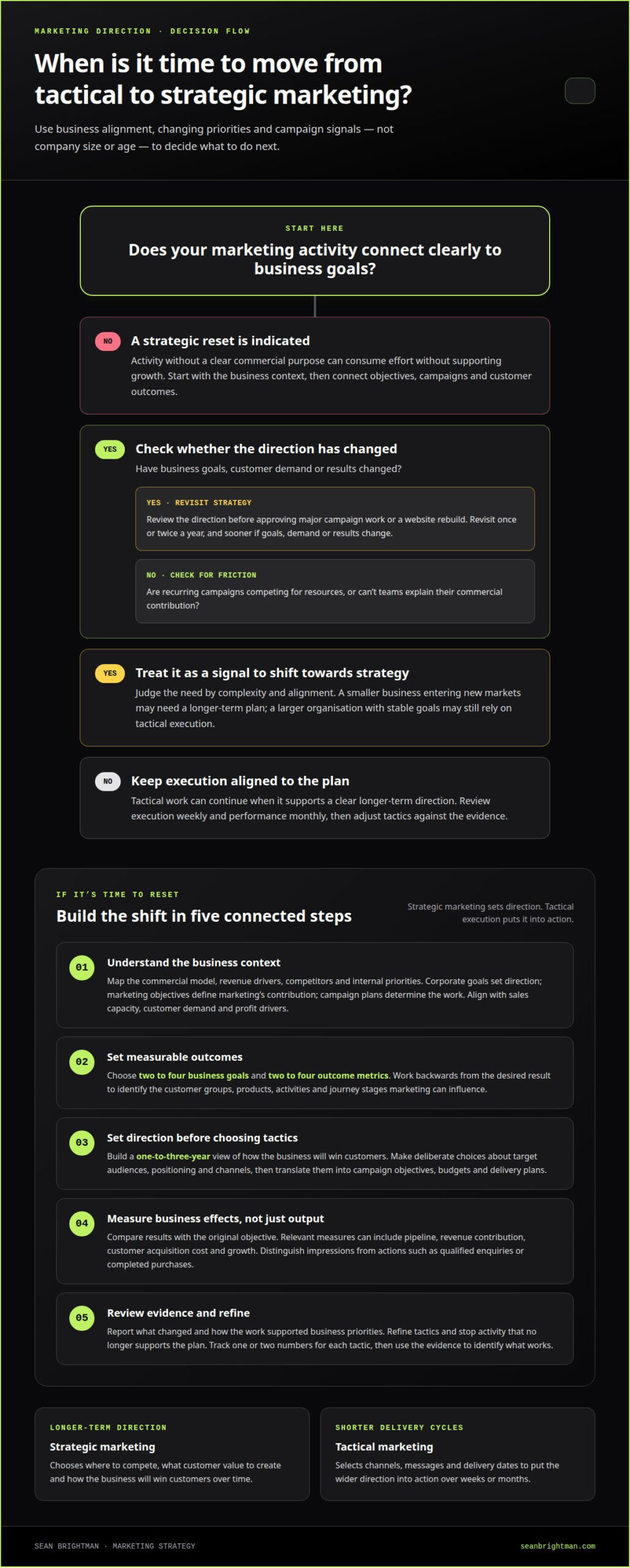
    Move towards strategic marketing when campaign choices need to support wider commercial priorities, not just immediate delivery. There’s no fixed growth stage for making the shift. Assess the business context, set outcomes, choose activity and measure the results.

    1. Understand the business context

      Map the organisation’s commercial model, revenue drivers, competitors and internal priorities. Then connect business planning to marketing: corporate goals set the direction, marketing objectives define its contribution, and campaign plans determine the work. Check that teams share the same priorities. Avoid planning channels in isolation from sales capacity, customer demand or profit drivers.

    2. Identify signs and growth stages

      Look for signs that recurring campaigns are competing for resources, teams can’t explain their commercial contribution, or business priorities have changed. These are stronger signals than company size or age. A smaller business entering new markets may need a longer-term plan, while a larger organisation with stable goals may still rely on tactical execution. Judge the shift by complexity and alignment.

    3. Set two to four measurable business goals, then choose two to four outcome metrics. For example, if the objective is to increase profit by 10%, assess which customer groups, products and activities can contribute. Work backwards from the desired result to define the customer journey, then identify where marketing can influence it. This replaces activity targets with business outcomes.
    4. Build a strategic plan around a one-to-three-year view of how the business will win customers. Make deliberate choices about target audiences, positioning and channels, then translate them into campaign objectives, budgets and delivery plans. Publishing two blog posts per month, for example, belongs in the plan only when its purpose and intended contribution are clear.
    5. Measure results against the original objective, not just completed outputs. Track relevant commercial effects, such as pipeline, revenue contribution, customer acquisition cost and growth. Report what changed and how the work supported business priorities. Review the evidence, refine tactics and stop activity that no longer supports the plan. Strategic marketing sets direction; tactical execution puts it into action.

    Strategic marketing versus tactical marketing

    Separate long-term choices from short-term actions. Strategic marketing sets the direction that tactical marketing serves.

    1. Compare planning time frames

      Set a longer planning horizon for strategic choices, then organise campaigns into shorter delivery cycles. Strategic marketing can define how the business will win customers over a one-to-three-year period, while tactics respond over weeks or months. A monthly email newsletter, for example, may support customer retention, but it isn’t the strategy itself. Check that each short cycle advances the longer-term direction.

    2. Distinguish planning approaches

      Start with the business position, target audience and intended outcome; choose tactics afterwards. Strategic planning decides where to compete and what customer value to create. Tactical planning selects channels, messages and delivery dates. Posting project photos on social media every week is an action, not a commercial objective. Before judging its value, connect it to a measure such as quote requests or conversions.

    3. Balance long-term plans with immediate needs

      Protect capacity for immediate demand whilst reserving deliberate effort for longer-term improvements. A small business might keep responding to current enquiries while improving its customer journey or positioning. Don’t let urgent tasks consume every planning session; equally, don’t pause useful activity for an abstract strategy exercise. For example, a tactical goal to increase quote requests by 25 percent this quarter can guide immediate work within the wider plan.

    4. Allow for the shift between approaches

      Build the change into existing planning and reporting rather than setting an arbitrary deadline. There’s no fixed duration for the shift: it depends on how quickly leaders agree priorities, teams connect activities to outcomes, and useful performance evidence becomes available. Review execution weekly and performance monthly, then adjust tactics against results. A clear marketing roadmap can help keep immediate decisions pointed toward longer-term goals.

    How to Align Marketing Strategy with Campaigns

    When to revisit strategy before campaigns or a website

    Review the direction before committing to major campaign work or a website rebuild. Revisit it once or twice a year, and sooner if business goals, customer demand or results change.

    Consider the risks of tactical focus

    Diagnose weak campaigns before adding more activity. Tactical work without a clear strategic link can consume effort without supporting growth, and reach alone doesn’t show whether people took action. Check whether campaigns attract the intended audience, convert leads into closed business and produce a return on investment. If results fall short, find where the customer journey breaks before changing channels.

    1. Compare performance with the campaign’s objective. For example, distinguish impressions from actions such as qualified enquiries or completed purchases.
    2. Track one or two numbers for each tactic. Use the evidence to identify what works, then refine or stop actions that miss their purpose.

    Revisit strategy before new activity

    Review the strategy before approving a campaign or website if its audience, offer or business goal has shifted. A new design can’t fix unclear positioning, and another campaign won’t repair a customer journey that loses people. Check that the proposed work supports the brand promise and addresses the right customer need.

    1. Map the customer journey across relevant touchpoints. Check whether each stage delivers on the promise and gives customers a clear next action.
    2. Build a repeatable campaign system: review execution weekly, assess performance monthly and record decisions. Scale effective work with clear ownership and governance, rather than relying on individual memory.
    3. Reassess the strategy once or twice a year, or when evidence points to a material change. Connect each campaign’s results to the strategic plan, then update priorities before committing further effort.

    What signs indicate a business should move from tactical to strategic marketing?

    Use these signals to decide whether marketing needs clearer direction, not simply more activity. One weak campaign isn’t enough; look for patterns across priorities, customers and commercial results.

    1. Check whether campaign briefs start with channels or business priorities. If teams repeatedly launch activity without agreeing on its purpose, reset the planning process. For example, content needs a clear connection to customer demand, not just a place in the calendar.
    2. Compare marketing targets with actual market capacity. One example sets a target of selling 1,000 more products in Market A within 12 months. The same example says demand cannot support 2,000 additional sales. That gap calls for strategic choices, not simply more campaign output.
    3. Test whether growth plans account for operational needs. In the Market A example, selling 1,000 more products would increase profits by 7%, but requires three new sales team members. If marketing plans ignore delivery capacity, expected growth and commercial reality can pull apart.
    4. Review whether customer targeting reflects who buys and why. A defined audience, such as professional women over 45 who pay for childcare, gives campaigns a sharper focus. Revisit strategy when teams cannot explain who they want to reach or what those customers value.
    5. Look beyond reach when judging campaign performance. Impressions show exposure; actions show whether people respond. Track pipeline created, conversion by stage, customer acquisition cost or cost per pipeline. If reports show activity but leaders can’t see its commercial effect, strengthen the link between marketing and business outcomes.
    6. Check whether the organisation’s priorities still match its marketing choices. A change in target market, competitive position or internal priorities can make yesterday’s campaign plan obsolete. Bring forward a strategy review when teams keep adjusting tactics without a shared reason for the changes.
    7. Assess whether marketing contributes ideas, not just completed briefs. Strategic teams raise opportunities, challenge assumptions and recommend actions proactively. If marketers spend all their time executing requests, make room for commercial analysis and stakeholder discussions before approving the next campaign.

    Sean Brightman

    Sean Brightman helps businesses turn marketing priorities into clear direction and practical next steps. If campaigns keep moving but their connection to commercial goals remains uncertain, Roadmapping can bring those priorities into focus. An Advisory Retainer provides ongoing strategic input as business needs and marketing decisions evolve.

    For businesses exploring how AI fits their marketing approach, AI Consulting can help assess the opportunity against wider objectives. The right next step depends on the challenge: clarify the direction, make better-informed decisions or keep strategic thinking connected to execution.

    If you’re ready to discuss your marketing direction, contact Sean Brightman.

    Make the next campaign a strategic choice

    Before approving your next campaign, write down the business decision it needs to support. Name the customer behaviour you want to influence, the evidence that would show progress and what you’ll change if the response falls short. This short test turns strategy into a working tool, not another document on a shelf.

    Deciding when to move from tactical to strategic marketing is only the start. The real test is whether leadership can keep priorities clear while campaigns adapt to customer behaviour. If direction, execution and accountability are pulling apart, Sean Brightman can help bring them back into alignment. A Fractional CMO provides strategic leadership; Roadmapping clarifies priorities and next steps; AI Consulting helps assess how AI fits your business objectives.

    Contact Sean Brightman to discuss your marketing direction. Make the next move with purpose, then put it to work.

    Frequently Asked Questions

    Which metrics matter most for strategic marketing?

    Prioritise metrics that reveal where commercial progress stalls. Pipeline contribution can show whether marketing creates sales opportunities; conversion by stage can reveal where prospects drop away. Retention and expansion contribution help assess ongoing customer value. If opportunity numbers rise but fewer progress to sale, for example, investigate that stage before increasing lead-generation activity.

    What Actually Changes When Marketing Becomes Strategic?

    Decision-making changes first. Teams bring commercial context and recommendations into planning instead of waiting for a campaign brief. Leaders discuss trade-offs, agree on ownership and use results to decide what continues. For example, a marketing review might recommend pausing a familiar activity to test a stronger customer proposition. The shift is from completing requests to influencing choices and taking responsibility for outcomes.

    What causes teams to fall back into tactical mode?

    Urgent requests, fragmented ownership and pressure to show visible activity can crowd out strategic work. Teams may default to producing deliverables because output is easy to report, while cross-functional decisions take longer. For example, sales may request a new campaign before agreeing which customer problem it should address. Protect time for planning and commercial discussion, or short-term requests will set the agenda.

    What is tactical marketing in simple terms?

    Tactical marketing is the specific work a team carries out to reach customers or prompt an action. A limited landing-page test, for example, can compare two messages for the same offer. It has a defined audience, channel and task. The tactic describes what the team will do; it doesn’t, by itself, explain why that action deserves priority.

    What is the difference between tactical and strategic marketing?

    Strategic marketing makes the choices that guide the work; tactical marketing puts those choices into action. For example, a business might choose to compete through specialist expertise, then develop proof points and customer communications to demonstrate it. The strategic choice shapes what the team says and to whom. Without that direction, separate campaigns can send inconsistent signals.

    How do you assess whether marketing tactics are supporting long-term business goals?

    Trace each tactic from its intended customer response to a business outcome, then review the evidence. For a product launch, map how a prospect discovers the offer, evaluates it and reaches a purchase decision. Check whether the tactic supports a relevant step and whether the results available show progress. If the link is unclear, revise the activity or its purpose before repeating it.

  • How to Prepare Marketing Data for AI Around Business Goals

    How to Prepare Marketing Data for AI Around Business Goals

    AI won’t rescue messy marketing data. Preparing your marketing data for AI means making it accurate, connected, governed and useful for a defined business goal. AI-ready data isn’t simply a larger dataset; it’s information your team can trust to support a specific decision or outcome.

    Focus on the foundations before choosing a model or launching a pilot. Poor-quality inputs can produce unreliable outputs, while disconnected systems make it harder to see what’s working. The practical fix is to assess what you have, identify what’s missing and prepare only the data your use case needs.

    This guide shows you how to assess marketing data readiness, engineer useful features and build governance into the process. You’ll also learn how to connect each preparation decision to a business goal, so the work supports measurable priorities rather than AI for its own sake.

    Key Takeaways

    • Map your marketing data sources, owners and update patterns to expose readiness gaps before choosing an AI use case.
    • Engineer features around useful customer behaviours, then keep validation and quality monitoring running as data changes.
    • Build governance into the data environment with clear ownership, permissions, definitions and lineage from source to use.
    • Start with a specific business outcome and prepare only the data needed to support it, not a larger dataset for its own sake.

    What role does feature engineering play in AI data preparation?

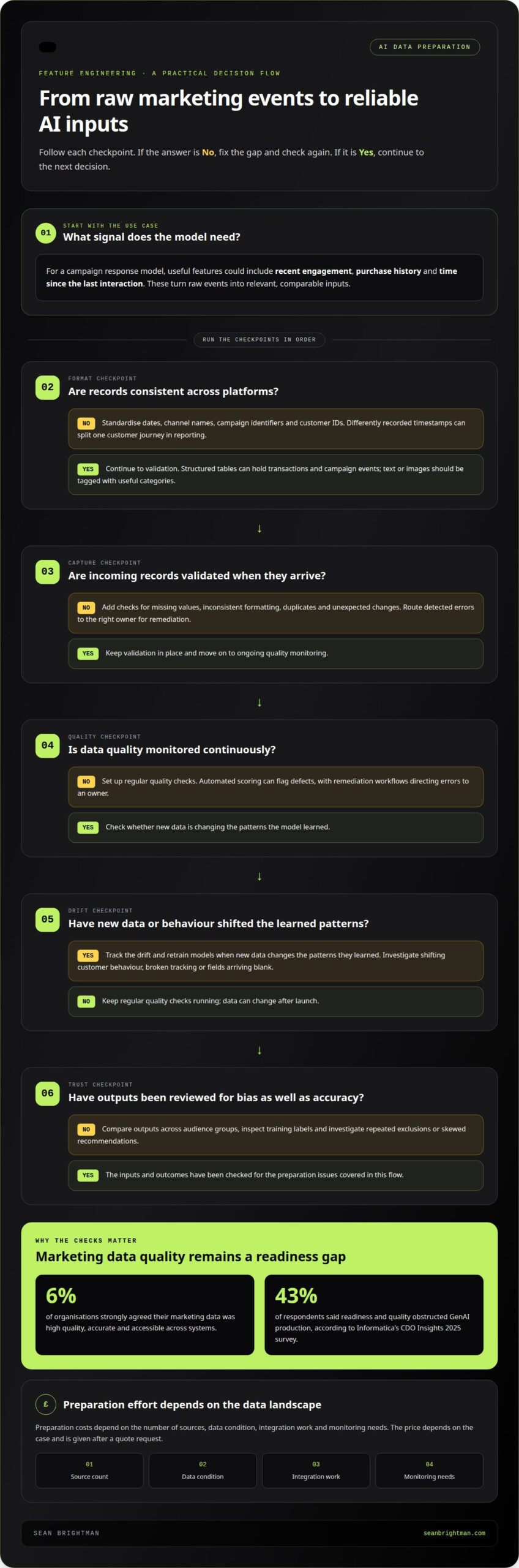
    AI marketing tools work best with consistent, clearly labelled records: structured tables for transactions and campaign events, plus text or images tagged with useful categories. Choose platforms that connect data sources and support access controls, lineage and audit trails. Preparation costs depend on source count, data condition, integration work and monitoring needs; the price depends on the case and is given after a quote request.

    1. Define the signal each model needs. For a campaign response model, engineer features such as recent engagement, purchase history and time since the last interaction. These turn raw events into relevant, comparable inputs.
    2. Standardise formats before feature creation. Align dates, channel names, campaign identifiers and customer IDs across platforms. A timestamp recorded differently in two systems can split one customer journey into misleading reporting.
    3. Build validation at the point of capture. Check incoming records for missing values, inconsistent formatting, duplicates and unexpected changes. Automated scoring can flag defects, while remediation workflows route errors to the right owner.
    4. Monitor quality continuously, not just before launch. Only 6% of organisations strongly agreed their marketing data was high quality, accurate and accessible across systems. Informatica’s CDO Insights 2025 survey found readiness and quality obstructed GenAI production for 43% of respondents.
    5. Track drift and retrain models when new data changes the patterns they learned. Regular quality checks can reveal shifting customer behaviour, broken tracking or a campaign field that suddenly arrives blank.
    6. Review generated content and model outcomes for bias as well as technical accuracy. Compare outputs across audience groups, inspect the labels behind training examples, and investigate repeated exclusions or skewed recommendations before using them in a campaign.

    How should companies approach data governance for AI initiatives?

    Governance makes marketing data traceable, controlled and fit for analytics tools and AI models. Build it into your data environment before connecting new applications.

    1. Track metadata and data lineage

      Map each important field from its original source to the analytics report or AI model that uses it. Record its owner, definition, update frequency, permitted uses and any transformations.

      Use shared definitions for measures such as campaign conversion, so teams don’t combine records based on different meanings. Version control and audit trails show what changed, when it changed and which outputs relied on that data.

    2. Govern data privacy and security

      Set access rules by role and purpose, then document who owns each dataset. Apply privacy controls to customer information and create policies that support GDPR compliance.

      Limit access to the fields an AI model needs. For example, campaign analytics may require purchase category and response history, not every detail in a customer record. Review permissions whenever data moves between platforms.

    3. Define accountability before putting a system under AI control. Name the people responsible for data quality, access approvals, model outputs and incident handling. Governance policies should cover data ownership, version control, audit trails, security and privacy.

      Set a review process for high-impact decisions. A human owner can check whether an output uses the intended data and whether its result should inform a marketing action. This gives teams a practical way to challenge errors.

    4. Make trust measurable. In a 2024 survey, 53% of business leaders said their organisation actively prioritised data management to reduce AI data-quality risks. Meanwhile, 78% of organisations do not yet trust agentic AI.

      Track access exceptions, unresolved lineage gaps and repeated output errors as governance signals. Adobe reports that 62% of consumers say transparency about AI use directly affects their trust. Explain where AI contributes to marketing decisions, and keep a record of the data and rules behind those decisions.

    How to Prepare Marketing Data for AI Around Business Goals

    Aligning AI data preparation with business goals

    Start with the business outcome, then prepare data to support it. To unify CRM, web analytics and advertising platforms, connect records through shared identifiers and definitions, while preserving their source and timing.

    1. Define the decision AI should improve. A churn objective, for example, needs data reflecting customer activity and retention outcomes, not just campaign clicks. Thirty-six per cent of UK organisations had AI projects fail because business problems were inadequately defined.
    2. Standardise metrics and business definitions

      Agree on the meaning of each metric before feeding it into an AI model. Define whether a conversion means a purchase, a signed agreement or another event, then apply that definition consistently across reports and teams.

      Use common naming conventions for fields such as campaign source and customer status. The Scottish Government notes that common standards can improve data quality and interoperability, making information easier to reuse and link.

    3. Unify marketing data sources

      Connect CRM records, web analytics events and advertising results through shared customer, campaign and time references. Preserve the original source and timestamp so teams can trace each interaction instead of losing useful context by flattening the data.

      Check that matching fields describe the same thing across platforms. A click in an advertising report and a visit in web analytics are different events, even when they belong to the same journey.

    4. Add business context and relevant history. A model assessing repeat purchases needs past purchase patterns and clear product category meanings. A short, disconnected snapshot can hide seasonal behaviour or shifts in customer intent.
    5. Give AI agents a shared business ontology, a structured account of entities, relationships and terms. Link concepts such as customer, account, product and campaign, and define how they relate. This helps an agent interpret existing data without confusing a lead with a customer.
    6. Evaluate outputs against business outcomes, not model activity alone. If a campaign platform optimises clicks, compare those results with the customer outcomes the business values. Keep the target metric visible in reporting and revise the data inputs when outputs miss the goal.

    Assessing marketing data readiness

    Start with a data audit, not an AI tool. Gartner’s Q3 2024 survey found 63% of organisations either lacked, or were unsure they had, suitable data management practices for AI.

    1. Inventory the sources that support one marketing decision. Include CRM records, spreadsheets, marketing platforms and customer support logs. Small businesses can start with first-party behavioural and transactional data, then expand once the first use case works.
    2. Audit each source for data type, storage location, access, ownership and update frequency. For example, note whether purchase history refreshes daily or only after a manual spreadsheet upload. These details show whether the information can support the intended action.
    3. Measure quality and completeness in critical fields. Count duplicates, missing values, inconsistent formats and outdated records. Use practical targets such as keeping customer data 99% duplicate-free and missing values below 1% in critical fields.
    4. Check whether records can be connected into a useful customer view. Identity resolution links a person’s interactions across systems, helping teams see a consistent history rather than isolated clicks or purchases. A clean, read-only profile refreshed nightly can be a manageable starting point.
    5. Match readiness to the AI capabilities required. A reporting assistant may need accurate campaign names and spend data; an agent taking action needs current customer data, defined permissions and reliable signals. Gartner predicted organisations would abandon 60% of AI projects unsupported by AI-ready data through 2026.
    6. Review readiness with business owners, not just technical teams. A 2024 survey found 73% of business leaders ranked data quality among their top AI concerns. Track gaps, assign owners and prioritise fixes by their effect on the chosen use case.
    7. Turn the audit into a practical roadmap before expanding scope. Map your AI readiness priorities into focused next steps.

    Sean Brightman

    Sean Brightman helps turn marketing data readiness into a practical AI plan tied to business priorities. If your data is spread across disconnected platforms, or teams can’t agree on what success means, AI Consulting can clarify the use case, capabilities and decisions that need support.

    Roadmapping can sequence the work: identify valuable data gaps, set governance priorities and define what to prepare before a model goes live. An Advisory Retainer provides ongoing strategic guidance as your needs and AI initiatives develop.

    The right next step depends on the bottleneck: unclear goals, fragmented data or a lack of implementation direction. If you’re ready to make those decisions, contact Sean Brightman to discuss your priorities.

    Make data readiness part of the operating plan

    Preparing your marketing data for AI isn’t a one-off clean-up. Treat it as an ongoing business capability, with clear ownership and regular decisions about which use cases deserve attention. As customer behaviour, campaign priorities and systems change, revisit whether the data still supports the decisions you want AI to improve.

    Choose one outcome and give it an accountable owner. That keeps the work grounded in business value instead of letting new tools dictate the agenda. Sean Brightman can help shape your strategy and decide how to move from data readiness to practical action.

    If you’re ready to set that direction, contact Sean Brightman to discuss your priorities. Start with the decision you want to improve, then build from there.

    Frequently Asked Questions

    What is AI-ready marketing data?

    AI-ready marketing data is information an AI tool can interpret and use for a defined task. It needs clear labels, usable formats and enough context to distinguish events, customers and outcomes. For example, product recommendations need meaningful product and purchase records, not an unlabelled export. Readiness depends on whether the data supports the intended decision, not simply how much information is stored.

    Does this differ for agencies and in-house teams?

    The foundations are similar, but ownership and access can differ. An in-house team usually works across its organisation’s systems and definitions. An agency may serve several clients, each with separate data permissions, reporting conventions and campaign goals. Keep client datasets distinct, document who can access them and agree how results are defined before combining information for analysis.

    How can organisations effectively handle unstructured data for AI applications?

    Structure unstructured material before using it. For support emails, label examples by topic or outcome; for customer feedback, use consistent sentiment categories. Text extraction can make documents searchable, while image labels can describe relevant visual content. Keep the original source attached to each record, and remove irrelevant or sensitive material before it enters a model workflow.

    Should you build the data pipeline yourself?

    Build in-house when your team can maintain the connections, transformations, monitoring and access controls the use case requires. A managed integration tool may suit standard sources and limited engineering capacity, but it still needs clear ownership. A sound plan for preparing your marketing data for AI considers ongoing maintenance, flexibility and auditability, not just setup speed. Either approach needs upkeep as platforms and data fields change.

    Why does AI get your marketing numbers wrong?

    AI can produce misleading figures when inputs use different definitions or contain incomplete records. For example, an advertising platform may count an attributed conversion differently from a CRM report of completed sales. Time periods, duplicate events and delayed updates can widen the gap. Trace the figure to its source, check the calculation and confirm both systems measure the same outcome.

    What does preparing marketing data for AI involve?

    Preparing your marketing data for AI means making information usable for a chosen task, not cleaning everything indiscriminately. The work can include selecting relevant sources, resolving inconsistent records, creating meaningful labels, setting access rules and testing whether outputs support the intended decision. For a small team, start with one clear use case and a manageable dataset, then expand as the process proves useful.