Tag: campaign planning

  • How to Align Marketing Strategy with Campaigns

    How to Align Marketing Strategy with Campaigns

    Campaigns don’t become strategy just because they perform. You know when to move from tactical to strategic marketing when activity no longer connects clearly to business goals, or when the goals themselves have shifted. Tactical work runs over weeks or months; strategic marketing looks further ahead and steers decisions towards outcomes that matter.

    It’s easy to get pulled into the next campaign, content deadline or channel report. Execution matters, but without a clear commercial purpose, a busy marketing team can struggle to show what its work is changing.

    This article explains how to make the shift: start with business goals, choose measurable outcomes and connect each campaign to the customer journey. You’ll also learn when to revisit your strategy, what to measure and how to keep marketing focused on impact, not just output.

    Key Takeaways

    • Start with the business outcome, then connect each campaign to the customer journey and the result it should drive.
    • Separate short-term execution from longer-term direction so campaigns support a clear plan, not just a busy calendar.
    • Revisit strategy once or twice a year, and use regular performance reviews to adjust tactics based on evidence.
    • Look for signs that activity isn’t producing meaningful business impact, then reset priorities, measures and ownership.

    How do you move from tactical to strategic marketing?

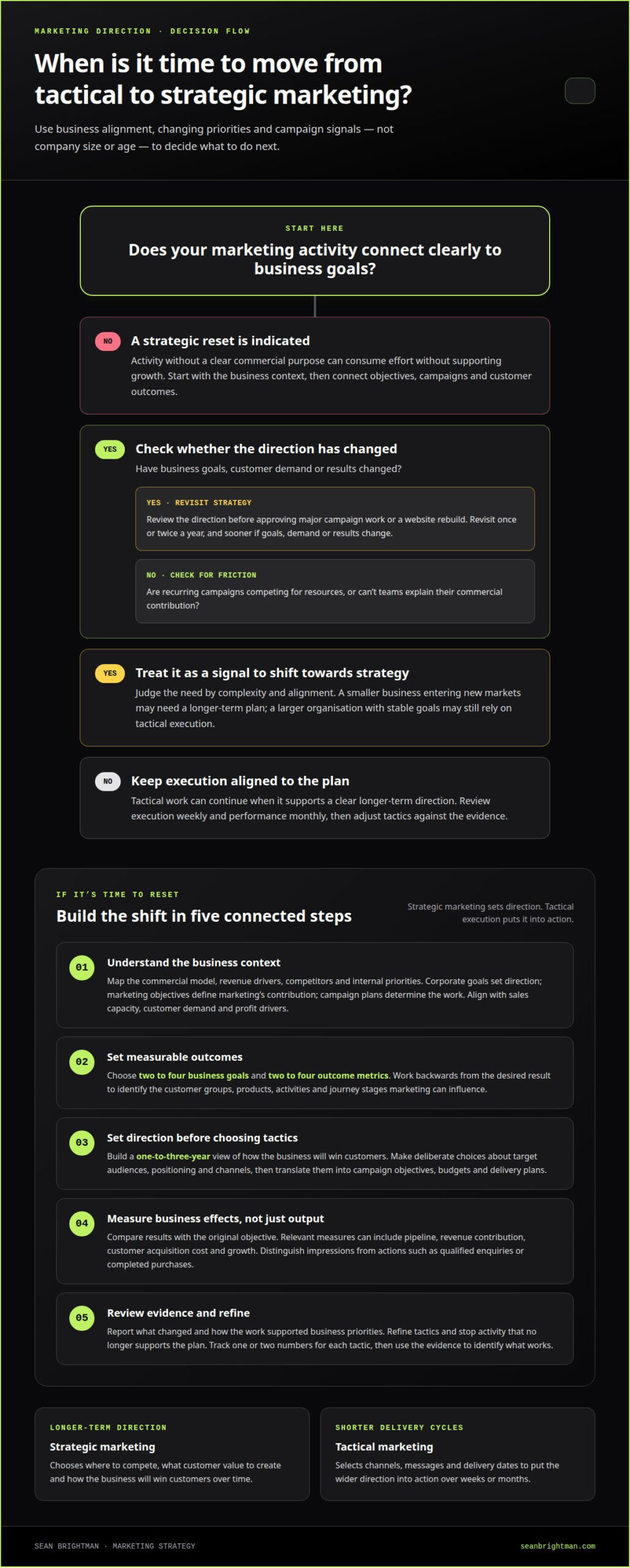
    Move towards strategic marketing when campaign choices need to support wider commercial priorities, not just immediate delivery. There’s no fixed growth stage for making the shift. Assess the business context, set outcomes, choose activity and measure the results.

    1. Understand the business context

      Map the organisation’s commercial model, revenue drivers, competitors and internal priorities. Then connect business planning to marketing: corporate goals set the direction, marketing objectives define its contribution, and campaign plans determine the work. Check that teams share the same priorities. Avoid planning channels in isolation from sales capacity, customer demand or profit drivers.

    2. Identify signs and growth stages

      Look for signs that recurring campaigns are competing for resources, teams can’t explain their commercial contribution, or business priorities have changed. These are stronger signals than company size or age. A smaller business entering new markets may need a longer-term plan, while a larger organisation with stable goals may still rely on tactical execution. Judge the shift by complexity and alignment.

    3. Set two to four measurable business goals, then choose two to four outcome metrics. For example, if the objective is to increase profit by 10%, assess which customer groups, products and activities can contribute. Work backwards from the desired result to define the customer journey, then identify where marketing can influence it. This replaces activity targets with business outcomes.
    4. Build a strategic plan around a one-to-three-year view of how the business will win customers. Make deliberate choices about target audiences, positioning and channels, then translate them into campaign objectives, budgets and delivery plans. Publishing two blog posts per month, for example, belongs in the plan only when its purpose and intended contribution are clear.
    5. Measure results against the original objective, not just completed outputs. Track relevant commercial effects, such as pipeline, revenue contribution, customer acquisition cost and growth. Report what changed and how the work supported business priorities. Review the evidence, refine tactics and stop activity that no longer supports the plan. Strategic marketing sets direction; tactical execution puts it into action.

    Strategic marketing versus tactical marketing

    Separate long-term choices from short-term actions. Strategic marketing sets the direction that tactical marketing serves.

    1. Compare planning time frames

      Set a longer planning horizon for strategic choices, then organise campaigns into shorter delivery cycles. Strategic marketing can define how the business will win customers over a one-to-three-year period, while tactics respond over weeks or months. A monthly email newsletter, for example, may support customer retention, but it isn’t the strategy itself. Check that each short cycle advances the longer-term direction.

    2. Distinguish planning approaches

      Start with the business position, target audience and intended outcome; choose tactics afterwards. Strategic planning decides where to compete and what customer value to create. Tactical planning selects channels, messages and delivery dates. Posting project photos on social media every week is an action, not a commercial objective. Before judging its value, connect it to a measure such as quote requests or conversions.

    3. Balance long-term plans with immediate needs

      Protect capacity for immediate demand whilst reserving deliberate effort for longer-term improvements. A small business might keep responding to current enquiries while improving its customer journey or positioning. Don’t let urgent tasks consume every planning session; equally, don’t pause useful activity for an abstract strategy exercise. For example, a tactical goal to increase quote requests by 25 percent this quarter can guide immediate work within the wider plan.

    4. Allow for the shift between approaches

      Build the change into existing planning and reporting rather than setting an arbitrary deadline. There’s no fixed duration for the shift: it depends on how quickly leaders agree priorities, teams connect activities to outcomes, and useful performance evidence becomes available. Review execution weekly and performance monthly, then adjust tactics against results. A clear marketing roadmap can help keep immediate decisions pointed toward longer-term goals.
    How to Align Marketing Strategy with Campaigns

    When to revisit strategy before campaigns or a website

    Review the direction before committing to major campaign work or a website rebuild. Revisit it once or twice a year, and sooner if business goals, customer demand or results change.

    Consider the risks of tactical focus

    Diagnose weak campaigns before adding more activity. Tactical work without a clear strategic link can consume effort without supporting growth, and reach alone doesn’t show whether people took action. Check whether campaigns attract the intended audience, convert leads into closed business and produce a return on investment. If results fall short, find where the customer journey breaks before changing channels.

    1. Compare performance with the campaign’s objective. For example, distinguish impressions from actions such as qualified enquiries or completed purchases.
    2. Track one or two numbers for each tactic. Use the evidence to identify what works, then refine or stop actions that miss their purpose.

    Revisit strategy before new activity

    Review the strategy before approving a campaign or website if its audience, offer or business goal has shifted. A new design can’t fix unclear positioning, and another campaign won’t repair a customer journey that loses people. Check that the proposed work supports the brand promise and addresses the right customer need.

    1. Map the customer journey across relevant touchpoints. Check whether each stage delivers on the promise and gives customers a clear next action.
    2. Build a repeatable campaign system: review execution weekly, assess performance monthly and record decisions. Scale effective work with clear ownership and governance, rather than relying on individual memory.
    3. Reassess the strategy once or twice a year, or when evidence points to a material change. Connect each campaign’s results to the strategic plan, then update priorities before committing further effort.

    What signs indicate a business should move from tactical to strategic marketing?

    Use these signals to decide whether marketing needs clearer direction, not simply more activity. One weak campaign isn’t enough; look for patterns across priorities, customers and commercial results.

    1. Check whether campaign briefs start with channels or business priorities. If teams repeatedly launch activity without agreeing on its purpose, reset the planning process. For example, content needs a clear connection to customer demand, not just a place in the calendar.
    2. Compare marketing targets with actual market capacity. One example sets a target of selling 1,000 more products in Market A within 12 months. The same example says demand cannot support 2,000 additional sales. That gap calls for strategic choices, not simply more campaign output.
    3. Test whether growth plans account for operational needs. In the Market A example, selling 1,000 more products would increase profits by 7%, but requires three new sales team members. If marketing plans ignore delivery capacity, expected growth and commercial reality can pull apart.
    4. Review whether customer targeting reflects who buys and why. A defined audience, such as professional women over 45 who pay for childcare, gives campaigns a sharper focus. Revisit strategy when teams cannot explain who they want to reach or what those customers value.
    5. Look beyond reach when judging campaign performance. Impressions show exposure; actions show whether people respond. Track pipeline created, conversion by stage, customer acquisition cost or cost per pipeline. If reports show activity but leaders can’t see its commercial effect, strengthen the link between marketing and business outcomes.
    6. Check whether the organisation’s priorities still match its marketing choices. A change in target market, competitive position or internal priorities can make yesterday’s campaign plan obsolete. Bring forward a strategy review when teams keep adjusting tactics without a shared reason for the changes.
    7. Assess whether marketing contributes ideas, not just completed briefs. Strategic teams raise opportunities, challenge assumptions and recommend actions proactively. If marketers spend all their time executing requests, make room for commercial analysis and stakeholder discussions before approving the next campaign.

    Sean Brightman

    Sean Brightman helps businesses turn marketing priorities into clear direction and practical next steps. If campaigns keep moving but their connection to commercial goals remains uncertain, Roadmapping can bring those priorities into focus. An Advisory Retainer provides ongoing strategic input as business needs and marketing decisions evolve.

    For businesses exploring how AI fits their marketing approach, AI Consulting can help assess the opportunity against wider objectives. The right next step depends on the challenge: clarify the direction, make better-informed decisions or keep strategic thinking connected to execution.

    If you’re ready to discuss your marketing direction, contact Sean Brightman.

    Make the next campaign a strategic choice

    Before approving your next campaign, write down the business decision it needs to support. Name the customer behaviour you want to influence, the evidence that would show progress and what you’ll change if the response falls short. This short test turns strategy into a working tool, not another document on a shelf.

    Deciding when to move from tactical to strategic marketing is only the start. The real test is whether leadership can keep priorities clear while campaigns adapt to customer behaviour. If direction, execution and accountability are pulling apart, Sean Brightman can help bring them back into alignment. A Fractional CMO provides strategic leadership; Roadmapping clarifies priorities and next steps; AI Consulting helps assess how AI fits your business objectives.

    Contact Sean Brightman to discuss your marketing direction. Make the next move with purpose, then put it to work.

    Frequently Asked Questions

    Which metrics matter most for strategic marketing?

    Prioritise metrics that reveal where commercial progress stalls. Pipeline contribution can show whether marketing creates sales opportunities; conversion by stage can reveal where prospects drop away. Retention and expansion contribution help assess ongoing customer value. If opportunity numbers rise but fewer progress to sale, for example, investigate that stage before increasing lead-generation activity.

    What Actually Changes When Marketing Becomes Strategic?

    Decision-making changes first. Teams bring commercial context and recommendations into planning instead of waiting for a campaign brief. Leaders discuss trade-offs, agree on ownership and use results to decide what continues. For example, a marketing review might recommend pausing a familiar activity to test a stronger customer proposition. The shift is from completing requests to influencing choices and taking responsibility for outcomes.

    What causes teams to fall back into tactical mode?

    Urgent requests, fragmented ownership and pressure to show visible activity can crowd out strategic work. Teams may default to producing deliverables because output is easy to report, while cross-functional decisions take longer. For example, sales may request a new campaign before agreeing which customer problem it should address. Protect time for planning and commercial discussion, or short-term requests will set the agenda.

    What is tactical marketing in simple terms?

    Tactical marketing is the specific work a team carries out to reach customers or prompt an action. A limited landing-page test, for example, can compare two messages for the same offer. It has a defined audience, channel and task. The tactic describes what the team will do; it doesn’t, by itself, explain why that action deserves priority.

    What is the difference between tactical and strategic marketing?

    Strategic marketing makes the choices that guide the work; tactical marketing puts those choices into action. For example, a business might choose to compete through specialist expertise, then develop proof points and customer communications to demonstrate it. The strategic choice shapes what the team says and to whom. Without that direction, separate campaigns can send inconsistent signals.

    How do you assess whether marketing tactics are supporting long-term business goals?

    Trace each tactic from its intended customer response to a business outcome, then review the evidence. For a product launch, map how a prospect discovers the offer, evaluates it and reaches a purchase decision. Check whether the tactic supports a relevant step and whether the results available show progress. If the link is unclear, revise the activity or its purpose before repeating it.

  • How to Build an Annual Marketing Strategy Presentation with Objectives, Budgets and KPIs

    How to Build an Annual Marketing Strategy Presentation with Objectives, Budgets and KPIs

    An annual marketing strategy presentation should do more than list campaigns. It should connect objectives and audience insight to channel choices, budget, timelines and KPIs, with clear ownership for the work. Without those links, polished slides still won’t guide decisions.

    The challenge isn’t finding more information to squeeze in. It’s making the plan clear enough to act on and accountable enough to measure. This guide covers what to include in an annual marketing strategy presentation, from focused objectives and audience definition to budget allocation and performance tracking. It also shows how to turn strategy into a working plan with timelines, responsibilities and regular reviews. Keep the story tight: explain what matters, why it matters and who owns the next move.

    Key Takeaways

    • Shape the presentation around a clear business story, using visuals to make the central message easy to grasp.
    • Turn the plan into a workable roadmap by connecting campaign milestones, budget choices and performance measures.
    • Ground objectives and channel tactics in audience research, so each activity has a clear purpose.
    • Assign ownership to each KPI and review progress regularly, making it easier to adjust the plan when results change.

    What should be included in a marketing presentation?

    Build the marketing plan presentation as a decision tool, not a slide archive. Give every slide a purpose, from explaining the opportunity to securing a clear next step.

    For UK annual campaigns, include a compliance checkpoint before launch. Review campaign claims, audience data and channel requirements against applicable UK rules, then record the approval and supporting evidence.

    1. Shape the marketing strategy deck

      Start with the decision the marketing strategy presentation must support. Give the opening slide its key message, then summarise the objective, audience and requested action. Keep the executive-summary delivery under 60 seconds. Use one slide, or at most two, for market context, then connect evidence to the proposed choice.

      Build a simple story: the business challenge, the audience insight, the response and the intended result. For example, link a customer retention issue to a relevant campaign, channel and measure. Choose a template that supports this sequence, and don’t add slides just because the template includes them.

    2. Design and deliver the presentation

      Make each slide readable from the back of the room. Replace dense text with visuals, such as a channel diagram, audience segment or budget breakdown. Apply brand colours consistently using PowerPoint Slide Master settings. Check contrast, labels and chart scales before presenting: a polished layout cannot rescue confusing evidence.

      Use animation only to reveal information in sequence. A Morph transition can show how a plan changes between stages, but skip it if the movement distracts from the point. Rehearse your spoken explanation alongside the slides. For example, explain what a performance chart means before asking the audience to approve its next action.

    3. Use Copilot to draft and adapt slides

      Use Microsoft Copilot to draft content from approved marketing-plan material or adapt existing slides for a different audience. Give it a precise task, such as turning a campaign brief into a channel summary. Then check every claim, figure, chart label and recommendation against the source material.

      Keep human judgement in charge. Copilot can help organise content, but the presenter must make the business logic clear. Remove generic wording, correct errors and ensure the final deck supports the decision being requested.

    Implementation timelines, budgets and performance metrics

    Connect objectives to a budget, delivery timeline and measurable outcomes. Compare planned metrics with previous years and report progress consistently. UK Government guidance recommends consistent metrics to assess communication effectiveness.

    1. Set marketing goals and budgets

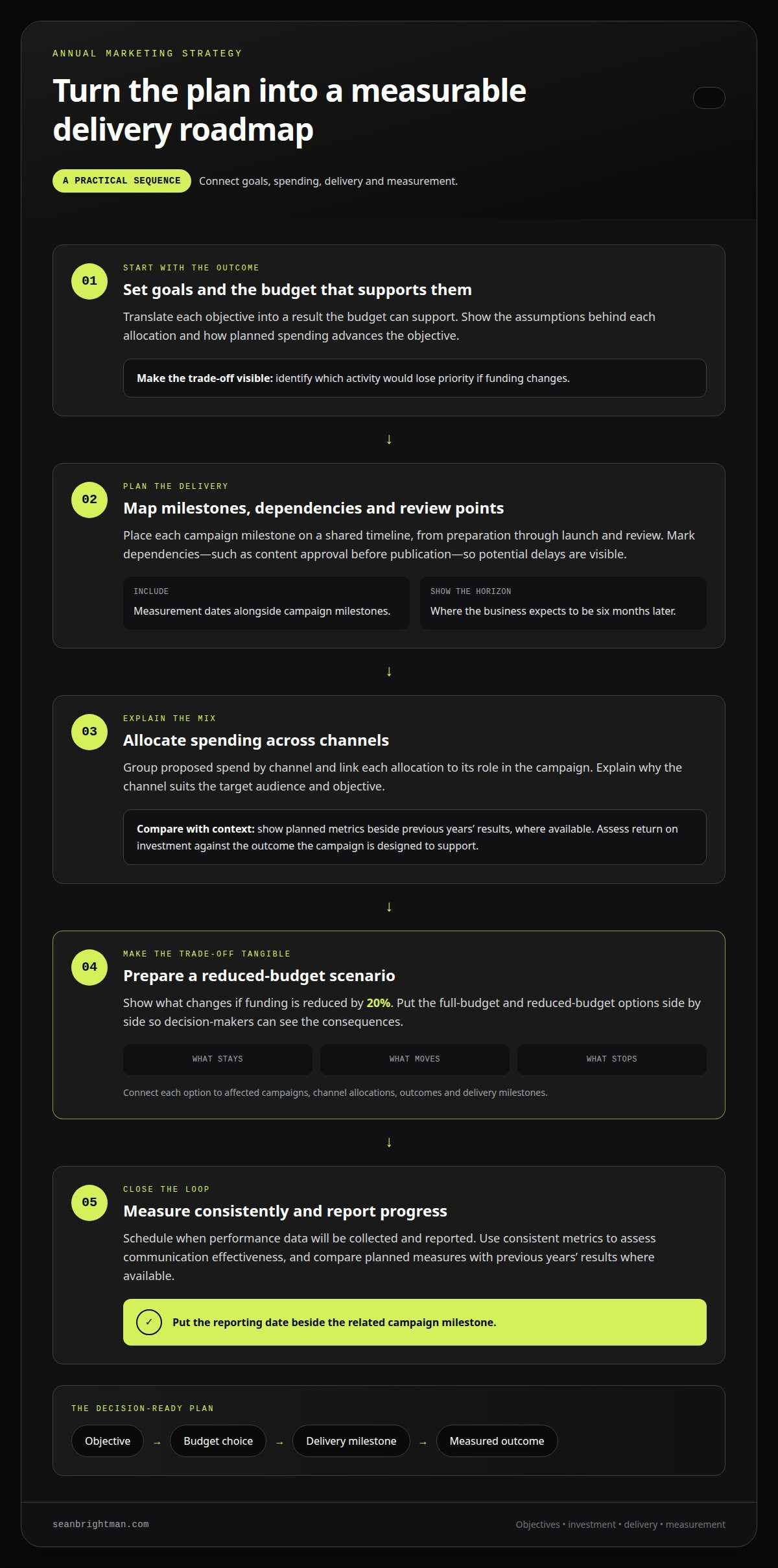
      Translate each objective into a result the budget can support. For example, connect a customer-retention objective to the campaigns, channels and resources needed to pursue it. This makes trade-offs visible and gives decision-makers a reason to approve or reshape spending.

      Show the assumptions behind each allocation, including what the campaign needs to run. Don’t present a budget as a standalone total. A clear summary shows how planned spending supports objectives and which activity would lose priority if funding changes.

    2. Map implementation timelines

      Place each campaign milestone on a shared timeline, from preparation to launch and review. Mark dependencies, such as content approval before publication, so delays become visible before they disrupt delivery. A roadmap can also show where the business expects to be six months later.

      Use the timeline to schedule measurement, not just activity. UK Government guidance notes that timelines can help determine when to collect performance data. Set each collection point alongside the related campaign milestone, then show the reporting date in the presentation.

    3. Allocate budgets across channels

      Group proposed spending by channel and connect each allocation to its role in the campaign. Use charts to show the distribution, then explain why each channel suits the target audience and objective. Assess return on investment against the outcome the campaign is designed to support.

      Keep comparisons practical: show planned metrics beside previous years’ results, where available, and explain what the figures mean for the next decision. A chart should clarify trade-offs, not imply that a channel works independently of the wider marketing mix.

    4. Address budget objections with scenarios

      Prepare a clear alternative before presenting the budget. Show what changes if funding is reduced by 20%, including which campaigns, channel allocations or outcomes would be affected. That scenario lets decision-makers assess consequences instead of cutting spend without a plan.

      Present the full-budget and reduced-budget options side by side. State what stays, what moves and what stops in each version. A marketing roadmap can help connect those choices to delivery milestones and measurement.

    How to Build an Annual Marketing Strategy Presentation with Objectives, Budgets and KPIs

    Marketing objectives, audiences, strategies and tactics

    Build the plan on market evidence, then connect each audience insight to an objective and practical action. This keeps tactics grounded in who you need to reach and why.

    1. Analyse the market and define audiences

      Start with focused market analysis, using SWOT or PEST to frame relevant conditions. Identify the opportunity, competing alternatives and customer needs that shape your plan. Don’t treat broad market trends as proof that every buyer wants the same thing.

      Define the target audience using evidence, such as customer research and existing engagement data. For example, compare how audience groups respond to social media with those arriving through Google. Use the differences to guide channel choices, rather than assuming one channel suits everyone.

    2. Develop target audience personas

      Turn useful audience evidence into buyer personas that describe real decision patterns. Include demographic and psychographic characteristics, shopping practices, channel use and responses to advertising. A persona should help the team decide what message to deliver and where, not become a fictional biography.

      For example, distinguish a research-led buyer who compares options from a returning customer seeking a straightforward repeat purchase. Connect each persona to content and an action that fit its behaviour. Refresh the profiles when campaign responses reveal a meaningful change.

    3. Set marketing objectives

      Choose three to five core business objectives for the marketing plan presentation. Make each specific enough to guide a decision, such as improving customer retention or attracting a defined audience. Link every objective to the business goal it supports.

      Separate outcomes from activity. “Publish social media content” describes a task; attracting qualified enquiries describes an intended outcome. State the starting point, desired direction and measure for each objective, so the team can judge progress rather than simply count completed tasks.

    4. Choose strategies and tactics

      Organise the plan into two to four strategic initiatives, each tied to an audience and objective. Explain why the strategy fits the market evidence, then list the tactics that put it into action. The 7Ps can help structure decisions across product, price, place and promotion, alongside the other elements.

      For example, a retention initiative might use customer-focused email content and supporting social media posts. Specify the content type, channel and intended audience for each tactic. Don’t add activity without a clear purpose: every action should advance an initiative and be easy to assess.

    Marketing objectives, KPIs and accountability

    KPIs make an annual marketing plan accountable, not just ambitious. Define a measure, owner and review action for every objective.

    1. Pair each objective with a KPI that shows progress towards its intended outcome. For a digital marketing campaign, track qualified enquiries rather than counting posts alone. Keep the measure relevant to the objective and explain how the team will use it to make decisions.
    2. Record the starting point and measurement method beside each KPI. If a social campaign aims to increase engagement, define which interactions count and where the data comes from. UK Government guidance recommends consistent metrics for measuring communication effectiveness. Stable definitions make comparisons more useful.
    3. Name one owner for each KPI and identify contributors to the work. The owner brings the figure into the review; contributors explain delivery factors. For example, a content lead can report engagement while the campaign owner connects the result to the objective.
    4. Set a review cadence that matches campaign activity and data availability. At each review, record the result, explain the gap against the plan and agree an action. If engagement rises but qualified enquiries don’t, investigate the audience, message or next step before changing direction.
    5. Build a concise PowerPoint overview around decisions, not a wall of charts. Show the KPI, its trend, owner and next action together. Keep measures current because useful KPIs vary by business and campaign. An engaging report tells leaders what changed and what happens next.

    To develop a KPI-led roadmap with clear ownership, build your marketing roadmap.

    Sean Brightman

    Sean Brightman helps turn marketing strategy into clear priorities, decisions and next steps. When objectives, budgets and KPIs feel disconnected, Roadmapping can bring them together in a coherent plan. An Advisory Retainer provides ongoing strategic input as priorities shift and performance reviews raise new questions.

    For teams assessing how AI could support marketing work, AI Consulting can clarify where it fits the strategy. The right next step depends on the challenge: planning a new direction, keeping execution aligned or evaluating AI’s role. The focus is on practical choices and accountable action, not another deck that sits untouched.

    Contact Sean Brightman to discuss your marketing strategy.

    Make the plan work beyond the presentation

    The real test starts after approval: does the plan shape decisions people make each week? Treat the annual marketing strategy presentation as a working commitment, not a finished document. When priorities shift, update the choices and keep the reasoning visible. This gives the team a practical basis for action without losing sight of the agreed direction.

    Sean Brightman offers Fractional CMO support, AI Consulting and Roadmapping for businesses that need to align strategy with action. These services suit different challenges, from setting marketing direction to assessing AI’s role or structuring a plan. Choose the conversation that matches the decision in front of you.

    Contact Sean Brightman to discuss your strategy. A clear next step can turn a presentation into purposeful progress.

    Frequently Asked Questions

    What should an annual marketing strategy presentation include?

    Include the decisions leaders need to make, not every detail behind the work. An annual marketing strategy presentation can include a decision log showing the choice required, the person responsible and the approval deadline. Note assumptions that could change the plan, such as a product launch date moving. This helps the team distinguish firm commitments from proposals still awaiting a decision.

    How do you structure an annual marketing strategy presentation?

    Arrange the slides so each section answers a natural follow-up question: what is changing, what should the business do, and what decision is needed now? Put supporting detail after the core argument instead of opening with background data. For a leadership meeting, end with a short list of approvals and unresolved decisions. This gives attendees a clear route from discussion to action.

    How do you set annual marketing objectives and KPIs?

    Start with a business priority and define the marketing contribution it needs. For example, if the priority is improving repeat purchases, choose a measure that reflects returning customers rather than general website visits. Add a data source and reporting owner to each KPI. Before setting a target, check that the team can collect the measure consistently and act on the result.

    How do you analyse market trends and competitors for an annual marketing strategy?

    Compare external signals with evidence from your own customers before changing direction. Review competitor messaging, offers and channel activity, then note what appears to be changing and what remains consistent. Check those observations against customer feedback, sales conversations and search behaviour. The aim isn’t to copy a rival; it’s to identify a customer need your positioning may be missing.

    How do you define target audiences and customer segments?

    Group customers by meaningful differences in needs, buying behaviour or decision barriers. For example, distinguish first-time buyers who need product education from returning customers who already understand the offer. Check whether each segment needs a distinct message or journey. If two groups respond to the same proposition and action, splitting them further may add complexity without improving campaign decisions.

    How do you create an annual marketing channel and campaign plan?

    Start with audience needs and the campaign outcome, then choose channels that can deliver the right message in context. Give each campaign a brief covering its audience, proposition, content, owner and intended action. Map dependencies such as asset approval or landing-page preparation. This reveals operational gaps early and helps teams coordinate campaigns instead of competing for the same resources.

  • How to Set Marketing Team Objectives and Key Results That Align

    How to Set Marketing Team Objectives and Key Results That Align

    Marketing objectives should drive business results, not just collect vanity metrics. Setting marketing team objectives and key results means pairing a clear, qualitative objective with measurable key results that show progress. When targets reflect wider business priorities, they guide the team’s work and define how success is judged.

    It’s easy to fill a plan with activity: more posts, clicks or campaigns. But activity matters only when it moves the business towards a meaningful outcome. The challenge is choosing targets that are ambitious enough to matter and realistic enough to pursue.

    This guide explains how marketing objectives shape strategy, how to set specific, achievable goals, and how to monitor performance and adapt. You’ll learn to connect targets to business priorities, choose measures that reveal progress, and keep the team focused on outcomes rather than busywork.

    Key Takeaways

    • Connect each marketing objective to a wider business priority, so the team knows what its work is meant to move.
    • Turn broad ambitions into SMART objectives with clear measures and deadlines.
    • Review campaign data against key results, then adjust tactics when performance or conditions change.
    • Set targets against current performance, team capacity and available resources to keep ambition achievable.

    How Do Different Goals Influence Overall Marketing Strategy?

    Start by tracing each marketing target back to a business priority. That connection turns strategy into focused work instead of a list of disconnected campaigns.

    1. Distinguish Marketing Goals from Objectives

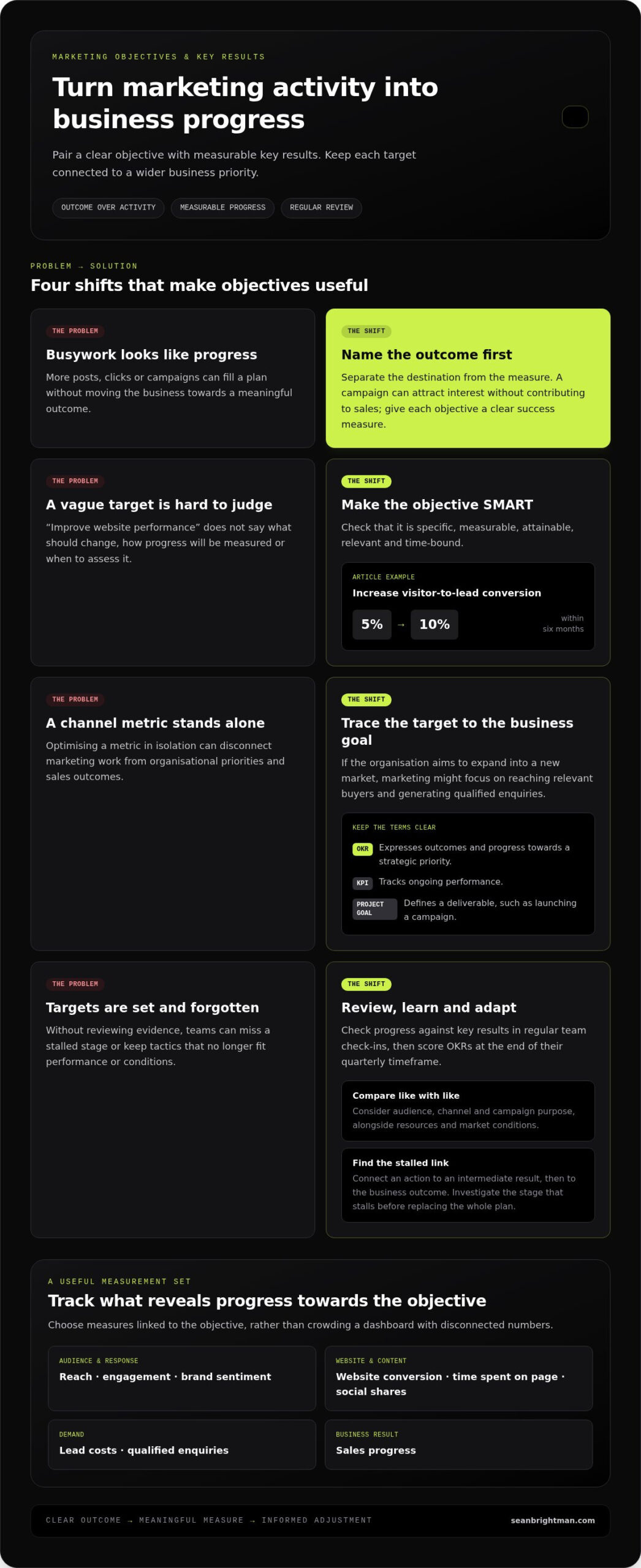
      Separate the destination from the measure. A marketing goal can describe a qualitative ambition, such as strengthening trust, while an objective makes progress measurable, such as improving customer retention. Give each objective a clear success measure. Publishing posts or running advertising is activity, not the outcome. A campaign, for example, can attract interest without contributing to sales.

    2. Align Objectives with Business Goals

      Choose the business result marketing must support, then define an objective around its contribution. If the organisation aims to expand into a new market, marketing might focus on reaching relevant buyers and generating qualified enquiries. Check the connection with sales and other teams: an objective should support organisational priorities, not optimise a channel metric in isolation. Explain how its measure signals progress towards the wider goal.

    3. Connect OKRs with Company Strategy and Sales

      Build each OKR around a strategic priority and a sales outcome. For example, if the company needs stronger sales from a new offer, make that the objective and use measurable key results to track qualified leads or sales progress. Marketing OKRs express outcomes and progress; KPIs track ongoing performance, while project goals define deliverables, such as launching a campaign. OKRs commonly run quarterly. Set only objectives and key results the team can own and review meaningfully.

    4. Communicate Goals and Their Purpose

      Record each objective, key result, owner and business rationale in one shared team tracker. An OKR document or project-management board keeps progress visible; the right tool is the one your team will update and use in reviews. Explain how each measure connects marketing activity to sales or strategy, and invite team members to flag dependencies. This clarity helps everyone understand their role and what success looks like.

    What are marketing objectives?

    A marketing objective turns a business priority into a measurable target. A practical approach to setting marketing team objectives and key results starts by naming the outcome, then deciding how the team will recognise progress.

    1. Brainstorm SMART Marketing Objectives

      Begin with a business objective, then identify the audience behaviour marketing can influence. If the priority is stronger brand awareness, consider recognition among target buyers or relevant social media engagement. If it is conversion, focus on moving interested prospects towards an enquiry or purchase. Ask the people delivering the work to suggest possible measures. Don’t choose a metric simply because it is easy to collect.

    2. Apply SMART Criteria to Objectives

      Test every draft against five checks: specific, measurable, attainable, relevant and time-bound. Replace “improve website performance” with a defined target, such as increasing visitor-to-lead conversion from 5% to 10% within six months. Next, check the baseline, available resources and the team’s influence over the result. A deadline without delivery capacity is wishful thinking; a measure without a connection to business objectives is noise.

    3. Explore Marketing OKR Examples

      Use the objective to state the outcome, then key results to show evidence of progress. For brand awareness, aim to strengthen recognition and track relevant audience reach. For demand generation, focus on qualified enquiries and follow their progress into sales conversations. For retention, target stronger customer loyalty and track repeat purchasing behaviour. Keep measures tied to outcomes, not simply activity volume.

      Common mistakes include vague outcomes, vanity metrics, targets disconnected from business priorities and results the team cannot influence. Treat setting marketing team objectives and key results as a working process: test whether each measure guides a useful decision. If your objectives need a clearer route into delivery, a marketing roadmap can connect priorities, measures and work.

    How to Set Marketing Team Objectives and Key Results That Align

    Monitoring performance and adjusting strategy

    A marketing strategy sets out how to reach prospective customers and turn them into sales. Monitor whether its actions move people through that journey, then adjust based on evidence.

    Review and Update OKRs

    1. Review progress against each key result in regular team check-ins, then score OKRs at the end of their quarterly timeframe. Compare actual results with the intended outcome and record what changed and why. According to NHS, OKRs can measure activities contributing to strategic focus areas and workstreams.
    2. Set realistic targets using previous campaign performance as a baseline. Compare like with like, including audience, channel and campaign purpose, then factor in available resources and market conditions. Historical data shows what your team has achieved. Relevant benchmarks can add context, but neither should replace a clear business rationale.

    Use Performance Data to Adjust Strategy

    1. Track metrics linked to each objective, not a dashboard crowded with disconnected numbers. For example, assess lead costs, website conversion, reach and engagement alongside sales progress. Review content performance through time spent on page and social shares. Brand sentiment analysis can also reveal how people respond to your message.
    2. Map cause and effect before changing tactics. If awareness is meant to create qualified interest, which should then lead to enquiries, measure each link in that chain. A strategy map makes the connections visible: an action should influence an intermediate result, which supports the business outcome. If one link stalls, investigate that stage before replacing the whole plan.
    3. Use campaign analytics to decide whether to refine a channel, message or audience. Compare results with KPIs and previous campaigns, then document the change and its expected effect. Effective marketing tests actions against evidence instead of defending a tactic simply because the team has already invested time in it.

    Keep the plan current: revisit goals and objectives using analytics and check-ins, and let feedback, results and future projections guide revisions.

    Setting specific and achievable marketing objectives

    Set objectives based on evidence, not optimism. Effective marketing OKRs link a business outcome to measurable results, a clear owner and work the team can realistically deliver.

    1. Start with the audience and business outcome. Identify whose behaviour needs to change, then choose a result marketing can influence. For example, if the target audience visits your site but rarely enquires, focus on conversion instead of adding unrelated campaigns. Audience research helps reveal the needs, preferences and behaviour behind the numbers.
    2. Benchmark current performance before choosing a target. Compare like-for-like periods and channels, then account for seasonality, campaign history, team skills, budget and available tools. A target of increasing website traffic by 20% within six months is meaningful only if the baseline and planned activity make that lift achievable.
    3. Work backwards through the customer journey. Start with the sales outcome, then estimate the leads, traffic and awareness needed to support it. Check each step with sales and the people delivering the work. If the plan depends on everyone changing several priorities at once, narrow the objective or adjust its scope.
    4. Choose key results that measure outcomes, not just effort. “Publish more content” describes an action; “generate 100 new leads per month through content marketing” gives the team a result to track. Set ambitious stretch targets, but keep them grounded in capacity and evidence. OKRs commonly use stretch targets teams expect to achieve at 40-70%.
    5. Write the objective, key results, owner, timeframe and dependencies together. Then ask the team whether the actions and resources match the target. If not, revise the target or remove competing work before the cycle starts. For a clearer plan connecting priorities to execution, build a marketing roadmap.

    Even when the right target is uncertain, set specific, measurable, numerical goals and use the results to iterate. A key result might be for repeat customers to account for 25% of sales; other examples include increasing social media followers by 15% over six months or securing media coverage in three industry publications within the next quarter.

    Set goals for each stage of the customer journey, so marketing and sales contribute throughout rather than focusing on selected stages. For funnel goals, start with sales targets and work backwards to the leads, traffic and awareness needed to support them.

    Sean Brightman: AI Consulting

    Sean Brightman’s AI Consulting can help you assess how practical AI systems could support marketing priorities and objectives. Explore where AI fits your strategy, keeping the focus on useful outcomes rather than adopting tools for their own sake.

    If objectives lack a clear route to delivery, Roadmapping can connect priorities with the work needed to move them forward. An Advisory Retainer provides ongoing strategic input as plans evolve. Choose support that matches the challenge: exploring AI’s role, turning objectives into a roadmap or maintaining strategic direction.

    Bring a defined marketing challenge and the business outcome you want to support. That gives the discussion a practical starting point. Visit seanbrightman.com to get in touch with Sean Brightman.

    Turn your objectives into the next decision

    Next, make your objectives part of how the team chooses and prioritises work. Before adding a campaign, ask which outcome it supports, who owns the result and what should stop if priorities shift. This discipline keeps strategy connected to daily decisions instead of leaving it on a planning document.

    The value of setting marketing team objectives and key results lies in making trade-offs visible. If your team needs senior marketing direction, Sean Brightman offers Fractional CMO support. Roadmapping can connect priorities to execution, while AI Consulting can help assess where practical AI systems fit your marketing work.

    Choose the support that matches the challenge in front of you. Contact Sean Brightman to discuss your marketing priorities. Make the next move with focus, and give the team a clearer path forward.

    Frequently Asked Questions

    How to Streamline Goal Setting in Marketing?

    Make goal setting more efficient by gathering business priorities and campaign evidence before the planning discussion. Ask sales which customer objections or lead-quality issues matter most, then use that input to shape marketing’s contribution. Record each proposed objective, decision-maker, data source and dependency in one shared document. This preparation keeps the discussion focused on decisions, rather than reconstructing context.

    What Key Performance Indicators Should Teams Monitor?

    Monitor indicators that match the work’s place in the customer journey. For a paid campaign, click-through rate shows whether an advert attracts clicks, while Return on Ad Spend measures revenue generated per pound invested in advertising. Pair these with a quality or conversion measure so rising traffic doesn’t disguise weak enquiries. Choose a small, relevant set for each campaign and apply its definitions consistently.

    What does a good team goal setting framework look like?

    A practical framework connects business priorities to team objectives, measurable results, named owners and supporting work. Record dependencies, decision rights and progress in a shared place, so contributors know where to raise blockers. For example, a product launch objective might depend on sales enablement and website updates. Review OKRs over a quarterly cycle, then carry forward only priorities that remain relevant.