
Tag: commercial outcomes

  • Reducing Marketing Budget Waste: Find the Leaks Before You Cut

    Reducing Marketing Budget Waste: Find the Leaks Before You Cut

    Cutting the marketing budget can make the spreadsheet look healthier whilst quietly weakening growth. If you’re reducing marketing budget waste, start by finding where spend loses momentum, not by slashing activity that may be working.

    The frustration is familiar: marketing uses budget, but its contribution to revenue is hard to pin down. Teams, agencies, channels and tools each tell a different success story. Under pressure, it’s tempting to cut what’s difficult to measure, even when it supports the business.

    This article shows you how to separate avoidable waste from useful investment, then decide what to fix first. You’ll learn to examine measurement gaps, targeting, messaging, tools and budget ownership using evidence and commercial context rather than guesswork.

    The goal isn’t a smaller budget for its own sake. It’s a clearer decision system: one that links marketing choices to business priorities, turns findings into a prioritised plan and builds regular accountability. That way, each review improves the next decision instead of resetting the conversation every quarter.

    Key Takeaways

    • Spot leaks across measurement, channel choices, tools and hand-offs, not just visible campaign spend.
    • For reducing marketing budget waste, assess performance against commercial outcomes rather than relying on a single metric.
    • Reconcile spend and reporting over a period that fits your sales cycle before acting on apparent underperformance.
    • Prioritise changes by evidence, likely impact, reversibility and how quickly you can learn from them.
    • Keep a decision log with owners, assumptions and review points so each budget decision informs the next.

    Reducing marketing budget waste starts with finding the real leak

    Pressure to cut spend often arrives before anyone can explain what the budget is doing. An across-the-board reduction may look decisive, but it can remove effective investment alongside genuine inefficiency. Disciplined optimisation starts by tracing the leak and fixing its cause. It doesn’t treat every unclear result as proof that activity should stop.

    Marketing budget waste is spend disconnected from a clear objective, useful learning or a credible contribution to commercial goals. That definition matters because weak measurement creates uncertainty, not a verdict. If a campaign’s results aren’t tracked properly, the first problem may be the measurement setup, not the campaign itself. Understanding marketing effectiveness means judging activity against its purpose and role in the wider marketing effort, not just its easiest-to-count output.

    What counts as marketing budget waste?

    Look for avoidable spend in the machinery around marketing as well as in channels. A team might pay for a tool no one uses, commission separate teams to produce near-identical assets, or run campaigns without agreeing who owns the outcome. These are different problems: process waste, channel underperformance and weak strategic fit each call for a different fix.

    A low short-term return isn’t automatically waste. A test that rules out a weak message can provide useful learning; brand activity may also support a customer journey that takes longer to convert. Ask whether there was a clear reason to spend, a way to learn and a sensible link to business priorities.

    Why cutting the budget is not the same as reducing waste

    Equal percentage cuts ignore differences in purpose and performance. They can shrink a proven source of demand just as readily as they remove duplicated work. Cheap leads can also distract from lead quality, whilst activity metrics such as clicks say little on their own about commercial contribution.

    Judge investment against the business goal, the customer journey and the time needed to observe an outcome. A short reporting window may miss a longer sales cycle; a longer one may hide a problem that needs attention now. Make the distinction clear: stop confirmed waste, investigate uncertain performance, and protect activity with a credible strategic role. That’s the starting point for reducing marketing budget waste without cutting growth potential by guesswork.

    Where marketing budgets leak: measurement, hand-offs, and misplaced activity

    Budget leaks rarely sit in one neat line on a report. They build where strategy, channel choices, measurement and delivery fail to connect. A campaign may have a clear objective, but if its results don’t reach the team planning the next activity, the learning gets lost. One team may pay for a tool whilst another buys a similar platform. An agency and an internal team may both produce reports without anyone owning the decision those reports are meant to inform.

    Fragmented tracking makes budget comparisons less reliable because teams may be measuring different activity, outcomes and time periods. That uncertainty is a measurement problem to investigate, not automatic proof that the marketing itself is wasteful.

    How weak measurement hides useful signals

    Attribution is an imperfect view of contribution, not a complete account of cause and effect. A platform may claim credit for a conversion that involved several other interactions, whilst a channel that helped build awareness may receive no direct credit at all. Use measurement to guide investigation, not to declare a winner from one dashboard. Harvard Business School Online’s guidance on how to measure marketing effectiveness offers a broader perspective than relying on a single metric.

    Start by checking the tracking basics. If one team names a campaign “spring_launch” and another uses “Spring-Launch”, or UTM parameters vary between links, reports can split the same activity into separate entries. Compare platform and web analytics with CRM outcomes: qualified enquiries, opportunities and sales can show whether apparent performance translates into business value. Record gaps rather than filling them with assumptions.

    How process and channel choices create avoidable spend

    Next, trace the work between planning and reporting. Look for overlapping agency scopes, duplicated tools, unclear briefs and manual reports that teams rebuild separately. For each activity, identify its objective, owner, cost and next decision. If nobody can explain what a task supports or who acts on its result, that’s a process leak worth investigating.

    Channel sprawl creates another trap. Spreading a budget thinly across multiple channels can leave each with too little activity to test a meaningful audience or message. But consolidation should follow evidence and strategic fit, not convenience. A channel with limited immediate conversions may still play a useful role in the customer journey; check how it supports other activity before judging it in isolation.

    For a deeper look at how joined-up processes support growth, explore marketing operations for a scalable growth engine. A focused marketing roadmapping discussion can also help turn these findings into clear priorities for reducing marketing budget waste.

    How to diagnose wasted marketing spend without trusting one metric

    Move from suspicion to evidence with a repeatable review. A metric should inform a budget decision, not make it alone. A low conversion figure might signal a weak campaign, a tracking gap or a delay between first contact and sale. Separate those possibilities before changing investment.

    Build a useful view of spend and outcomes

    Choose one reporting period that reflects your sales cycle, then use it consistently across the review. Group investment by objective, audience, channel, campaign and internal or external owner. Reconcile planned budget with actual spend, then compare platform and web analytics with CRM outcomes where available. Select the business outcome that fits the objective, such as qualified pipeline, revenue, retention or another meaningful measure.

    Flag missing tracking, inconsistent campaign names, differing attribution windows and gaps between platforms and CRM. Don’t hide incomplete evidence inside a single performance score.

    Use five steps to diagnose the leak

    • Set the outcome: State what the activity was meant to achieve and how that connects to a business priority.
    • Reconcile spend: Check planned allocation against actual spend across teams, channels and suppliers.
    • Compare evidence: Review the chosen outcome alongside relevant platform, website and CRM signals.
    • Investigate variance: Trace unexpected results to possible causes, such as a tracking change, audience shift, delivery issue or a genuine performance decline.
    • Record confidence: Note what the evidence supports, what remains uncertain and what check or test could improve the picture.

    Warning sign | Evidence to investigate | Possible explanation

    Spend rises, but qualified pipeline doesn’t | CRM stages, lead quality and campaign changes | Lower-quality demand, a longer conversion path or a tracking gap

    Two reports show different results | Reporting period, attribution window and campaign definitions | Different measurement rules, not necessarily different performance

    Activity is hard to connect to an objective | Brief, owner and intended audience | Unclear strategy or work that has lost its purpose

    Look for repeated patterns across comparable activity, not a verdict from one campaign or reporting period. Check results against the intended customer journey and the time it takes for outcomes to appear. A short-term dip may matter, but it needs context before it triggers a cut.

    This method makes reducing marketing budget waste more rigorous: it distinguishes a confirmed problem from an incomplete signal and points to the next decision rather than pretending every answer is already in the data.
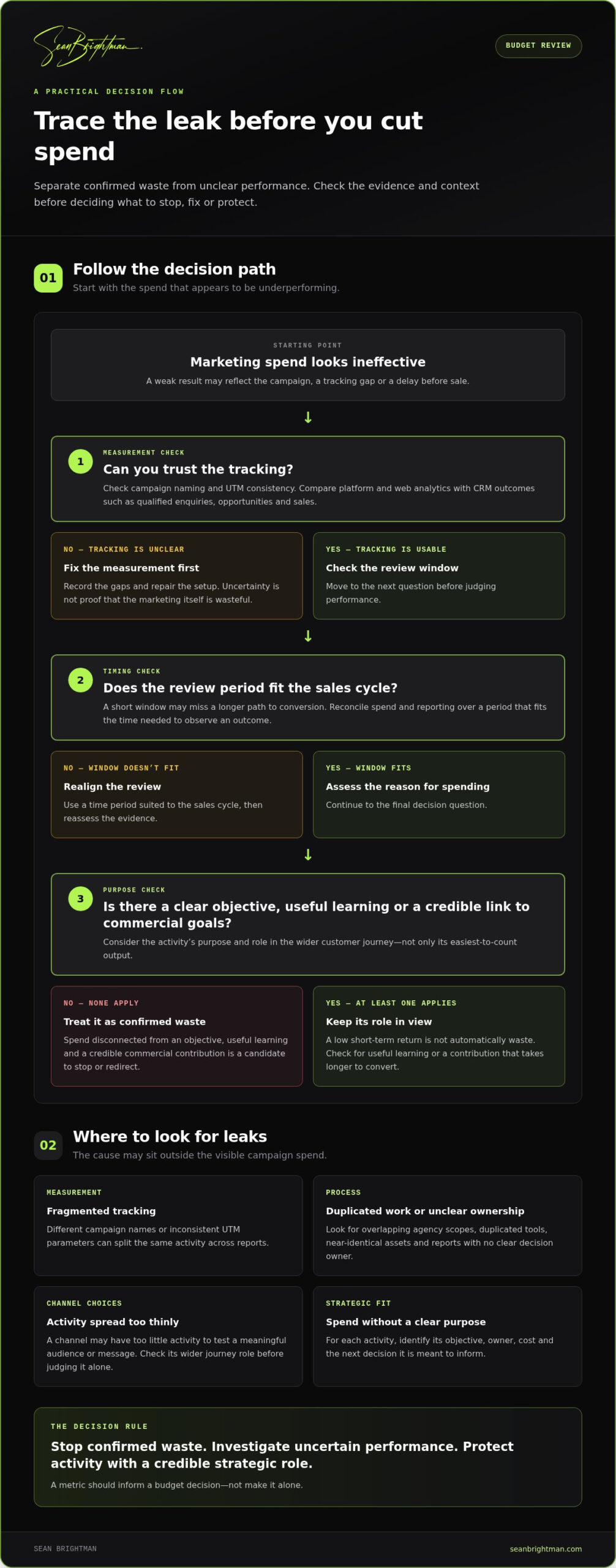
    Reducing Marketing Budget Waste: Find the Leaks Before You Cut

    What to fix first: prioritise marketing budget changes by evidence

    Start with changes where the waste is visible and the downside is limited. Duplicate subscriptions, overlapping work or activity with no accountable owner are stronger clean-up candidates than a campaign that simply lacks reliable measurement. Don’t cut a channel by default. First weigh the evidence, likely business impact, reversibility and time needed to learn.

    Decision type | Evidence strength | Likely impact | Reversibility | Time to learn

    Immediate clean-up: duplicated tool or repeated task | Clear and verifiable | Usually contained | High | Short

    Test: campaign with mixed results | Partial or inconsistent | Could affect demand | Often high | Depends on the sales cycle

    Tracking fix: activity with incomplete attribution | Insufficient to judge | Unclear until measured | High | Depends on data availability

    Strategic review: investment affecting key audiences or positioning | Requires broader context | Potentially substantial | Lower | Longer-term

    Which budget leaks should you address first?

    Remove confirmed duplication and resolve ownership gaps first. Treat weakly measured activity as an investigation or test candidate, not an automatic cancellation. Escalate choices that could reshape how you reach key audiences, express your positioning or support longer-term growth. The harder a change is to reverse, the stronger the evidence and business case should be.

    How to test a change without damaging growth

    Change one meaningful variable where practical, such as the audience or message, and write down what evidence would change your decision. Set a review point that fits the sales cycle and gives the relevant data time to emerge. If several elements change at once, you may not know what caused the result.

    Example: A team finds two subscriptions that appear to serve the same purpose, whilst one campaign has weak lead tracking but supports an important audience. It can verify and remove the duplicate, then improve tracking and test the campaign before deciding whether to reduce its allocation. The example is illustrative, not a client result.

    If the evidence points beyond channel adjustments to priorities around positioning or growth, use strategic brand roadmapping to shape the next decisions. For senior-level direction on turning findings into a prioritised plan, explore strategic marketing guidance. That’s how reducing marketing budget waste becomes a controlled decision, not a blunt cut.

    Make marketing budget control an ongoing leadership system

    A one-off budget review finds leaks. A leadership system helps stop them returning. Tie each marketing investment to a business outcome, a clear owner and an assumption that can be revisited. Then review what changed, what the evidence says and what decision comes next. This keeps the budget connected to commercial priorities, not just last quarter’s activity.

    Set a budget review cadence that drives decisions

    Set review points around business planning and the sales cycle, not an arbitrary reporting ritual. At each review, look at business outcomes, committed spend, key assumptions and any changes in customer behaviour, team capacity or commercial priorities. If an assumption no longer holds, update the plan rather than allowing old allocations to roll forward by default.

    Keep a decision log that makes accountability visible. Record what changed, why it changed, the expected effect, the person responsible and when the decision will be reviewed. That record helps the team distinguish a deliberate test from unplanned drift in spend.

    Make sure the parts of the system reinforce one another. Positioning shapes which audiences matter; channel choices determine how you reach them; measurement shows what the activity contributes; and operating capacity determines what the team can deliver well. A mismatch between any of these can undermine the rest.

    When strategic marketing support can help

    If priorities keep fragmenting, ownership remains unclear or measurement problems recur, the issue may need senior strategic direction rather than another reporting template. Fractional CMO leadership and ongoing advisory support can connect budget choices to positioning and business goals, and bring accountability to regular reviews. This is strategic oversight, not advertising execution.

    Sean Brightman’s advisory retainer provides ongoing strategic direction and accountability. For senior marketing leadership on a part-time basis, explore Fractional CMO support.

    Start with one action: map current spend against its objective, then identify the biggest evidence gap. Assign someone to close it and bring the finding into your next review. That’s how reducing marketing budget waste becomes an ongoing discipline, not another round of reactive cuts.

    Make your next marketing budget decision count

    Reducing marketing budget waste isn’t about cutting spend evenly. It’s about finding where investment loses momentum, separating confirmed waste from uncertain performance, and choosing changes that fit your business goals.

    Use consistent evidence to guide decisions, not a single metric. Give each investment a clear objective and owner, then record what changes and when you’ll review it. That turns budget control into an ongoing leadership system, not another reactive round of cuts.

    When priorities or accountability are unclear, Fractional CMO leadership brings part-time senior marketing direction. Roadmapping creates structured marketing and brand direction, whilst an advisory retainer supports ongoing strategic oversight and accountability.

    Build a sharper marketing decision system with Sean Brightman. Start with the evidence, make the next decision with confidence, and protect the investment that can support growth.

    Frequently Asked Questions

    What does reducing marketing budget waste actually mean?

    Reducing marketing budget waste means removing or redesigning spend without a clear purpose, accountable owner, useful evidence or credible connection to business outcomes. It doesn’t mean cutting every activity with weak short-term attribution. Some investment supports learning, awareness or longer buying journeys. First diagnose why performance appears weak. Then decide whether to stop, fix, measure or test the activity, based on its intended role and the evidence available.

    How can I tell whether marketing spend is being wasted?

    Map spend to its objectives, owners, campaign activity and relevant outcomes. Check that reporting uses consistent definitions, then compare platform results with CRM or sales information where available. Look for repeated signs such as duplicated work, unused tools or activity without a defined purpose. If tracking is missing or unreliable, treat that as an evidence gap to investigate. Weak measurement alone doesn’t prove that the activity is wasteful.

    Should I cut marketing spend if I cannot measure its return?

    No, not automatically. Start by clarifying the outcome the activity was meant to support and checking whether your tracking captures it. Consider the customer journey, sales cycle and missing data before deciding. If the evidence remains weak, improve measurement or run a bounded test with a clear review point. Preserve investment that has a credible strategic role, and decide in advance what evidence would justify changing it.

    How much marketing budget should a business allocate to each channel?

    There’s no universal channel split that suits every business. Allocation depends on commercial goals, audience behaviour, sales-cycle length, existing evidence and your capacity to execute well. Define the outcome each channel should support, then compare its contribution and the uncertainty around that evidence. Keep room to test and learn. Review the allocation when results, customer behaviour or business priorities change, rather than copying another organisation’s budget mix.

    Which marketing metrics should I use to find wasted spend?

    Choose measures that match the activity’s objective and connect, where possible, to commercial outcomes. Depending on the goal, these could include qualified pipeline, revenue, customer acquisition, retention or meaningful engagement. Use platform metrics as diagnostic signals, not final proof of business impact. Before comparing campaigns or channels, check that definitions, attribution windows and tracking are consistent, and compare platform data with CRM outcomes where available.

    Can AI help reduce marketing budget waste?

    AI can help organise data, surface patterns and speed up analysis when the inputs and definitions are reliable. It can’t resolve unclear objectives, inconsistent tracking or poor judgement by itself. Use it to support investigation, not to make unreviewed budget decisions. Keep a named person accountable for validating the evidence, weighing commercial context and deciding what to change. The quality of the decision still depends on the quality of the information and oversight.

    How often should a business review its marketing budget?

    Set review frequency to fit your sales cycle, business planning rhythm and pace of change. Use regular checkpoints to compare actual spend with objectives and outcomes, then schedule a deeper review when assumptions shift or evidence raises a concern. Don’t change investment so frequently that activity has no time to produce useful learning. Record each decision, its rationale and a proportionate review date so you can assess the effect.

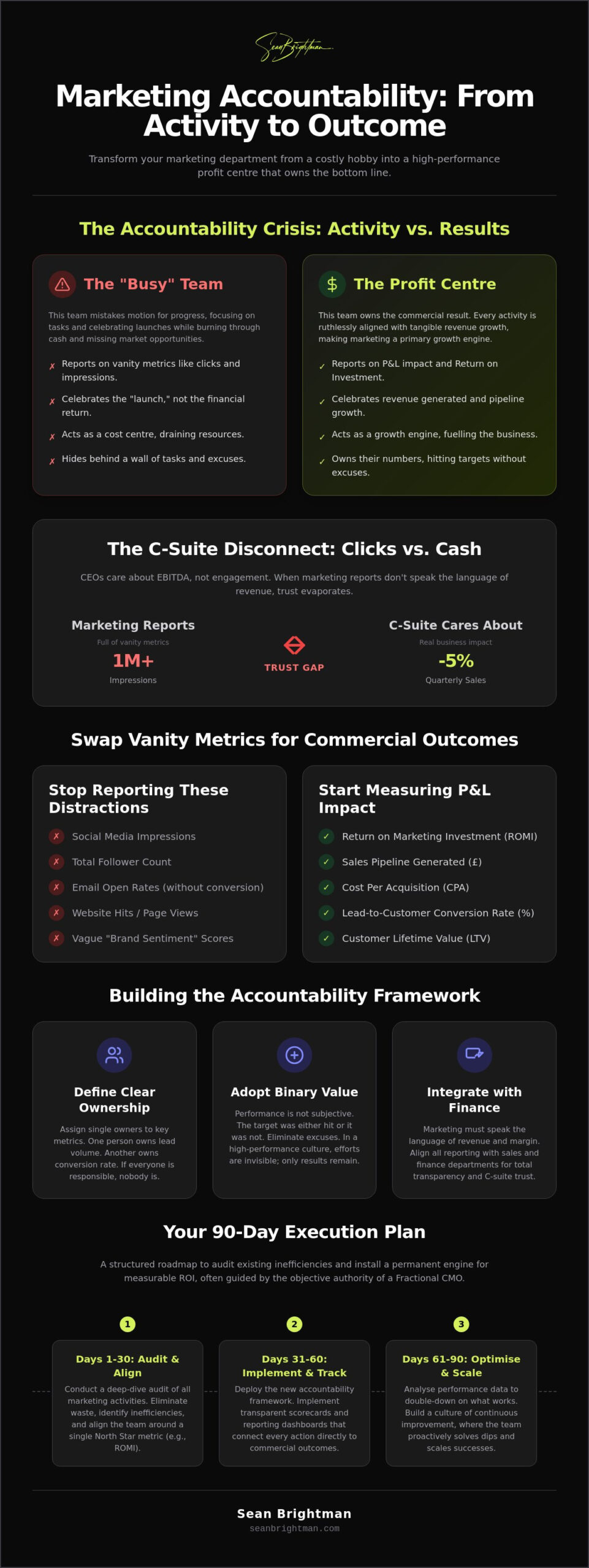
  • Marketing Team Accountability: How to Drive Commercial Outcomes, Not Just Activity

    Marketing Team Accountability: How to Drive Commercial Outcomes, Not Just Activity

    Activity is not an outcome. Your team might be the busiest department in the building, but if their “wins” don’t show up on the P&L, you don’t have a marketing department; you have an expensive hobby. True marketing team accountability isn’t about counting clicks; it’s about owning the bottom line.

    You’re likely tired of seeing reports packed with vanity metrics whilst the bank balance remains stubbornly flat. You’ve had enough of the culture of excuses that surfaces whenever a target is missed. You need a team that owns their numbers, not a team that explains them away. It’s a common frustration, but it’s one that costs you growth every single day.

    This guide will show you how to bridge that gap. You’ll learn how to transform your department into a high-performance profit centre that delivers measurable ROI. We’ll break down the frameworks for transparent reporting that the C-suite actually trusts and show you how to build a team that proactively solves performance dips before they become disasters.

    Key Takeaways

    • Stop rewarding “busy” work and start measuring what hits the P&L by swapping vanity metrics for commercial outcomes.
    • Build a framework for marketing team accountability by defining North Star metrics that align tactical execution with business growth.
    • Deploy a scorecard system to provide the C-suite with transparent reporting that eliminates the “black box” of marketing activity.
    • Leverage the objective authority of a Fractional CMO to cut through internal politics and drive high performance without micro-management.
    • Execute a 90-day roadmap to audit existing inefficiencies and install a permanent engine for measurable ROI.

    The Accountability Crisis: Why Marketing Teams Default to Activity Over Outcomes

    Marketing isn’t a cost centre. It’s a growth engine. Or at least, it should be. Most businesses suffer from a fundamental misunderstanding of marketing team accountability. They mistake motion for progress. They mistake a busy Slack channel for a successful campaign. This is the accountability crisis: a culture where teams are obsessed with doing things rather than achieving things.

    Accountability means owning the commercial result. It’s not about whether the ad looked pretty or the copy was clever. It’s about whether the phone rang. If your team is hiding behind a wall of tasks, they aren’t being accountable; they’re being busy. A messy marketing department burns through cash whilst missing market windows that your competitors are currently jumping through. A busy team is often a failing team.

    The cost of this inefficiency is staggering. It’s not just the wasted salary or the ad spend that doesn’t convert. It’s the opportunity cost of a market that moves whilst you’re still debating the hex code of a button. Activity-based cultures celebrate the “launch”. Outcome-based cultures celebrate the “return”. One is a hobby; the other is a business. Ownership is binary. You either hit the number or you didn’t.

    The C-Suite Disconnect: Clicks vs. Cash

    CEOs don’t care about click-through rates. They care about EBITDA. When a marketing manager presents a deck full of graphs showing “engagement” whilst sales are down, trust evaporates instantly. Trust is built on revenue, not rainbows. Creative freedom is vital, but without commercial constraints, it’s just self-indulgence. You need a team that understands that their primary job is to sell, not just to create. Commercial Marketing is the ruthless alignment of brand expenditure with tangible revenue growth.

    Vanity Metrics: The Shield for Underperformance

    Vanity metrics are the comfort blanket of the underperformer. They provide a false sense of security whilst the business starves. To fix this, you must pivot. Don’t tell me you sent four emails; tell me you generated £50k in pipeline. Transparency is the only cure for a team hiding in the weeds. If you cannot track the path from a click to a customer, you aren’t managing a department; you’re gambling with the company’s future.

    Stop reporting on these five distractions today:

    • Social media impressions
    • Total follower count
    • Email open rates (without conversion data)
    • Website hits
    • Vague “brand sentiment” scores

    Focus instead on your Return on Marketing Investment (ROMI). This is the only number that proves your department is a profit centre rather than a drain on resources. Marketing team accountability requires a shift in mindset where every team member views themselves as a commercial stakeholder. If the activity doesn’t move the needle on the bank balance, it’s noise. Cut the noise. Focus on the numbers.

    Building the Framework: Defining Ownership and Commercial Metrics

    Accountability isn’t a vague feeling. It’s a structural choice. If you want marketing team accountability, you must stop treating the department as a creative black box. You need clear lines of ownership. One person owns lead volume. Another owns lead quality. A third owns the conversion rate. If everyone is responsible for “growth”, then nobody is actually responsible when the numbers tank.

    The Binary Value concept is non-negotiable. It’s a brutal, effective way to look at performance. Either the target was hit, or it wasn’t. There is no “we worked really hard” or “the creative was award-winning”. In a high-performance engine, efforts are invisible; only results remain. This level of rigour is why organisations like the Marketing Accountability Standards Board push for standardised financial linkages. Marketing must integrate with sales and finance. It must speak in the language of revenue and margin, not clicks and likes.

    If your current structure feels like it’s drifting, a Fractional CMO can provide the external force needed to redefine these boundaries and install a culture of ownership.

    OKRs vs KPIs: Choosing the Right Measuring Stick

    KPIs are your dashboard. They tell you if the car is running. OKRs are your GPS. They tell you where you’re going. Use KPIs to keep the lights on. Use OKRs to drive the structural shifts that move the business forward. Most teams fail because they confuse the two, measuring their success by how many tasks they completed whilst the business stays stationary.

    Activity Metric (The Busy Trap) Outcome Metric (The Commercial Goal)
    Published 12 LinkedIn posts Generated £150k in qualified pipeline
    Sent 50,000 cold emails Achieved a 12% lead-to-opportunity rate
    Increased website traffic by 20% Reduced Customer Acquisition Cost (CAC) by 15%

    The North Star Metric: One Number to Rule Them All

    You need one number that rules them all. For a scale-up, it might be new customer acquisition. For an established firm, it might be net revenue retention. Whatever it is, every person in the team must know exactly how their daily tasks pull that specific lever. This is commercial ownership. It’s the difference between a team that asks “what should I do today?” and a team that asks “how do we hit the number?”. When the North Star is clear, the fluff disappears. Every meeting, every budget request, and every campaign is filtered through a single question: does this drive our primary commercial outcome?

    The Manager’s Toolkit: Systems for Driving Results, Not Just Clicks

    Systems are the plumbing of performance. Without them, your framework is just a wish list. To drive marketing team accountability, you need a live scorecard. Not a static PDF that gets emailed once a month. A real-time dashboard that shows exactly where you are against the target. If the data is 30 days old, it’s an autopsy, not a management tool. You need to see the pulse of the business whilst there is still time to change the outcome.

    This is where a Marketing Operations Consultant earns their keep. They build the machinery that connects your CRM to your reporting suite. They ensure that measuring the success of marketing efforts is automated and bulletproof. You want a system that flags a performance dip on Tuesday so you can fix it by Thursday. Waiting for the end of the quarter to realise a campaign failed is a luxury you cannot afford. Your budget is too precious to waste on lag time.

    Standardise your reporting rhythms immediately. Implement daily pulses for tactical execution. Establish weekly loops for milestone tracking. Schedule monthly deep dives for strategic adjustment. These loops create a drumbeat of ownership that makes it impossible for underperformance to hide in the shadows. Accountability is a habit, not an event.

    The Weekly Accountability Loop

    High-impact teams don’t sit in hour-long meetings. They use 15-minute stand-ups. The structure is simple: what was the target, what was the result, and what is the blocker? Radical candour is the foundation of team accountability. If a target is missed, we don’t look for a scapegoat. We look for a solution. The culture must be safe enough to admit failure but rigorous enough to demand a fix. You aren’t punishing people for missing numbers; you’re challenging them to solve the problem before it hits the bottom line.

    AI-Powered Performance Monitoring

    AI is the ultimate accountability partner. It doesn’t get tired. It doesn’t have biases. It just looks at the data. Use predictive analytics to hold the team accountable for future forecasts. If the AI suggests you’ll miss the month-end target based on current velocity, the team must act now. This shifts the culture from manual reporting to automated insight generation. It’s about being proactive, not reactive. AI flags the smoke so your team can put out the fire before the whole house burns down. Predictive models now allow marketers to see the commercial impact of their work weeks before the final invoice is raised, ensuring every pound spent is working as hard as possible.

    Marketing Team Accountability: How to Drive Commercial Outcomes, Not Just Activity

    The Fractional Edge: Maintaining High Performance Without Micro-management

    Dashboards don’t manage people. Leadership does. For most founders, managing a marketing department feels like herding cats. You don’t have the time to check every campaign. You shouldn’t have to. This is where marketing team accountability breaks down. You hire for talent but fail because of a lack of professional oversight. You end up micro-managing tactical tasks because you don’t trust the strategic outcomes.

    A Fractional CMO provides the “External Force” effect. They aren’t there to climb the corporate ladder or win popularity contests. They’re there to deliver a result. Because they operate outside your internal politics, they can be ruthlessly objective. They see the “busy trap” that full-time managers often become part of. An advisor sees the waste that your team has become blind to. They identify the work that feels productive but delivers zero commercial value. This objectivity is the fastest way to drive marketing team accountability without the friction of internal power struggles.

    This isn’t about checking emails. It’s about system-management. A senior leader builds the framework, sets the expectations, and then holds the line. They don’t do the work; they ensure the work is done to a standard that drives the bank balance. They focus on building engines that run without them, rather than becoming a bottleneck for every creative decision. Before committing to this model, understanding Fractional CMO pricing UK will help you build a budget framework that prioritises commercial outcomes over activity costs.

    Leadership Without the Overhead

    A Fractional CMO installs the accountability framework and then gets out of the way. They act as an accountability partner, not a traditional boss. This creates a permanent shift in the team’s behaviour. They stop performing for the person and start performing for the metrics. Senior-level strategy is the only cure for tactical mess. It provides the clarity your team needs to stop guessing and start executing with precision. You get the impact of a heavy-hitting executive without the bloated salary and long-term commitment of a full-time hire.

    The Advisory Retainer: Consistent Direction

    Strategy drift is the silent killer of ROI. Teams naturally gravitate toward comfortable, low-impact tasks. An Advisory Retainer prevents this. Monthly sessions act as a structural reset, forcing the team to justify their activity against the roadmap. It’s having a battle-hardened expert on speed dial to kill bad ideas before they cost you money. This consistent oversight ensures that the systems installed actually stick, turning accountability from a one-off project into a permanent culture.

    If your team is stuck in a cycle of activity without outcomes, you need an external force to restore order. Deploy a Fractional CMO to turn your marketing department into a high-performance profit centre.

    Implementing an Accountability Engine: Your 90-Day Execution Plan

    Culture doesn’t shift because you sent a memo. It shifts because you installed a new operating system. To drive marketing team accountability, you need a structured, 90-day rollout that moves from diagnosis to discipline. This is not a “soft launch”. It is a fundamental rewiring of how your department justifies its existence. You are moving from a culture of effort to a culture of effect.

    Step 1: The Brutal Audit (Days 1-30)

    Start with a cold, hard look at the current state. Evaluate your tools, your talent, and your reporting accuracy. Most founders discover their marketing data is 40% noise and 60% guesswork. You must identify the “activity-to-outcome” ratio for every team member. If an executive spends 30 hours a week on “brand awareness” whilst the sales pipeline is bone dry, you’ve found a leak. Define the gaps in your growth engine now. You cannot fix what you haven’t measured. This audit is about finding the truth, no matter how uncomfortable it feels.

    Step 2: Setting the New Standard (Days 31-60)

    Architecture follows audit. Communicate the shift in expectations clearly. The era of “being busy” is over. Install the primary North Star metric and the supporting OKRs that we defined in the framework section. Provide the team with the automated tools they need to succeed. If you expect data-driven ownership, you must provide the data. This is the phase where you build the scorecards and establish the reporting loops that make performance visible to everyone. You are giving them a map and a compass; there are no more excuses for being lost.

    Phase 3 (Days 61-90) is about execution and refinement. This is where the weekly stand-ups and daily pulses become muscle memory. By the end of this period, marketing team accountability should be the default setting. The team should no longer wait for you to ask why a target was missed. They should be arriving at the meeting with the reason and the remedy already prepared. You are moving from a reactive department to a proactive profit centre that owns its numbers.

    Expect resistance. Some people prefer the “messy” way because it provides cover for mediocrity. Be unapologetically direct about this. Accountability is a filter. It rewards your high performers and exposes those who are merely taking up space. If team members cannot adapt to a culture of commercial ownership, they are a liability to your growth. You aren’t managing a social club; you’re running a business. Hire for the new standard, or watch the old one drag you down.

    Stop Measuring Motion, Start Measuring Money

    Activity is a cost; results are a currency. Your marketing department should be a high-performance engine, not a black box of unexplained spend. True marketing team accountability requires a fundamental shift from tracking tasks to owning the bottom line. By implementing real-time scorecards, leveraging AI-powered monitoring, and installing senior-level oversight, you replace a culture of excuses with a culture of clinical execution.

    You have the 90-day roadmap. You understand the framework. Now, you need the machinery to drive it. Whether you require a Fractional CMO to overhaul a messy department or an Advisory Retainer for consistent, senior-level direction, the objective remains the same: commercial outcomes. This is how UK scale-ups move from tactical noise to a scalable growth engine that the C-suite finally trusts. Strategic brand positioning provides the clear direction your team needs to stop guessing and start delivering.

    Don’t let another quarter slip away in a fog of vanity metrics. Book an AI Roadmapping Session to build your accountability engine and transform your marketing into a profit centre today. You have the plan. It’s time to build the engine.

    Frequently Asked Questions

    What is the best way to track marketing team accountability?

    The best way is through a live, CRM-integrated scorecard that tracks commercial outcomes in real time. Static monthly reports are historical autopsies. You need a dashboard that shows exactly how current activity influences the sales pipeline today, allowing you to manage the engine whilst it is still running.

    How do I tell my marketing team their current reporting is useless?

    Be blunt. Tell them their reports don’t show up on the P&L. If they are presenting engagement rates whilst revenue is flat, explain that you are paying for profit, not popularity. Demand a reporting structure that links every pound spent to a specific stage of the customer journey.

    Can creative teams really be held accountable for revenue?

    Absolutely. Creative work is a tool for conversion, not an end in itself. Hold them accountable for the performance of the assets, such as click-through rates and landing page conversion. If a “beautiful” ad doesn’t convert, it’s a failure of marketing team accountability.

    What are the best tools for marketing accountability in 2026?

    The best tools are those that integrate your entire tech stack into a single source of truth. Look for predictive analytics platforms that flag performance dips before they hit your bank balance. Automation is key. If your team is manually building spreadsheets, they aren’t managing the commercial engine.

    How often should I review marketing performance with my team?

    Conduct a 15-minute tactical stand-up every week and a deep-dive commercial review every month. The weekly pulse keeps the team focused on the immediate roadmap. The monthly review ensures your strategy is actually moving the North Star metric rather than just generating noise.

    What happens if the marketing team misses their commercial targets?

    Identify whether the failure was in the strategy or the execution. If the strategy was sound but the team didn’t own the result, you have an ownership crisis. Use a “blocker” framework to see if they need better tools or if they simply aren’t suited for a high-performance culture.

    Is a Fractional CMO responsible for team accountability?

    A Fractional CMO is the architect of the system. They don’t just “oversee” the team. They install the frameworks and scorecards that make marketing team accountability possible. They provide the senior-level authority to challenge the status quo and kill low-impact activity before it wastes your budget. If you’re evaluating this model, reviewing the Fractional CMO pricing UK 2026 guide will give you a clear picture of market rates and how to structure a budget around commercial outcomes rather than activity costs.

    How does AI improve marketing team accountability?

    AI removes the “gut feeling” from performance management. It provides objective, data-driven insights into which campaigns are actually driving ROI and which are burning cash. Predictive models allow you to see a missed target weeks before it happens. This forces the team to pivot early and take ownership of the future result.