
Tag: commercial strategy

  • Strategic Marketing Advisor for Hire: Find the Right Fit in 2026

    Strategic Marketing Advisor for Hire: Find the Right Fit in 2026

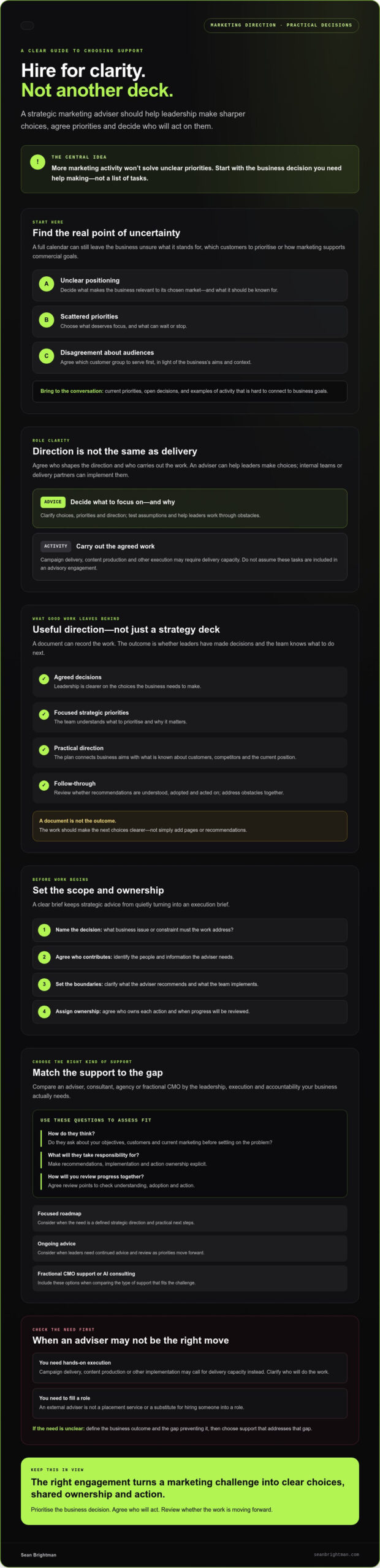
    More marketing activity won’t fix unclear priorities. If campaigns are running but their commercial contribution is hard to see, a strategic marketing advisor for hire should help you make sharper choices and agree who will act on them, not simply deliver another polished strategy deck.

    You may already know the business needs senior direction. The challenge is finding support that fits without committing to a full-time leadership hire, and making sure recommendations keep moving once the adviser leaves. Before comparing people, identify the decision you need help with and what is currently stopping you from making it.

    This guide explains what a strategic marketing adviser should solve, how to assess their experience and working style, and what to agree before you hire. It also compares advisory support with consultants, agencies and fractional marketing leadership, and explains when a one-off roadmap or ongoing advice may be a better fit. You’ll learn how to define a practical scope, working rhythm and measures of progress, so the work connects to business decisions rather than ending as a document gathering dust.

    Key Takeaways

    • Before choosing a strategic marketing advisor for hire, pinpoint the business decision or marketing problem you need them to address.
    • Look for practical direction and agreed priorities, not a strategy document that nobody owns or acts on.
    • Compare an adviser, consultant, agency and fractional CMO by the leadership, execution and accountability your business actually needs.
    • Assess fit by asking how the adviser thinks, what they’ll take responsibility for and how you’ll review progress together.
    • Choose support that matches the challenge, from a focused roadmap to ongoing advice, Fractional CMO support or AI consulting.

    Strategic marketing adviser: what to look for?

    A full calendar can still hide a failure to make the decisions that matter. Campaigns, content and meetings keep moving, while the business remains unsure what it stands for, which customers to prioritise or how marketing supports its commercial goals.

    A strategic marketing advisor helps a leadership team clarify its marketing choices, priorities and direction. Strategic marketing advice helps a business decide what to focus on and why; tactical marketing activity carries out the agreed work. The adviser shapes the direction, while internal teams or delivery partners implement it.

    Marketing strategy provides a framework for connecting business goals with markets and choices. In practice, an adviser should help turn that broad idea into decisions your team can use, rather than simply adding more activity to the plan.

    If you’re looking for a strategic marketing advisor for hire, start with the decision you need help making, not a list of marketing tasks. The right starting point depends on your business context, so agree the problem with the adviser before defining the work.

    What problems should a strategic marketing advisor solve?

    Look for a specific point of uncertainty that leadership can resolve. For example:

    • Unclear positioning: decide what makes the business relevant to its chosen market and what it should be known for.
    • Scattered priorities: choose which marketing priorities deserve focus, and which can wait or stop.
    • Disagreement about audiences: agree which customer group to serve first, based on the business’s aims and context.

    These are decisions, not requests for a longer activity list. A useful adviser will ask about your objectives, customers and current marketing before settling on the problem to address. You can make that conversation more productive by bringing examples of current priorities, open decisions and activity that is proving difficult to connect to business goals.

    When is hiring an adviser the wrong move?

    If the immediate need is hands-on campaign delivery, content production or other execution, you may need delivery capacity rather than strategic advice. An adviser can help set direction, but don’t assume that includes carrying out the work. Clarify who owns implementation before agreeing the scope.

    Recruitment is a separate need, too. An external marketing adviser isn’t a placement service or a substitute for hiring someone into a role. If you’re unsure whether you need strategy, execution or a new team member, define the business outcome and the gap preventing it. Then choose support that addresses that gap.

    What a strategic marketing advisor should deliver beyond a strategy deck

    A strategy deck can record the work, but it can’t prove that the business has made a decision or that the team is acting on it. A useful engagement leaves leaders clearer on what to prioritise, why it matters and what the team should do next.

    Expect agreed decisions, a focused set of strategic priorities and practical direction the team can apply. That might mean choosing which market to focus on, stopping activity that no longer fits or identifying what evidence would change the plan. The document captures those choices; it is not the outcome itself.

    A useful plan connects business aims with what the team knows about its customers, competitors and current position. The adviser should help leaders weigh that information and decide what it means for the business. The result should make the next choices clearer, not simply add pages or recommendations.

    Good advice includes challenge and follow-through, not taking over every task. The adviser can test assumptions, check whether agreed priorities are being adopted and help leaders address obstacles. Your team or delivery partners can own implementation, with responsibilities agreed upfront. If you’re considering a strategic marketing advisor for hire, make that boundary explicit before work begins.

    How to define the work before the engagement starts

    Start with the business decision or constraint the engagement must address. Agree who needs to contribute, what information the adviser needs and which decisions leadership expects to make. Then set the boundaries: what the adviser will recommend, what your team will implement and who owns each action. This helps prevent a strategy brief quietly turning into an execution brief.

    What accountability should look like in practice

    Agree review points to check whether recommendations have been understood, adopted and acted on. Choose progress measures with the adviser that fit the business challenge; avoid generic targets and don’t assume a particular result. If new evidence undermines the original plan, decide how you’ll revisit priorities rather than pushing ahead by default.

    For ongoing direction and review, explore the marketing advisory retainer guide. It can help you consider whether continuing advice fits better than a defined, one-off piece of roadmapping.

    Strategic marketing advisor, consultant, agency or fractional CMO: compare the fit

    These labels can overlap, and a title alone won’t tell you who owns the work. Compare support by its purpose, decision-making role, delivery capacity and likely engagement shape. For an overview of a consultant’s possible responsibilities and specialisms, see What Is a Marketing Consultant, then confirm the actual scope with each provider.

    The right option depends on the gap you need to fill: clearer decisions, defined expertise, delivery capacity or sustained senior marketing leadership.

    Support Main purpose Leadership ownership Execution capacity and likely shape
    Strategic marketing adviser Clarify choices, priorities and direction. Informs decisions; leadership remains with your business. Doesn’t automatically include implementation. May be a focused piece of work or ongoing advice.
    Marketing consultant Bring specialist analysis or recommendations to a defined challenge. Usually advises rather than taking ongoing leadership ownership. Scope can range from a discrete project to continuing support. Confirm whether implementation is included.
    Agency Deliver agreed marketing work within its contracted remit. Your business retains strategic ownership unless leadership responsibilities are explicitly agreed. May provide delivery capacity; channels, tasks and ownership depend on the agreement.
    Fractional CMO Provide part-time senior marketing leadership. Can take sustained responsibility for marketing direction and leadership, as agreed. Typically an ongoing, part-time arrangement; confirm the remit, authority and responsibilities.

    Don’t assume every consultant or agency works the same way. Ask what they’ll own, what your team must provide and whether the engagement covers recommendations, delivery or both. The distinction matters: an adviser informs decisions, while a fractional CMO can provide part-time senior leadership across teams and priorities.

    When an adviser is a better fit than an agency

    Choose advisory support when the main gap is diagnosis, prioritisation or an independent view of a difficult choice, rather than a shortage of people to deliver campaigns. An adviser can help define what work should happen and why. Someone still needs to own implementation, whether that’s your internal team or a separately commissioned delivery partner. An agency may be the right fit when delivery itself is the need.

    When fractional marketing leadership may be the better fit

    If priorities need a senior owner who can stay involved across teams and decisions, explore fractional leadership rather than assuming an advisory scope will cover it. Advisory and fractional CMO responsibilities can differ, so agree decision rights, accountability and time commitment before starting. Read the Fractional CMO guide for a deeper explanation.
    Strategic Marketing Advisor for Hire: Find the Right Fit in 2026

    How to assess a strategic marketing advisor before you hire

    A strong proposal should show how the adviser will move from your business challenge to a decision you can act on. Don’t judge fit on confidence or polished slides alone. Test the thinking, responsibilities and working rhythm before you commit.

    Use this process to assess a strategic marketing advisor for hire:

    • 1. Define the issue. State the decision or constraint you need help with. “We need better marketing” is too broad; explain what leadership can’t currently decide or what is holding progress back.
    • 2. Assess the adviser’s thinking. Ask how they would learn about your business before recommending priorities. Look for relevant questions, clear reasoning and an approach that fits your situation. You’re assessing how they think, not asking them to promise results or disclose another client’s confidential work.
    • 3. Scope responsibilities. Write down the decisions and outputs expected, who from your team needs to contribute and who owns implementation. Make clear what sits outside the engagement, too.
    • 4. Agree review points. Decide how you’ll check whether recommendations are understood and used, which business measures are relevant and how you’ll revisit the plan if its assumptions don’t hold.

    Questions to ask before agreeing a scope

    Ask: “What information would you need before recommending priorities?” “Which decisions and outputs would this engagement cover?” “What will you need from our team?” “How will we review progress, and what happens if new evidence challenges the original assumptions?” Clear answers should make the boundaries visible. If success measures or ownership are vague, or promises are made without context, pause and ask for specifics.

    Signals that the advisor fits your business

    Good fit shows up in the conversation. The adviser explains their reasoning, asks questions that sharpen the brief and is willing to challenge your starting assumptions respectfully. They can describe a working rhythm that suits how your leadership team makes decisions. Check that the proposed scope matches your actual need; don’t infer expertise or delivery capacity that hasn’t been confirmed.

    If the central need is a structured roadmap, explore this strategic brand roadmapping guide. It may help you decide whether a defined roadmap is the right shape of support before discussing an engagement.

    Ready to turn a marketing challenge into a scoped next step? Discuss strategic marketing support with Sean Brightman.

    Hiring Sean Brightman: turn your marketing challenge into a clear next step

    Start with the business challenge, not a preselected service. Be clear about the decision you need to make, the support that could help and how you’ll review progress. That gives you a firmer basis for discussing fit and scope, without assuming every problem needs the same kind of engagement.

    Sean Brightman provides strategic marketing support through roadmapping, advisory retainers, Fractional CMO support and AI consulting. These options address different needs. The right place to start depends on the challenge, the leadership involvement required and whether you need a defined piece of guidance or continuing support.

    Which type of support should you explore?

    A one-off roadmap may suit a business that needs clearer direction and a practical set of priorities. An advisory retainer may fit when leaders need ongoing strategic input and accountability as they make decisions. Fractional CMO support is worth exploring if the gap is part-time senior marketing leadership. Consider AI consulting when the challenge specifically involves applying AI to marketing. Confirm the available scope and responsibilities before agreeing an engagement.

    These are strategic support options, not a recruitment route or outsourced advertising service. Sean doesn’t provide full-time CMO placement, recruitment or advertising execution. If you need someone to deliver campaigns or fill an employee role, clarify that requirement separately rather than expecting an advisory engagement to cover it.

    Prepare for a useful first conversation

    Describe the business challenge in plain terms. Note your current marketing priorities, the decisions still open, what you’ve already tried and where progress stalls. You don’t need a perfect brief, but you do need enough context to explain what’s getting in the way and what leadership needs to resolve.

    Use the conversation to test fit, not to chase a promised outcome. Discuss which type of support might match the challenge, what the scope could include, what your team would need to contribute and how accountability would work. A useful next step is clarity on whether the proposed support fits, what remains to be defined and how to proceed.

    If you’re looking for a strategic marketing advisor for hire, discuss your strategic marketing challenge with Sean Brightman. Bring the decision you’re trying to make and use the conversation to establish whether roadmapping, ongoing advice, Fractional CMO support or AI consulting is the right fit.

    Make your next marketing decision count

    The right support starts with a clear business challenge, not a wish list of marketing activity. Define the decision you need to make, then choose support that fits: a focused roadmap for clearer direction, ongoing advisory for continued guidance, or Fractional CMO support when you need part-time senior leadership. Agree responsibilities and review points before work begins.

    A strategy document only matters if your team uses it. Look for clear priorities, practical direction and accountability, with measures that make sense for your business. If AI is central to the challenge, AI consulting may be relevant, but it isn’t the answer by default.

    If you’re considering a strategic marketing advisor for hire, Sean Brightman offers roadmapping, advisory retainers, Fractional CMO services and AI consulting. Start by explaining the challenge, what you’ve tried and where progress stalls. Then you can establish whether the support and scope fit, without assuming a particular outcome.

    Discuss your strategic marketing challenge and take the next step with greater clarity and confidence.

    Frequently Asked Questions

    What does a strategic marketing advisor do?

    A strategic marketing advisor helps a business make clearer marketing decisions. They assess the situation, challenge assumptions and help leaders set priorities and direction. For example, they might help clarify which audience to focus on or how marketing should support business objectives. Their role is advisory unless the agreed scope includes leadership responsibilities. Your team or delivery partners may still own implementation, so confirm who is responsible for turning recommendations into action.

    When should a business hire a strategic marketing advisor?

    Hire an adviser when an important marketing decision is unclear or activity isn’t adding up to a coherent direction. You might be weighing different audiences, struggling to prioritise initiatives or unsure what marketing should contribute to business goals. A strategic marketing advisor for hire can help define the issue and guide decisions, but first clarify what you need: advice, senior leadership, implementation capacity or recruitment. The right support depends on the gap.

    How is a strategic marketing advisor different from a marketing consultant?

    The titles can overlap, so compare the proposed work rather than relying on the label. A strategic marketing adviser typically focuses on choices, priorities and direction. A marketing consultant may bring specialist expertise to a defined problem and could provide recommendations or other agreed work. Neither title guarantees implementation or ongoing leadership. Ask what the person will deliver, what decisions they’ll inform and who owns follow-through before agreeing a scope.

    Should I hire a strategic marketing advisor or a fractional CMO?

    Choose an adviser if you mainly need help thinking through marketing choices and setting direction. Consider a fractional CMO if you need part-time senior marketing leadership with sustained ownership across teams and decisions. The distinction depends on the responsibilities you need, not just the job title. Agree decision-making authority, accountability, working rhythm and implementation expectations before engaging either option, as advisory and fractional leadership scopes can differ.

    Can a strategic marketing advisor help with implementation?

    They can help connect strategic decisions to implementation, but that doesn’t mean they’ll personally deliver campaigns or marketing activity. Some scopes may include ongoing guidance, progress reviews or senior leadership; others focus on advice and a roadmap. Ask what support is included, who will carry out the work and who is accountable for delivery. If hands-on execution is your main need, identify that capacity separately rather than assuming advisory support covers it.

    What should I ask before hiring a marketing advisor?

    Ask how they’ll understand your business before recommending priorities, what decisions and outputs the engagement covers, and what they’ll need from your team. Clarify who owns implementation and how you’ll review progress. Ask what happens if new evidence challenges the original assumptions. Look for clear reasoning and relevant questions, not vague success measures or promises without context. The answers should help you judge both strategic fit and whether the working arrangement is practical.

    How much involvement does a strategic marketing advisor provide?

    Involvement varies with the agreed scope. A focused roadmapping engagement may centre on setting direction, while an advisory retainer provides continuing strategic input and accountability. Fractional CMO support can involve broader part-time marketing leadership. Before starting, agree how often you’ll meet, who will take part, what decisions the adviser will support and how progress will be reviewed. Don’t assume a particular level of access or execution is included unless it’s confirmed.

  • Marketing Transformation Consultant: Re-engineering Your Growth Engine for 2026

    Marketing Transformation Consultant: Re-engineering Your Growth Engine for 2026

    Your marketing department isn’t a growth engine; it’s an expensive black box of busywork. You’re pouring budget into campaigns that feel like guesswork, whilst your team remains overwhelmed by a stack of AI tools they don’t know how to use effectively. It’s frustrating to watch competitors scale whilst you’re stuck in endless meetings about “brand awareness” that never seems to hit the bottom line. You need a functional system, not more abstract theory. Engaging a marketing transformation consultant is the quickest way to stop the bleeding and start building a high-performance commercial machine.

    I understand the pressure to deliver measurable results in a landscape that shifts every week. You’re tired of the corporate fluff and ready for hard accountability. This article will show you exactly how to strip away the bloat to create a lean, AI-powered system that delivers predictable growth. We’ll explore a clear, executable roadmap that replaces internal chaos with tactical precision. By the end, you’ll know how to re-engineer your operations to ensure every marketing pound spent aligns directly with your commercial outcomes for 2026.

    Key Takeaways

    • Stop treating marketing as a creative experiment. Learn how to re-engineer your department into a predictable commercial machine that focuses on revenue, not just activity.
    • Discover why an independent marketing transformation consultant is the key to stripping away corporate fluff and building an accountable system that actually scales.
    • Avoid the “Junior-Shuffle” common in large agencies. Understand the difference between firms that sell you more work and consultants who fix your underlying strategy.
    • Implement an AI-powered growth engine that serves as your new operating system. Move beyond simple tools to integrate strategic intelligence into every part of your workflow.
    • Shift your team’s focus from vanity metrics to commercial outcomes. Replace vague brand awareness goals with a clear, executable roadmap that delivers measurable lead quality.

    Why Your Marketing Department Feels Like a Black Box (And How a Consultant Fixes It)

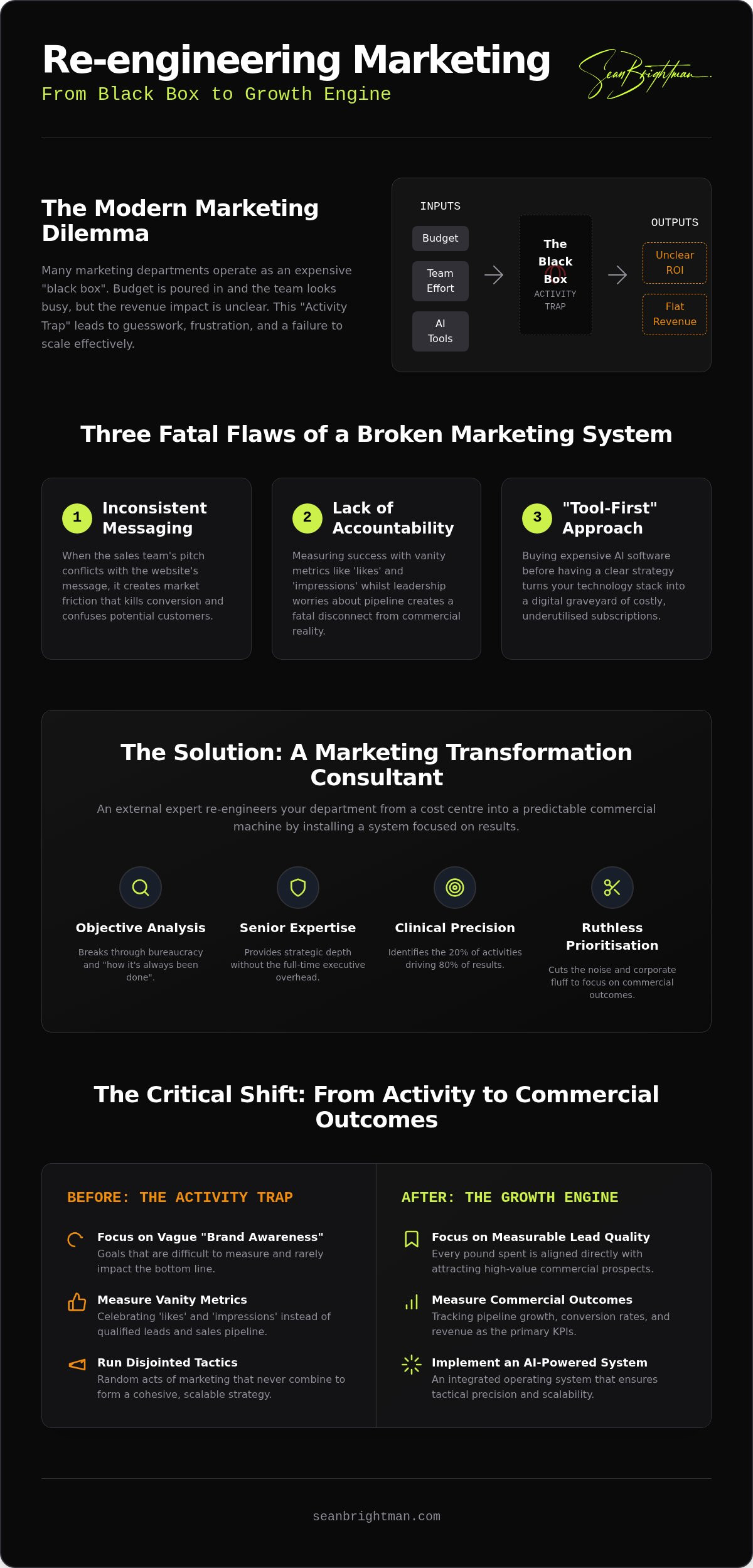
    Marketing shouldn’t be a mystery. It’s a predictable commercial system that either works or it doesn’t. If you cannot see how every pound invested converts into a measurable outcome, your system is broken. Most leaders feel like they are staring into a black box. They see the budget going in, they see the team looking busy, but the revenue line remains stubbornly flat. This is the “Activity Trap.” It’s the result of a team focused on output rather than impact, running a series of disjointed tactics that never quite coalesce into a strategy.

    A true market transformation requires a fundamental shift in how you view your growth engine. You aren’t just “doing marketing” anymore; you’re building a functional piece of machinery. Internal teams often struggle with this because they lack the objective distance to see where the gears are grinding. They are too close to the daily fires to notice the systemic flaws. Engaging a marketing transformation consultant provides the external pressure and senior-level perspective needed to stop the busywork and start the engineering.

    Symptoms of a Broken Marketing Strategy

    If your marketing feels chaotic, it’s usually because of three specific failures. First, inconsistent messaging. If your sales team is pitching one value proposition whilst your website screams another, you’re creating market friction that kills conversion. Second, a total lack of marketing team accountability. If your department measures success by “likes” or “impressions” whilst the CEO is worried about pipeline, there’s a fatal disconnect. Finally, many firms suffer from a “tool-first” approach. They buy expensive AI software and complex CRMs before they have a strategy to run through them. This adds complexity without adding value, turning your marketing stack into a graveyard of expensive subscriptions.

    The Role of the Marketing Transformation Consultant

    A marketing transformation consultant acts as a battle-hardened expert who enters the fray to provide order. They don’t care about internal politics or “the way things have always been done.” Instead, they act as a high-impact external force that breaks through bureaucracy. By providing the strategic depth of a Fractional CMO, they offer senior leadership without the overhead of a full-time executive hire. The goal is clinical precision. They identify the 20% of activities driving 80% of your commercial results, then they ruthlessly cut the noise. It’s about stripping away the corporate fluff to build a system that prioritises accountability and commercial outcomes over aesthetic preferences.

    The 2026 Marketing Transformation Framework: Systems, Not Just Stories

    Marketing transformation is a structured alignment of brand, team, and technology with commercial reality. It isn’t a vague evolution. It’s a high-stakes engineering project. For a marketing transformation consultant, the success of this project is binary. Your system either delivers measurable growth, or it’s a liability. Most businesses operate on random acts of marketing. They try a new tool here, a social post there, and hope for the best. 2026 demands a documented, scalable roadmap that replaces hope with logic. If the system doesn’t produce revenue, it’s irrelevant.

    This process starts with clarity. You cannot fix a machine if you don’t know where the friction is. This is where the expertise of a brand positioning consultant UK becomes vital. If your position in the market is weak, no amount of automation will save you. You need a foundation that resonates before you build the engine. We ensure your brand’s voice isn’t just noise, but a strategic tool that drives commercial interest. A disciplined approach to strategic brand roadmapping is what separates businesses that scale predictably from those that remain trapped in the activity cycle.

    Phase 1: The Strategic Audit

    We start by deconstructing your current funnel with clinical precision. We look for the leaks where leads vanish and budget is wasted. We evaluate your team’s current capabilities against your 2026 objectives. Do they have the skills to run an AI-powered system? Or are they stuck in 2019 tactics? During this phase, many leaders find it helpful to benchmark fractional cmo pricing UK against the bloated costs of a full-time senior hire. It’s often the first step in moving toward a leaner, more efficient operation that prioritises results over headcount.

    Phase 2: Building the Growth Engine

    Once the audit is complete, we build the actual machinery. We define the One Metric That Matters. This isn’t a vanity metric like impressions or reach. It’s the core commercial outcome that proves the system is working. We then organise the team around outcomes rather than specific channels. A Social Media Manager becomes a Demand Generation Specialist. We design a plug-and-play infrastructure that allows for rapid scaling without adding unnecessary complexity. This is about building a system that runs itself. If you’re ready to stop guessing and start building, you can book a roadmapping session to see how this framework applies to your specific challenges.

    Big Agency vs Independent Marketing Transformation Consultant: The Brutal Truth

    Choosing between a global consultancy and an independent marketing transformation consultant isn’t just about budget. It’s a choice between buying a process or buying a result. Big agencies are designed to sell you “doing.” They want to manage your social media, run your ads, and write your blogs. Their business model relies on billable hours and massive execution contracts. They have little incentive to fix your underlying system because a broken system often requires more of their “doing” to stay afloat. They want to be your vendor; a consultant wants to fix your thinking.

    Then there is the “Junior-Shuffle.” You’ve seen it before. The Managing Director and a senior partner show up for the pitch, dazzle you with high-level strategy, and promise the world. Two weeks later, your account is handed to a junior who is learning the ropes on your dime. You’re paying senior rates for entry-level execution. An independent expert doesn’t have a junior bench to hide behind. The person you hire is the person doing the work. There’s no dilution of expertise and no layers of account management to navigate before you get an answer.

    Agencies deliberate whilst consultants move. A massive firm needs three internal meetings just to decide on the agenda for your next call. They are bogged down by their own internal bureaucracy and “alignment” sessions that serve their own structure more than your growth. An independent marketing transformation consultant operates with tactical precision. They have seen the chaos before and know exactly where to cut. You’re paying for strategic outcomes, not agency office space, flashy receptions, and corporate overheads.

    When to Hire a Massive Consultancy

    There are times when the big firms make sense. If you lead a 10,000-person organisation and your primary goal is “safety” in numbers, a global consultancy provides board-level validation. If you need 50 people to execute a global rollout across twelve time zones simultaneously, you need the sheer headcount they provide. In these scenarios, budget is secondary to corporate optics. You aren’t just buying a strategy; you’re buying a shield against internal criticism if things go wrong.

    When an Independent Expert is the Only Logical Choice

    If you’re a scale-up or a mid-market firm, you don’t need a shield; you need a sword. You need a battle-hardened strategist who has actually built growth engines, not just presented slides about them. You want a direct line to the expert, ensuring that every strategic decision is made by someone with senior-level skin in the game. This is where you need a fractional cmo who acts as a true partner. They provide the high-level leadership required to re-engineer your operations without the bloated costs or the junior-heavy delivery of a traditional agency.

    Marketing Transformation Consultant: Re-engineering Your Growth Engine for 2026

    Case Study: From Strategic Slump to Scalable Engine

    Last year, I walked into a UK tech scale-up where the CEO was ready to fire the entire marketing department. On paper, the team was winning. Impressions were up. Their social presence was polished. But lead quality had dropped for three consecutive quarters. The sales team was starving whilst the marketing team celebrated “engagement.” It was a classic case of the Activity Trap. As their marketing transformation consultant, my diagnosis was blunt: they were optimised for ego, not revenue. We needed to stop the bleeding and re-engineer the entire operation from the ground up.

    The intervention wasn’t about a new logo or a bigger ad budget. It was about structural re-engineering. We implemented a 90-day transformation roadmap designed to move the needle on commercial outcomes. We stopped guessing and started measuring. The goal was to turn a bloated cost centre into a lean, high-performance growth engine that the CEO could actually trust. By the end of the project, we had achieved a 40% reduction in Customer Acquisition Cost (CAC) and established a culture of total accountability.

    Step 1: Killing the Fluff

    We started by ruthlessly auditing every campaign and channel. If an activity couldn’t be tracked directly to a commercial outcome, we killed it. No exceptions. We re-aligned the budget away from broad-reach “awareness” and towards high-intent channels and sharp brand positioning. We established a weekly accountability rhythm. Every Monday, the team had to prove their impact on the pipeline. This shift in focus ensured that every marketing pound spent was working toward a sale, not just a “like.”

    Step 2: Automating the Pipeline

    Once we had a clean strategy, we integrated AI to handle the repetitive heavy lifting. We used automated systems to qualify leads and handle initial outreach, which freed the team to focus on high-level strategy and creative execution. We built a real-time dashboard that gave the CEO total visibility into the health of the funnel. No more waiting for monthly reports that hide the truth. The “transformation” moment happened on day 75. Marketing was no longer a black box of spending; it had become a predictable profit centre. If you’re ready to stop the waste and start scaling, you can apply for a growth engine audit to see where your leaks are.

    Implementing Your AI-Powered Growth Engine: The Road Ahead

    AI isn’t a “nice-to-have” tool or a creative playground. It’s the new operating system for your entire marketing transformation. By 2026, the gap between businesses that “use” AI and those that are “powered” by it will be an unbridgeable chasm. A marketing transformation consultant doesn’t just suggest a few prompts; they re-architect your team to function with strategic intelligence at its core. This is about building a “Lean Marketing” structure. You don’t need a bloated 20-person department if five people and a well-tuned AI stack can deliver superior commercial outcomes. Headcount is a cost; strategic intelligence is an asset.

    The biggest threat to your progress is “Tool Fatigue.” Most companies are drowning in subscriptions, buying the latest SaaS product whilst hoping it fixes a broken process. It won’t. Complexity is the enemy of execution. This is why you need a specific ai consulting lens. You must view your technology through the prism of ROI and operational efficiency. If a tool doesn’t directly accelerate your growth engine or reduce manual labour, it has no place in your stack. We strip away the noise so your team can focus on what actually moves the needle.

    The AI Transformation Checklist

    Your transformation begins with a ruthless audit of your current stack. Identify what can be automated and, more importantly, what should be eliminated entirely. Next, you must focus on upskilling. Your team needs to move from being “creatives” or “executors” to becoming “AI-orchestrators.” They should be managing the machine, not doing the manual heavy lifting. Finally, you must set up a data architecture that allows for real-time, data-driven decisions. If your systems don’t talk to each other, you aren’t running an engine; you’re running a collection of disconnected parts.

    Your First 30 Days of Transformation

    Don’t try to boil the ocean in week one. Identify the “Quick Wins” that plug immediate leaks and fund the rest of the transformation. Once you’ve secured these early victories, book a strategy roadmapping session to define your long-term direction. This roadmap serves as your blueprint for 2026. To maintain velocity and ensure the gears keep turning, establish a marketing advisory retainer. This provides the ongoing senior-level accountability needed to prevent your organisation from sliding back into old, ineffective habits. The road ahead is clinical and fast-paced. It’s time to stop talking about change and start engineering it.

    Stop Guessing and Start Engineering Your Growth

    You’ve seen the cost of operational chaos. Marketing shouldn’t be a gamble; it’s a structural necessity. By stripping away the corporate fluff and building a lean, AI-powered system, you move from a cost centre to a predictable profit engine. A marketing transformation consultant provides the senior-level perspective needed to turn this vision into a documented, executable roadmap. It’s about moving from random acts of marketing to tactical precision.

    As a Fractional CMO for UK scale-ups, I bring battle-hardened strategic expertise and a direct, no-fluff approach to your commercial growth. We don’t waste time on vanity metrics that don’t hit the bottom line. Instead, we focus on the systems and accountability that drive real revenue. If you’re ready to fix the engine and outpace the competition in 2026, it’s time to act.

    Book your 90-minute Marketing Strategy Roadmap session with Sean Brightman today. Your high-performance growth engine is only a few strategic decisions away. Let’s get to work.

    Frequently Asked Questions

    What does a marketing transformation consultant actually do?

    A marketing transformation consultant re-engineers your marketing department into a predictable growth engine. They audit your current funnel, strip away ineffective tactics, and install a system focused on commercial outcomes. It isn’t about creative tweaks; it’s about structural alignment. They provide the senior leadership needed to ensure every pound spent correlates with revenue growth.

    How long does a typical marketing transformation take?

    Most high-impact transformations follow a 90-day roadmap to deliver measurable results. The first 30 days focus on diagnostic audits and killing the “fluff” that wastes your budget. The following 60 days involve building the growth engine architecture and upskilling your team. Whilst the initial overhaul is rapid, ongoing refinement ensures the system doesn’t slide back into chaos.

    Is a transformation consultant different from a marketing agency?

    Yes, the difference is between fixing the “thinking” and selling the “doing.” Agencies are built on billable hours and execution contracts; they want to manage your social media or run ads. A marketing transformation consultant is a strategic partner who fixes the underlying machinery. They provide high-level leadership and accountability rather than just adding more tasks to your to-do list.

    Do I need to fire my current marketing team for a transformation?

    No, you don’t need to fire your team, but you must evolve their roles. A transformation focuses on moving your staff from “creatives” to “AI-orchestrators” who manage the machine. We install a culture of accountability where everyone understands their impact on the bottom line. It’s about making your current team more effective by removing friction and busywork.

    How much does a marketing transformation consultant cost in the UK?

    Costs vary based on the complexity of your organisation and the scope of the re-engineering required. Engaging a fractional expert is a lean alternative to hiring a full-time CMO at a six-figure salary. You are paying for senior-level strategic outcomes and speed of execution rather than just headcount. Most firms view this as a strategic investment that pays for itself through reduced waste.

    Can a consultant help with AI implementation for my marketing?

    Absolutely, AI is the core operating system of a modern growth engine. A marketing transformation consultant helps you move past “tool fatigue” to integrate AI into your actual workflow. This involves automating repetitive lead-gen tasks and using data for predictive decision-making. It’s about using strategic intelligence to scale your operations without increasing your headcount.

    What is the ROI of a marketing transformation project?

    The ROI is measured in commercial outcomes like reduced Customer Acquisition Cost (CAC) and increased pipeline velocity. By removing the 80% of activity that doesn’t drive results, you immediately improve your margins. A successful transformation turns your marketing department from a black-box cost centre into a predictable profit centre. You gain total clarity on your revenue drivers.

    How do I know if my business is ready for a transformation?

    You are ready if your marketing feels like a mystery and your revenue line is flatlining. If your team is busy but your sales department is starving for quality leads, your system is broken. Other signs include a lack of data-driven decisions or feeling overwhelmed by AI tools without a strategy. If you’re tired of “random acts of marketing,” you’re ready for a consultant.