
Tag: conversion optimisation

  • Sustainable Customer Acquisition: A 2026 Practical Guide

    Sustainable Customer Acquisition: A 2026 Practical Guide

    Your next winning channel won’t fix a broken acquisition model. Building a sustainable customer acquisition model means making growth repeatable, rather than betting the month’s target on whichever platform looks promising.

    If customer numbers swing from month to month, marketing activity is hard to connect to profitable customers, or channel choices rely more on assumptions than comparable evidence, the problem may not be a lack of tactics. It may be a lack of joined-up measurement and learning.

    This guide shows you how to connect the right audience, channels and commercial economics, then use what you learn to improve the system. You’ll see how to compare channel performance on consistent terms, assess whether customer value supports acquisition costs, and set review habits that lead to better decisions.

    No channel wins forever. A resilient model gives you a clear way to test, invest and adjust without confusing activity with profitable growth. The steps below cover the measures that matter and common traps that make acquisition unpredictable.

    Key Takeaways

    • Build a dependable flow of suitable customers, not a short-lived spike in leads.
    • Define what a qualified customer and a meaningful conversion look like before judging performance.
    • Compare search, referrals, partnerships, events and paid media by audience fit, evidence and the work each requires.
    • Use a focused process to build a sustainable customer acquisition model, from clarifying your offer to testing channels and tracking results.
    • Review results regularly to identify whether the issue is channel choice, positioning, conversion friction or follow-up.

    What makes a customer acquisition model sustainable over time?

    A campaign can flood your inbox with leads one month, then leave sales chasing poor-fit prospects the next. A dependable acquisition model does something harder: it attracts suitable customers through a process the business can afford, deliver and improve.

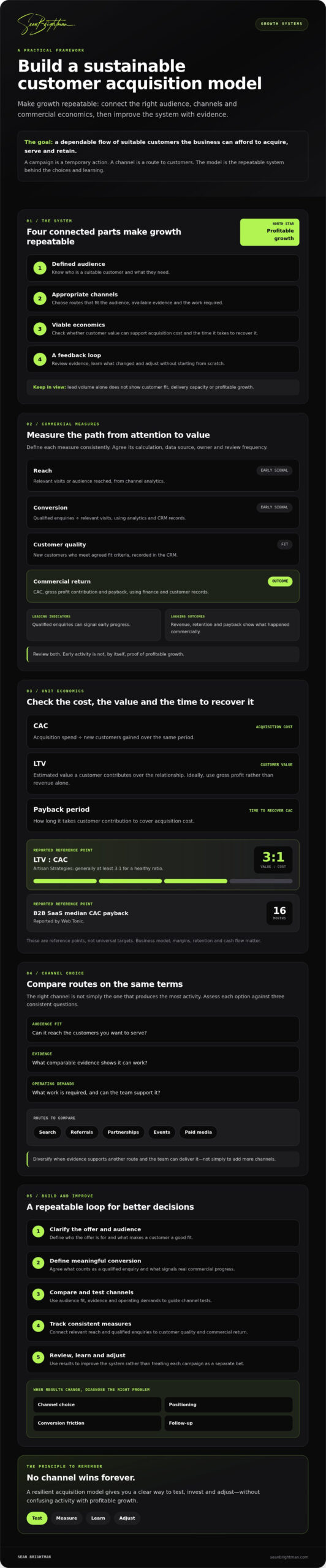
    A sustainable customer acquisition model is a repeatable system that connects a defined audience, appropriate channels, viable economics and a feedback loop that improves decisions over time. It isn’t a campaign, a channel, a funnel diagram or a pile of disconnected tactics. Campaigns are temporary actions within the system. Channels are routes to customers. Neither replaces the choices and learning that make growth repeatable.

    The system needs to account for customer quality and the organisation’s capacity to serve them, not just lead volume. A surge in demand can create problems if the offer attracts the wrong buyers or the team can’t deliver well. The fundamentals sit within broader core marketing concepts: understand the market, shape an offer and decide deliberately how it reaches customers.

    How is a customer acquisition model different from a marketing plan?

    A marketing plan often sets out activities and timing. A model sets the strategic choices behind those activities, then uses evidence to adjust them. For example, assumption only: a small software firm might test search content for buyers already looking for a solution, then track which enquiries become suitable customers. The campaign delivers the test. The model determines what to measure and what to change based on the result.

    What does sustainable customer growth actually mean?

    Repeatable doesn’t mean identical results every month. Markets shift, competitors respond and customer needs change. Sustainability means you can see what drives suitable demand, learn when performance changes and adapt without starting from scratch. It also means checking whether customers stay, whether the business can deliver the promised value and whether the economics make sense over time.

    Don’t diversify channels just to tick a box. A second or third route can reduce reliance on one source, but only when evidence shows it can reach the right audience and the team can support it. The goal is a resilient mix that fits your customers and capabilities, not more activity for its own sake.

    Build the economics and measurement behind your acquisition model

    Start with the commercial outcome, not the dashboard. Decide what the business needs to gain, then define a qualified customer and the conversion that signals real progress. A form submission may be a useful early indicator. A customer who buys, stays and can be served profitably is the outcome that matters.

    Keep the core economics clear. Customer acquisition cost (CAC) is the acquisition spend divided by the number of new customers gained over the same period. Customer lifetime value (LTV) estimates the value a customer contributes over the relationship, ideally using gross profit rather than revenue alone. Payback period measures how long it takes for that contribution to cover CAC. In plain terms, acquisition cost must be supported by the value customers generate, and the business must be able to wait for that value to arrive.

    For context, Artisan Strategies reported in April 2026 that a healthy LTV:CAC ratio is generally at least 3:1. Web Tonic reported a 16-month median CAC payback period for B2B SaaS in 2026. These are reference points, not universal targets. Business model, margins, retention and cash flow all matter.

    Which acquisition metrics should a growing business track?

    Choose a small set of metrics that follows the path from attention to commercial return. For each one, agree on its calculation, data source, owner and review frequency. This prevents teams from comparing figures built on different definitions.

    • Reach: relevant visits or audience reached, from channel analytics.
    • Conversion: qualified enquiries divided by relevant visits, using analytics and CRM records.
    • Customer quality: new customers who meet the agreed fit criteria, recorded in the CRM.
    • Commercial return: CAC, gross profit contribution and payback, using finance and customer records.

    Qualified enquiries are leading indicators. Revenue, retention and payback are lagging outcomes. Review both, but don’t mistake early activity for proof of profitable growth. Cohort analysis can help: group customers by when or how they were acquired, then compare retention and contribution over the same period.

    How do you know whether acquisition is economically sustainable?

    Compare acquisition investment with realised customer value over consistent time windows. Include gross margin, retention and delivery costs where the data is reliable, and label estimates rather than presenting them as facts. Attribution will never be perfect, especially when buyers encounter several touchpoints. Consistent definitions and directional evidence are more useful than false precision. To understand what customers are trying to achieve, the Jobs to Be Done framework can sharpen how you define fit and value.

    For wider systems context, explore the Marketing operations growth engine. If measurement exposes gaps in ownership or strategic alignment, marketing roadmapping support may help turn the diagnosis into prioritised next steps.

    Compare acquisition channels by fit, evidence and operating demands

    There’s no universally best acquisition channel. Search may reach people actively looking for an answer, while referrals can bring trust from the first conversation. The right choice depends on your audience, offer, sales cycle and ability to run the channel well. Building a sustainable customer acquisition model means comparing those factors, not copying a competitor’s channel mix.

    How should you compare channels before committing resources?

    Consider where your audience pays attention, how much buying intent they show, how quickly you can learn and what your team can realistically manage. Check audience concentration, control over the message and how each channel fits your sales cycle. Separate what you know from customer or sales evidence from assumptions that still need testing.

    Use the same definition of a qualified customer and comparable review periods across channels. Otherwise, one route may look stronger simply because you counted an early enquiry while another was judged on a completed sale.

    Channel Evidence to collect Common trade-offs
    Search Relevant search demand, qualified enquiries and eventual customer fit Captures existing intent, but learning and visibility may take time
    Referrals Source of introductions, conversion quality and repeatability Can bring warm prospects, but relies on relationships and may be hard to scale predictably
    Partnerships Audience overlap, partner contribution and follow-through Can extend reach, but needs alignment and ongoing coordination
    Events Suitable conversations, follow-up completion and sales progression Creates direct engagement, but demands preparation and timely follow-up
    Paid media Qualified conversions, customer outcomes and total acquisition investment Offers control over testing, but spend alone doesn’t prove customer quality

    When should you diversify beyond one acquisition channel?

    First, make sure your current route can produce suitable customers and that follow-up works. Adding channels before you understand the core process creates more moving parts, not resilience. Consider diversification when reliance on one source creates a material business risk and you have the capacity to test another route without weakening delivery.

    Positioning shapes channel choice. It clarifies who the offer is for and where that audience is likely to respond. A strategic brand roadmapping process can help connect those choices to a coherent growth direction. Add a channel when evidence and operating capacity support it, not to make the plan look balanced.
    Sustainable Customer Acquisition: A 2026 Practical Guide

    How to build a sustainable customer acquisition model step by step

    Don’t launch five channels at once and call the noise learning. Building a sustainable customer acquisition model starts with a focused test that the team can deliver, measure and interpret. Use this sequence:

    • 1. Define the customer. Describe the people or organisations most likely to need your offer, including the problem they want solved and the signs that make them a good fit.
    • 2. Clarify the offer. State what you help them achieve, why it matters and what action you want them to take. If the message is vague, channel results won’t tell you much.
    • 3. Select a channel. Choose one route that gives you a credible way to reach that audience and matches your team’s skills and capacity. Treat unproven assumptions as questions to test.
    • 4. Set up measurement. Agree the conversion definition, data source, owner and review point before launch. Make sure enquiries can be traced through to customer quality, not just counted at the first touchpoint.
    • 5. Run a bounded test. Set a time boundary that fits the channel and sales cycle. Decide in advance what evidence would justify continuing, changing the approach or stopping.

    A useful acquisition experiment tests one clear hypothesis with a defined audience, measure, time boundary and decision rule. That structure won’t guarantee a result. It will make the result easier to interpret.

    How do you choose a first acquisition experiment?

    Start with the biggest evidence-backed uncertainty affecting conversion or customer quality. For instance, if sales conversations suggest prospects don’t understand the offer, test a clearer message with a defined audience before adding another channel. Check that the team can run the test without disrupting essential work. Set the decision rule beforehand: continue if the agreed evidence supports it, change direction if it exposes a fixable issue, or stop if the core assumption doesn’t hold.

    How can teams turn early results into a repeatable process?

    Record the audience, message, channel, conversion definition, time boundary, result and limitations. Note what changed during the test, too. A result shaped by delayed follow-up or incomplete tracking shouldn’t be treated as a clean verdict on the channel.

    Repeat and refine promising approaches across relevant customer situations before standardising them. Use marketing strategy roadmap guidance to prioritise what to test next and keep actions tied to strategic direction. If you need help turning acquisition questions into a prioritised plan, explore marketing roadmapping support.

    Improve the model through review, accountability and strategic direction

    A customer acquisition model only improves when evidence changes what the team does next. Set a review cadence that fits your sales cycle and allows enough time for meaningful results to emerge. Each review should end with a decision, a named owner and a clear next action, not another list of marketing activity.

    What should an acquisition review meeting decide?

    Look at customer quality, channel evidence, conversion friction and delivery capacity together. If a channel brings relevant enquiries but few become customers, the channel may not be the problem. The positioning could be unclear, the buying journey may create friction, or follow-up may be inconsistent. Diagnose the weak point before switching tactics.

    Keep the meeting focused. For each issue, record whether to:

    • Continue: evidence supports the current approach.
    • Adjust: a specific change could address a weakness.
    • Pause: the activity isn’t justified by current evidence or capacity.
    • Investigate: the cause is unclear and needs a targeted check.

    Assign an owner and next step to every decision. A short written record of the evidence, interpretation and action makes the next review more useful. It also stops teams celebrating clicks or enquiries without asking whether they lead to suitable customers.

    When can outside strategic support help?

    A focused roadmap can help when priorities are unclear or acquisition activity lacks a coherent direction. It turns the diagnosis into a sequence of strategic actions. Ongoing senior oversight may be more useful when decisions span channels, measurement and internal execution, and the business needs continued direction and accountability.

    Fractional CMO and advisory support provide strategic leadership, not a promise of execution or results. The right level depends on the gap: a defined planning need may call for roadmapping; a continuing need for senior direction may suit an advisory retainer. For a closer look at ongoing support, read the Marketing advisory retainer guide.

    AI may help organise information or support repeatable workflow tasks, but it can’t replace customer understanding, reliable measurement or sound judgement. Treat its output as something to check, not as evidence in itself.

    Before adding another channel or campaign, identify the biggest constraint in your acquisition model and decide what evidence would help resolve it. If you want strategic input on that diagnosis, discuss your acquisition model with Sean.

    Make your next acquisition decision count

    Sustainable growth doesn’t come from chasing a channel that worked last month. It comes from a clear view of who you want to reach, what makes an acquired customer commercially valuable and how the team will learn from each test.

    Start small. Compare channels using consistent definitions, measure customer quality as well as early interest, and review what happens after conversion. When results disappoint, check the whole system before blaming the channel. Positioning, follow-up and delivery capacity can all shape the outcome.

    That’s the practical work of building a sustainable customer acquisition model. If your priorities are unclear or channel decisions lack strategic ownership, fractional CMO support can provide senior marketing leadership. Roadmapping can turn the diagnosis into a prioritised plan, while an advisory retainer can provide ongoing direction and accountability.

    Discuss your customer acquisition model with Sean to identify the constraint to tackle first. A more dependable approach starts with one informed decision, then improves through disciplined learning.

    Frequently Asked Questions

    What is a sustainable customer acquisition model?

    A sustainable customer acquisition model is a repeatable way to attract suitable customers while keeping acquisition commercially viable and manageable for the business. It connects a defined audience and relevant channels with clear measures and regular learning. It doesn’t promise identical results every month. Instead, it helps the team understand what’s working, spot changes and make informed adjustments without relying on a single campaign or a constant rise in activity.

    How do you build a customer acquisition model from scratch?

    Start by defining the customer you want to reach and the business outcome you need. Clarify the offer, choose a channel that fits your audience and team, then set up tracking before launching a focused test. State the hypothesis, measure, time boundary and decision rule in advance. Review the findings, including limitations, then adjust or repeat. Building a sustainable customer acquisition model is a process of structured learning, not a one-off campaign.

    Which customer acquisition channel is best for a small business?

    There’s no single best channel for every small business. Search may suit an offer people actively look for; referrals may work where trusted relationships influence buying decisions. Consider audience access, intent, sales-cycle fit, time to learn and the team’s capacity to manage the channel. Test a suitable option and assess qualified customers, not just clicks or enquiries. Compare results using the same conversion definitions and review periods.

    How do you measure whether customer acquisition is profitable?

    Compare acquisition cost with the value customers contribute over a consistent period. Include gross margin and, where reliable data exists, retention and delivery costs. Customer acquisition cost is acquisition spend divided by the number of new customers gained; customer lifetime value estimates their contribution over time. Payback period shows how long it takes to recover acquisition cost. Treat estimates carefully, and don’t confuse early indicators such as enquiries with realised commercial returns.

    How many acquisition channels should a business use?

    Use the number of channels your team can operate and measure properly, rather than aiming for a set total. Begin with a focused route that can generate useful evidence. Consider adding another when the existing process is understood, reliance on one source creates a genuine risk and you have the capacity to manage additional demand. More channels can spread risk, but they also add work and can make results harder to interpret.

    How often should you review a customer acquisition model?

    Review it regularly, with the cadence guided by your sales cycle and how quickly reliable evidence becomes available. Each review should consider customer quality, channel results, conversion friction and delivery capacity, then record a decision, an owner and a next action. Avoid reacting to short-term fluctuations before enough evidence has accumulated. Review test progress sooner if needed, but judge commercial outcomes over a period that fits the buying journey.

    Can AI help build a sustainable customer acquisition model?

    Yes, AI can support parts of the workflow, such as organising information or helping teams work more efficiently. It can’t replace direct customer understanding, sound measurement or strategic judgement. Check outputs against dependable data and the needs of your audience before acting on them. For example, AI may help summarise enquiry themes, but the team still needs to confirm whether those themes reflect suitable customers and lead to meaningful commercial outcomes.

  • Why Is My Marketing Not Generating Leads? The Brutal Truth for 2026

    Why Is My Marketing Not Generating Leads? The Brutal Truth for 2026

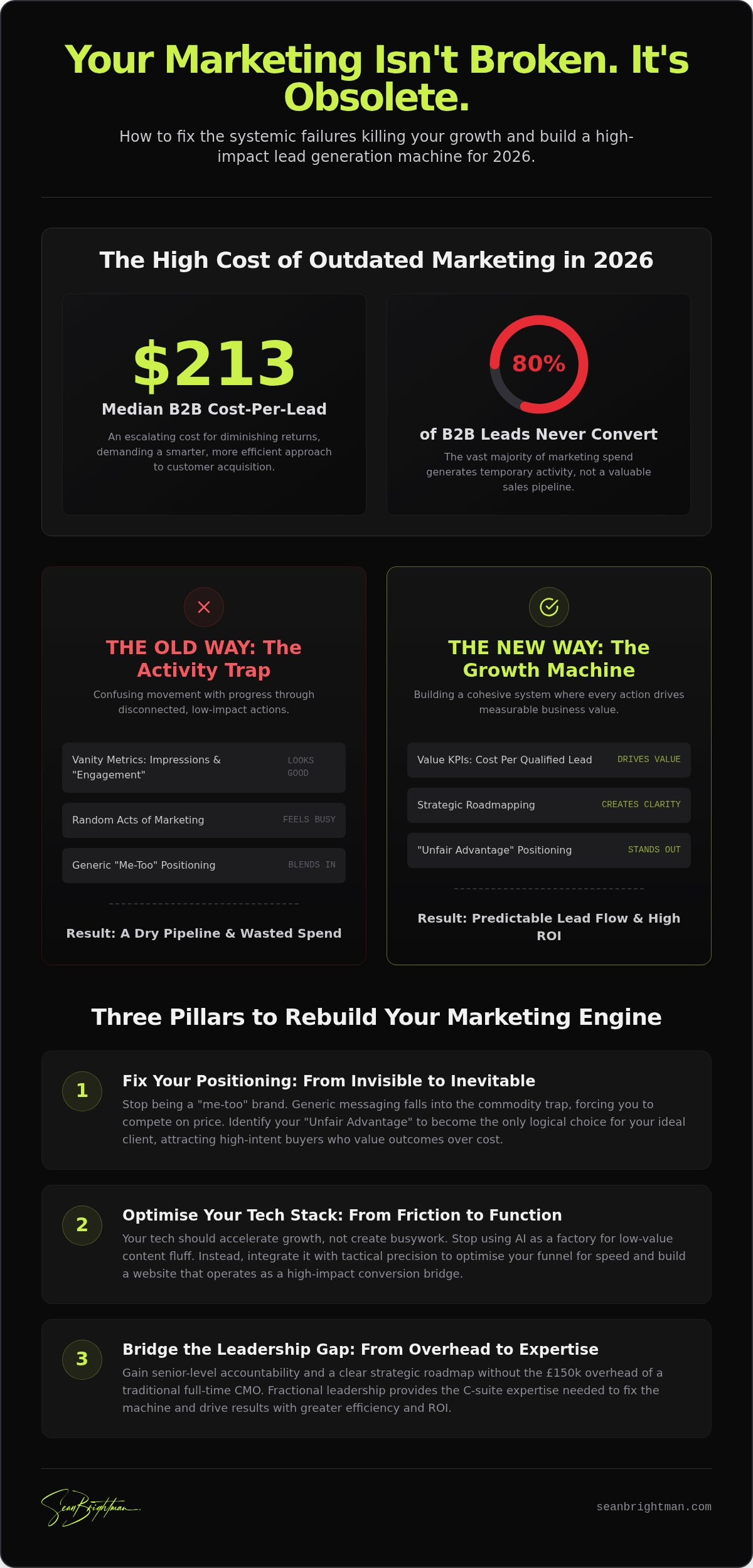
    Your marketing isn’t broken; it’s obsolete. In 2026, the median B2B cost-per-lead has climbed to $213, yet 80% of those leads will never result in a single sale. If you are staring at a dashboard full of activity whilst your pipeline remains bone dry, you are likely asking: why is my marketing not generating leads? It is a brutal question with a simple answer. You are paying for noise when you should be investing in a machine.

    You’re tired of agencies that promise the moon but deliver nothing but high invoices and “brand awareness.” You want predictable lead flow and a marketing spend that actually drives business value. I get it. The disconnect between marketing effort and sales results is the single biggest drain on your ROI. This article will expose the systemic failures killing your growth and show you how to rebuild a high-impact marketing engine that converts.

    We will strip away the fluff to audit your current funnel, integrate AI with tactical precision, and align your strategy with the reality of the 2026 market. It’s time to stop guessing and start scaling.

    Key Takeaways

    • Stop confusing movement with progress. Identify the “random acts of marketing” that look good on reports but fail to generate actual business value.
    • Discover why is my marketing not generating leads by fixing your positioning; if you are a “me-too” brand, you are invisible to the high-quality prospects you actually want.
    • Optimise your tech stack for speed, not just scale. Learn to use AI as a functional growth component rather than a factory for low-value content fluff.
    • Execute a clinical lead generation audit to find the friction in your funnel. Stop buying the wrong traffic and start building a website that operates as a high-impact conversion bridge.
    • Bridge the leadership gap with fractional expertise. Get senior-level accountability and a clear roadmap without the £150k overhead of a traditional full-time CMO.

    The Activity Trap: Why Busy Marketing Isn’t Better Marketing

    Movement is not progress. Your marketing team might be the busiest department in the building, but if the pipeline is empty, that activity is just expensive theatre. Many CEOs find themselves frustrated, staring at a flurry of social posts and email blasts whilst asking: why is my marketing not generating leads? The answer usually lies in the difference between random acts of marketing and a cohesive system. You are likely mistaking motion for momentum.

    Most marketing departments operate on a “more is better” philosophy. More content. More platforms. More noise. This is tactical friction. It creates the illusion of productivity whilst masking a fundamental strategy failure. Real lead generation requires a machine, not a series of disconnected events. If you are measuring success by how many blogs were published rather than how many qualified opportunities were created, you have already lost. You’re paying for the engine to rev in neutral.

    Vanity metrics are the primary weapon of the mediocre marketer. Impressions and “engagement” look fantastic on a colourful slide deck, but they don’t impact the bottom line. Your agency is likely incentivised by these metrics. They get paid to execute activity; they don’t usually get fired if that activity fails to drive business value. It is a misalignment of interests that leaves you holding the bill for a campaign that never had a chance of converting.

    The High Cost of Tactical Noise

    Throwing more money at a broken funnel doesn’t fix the leak; it just makes the puddle bigger. If your conversion rates are abysmal, increasing your ad spend is a guaranteed way to burn cash faster. This is “shiny object syndrome” in action. Teams pivot from TikTok to generative AI tools without a foundational plan, hoping the next tool will be the magic bullet. It won’t be. Busy teams aren’t always effective teams. Recognise when your people are sprinting in the wrong direction and pull the handbrake.

    Moving from Activity to Outcomes

    Stop asking for reports on activity and start demanding accountability for outcomes. In 2026, the KPIs that matter are Cost Per Qualified Lead (CPQL) and Pipeline Velocity. Marketing must be held to the same standards as sales. This shift requires a total re-evaluation of your engine. You cannot fix a systemic failure with a new set of ads. You need Strategic brand roadmapping to define the route before you press the accelerator. Without a roadmap, you are just a tourist in your own industry.

    The Positioning Problem: You Are Invisible Because You Are Generic

    Positioning is not your logo. It is not your colour palette or your choice of font. It is the singular reason why you are the only logical choice for your target prospect. If you are asking why is my marketing not generating leads, the answer is likely staring back at you from your own homepage. Most businesses suffer from “me-too” marketing. They copy their competitors’ homework, adopt the same tired industry jargon, and then wonder why the market treats them with total indifference. You aren’t just competing for budget; you are competing for attention in an economy that is already over-saturated with noise.

    When your messaging is generic, you fall headfirst into the commodity trap. If a high-value lead cannot distinguish your offering from the next five options in a Google search, they will default to the only metric they understand: price. You don’t want to be the cheapest; you want to be the most certain. High-intent buyers don’t purchase services; they purchase outcomes. You must identify your “Unfair Advantage” and bake it into every lead magnet and touchpoint. This isn’t about being “better” in a vague sense. It’s about being different in a way that solves a specific, high-stakes problem for your client.

    The Psychology of Lead Conversion

    In 2026, buyers have developed sophisticated “clutter filters.” They can spot a generic sales pitch from a mile away and they have zero patience for fluff. To convert, you must adopt a “Problem-First” approach. Stop talking about your features and start solving a micro-portion of the lead’s pain for free. Your value proposition should be a “this, not that” statement that polarises your audience. It should actively push away the tyre-kickers whilst pulling in the serious prospects who recognise their specific struggle in your words. If your marketing tries to speak to everyone, it will resonate with no one.

    Fixing the Messaging Disconnect

    Audit your current headlines right now. Are they about your “passion for excellence” or are they about the customer’s bottom line? Most websites are digital brochures when they should be sales machines. Apply the 5-second test: if a stranger lands on your site, can they tell exactly what you do and who you do it for before they scroll? If not, your lead flow will remain stagnant. Align your brand voice with the expectations of a senior B2B buyer who values tactical precision over corporate platitudes. If you need to stop the rot and find a clear direction, a Fractional CMO can help sharpen that messaging until it cuts through the noise.

    Systemic Failure: Why Your AI and Tech Stack Are Creating Friction

    Your tech stack is a liability. For most businesses in 2026, the marketing infrastructure is a tangled mess of disconnected subscriptions that create more work than they solve. If you are asking why is my marketing not generating leads, you need to look at the friction in your follow-up. Tool fatigue is real. When your systems don’t talk to each other, leads die in the gaps. You don’t need another “all-in-one” platform; you need a system that actually works.

    Your CRM is likely a graveyard. It’s filled with stale data and ignored prospects because your team is too busy managing the tools to manage the relationships. This is a systemic failure. Marketing Operations is no longer a luxury for enterprise firms; it is the backbone of any lead gen cycle that expects to scale. If you are constantly wondering why is my marketing not generating leads, the answer is often found in the friction of your own making.

    The AI Growth Engine vs. AI Noise

    Most firms use AI to create content fluff. They churn out generic blogs that no one reads and wonder why the phone isn’t ringing. This isn’t growth; it’s noise. High-impact AI consulting focuses on personalising the lead journey at scale. It’s about using machine learning to qualify leads in real-time, freeing your sales team to talk to humans, not chatbots. Fix your data flow before you buy the tool. AI is an accelerant; if you point it at a mess, you just get a faster mess.

    Building Scalable Marketing Systems

    Scalability is about integration, not accumulation. Your tech stack must be a cohesive engine where data flows seamlessly from the first click to the final sale. This is where Marketing operations consultants find hidden profit. They strip away the bloat and build a “plug-and-play” architecture. You need a machine that doesn’t rely on the institutional knowledge of one person. If your lead gen stops when your marketing manager goes on holiday, you don’t have a system. You have a bottleneck.

    Why Is My Marketing Not Generating Leads? The Brutal Truth for 2026

    The Lead Generation Audit: Diagnosing the Leak in Your Growth Engine

    Stop guessing. If you are still asking why is my marketing not generating leads, it is time to stop the creative brainstorming and start the clinical diagnosis. You don’t need a new campaign; you need an audit of the one you already have. Most funnels aren’t broken; they are just leaking. You must find the holes before you pour in more budget. If you are constantly frustrated by why is my marketing not generating leads, the answer is often hidden in these five steps.

    The first step is a Traffic Quality Audit. Are you buying the wrong audience? High traffic counts are a vanity metric if the visitors have zero intent to buy. Next, perform the Conversion Friction Test. Is your website a bridge or a hurdle? If your contact form asks for fourteen fields of data, you are actively sabotaging your own growth. Follow this with an Offer Relevancy Check. Your lead magnet must be visceral and valuable, not just another generic PDF that ends up in a “downloads” folder.

    Finally, look at Lead Velocity and Sales-Marketing Alignment. If it takes three days to contact a lead, you have already lost them. Marketing and sales must stop the blame culture and start a feedback loop. If marketing delivers leads that sales can’t close, the system is failing. It’s that simple. You need a machine that works, not a department that makes excuses.

    Finding the “Point of Failure”

    Data tells the truth when people won’t. Use your analytics to pinpoint exactly where potential leads drop off. A 1% improvement at the bottom of your funnel often beats a 10% increase in raw traffic. It is more efficient to fix the bucket than to buy more water. Try the “Secret Shopper” method. Enquire through your own website and see how long it takes to get a response. The results are usually eye-opening and often embarrassing. It is the fastest way to see the reality of your customer journey.

    The Accountability Framework

    Systems require discipline. Set up a weekly session where marketing and sales review every single lead. Define a “Qualified Lead” once and for all. If you cannot agree on what an MQL or an SQL looks like, your engine will never run smoothly. Maintaining this level of audit discipline is difficult in the heat of daily operations. Using a Marketing advisory retainer ensures you have an external force keeping the machine on track. To stop the leak and start the engine, book a strategic audit to find your growth bottlenecks.

    Fractional Leadership: Fixing the Machine Without the £150k Overhead

    The solution to why is my marketing not generating leads is rarely “more marketing.” It is better leadership. You don’t need another tactical specialist to pull a lever; you need a strategist to design the machine. Most CEOs are trapped in a cycle of hiring agencies that execute without accountability. This is why your department feels messy. It is reactive, not proactive. It is a collection of tasks, not a system for growth. If the pilot is missing, the plane will never reach its destination, no matter how much fuel you pour into the engines.

    The Fractional CMO revolution provides the solution. You gain senior-level strategic direction and the “outside-in” perspective your internal team naturally lacks. Internal teams often suffer from tunnel vision; they are too close to the problem to see the solution. A fractional leader brings the battle-hardened experience of multiple industries to your specific challenge. You get this high-impact authority without the £150k+ overhead of a full-time hire. This isn’t just about saving money; it’s about buying speed. A fractional strategist builds a scalable, exit-ready marketing engine that runs like a machine, adding tangible value to the company balance sheet.

    Advisory vs. Execution

    You don’t need more “doers.” You need a strategist to tell the doers what to do. Most businesses are over-staffed with people who can execute tactics but under-resourced with people who can define strategy. This is a recipe for wasted budget. An advisory retainer provides the CEO with direct accountability and strategic velocity. It ensures that every pound spent on marketing is an investment in business value, not just another expense. Fractional leadership can fix a “messy” marketing department in 90 days by stripping away the fluff and installing functional systems. It is the difference between a department that costs you money and an engine that makes you money.

    The Path Forward

    Moving from “Why isn’t this working?” to “How do we scale this?” requires a fundamental shift. You must move from a reactive “campaign” mindset to a proactive “system” mindset. Integrating a Fractional CMO into your existing leadership team provides the strategic anchor your growth requires. You stop guessing and start measuring what actually moves the dial. Your next step is clear. You need a clinical assessment of your current state and a defined path to your future state. This starts with a Roadmapping session. It is time to stop playing with marketing and start building a high-impact growth engine.

    From Tactical Friction to Strategic Velocity

    Stop paying for noise. You now have the clinical diagnosis for why is my marketing not generating leads. It is rarely a lack of effort; it is a failure of systems, positioning, or leadership. You don’t need another agency to pull a lever. You need a strategist to design the machine. Fix the friction in your tech stack. Sharpen your message until it cuts through the 2026 clutter. Most importantly, install the senior accountability required to keep your growth engine running at peak performance.

    As a proven Fractional CMO for UK scale-ups and the author of the definitive book on marketing strategy, I specialise in building AI-powered growth engines that actually convert. I have no patience for bureaucracy or vanity metrics. I focus on movement, machinery, and tactical precision. You have two choices. You can keep burning cash on random acts of marketing, or you can build a predictable lead machine that drives real business value.

    It is time to take control of your ROI and build an engine that runs like a machine. Book a Strategic Roadmapping session to fix your marketing engine today. Let’s turn your messy department into a high-impact asset. You can do this.

    Frequently Asked Questions

    Why is my marketing generating traffic but no leads?

    Traffic is a vanity metric; conversion is a business metric. If people are visiting but not converting, you likely have a messaging disconnect or a friction-heavy website. Your headlines might be about your company whilst the visitor is looking for a solution to their specific pain. Audit your “Problem-First” approach. If your website is a hurdle instead of a bridge, your traffic spend is just expensive noise.

    How do I know if my marketing agency is doing a good job?

    Measure your agency by pipeline value, not activity reports. A good agency focuses on outcomes like Cost Per Qualified Lead (CPQL) and sales-ready opportunities. If they only talk about impressions, reach, or “brand awareness,” they are hiding a lack of results. You don’t pay for posters; you pay for profit. Demand total transparency and a feedback loop that connects their work directly to your sales team’s success.

    What is the most common reason lead generation fails in B2B?

    The most common reason is the “commodity trap.” You look exactly like your competitors and offer no unique reason for a prospect to choose you. This fundamental messaging disconnect is usually why is my marketing not generating leads. When you combine generic positioning with a leaky tech stack, your budget just evaporates. You need a system that qualifies intent rather than just counting clicks and impressions.

    Is AI actually helpful for lead generation or just hype?

    AI is a functional growth component, not a magic wand. It is incredibly helpful for automating lead qualification and personalising the user journey at scale. However, it is pure hype if you’re only using it to generate low-value content fluff. Focus on using AI to fix your data flow and speed up follow-up times. If your AI doesn’t reduce your cost-per-lead or increase velocity, you’re using it wrong.

    How much should I be spending on marketing to generate leads?

    Focus on your Cost Per Qualified Lead (CPQL) rather than a fixed percentage of revenue. In early 2026, the median B2B lead cost reached $213, but top-tier programs achieved $84 through better efficiency. Your spend should scale only after you have proven your funnel works. Don’t pour fuel into a car that won’t start. Build the engine first, then invest in the accelerator to drive predictable growth.

    What is a Fractional CMO and how can they fix my lead flow?

    A Fractional CMO is a senior strategist who works part-time to install growth engines and provide accountability. They fix your lead flow by stripping away “random acts of marketing” and replacing them with a functional system. They provide the “outside-in” perspective that internal teams lack. It is a plug-and-play solution for CEOs who need senior leadership to fix a messy department without a full-time hire’s overhead.

    Should I hire a full-time Marketing Director or a Fractional CMO?

    Hire a Fractional CMO for strategic velocity and a full-time director for execution. Most businesses don’t need a £150k+ salary on the books to fix a messy department. They need a battle-hardened expert to build the engine and train the team. A fractional leader provides senior-level accountability without the long-term liability. It’s about buying the result, not the person’s time. Focus on leadership, not just headcount.

    How can I improve the quality of the leads I am getting?

    Better lead quality starts with tighter positioning and harder qualification. Stop trying to speak to everyone. Use a “this, not that” value proposition to polarise your audience and attract high-intent buyers. If you are asking why is my marketing not generating leads that actually close, your conversion hurdles are too low. Ask for the right data early to filter out tyre-kickers and focus your sales team on genuine opportunities.