
More AI tools won’t fix a disconnected marketing system. A practical AI marketing stack connects five layers: AI models, content and creative tools, first-party data and CRM, automation, and measurement. Knowing how to build an AI marketing stack means choosing the smallest setup that supports your business goals and lets information move between those layers.
A marketing tech stack is the set of tools your business uses to plan, create, deliver and measure marketing. The challenge isn’t finding another platform. It’s choosing tools that work together, suit your team’s capacity and solve real bottlenecks.
This guide explains how to build an AI marketing stack for a UK small business, including how to connect analytics, SEO, content, paid media and CRM. Learn how to audit your existing tools, spot gaps and add automation where it makes a practical difference. No bloated tool list. No AI for its own sake. Just a workable system built around your priorities.
Key Takeaways
- Start with a business goal and a bottleneck, then choose tools that solve it rather than adding AI for its own sake.
- Keep customer data, measurement and core workflows under your control so you can change tools without losing the system.
- Connect your CRM, analytics and content workflows so useful signals can move between them without manual hand-offs.
- Automate repetitive tasks first, keep human oversight in place and measure whether the change improves your marketing work.
Marketing automation and campaign orchestration
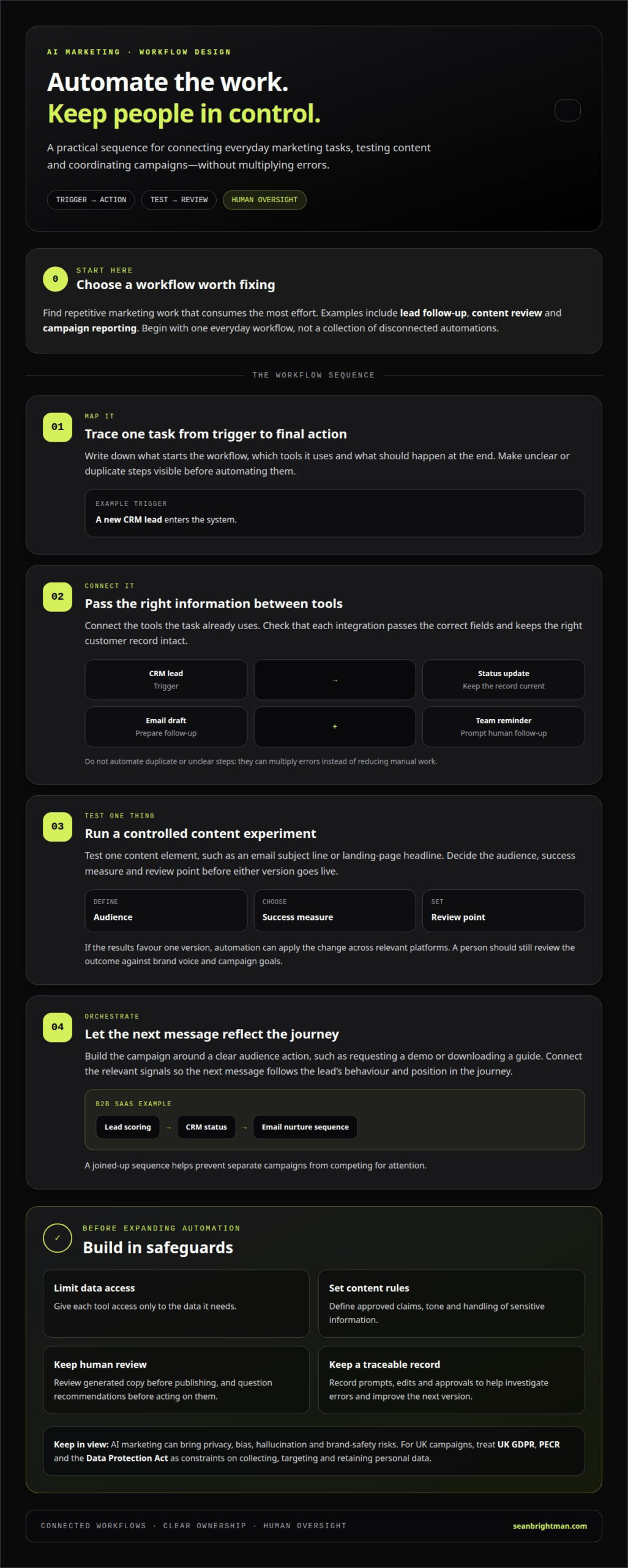
Start by identifying the repetitive marketing workflows that consume the most effort, such as lead follow-up, content review and campaign reporting. AI marketing also brings privacy, bias, hallucination and brand-safety risks, so maintain human oversight and clear rules for data access and generated content.
-
Automate workflows and integrate tools
Map one everyday workflow from trigger to final action, then connect the tools it already uses. For example, a new CRM lead could trigger a status update, an email draft and a reminder for a team member. Check that each integration passes the right fields and preserves the correct customer record. Don’t automate duplicate or unclear steps: they multiply errors instead of reducing manual work.
-
Automate content experimentation
Set up a controlled test for one content element, such as an email subject line or landing-page headline. Define the audience, success measure and review point before launching either version. If the results show a stronger version, automation can apply the change across relevant platforms. Keep a person responsible for reviewing the outcome, so a short-term lift doesn’t override brand voice or campaign goals.
- Build campaign orchestration around a clear audience action, such as requesting a demo or downloading a guide. A B2B SaaS team, for example, can connect lead scoring, CRM status and a multi-step email nurture sequence. Set the next message according to the lead’s behaviour and position in the journey. This creates a joined-up workflow, rather than separate campaigns competing for attention.
- Build safeguards into the workflow before expanding automation. Give each tool access only to the data it needs, and set rules for approved claims, tone and sensitive information. Require human review before publishing AI-generated copy or acting on a questionable recommendation. Keep a record of prompts, edits and approvals. This traceable foundation makes it easier to investigate errors and improve the next version.
What is a marketing tech stack?
A marketing tech stack connects customer data, software and workflows so teams can make informed decisions. For UK campaigns, treat UK GDPR, PECR and the Data Protection Act as constraints on collecting, targeting and retaining personal data.
-
Own core data and workflows
Keep customer records, measurement definitions and campaign workflows under your control, while renting the tools that process them. Store agreed fields such as consent status, lead stage and product category somewhere your team can export them. Document how a lead moves from first interaction to sales hand-off. Avoid building that logic solely inside one vendor, where changing tools could break the process.
-
Centralise marketing intelligence
Connect your CRM, website analytics, email and commerce data using shared identifiers. For a retailer, standardise product names, attributes and categories before asking AI to draft descriptions. Disconnected systems can feed different specifications into each channel, creating inconsistent copy and targeting. Include access controls, privacy rules and human review. Keep prompts, generated versions and approvals traceable.
-
Enrich and validate data
Validate sales records before using them for scoring or audience selection. Combine relevant firmographic details with first-party actions, such as a demo request or repeat visits, and show sales teams where each signal came from. Set rules for required fields, duplicate records and outdated contact details. Review bounce patterns and rejected updates as signs of data decay; refresh or suppress weak records before they distort campaign decisions.
- Define who owns each data field and workflow, then record that responsibility in a shared process document. For example, marketing can manage campaign tags while sales owns lead-stage updates. Set a review path for AI-generated recommendations and content, with a named person responsible for approval. These controls promote consistent data use and help teams trace decisions back to their inputs.
Connecting analytics, SEO, content, paid media and CRM
Connect each channel to a shared campaign strategy, from search discovery through CRM conversion. Measure whether AI improves the work, not just how much content it generates.
-
Build content creation and publishing workflows
Map a content workflow from keyword research to publishing, then give each tool a clear function. For example, analytics can identify pages losing organic traffic, while an AI assistant drafts an updated outline. Use a content management system to manage review and publication. For product content, provide approved attributes and facts, then check every claim before publishing. Don’t let automation bypass editorial approval or duplicate existing pages.
-
Use CRM signals for targeting
Connect CRM stages and customer actions to content and paid-media decisions. A prospect who requests a product demonstration needs different follow-up from someone who only reads a guide. Use those signals to shape audience segments, campaign exclusions and relevant content. Check that each channel receives the correct status and consent information. Don’t treat a single click as proof of purchase intent.
-
Scale personalised content
Start with one useful variation, such as adapting an email introduction for existing customers and new prospects. Use approved audience attributes to guide generation while keeping the central offer and brand voice consistent. Review examples across email, landing pages and paid channels before extending the workflow. Check that personalisation reflects real customer context, not assumptions drawn from incomplete data.
-
Measure ROI and performance
Set a baseline before adding AI, then track time recovered, output per employee and campaign performance. Compare similar campaigns or run controlled tests to isolate AI’s contribution. Changing several variables at once makes results hard to interpret. Review analytics alongside CRM outcomes, not clicks alone. If production speeds up but qualified enquiries don’t improve, adjust the workflow or targeting before scaling.
Choosing a small-business AI marketing stack
Choose tools around a business goal, not a vendor’s feature list. A lean stack should connect the marketing team’s core work without adding needless manual steps. Start by identifying the outcome your business needs most to work out how to build an AI marketing stack.
-
Assess goals, data maturity and use cases
Write down the outcome first, such as improving qualified enquiries or publishing product updates faster. Then trace the data and steps behind the task. If contact records lack consistent stages, fix the source data before adding AI scoring. Match each proposed tool to a specific use case, owner and success measure. Don’t buy software to solve a workflow nobody has mapped.
-
Compare AI marketing platforms
Compare features, integrations, ease of use and UK pricing against the same workflow. Consider how well each platform fits your existing workflow and whether staff can use it easily. Compare subscription tiers, user limits and usage-based charges in pounds. Include the cost of integrations and overlapping functions, not just the headline subscription.
- Keep the tool count tight. Four to six tools can cover core stack layers when native integrations connect them. If two platforms overlap substantially, consider whether one can be removed or whether each has a distinct role. Choose a primary large language model for routine marketing tasks, and add another only to address a clear capability gap. Before purchase, name the person who will use each tool weekly.
- Run a small pilot before a wider rollout. Give the marketing team one defined task, such as drafting an email from approved product details. Track time saved, output quality and whether the result supports the original goal. Set a review date and decide what would justify keeping the platform. If the pilot creates extra corrections or fails to connect with existing systems, fix the workflow before expanding. Build an AI marketing stack around evidence, not assumptions.
Turn your priorities into a practical AI marketing stack roadmap before committing to more software.
Sean Brightman
Sean Brightman helps turn marketing priorities into a clear AI strategy and practical stack roadmap. If your tools feel disconnected or you’re unsure which use case should come first, AI Consulting can clarify the decisions and shape a focused plan. Roadmapping can structure the next steps, from identifying workflow priorities to planning how tools fit together. For ongoing strategic input as your stack develops, an Advisory Retainer provides continuing guidance.
Seek support when tool choices are slowing progress, data and workflows aren’t connecting, or your team needs clearer direction. You don’t need a bigger stack by default. You need a system built around the work that matters. Contact Sean Brightman to discuss your AI marketing stack.
Make your next stack decision count
Your marketing stack should evolve with your business, not become another system nobody wants to maintain. Treat each new tool as a decision about how your team works: what changes, who owns it and how you’ll know it helps. That discipline keeps technology in service of the strategy, rather than letting a growing tool list dictate it.
The practical question is how to build an AI marketing stack that can adapt as your priorities change. Start with the next constraint holding marketing back, then choose a focused improvement your team can put into practice. If you want help turning that decision into a workable direction, contact Sean Brightman to discuss your stack.
Build deliberately, learn from each change and keep moving forward.
Frequently Asked Questions
How do I know if my current stack has too many tools?
Look for tools with no active owner, overlapping functions or data staff copy manually between systems. A platform sitting unused during a typical campaign adds admin, not capability. More than 25 marketing tools can signal fragmentation rather than strength. The sharper test is whether each tool has a defined job, a regular user and an output that informs a decision.
What Is a MarTech Stack?
A MarTech stack is the connected set of marketing technology a business uses to plan and run customer communications. For example, a website form can pass an enquiry into a CRM, trigger a follow-up and record the eventual sale in analytics. The value comes from smooth hand-offs, not from collecting software under one label.
What is an AI marketing stack and what core components does it need?
An AI marketing stack adds AI capabilities to the connected systems that support planning, execution and measurement. Its core layers are models; content and creative tools; first-party data and CRM; automation; and measurement. A small firm might use a model to draft a campaign, CRM context to tailor it, automation to route it, and analytics to assess the response. Human judgement still sets direction and approval.
Which AI marketing platforms and tools are best for CRM, content, analytics, advertising and automation?
No single platform is best across CRM, content, analytics, paid media and automation. Choose by task: can it connect to your current records, give the team usable controls and export its data? Compare UK prices in pounds, including user tiers, usage limits and add-on integrations. A product that excels at content generation may still be a poor fit for CRM workflows.
How can you integrate AI marketing tools with a CRM, website, analytics and existing data sources?
Connect tools by matching shared fields, such as email address, campaign source and lead stage, then map which system owns each field. Use an API integration where available; otherwise, a connector can bridge systems. Test with a sample record and confirm that updates flow both ways only where intended. This catches duplicate contacts and overwritten CRM values before they affect live campaigns.
What customer data and analytics infrastructure is needed for an AI marketing stack?
Build around first-party records your business can use appropriately, with clear identifiers, source labels and consent status. Capture useful events such as form submissions, purchases or email engagement, then align their names across the website, CRM and analytics. Add role-based access, retention rules and a process for correcting inaccurate records. AI outputs depend on the data and controls behind them.