
Tag: customer acquisition

  • Marketing Growth Models for Tech Companies: How to Choose in 2026

    Marketing Growth Models for Tech Companies: How to Choose in 2026

    The growth model that looks fastest at another tech company could be the wrong one for yours. The right marketing growth models for tech companies depend on how your customers buy, how quickly they realise value and what your business economics can sustain.

    If you’re unsure whether product-led, sales-led or marketing-led growth fits, you’re not alone. The labels can make the choice seem simpler than it is. Copying a competitor’s playbook won’t help if your buyers behave differently or your marketing activity isn’t tied to acquisition, retention and revenue.

    This guide compares the strengths and limits of the main growth models, so you can choose based on customer behaviour and unit economics, not fashion or guesswork.

    You’ll also learn how to test your assumptions, track whether the model is working and turn the evidence into practical priorities. The goal isn’t to choose a label and stick with it. It’s to build a growth system that fits your product, buyers and business.

    Key Takeaways

    • See how product-led, sales-led, marketing-led and partner-led growth differ, and which conditions favour each model.
    • Use buyer complexity, time to value and customer behaviour to judge which marketing growth models for tech companies fit your offer.
    • Check activation, retention and expansion before assuming a self-serve product can carry growth.
    • Test your preferred model with a defined segment, a clear hypothesis and one primary outcome before scaling investment.
    • Align marketing, product, sales and customer success around shared measures and a regular review rhythm.

    What marketing growth models for tech companies actually describe

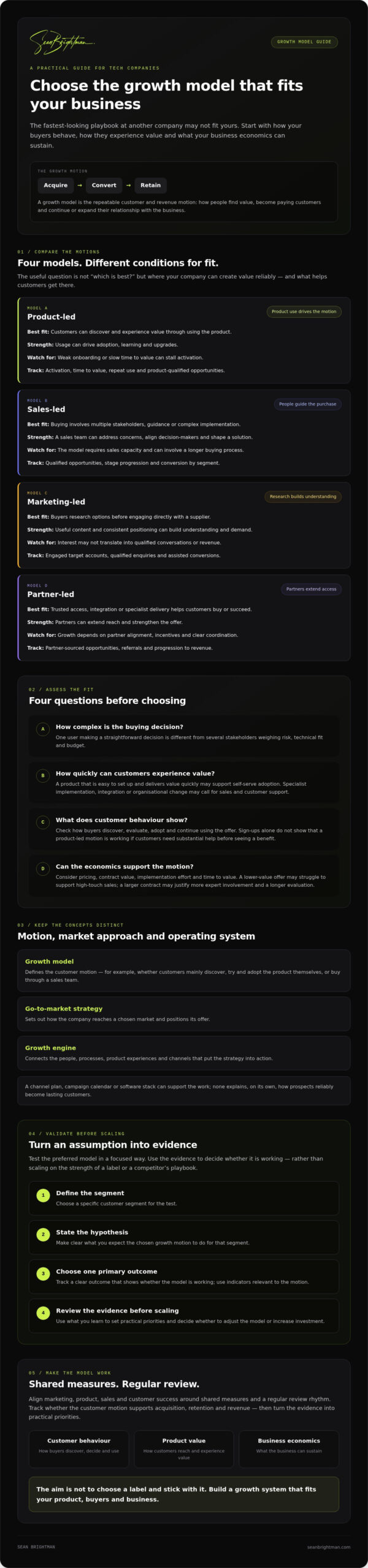
    A growth model is the repeatable way a company acquires, converts and retains customers. It describes how customers experience value, become paying users and continue using or expanding their relationship with the business.

    A growth model is the repeatable customer and revenue motion; a marketing strategy is the set of choices that helps make that motion work. A channel plan names where you’ll show up. A campaign calendar schedules activity. A software stack supports the work. None of these, on its own, explains how the company will reliably turn prospects into lasting customers.

    Growth model, go-to-market strategy and growth engine: what is different?

    The growth model defines the motion: for example, whether customers mainly discover, try and adopt a product themselves, or buy through a sales team. The go-to-market strategy sets out how the company reaches a chosen market and positions its offer. The growth engine is the connected set of people, processes, product experiences and channels that puts the strategy into action.

    Consider a software company aiming for self-serve adoption. Customers need to understand and experience value without a lengthy sales process. The company might target a specific business segment, then connect useful content, a low-friction product journey and follow-up based on user behaviour. Growth hacking also puts experimentation and scalable growth at the centre, but experiments still need to support a coherent model.

    Why one company’s successful playbook may fail at another

    A familiar playbook isn’t proof of fit. A product that’s easy to set up and delivers value quickly may support self-serve adoption. A platform that requires specialist implementation, integration or organisational change may need sales and customer support to guide the buyer. The buying group matters too: one user making a simple decision is different from several stakeholders weighing risk, technical fit and budget.

    Pricing and contract value affect the economics. A lower-value offer may struggle to support a high-touch sales process, while a larger contract may justify more expert involvement and a longer evaluation. Implementation effort and time to value matter just as much. If customers need substantial help before seeing a benefit, sign-ups alone won’t show that a product-led motion is working.

    That’s why marketing growth models for tech companies should be chosen using evidence about customer behaviour, product value and business economics, not copied from a fashionable success story. Compare the models on consistent terms, then test which one fits.

    Compare the main marketing growth models for tech companies

    Each model puts a different part of the customer journey in the driving seat. The useful question isn’t “which is best?” but “where can your company create value reliably, and what must it do to help customers get there?”

    Model Best-fit conditions Strengths Constraints Leading indicators
    Product-led Customers can discover and experience value through product use. Usage can drive adoption, learning and upgrades. Weak onboarding or slow time to value can stall activation. Activation, time to value, repeat use and product-qualified opportunities.
    Sales-led Buying involves multiple stakeholders, guidance or complex implementation. People can address concerns, align decision-makers and shape a solution. Requires sales capacity and can involve a longer buying process. Qualified opportunities, stage progression and conversion by segment.
    Marketing-led Buyers research options before engaging directly with a supplier. Useful content and consistent positioning can build understanding and demand. Interest may not translate into qualified conversations or revenue. Engaged target accounts, qualified enquiries and assisted conversions.
    Partner-led Trusted access, integration or specialist delivery helps customers buy or succeed. Partners can extend reach and strengthen the offer. Growth depends on partner alignment, incentives and clear coordination. Partner-sourced opportunities, referrals and progression to revenue.

    Product-led and sales-led growth: where each motion earns its place

    Product-led growth makes sense when people can explore the product, understand its value and make progress without extensive one-to-one guidance. That doesn’t rule out sales. A self-serve route can support straightforward needs, while sales steps in when account complexity, user activity or implementation requirements call for human support.

    Sales-led growth earns its place when buyers need help building a case, involving stakeholders or managing technical change. Set clear hand-off rules: define which behaviours or requirements trigger human support, who owns the next step and how product activity informs the conversation.

    Marketing-led and partner-led growth: two routes beyond direct product adoption

    Marketing-led growth suits buyers who compare approaches and gather information before speaking with sales. Marketing helps them understand the problem, assess options and see how the offer is relevant. Partner-led growth relies on another organisation’s trusted relationships, complementary product or specialist delivery to reach or serve customers. The route needs to fit the company’s market and offer, not just a promising channel.

    Hybrid models can work, but “everyone owns growth” often means nobody owns the hand-off. Name the owner for each stage, agree what qualifies a lead or partner opportunity, and track whether it progresses. For help turning a model choice into sequenced priorities and accountable decisions, strategic marketing roadmapping can provide a useful framework.

    How to assess which tech company growth model fits

    Choose the model that matches how customers make decisions and reach value, not the one that sounds easiest to scale. Start with the buying process: who feels the problem, who evaluates the product, who approves the spend, and how long does a decision take? Then identify what customers need to use the product successfully. A simple tool may need clear onboarding; a product tied to existing systems may need technical guidance or implementation support.

    Software doesn’t automatically mean product-led growth. If buyers need internal approval, specialist advice or help proving the business case, a self-serve journey may not support the entire sale. Product-led elements can still help with discovery or evaluation, but the growth motion should reflect the actual purchase and adoption process.

    Use customer behaviour to test the fit

    Map the customer journey from first discovery through evaluation, purchase, activation and expansion. Use customer interviews, sales conversations and product data to find where people pause, ask for help or drop out. Then identify what could unblock them: a person, a partner, a more useful product experience or educational content.

    Let observed buying behaviour choose the growth model, not the model you wish customers would follow. Compare patterns across the segments you serve. One group may adopt independently, while another needs guided evaluation. Different paths can work, provided the hand-offs are deliberate.

    Use growth metrics without mistaking activity for progress

    Connect each acquisition measure to what happens next. Website visits or enquiries show activity; qualified pipeline, conversion, retention and expansion indicate whether that activity contributes to commercial progress. Track early signals, such as product activation or qualified meetings, alongside later outcomes, such as closed revenue and customer retention.

    • Leading indicators: target-account engagement, completed onboarding, activation, qualified opportunities and progression through the buying process.
    • Commercial outcomes: acquisition cost, conversion, retention, expansion and revenue.

    Use your own data to compare customer acquisition cost (CAC), customer lifetime value (LTV) and payback. Before comparing models, agree what each measure includes: which acquisition costs count, how you calculate customer value, and whether payback means the time until gross profit or another defined contribution measure covers CAC. Keep the period, segment and attribution rules consistent. If the underlying data is incomplete, label assumptions rather than presenting estimates as facts.

    This gives you a practical fit test for marketing growth models for tech companies: follow customer behaviour, then check whether the economics support repeating that motion.
    Marketing Growth Models for Tech Companies: How to Choose in 2026

    How to validate a marketing growth model before scaling it

    Don’t make a company-wide bet on an untested assumption. Run a bounded test to see whether a specific growth motion works for a defined group of customers. Before you start, choose one primary outcome, supporting indicators and the evidence that would make you continue, adjust or stop.

    Design a test that answers one growth question

    Keep the test narrow. Choose a customer segment, offer and acquisition or activation motion, then record the baseline and write down your assumptions. Changing several things at once makes the results difficult to interpret.

    1. Set a hypothesis. State what you expect to happen, for whom and why. For example: “A guided product demonstration will help operations teams in this segment reach activation more often than the current self-serve onboarding.”
    2. Select a segment. Focus on customers with a shared need or buying context, rather than mixing very different accounts in one test.
    3. Run a bounded test. Limit its scope and agree the review point in advance. Track the primary outcome, such as activation or qualified opportunities, alongside useful indicators such as completion rates, drop-off points or requests for help.
    4. Review the evidence. Compare results with the baseline and your decision criteria. Continue if the evidence supports the hypothesis, adjust if it points to a fixable barrier, or stop if the motion doesn’t appear to fit.

    For example, when testing a sales-assisted path, define which customer signals trigger sales involvement and track whether those prospects progress. Don’t treat more meetings as success unless they lead to stronger qualification or commercial outcomes.

    Reliable tests depend on clear processes for recording activity, assigning ownership and reviewing results. See marketing operations and scalable growth systems for more on building that operating discipline.

    Turn test results into a practical roadmap

    A test is useful only if it changes what the team does next. Turn the findings into a short plan: name the priority, assign an owner, identify dependencies and set a review point. If the evidence is mixed, record what remains uncertain and design the next test to resolve it. Strategic brand roadmapping can help sequence those choices into a clear direction.

    Still unsure which motion the evidence supports? Discuss a growth roadmap with Sean to turn the decision into priorities and accountable next steps.

    Build the leadership and systems to make the chosen model work

    A growth model won’t run itself. Marketing, product, sales and customer success need shared definitions of progress, clear ownership and reliable hand-offs. Otherwise, one team celebrates sign-ups while another sees stalled activation or customers who never reach value.

    Give the growth model clear owners and decision rights

    Name an owner for each stage: acquisition, conversion, activation, retention and expansion. Clarify who acts when a prospect becomes a sales opportunity, when product usage signals a need for support, or when a customer is ready to grow their account. Agree what each hand-off includes and how the receiving team confirms it’s complete.

    Separate strategic accountability from execution. A leader sets direction, priorities and measures; internal teams or providers carry out assigned work. AI can support workflows such as analysis, personalisation or content development, but it can’t decide which growth model fits the business or take responsibility for the outcome. People still need to check the evidence and own the decisions.

    Set a regular review cadence. Bring together leading indicators, customer evidence and commercial outcomes. Ask what’s changing, where customers are getting stuck and whether the priorities still make sense. Change the plan when the evidence changes, not simply because a new tactic looks appealing.

    Know when to bring in senior marketing direction

    Watch for warning signs: teams are pursuing conflicting priorities, positioning shifts between channels, or marketing measures don’t connect to pipeline, retention or revenue. These are leadership and alignment problems, not simply requests for more activity.

    Fractional CMO support can provide senior marketing direction on a part-time basis, with strategic oversight rather than full-time placement or advertising execution. If the main need is to establish direction and sequence priorities, roadmapping can create a structured plan. If the business needs continued guidance and accountability, an advisory retainer may be a better fit. The marketing advisory retainer offers more context on ongoing strategic direction.

    For marketing growth models for tech companies, the operating system matters as much as the choice of model. Clear ownership, shared measures and regular decisions turn strategy into coordinated work. If you’re weighing up the next step, explore Fractional CMO, roadmapping and advisory support with Sean.

    Choose your model, then prove it in practice

    The strongest marketing growth models for tech companies aren’t borrowed from a competitor. They fit how your customers buy, experience value and continue using your product. Product-led, sales-led, marketing-led and partner-led motions each have a place, and a hybrid can work when ownership and hand-offs are clear.

    Start with customer behaviour and your own unit economics. Then test one focused hypothesis, define what success looks like and decide in advance whether to continue, adjust or stop. A burst of activity isn’t proof of growth. Look for progress through the customer journey and towards commercial outcomes.

    Make the model workable with shared measures, clear decision rights and regular reviews. If your team needs senior direction, Fractional CMO support offers part-time marketing leadership. Strategic roadmapping can turn direction into a structured plan, while ongoing advisory provides continued guidance and accountability.

    Talk through your growth model with Sean to identify practical next steps. You don’t need to copy someone else’s playbook; you can build a model that fits your business and improve it with evidence.

    Frequently Asked Questions

    What is a marketing growth model for a tech company?

    A marketing growth model describes the repeatable way a tech company attracts, converts and retains customers. It shows how customers discover the offer, decide to buy, reach value and continue using or expanding their use of it. It’s different from a channel plan or campaign calendar: those organise marketing activity, while the growth model explains how that activity connects to customer behaviour and business growth.

    Which growth model is best for a B2B SaaS company?

    There’s no single best model for every B2B SaaS company. Product-led growth may fit when customers can try the software and experience value without much assistance. Sales-led growth may fit complex purchases involving several decision-makers, technical evaluation or implementation support. Marketing-led and partner-led motions can also play key roles. Assess how your target buyers evaluate and adopt the product, then test the motion against customer and commercial evidence.

    Is product-led growth right for every tech company?

    No. Product-led growth depends on customers being able to discover, adopt and realise value through the product itself. If onboarding is difficult, implementation is substantial or buyers need guidance to build internal agreement, a self-serve path may not be enough. Software companies can still use product-led elements, such as a self-serve trial, alongside sales support. Check activation, time to value, retention and expansion before making product-led growth the primary motion.

    How do you choose between sales-led and product-led growth?

    Choose based on what buyers need to make a decision and succeed after purchase. Product-led growth is more plausible when users can experience value independently and adoption doesn’t require extensive support. Sales-led growth may suit purchases with multiple stakeholders, detailed evaluation or complex implementation. Map the journey from discovery to activation, then identify where customers ask for help or stall. You can support self-serve users with sales by setting clear qualification and hand-off rules.

    Can a tech company use more than one growth model?

    Yes. A company could combine self-serve product adoption for simpler needs with sales support for larger or more complex accounts. Marketing may create demand across both routes, while partners help reach customers or support implementation. The risk is confusion, not variety. Set clear ownership, shared definitions and hand-off rules so teams know who acts next, which customer fits each route and how each motion contributes to acquisition, retention or revenue.

    How should an early-stage tech company measure its growth model?

    Start with a small set of measures tied to the model you’re testing. Track a leading indicator, such as qualified enquiries, onboarding completion or product activation, alongside outcomes such as conversion, retention and expansion. Record a baseline, define each metric consistently and review a specific customer segment. Don’t treat traffic or sign-ups alone as proof of progress. Set decision criteria in advance, then continue, adjust or stop based on the evidence.

  • Sustainable Customer Acquisition: A 2026 Practical Guide

    Sustainable Customer Acquisition: A 2026 Practical Guide

    Your next winning channel won’t fix a broken acquisition model. Building a sustainable customer acquisition model means making growth repeatable, rather than betting the month’s target on whichever platform looks promising.

    If customer numbers swing from month to month, marketing activity is hard to connect to profitable customers, or channel choices rely more on assumptions than comparable evidence, the problem may not be a lack of tactics. It may be a lack of joined-up measurement and learning.

    This guide shows you how to connect the right audience, channels and commercial economics, then use what you learn to improve the system. You’ll see how to compare channel performance on consistent terms, assess whether customer value supports acquisition costs, and set review habits that lead to better decisions.

    No channel wins forever. A resilient model gives you a clear way to test, invest and adjust without confusing activity with profitable growth. The steps below cover the measures that matter and common traps that make acquisition unpredictable.

    Key Takeaways

    • Build a dependable flow of suitable customers, not a short-lived spike in leads.
    • Define what a qualified customer and a meaningful conversion look like before judging performance.
    • Compare search, referrals, partnerships, events and paid media by audience fit, evidence and the work each requires.
    • Use a focused process to build a sustainable customer acquisition model, from clarifying your offer to testing channels and tracking results.
    • Review results regularly to identify whether the issue is channel choice, positioning, conversion friction or follow-up.

    What makes a customer acquisition model sustainable over time?

    A campaign can flood your inbox with leads one month, then leave sales chasing poor-fit prospects the next. A dependable acquisition model does something harder: it attracts suitable customers through a process the business can afford, deliver and improve.

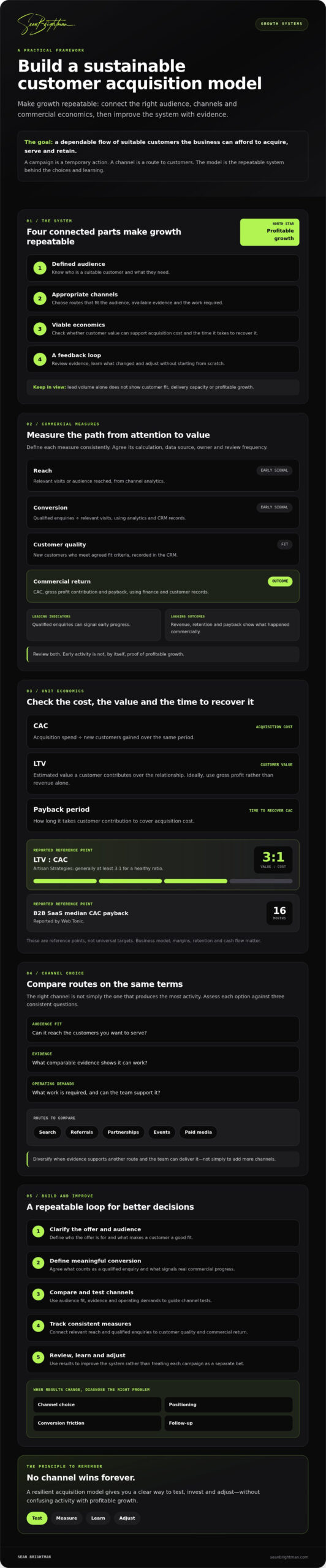
    A sustainable customer acquisition model is a repeatable system that connects a defined audience, appropriate channels, viable economics and a feedback loop that improves decisions over time. It isn’t a campaign, a channel, a funnel diagram or a pile of disconnected tactics. Campaigns are temporary actions within the system. Channels are routes to customers. Neither replaces the choices and learning that make growth repeatable.

    The system needs to account for customer quality and the organisation’s capacity to serve them, not just lead volume. A surge in demand can create problems if the offer attracts the wrong buyers or the team can’t deliver well. The fundamentals sit within broader core marketing concepts: understand the market, shape an offer and decide deliberately how it reaches customers.

    How is a customer acquisition model different from a marketing plan?

    A marketing plan often sets out activities and timing. A model sets the strategic choices behind those activities, then uses evidence to adjust them. For example, assumption only: a small software firm might test search content for buyers already looking for a solution, then track which enquiries become suitable customers. The campaign delivers the test. The model determines what to measure and what to change based on the result.

    What does sustainable customer growth actually mean?

    Repeatable doesn’t mean identical results every month. Markets shift, competitors respond and customer needs change. Sustainability means you can see what drives suitable demand, learn when performance changes and adapt without starting from scratch. It also means checking whether customers stay, whether the business can deliver the promised value and whether the economics make sense over time.

    Don’t diversify channels just to tick a box. A second or third route can reduce reliance on one source, but only when evidence shows it can reach the right audience and the team can support it. The goal is a resilient mix that fits your customers and capabilities, not more activity for its own sake.

    Build the economics and measurement behind your acquisition model

    Start with the commercial outcome, not the dashboard. Decide what the business needs to gain, then define a qualified customer and the conversion that signals real progress. A form submission may be a useful early indicator. A customer who buys, stays and can be served profitably is the outcome that matters.

    Keep the core economics clear. Customer acquisition cost (CAC) is the acquisition spend divided by the number of new customers gained over the same period. Customer lifetime value (LTV) estimates the value a customer contributes over the relationship, ideally using gross profit rather than revenue alone. Payback period measures how long it takes for that contribution to cover CAC. In plain terms, acquisition cost must be supported by the value customers generate, and the business must be able to wait for that value to arrive.

    For context, Artisan Strategies reported in April 2026 that a healthy LTV:CAC ratio is generally at least 3:1. Web Tonic reported a 16-month median CAC payback period for B2B SaaS in 2026. These are reference points, not universal targets. Business model, margins, retention and cash flow all matter.

    Which acquisition metrics should a growing business track?

    Choose a small set of metrics that follows the path from attention to commercial return. For each one, agree on its calculation, data source, owner and review frequency. This prevents teams from comparing figures built on different definitions.

    • Reach: relevant visits or audience reached, from channel analytics.
    • Conversion: qualified enquiries divided by relevant visits, using analytics and CRM records.
    • Customer quality: new customers who meet the agreed fit criteria, recorded in the CRM.
    • Commercial return: CAC, gross profit contribution and payback, using finance and customer records.

    Qualified enquiries are leading indicators. Revenue, retention and payback are lagging outcomes. Review both, but don’t mistake early activity for proof of profitable growth. Cohort analysis can help: group customers by when or how they were acquired, then compare retention and contribution over the same period.

    How do you know whether acquisition is economically sustainable?

    Compare acquisition investment with realised customer value over consistent time windows. Include gross margin, retention and delivery costs where the data is reliable, and label estimates rather than presenting them as facts. Attribution will never be perfect, especially when buyers encounter several touchpoints. Consistent definitions and directional evidence are more useful than false precision. To understand what customers are trying to achieve, the Jobs to Be Done framework can sharpen how you define fit and value.

    For wider systems context, explore the Marketing operations growth engine. If measurement exposes gaps in ownership or strategic alignment, marketing roadmapping support may help turn the diagnosis into prioritised next steps.

    Compare acquisition channels by fit, evidence and operating demands

    There’s no universally best acquisition channel. Search may reach people actively looking for an answer, while referrals can bring trust from the first conversation. The right choice depends on your audience, offer, sales cycle and ability to run the channel well. Building a sustainable customer acquisition model means comparing those factors, not copying a competitor’s channel mix.

    How should you compare channels before committing resources?

    Consider where your audience pays attention, how much buying intent they show, how quickly you can learn and what your team can realistically manage. Check audience concentration, control over the message and how each channel fits your sales cycle. Separate what you know from customer or sales evidence from assumptions that still need testing.

    Use the same definition of a qualified customer and comparable review periods across channels. Otherwise, one route may look stronger simply because you counted an early enquiry while another was judged on a completed sale.

    Channel Evidence to collect Common trade-offs
    Search Relevant search demand, qualified enquiries and eventual customer fit Captures existing intent, but learning and visibility may take time
    Referrals Source of introductions, conversion quality and repeatability Can bring warm prospects, but relies on relationships and may be hard to scale predictably
    Partnerships Audience overlap, partner contribution and follow-through Can extend reach, but needs alignment and ongoing coordination
    Events Suitable conversations, follow-up completion and sales progression Creates direct engagement, but demands preparation and timely follow-up
    Paid media Qualified conversions, customer outcomes and total acquisition investment Offers control over testing, but spend alone doesn’t prove customer quality

    When should you diversify beyond one acquisition channel?

    First, make sure your current route can produce suitable customers and that follow-up works. Adding channels before you understand the core process creates more moving parts, not resilience. Consider diversification when reliance on one source creates a material business risk and you have the capacity to test another route without weakening delivery.

    Positioning shapes channel choice. It clarifies who the offer is for and where that audience is likely to respond. A strategic brand roadmapping process can help connect those choices to a coherent growth direction. Add a channel when evidence and operating capacity support it, not to make the plan look balanced.

    Sustainable Customer Acquisition: A 2026 Practical Guide

    How to build a sustainable customer acquisition model step by step

    Don’t launch five channels at once and call the noise learning. Building a sustainable customer acquisition model starts with a focused test that the team can deliver, measure and interpret. Use this sequence:

    • 1. Define the customer. Describe the people or organisations most likely to need your offer, including the problem they want solved and the signs that make them a good fit.
    • 2. Clarify the offer. State what you help them achieve, why it matters and what action you want them to take. If the message is vague, channel results won’t tell you much.
    • 3. Select a channel. Choose one route that gives you a credible way to reach that audience and matches your team’s skills and capacity. Treat unproven assumptions as questions to test.
    • 4. Set up measurement. Agree the conversion definition, data source, owner and review point before launch. Make sure enquiries can be traced through to customer quality, not just counted at the first touchpoint.
    • 5. Run a bounded test. Set a time boundary that fits the channel and sales cycle. Decide in advance what evidence would justify continuing, changing the approach or stopping.

    A useful acquisition experiment tests one clear hypothesis with a defined audience, measure, time boundary and decision rule. That structure won’t guarantee a result. It will make the result easier to interpret.

    How do you choose a first acquisition experiment?

    Start with the biggest evidence-backed uncertainty affecting conversion or customer quality. For instance, if sales conversations suggest prospects don’t understand the offer, test a clearer message with a defined audience before adding another channel. Check that the team can run the test without disrupting essential work. Set the decision rule beforehand: continue if the agreed evidence supports it, change direction if it exposes a fixable issue, or stop if the core assumption doesn’t hold.

    How can teams turn early results into a repeatable process?

    Record the audience, message, channel, conversion definition, time boundary, result and limitations. Note what changed during the test, too. A result shaped by delayed follow-up or incomplete tracking shouldn’t be treated as a clean verdict on the channel.

    Repeat and refine promising approaches across relevant customer situations before standardising them. Use marketing strategy roadmap guidance to prioritise what to test next and keep actions tied to strategic direction. If you need help turning acquisition questions into a prioritised plan, explore marketing roadmapping support.

    Improve the model through review, accountability and strategic direction

    A customer acquisition model only improves when evidence changes what the team does next. Set a review cadence that fits your sales cycle and allows enough time for meaningful results to emerge. Each review should end with a decision, a named owner and a clear next action, not another list of marketing activity.

    What should an acquisition review meeting decide?

    Look at customer quality, channel evidence, conversion friction and delivery capacity together. If a channel brings relevant enquiries but few become customers, the channel may not be the problem. The positioning could be unclear, the buying journey may create friction, or follow-up may be inconsistent. Diagnose the weak point before switching tactics.

    Keep the meeting focused. For each issue, record whether to:

    • Continue: evidence supports the current approach.
    • Adjust: a specific change could address a weakness.
    • Pause: the activity isn’t justified by current evidence or capacity.
    • Investigate: the cause is unclear and needs a targeted check.

    Assign an owner and next step to every decision. A short written record of the evidence, interpretation and action makes the next review more useful. It also stops teams celebrating clicks or enquiries without asking whether they lead to suitable customers.

    When can outside strategic support help?

    A focused roadmap can help when priorities are unclear or acquisition activity lacks a coherent direction. It turns the diagnosis into a sequence of strategic actions. Ongoing senior oversight may be more useful when decisions span channels, measurement and internal execution, and the business needs continued direction and accountability.

    Fractional CMO and advisory support provide strategic leadership, not a promise of execution or results. The right level depends on the gap: a defined planning need may call for roadmapping; a continuing need for senior direction may suit an advisory retainer. For a closer look at ongoing support, read the Marketing advisory retainer guide.

    AI may help organise information or support repeatable workflow tasks, but it can’t replace customer understanding, reliable measurement or sound judgement. Treat its output as something to check, not as evidence in itself.

    Before adding another channel or campaign, identify the biggest constraint in your acquisition model and decide what evidence would help resolve it. If you want strategic input on that diagnosis, discuss your acquisition model with Sean.

    Make your next acquisition decision count

    Sustainable growth doesn’t come from chasing a channel that worked last month. It comes from a clear view of who you want to reach, what makes an acquired customer commercially valuable and how the team will learn from each test.

    Start small. Compare channels using consistent definitions, measure customer quality as well as early interest, and review what happens after conversion. When results disappoint, check the whole system before blaming the channel. Positioning, follow-up and delivery capacity can all shape the outcome.

    That’s the practical work of building a sustainable customer acquisition model. If your priorities are unclear or channel decisions lack strategic ownership, fractional CMO support can provide senior marketing leadership. Roadmapping can turn the diagnosis into a prioritised plan, while an advisory retainer can provide ongoing direction and accountability.

    Discuss your customer acquisition model with Sean to identify the constraint to tackle first. A more dependable approach starts with one informed decision, then improves through disciplined learning.

    Frequently Asked Questions

    What is a sustainable customer acquisition model?

    A sustainable customer acquisition model is a repeatable way to attract suitable customers while keeping acquisition commercially viable and manageable for the business. It connects a defined audience and relevant channels with clear measures and regular learning. It doesn’t promise identical results every month. Instead, it helps the team understand what’s working, spot changes and make informed adjustments without relying on a single campaign or a constant rise in activity.

    How do you build a customer acquisition model from scratch?

    Start by defining the customer you want to reach and the business outcome you need. Clarify the offer, choose a channel that fits your audience and team, then set up tracking before launching a focused test. State the hypothesis, measure, time boundary and decision rule in advance. Review the findings, including limitations, then adjust or repeat. Building a sustainable customer acquisition model is a process of structured learning, not a one-off campaign.

    Which customer acquisition channel is best for a small business?

    There’s no single best channel for every small business. Search may suit an offer people actively look for; referrals may work where trusted relationships influence buying decisions. Consider audience access, intent, sales-cycle fit, time to learn and the team’s capacity to manage the channel. Test a suitable option and assess qualified customers, not just clicks or enquiries. Compare results using the same conversion definitions and review periods.

    How do you measure whether customer acquisition is profitable?

    Compare acquisition cost with the value customers contribute over a consistent period. Include gross margin and, where reliable data exists, retention and delivery costs. Customer acquisition cost is acquisition spend divided by the number of new customers gained; customer lifetime value estimates their contribution over time. Payback period shows how long it takes to recover acquisition cost. Treat estimates carefully, and don’t confuse early indicators such as enquiries with realised commercial returns.

    How many acquisition channels should a business use?

    Use the number of channels your team can operate and measure properly, rather than aiming for a set total. Begin with a focused route that can generate useful evidence. Consider adding another when the existing process is understood, reliance on one source creates a genuine risk and you have the capacity to manage additional demand. More channels can spread risk, but they also add work and can make results harder to interpret.

    How often should you review a customer acquisition model?

    Review it regularly, with the cadence guided by your sales cycle and how quickly reliable evidence becomes available. Each review should consider customer quality, channel results, conversion friction and delivery capacity, then record a decision, an owner and a next action. Avoid reacting to short-term fluctuations before enough evidence has accumulated. Review test progress sooner if needed, but judge commercial outcomes over a period that fits the buying journey.

    Can AI help build a sustainable customer acquisition model?

    Yes, AI can support parts of the workflow, such as organising information or helping teams work more efficiently. It can’t replace direct customer understanding, sound measurement or strategic judgement. Check outputs against dependable data and the needs of your audience before acting on them. For example, AI may help summarise enquiry themes, but the team still needs to confirm whether those themes reflect suitable customers and lead to meaningful commercial outcomes.