Tag: customer data

  • AI marketing automation: How data, agents and workflows work together

    AI marketing automation: How data, agents and workflows work together

    AI marketing automation fails when it stops at a single tool. Automating marketing workflows with AI means connecting customer data, AI agents and systems so work moves from one stage to the next, from identifying an audience to preparing a message and feeding campaign results back into the process. The aim isn’t to automate every decision, but to connect the right decisions and actions.

    The appeal is clear: fewer manual hand-offs and more consistent execution. But AI can’t make disconnected data useful by magic. Incomplete records, systems that don’t share context and unclear rules for human review can simply help mistakes travel faster.

    This guide explains what AI marketing automation does, what data it relies on and how agents work with existing workflows and platforms. You’ll see which routine tasks can be automated, where human judgement still matters and why the real advantage comes from connecting systems, not piling on more tools.

    Key Takeaways

    • AI agents can support content research, creation and publishing, but clear review points keep people in control of important decisions.
    • Useful automation starts with reliable, well-organised data and thoughtful handling of consent and privacy.
    • Marketing workflows connect customer signals to timely actions, then use campaign results to shape what happens next.
    • Map how your systems hand work between them to spot where a clearer roadmap or AI advice could make automation more useful.

    AI agents for researching, creating and publishing content

    AI agents can support content tasks from research through drafting and publication. Their value depends on how well platforms, audience data and human review work together.

    Content operations and workflow intelligence

    Content operations platforms coordinate briefs, drafts, approvals and publishing; workflow intelligence reveals where work stalls or repeats. That matters because an agent needs a defined route, not just access to a text box. A platform covering 80% of workflows can be more useful than stitching together 20 tools. For example, an agent can research a brief, generate a draft, apply SEO checks, then send it to an editor before publication. The editor can catch unsupported claims, weak search intent or a mismatch with the brand’s voice.

    Audience segmentation and personalised content

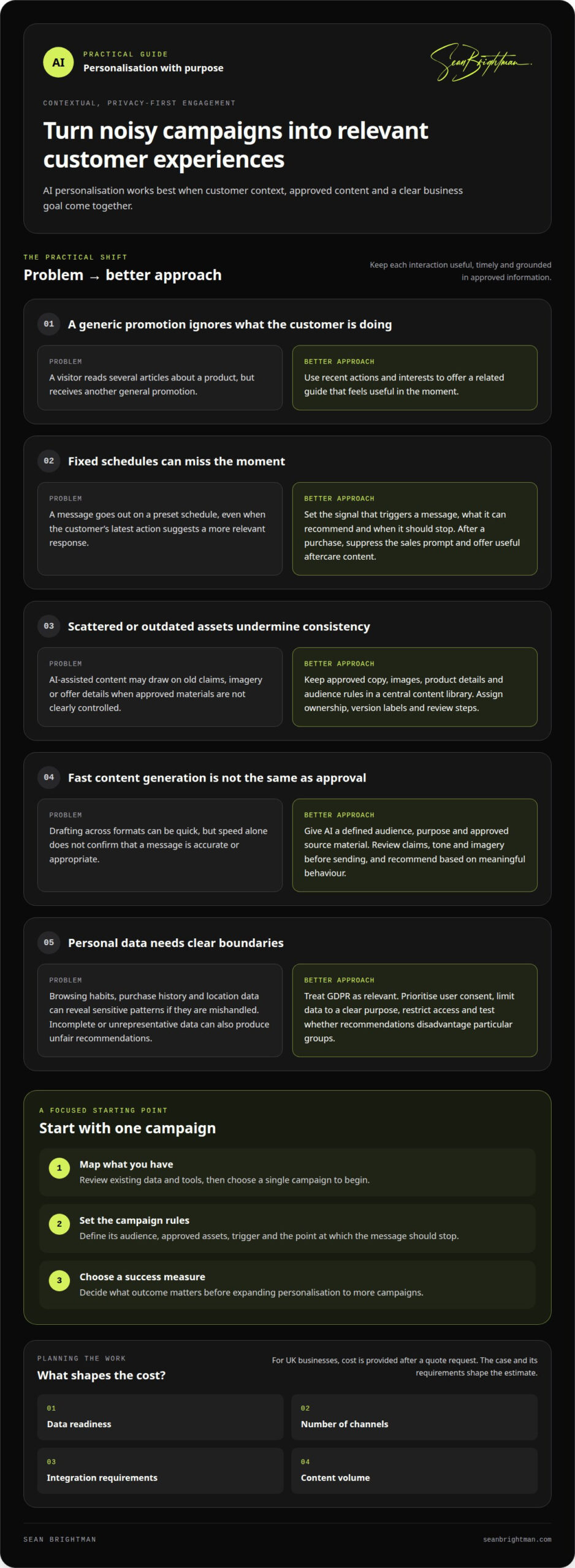
    Audience segmentation groups people by shared characteristics or behaviour, helping teams make content more relevant. AI marketing automation can analyse customer data to spot patterns and create micro-segments. For example, a team might distinguish first-time visitors researching a service from returning customers comparing options. Agents can then suggest different subject lines, introductions or calls to action for each group. The goal is relevance, not endless variations: segment criteria should reflect a genuine difference in what people need.

    Personalised outreach workflows

    Personalised outreach workflows use audience signals to select a message and determine what happens next. A customer viewing a product guide, for example, could receive a related email; a reply or purchase can then pause or change the sequence. Timing controls are associated with 14% better open rates in marketing workflows. Keep the logic visible: define the trigger, approved content, next action and exit condition. Agents can prepare and route messages, while people retain oversight of sensitive or high-impact communication.

    Data foundations for AI marketing automation

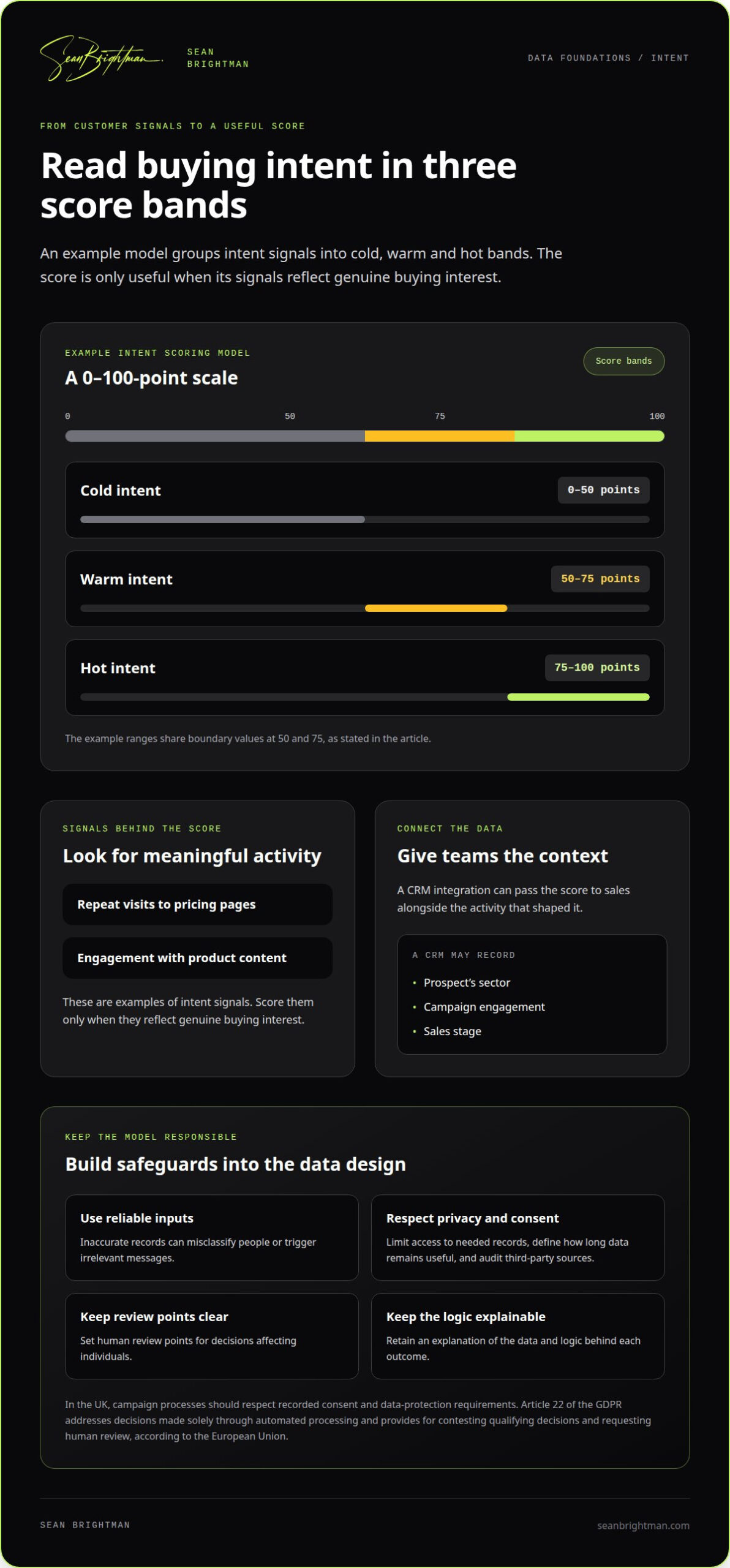
    AI depends on data that is accurate, connected and useful for decisions. A CRM might record a prospect’s sector, campaign engagement and sales stage, while an email platform stores a separate interaction history. Integration can synchronise these records, helping teams see the customer journey rather than disconnected channel activity. Clear definitions for fields such as “qualified lead” also make reporting more consistent.

    Reporting and attribution turn those records into evidence about campaign performance. A dashboard can show which channel generated an enquiry, but attribution rules determine how credit is assigned when someone reads an article, attends an event and then converts. Aligning those rules with commercial goals helps teams optimise spend and avoid treating the last recorded interaction as the whole story.

    Intent data helps prioritise accounts by signals such as repeat visits to pricing pages or engagement with product content. One example scoring model uses 0-50 points for cold intent, 50-75 for warm and 75-100 for hot. Those bands are useful only when signals reflect genuine buying interest. A CRM integration can then pass the score to sales, alongside the activity that shaped it.

    Security and privacy belong in the data design, not as an afterthought. Limit access to the records each team needs, define how long data remains useful, and audit third-party sources for privacy standards. In the UK, campaign processes should also respect recorded consent and data-protection requirements. Poor-quality inputs can expose sensitive information, misclassify people or trigger irrelevant messages.

    The risks include inaccurate records, misleading attribution and automated decisions that remove meaningful human judgement. Article 22 of the GDPR addresses decisions made solely through automated processing and provides for contesting qualifying decisions and requesting human review, according to the European Union. Set clear review points for decisions affecting individuals, and keep an explanation of the data and logic behind each outcome.

    In the UK, platform pricing depends on factors such as user seats, data volume, integrations and features; vendors provide prices after a quote request. Those factors also shape implementation complexity and ongoing data processes.

    A focused AI strategy conversation can help turn these data questions into a workable plan.

    AI marketing automation: How data, agents and workflows work together

    What is AI marketing automation?

    AI marketing automation combines customer data, decision rules and AI agents to select and carry out marketing actions. Traditional automation follows fixed if-then rules; AI can interpret patterns and adapt the next step. For teams automating marketing workflows with AI, the key question is whether the system can respond to changing signals.

    Marketing workflows and customer engagement

    A marketing workflow is a sequence of actions triggered by a customer signal, such as a form submission or product-page visit. It gives each interaction a chance to lead to a relevant next step instead of a generic campaign. For example, a new enquiry could trigger a welcome email, then route a sales-ready contact to a team member.

    Traditional automation runs the sequence marketers define; AI-powered tools can help choose or adjust actions using engagement patterns. A website chatbot can answer visitor questions 24 hours a day, seven days a week. Behavioural triggers are associated with 3× higher engagement in marketing workflows, making timely responses useful for customer experience and retention. Reporting then shows where people continue, pause or leave.

    AI can also help tailor customer experiences in response to fresh signals. If a visitor returns to a service page after reading an introductory email, a system might prioritise more detailed information rather than repeat the same message. The trigger and action should serve the campaign goal, such as a booked demonstration or completed enquiry.

    Automated journeys and personalisation

    An automated customer journey connects messages and actions across stages, from first interaction to repeat purchase. A consistent sequence can support conversion without relying on manual follow-ups for every contact. AI can personalise email campaigns using relevant signals, such as someone’s stated interests or recent engagement, to tailor content and timing.

    For example, someone who downloads a beginner’s guide might receive a practical follow-up, while a returning reader gets a deeper case study. AI agents can recommend content or adjust a journey when behaviour changes; marketers set the boundaries and review the results. Automating marketing workflows with AI works best when human oversight guides those adjustments.

    Useful journeys include clear exit rules. A purchase can stop promotional reminders, while a support request can pause sales messages. Teams can use customer feedback and reporting to spot friction, update the journey and improve the experience after conversion.

    Workflow automation across marketing systems

    AI can automate email, lead scoring, campaign reporting and follow-up across connected marketing systems. To automate a workflow, define its goal, trigger, systems, actions and human review points, then test the hand-offs before scaling.

    Marketing workflow use cases

    Marketing workflow automation links a customer signal to actions across platforms, helping the marketing team deliver consistent execution. Email is the most commonly automated marketing task, at 65%. Lead scoring can also speed qualification by passing engagement signals from analytics into a CRM, where sales can prioritise follow-up. These use cases matter because automation connects campaign creation and messaging to what happens next.

    Connect the systems, not just the tasks

    The hard part is often the hand-off between platforms. A form submission can create a CRM record, trigger an email and update a reporting dashboard; if one connection fails, the team may miss the enquiry or duplicate messaging. Map where each system receives and passes information. Effective workflow automation can reduce manual marketing tasks by up to 67%, but only when connected processes carry accurate data and clear ownership.

    Steps for automating workflows with AI

    A workflow is a defined route from a business goal to a measurable action. A clear sequence helps teams avoid automating broken processes:

    1. Choose a use case, such as routing new enquiries.
    2. Define the trigger, outcome and success measure.
    3. Map the systems, data fields and decisions involved.
    4. Test edge cases, assign human review, then monitor results.

    Activities accounting for 10% to 15% of marketing executives’ time can become fully automated through workflow adaptations. Start with a repeatable task, not a complex process with unclear ownership.

    Measure the hand-offs

    Track whether each system receives the right information and completes its assigned action. For a lead-scoring workflow, compare qualification speed with the previous process; lead scoring is associated with 67% faster qualification. Use results to adjust triggers, messaging and routing, rather than adding tools before identifying the bottleneck.

    For a practical roadmap connecting workflow goals to system decisions, discuss your AI marketing strategy.

    Sean Brightman

    Sean Brightman can help you decide where AI fits across your marketing workflows, systems and data. Turn to him when disconnected platforms, unclear ownership or competing automation ideas make the next move difficult to define.

    AI Consulting provides strategic guidance on practical AI systems and workflows; Roadmapping turns priorities into a clear sequence of decisions and work. For continued strategic input as your approach develops, an Advisory Retainer offers ongoing direction and accountability. The focus is on choosing workflows that support your goals, not adding AI for its own sake.

    Contact Sean Brightman to discuss the marketing workflow you want to improve.

    Make the next move a strategic one

    Automation becomes valuable when it changes how marketing decisions are made, not simply how quickly tasks are completed. Before expanding your use of AI, decide what role it should play in your operating model: which outcomes matter, how teams stay accountable, and where human judgement must remain part of the process.

    That’s the difference between treating automating marketing workflows with AI as a collection of disconnected experiments and building it into a deliberate business capability. The right next step depends on the challenge. Sean Brightman offers Fractional CMO support for broader marketing leadership, AI Consulting for practical AI systems and strategic direction, and Roadmapping to shape the work ahead.

    If you’re ready to turn workflow questions into a clear direction, contact Sean Brightman to discuss your workflows. You can build from what’s already working and move forward with purpose.

    Frequently Asked Questions

    What Are Marketing Workflows?

    Marketing workflows are the rules and tasks that move marketing work from a starting point to an outcome. A workflow might take a webinar registration, add the person to a campaign, notify the relevant team and record attendance. Clear ownership matters: specify who handles exceptions, such as incomplete registrations, so unusual cases don’t disappear between teams.

    How Should Teams Think About Building Intelligent Content Workflows?

    Build around the content decision, not the AI feature. Start with a specific job, such as adapting a product announcement for different audiences, then define approved sources, brand constraints and who signs off. Keep source material and final versions traceable. That makes corrections easier and stops an unreviewed draft becoming the version other teams reuse.

    What’s the difference between AI-assisted, AI-augmented, and AI-native marketing?

    These labels describe how deeply AI is integrated into marketing work. AI-assisted marketing uses AI for individual tasks, such as drafting subject lines. AI-augmented marketing combines those outputs with human judgement and established processes. AI-native marketing designs the operating model around AI from the outset, including roles, data and decision paths. The useful distinction is the level of redesign, not the tool’s label.

    How can businesses connect AI marketing tools to their CRM and other systems?

    Connect systems by agreeing how records and events should match before data moves. For example, define which CRM field stores campaign source, how duplicate contacts are handled and which system owns email preferences. Then map permissions, sync direction and error handling. Test with sample records first, including missing fields and duplicate entries, and monitor failed transfers after launch.

    What UK GDPR and PECR rules apply to AI-driven marketing automation?

    UK GDPR is relevant when a workflow uses personal data, while PECR is relevant to electronic marketing. Build controls around the campaign’s purpose, permission and preference records, suppression requests, data retention and access. Keep evidence of the choices behind a message, and don’t let an AI system override those controls. The precise requirements depend on the data and channel involved.

    How can businesses measure the ROI of AI marketing automation?

    Measure ROI against a baseline for the specific workflow, not broad claims about AI. Compare the value created, such as qualified enquiries or completed purchases, with platform, integration and staff costs. Track time spent and error rates as operational measures, then use consistent attribution rules to assess revenue. Review results over the same period and audience before expanding the workflow.

  • How to Build an AI-Powered Marketing Engine with Customer Data

    How to Build an AI-Powered Marketing Engine with Customer Data

    Building an AI-powered marketing engine should take repetitive work off your team’s plate, not hand AI the decisions that shape your brand. It means connecting customer data, audience segments, CRM workflows and automation so routine tasks happen with less manual effort. People remain responsible for strategy, creative direction and quality control.

    The tools are only part of the job. Without usable data, connected systems and a team that knows how to apply AI, automation can simply make the wrong work happen faster.

    This guide covers the foundations: organising first-party customer data, segmenting audiences, connecting your CRM, automating practical workflows and preparing your team to use AI. You’ll also learn what AI can automate, how to measure its impact and where human judgement needs to stay in the loop.

    Key Takeaways

    • Prioritise customer data that can inform a clear marketing decision, rather than collecting information without a purpose.
    • Build audience segments around meaningful behaviours and needs so each campaign has a sharper target.
    • Automate repeatable tasks, but keep people responsible for strategy, brand decisions and final content checks.
    • Prepare your team to interpret AI outputs and improve workflows through regular review.

    First-party customer data and audience segmentation

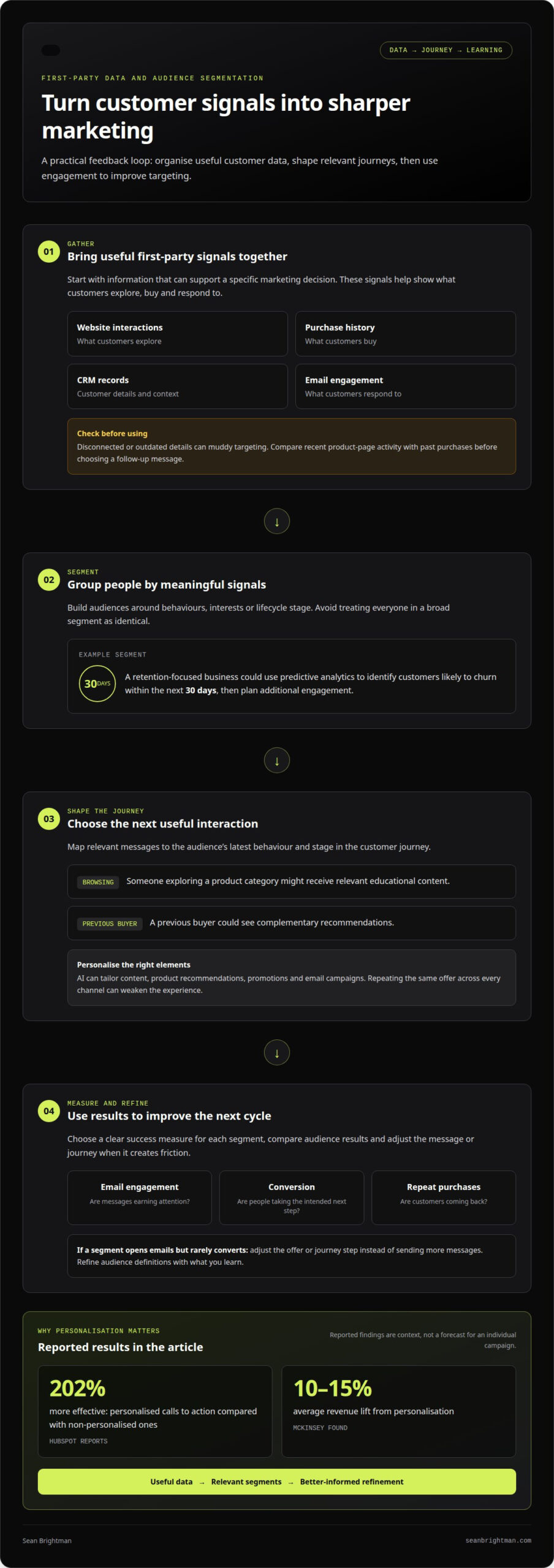
    Use first-party data to connect customer behaviour with relevant messaging. Then turn those signals into audience segments and journeys your team can measure.

    1. Gather first-party customer data

      Start by bringing together website interactions, purchase history, CRM records and email engagement. These first-party signals show what customers explore, buy and respond to. Check that each record supports a specific marketing decision: disconnected or outdated details can muddy targeting. For example, compare recent product-page activity with past purchases before choosing a follow-up message. Focus on understanding customer behaviour, not collecting information without a clear purpose.

    2. Segment audiences for personalisation

      Group customers by meaningful behaviours, interests or lifecycle stage, then tailor the message to each group. A retention-focused business could use predictive analytics to identify customers likely to churn within the next 30 days and plan additional engagement. Avoid treating every customer in a broad segment as identical. HubSpot reports personalised calls to action are 202% more effective than non-personalised ones. McKinsey found personalisation lifts revenue by 10 to 15% on average.

    3. Shape personalised customer journeys

      Map the next useful interaction for each audience segment, from initial interest to repeat purchase. Someone browsing a product category might receive relevant educational content, while a previous buyer could see complementary recommendations. Use AI to personalise content, product recommendations, promotions and email campaigns. Check that each message fits the customer’s latest behaviour and journey stage. Repeating the same offer across every channel can weaken the experience rather than improve engagement.

    4. Measure engagement and refine targeting

      Choose a clear success measure for each segment, such as email engagement, conversion or repeat purchases. Compare results across audiences to see which messages earn attention and which create friction. If a segment opens emails but rarely converts, adjust the offer or journey step instead of sending more messages. Use the findings to refine audience definitions and future targeting. This turns customer data into a practical feedback loop, not a static list.

    What Do AI-Powered Marketing Solutions Automate?

    For UK businesses, the right AI marketing platform fits existing data, CRM workflows and campaign goals. Measure its return using conversion rates, customer acquisition cost, customer lifetime value and revenue attribution, not output volume alone.

    1. Assign AI repeatable production tasks. Use generative AI to draft campaign variations, summarise research or organise content ideas. Give it a clear brief, audience and format. Before publication, a marketer should check factual claims, tone and brand fit. AI can speed up production, but it shouldn’t set strategy or publish unchecked material.
    2. Keep strategic decisions with people. Set the positioning, campaign objective and creative direction before asking a tool to produce actions. For example, a team can use AI to generate email subject-line options, then choose the version that fits its audience and brand. Human judgement can catch weak assumptions that a platform may repeat confidently.
    3. Build AI literacy through practical learning. Teach the team to write clear prompts, interpret data analysis and recognise when an output needs review. Start with a workflow such as turning approved campaign notes into draft social posts. Record useful inputs and corrections, then refine the process. That creates hands-on learning, rather than a tool demo disconnected from daily work.
    4. Set review points and track outcomes. Assign a person to approve content, check predictive recommendations and monitor campaign actions. Compare conversion rates, customer acquisition cost, customer lifetime value and revenue attribution before and after a workflow change. If the numbers don’t improve, examine the audience, data and process before increasing automation. Teams shaping their approach can explore AI marketing strategy as a practical next step.

    How to Build an AI-Powered Marketing Engine with Customer Data

    Marketing workflow automation and CRM integration

    Automate tasks with clear inputs, owners and outcomes. Connect each workflow to your CRM, then test whether it improves campaign performance.

    1. Identify marketing tasks for AI automation

      Start with repeatable work that follows a defined process, such as summarising campaign results, drafting email variations or organising research. Map each task from trigger to outcome before deciding what to automate. For example, a new CRM lead could trigger a tailored nurture sequence. Keep positioning and marketing strategy decisions with people, and don’t automate a process with unreliable inputs.

    2. Integrate marketing workflows with CRM

      Connect your CRM to the channels and workflows that need shared customer context. Define which system owns each field, how updates flow and what action follows a change. For example, a lead’s event participation could update their CRM record and prompt a relevant follow-up. Centralised customer data supports campaign coordination, while automated reporting can track performance, lead generation and engagement. Check that duplicated or stale records don’t trigger conflicting messages.

    3. Run automated experimentation

      Test one campaign variable at a time, such as a subject line, audience or landing-page message. Set the success measure before launch, then use results to develop the next test rather than declaring a winner from a single click. AI can help analyse performance and optimise campaign workflows, but teams still need to review the findings. Cross-channel coordination using AI has been reported to produce 32% higher engagement and 25% more conversions than isolated campaigns. Treat those figures as context, not a forecast for your own results.

    Building an AI-ready marketing organisation

    AI readiness depends on people, usable data and workflows tied to measurable business goals. Build those foundations before adding more tools.

    1. Assess the data and skills required

      List the customer data, systems and skills needed for one defined marketing task. For example, a team personalising social media content needs reliable audience insights and people who can assess the output. Build AI literacy through practical work in data analysis, prompt development and generative content. Bring marketing, data and technology colleagues together to interpret results and spot gaps. Set clear privacy, security and consent practices for customer information.

    2. Plan the AI marketing engine build

      Build step by step: choose a business objective, map the workflow, identify its data inputs, select a suitable tool, assign human review and measure results. Start with a contained use case, such as turning approved campaign notes into draft digital content. Use tools your team already works with, then review what works before expanding. Keep strategy and brand decisions with people; use AI to support defined actions.

    3. Estimate build and running costs

      In the UK, build and running costs depend on the tools, data preparation, system integration, staff time and ongoing review required. Map these factors before comparing options: an existing CRM and clean data create a different workload from disconnected systems that need extensive preparation. Include the time needed for training, testing and optimisation, not just software. A simple workflow may require less infrastructure than a connected, multi-channel engine.

    Use a clear AI implementation roadmap to turn these decisions into an accountable plan.

    Sean Brightman: AI Consulting

    Sean Brightman’s AI Consulting helps businesses turn AI marketing ideas into practical decisions and a workable plan. It’s a useful next step when your team has identified opportunities but needs to prioritise use cases, connect them to business goals and decide what to build first.

    Roadmapping can structure the build, from choosing an initial workflow to planning how the engine will develop. An Advisory Retainer provides ongoing guidance as your team puts its approach into practice and learns from results. The right starting point depends on the decisions you need to make and the support that will help your team move forward.

    If you’re ready to map out your next steps, contact Sean Brightman.

    Turn your next AI decision into action

    Building an AI-powered marketing engine is a leadership decision, not a software shopping exercise. Identify what is blocking progress: unclear ownership, competing priorities or a gap between strategy and execution. Address that constraint first, then give the team a focused task to deliver.

    Sean Brightman offers Fractional CMO support for marketing leadership, AI Consulting for practical AI decisions, and Roadmapping to set out a clear path forward. Each suits a different need, from sharpening direction to structuring the work ahead. Start with the decision your business needs to make, not another tool to add.

    Ready to discuss your marketing engine and decide on a useful next step? Contact Sean Brightman to discuss your marketing engine. A clear plan gives your team a stronger place to begin.

    Frequently Asked Questions

    What Is an AI-Powered Marketing Growth Engine?

    An AI-powered marketing growth engine connects marketing activity to decisions and actions that support growth. For example, a software business could use customer questions to identify a confusing onboarding message, then improve the relevant campaign. The engine is more than a single AI tool: it links business objectives, customer signals, marketing work and review so teams can learn from the results.

    What is possible when you get this right?

    You can make marketing decisions with a clearer view of customer needs and campaign results. For instance, a retailer could identify where customers lose interest between browsing and purchase, then adjust its follow-up content. AI can help teams explore patterns and produce useful options, while people decide what fits the brand. The practical value is a more responsive marketing operation, not automatic growth or a substitute for sound decisions.

    What is an AI-powered marketing engine?

    An AI-powered marketing engine uses AI to support analysis, content work and repeatable decisions across connected processes. Consider a campaign launch: the team sets the objective and audience, AI helps prepare and analyse campaign materials, and people review the output and decide what to change. That feedback loop distinguishes an engine from a standalone tool used for an occasional draft or isolated task.

    How can AI integrate with CRM, analytics, and marketing automation systems?

    Integration starts with defining how information moves between systems and what each team needs to see. For example, agree on consistent campaign names, lead stages and conversion events across the CRM and analytics platform. AI can then help surface patterns in joined-up reporting or support a workflow triggered by a meaningful update. Clear ownership of fields and hand-offs helps prevent conflicting records and misleading performance analysis.

    How can AI personalise marketing campaigns and automate content creation?

    Give AI approved brand examples, campaign goals and audience context, then use it to draft suitable variations. A team might generate different versions of a product announcement for existing customers and prospective buyers. Review every draft for accuracy, tone and relevance before it reaches an audience. Keep a person responsible for the final choice, especially when a message could affect customer trust or make claims about a product.

    What are the risks and limitations of AI in marketing?

    AI can produce inaccurate material, miss context or reinforce weaknesses in its data. Careless handling of customer information can also create privacy and security risks. Set access controls, define appropriate data use and make a person accountable for reviewing important outputs. Don’t automate sensitive or high-impact decisions simply because a tool can process them; assess each use against its purpose and potential effect on customers.