
More channels don’t mean more customers. For most small businesses, the sharper move is to focus on three to five high-impact marketing strategies for SMEs, then build repeatable ways to run and measure them.
It’s tempting to spread a limited budget across every platform and campaign. But SMEs don’t have the same resources as large companies, and they shouldn’t copy their playbook. Focus beats frantic activity.
This guide explains how to choose channels that suit your audience, invest in what’s working and create useful content instead of daily filler. You’ll also learn how to improve customer acquisition and grow customer value through upselling and cross-selling. The aim is a leaner marketing engine: fewer scattered efforts, clearer priorities and decisions based on what customers actually do.
Key Takeaways
- Focus on three to five marketing channels that fit your audience, then build repeatable ways to run and measure them.
- Use a 70/20/10 budget split as a starting point: back proven campaigns, improve what works and test new channels carefully.
- Choose useful content over filler, with clear calls to action that give potential customers a practical next step.
- Make growth work beyond the first sale: smooth the route to enquiry, use customer feedback and identify relevant upselling and cross-selling opportunities.
1. Advertising budgets and media costs
UK SMEs can use paid social to reach a defined customer group and test different offers. For influencer marketing, choose creators whose audiences match your buyers, agree on a trackable action and measure enquiries or sales, not follower counts.
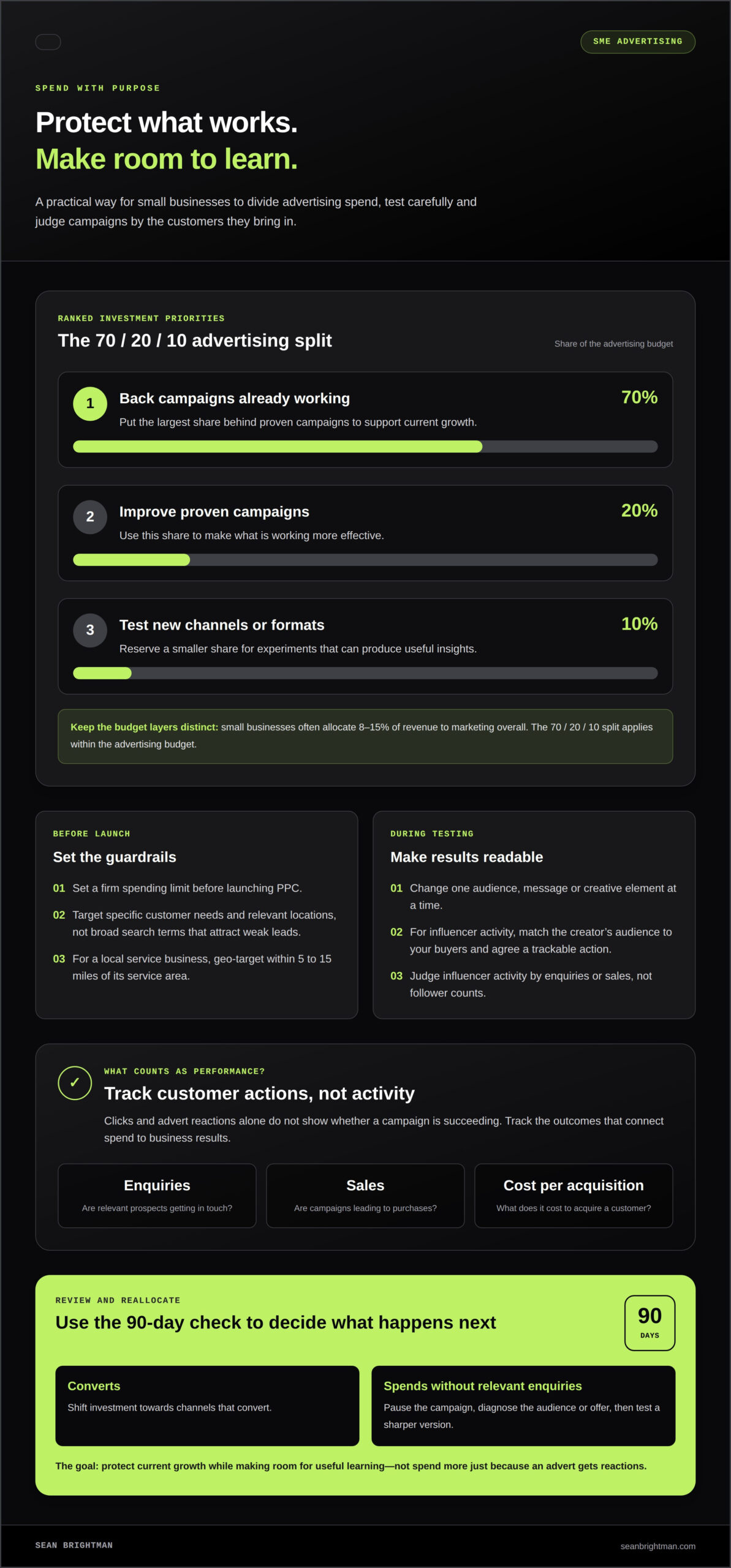
Start with the total marketing budget, then separate advertising from other activity. Small businesses often allocate 8-15% of revenue to marketing. Within the advertising budget, use a 70/20/10 split: put 70% behind campaigns already working, 20% into improving proven campaigns, and 10% into testing new channels or formats. This protects current growth while creating room for useful insights.
For PPC, set a firm spending limit before launching. Focus search adverts on specific customer needs and relevant locations, rather than broad terms that attract weak leads. A local service business can use geo-targeting within a 5 to 15 mile radius of its service area. Paid advertising can generate leads quickly, but clicks alone don’t show success. Track enquiries, sales and cost per acquisition to see which campaigns deserve more budget.
Apply the same discipline to paid social. Test one audience, message or creative change at a time, so the results point to a clear next step. Avoid increasing spend just because an advert gets reactions; check whether those interactions lead to valuable customer actions. Review performance after 90 days and shift investment towards channels that convert. If a campaign spends without producing relevant enquiries, pause it, diagnose the audience or offer, then test a sharper version. That’s how SMEs make media costs work harder, rather than paying for activity that looks busy.
2. Content formats, value and calls to action
Useful content answers a real customer question and leads to one clear next step. For example, a trades business could explain how to prepare for a boiler replacement, then invite readers to request an assessment. Three strong social media posts a week can outperform daily filler when each shares practical expertise, a customer story or a useful demonstration. Respond to comments and messages: those conversations can reveal objections and ideas for future content.
For SEO, build pages around the services and questions customers actually search for. SMEs may need three to six months to see SEO results, so track relevant measures such as qualified enquiries, not just page visits. Content marketing may take three to nine months to produce results. A weekly core article can provide material for social media, email and other channels, helping one useful idea go further.
Which marketing strategies deliver the highest ROI for UK SMEs? There’s no universal winner: measure returns against your goals and costs. Email can produce results in one to four weeks, with ROI taking two to six weeks, so it can work well for timely offers to an engaged audience.
When considering UK GDPR, PECR and ASA requirements, be transparent about data use, respect marketing preferences and keep promotional claims clear and supportable. Don’t copy competitors’ content, make claims you can’t substantiate or send irrelevant messages. These mistakes damage trust and waste effort.
Email marketing automation helps SMEs send timely, relevant messages, such as a welcome note after sign-up. Use it to organise follow-ups, then measure opens, clicks and resulting enquiries. For social video, get to the point within five to 10 seconds; tutorials, demonstrations and customer testimonials give viewers a reason to stay. Share each video on your website, in email newsletters and across social media, with a call to action matched to its purpose.
3. Customer acquisition, upselling and cross-selling
Customer acquisition works best when digital marketing addresses a clear customer need. Map the journey from first contact to purchase, then remove friction at each step. For example, simplify an enquiry form so prospective customers can get in touch easily. High-impact marketing strategies for SMEs connect promotional activity to qualified leads, not just website visits.
Use customer feedback to identify where your marketing misses the mark. Ask recent buyers what problem they needed solved, what nearly stopped them purchasing and which information helped them decide. A short post-purchase survey can reveal gaps between your message and customers’ experience. Combine the answers with sales conversations and customer service themes to sharpen your audience, offer and messaging.
Market research needn’t consume scarce resources. Review customer questions, lost-sale reasons and recurring requests to spot patterns. If buyers repeatedly ask whether a service includes a particular feature, explain it earlier in your sales material. These insights can improve acquisition and reveal a relevant next offer, rather than leaving you to rely on guesswork.
Upselling means offering a more suitable or expanded option; cross-selling adds a related product or service. A software provider might offer extra support to a customer whose needs have grown, or suggest relevant training alongside a new subscription. Match every recommendation to the customer’s stated goal. A pushy add-on can weaken trust; a useful recommendation can deepen the relationship.
Retention depends on consistent interaction after the first sale. Send a practical follow-up, ask whether the solution is working and respond to feedback with a clear next step. Satisfied customers may refer others, so make referrals easy by explaining who could benefit and how. Track repeat purchases, referrals and recurring feedback themes to see what supports customer growth. High-impact marketing strategies for SMEs use those signals to make future campaigns more relevant.
4. How small businesses’ marketing differs from that of large companies
Large companies can run broad campaigns across television, sponsorships and digital platforms. A small business rarely has the same budget, team or brand reach, so copying that playbook can spread limited effort too thinly. Instead, centre each campaign on one customer group and one commercial objective. For example, an accountant could focus on self-employed clients seeking help with year-end accounts.
Scale also changes how businesses earn attention. A national brand may rely on repeated exposure; an independent firm can build trust through direct customer interaction. The owner’s expertise, a detailed answer to a common question or a customer’s real experience can make social posts more relevant. A personal reply to an enquiry also gives a small business the chance to understand objections before they lead to lost sales.
Large organisations often divide marketing across specialist teams. A small firm may have one person handling content, sales and customer service, which makes clear priorities essential. Choose a manageable set of platforms, assign responsibility for each task and connect every activity to a business outcome. For example, a monthly review can compare campaign enquiries with completed sales to show whether effort should shift towards a stronger message or a different audience.
Customer proximity can give SMEs useful insight, but only if they capture it. Record the questions customers ask, the language they use and the reasons they hesitate. Use those details to improve website copy, shape campaigns and create content that reflects real buying concerns. Large brands may have wider reach; smaller businesses can move faster when customer feedback reveals a better approach. The practical advantage isn’t doing everything. It’s connecting each effort to a clear audience, measurable engagement and the next sales step. To turn scattered activity into a focused plan, build a sharper marketing roadmap.
Sean Brightman
Sean Brightman helps SMEs turn scattered marketing activity into a focused plan. When channel choices, advertising spend and customer growth pull in different directions, Roadmapping can clarify priorities and link each effort to a business objective. An Advisory Retainer provides ongoing strategic input as the plan develops, while AI Consulting can help identify practical ways to use AI in marketing operations.
The right next step depends on the problem: clarify direction, strengthen decision-making or explore practical uses for AI. The goal is a joined-up approach, not another disconnected campaign.
Contact Sean Brightman to discuss your marketing priorities.
Turn your next decision into momentum
The strongest high-impact marketing strategies for SMEs don’t depend on doing more. They make the next decision clearer: what deserves attention, who owns the work and what evidence will guide the next move. Make that decision the start of a working system, not another plan that sits untouched.
When you need senior marketing direction or help turning priorities into action, Sean Brightman offers Fractional CMO support, AI Consulting and Roadmapping. A focused conversation can help you tackle what’s holding progress back, whether that’s unclear direction, disconnected activity or uncertainty about where AI fits.
Discuss your marketing priorities with Sean Brightman, and take the next step with a sharper plan.
Frequently Asked Questions
How many marketing channels should a small business focus on?
Focus on three to five channels your team can maintain consistently. For example, a consultancy might combine search visibility, LinkedIn, email and referrals, then drop any channel that attracts attention without generating relevant enquiries. Choose channels based on where customers research, ask questions and make decisions. A smaller, coordinated mix is easier to manage and measure than scattered activity across every platform.
How should marketing budget be allocated across strategies?
Use a 70/20/10 split within the advertising budget: 70% for proven campaigns, 20% for improving them and 10% for testing new approaches. Separately, set an overall marketing budget against business revenue, cash flow and growth priorities. Review spending alongside sales outcomes, not impressions alone. If a campaign attracts interest but few qualified enquiries, adjust its audience, message or offer before increasing investment.
What are the main types of marketing strategies for small businesses?
The main approaches include search engine optimisation, useful content, social media, email, paid advertising, partnerships and referral marketing. Choose a mix that reflects how customers discover and assess your offer. A specialist supplier might publish a practical buying guide, share it by email and on social media, then use customer referrals to reach similar businesses. Each tactic should support a clear step in the customer journey.
How should UK SMEs set a marketing budget and measure ROI?
Start with a budget the business can sustain, guided by revenue, cash flow and sales goals. Set a baseline for enquiries, conversions and customer value before launching a campaign. Then compare campaign costs with the sales it generates, allowing time for leads to convert. Track results by channel and campaign to distinguish profitable activity from busywork.
What are the best low-cost digital marketing channels for small businesses?
Organic search, email, social media and customer referrals can be practical, lower-cost options, especially when you create material from questions customers already ask. An accountancy firm could turn a common client query into a useful website article, then share its key points in an email or social post. These channels still require time and consistent effort, so prioritise the ones your audience uses.
What are the costs and benefits of paid search and social advertising for SMEs?
Paid search can put an offer in front of people actively looking for a solution; paid social can target audiences by relevant characteristics and interests. Costs depend on factors such as competition, audience, location, format and campaign settings. Set a spending limit, define the action you want and track qualified enquiries or sales. This makes it easier to judge whether paid activity merits further investment.