
Tag: data quality

  • How to Prepare Marketing Data for AI Around Business Goals

    How to Prepare Marketing Data for AI Around Business Goals

    AI won’t rescue messy marketing data. Preparing your marketing data for AI means making it accurate, connected, governed and useful for a defined business goal. AI-ready data isn’t simply a larger dataset; it’s information your team can trust to support a specific decision or outcome.

    Focus on the foundations before choosing a model or launching a pilot. Poor-quality inputs can produce unreliable outputs, while disconnected systems make it harder to see what’s working. The practical fix is to assess what you have, identify what’s missing and prepare only the data your use case needs.

    This guide shows you how to assess marketing data readiness, engineer useful features and build governance into the process. You’ll also learn how to connect each preparation decision to a business goal, so the work supports measurable priorities rather than AI for its own sake.

    Key Takeaways

    • Map your marketing data sources, owners and update patterns to expose readiness gaps before choosing an AI use case.
    • Engineer features around useful customer behaviours, then keep validation and quality monitoring running as data changes.
    • Build governance into the data environment with clear ownership, permissions, definitions and lineage from source to use.
    • Start with a specific business outcome and prepare only the data needed to support it, not a larger dataset for its own sake.

    What role does feature engineering play in AI data preparation?

    AI marketing tools work best with consistent, clearly labelled records: structured tables for transactions and campaign events, plus text or images tagged with useful categories. Choose platforms that connect data sources and support access controls, lineage and audit trails. Preparation costs depend on source count, data condition, integration work and monitoring needs; the price depends on the case and is given after a quote request.

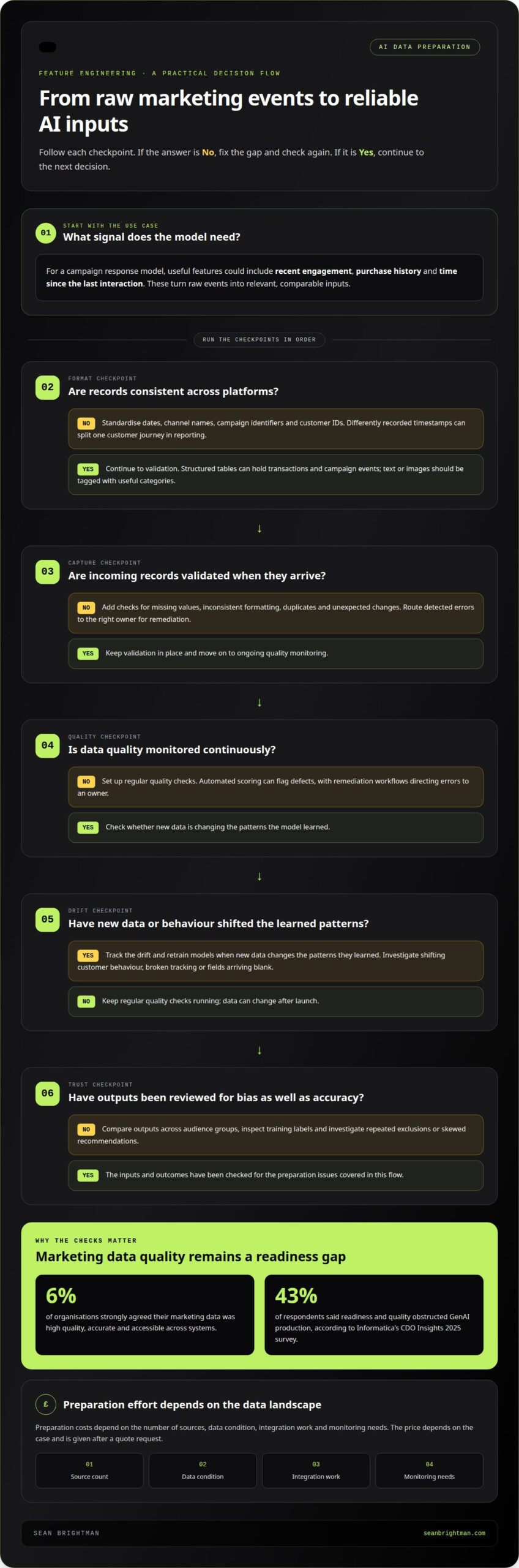
    1. Define the signal each model needs. For a campaign response model, engineer features such as recent engagement, purchase history and time since the last interaction. These turn raw events into relevant, comparable inputs.
    2. Standardise formats before feature creation. Align dates, channel names, campaign identifiers and customer IDs across platforms. A timestamp recorded differently in two systems can split one customer journey into misleading reporting.
    3. Build validation at the point of capture. Check incoming records for missing values, inconsistent formatting, duplicates and unexpected changes. Automated scoring can flag defects, while remediation workflows route errors to the right owner.
    4. Monitor quality continuously, not just before launch. Only 6% of organisations strongly agreed their marketing data was high quality, accurate and accessible across systems. Informatica’s CDO Insights 2025 survey found readiness and quality obstructed GenAI production for 43% of respondents.
    5. Track drift and retrain models when new data changes the patterns they learned. Regular quality checks can reveal shifting customer behaviour, broken tracking or a campaign field that suddenly arrives blank.
    6. Review generated content and model outcomes for bias as well as technical accuracy. Compare outputs across audience groups, inspect the labels behind training examples, and investigate repeated exclusions or skewed recommendations before using them in a campaign.

    How should companies approach data governance for AI initiatives?

    Governance makes marketing data traceable, controlled and fit for analytics tools and AI models. Build it into your data environment before connecting new applications.

    1. Track metadata and data lineage

      Map each important field from its original source to the analytics report or AI model that uses it. Record its owner, definition, update frequency, permitted uses and any transformations.

      Use shared definitions for measures such as campaign conversion, so teams don’t combine records based on different meanings. Version control and audit trails show what changed, when it changed and which outputs relied on that data.

    2. Govern data privacy and security

      Set access rules by role and purpose, then document who owns each dataset. Apply privacy controls to customer information and create policies that support GDPR compliance.

      Limit access to the fields an AI model needs. For example, campaign analytics may require purchase category and response history, not every detail in a customer record. Review permissions whenever data moves between platforms.

    3. Define accountability before putting a system under AI control. Name the people responsible for data quality, access approvals, model outputs and incident handling. Governance policies should cover data ownership, version control, audit trails, security and privacy.

      Set a review process for high-impact decisions. A human owner can check whether an output uses the intended data and whether its result should inform a marketing action. This gives teams a practical way to challenge errors.

    4. Make trust measurable. In a 2024 survey, 53% of business leaders said their organisation actively prioritised data management to reduce AI data-quality risks. Meanwhile, 78% of organisations do not yet trust agentic AI.

      Track access exceptions, unresolved lineage gaps and repeated output errors as governance signals. Adobe reports that 62% of consumers say transparency about AI use directly affects their trust. Explain where AI contributes to marketing decisions, and keep a record of the data and rules behind those decisions.
    How to Prepare Marketing Data for AI Around Business Goals

    Aligning AI data preparation with business goals

    Start with the business outcome, then prepare data to support it. To unify CRM, web analytics and advertising platforms, connect records through shared identifiers and definitions, while preserving their source and timing.

    1. Define the decision AI should improve. A churn objective, for example, needs data reflecting customer activity and retention outcomes, not just campaign clicks. Thirty-six per cent of UK organisations had AI projects fail because business problems were inadequately defined.
    2. Standardise metrics and business definitions

      Agree on the meaning of each metric before feeding it into an AI model. Define whether a conversion means a purchase, a signed agreement or another event, then apply that definition consistently across reports and teams.

      Use common naming conventions for fields such as campaign source and customer status. The Scottish Government notes that common standards can improve data quality and interoperability, making information easier to reuse and link.

    3. Unify marketing data sources

      Connect CRM records, web analytics events and advertising results through shared customer, campaign and time references. Preserve the original source and timestamp so teams can trace each interaction instead of losing useful context by flattening the data.

      Check that matching fields describe the same thing across platforms. A click in an advertising report and a visit in web analytics are different events, even when they belong to the same journey.

    4. Add business context and relevant history. A model assessing repeat purchases needs past purchase patterns and clear product category meanings. A short, disconnected snapshot can hide seasonal behaviour or shifts in customer intent.
    5. Give AI agents a shared business ontology, a structured account of entities, relationships and terms. Link concepts such as customer, account, product and campaign, and define how they relate. This helps an agent interpret existing data without confusing a lead with a customer.
    6. Evaluate outputs against business outcomes, not model activity alone. If a campaign platform optimises clicks, compare those results with the customer outcomes the business values. Keep the target metric visible in reporting and revise the data inputs when outputs miss the goal.

    Assessing marketing data readiness

    Start with a data audit, not an AI tool. Gartner’s Q3 2024 survey found 63% of organisations either lacked, or were unsure they had, suitable data management practices for AI.

    1. Inventory the sources that support one marketing decision. Include CRM records, spreadsheets, marketing platforms and customer support logs. Small businesses can start with first-party behavioural and transactional data, then expand once the first use case works.
    2. Audit each source for data type, storage location, access, ownership and update frequency. For example, note whether purchase history refreshes daily or only after a manual spreadsheet upload. These details show whether the information can support the intended action.
    3. Measure quality and completeness in critical fields. Count duplicates, missing values, inconsistent formats and outdated records. Use practical targets such as keeping customer data 99% duplicate-free and missing values below 1% in critical fields.
    4. Check whether records can be connected into a useful customer view. Identity resolution links a person’s interactions across systems, helping teams see a consistent history rather than isolated clicks or purchases. A clean, read-only profile refreshed nightly can be a manageable starting point.
    5. Match readiness to the AI capabilities required. A reporting assistant may need accurate campaign names and spend data; an agent taking action needs current customer data, defined permissions and reliable signals. Gartner predicted organisations would abandon 60% of AI projects unsupported by AI-ready data through 2026.
    6. Review readiness with business owners, not just technical teams. A 2024 survey found 73% of business leaders ranked data quality among their top AI concerns. Track gaps, assign owners and prioritise fixes by their effect on the chosen use case.
    7. Turn the audit into a practical roadmap before expanding scope. Map your AI readiness priorities into focused next steps.

    Sean Brightman

    Sean Brightman helps turn marketing data readiness into a practical AI plan tied to business priorities. If your data is spread across disconnected platforms, or teams can’t agree on what success means, AI Consulting can clarify the use case, capabilities and decisions that need support.

    Roadmapping can sequence the work: identify valuable data gaps, set governance priorities and define what to prepare before a model goes live. An Advisory Retainer provides ongoing strategic guidance as your needs and AI initiatives develop.

    The right next step depends on the bottleneck: unclear goals, fragmented data or a lack of implementation direction. If you’re ready to make those decisions, contact Sean Brightman to discuss your priorities.

    Make data readiness part of the operating plan

    Preparing your marketing data for AI isn’t a one-off clean-up. Treat it as an ongoing business capability, with clear ownership and regular decisions about which use cases deserve attention. As customer behaviour, campaign priorities and systems change, revisit whether the data still supports the decisions you want AI to improve.

    Choose one outcome and give it an accountable owner. That keeps the work grounded in business value instead of letting new tools dictate the agenda. Sean Brightman can help shape your strategy and decide how to move from data readiness to practical action.

    If you’re ready to set that direction, contact Sean Brightman to discuss your priorities. Start with the decision you want to improve, then build from there.

    Frequently Asked Questions

    What is AI-ready marketing data?

    AI-ready marketing data is information an AI tool can interpret and use for a defined task. It needs clear labels, usable formats and enough context to distinguish events, customers and outcomes. For example, product recommendations need meaningful product and purchase records, not an unlabelled export. Readiness depends on whether the data supports the intended decision, not simply how much information is stored.

    Does this differ for agencies and in-house teams?

    The foundations are similar, but ownership and access can differ. An in-house team usually works across its organisation’s systems and definitions. An agency may serve several clients, each with separate data permissions, reporting conventions and campaign goals. Keep client datasets distinct, document who can access them and agree how results are defined before combining information for analysis.

    How can organisations effectively handle unstructured data for AI applications?

    Structure unstructured material before using it. For support emails, label examples by topic or outcome; for customer feedback, use consistent sentiment categories. Text extraction can make documents searchable, while image labels can describe relevant visual content. Keep the original source attached to each record, and remove irrelevant or sensitive material before it enters a model workflow.

    Should you build the data pipeline yourself?

    Build in-house when your team can maintain the connections, transformations, monitoring and access controls the use case requires. A managed integration tool may suit standard sources and limited engineering capacity, but it still needs clear ownership. A sound plan for preparing your marketing data for AI considers ongoing maintenance, flexibility and auditability, not just setup speed. Either approach needs upkeep as platforms and data fields change.

    Why does AI get your marketing numbers wrong?

    AI can produce misleading figures when inputs use different definitions or contain incomplete records. For example, an advertising platform may count an attributed conversion differently from a CRM report of completed sales. Time periods, duplicate events and delayed updates can widen the gap. Trace the figure to its source, check the calculation and confirm both systems measure the same outcome.

    What does preparing marketing data for AI involve?

    Preparing your marketing data for AI means making information usable for a chosen task, not cleaning everything indiscriminately. The work can include selecting relevant sources, resolving inconsistent records, creating meaningful labels, setting access rules and testing whether outputs support the intended decision. For a small team, start with one clear use case and a manageable dataset, then expand as the process proves useful.

  • AI customer segmentation for more personalised, efficient marketing

    AI customer segmentation for more personalised, efficient marketing

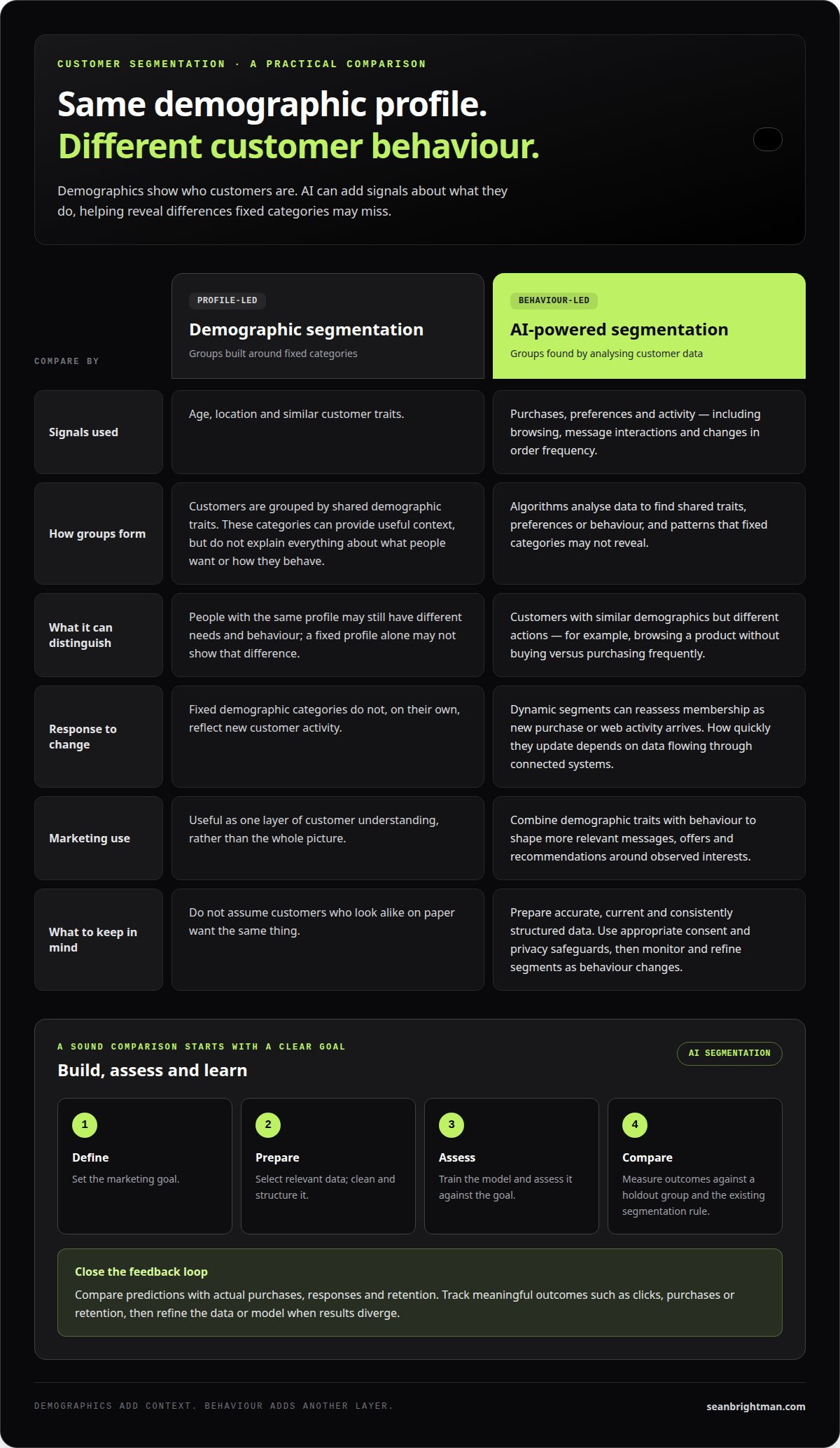
    Demographics describe who customers are; AI can help reveal how their behaviour differs. Using AI for customer segmentation means analysing data such as purchases, preferences and activity to identify useful groups and patterns that fixed demographic categories may miss.

    Age, location and similar traits still matter, but they do not explain everything. Customers with the same profile may want different things or behave differently. AI can bring more signals into view, helping marketers shape relevant messages and make decisions with less manual analysis.

    This article explains how AI segmentation works, how it can support personalisation and faster decisions, and how it differs from demographic segmentation. It also covers data quality, dynamic segments that respond to changing behaviour, and what to consider before relying on AI-generated insights.

    Key Takeaways

    • Audit the data feeding your segments: clean, well-structured inputs make the patterns more useful, while privacy safeguards belong in the plan from the start.
    • Turn customer behaviour into more relevant messages and sharper decisions, then measure whether those segments outperform your current approach.
    • Review segments as customer behaviour changes; dynamic models need ongoing monitoring and refinement to stay useful.
    • Use demographic traits as one layer, not the whole picture: AI can combine them with other signals to uncover groups fixed categories may miss.

    What is AI customer segmentation in marketing?

    AI customer segmentation uses algorithms to analyse customer data and group people by shared traits, preferences or behaviour. Using AI for customer segmentation can reveal patterns across large datasets and help marketers spot differences that fixed demographic categories may miss.

    Customer data collection and preparation

    Customer data collection and preparation involves bringing information from sources such as CRM records, website analytics and social media into a consistent format. This matters because mismatched records or missing purchase history can distort both the segments and the messages built around them.

    For UK businesses, suitable tools include CRM and analytics platforms connected to machine-learning or predictive analytics capabilities. Choose tools based on your existing systems, available data and marketing task. Costs depend on the licence model, data volume, integrations and features, so there is no single price for every setup.

    Using AI for customer segmentation involves analysing prepared data, finding patterns and assigning customers to groups. To build a model, define the marketing goal, select relevant data, clean and structure it, then train and assess the model against that goal.

    Behavioural signals in customer data

    Behavioural signals are customer actions, such as browsing pages, interacting with messages, making purchases or changing order frequency. They can distinguish people with similar demographics but different needs, supporting more relevant retention and revenue strategies.

    For example, someone who repeatedly browses a product but has not purchased may need different messaging from a frequent buyer. Real-time data streaming can update audience membership as new activity arrives, helping messages reflect current behaviour. The useful update speed depends on how quickly data flows through connected systems.

    Data quality, accuracy and privacy

    Data quality means keeping customer records accurate, current and consistently structured. Remove duplicates, correct conflicting fields and review missing values before analysis. Otherwise, an algorithm might treat one person as several customers or mistake an incomplete profile for a meaningful pattern.

    Use customer data with appropriate consent and privacy safeguards, and limit inputs to those that support the marketing purpose. UK businesses must consider applicable data-protection requirements when collecting and using personal information. Feedback loops matter too: compare predictions with actual purchases, responses and retention, then refine the data or model when results diverge.

    Personalisation, efficiency and decision-making benefits

    AI segmentation turns customer patterns into practical marketing choices: which message to send, which offer to show and when to act. It helps teams move beyond broad campaigns towards experiences shaped by preferences and observed behaviour.

    For example, an online retailer can distinguish customers who browse running shoes from those who buy them regularly. The first group might receive useful product information; the second, recommendations based on previous purchases. This is personalisation guided by a clear signal, not guesswork dressed up as personalisation.

    Context adds another layer. A customer browsing winter coats during cold weather may respond to different content from someone researching lightweight jackets in warmer conditions. AI can analyse these signals alongside purchase history to select more relevant messages and recommendations. The aim is to make each interaction fit current interests, not just a customer’s profile.

    That relevance matters. In SAP’s Global Engagement Index 2026, 58% of consumers said most marketing emails they receive are not relevant. SAP’s Customer Loyalty Index 2026 found 60% felt more loyal to brands that make them feel personally valued. These findings point to a straightforward opportunity: use customer intelligence to make communications more useful.

    AI can reduce manual analysis across large datasets, helping marketers spot changes and make decisions faster. But speed alone proves nothing. Define a goal, such as improving engagement in a high-intent group, then compare the AI-generated segment with a holdout group and the existing segmentation rule. Track meaningful outcomes such as clicks, purchases or retention, rather than treating a larger audience or more messages as success.

    That comparison creates a feedback loop. If personalised recommendations increase clicks but not purchases, refine the offer or segment definition. If a targeted message improves purchases without weakening retention, the team has stronger evidence for scaling it. AI supplies the analysis; marketers still need to interpret results, set priorities and align the strategy with the business.

    AI customer segmentation for more personalised, efficient marketing

    Dynamic segmentation and real-time insights

    Dynamic segments change as customer signals change, rather than staying fixed around a demographic profile. AI can update audience membership as new purchase or web activity arrives.

    Feature engineering for dynamic segments

    Feature engineering turns raw activity into useful signals, such as purchase frequency or time since the last visit. These features help AI spot changes that a static demographic label would miss.

    For example, a retailer could combine recent product views with purchase history to identify customers showing renewed interest. Choosing features that connect to a campaign goal keeps segments useful, rather than creating groups marketers cannot act on.

    Creating and updating customer segments

    Dynamic segment creation uses data from sources such as a CRM, purchase history and web activity to group customers. As new signals arrive, the model can reassess who meets the criteria for each group.

    A fixed rule might label someone active after logging in 3x per week. AI can also consider purchase patterns and other behaviour, updating the audience as those signals shift. This helps campaigns respond to customers’ current actions, not only an old demographic snapshot.

    Real-time insights from dynamic segments

    Real-time insights show how customer groups change as fresh data arrives. AI can process large datasets faster than manual analysis and automate segmentation for millions of users in real time.

    That speed can help marketers adjust campaigns when browsing or purchase activity changes. For example, a customer who stops engaging may move into a group for retention messaging. Teams still need to monitor segment performance and refine the model when its outputs no longer support the intended strategy.

    AI-identified marketing and sales segments

    AI can identify groups using demographic, behavioural, transactional and psychographic signals. Examples include likely churners, customers with shared product interests, or people whose purchase patterns suggest different needs.

    For sales, segments can highlight customers with similar preferences or changing engagement. For marketing, predictive segmentation can identify customers likely to stop buying in the next 30 days. The Bank of England notes that AI can enable more granular customer classification by analysing larger data volumes and new sources, helping teams see groups traditional segmentation may overlook.

    AI-powered customer segmentation compared with demographic segmentation

    Demographic segmentation groups customers by traits such as age, location or household characteristics. AI-powered segmentation can combine those traits with browsing, purchase history and behaviour to find patterns fixed categories miss. In practice, demographics describe who customers are; AI can also help explain what they do and what they may do next.

    How accurate are AI customer segmentation models compared with traditional methods? There is no single accuracy figure that applies across businesses. Results depend on the data, group definitions and outcome being tested, so compare the model with your existing rule and a holdout group.

    For example, a traditional campaign might target everyone in a particular age band. An AI model could identify a smaller audience within that band based on recent product browsing and repeat purchases. This can make messages more relevant, while demographics remain useful for setting context or reaching broad groups.

    Predictive segmentation adds a forward-looking view. Rather than only describing past behaviour, a model can identify customers likely to churn or groups showing increasing interest in a product. Marketers can then test whether a retention message or tailored recommendation changes behaviour. Measure purchases, engagement or loyalty against the existing approach, not just the number of segments created.

    AI is not automatically better. Inaccurate or incomplete inputs can produce weak groupings, and a complex model may add little if a simple demographic rule already supports the campaign goal. Setup costs may also exceed those of conventional solutions, although AI segmentation can potentially deliver greater returns over time. Base the decision on measurable value, operational fit and whether the extra signals improve action.

    Use demographics as a foundation, then add behavioural and predictive signals where they sharpen a decision. To turn that comparison into a workable segmentation strategy, map your customer segmentation approach.

    Sean Brightman: AI Consulting

    Sean Brightman’s AI Consulting helps turn customer segmentation ideas into a practical business strategy. It is a natural next step when you have identified promising data or use cases but need to decide what to build, how it fits existing marketing processes and how to assess its value.

    Start with the decision you need segmentation to improve. You might want clearer insight into customer groups, more relevant campaigns or stronger retention. Roadmapping can help set priorities and map the path from analysis to implementation; an Advisory Retainer provides ongoing strategic input as your approach develops.

    The focus is not AI for its own sake. It is making the strategy, data and intended business outcome work together. To discuss how AI Consulting could support your segmentation plans, contact Sean Brightman.

    Turn segmentation into your next strategic move

    The next step is choosing a customer decision worth improving, then ensuring your segmentation work serves it. Using AI for customer segmentation is most useful when it supports a clear direction, not when it adds technology without purpose.

    If you are considering where AI belongs in your marketing strategy, Sean Brightman offers AI Consulting and Roadmapping to help shape the way forward. Fractional CMO support can also connect strategic priorities with marketing decisions, giving customer insight a clear role in the wider business.

    Bring a specific challenge, such as making audience insights more actionable or deciding which AI opportunity deserves attention. A focused conversation can clarify the next move and what it needs to support.

    Contact Sean Brightman to discuss your needs and take the next step with confidence.

    Frequently Asked Questions

    How does predictive segmentation work?

    Predictive segmentation uses past customer records to estimate which future action or outcome is more likely. A model might learn from customers who renewed and those who left, then score current customers against those patterns. Teams can use the score to prioritise a retention conversation. Test predictions against later outcomes, and review whether the model ranks customers usefully, not merely whether it reproduces historical patterns.

    Why does real-time segmentation matter?

    Real-time segmentation matters when a customer’s latest action should change the next interaction. For example, after someone buys a product, a connected campaign can stop promoting that same purchase and shift to relevant follow-up content. Ask how fresh the incoming signal needs to be. A time-sensitive trigger needs a shorter delay than a segment used for a planned seasonal campaign.

    What data is needed for AI customer segmentation?

    Start with data connected to the decision: customer or account identifiers, dated purchases, product interactions and campaign responses. For a subscription business, renewal and cancellation records can help distinguish stable customers from those showing signs of disengagement. Add service or support interactions only if they contribute to the segmentation goal. Clear definitions for fields and event dates help teams interpret the resulting groups consistently.

    How to measure the ROI of AI customer segmentation?

    Measure whether segmentation creates incremental value, not simply whether it produces more groups. Compare outcomes such as additional purchases, retained revenue or reduced campaign waste against the resources needed to run the approach. Include data preparation, platform costs, staff time and ongoing model review in the calculation. Link each benefit and cost to the same campaign period and business objective.

    What are the risks and limitations of AI customer segmentation?

    AI can amplify historical bias, misread incomplete patterns or lose accuracy as customer behaviour changes. A model may also create groups too small for a practical campaign or produce scores that teams cannot explain clearly. Review who is included or excluded, check performance across relevant customer groups, and monitor changes in results. Keep a simpler segmentation method available if the AI output is not actionable.

    What UK GDPR rules apply to AI customer segmentation and profiling?

    For UK GDPR, assess the purpose and lawful basis for using personal data, explain profiling clearly, and consider data minimisation, retention and people’s rights. Also assess whether a decision is solely automated and has legal or similarly significant effects, as this can trigger additional safeguards. Record data inputs and review access, bias and deletion processes as the model and its use evolve.