AI search is changing what marketing visibility has to earn. Future-proofing your marketing strategy for 2026 means building an adaptable plan that connects privacy-first data, useful technology and content people and AI systems can understand to clear business objectives. It’s a working system, not a set-and-forget campaign.
The pressure to adapt is real. Customer behaviour shifts, platforms change and new tools arrive fast. But chasing every trend isn’t a strategy, and adding AI without a clear business problem can create more noise than value.
This article explains what future-proofing a marketing plan involves and how to make it practical. You’ll learn how to use first-party data responsibly, choose technology that supports your goals and shape content for AI-powered search without losing sight of human readers.
The goal isn’t to predict every change. It’s to build a plan you can test, learn from and adjust, so your marketing keeps moving as conditions change.
Key Takeaways
- Use first-party data to understand customer needs, then make each interaction relevant and transparent.
- Build a flexible marketing plan around clear business objectives, with regular reviews that turn new evidence into action.
- Choose technology to solve a defined problem, not simply because a tool is new or popular.
- Make content easy for people and AI-powered search to understand: answer real questions clearly and show practical expertise.
- Test emerging approaches on a small scale, measure their contribution and expand what supports your goals.
1. First-party data and privacy-first marketing
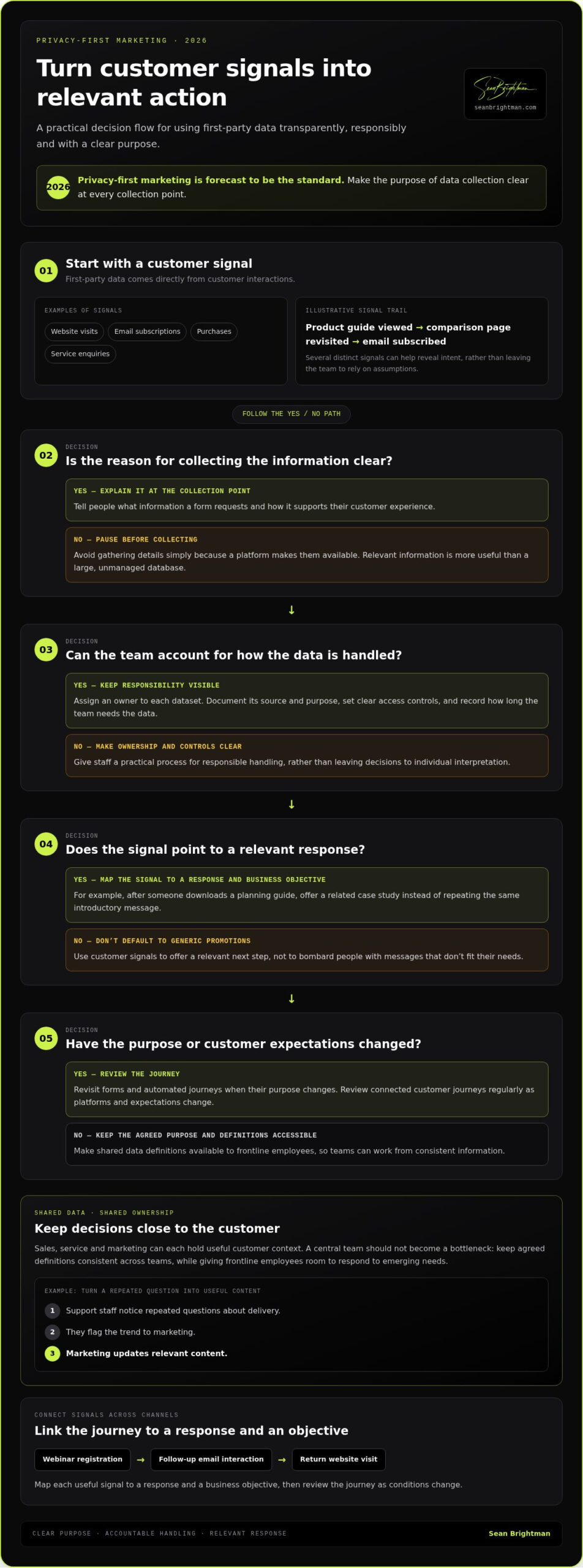
First-party data comes directly from customer interactions, such as website visits, email subscriptions, purchases and service enquiries. It helps teams understand intent instead of relying on assumptions. For example, someone who reads a product guide, returns to a comparison page and subscribes to email has shown several distinct signals. Use those signals to offer a relevant next step, not to bombard them with generic promotions.
Privacy-first marketing is forecast to be the standard in 2026. Put transparency into each collection point: explain what information a form requests and how it supports the customer experience. Keep records of the purpose for collecting data, who can access it and how long the team needs it. Avoid gathering details simply because a platform makes them available. Relevant information is more useful than a large, unmanaged database.
For privacy compliance, make responsibility visible. Assign an owner to each dataset, document its source and purpose, and set clear access controls. A marketing team using email preferences, for instance, should make sure those preferences remain understandable and usable across its campaigns. Review forms and automated journeys when their purpose changes. This gives staff a practical process for handling data responsibly, rather than leaving decisions to individual interpretation.
Shared data also needs shared ownership. Sales, service and marketing may each hold useful customer context, but a central team shouldn’t become a bottleneck. Make agreed data definitions accessible to frontline employees, then give them room to respond to emerging needs. If support staff notice repeated questions about delivery, they can flag the trend to marketing, which can update relevant content. Keep decisions close to the customer and shared definitions consistent across teams.
Connecting marketing data systems can help teams respond to customer behaviour. Link useful signals across channels, such as a webinar registration, a follow-up email interaction and a return website visit. Map each signal to a response and a business objective. If someone downloads a planning guide, for example, offer a related case study instead of repeating the same introductory message. Review the journey regularly as platforms and customer expectations change.
What UK marketing channels are forecast to deliver the best ROI in 2026? No single channel is established as the universal winner here. Compare search, social, retail media and traditional advertising against your audience, objective and measured results.
How should marketers compare search, social, retail media and traditional advertising in 2026? Give each channel a clear conversion goal, then assess conversion rate, acquisition cost, customer lifetime value, engagement quality and return on investment. Search can capture active intent, whilst social can build discovery; compare each contribution across the customer journey, not just its last click.
2. What does it mean to future-proof your marketing plan?
Future-proofing means building a strategy that can adapt when customer behaviour, technology or competition changes. It doesn’t mean predicting every trend correctly. Treat each strategic choice as a hypothesis, then test it against evidence. A guide targeting the search phrase “future-proofing your marketing strategy 2026” should connect business objectives to actions, review points and clear criteria for changing direction.
Keep the core consistent while adapting the execution. A business might retain its promise of reliable delivery while changing how it explains that benefit across search, social and email. Review customer questions, sales conversations and campaign responses. When those signals shift, update the message or channel without changing the underlying purpose unless there’s a good reason.
Customer needs change in practical ways. A retailer may find that customers are moving from browsing broad inspiration to comparing product details before buying. That shift calls for clearer comparison content and a stronger path to purchase. Create a routine for capturing frontline observations, reviewing search intent and turning recurring questions into useful marketing action.
Marketing skills need to adapt too. Platform-specific expertise can lose value when a channel changes its features or reach. Prioritise people who understand audience needs, measurement, creative thinking and core marketing principles across platforms. Give teams hands-on opportunities to test emerging tools in low-risk settings, then share what worked and what didn’t.
Adaptability needs structure. Use a repeating cycle: discuss the evidence, agree on a response, act, review the result and repeat. Assign an owner to each decision, record the assumption behind it and set a review point. This helps teams stay responsive and prevents the plan from becoming a fixed document that no longer guides daily choices.
What should UK businesses budget for marketing in 2026? Set the budget against business objectives, expected return, audience reach and the resources needed to deliver. Review spending against conversion rate, customer lifetime value and return on investment, then shift investment towards activity that supports the commercial goal.
The UK consumer and advertising landscape will reward authenticity and relevant experiences. PA Consulting research found that 87% of people prioritise trustworthy media, whilst 81% look for authenticity. By 2026, audiences are forecast to seek content from real people with real experiences, making clear expertise and credible examples valuable.
To future-proof your plan, define the business outcome first, document the assumptions behind each activity and choose measures linked to that outcome. Test new approaches on a small scale, review results, and expand only when evidence supports the move. A team using “future-proofing your marketing strategy 2026” as a planning prompt should keep people accountable for decisions, even when technology helps with analysis or execution.
Relying too heavily on AI can weaken human judgement and produce work that misses customer context. Platform dependence leaves reach vulnerable to changes outside your control, while third-party data can create gaps in your view of customer behaviour. Reduce these risks by retaining human review, building direct customer relationships and making decisions using evidence from across channels.
3. Aligning technology choices with business objectives
Start with the business problem, not a software demo. If customers abandon a booking journey, identify where they drop out and what information might help. Then decide whether a technology change could address the cause. A tool should support a measurable objective, such as increasing completed bookings or helping staff respond to enquiries faster.
Define the task before comparing options. Specify the user, the data required, the process to improve and the outcome that matters. For a retailer, that might mean connecting product interest with stock information so marketing can promote available items. This simple test keeps teams focused on business value rather than feature lists.
Build a modular marketing system that can evolve. Keep core functions, such as customer records, analytics and campaign delivery, connected through clear data flows. A modular approach lets a team replace one component without rebuilding the whole system. It also makes adaptation more practical when customer needs or platform capabilities change.
Technology adoption should be ongoing, not a panic response to every new release. Track emerging changes that affect your customers, channels or internal processes. Test relevant tools in a controlled, low-risk setting, then record what the team learns. A small pilot can show whether a tool solves the stated problem before it becomes part of daily work.
Technical SEO still relies on solid foundations. Keep the website fast and mobile-friendly, organise its structure, support proper indexing and use appropriate structured data. A clear category structure, for example, helps visitors find related pages, while crawlable content gives search systems a better chance of understanding them. Review these foundations whenever a redesign changes navigation or page templates.
Connect technology decisions to the customer journey across search, email and social media. If campaign analytics show that visitors engage with a guide but don’t take the next step, examine the page journey before buying another tool. The ability to interpret that signal matters as much as the technology itself. Choose systems that help teams act on useful evidence.
Make ownership part of implementation. Name the person responsible for adoption, document how the tool supports the business objective and set a review point. Give staff hands-on practice with realistic tasks, such as building a report or checking an automated journey. Teams learn faster when they can test a system against actual work rather than sit through feature presentations.
Finally, assess whether the technology still earns its place. Compare its contribution with the original objective, check whether staff use it and identify friction between systems. Keep what supports the outcome; adjust or replace what doesn’t. That discipline turns a collection of platforms into a working marketing system.
4. Generative Engine Optimisation and AI-powered search
Generative Engine Optimisation, or GEO, prepares useful content for AI-powered search experiences. These tools can give users direct answers, changing how people discover businesses. GEO is forecast to become important in 2026. The aim isn’t to write for machines alone. Make your expertise easy for people and digital systems to find, interpret and trust.
AI adoption is already part of the marketing conversation: in 2026, 75% of brands have incorporated generative AI into their strategies. That figure doesn’t make every AI tool useful. Start with a real customer question, then publish a clear answer grounded in your experience. A specialist answering “How do I choose the right solution?” should explain the criteria, trade-offs and next steps.
Structure each page for quick understanding. Use descriptive headings, short paragraphs and a logical sequence. Put the answer near the beginning, then add evidence and useful detail. For example, a service page can explain who it helps, how it works and answer common concerns. Readers can scan it, and search systems can identify its main points.
Invest in original insight rather than rushing to publish more pages. A small business doesn’t need thousands of pages to compete in AI-powered search. A detailed case study can explain the problem, the decisions made and the outcome. Add first-hand observations, practical steps and relevant examples. This gives content substance that generic summaries lack.
Clear writing won’t help if a page can’t be accessed. AI cannot surface content it cannot crawl, understand or trust. Keep important pages accessible to search crawlers, use clear navigation and avoid burying key information in confusing layouts. Check that each page has a specific purpose and supports the wider site structure.
Trust also depends on consistent signals across your digital presence. Keep author biographies, expertise and business information accurate on your website and relevant profiles. Support claims with case studies, reviews or named credentials where appropriate. When a company’s website and public profiles describe its work consistently, readers have a clearer basis for assessing its credibility.
Measure GEO using more than a single ranking. Track relevant organic visits, enquiries, engagement with useful pages and assisted conversions. Compare those signals with the business objective behind each page. If a guide attracts attention but doesn’t help readers take the next step, improve its examples, internal journey or call to action.
Make GEO a practical part of search planning: choose customer questions, publish direct answers, demonstrate real expertise and review performance. Keep testing as AI-powered search and user behaviour evolve. Success comes from useful, accessible content that earns attention, not from repeating keywords or building pages solely to chase emerging platforms.
5. What marketing trends will shape UK businesses in 2026?
UK businesses should focus on changes that improve customer relevance, not chase every new format. In 2026, useful priorities include authentic content, personalised experiences, stronger local connections and practical uses of AI. Treat each as a testable direction. Choose the trend that fits your audience and commercial objective, then measure its contribution.
Authenticity means showing the people, experience and decisions behind a business. A UK accountancy firm, for example, could explain how it helps a client prepare for a business challenge, sharing its reasoning and lessons. That’s more useful than polished claims without evidence. Build credibility with consistent author information, customer reviews and examples across your website and professional profiles.
Local relevance can sharpen that message. In 2026, brands are expected to engage more with specific cities, towns and interest groups. A business serving a particular community could create content around local questions, events or needs, rather than publishing generic national messaging. Keep the connection real: local references should reflect actual expertise or participation, not just a place name inserted for attention.
Serialised video is also forecast to build brand loyalty in 2026. Use a recurring format, such as short episodes answering customer questions or showing how a service works. Each instalment should deliver value on its own, while giving viewers a reason to return. Track meaningful engagement and enquiries, not views alone. The aim is an ongoing relationship, not a one-off spike.
Personalisation needs to earn its place in the customer journey. In 2026, 75% of consumers are more likely to buy from brands that deliver personalised content. Start with a useful distinction, such as a customer’s product interest or stage in the buying process. Tailor the message to that signal, then compare responses with a relevant business measure. Personalisation without purpose is just extra complexity.
AI can connect customer data with marketing decisions, support behaviour analysis and handle routine tasks. Use it to help draft email variations, organise recurring questions or identify patterns for human review. Keep people responsible for the message and the decision. A tool should free the team to focus on strategy and creativity, not replace judgement or publish unchecked material.
Augmented reality offers another option where customers benefit from seeing products in context. In 2026, 71% of consumers say they would shop more if augmented reality were available, and over 30% of marketers are integrating augmented or virtual reality into campaigns. AR can increase conversion rates by up to 40% in some cases. Start with a specific customer problem and test whether an interactive experience helps solve it.
Don’t adopt every trend at once. Select one relevant opportunity, define the intended outcome and test it with a focused campaign. Review customer response and commercial performance before expanding. To turn these shifts into a clear set of priorities, plan your next marketing move.
Sean Brightman: AI Consulting
Sean Brightman’s AI Consulting helps businesses assess where AI fits their marketing objectives and where it doesn’t. Turn to it when your team has promising use cases but needs a clearer way to prioritise them, connect them to customer needs and decide what to test.
For wider planning, Roadmapping can turn strategic priorities into a practical sequence of decisions. An Advisory Retainer provides ongoing guidance as your marketing plan evolves. The right starting point depends on the challenge: a specific AI question calls for focused consulting, while broader priorities may need a roadmap.
Bring your current objectives and the decisions causing friction into the conversation. Visit seanbrightman.com to explore the next step with Sean Brightman.
Make your next marketing decision count
Don’t wait for certainty before acting. Choose the business challenge that matters most, decide what evidence would change your mind, and set a clear point to review progress. That turns future-proofing your marketing strategy for 2026 into an active discipline, not another plan sitting untouched on a shared drive.
When priorities compete or AI raises questions your team can’t resolve, focused strategic input can help. Sean Brightman offers Fractional CMO support, AI Consulting and Roadmapping to bring direction to marketing decisions and connect them to business objectives.
Bring the decision you need to make, not a polished pitch deck. Contact Sean Brightman to discuss your next step and build a marketing plan ready to evolve.
Frequently Asked Questions
What does it mean to future-proof your marketing plan?
It means making your plan adaptable without losing sight of the business result it needs to deliver. A subscription business, for example, can set a target for customer renewals, then test different ways to support that outcome as preferences shift. Record the assumption behind each major decision and the evidence that would prompt a change. That makes adjustments deliberate rather than reactive to whichever platform or trend is getting attention.
How do you balance consistency with adaptation?
Keep your core promise and brand principles steady, then adapt how you deliver them. A small business might remain known for dependable service while changing its content format to answer newer customer questions. Set boundaries before testing: which messages must stay consistent, and which channels or creative approaches can change? Review the result against customer response and business goals. This protects recognition while giving the team room to improve execution.
Should a marketing plan change when customer behaviour changes?
Yes, when a change is persistent and relevant to a business objective. A single unusual week may not justify a strategic shift, but repeated changes in enquiries, customer questions or buying patterns deserve investigation. Compare what people say with what they do, such as checking whether more visitors read delivery information before ordering. If the evidence points to a genuine change, adjust the customer journey or message, then monitor the effect.
What evidence can reveal emerging risks?
Look for mismatches between customer behaviour, campaign results and business performance. For example, rising website visits alongside fewer qualified enquiries may signal a targeting or landing-page issue. Consider customer complaints, sales-team feedback, changes in search queries, channel performance and conversion patterns together. A sudden change in one metric needs context; several signals moving in the same direction deserve investigation. Assign an owner to investigate and record the decision that follows.
How will AI change marketing strategy and workflows in 2026?
AI can help teams handle routine analysis and production tasks, giving people more time for decisions that need judgement. A marketer might use AI to group recurring customer questions, then write and approve the response personally. Build a workflow that specifies which tasks AI can support, who reviews its output and how errors are corrected. Keep sensitive information out of tools unless their use has been assessed appropriately. Measure usefulness by the work improved, not tool adoption.
What UK advertising, privacy and AI regulations will affect marketing in 2026?
UK marketing activity needs to account for applicable privacy and data-protection requirements, rules for electronic marketing and standards governing advertising claims. Exact obligations depend on the data, channel, audience and type of claim involved. AI use adds questions about how information is handled and generated content reviewed. Before launching a campaign, identify those factors, document the checks and review current requirements with appropriate legal expertise.
How should businesses prepare first-party data and customer consent for 2026?
Start by mapping where customer information comes from and how teams use it. For each form, newsletter or preference centre, explain choices in plain language and make it easy for people to manage their preferences. Keep a usable record of consent and its context, and ensure campaign systems respect changes. Remove redundant fields that don’t serve a clear purpose. This gives marketers cleaner audience information and helps customers understand their choices.