
Tag: digital transformation

  • Marketing Accountability Frameworks That Connect Activity to Outcomes

    Marketing Accountability Frameworks That Connect Activity to Outcomes

    Marketing activity only earns its place when you can connect it to business results. A marketing accountability framework links what marketing does and measures to financially relevant outcomes, from revenue and retention to growth over time. It moves the conversation beyond clicks and impressions.

    That doesn’t mean every campaign must prove its value through a single headline figure. It means choosing useful measures, understanding how they relate to commercial performance and reviewing them consistently. Clear accountability gives teams a stronger basis for decisions, not just a fuller report.

    This article explains how reporting can connect activity to outcomes, what measurement standards add and how the Marketing Metric Audit Protocol (MMAP) tests the links between marketing measures and financial performance. It also explores why accountability matters during digital transformation, when teams need clear ownership and the freedom to act in alignment.

    Key Takeaways

    • Set measures that connect marketing activity to commercial outcomes, then review whether they still reflect business priorities.
    • Separate campaign performance from business-system problems, such as tracking gaps or approval delays, so teams can act on the real constraint.
    • Use MMAP to examine how marketing measures link to cash-flow drivers and test the assumptions behind those connections.
    • Make ownership and team dependencies visible during digital transformation, giving people room to act without losing alignment.

    What is a marketing accountability framework?

    A marketing accountability framework connects marketing activity to commercial outcomes, including revenue, acquisition and retention. It assigns responsibility for results, not just for reporting impressions.

    Marketing metrics and performance benchmarks

    Metrics track activity or results; benchmarks put those figures in context against a baseline, target or earlier period. Set them by starting with the business objective, choosing measures that reflect it, then assigning an owner and review point. Performance measurement frameworks report what happened; accountability frameworks also connect results to business objectives and decisions. This distinction helps teams judge whether activity merits further investment.

    Lead costs and customer acquisition

    Cost per lead compares marketing spend with the number of leads generated, while customer acquisition cost measures the cost of gaining a customer. Read them together: a low-cost lead has little value if it rarely becomes a paying customer. Assign responsibility for lead quality and track conversion through sales stages. This shows where costs rise, where prospects drop out and which changes could improve acquisition.

    Connecting metrics to business outcomes

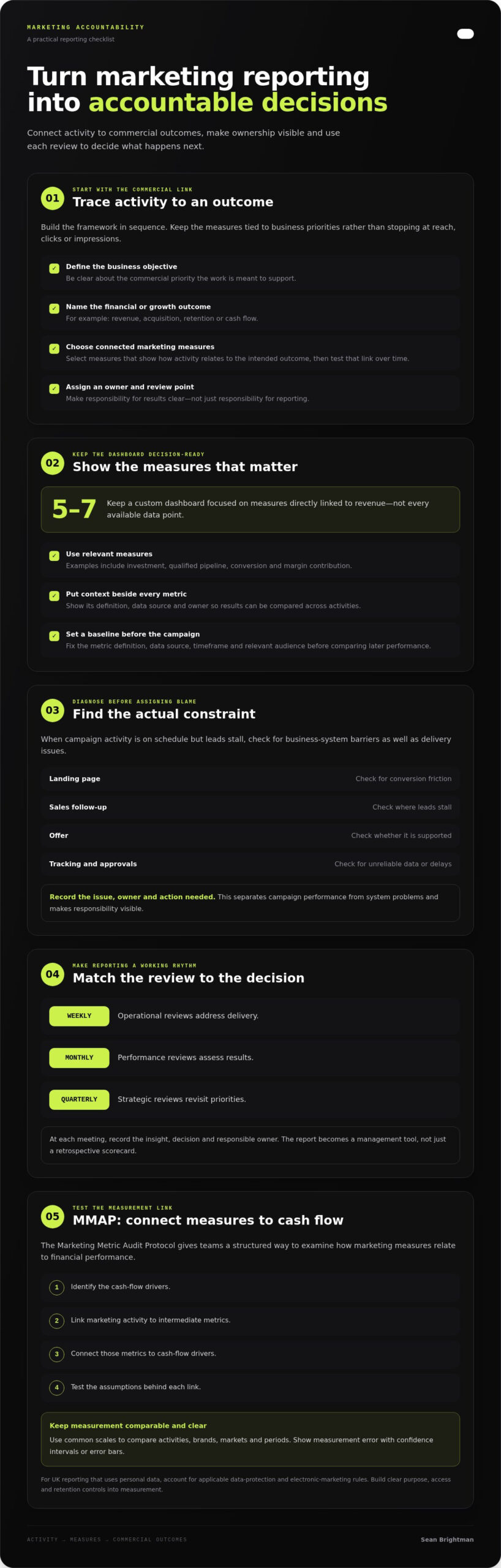
    Outcome measures show how marketing contributes to commercial performance, rather than stopping at reach or clicks. Build the framework in sequence: define the business objective, identify the cash-flow or growth outcome, select the marketing measures connected to it, then test those connections over time. Examples include return on marketing investment, acquisition cost and retention. Effective frameworks combine these measures with clear ownership and regular management reviews, so results inform the next decision.

    Sales and marketing metric alignment

    Sales and marketing alignment means both teams use shared definitions and measures across the customer journey. Agree what counts as a qualified lead, who owns follow-up and how progress is recorded. Then compare marketing’s lead and conversion measures with sales outcomes, such as new-customer revenue. This makes responsibility visible: if leads fail to progress, teams can identify the stage causing friction instead of arguing over separate dashboards.

    How should a report connect marketing activity to business outcomes?

    UK reporting that uses personal data should account for applicable data-protection and electronic-marketing rules. Build clear purpose, access and retention controls into measurement, then connect each activity to a financial outcome and an owner.

    Marketing investment and financial performance

    Linking investment to financial performance means tracing how marketing spend contributes to revenue, margin or cash flow. It matters because activity counts alone cannot show whether investment supports commercial priorities. For each programme, record its cost, the intermediate result, such as qualified demand, and the financial outcome it is expected to influence. Compare those measures over time and state the assumptions behind the link. This gives leaders insight into contribution, not just output.

    Diagnosing agency and business-system performance

    Diagnosis separates delivery issues from business-system barriers that prevent results. If campaign activity is on schedule but leads stall, examine the landing page, sales follow-up, offer and tracking before blaming the agency. Record the issue, its owner and the action needed. An agency performance review should also surface unsupported offers, conversion friction, unreliable data or approval delays while there is time to respond. This structured view makes responsibility clear and directs attention to the actual constraint.

    A custom dashboard should reflect the organisation’s strategic priorities, not every available data point. Keep it focused on five to seven measures directly linked to revenue, such as investment, qualified pipeline, conversion and margin contribution. Show definitions, data sources and owners beside each metric. That makes reporting comparable across activities and helps readers spot whether a change reflects performance or a tracking problem.

    Set a review rhythm that turns reporting into decisions: weekly operational reviews address delivery, monthly performance reviews assess results, and quarterly strategic reviews revisit priorities. Use each meeting to record the insight, decision and responsible owner. The report then becomes a working management tool, not a retrospective scorecard.
    Marketing Accountability Frameworks That Connect Activity to Outcomes

    Marketing measurement standards and MMAP

    Standards make campaign results more comparable and show how much confidence to place in them. MMAP gives teams a structured way to test how marketing measures connect to financial performance.

    Measurement standards and standardised measures

    Marketing measurement standards define consistent methods for assessing activity, outcomes and the reliability of results. The Marketing Accountability Standards Board provides the Marketing Metric Audit Protocol (MMAP), which identifies cash-flow drivers, links marketing activity to intermediate metrics, connects those metrics to cash-flow drivers and tests the assumptions behind each link. This matters because a campaign measure only supports a business decision when its meaning and relationship to financial performance are clear. Use common scales to compare activities, brands, markets and periods; show measurement error with confidence intervals or error bars.

    Establishing baseline measurements

    A baseline is a recorded starting point for comparing later performance. Establish it by fixing the metric definition, data source, timeframe and relevant audience before a campaign begins. For example, record existing customer acquisition and retention measures using the same definitions planned for evaluation. Gather outcome measures continuously over time; repeated observations help identify changes associated with marketing initiatives and shifting customer needs. A consistent baseline makes growth visible without confusing a change in measurement with a change in performance.

    Industry measurement practices

    Industry practice includes benchmarking return on investment and testing whether measurement methods produce valid results. The American Productivity and Quality Center and the Advertising Research Foundation conducted return-on-investment benchmarking surveys in 2001 and 2003. The Chief Marketing Officers Council carried out a survey on marketing accountability and measurement in 2004. The Association of National Advertisers and Forrester conducted surveys on those topics in 2002, 2004 and 2006. These examples show why shared definitions matter: comparisons need consistent measures, not merely familiar labels. For your own campaigns, document methodology and uncertainty alongside results, then compare like with like.

    Accountability frameworks and digital transformation

    Digital transformation spreads work across teams, platforms and customer-facing services. MIT Sloan Center for Information Systems Research identifies accountability as one of digital transformation’s five building blocks. Without defined ownership, teams can launch connected digital offerings but lose sight of their purpose, decisions and commercial contribution.

    An accountability framework connects leadership priorities to the people making product, data and channel decisions. For example, a team responsible for a customer portal can manage its design independently while agreeing shared service standards with sales and support. That balance protects local initiative and keeps the customer experience aligned. It also clarifies who can resolve a dependency when another team controls a required system or approval.

    RACI matrices make those relationships explicit by assigning responsibility, accountability, consultation and information-sharing roles. Apply the roles to a specific outcome, such as launching a digital service or changing its customer journey. One person or team needs clear accountability for the result; others need defined roles in delivery, input or updates. This prevents a common failure: everyone contributes, but no one can make the decision.

    Budget decisions need the same clarity. Define who can move investment between digital activities, who approves changes and which business purpose guides those choices. For example, a team running digital advertising may report campaign performance, while leadership decides whether the activity supports growth priorities. Visualising dependencies helps teams see how budget, data access and approvals affect delivery before delays become entrenched.

    Make the framework operational with shared tools that show ownership, decision rights and cross-team dependencies. Review those links as digital services or priorities change, rather than treating the structure as permanent. This turns accountability into a working system: teams can act with autonomy, leadership can see how decisions connect, and obstacles have an owner. Turn digital accountability into a practical operating plan.

    Sean Brightman: AI Consulting

    Sean Brightman’s AI Consulting helps leaders assess where AI fits their business priorities and decision-making. It’s relevant when your team is exploring AI but lacks a clear purpose, ownership or way to measure its contribution. Tie any proposed use to a defined outcome, accountable owner and agreed measure before committing resources.

    For broader planning, Roadmapping can clarify priorities and the sequence of work. An Advisory Retainer provides ongoing strategic guidance as decisions and business needs evolve. The right starting point depends on the challenge: AI Consulting for AI questions, Roadmapping for direction or an Advisory Retainer for continued advice.

    If you’d like to discuss your priorities, contact Sean Brightman or visit seanbrightman.com.

    Make accountability part of the next decision

    A marketing accountability framework should keep pace as your business priorities, teams and channels change. Treat it as a working management tool, not a dashboard you build once and leave untouched. Start by identifying where decisions still rely on activity counts, disconnected data or unclear ownership, then decide what needs to change.

    That work may call for strategic leadership as well as measurement discipline. Sean Brightman offers Fractional CMO support, AI Consulting and Roadmapping to help businesses tackle leadership, technology and planning challenges. The right focus depends on the gap: leadership direction, a clearer path forward or considered AI decisions.

    Start with the decision you need marketing to support. Make the commercial purpose clear, then give the team a way to learn and adjust as evidence changes. Contact Sean Brightman to discuss your framework, and take the next step towards marketing decisions grounded in business outcomes.

    Frequently Asked Questions

    How does a framework improve CMO tenure and team performance?

    A framework can support CMO continuity by making priorities, decision rights and progress visible to leadership and the team. It can reduce avoidable friction: a new CMO can inherit agreed definitions, reporting history and named owners instead of rebuilding the measurement system. Reviews that examine causes and next actions, rather than blame, also help teams learn from results and improve their decisions.

    How long does it take to implement the framework?

    Implementation time depends on data readiness and how much of the customer journey needs tracking. Basic tracking can take 2-3 weeks when the business has the right technology stack; comprehensive customer-journey tracking typically takes 4-6 weeks to deploy and validate. Allow time to define metrics, connect data, test outputs and train owners. A dashboard is only useful once its inputs are reliable.

    How should accountability be divided between the agency and the business?

    Divide accountability by decision and dependency, not by who appears on a report. An agency can own agreed campaign delivery, measurement quality and early warnings about tracking or conversion barriers. The business should own commercial objectives, its offer, approvals, internal data access and timely sales follow-up. If a launch stalls, record the blocker, decision-maker and next action so each party can address what it controls.

    What are the key components of a marketing accountability framework?

    Define the business objective, each metric’s calculation, its data source, an owner, a review rhythm and the decision it informs. A marketing accountability framework should also document how a measure is expected to influence customer behaviour and commercial results. For example, name who validates CRM lead stages and who can change a campaign if qualified prospects stop progressing.

    Which marketing KPIs and metrics should an accountability framework include?

    Choose KPIs that fit the business model and decision. A subscription business may focus on acquisition cost, payback and retention; a retailer may track new-customer revenue, repeat purchases and contribution margin. Pair an early signal, such as qualified enquiries, with a later result, such as revenue. Treat impressions as diagnostic context, not the sole evidence that marketing investment is working.

    How can marketing activity be linked to revenue, profit and business outcomes?

    Map each activity through a customer response to an economic driver: advertising generates qualified demand, sales converts that demand, and revenue contributes to margin after relevant costs. Use consistent time periods and account for influences such as price changes before assigning credit. The Marketing Metric Audit Protocol provides a structured way to test assumptions linking marketing measures with cash-flow drivers.

  • Common AI Implementation Challenges: What Goes Wrong and How to Fix It in 2026

    Common AI Implementation Challenges: What Goes Wrong and How to Fix It in 2026

    Only 41% of AI projects make it from prototype to deployment, according to Gartner. The problem often isn’t the technology. It’s the gap between a promising experiment and the leadership, workflows and controls needed to make it useful. Common AI implementation challenges often start in this gap.

    If your pilot sits outside commercial priorities, relies on messy data or leaves teams unsure how to use it, buying another tool won’t fix the blockage. These challenges can create risk, rework and wasted spend before AI delivers a measurable result.

    A stalled initiative is a signal to diagnose the system, not rush into another investment. This guide will help you identify the root cause, prioritise practical fixes and decide what needs to be in place before scaling.

    We’ll break down the real barriers, from unclear ownership and governance to skills gaps and workflows that haven’t changed. You’ll also see how to connect AI adoption to measurable business and marketing outcomes, so experiments have a clear route to value.

    Key Takeaways

    • Turn common AI implementation challenges into specific questions about goals, workflows, data and ownership, so you can find the actual blocker.
    • Prioritise issues by business impact, risk, dependencies and how readily your team can address them.
    • Before testing a use case, set a baseline, define a measurable outcome, assign an accountable owner and plan for human review.
    • Evaluate a pilot against its intended outcome before deciding whether to adjust, stop or expand it.
    • Use strategic roadmapping to connect AI use cases with marketing priorities, workflow changes and accountable owners.

    Common AI implementation challenges: why promising initiatives stall

    An AI demonstration can look impressive: a prompt produces a polished campaign draft, a chatbot answers a sample query, or an assistant summarises a report in seconds. Then everyday work starts. The output needs checking, staff return to familiar tools, and nobody can say whether the experiment improved a business result. The gap isn’t mysterious. A convincing demo proves a task can be done. It doesn’t prove the task fits the workflow or creates dependable value.

    That distinction sits at the heart of common AI implementation challenges. Implementation means embedding AI into real decisions and routines, with clear responsibility for how people use and assess it. Buying access to a tool, connecting a model or completing a pilot is only a starting point. The process around the technology has to change too.

    Experimentation asks, “Can this work?” Operational implementation asks, “Does it reliably improve a defined business outcome as part of everyday work?”

    What does successful AI implementation actually mean?

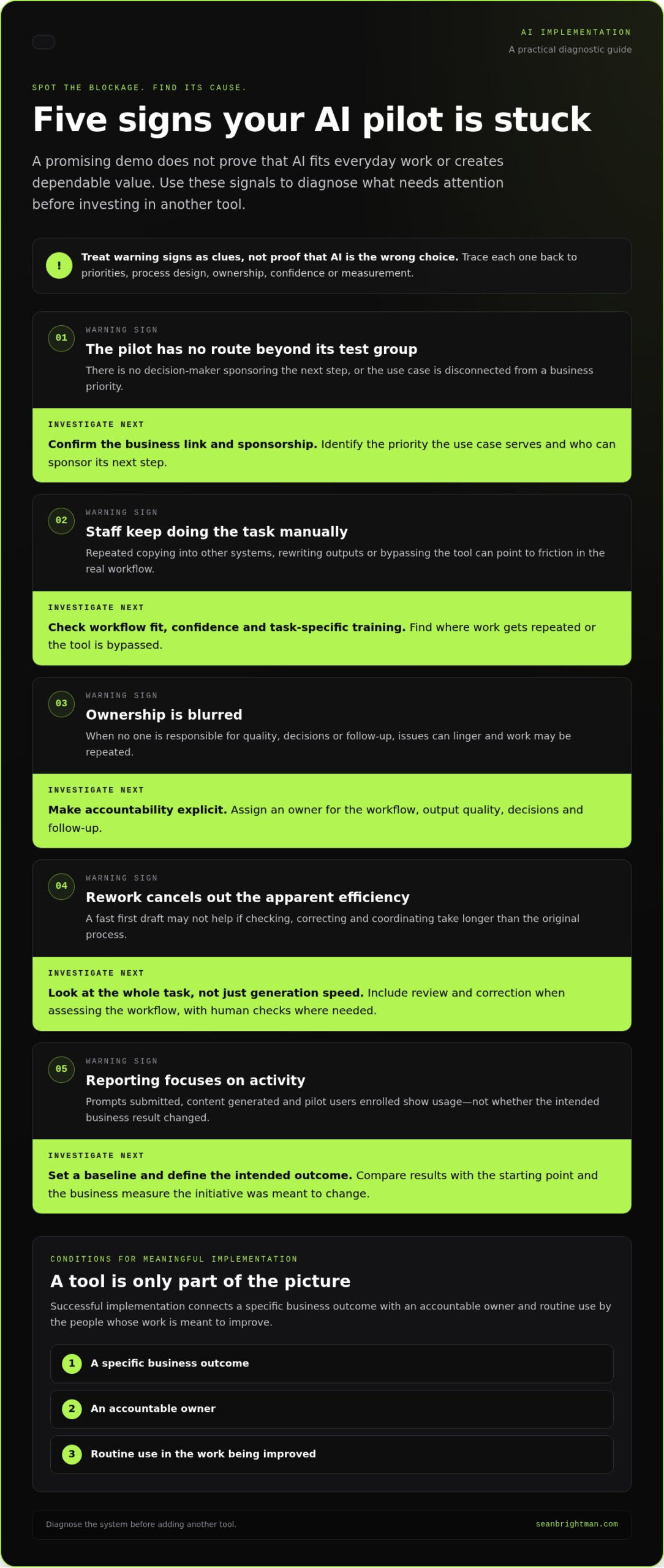
    Success needs three things: a specific business outcome, an accountable owner and routine use by the people whose work is meant to improve. For a marketing team, that might mean reducing avoidable drafting effort whilst maintaining agreed quality, rather than simply generating more copy. The measure should reflect the intended benefit, not just how often someone opens the tool.

    A model can perform well in a controlled test and still fail in practice. The process may lack suitable review, staff may not trust the output, or the tool may not fit how work moves between colleagues. Technical performance matters, but so do adoption, usefulness and safeguards. Clear human oversight also helps teams consider AI safety in the context of their use case.

    Which warning signs appear before an AI initiative stalls?

    Look for patterns in the work, not just status updates. An initiative may appear active whilst the conditions for real adoption are missing:

    • The pilot has no route beyond its test group. If nobody with decision-making authority is sponsoring the next step, or the use case doesn’t connect to a business priority, the pilot may be exploration without a path to operational use.
    • Staff keep doing the task manually. Repeatedly copying outputs into other systems, rewriting results or bypassing the tool can signal poor workflow fit, low confidence or training that hasn’t addressed the actual task.
    • Ownership is blurred. If no one is responsible for quality, decisions or follow-up, issues linger and teams may redo work to compensate.
    • Rework cancels out the apparent efficiency. Fast first drafts mean little if checking, correcting and coordinating take longer than the original process.
    • Reporting focuses on activity. Prompts submitted, content generated or pilot users enrolled show usage, not business impact. Compare results with a baseline and the outcome the initiative was meant to change.

    These signs are diagnostic clues, not proof that AI itself is the wrong choice. Trace each one back to its cause: priorities, process design, ownership, confidence or measurement. That gives you a sharper starting point than adding another tool or declaring the pilot a success because it produced a polished demo.

    The root causes behind common AI implementation challenges

    Teams often choose a tool before agreeing what needs to improve. A request to “use AI in marketing” sounds like a plan, but it doesn’t define the problem, the intended outcome or who will own the result. Without those decisions, tool selection becomes guesswork. The team may build a capable solution that answers the wrong question.

    Data can expose the same gap. Useful outputs depend on information that’s relevant, accessible and managed with care. If customer records are incomplete, definitions differ between teams, or nobody owns updates, the output may be inconsistent. Staff then lose confidence, even if the underlying model performs as expected. Access matters too: information that can’t be used appropriately in the workflow can’t support the intended task.

    Data, governance and security: the foundations teams overlook

    Before a use case moves into routine work, decide which data it needs, who is responsible for its quality and who can access it. Set practical rules for handling sensitive information, reviewing outputs and escalating errors. For a marketing workflow, that could mean defining which source material staff may use and requiring human checks before AI-assisted content is shared.

    In the UK, organisations using personal data need to consider their responsibilities under UK GDPR. The Information Commissioner’s Office (ICO) publishes guidance on data protection and AI. The appropriate steps depend on the use case, so this is an operational prompt, not legal advice. Clear governance gives people a usable framework; vague warnings often leave them guessing.

    People, leadership and workflow integration

    Leadership sponsorship must translate into decisions: which problem matters, what teams should prioritise, who owns the workflow and how success will be assessed. Without that direction, departments can run disconnected experiments or wait for approval whilst the initiative loses momentum. Research into AI’s impact on work and organizations reflects why implementation needs attention to organisational conditions as well as the technology.

    Low adoption isn’t automatically a sign that employees are unwilling to change. Staff may lack practice with the specific task, know the output needs too much correction, or be unsure where human judgement is essential. Generic tool demonstrations won’t resolve those issues. Role-specific learning should show people how AI fits their work, what to check and when to take over.

    AI readiness is a leadership and operating-model challenge: leaders must align priorities, data, responsibilities and workflows before teams can use AI with confidence.

    That alignment matters because the causes compound. An unclear objective leads to a poor use case; weak ownership leaves data and review rules unresolved; awkward workflow design creates workarounds; and workarounds make benefits harder to measure. Redesign the task around both AI assistance and human judgement, then equip the people doing it. Strategic AI roadmapping can help teams connect those decisions to marketing priorities before they scale.

    How to diagnose and prioritise AI implementation challenges

    Don’t label every setback a tool failure. Start with what people can observe, then test the cause. Is the output unreliable, is usage low, or has the pilot stopped moving? Each symptom points towards different questions. This approach turns common AI implementation challenges from a broad list into a diagnosis your team can act on.

    Use the comparison below as a first pass. A symptom is a clue, not a verdict. Check the process before changing technology.

    Match the symptom to the implementation blocker

    Symptom: outputs vary in quality.
    Likely blockers: unsuitable or inconsistent data, a task that’s too broad, or unclear review requirements.
    Ask: Does the system have relevant source material? Have we defined what a useful answer looks like, and who checks it?

    Symptom: people rarely use the tool.
    Likely blockers: the tool doesn’t fit the workflow, leaders haven’t made its purpose clear, or staff lack confidence with the specific task.
    Ask: Where does the tool sit in the existing process? What makes people return to the old method?

    Symptom: a pilot has stopped progressing.
    Likely blockers: success criteria were never set, no one owns the next decision, or expansion depends on assumptions that haven’t been tested.
    Ask: What evidence would justify continuing, who decides, and what must change before wider use?

    These questions help separate a genuine tool limitation from a data, workflow, ownership or adoption problem. If a process is unclear or the desired outcome keeps shifting, AI may not be the right fix. Clarify the task first. A tool can speed up a sound process, but it won’t decide what the process should achieve.

    Decide what to fix first

    Once you’ve identified possible blockers, rank them against four factors: business impact, risk, dependency and your ability to address them. A useful order is:

    1. Set aside use cases with no meaningful outcome. If the team can’t explain what should improve, stop or redesign the idea before spending more effort on it.
    2. Resolve critical risks and ownership gaps. Privacy, security and accountability concerns are gates to wider use, not details to tidy up after scaling.
    3. Fix dependencies that block other work. For example, resolve access to reliable source information before comparing output quality across teams.
    4. Address adoption issues with a clear route to change. Improve workflow fit, role-specific guidance or leadership decisions where those are holding up useful progress.

    When priorities compete, favour the blocker that affects the most important outcome, creates the greatest risk or prevents several other fixes. Keep the decision visible: record the symptom, evidence, owner and next action. That makes it harder for an initiative to drift back into activity without progress.

    Common AI Implementation Challenges: What Goes Wrong and How to Fix It in 2026

    A practical sequence for overcoming AI implementation challenges

    Don’t start by rolling a tool out across the business. Start with one real problem and a test that can show whether AI helps. A disciplined sequence gives the team clear evidence, limits avoidable risk and makes the next decision straightforward: continue, change the use case, pause or scale.

    Design a pilot around a real business problem

    Choose a bounded, recurring task with a clear user and business consequence. Before testing, record the current baseline, define the outcome you want to improve and agree what unacceptable output looks like. Assign a business owner who can make decisions, involve the people who will use the workflow, and set out when a human must review or override AI output.

    For example, a marketing team might test AI assistance on a defined part of content preparation, not “transform marketing” all at once. The task, quality bar and review responsibility should be clear before the pilot begins.

    Move from pilot to responsible adoption

    Run the test in the workflow it’s meant to support, then compare results with the baseline. Review output quality, actual usage, friction in the process and any risks, not just whether the tool produced an answer. If the evidence points to a training, governance or process issue, fix that before exposing more people or work to the use case.

    1. Select the problem. Name the recurring task, its users and the business outcome it affects. If there’s no meaningful outcome, don’t build a pilot around it.
    2. Set the baseline and measures. Record how the task works now, then choose an outcome measure that reflects the intended benefit. Track activity separately; usage alone isn’t proof of value.
    3. Assign ownership and controls. Name the person accountable for the result. Agree who reviews outputs, what errors require escalation and how the team will handle sensitive or unsuitable results.
    4. Test with the intended users. Keep the pilot focused. Give participants task-specific guidance and capture where the tool helps, creates extra work or fails to fit the process.
    5. Evaluate against the baseline. Use a simple scorecard covering value, adoption, quality, risk and workflow fit. Note evidence and unresolved issues for each measure.
    6. Make a decision, then act. Continue if the test shows useful, repeatable value with accountable oversight. Change the use case if the task or measure was wrong. Pause if risks or dependencies remain unresolved. Scale only when the evidence supports wider use.

    Keep the scorecard practical. For value, compare the intended business outcome with the baseline. For adoption, check whether intended users rely on the workflow. For quality, assess outputs against the agreed standard. For risk, record outstanding concerns and controls. For workflow fit, identify workarounds and extra steps. A weak score is a signal to investigate, not a reason to hide the result.

    AI roadmapping can help connect these pilot decisions to business priorities and a measured path to expansion. Plan your AI adoption roadmap before committing to wider rollout.

    Turn AI implementation into a managed growth system

    A pilot can show whether a use case has potential. A managed growth system makes sure the right use cases get selected, owned and reviewed as business needs change. That takes strategic direction, not a growing catalogue of tools. Connect each initiative to a marketing priority, the workflow it affects, the people responsible and a business outcome worth tracking.

    Connect AI use cases to marketing and business priorities

    Start with the constraint, not the technology. Is the team struggling to keep customer communications consistent, or spending too much effort on repetitive work that limits higher-value activity? Define the business or customer-facing need first. Then assess possible uses by strategic relevance, feasibility and measurable value. A use case that looks impressive but doesn’t address a real priority belongs lower on the roadmap.

    This is how teams move beyond disconnected experiments. A roadmap can show which decisions need to come first, what depends on reliable information or a redesigned workflow, and how each use case supports wider marketing aims. For the broader strategic context, explore this AI consulting guide.

    Build the leadership and operating rhythm to keep progress on track

    Priorities need a regular review, not a one-off launch meeting. Set points to assess adoption, outcomes, risks and shifts in business needs. Record who owns each decision and what happens if the use case stops delivering value. This rhythm keeps teams accountable and helps leaders adjust direction before an underperforming initiative gathers more effort behind it.

    Marketing leadership can connect business priorities to the people doing the work, clarify ownership and keep measures visible. It works alongside specialist technical teams, aligning technical work with a defined purpose and ensuring business and technical colleagues agree on scope, dependencies and review.

    That coordination sits alongside sound marketing operations: roles, processes and hand-offs need to support the intended outcome. As priorities evolve, strategic brand roadmapping can help keep AI activity connected to how the business wants to grow and communicate.

    Common AI implementation challenges rarely sit in one place. They emerge when priorities, workflows and accountability pull in different directions. Strategic roadmapping and ongoing advisory support bring those decisions together, maintain direction and keep marketing teams focused on measurable outcomes.

    If your AI plans need a clearer connection to growth priorities, explore strategic AI guidance to help shape the next decisions.

    Make your next AI decision count

    The real test of common AI implementation challenges isn’t whether you can remove every obstacle. It’s whether your next decision makes the work clearer, safer and more valuable. Treat each use case as a learning loop: what it changes, what your team learns and where that insight should shape the next priority.

    That shift turns AI from a string of disconnected projects into a capability the business can strengthen over time. AI consulting focused on AI-powered growth engines, supported by strategic roadmapping and ongoing advisory, can help leaders keep that direction tied to business priorities and team accountability.

    If you’re ready to give your AI plans a clearer strategic path, explore strategic AI consulting and roadmapping.

    You don’t need to scale everything. You need a purposeful next step, and the confidence to build from what you learn.

    Frequently Asked Questions

    What are the most common AI implementation challenges?

    Common AI implementation challenges include unclear business goals, unsuitable or inaccessible data, weak governance, skills gaps, low adoption and poor workflow fit. They can overlap: for example, inconsistent customer records may produce unreliable campaign suggestions, whilst no named owner leaves the team unsure who should correct them. Trace the problem from the visible result back through the task, information and decisions behind it before blaming the tool.

    Why do AI implementation projects fail?

    Projects often lose momentum because teams choose technology before agreeing which business problem it should solve. Without an owner, usable information or a measure of success, a pilot can generate activity but no clear decision about what comes next. For instance, a team might produce AI-assisted content but never define who approves it or whether it improves the publishing process. The missing link is often the operating plan, not the demonstration.

    How can a business overcome AI implementation challenges?

    Start with one task that causes a clear business issue, such as repeated manual sorting of incoming enquiries. Map who handles it now, what information they need and where a person must make a judgement. Then test a limited change with the people doing the work. Their feedback can reveal whether the obstacle is data, training or process design, and help you adjust before extending the approach to other tasks.

    What happens if a business scales an AI pilot too early?

    Early expansion can multiply the pilot’s weaknesses. If a sales team adopts an unreliable lead summary across several teams, for instance, staff may act on poor information and spend time correcting it. Wider use also makes it harder to pinpoint whether the cause is the source data, the task design or inconsistent review. Set a decision gate before expansion and require evidence of dependable outputs, appropriate oversight and genuine user uptake.

    Can small businesses implement AI successfully?

    Yes. A small business can focus on one frequent, low-complexity task rather than launching a broad programme. For example, it could trial AI to organise meeting notes, with a colleague checking important actions before they enter a project plan. Keep the test manageable, agree what information can be used and review whether it saves effort without adding corrections. A small, well-understood use case can give the business useful evidence for its next decision.

    How do you measure the ROI of AI implementation?

    Measure a business outcome against the process before AI was introduced. If the aim is to reduce time spent preparing reports, record the time involved beforehand and compare it with the time needed after adoption, including checking and correction. Also consider quality, staff uptake and any extra oversight effort. The right measure depends on the task; counting prompts or generated documents alone says little about whether the business gained value.

    Is AI implementation mainly a technology challenge?

    No. Technology is one part of the work, alongside leadership, information quality, governance, skills and process design. A tool may work as intended but still create little value if nobody has decided how its output enters a customer-facing decision. Involve the people accountable for the business outcome and those who will use the process. Their input helps distinguish a technical fault from an unclear task or a workflow that needs redesign.