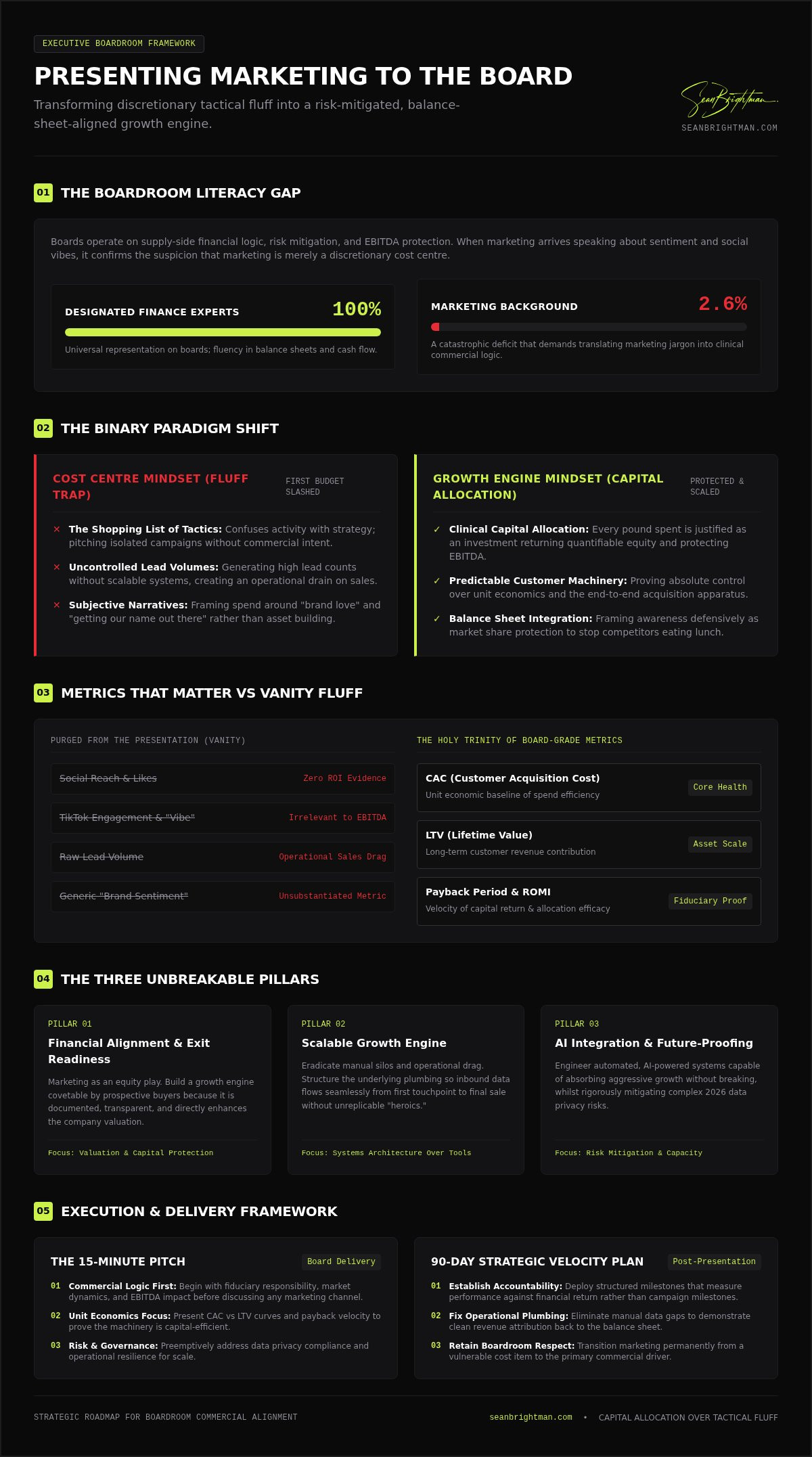
A CEO doesn’t back a list of campaigns. They back a case for growth. If you’re working out how to get ceo buy-in for marketing strategy, start with the business problem your plan solves, not the channels you want to use.
The frustration is familiar: marketing looks like a cost, attribution doesn’t tell a complete story, and the strategy takes longer to explain than the leadership meeting allows. You don’t need to claim every sale or pretend the numbers are certain. Show what the evidence supports, what you’re assuming and where the risks sit.
This article gives you a practical way to connect marketing priorities to outcomes your CEO cares about, such as revenue, customer acquisition and pipeline. You’ll learn how to make the case with credible measures, explain uncertainty without weakening your argument and propose a measured commitment rather than a leap of faith. Then bring the discussion to a clear decision: what gets approved, who owns it and what happens next.
Key Takeaways
- Anchor your proposal in the business problem leadership needs to solve, not a list of marketing activities.
- Show the baseline, target, time horizon and source behind your figures so the CEO can assess the case.
- Explain how to get ceo buy-in for marketing strategy by being candid about uncertainty, trade-offs and what attribution can’t prove.
- Structure the discussion around one clear decision, with supporting detail ready but no slide marathon.
- Turn approval into action by agreeing priorities, decision rights, owners and a review cadence before work begins.
Why CEO buy-in for a marketing strategy starts with the business problem
Marketing has a plan, but leadership hasn’t approved its direction, priorities or resources. That gap rarely closes with another campaign slide. It closes when the proposal makes clear which business problem needs solving, why the response fits and what decision the CEO must make.
CEO buy-in means agreement on the outcomes marketing must support, the investment and resources required, and who is accountable for progress. It doesn’t mean the CEO must endorse every tactic. It means there’s a shared case for action and a clear mandate to move forward.
Before preparing your pitch, diagnose the hesitation. Is the CEO concerned about committing resources, the timing of results, the strength of the evidence, the team’s capacity or the strategy’s fit with current priorities? Don’t guess. Review previous decisions, current business plans and questions leaders have raised. If possible, clarify the concern before the meeting. A timing objection needs a different answer from a capacity problem.
This is the core of Marketing Strategy Overview: a strategy coordinates choices to support sales, market presence and competitive advantage. For an approval discussion, translate that broad purpose into one specific business challenge. Keep the problem distinct from the marketing activity proposed to address it.
Translate the marketing challenge into a business priority
Start with a priority already on the leadership agenda, such as growth, retention, entering a market or strengthening positioning. Then state the problem in business terms. “We need more LinkedIn activity” describes a tactic. “Qualified opportunities are not keeping pace with the sales target” identifies a problem the company can assess.
Show the cost of inaction using the company’s own evidence. That might be a trend in renewal rates, sales-cycle length, conversion between pipeline stages or customer feedback. Explain the source and limits of the evidence. Don’t attach a made-up revenue loss to a weak assumption. If the impact can’t yet be quantified, say what is known and what needs testing.
Work out what decision the CEO needs to make
Be precise about the purpose of the meeting. Are you seeking approval for a direction, alignment on priorities, resources to deliver it or permission to test an approach? These are different decisions. A request for a limited test, for example, should name what it is intended to learn and what evidence will inform the next decision.
Surface likely concerns before debating campaign details. Prepare a direct response on expected timing, evidence, capacity, risk and strategic fit. Keep the discussion focused on securing the decision, rather than offering general advice about how a CEO should lead.
For a practical how to get ceo buy-in for marketing strategy conversation, write one sentence before you build the presentation: “We’re asking you to decide [what], because [business problem], with progress judged by [outcome].” If that sentence is vague, the proposal isn’t ready. Strategic roadmapping can help clarify priorities and shape a plan for leadership discussion.
Build a marketing strategy case with evidence the CEO can trust
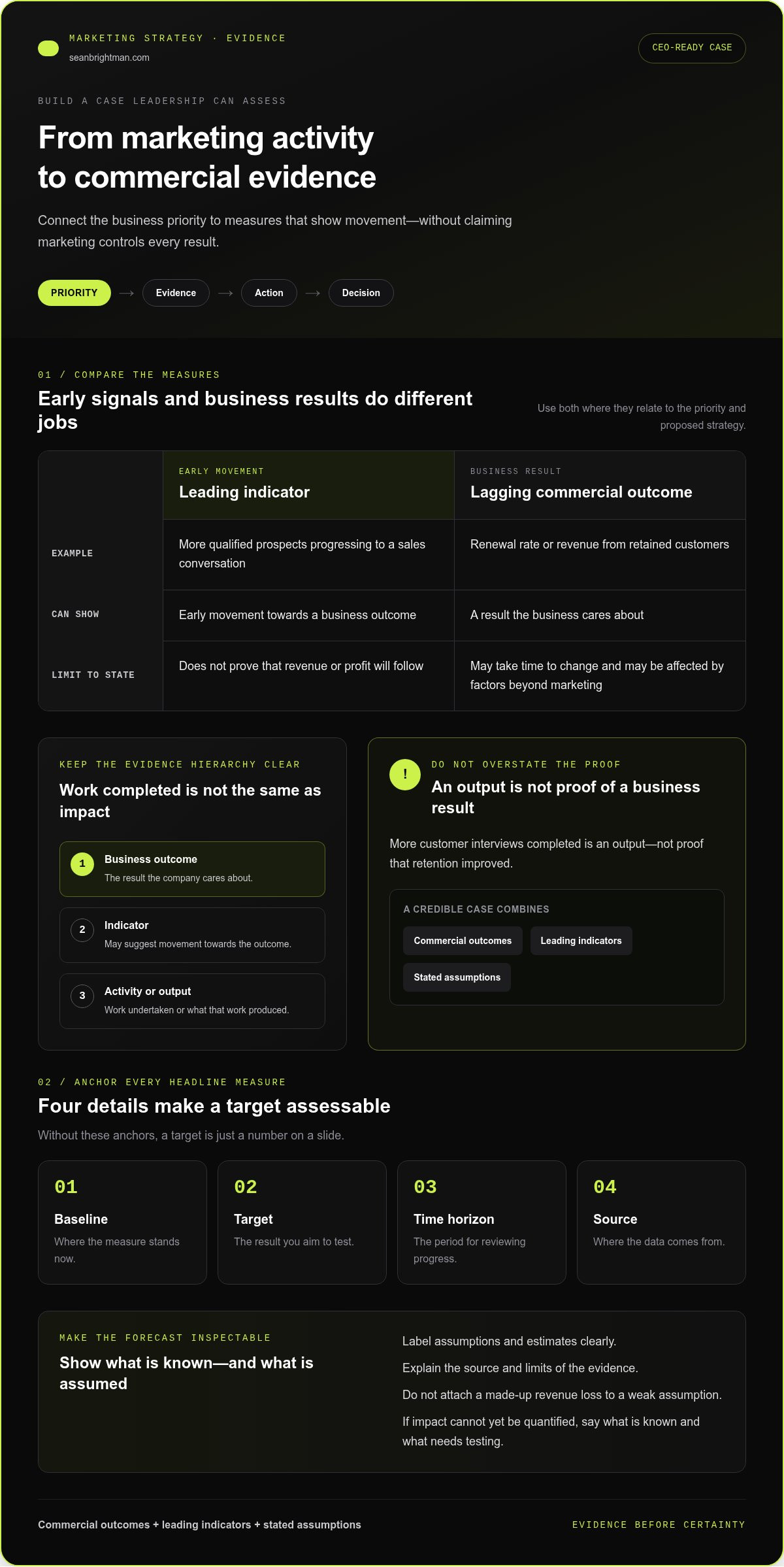
A credible case doesn’t claim marketing controls every commercial result. It shows a traceable line from the business priority to the evidence, the proposed action and the decision. Give each headline measure four anchors: its current baseline, target, time horizon and source. Without those, a target is just a number on a slide.
For example, if the priority is customer retention, state the current renewal rate, the improvement you aim to test, the period for reviewing it and where the renewal data comes from. If the target relies on assumptions, label them. A forecast is useful when the CEO can see how it was built, not when it’s presented as certainty.
Keep the evidence hierarchy clear. A business outcome is the result the company cares about. An indicator may suggest movement towards it. An activity is work undertaken; an output is what that work produced. More customer interviews completed is an output, not proof that retention improved.
| Measure type | Example | What it can and can’t tell you |
|---|---|---|
| Leading indicator | More qualified prospects progressing to a sales conversation | Can show early movement; doesn’t prove that revenue or profit will follow. |
| Lagging commercial outcome | Renewal rate or revenue from retained customers | Shows a business result; may take time to change and can be affected by factors beyond marketing. |
Marketing evidence should combine commercial outcomes, leading indicators and clearly stated assumptions, because no single measure tells the whole story. That gives the CEO a more honest basis for judgement than a dashboard packed with disconnected figures.
Choose metrics that connect to the decision
Pick a small set of measures that relate directly to the priority and proposed strategy. For a retention focus, that could mean tracking renewal rate alongside engagement with a relevant customer programme. For growth, consider pipeline progression and conversion. Brand measures can help assess whether positioning is reaching the intended audience, but don’t present awareness as a sale. State why each measure matters, label projected results as estimates and show the assumptions behind them.
Make attribution limits visible without weakening the case
A buyer may encounter several channels, speak to colleagues and take months to decide. That makes it difficult to assign a commercial outcome to one activity alone. Separate observed results from projections and causal claims: “renewals rose during this period” is not the same as “this campaign caused the rise”. Agree a review cadence and define in advance what evidence would prompt a change, such as an indicator failing to move or a key assumption proving wrong.
That’s how to get ceo buy-in for marketing strategy without overstating the numbers: make the evidence auditable and the uncertainty manageable. If the measures or assumptions need sharpening, strategic roadmapping can help turn priorities into a plan for leadership discussion.
Answer the CEO’s toughest objections without overselling marketing
The hardest question is often the fairest one: “What return will this deliver, and when?” The honest answer may be that return is uncertain, takes time to emerge or can’t be credited to one channel alone. Don’t dodge that. Explain what the plan can test, what it cannot prove yet and how leadership will decide whether to continue.
Transparent assumptions build a stronger case than false precision. A credible test has a defined purpose, measures, review point and decision criteria. It doesn’t promise guaranteed results or disguise a forecast as fact.
When the CEO asks for immediate return
Separate early signals from commercial outcomes. A change in qualified enquiries or prospects moving to a sales conversation may be visible before revenue, renewals or lifetime value. Those indicators can show whether the strategy is gaining traction, but they aren’t substitutes for the commercial result.
Make the time lag explicit. For example: “We’ll review whether more suitable prospects are entering the pipeline at the agreed checkpoint. Closed revenue may take longer, so we’ll track it separately and won’t treat early interest as proof of return.” Set that checkpoint and agree what happens next before activity starts.
- Pros: A defined test can produce useful evidence, limit commitment and show whether key assumptions hold.
- Cons: Early indicators may not translate into sales, and a short evaluation window may miss a longer buying journey.
Agree decision criteria in advance: continue if the indicator moves in the right direction and the assumptions remain credible; adjust if the evidence is mixed; stop or rethink if the test fails to address the business problem. The threshold should fit the company’s baseline and the decision at hand, not be a convenient number invented for the pitch.
When the CEO questions the budget or the data
Make the resource request concrete. Show what the proposed investment enables, which work takes priority and what will be delayed or excluded. If the data is incomplete, name the gap plainly and explain how the plan will improve visibility. Don’t hide behind attribution jargon or imply that better reporting alone will solve a commercial problem.
Use a direct response: “We can’t reliably connect every customer outcome to one activity today. This plan prioritises the work most closely tied to retention, establishes a clearer baseline and gives us a review point to assess progress.” That acknowledges the limitation and brings the discussion back to the business objective.
- What the plan may enable: A focused test, clearer evidence and an informed next decision.
- What it can’t promise: Immediate sales, perfect attribution or certainty where the data doesn’t support it.
This is how to get ceo buy-in for marketing strategy without selling certainty you don’t have. Put the trade-off on the table, then ask the CEO to approve a measured test, revise its scope or decline it.
Present the marketing strategy as a clear decision, not a slide marathon
A CEO shouldn’t have to work out what you want from a presentation. Put the decision up front, then give them the logic to assess it. A concise executive summary should state the business outcome sought, the strategic choice, the evidence, the resources required and the approval you need. Keep supporting detail ready for questions rather than cramming it into every slide.
Use this sequence to keep the discussion focused on a decision:
- Business problem: Name the issue and why it matters to a current company priority.
- Strategic choice: Explain the direction you recommend before listing channels or campaign ideas.
- Evidence: Present the baseline, target, time horizon and assumptions behind the case.
- Resources: Specify the people, budget and capacity required, and what those resources will prioritise.
- Risks: State the main dependencies, limitations and what would prompt a change.
- Decision: Make one clear request for approval, resources or a defined next step.
Structure the pitch around one decision
Lead with the outcome you’re seeking and why it matters now. Then state the strategic choice: for instance, focus on improving retention before expanding into a new audience. Only then explain which channels or activities support that choice. End with a specific request, such as approval to proceed with the proposed priorities or agreement to test an approach. Don’t leave the CEO guessing whether you want a decision or just feedback.
Tailor the order and emphasis to the CEO’s priorities, but don’t change the evidence to make the proposal sound more appealing. If growth is the immediate concern, lead with its implications. If delivery capacity is the constraint, bring the resource trade-off forward. Keep the underlying figures, assumptions and limitations consistent in every version of the case.
Strategic brand roadmapping can help organise priorities into a plan for leadership discussion when the strategy still needs shaping.
Prepare for the questions that can derail approval
Expect questions about timing, ownership, measurement, dependencies and what will stop if the proposal proceeds. Prepare concise answers, with evidence and working detail available for follow-up. The meeting should carry the decision, not every supporting calculation. If delivery responsibilities or systems need clarification, a marketing operations framework can help show how the work will be organised.
To sharpen how to get ceo buy-in for marketing strategy, rehearse the opening summary and final request aloud. If either takes several minutes to explain, strip it back. Strategic roadmapping with Sean helps turn priorities into a leadership-ready plan.
Turn CEO approval into ownership, action and accountable follow-through
Approval isn’t the finish line. It’s the point where the strategy becomes work, with priorities, decision rights, resources and review dates agreed. Record what the CEO has approved, what remains out of scope and who can make decisions without returning to the boardroom. If those details are unclear, teams can leave the meeting with different versions of the plan.
Assign an owner to each critical role before work begins:
- Strategy: keeps activity aligned with the agreed business priority.
- Delivery: coordinates the people and work needed to carry out the plan.
- Measurement: tracks outcomes, indicators and assumptions using agreed sources.
- Escalation: raises material risks, resource conflicts or decisions that exceed delegated authority.
One person may hold more than one role, particularly in a small team. The important thing is that each responsibility has a named owner and a route for resolving issues.
Create a simple review rhythm after approval
Set review points to match the strategy’s timing and when useful evidence is likely to exist. A short-term activity check may confirm whether delivery is on track, whilst a commercial outcome may take longer to show movement. Don’t mistake an early dip or an incomplete signal for proof that the strategy has failed.
At each review, report against the agreed outcomes, indicators, assumptions and risks. Record the decision: continue, adjust, investigate or stop. Note what changed and why, so leadership can see whether new evidence altered a tactic, a resource choice or the underlying strategic direction. This creates a record of active management, not a trail of shifting goalposts.
Know when external strategic support can help
If the direction is still unclear, roadmapping can organise priorities into a plan before it goes to leadership. Sean’s part-time Fractional CMO support provides senior marketing leadership, while an ongoing marketing advisory retainer provides continued direction and accountability. The focus is strategic direction, positioning and marketing systems.
For marketers asking how to get ceo buy-in for marketing strategy, follow-through is part of the case. The CEO needs to see that approval leads to ownership, disciplined review and decisions based on evidence, not simply more activity.
If you’re preparing a proposal or have secured approval but need clearer strategic direction, discuss your marketing strategy and the decision you need to secure.
Make the next leadership conversation count
The next step isn’t another deck. It’s a sharper conversation about the choice in front of the business. Before you meet, write down the decision you need, the evidence that supports it and the uncertainty you’re prepared to discuss. That clarity gives your CEO something useful to respond to, even if the answer is to refine the proposal before committing.
Knowing how to get ceo buy-in for marketing strategy is ultimately about making the decision easier to understand and own. You don’t need perfect certainty. You need a credible case, a clear ask and the discipline to act on the answer.
Preparing for that conversation? Discuss the marketing decision you need to secure with Sean Brightman. A focused plan can turn a difficult approval meeting into a practical next move.
Frequently Asked Questions
How do I convince a CEO to invest in marketing?
Show how marketing addresses a business issue the CEO is already accountable for, then make the decision easy to assess. For example, if growth is the priority, explain how your proposal addresses a specific gap, such as too few suitable enquiries reaching a sales conversation. To work out how to get ceo buy-in for marketing strategy, prepare clear answers on what changes, what it requires and what the business will learn if results fall short.
What should a marketing strategy presentation to a CEO include?
Include the information the CEO needs to make the decision, not every detail the marketing team needs to deliver the work. A useful opening summary can state the recommendation, the reason for it, the main trade-off and the decision requested. Keep channel plans, supporting calculations and detailed timelines in an appendix. That lets the CEO follow the case quickly, then inspect the mechanics if an assumption or dependency needs scrutiny.
How can I prove marketing ROI to a CEO?
Start by defining what “return” means for this proposal, such as revenue from a particular customer group or improved renewal behaviour. Compare results with a relevant baseline, and be careful about claiming marketing caused a change when sales, pricing or market conditions may also have influenced it. Where practical, compare customer groups or periods consistently. Report what the evidence supports, what remains uncertain and whether the result justifies the next investment decision.
What happens if a CEO rejects the marketing strategy?
Don’t immediately rebuild the whole plan. Ask which part failed the test: the business priority, timing, evidence, resources or risk level. If the issue is sales capacity, for example, explain how the proposal could be sequenced around the team’s ability to follow up. Clarify what new evidence or change would make reconsideration useful, then record it. A rejection can expose a constraint the strategy must address before it can earn approval.
Can marketing strategy results be measured if sales take months?
Yes. Match reporting to the buying cycle and track progress in stages. For a considered purchase, you might monitor whether the right accounts engage, request a conversation and progress through sales, then assess eventual revenue separately. Compare like with like, and note factors such as seasonality or changes in sales follow-up that could affect results. This gives leaders useful interim visibility without presenting early movement as a final commercial outcome.
How much detail should I give a CEO about marketing tactics?
Give detail when it changes the decision. Explain a tactic if it affects the resources required, creates a dependency on another team, introduces a material risk or is central to the strategic choice. Otherwise, keep execution specifics in backup material. For instance, the CEO may need to know that a plan relies on timely sales follow-up, but probably doesn’t need a week-by-week content calendar to approve the direction.
Should I ask a CEO to approve a full marketing plan or a test?
Ask for the level of commitment the evidence can support. If the strategy depends on an untested assumption, propose a bounded test that will answer a defined question, such as whether a target audience responds to new positioning. If the direction and operating requirements are already clear, seek approval for the broader plan. In both cases, specify what happens after the review: expand, revise or stop, based on the evidence gathered.