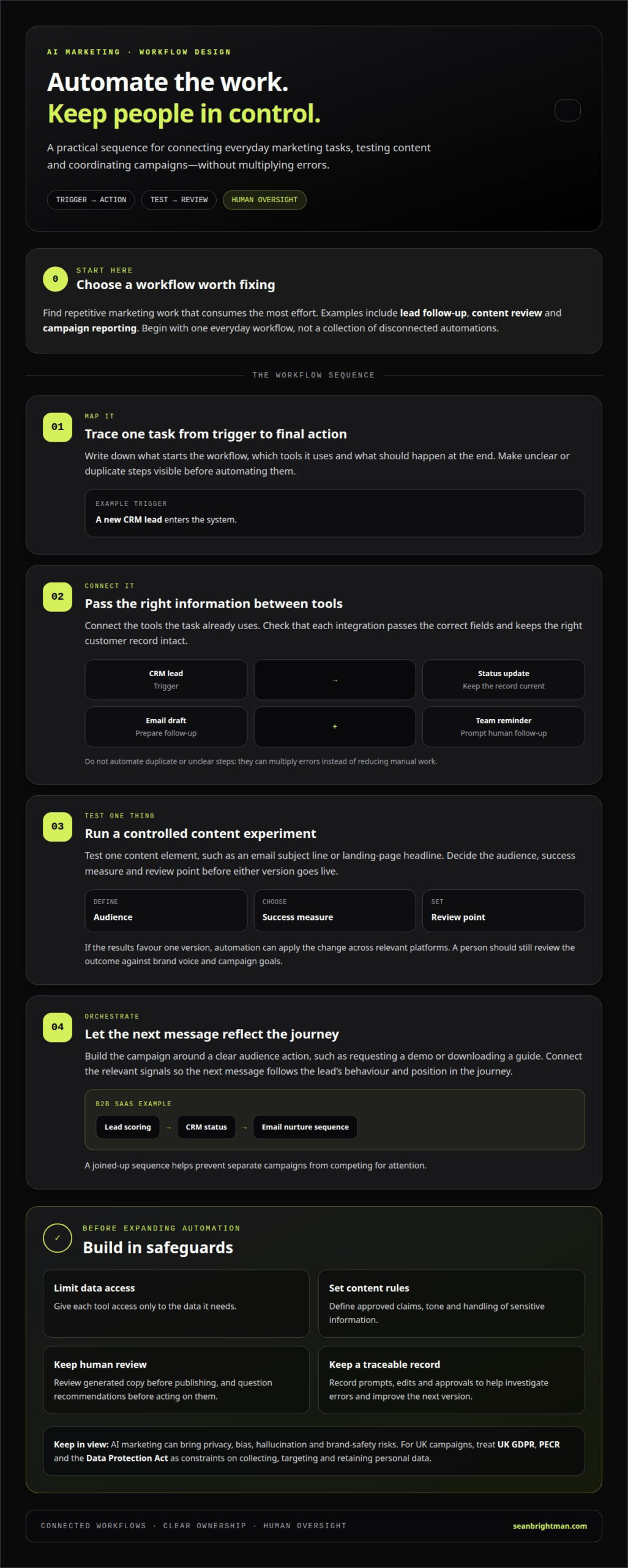
Personalisation without a clear business goal is just more noise. Personalised marketing at scale with AI uses customer data and context to shape relevant messages, content and recommendations for different people, without creating every interaction by hand.
The promise is compelling, but relevance alone isn’t a strategy. Customers expect experiences that reflect their needs, while businesses need marketing that supports measurable objectives. AI can help connect the two, but only when the data, timing and intended outcome work together.
This article explains how AI personalisation shapes customer experience, how contextual engagement can make interactions more relevant, and which customer data can guide those decisions. It also shows why business objectives need to lead, so personalisation scales with purpose rather than generating activity for its own sake.
Key Takeaways
- Match each message to the customer’s context and preferred channel, while handling personal data responsibly.
- Use relevant interactions to support engagement and loyalty, rather than treating personalisation as a cosmetic change.
- Bring customer information into a coherent profile and use it to make more relevant decisions.
- Set a clear business objective first, then shape personalisation around the outcome you want to improve.
1. Multimodal, contextual and privacy-first engagement
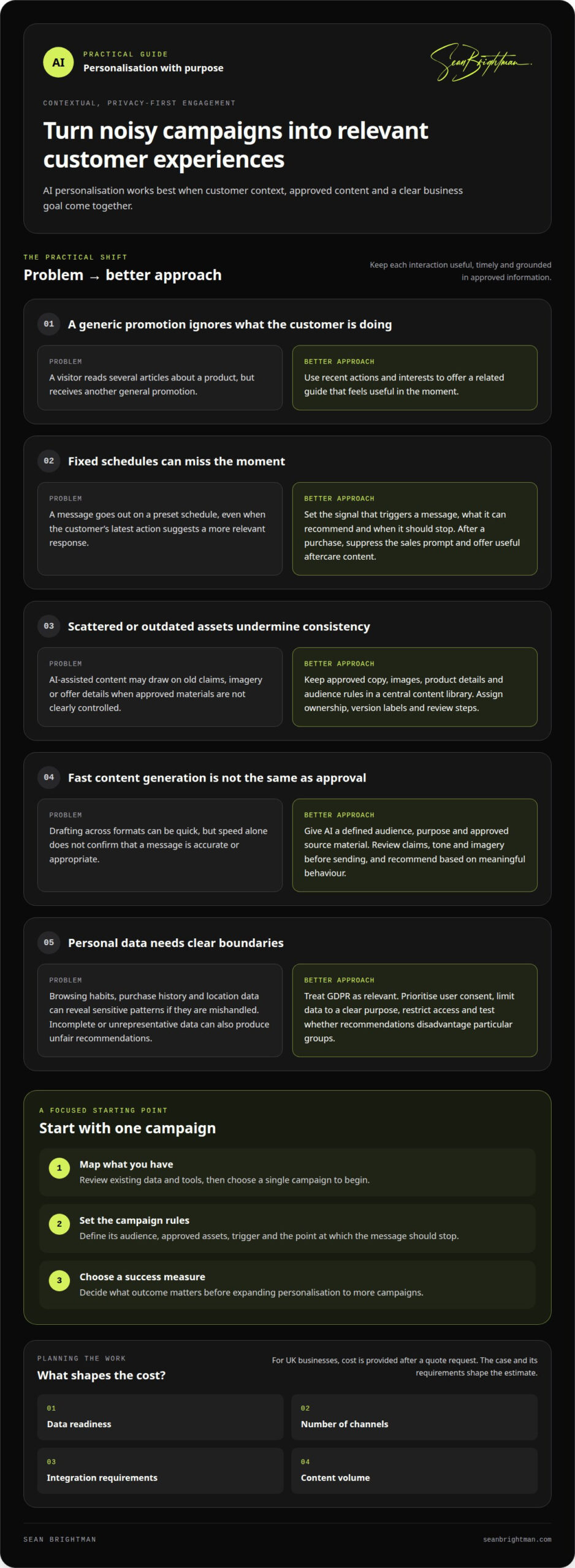
AI can adapt emails, website content and recommendations to a customer’s interests and recent actions. For example, a visitor who reads several articles about a product could receive a related guide instead of another general promotion. This helps campaigns deliver content that feels useful in the moment.
Start with a centralised content library. Keep approved copy, images, product details and audience rules in one controlled source. Assign ownership, version labels and review steps so AI-assisted content uses current assets, not outdated claims. A campaign promoting an offer, for example, should use only that offer’s approved wording and imagery.
Context also affects timing. An email triggered by a recent customer action may be more relevant than one sent on a fixed schedule. Set rules for the signal that triggers a message, the content it can recommend and when it should stop. If someone has already bought the featured item, suppress the purchase prompt and offer useful aftercare content instead.
AI can draft and adapt campaign content across formats, but speed isn’t approval. Give it a defined audience, purpose and approved source material, then review claims, tone and imagery before sending. Recommendations should reflect meaningful behaviour, rather than showing every visitor the most popular item.
Privacy and bias need controls. Browsing habits, purchase history and location data can reveal sensitive patterns if mishandled. Treat GDPR as a relevant regulation, prioritise user consent, limit data use to a clear purpose and restrict access. Test whether incomplete or unrepresentative data leads to unfair recommendations for particular groups.
For UK businesses, the cost depends on the case and is given after a quote request; key factors include data readiness, channel count, integration and content volume. These same factors shape the practical starting point: map existing data and tools, choose one campaign, and define its audience, approved assets and success measure before expanding.
2. How does AI personalisation impact the customer experience?
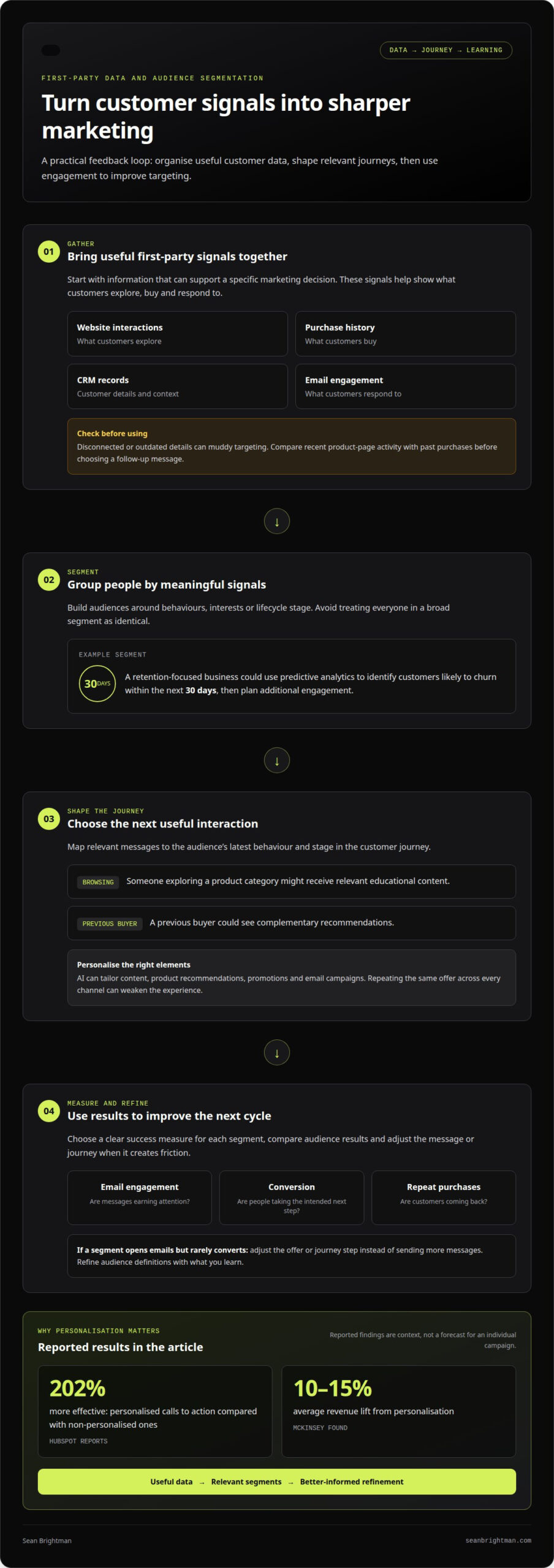
Useful personalisation reduces friction across the customer journey. A platform can group consumers by behaviour and demographics, then tailor recommendations to their interests. For example, repeated product-page visits and a saved item may signal stronger intent than a single advert click. These signals can help shape more relevant messages across email, web and other channels.
Timing matters too. AI can predict likely next actions from patterns such as repeat visits, purchases or declining engagement. A churn score can flag customers whose activity has dropped, prompting a relevant service message instead of another blanket offer. Define what action each score triggers, then review whether the message helps customers continue their journey.
The gains can reach loyalty and revenue. In market findings, 76% of consumers get frustrated when organisations fail to personalise interactions, while 56% become repeat buyers after a personalised experience. McKinsey research says fast-growing organisations gain 40% more revenue from hyper-personalisation than slower-growing competitors. These figures show why relevance matters, but not every message will produce the same result.
UK examples show how the approach works in practice. British retailer HMV saw a 14% week-over-week campaign revenue lift after using agentic AI to personalise ad targeting. To measure effectiveness, compare a personalised campaign with a suitable control group. Track conversion, repeat purchases, revenue per customer and retention, alongside the campaign’s costs.
Read the results across the full journey, not just the first click. A recommendation may earn attention but fail to support a purchase or repeat visit. Separate outcomes by segment and channel, then use the findings to refine targeting and timing. A clear AI strategy can help connect those measures to the business outcomes that matter.
3. Unified profiles using first-party and zero-party data
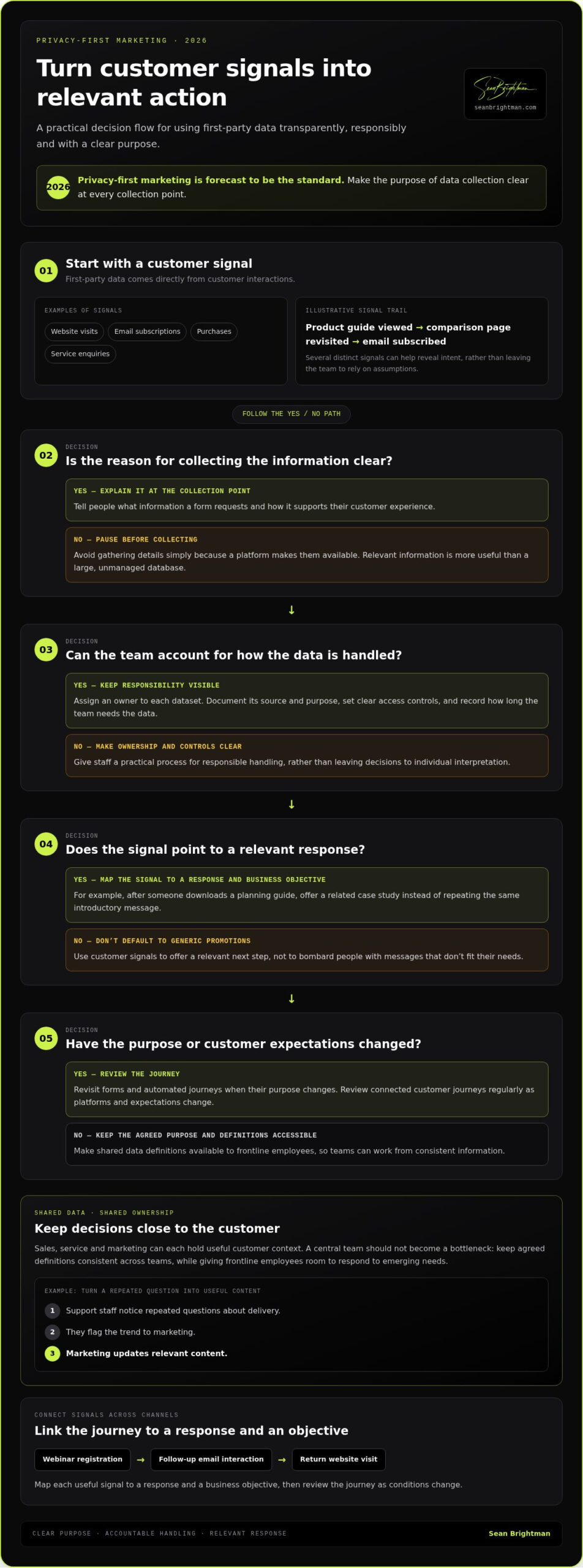
A useful customer profile brings together relevant interactions rather than treating each channel as a separate person. First-party data comes from a business’s own interactions, such as purchases, email clicks and website visits. Zero-party data is information customers deliberately share, such as preferred product categories or communication preferences.
Connect these signals to a consistent profile using reliable identifiers and clear data definitions. For example, a customer who selects “vegetarian recipes” in a preference centre and later browses a recipe page can receive relevant recommendations. Link activity across devices and channels only when the data supports an accurate match.
For UK marketing, UK GDPR and PECR are relevant frameworks when using personal data and electronic communications. Build privacy and consent into the strategy: record data sources and permissions, explain how information supports personalisation, and provide clear ways to manage marketing preferences.
Data governance keeps profiles useful. Set rules for access, accuracy, retention and correction, then assign responsibility for each data source. A CRM record, email platform and purchase system should use compatible definitions. Otherwise, one system may mark a customer as active while another treats them as inactive.
To implement AI personalisation, begin with a defined objective, such as improving product recommendations. Map available first-party and zero-party data, identify gaps, and connect only relevant systems. Then create audience rules, test a small campaign and use response data to improve email subject lines, content and timing.
- Prepare: document data sources, permissions and profile fields.
- Connect: align CRM, purchase and email records around consistent identifiers.
- Test: compare dynamic messages with a standard version, tracking clicks and purchases.
Integrated data can also guide language and tone. If a customer selects a preferred language or asks for concise updates, use that stated preference in future messages. Keep automated changes within approved brand guidelines, and review campaign performance before expanding to more audiences.
4. Aligning personalisation with business objectives
Start with the business result, not the automation. Choose a target, such as increasing repeat purchase, improving retention or reducing abandoned orders. Then decide how a personalised interaction could influence it. If loyalty is the goal, for example, prioritise useful post-purchase content over messages designed only to win an immediate click.
Connect each campaign to a measure that reflects its objective. For repeat purchase, track returning customers and purchases after exposure. For retention, monitor whether customers continue engaging or buying. Click-through rate can show whether a message attracted attention, but it cannot prove that the customer experience or commercial outcome improved.
Market findings report that organisations using AI personalisation typically achieve 5–8x return on marketing spend. Treat that as a reported benchmark, not a forecast for an individual campaign. Calculate your own return by comparing incremental outcomes against the full campaign costs, including data, technology, content and implementation.
Check your capabilities before expanding. A business with fragmented customer records may struggle to connect a message with a later purchase. A team without clear approval rules may scale errors along with relevant content. Map the data, channels, systems and decision-makers needed for one campaign, then address the biggest constraint first.
Automation should support a defined customer experience. For example, a replenishment message can encourage repeat purchase when buying patterns suggest a customer may need the product again. Set rules for eligibility, exclusions and stopping messages after purchase. Review results by audience and channel, then refine the logic before widening the campaign.
Use a simple decision sequence: set the commercial objective, choose the customer action, select the relevant data, and assign a success measure. This keeps personalisation focused on business value rather than activity for its own sake. If that strategy needs structure, build a business-led AI roadmap around the objective, required capabilities and measures.
Sean Brightman
Sean Brightman helps businesses connect AI personalisation with clear commercial objectives. If your campaigns generate activity but aren’t improving customer experience, purchase or loyalty measures, AI Consulting can help bring the decisions, data and priorities into focus.
Use Roadmapping to create a practical path from your current capabilities to a focused programme of work. An Advisory Retainer provides ongoing guidance as priorities develop and new decisions arise. The aim is to connect customer context with business outcomes, not add automation for its own sake.
Bring Sean Brightman the challenge you’re working through, whether you need to choose a starting point or align personalisation with business goals. Contact Sean Brightman to discuss the next step.
Turn your personalisation strategy into action
The next move is to turn personalised marketing at scale with AI into a focused business decision. Choose the customer experience or commercial outcome that needs attention, then decide what must change in your data, processes or team to support it. A clear priority gives experimentation direction and keeps new technology in service of the business.
Sean Brightman can help set that direction through Fractional CMO support, AI Consulting and Roadmapping. These services suit businesses seeking strategic leadership, clearer AI decisions or a practical route from ambition to implementation. The right starting point depends on the challenge you need to solve.
Bring your current priorities and the decisions holding progress back. Start a conversation about your marketing goals and explore a practical way forward. You don’t need every answer before taking the next step; a focused conversation can help clarify where to begin.
Frequently Asked Questions
What Is AI Personalisation?
AI personalisation uses software to select or adapt marketing content based on information about an individual or audience. For example, a streaming service might use a viewer’s saved genres to shape programme suggestions. The system can help decide which message or recommendation to show, while marketers set its purpose, brand rules and boundaries.
How does AI personalisation impact the customer experience?
AI personalisation can make an interaction more useful by reflecting what a customer has chosen or done. For example, someone who has updated delivery preferences shouldn’t have to repeat them in every relevant message. The practical test is whether an interaction removes a real obstacle or meets a need, rather than simply inserting someone’s name into generic copy.
What is AI-powered personalised marketing at scale?
Personalised marketing at scale with AI uses automated systems to adapt marketing for different customers without manually creating every variation. A retailer could tailor product guidance to different audiences while keeping the central offer consistent. Scale comes from applying clear rules across many interactions; it doesn’t mean everyone receives a completely unique campaign or that automation runs without oversight.
How does AI personalise marketing across email, websites, apps and advertising?
AI can use permitted customer signals to adapt content or recommendations across channels. Someone who saves an item in an app might later see related guidance on the website, while an email could focus on product care. Consistent identity and campaign rules help prevent disconnected messages; teams should also stop repeated prompts after a customer has acted.
What are the best AI tools for personalised marketing, and how do they compare on price?
The right tool depends on the task: some focus on customer data, others on content, recommendations or campaign automation. Compare how each fits your existing systems, supports your channels, handles data controls and reports outcomes. Usage, users and integrations can affect costs, so consider the full operating requirements, not just the headline subscription figure.