
A full-time hire may seem like the obvious choice, but it can be the wrong one. The pros and cons of an outsourced marketing director come down to the leadership your business needs: choose outsourced support for senior strategy and direction without a full-time hire; choose in-house when daily access, deep brand knowledge and hands-on control matter most. Either way, keep customer relationships and strategic ownership close to the business.
That trade-off is easy to blur. An outsourced director can set strategy and budget, take ownership of agreed outcomes and coordinate other providers, but won’t be there for every day-to-day decision. An in-house hire offers closer involvement, although one person may not have every specialist skill your campaigns need.
This comparison explains how the two models differ in responsibilities, reporting, accountability and campaign flexibility, and when a hybrid setup makes sense. Use it to assess your current capabilities and goals, then choose the leadership model that gives marketing clear ownership without adding unnecessary complexity.
Key Takeaways
- Choose leadership based on the work that needs ownership: strategic direction, day-to-day execution or both.
- Set clear reporting rhythms and success measures so progress stays visible, whether leadership is internal or external.
- Build flexibility into campaign plans, with clear decision-making and turnaround expectations when priorities shift.
- Use the decision guide to match your marketing model to your team’s capabilities, goals and need for direct control.
Reporting, data access, and accountability
The benefits of an outsourced marketing director include senior strategic direction and access to specialist skills without building every capability in-house. An agency can bring expertise in areas such as SEO, analytics and digital marketing, while your business retains its customer relationships and core decisions.
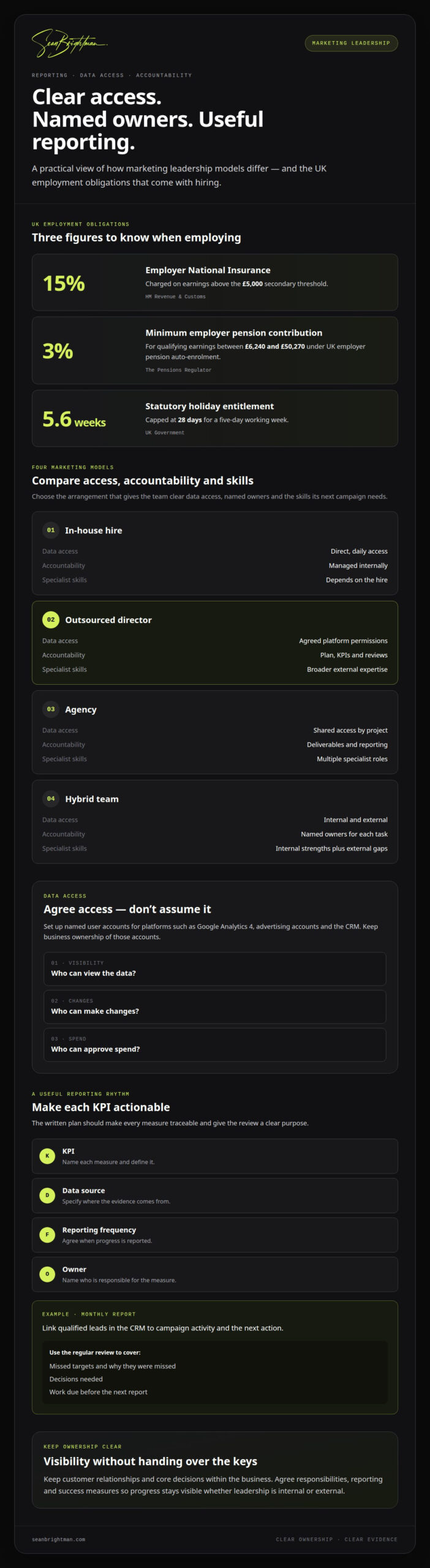
Access must be agreed, not assumed. Set up named user accounts for platforms such as Google Analytics 4, your advertising accounts and CRM. Keep business ownership of those accounts, and define which people can view data, make changes and approve spend. That gives your house team visibility without handing over the keys.
Make reporting useful for decisions. Agree a short written plan that names each KPI, its data source, reporting frequency and owner. For example, a monthly report could link qualified leads in the CRM to campaign activity and the next action. Use a regular review to explain missed targets, decisions needed and work due before the next report.
Employment also carries specific UK obligations. HM Revenue & Customs states that employer National Insurance is charged at 15% on earnings above the £5,000 secondary threshold. The Pensions Regulator states that UK employer pension auto-enrolment requires a minimum 3% employer contribution on qualifying earnings between £6,240 and £50,270. According to the UK Government, statutory holiday entitlement is 5.6 weeks, capped at 28 days for a five-day working week.
| Option | Data access | Accountability | Specialist skills |
|---|---|---|---|
| In-house hire | Direct, daily access | Managed internally | Depends on the hire |
| Outsourced director | Agreed platform permissions | Plan, KPIs and reviews | Broader external expertise |
| Agency | Shared access by project | Deliverables and reporting | Multiple specialist roles |
| Hybrid team | Internal and external | Named owners for each task | Internal strengths plus external gaps |
Choose the model that gives your team clear data access, named owners and the skills its next campaign actually needs.
Flexibility and ability to pivot campaigns
Outsourced support can flex with changing priorities, whilst an in-house team offers direct, day-to-day capacity. The trade-off is speed of access versus control over available time.
Campaign flexibility
An outsourced director can redirect campaigns when business priorities shift, then coordinate specialist work through an agency. For example, changing demand might lead a business to revise its digital campaign focus. The advantage is access to skills beyond one marketer’s remit; the constraint is that external teams divide their time across clients, which can slow delivery.
Marketing scalability
Outsourcing lets a business match marketing support to its needs and budget instead of hiring a full-time team before demand is steady. A business in an early, volatile stage can bring in external support for a defined campaign, then adjust the scope as priorities change. An in-house team offers more consistent daily availability, but scaling it means changing internal capacity.
In-house marketing teams can move quickly because colleagues work closely together. Yet urgent client requests or short-term tasks can push long-term campaigns down the list. An external partner can add capacity, but the agency’s schedule still affects turnaround. Agree which decisions need immediate action and which can wait for the next planning review.
A hybrid model combines a small in-house team with an external consultant for complex campaigns. Internal staff can manage customer insight and brand decisions, for example, while external specialists support a technical digital launch. A consultant can also help set priorities while the business builds its internal capability. Outsourcing and hiring do not have to be an all-or-nothing choice.
To choose, map the campaigns you need, the skills available in-house and how quickly each task must move. If the gap is strategic direction, set a clear marketing roadmap before expanding delivery capacity.
Accountability, KPIs and reporting
Strong accountability starts with shared ownership, not a supplier working in isolation. An external marketing partner brings delivery expertise; internal leaders retain decisions about priorities, customer relationships and brand direction. Treat the arrangement as a working partnership, with clear responsibilities and regular discussion of what results mean for the business.
Choose KPIs that connect marketing activity to a business outcome. A social media engagement measure can show whether content prompts interaction, for example, but it doesn’t prove that engagement creates sales. Pair it with a relevant next-stage measure, such as enquiries recorded in the CRM. Agree how each measure is defined, where its data comes from and who explains changes.
A practical way to assess the pros and cons of an outsourced marketing director is to see whether reporting leads to better decisions. A dashboard can show performance, while written commentary explains what changed, why it matters and what the team proposes next. If LinkedIn engagement rises but qualified enquiries stay flat, the external partner should explain the gap and recommend a test. You should be able to see the underlying data, not just a polished summary.
Set the working rules before activity begins. Record the following in the marketing plan:
- Ownership: name the internal decision-maker, external delivery lead and approver for campaign changes.
- Evidence: define the data source for each KPI, including CRM records for leads and platform analytics for social media.
- Response: agree how the team escalates a missed target, reports a tracking issue and records the action taken.
The pros and cons of an outsourced marketing director become clearer when review meetings lead to decisions, not just dashboard readings. The partner presents evidence and options; internal leaders provide context such as sales feedback, product changes or customer objections. Record agreed actions, owners and deadlines in the same plan. This links campaign activity to business decisions and helps the team identify whether weak performance reflects execution, measurement or changing customer behaviour.
Outsourced marketing director responsibilities
An outsourced marketing director sets marketing strategy and budget, takes ownership of agreed outcomes and manages other providers. They turn business goals into priorities, then coordinate specialists such as designers, writers or SEO professionals. For example, a launch plan might connect the audience, message, channels, budget and delivery dates.
The director should align that plan with senior leaders, who retain responsibility for the business’s overall strategy and customer relationships. They can brief the in-house marketing team, clarify decision rights and identify where training or development could strengthen internal capability. This is leadership and coordination, not simply a list of campaign tasks.
The main risks are less day-to-day access, reduced direct control over execution and a learning curve while an external director gets to know the brand. Providers may also divide their attention across clients, delaying decisions or delivery. Mitigate those risks with agreed availability, clear approval limits and documented handovers for active campaigns.
UK businesses may benefit when marketing complexity or spending is growing, but a full-time senior leader isn’t yet the right fit. Smaller firms with gaps in strategic or specialist skills can gain direction without building every role in-house. Businesses that need constant on-site leadership and immediate daily decisions may prefer an internal hire.
A contract should define the work, decision-making authority, reporting expectations, data access, confidentiality, fees and exit arrangements. It should also distinguish strategic leadership from campaign execution, so neither party assumes the director will personally deliver every task.
- Scope: name strategy, budget planning, provider management and any excluded delivery work.
- Measures: specify agreed outcomes, data sources, reporting frequency and review meetings.
- Authority: state who approves spend, campaign changes and external supplier work.
- Working terms: record availability, information access, confidentiality and how either party ends the arrangement.
Keep final business decisions with your leadership team, and give the director clear ownership of agreed marketing actions.
Sean Brightman: AI Consulting
Sean Brightman’s AI Consulting can help you assess where practical AI systems fit into marketing work and decision-making. It’s a relevant next step if your team sees potential uses but needs a clearer route from ideas to practical priorities.
For broader marketing direction, Roadmapping can organise goals, priorities and next steps. An Advisory Retainer provides ongoing strategic input as plans develop. Each option meets a different need: AI-focused advice, a structured roadmap or continuing guidance.
If choosing between outsourced and in-house leadership has revealed a gap in strategy or direction, contact Sean Brightman to discuss what would help your business move forward.
Choose the leadership model that moves you forward
The right choice is the one your business can support and act on. Before committing, define which decisions marketing leadership should own, what your internal team can deliver and where outside expertise would make a difference. That turns the pros and cons of an outsourced marketing director into a practical decision, not an abstract debate.
Sean Brightman offers Fractional CMO support for senior marketing direction, alongside AI Consulting and Roadmapping. Each can address a different strategic need, from clarifying leadership priorities to shaping a plan for what comes next.
You don’t need to solve every marketing challenge at once. Start with the gap holding back progress, then choose a model that gives it clear ownership and momentum.
Contact Sean Brightman to discuss your options and take the next step with confidence.
Frequently Asked Questions
Which should you choose?
Choose in-house leadership if marketing needs constant daily attention and close collaboration across departments. Choose outsourced direction if you need senior judgement but not a full-time director embedded in the business. A hybrid model can suit teams with strong internal delivery but a strategic gap. Start with the work that currently stalls, then match the leadership model to that bottleneck.
What does an outsourced marketing director do?
An outsourced marketing director turns business priorities into a marketing plan and aligns people around it. They might clarify the audience for a new service, shape its positioning, then coordinate the internal team and external specialists responsible for delivery. Their role is to steer priorities and decisions, not automatically create every asset or manage every customer interaction.
How does an outsourced marketing director compare with a full-time marketing director?
A full-time director works within the business every working day, building close familiarity with its people, products and routines. An outsourced director provides senior input on a part-time basis, which can suit a business that needs strategic direction without a permanent leadership role. The deciding factor is how much daily presence the organisation needs, not which title sounds more senior.
How does an outsourced marketing director compare with a marketing agency or consultant?
An outsourced director leads the marketing function and connects strategic choices with delivery across internal teams and suppliers. A marketing agency typically delivers agreed specialist work, such as web development or social media campaigns. A consultant may advise on a defined challenge without coordinating the wider function. For example, a director can set priorities before an agency produces campaign assets.
How can a business assess and choose an outsourced marketing director?
Start with a current business challenge, such as weak positioning or disconnected campaign activity. Assess whether the director can explain the decisions they would make, the information they need and how they would involve your team. Review relevant past work and discuss how they handle disagreement or changing priorities. A strong fit brings clear thinking and practical direction, not a generic presentation.
How can businesses measure the performance and ROI of an outsourced marketing director?
Connect agreed marketing objectives to commercial evidence. For example, track qualified opportunities from the CRM through to sales, then compare attributable revenue with marketing investment over the same reporting period. Also assess progress against strategic milestones, such as launching a new proposition or improving lead quality. Distinguish the director’s contribution from wider factors, including sales follow-up and changes in demand.