
Understanding how AI will change marketing leadership starts with a simple point: AI won’t make marketing leadership less human. It will make weak leadership harder to hide.
The question is no longer whether AI belongs in marketing. It’s how it changes the job, shifting leaders from overseeing campaigns to designing growth systems that connect data, people and automation to business priorities.
Marketing teams already feel the pressure to prove results, move faster and adopt new tools without letting automation erode judgement, creativity or customer trust. More tools won’t solve that problem. Clear ownership will.
This article explains how the leadership mandate is changing, which decisions still need human judgement, and how to prepare teams and systems for responsible, measurable adoption. You’ll see where AI can support execution, where leaders must set direction and guardrails, and why a strong operating plan starts with business priorities, not technology.
For marketing leaders, the task isn’t to chase every new capability. It’s to build a system where AI sharpens the work and accountability stays human.
Key Takeaways
- See how AI will change marketing leadership, shifting leaders towards designing accountable systems tied to business value.
- Connect AI initiatives to business priorities, clear ownership and the capabilities your team needs.
- Use risk, data quality, reversibility and human review to decide which marketing tasks are suitable for automation.
- Start with a defined business problem, then diagnose the work, choose a use case, set guardrails and review the evidence.
- Build the judgement and oversight needed to make AI useful without handing strategic responsibility to the technology.
How AI will change marketing leadership: from campaigns to business value
More AI capability doesn’t automatically produce better marketing. A team can analyse data faster, draft more content and automate routine tasks, yet still focus on the wrong audience or business priority. That’s the leadership tension behind how AI will change marketing leadership: the challenge isn’t simply adding technology, but ensuring the work contributes to outcomes the organisation values.
AI use means applying tools to existing tasks; AI-led operating change means redesigning how insight, decisions and execution connect, with clear ownership and measures of business value.
That distinction changes the remit. An AI-enabled marketing leader sets direction, assigns responsibility and decides how to assess whether the work supports commercial priorities. Rather than supervising campaign output in isolation, they build a connected, accountable growth system. Customer insight informs choices; teams or automated workflows act on those choices; results inform what happens next. The leader remains accountable for the direction of travel.
AI can support different parts of marketing, from analysing information to generating content. The Artificial Intelligence in Marketing overview describes a range of these applications. But a list of possible uses isn’t an operating plan. Leaders need to decide where a capability belongs in the organisation’s decision-making and how its contribution will be assessed.
What changes when AI enters the marketing function?
Analysis and production can move faster, changing the workflow without proving strategic impact. Leaders still need to connect customer insight to commercial priorities, then decide what action should follow. For example, an illustrative retailer might use AI to summarise customer feedback. A leader must then judge whether the insight supports a change in messaging, channel focus or the offer itself. The tool surfaces information; human judgement sets its direction and use.
Why more AI tools do not automatically create better leadership
Tool access is only one part of the operating model. Teams also need suitable data, clear ownership of outputs and agreed decision rights: who can act on a recommendation, who reviews it and who is answerable for the result. Without those arrangements, separate experiments can create more activity without answering the central question: which business priority should marketing address first?
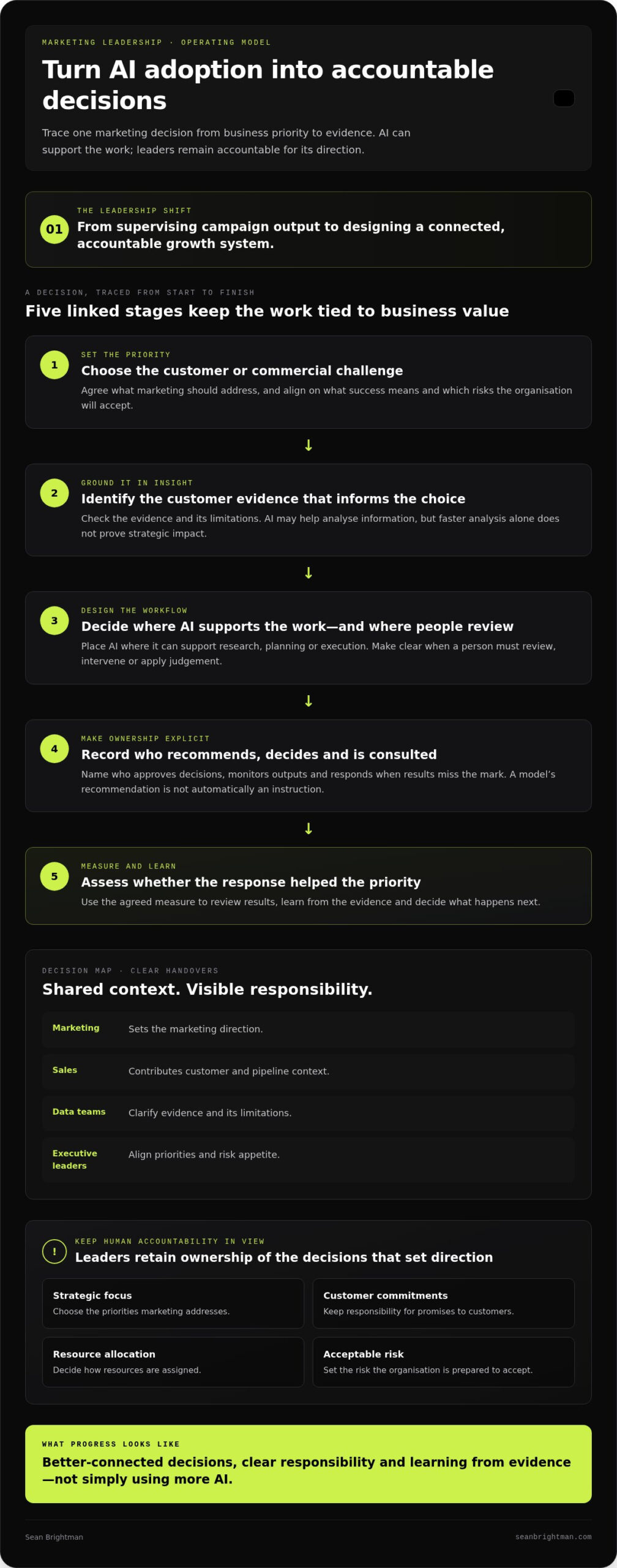
Make the shift concrete by tracing one decision from start to finish. Identify the business priority, the customer insight that informs it, the person responsible for choosing a response and the measure that will show whether the response helped. Then examine where AI can support that chain and where human review must remain. This turns adoption into an accountable management choice, not a race to accumulate tools.
Progress isn’t measured by how much AI a team uses. It’s measured by whether the organisation can make better-connected marketing decisions, act with clear responsibility and learn from the evidence.
The marketing leader’s new mandate: connect AI to decisions and growth
AI changes the marketing leader’s remit from approving activity to setting the conditions for sound decisions. That means translating business priorities into workflows, assigning responsibility for each step and building the skills people need to use AI well. The work is practical: decide what matters, determine where AI can help and make sure the team can explain its choices.
The marketing leader owns the direction, accountability and measurement of AI-enabled marketing, even when a system contributes to the work.
That mandate has four connected parts:
- Business priorities: Choose the customer or commercial challenge marketing should address.
- Workflow design: Decide where AI supports research, planning or execution, and where people need to review or intervene.
- Accountability: Name who approves decisions, monitors outputs and acts when results miss the mark.
- Capability building: Equip the team to question AI-generated recommendations, interpret evidence and apply sound judgement.
These choices can’t sit inside marketing alone. The wider leadership team needs shared definitions of value and risk. If executives expect growth while marketing measures output, the plan is already misaligned. Agree what success means, which risks the organisation will accept and who owns decisions across functions before a workflow becomes business as usual.
Which decisions should marketing leaders own?
AI can produce recommendations, but it can’t take responsibility for the organisation’s priorities or promises. Marketing leaders should retain ownership of strategic focus, customer commitments, resource allocation and acceptable risk. Make that ownership visible with a simple decision map: marketing sets the marketing direction; sales contributes customer and pipeline context; data teams clarify evidence and limitations; executive leaders align priorities and risk appetite.
For each decision, record who recommends, who decides and who must be consulted. This stops a model’s output from quietly becoming an instruction. It also clarifies handovers: teams know when they can act, when they need review and where to raise a concern. Roles will vary between organisations, but responsibility should never be left implicit.
How should leaders measure progress beyond output?
Faster production and higher content volume describe activity, not necessarily value. Before changing a workflow, agree a baseline and the outcome the experiment is meant to influence. Depending on the business goal, that might mean examining customer response, qualified demand, conversion quality or what the team learns about a particular audience. There’s no universal benchmark; choose measures that reflect the organisation’s priorities.
Review the evidence as a chain, not as a single headline number. Did the workflow change the decision? Did the decision improve the intended customer or commercial outcome? What did the team learn, and what needs adjusting? Keep measures proportionate and decide how results will be reviewed before the work starts. This gives marketing and executives a shared basis for deciding whether to continue, change or stop an AI-supported approach.
Leaders shaping this mandate can use strategic marketing and AI guidance to turn priorities into a practical roadmap.
AI and human judgement: what to automate in marketing
Marketing leaders don’t have to choose between automating everything and resisting automation altogether. The useful question is narrower: which parts of the work can AI support without losing the context, care and accountability behind a good decision? That distinction is central to how AI will change marketing leadership. AI may speed up a task, but speed alone doesn’t make the task safe or the result sound.
AI can generate recommendations; a named human must own the marketing decision and its consequences.
Assess a task against four practical factors before automating it:
- Risk: Could an error mislead customers, damage trust or create a serious business consequence?
- Data quality: Is the information relevant, reliable and suitable for the task?
- Reversibility: Can the action be reviewed or undone before lasting harm occurs?
- Human review: Is someone able to check the output with enough expertise and context?
| Marketing work | AI can assist with | Human responsibility |
|---|---|---|
| Research synthesis | Grouping feedback or summarising material | Checking sources, gaps and audience context |
| Content drafting | Producing a first draft or alternate wording | Setting the message, checking accuracy and shaping brand voice |
| Performance analysis | Surfacing patterns or possible explanations | Testing whether the interpretation fits the commercial context |
Where can AI support marketing work?
Research synthesis, first-draft content and analysis can be useful support tasks when the organisation has suitable information, tools and a workable review process. Treat the output as material to assess, not finished work. Check facts and sources, audience fit, brand voice and missing context. For example, an AI-generated summary of customer comments may help a team spot themes, but people should check that the summary reflects the comments fairly before acting on it.
Where must human judgement remain accountable?
People must own positioning, customer promises, ethical trade-offs and high-impact brand decisions. These choices depend on what the organisation stands for, what it can deliver and how customers may interpret its actions. A named owner matters: if an AI-supported decision causes harm, responsibility can’t be passed to the tool. Creativity also means more than producing fresh words. It involves choosing a relevant direction, exercising taste and knowing what may resonate with a particular audience.
That doesn’t make whole roles or disciplines obsolete. It changes how people spend their time and where they apply expertise. Leaders can begin with lower-risk, reversible tasks that have clear review, then adjust oversight as risk rises. Keep a person responsible for approval, and make it possible to pause or correct the process when outputs are inaccurate or out of step with the brand. That’s how AI supports the team without replacing its judgement.
How marketing leaders can prepare for AI: a practical readiness sequence
AI readiness doesn’t start with choosing a tool. It starts with a real business problem and a clear view of how work gets done now. That’s the practical response to how AI will change marketing leadership: turn interest into a controlled learning process, with an owner, a review method and a reason to continue or stop.
Use this sequence to make the first experiment useful, rather than novel for novelty’s sake:
- Diagnose the work. Map a recurring marketing decision or workflow from the initial need to the final action. Note where delays, duplication, uncertainty or avoidable effort appear. Check what evidence is available and where the process carries risk. Don’t assume automation is the answer; the diagnosis may point to a workflow problem that needs clearer roles or better information instead.
- Prioritise one use case. Choose a bounded task linked to a defined business problem. State what the experiment should help the team learn, who owns it and what would count as useful evidence. Keep the scope small enough to review properly. A tool being available is not a reason to use it.
- Set guardrails. Before testing, decide who reviews outputs, what information can be used, how errors or unexpected results will be raised, and who can pause the workflow. Make sure everyone involved understands their responsibilities. Human review should be part of the process, not a last-minute check added after something goes wrong.
- Review the evidence. Compare results with an agreed baseline. Record what changed, what didn’t, and any limitations or unintended effects. Decide whether to adapt, stop or extend the test. Scale only when the evidence supports it and ownership, review and measurement can remain clear.
Start with the work, not the latest AI tool
Map recurring decisions and handovers first. A workflow might involve research, approval and a customer-facing response, with friction at several points. Identify where time or quality suffers, what information teams rely on and who makes each call. Then select one contained opportunity and name an owner. This grounds the experiment in actual work, without assuming automation is necessary or that existing data is suitable.
Build guardrails and learn from evidence
Agree review responsibilities, information-handling expectations and escalation routes before the test begins. Set a baseline and choose measures that reflect the problem, not just the volume or speed of output. Record surprises and limitations alongside results. A useful test can show that a workflow needs changing or that AI isn’t the right fit. Either way, make the decision from evidence, not enthusiasm.
A joined-up plan can help connect an experiment to wider marketing priorities. Explore AI consulting for a more joined-up approach. For strategic support turning priorities into an actionable roadmap, discuss a practical AI roadmap.
The future marketing leader builds the system, not just the campaign
AI changes the system a marketing leader must design, not the need for leadership. Someone still has to decide which customer problems matter, how the organisation responds and whether the work supports its goals. Decisions, data and execution may now move through AI-supported workflows. Leaders need to make those connections deliberate, visible and accountable.
That’s the practical answer to how AI will change marketing leadership: the role calls for commercial judgement, technical curiosity and clear responsibility for human oversight. Leaders don’t need to build every system. They do need enough understanding to ask what it uses, where it may fail, how its output will be checked and who owns the resulting decision.
What capabilities will future marketing leaders need?
Four capabilities matter: commercial judgement to connect activity to business priorities; workflow thinking to understand how decisions pass between people and systems; data literacy to question evidence and its limitations; and clear communication to explain choices across teams. Technical curiosity helps leaders challenge assumptions and spot risks. It doesn’t require them to become engineers or master every new tool.
These capabilities work together. A commercially grounded leader can ask whether an AI-supported process addresses the right problem. Workflow thinking reveals where handovers or approvals need attention. Data literacy helps the team avoid treating a model’s confident output as proof. Clear communication makes responsibilities and expectations understandable to colleagues beyond marketing.
Where the operating design needs deeper treatment, marketing operations and scalable growth systems offer a useful next lens. The focus isn’t technology for its own sake. It’s how the organisation joins up priorities, processes and people so marketing can work coherently.
How can senior leadership support the transition?
Marketing cannot set the full direction in isolation. Senior leaders need to align on the business priorities AI should support, the decisions marketing can make and the risks that require wider oversight. This gives teams a shared reference point when trade-offs arise. A fractional CMO leadership model can bring senior strategic direction to those conversations and help connect marketing choices with wider organisational priorities.
If priorities, ownership or implementation remain fragmented, strategic AI guidance can help bring the moving parts into focus. Responsible experimentation still needs direction, named owners and regular review. Keep those elements in place, and AI can become part of a purposeful marketing system rather than a collection of disconnected tasks.
Explore strategic AI and marketing leadership support to bring greater clarity to your next steps.
Make your next AI decision a deliberate one
The next step isn’t to predict every change AI might bring. Choose one decision or workflow where clearer direction could make a difference, then give someone responsibility for guiding and reviewing it. That’s the practical edge in understanding how AI will change marketing leadership: progress comes from thoughtful choices, not trying to keep pace with every new tool.
If priorities or implementation feel fragmented, senior support can help turn intent into a workable plan. Fractional CMO services provide part-time senior marketing leadership, while AI consulting and roadmapping focus on practical strategy and implementation.
You don’t need a perfect blueprint before you begin. Start with a clear business priority, bring the right people into the decision and learn from the work as it develops. Explore strategic AI and marketing leadership support and take a confident next step.
Frequently Asked Questions
How will AI change the role of a marketing leader?
AI will push marketing leaders to shape how insight becomes action across the organisation, rather than focus mainly on campaign delivery. They’ll need to decide which customer signals deserve attention, how teams respond and where AI fits into that process. For example, if analysis points to a change in customer needs, a leader must help turn that finding into a clear marketing choice, not just circulate a report.
Will AI replace marketing leaders?
No. AI can help with analysis and production, but it can’t own a company’s priorities or answer for its decisions. The leadership challenge is to redesign work so technology supports people rather than obscuring who decides. A marketing leader who can explain why a recommendation fits the strategy, what assumptions it relies on and who approves the next action remains central to guiding change.
What skills will marketing leaders need in 2026?
Marketing leaders will need commercial judgement, data literacy and enough understanding of AI to assess where its outputs may be useful or misleading. They’ll also need to map workflows and explain decisions clearly to colleagues. In practice, that means asking what information shaped a recommendation, what it leaves out and how the team will test it before using it in customer-facing work.
How should a marketing team start using AI?
Start with a specific point of friction, such as the time a team spends sorting recurring customer questions, rather than a general aim to “use AI”. Define what a helpful result would look like and who will assess it. Then test whether the output is accurate and useful in the team’s actual context. Keep notes on errors and limitations so the next decision reflects what the test revealed.
Can AI make marketing more creative?
AI can help a team generate options, but creative leadership is about choosing what deserves to exist. A draft may offer several ways to describe a product, for instance, but a marketer must judge which message is distinctive, credible and right for the intended audience. The tool can widen the starting point; people provide the taste, cultural understanding and strategic direction that make an idea meaningful.
What is the biggest risk of using AI in marketing?
A major risk is allowing a plausible-sounding output to reach customers without enough scrutiny. A generated claim might be inaccurate, overstate what a business can deliver or clash with the brand’s position. Reduce that risk by matching review to the potential impact: check factual claims closely, route sensitive decisions to an appropriate person and keep a record of why important outputs were approved.
How can a CEO prepare the marketing function for AI?
A CEO can give marketing a clear business question to solve and make space for other teams to contribute relevant insight. For example, a discussion involving marketing, sales and data colleagues can clarify whether the priority is improving customer understanding, supporting a launch or addressing a gap in the customer journey. That shared direction helps teams assess AI proposals against organisational needs rather than tool availability.
Does AI mean marketing teams will need fewer people?
Not automatically. The effect on team size depends on which tasks change, what work the organisation chooses to prioritise and what quality standards it needs to maintain. Before making structural decisions, map the work people actually do, including review, coordination and customer understanding. Then assess whether AI changes the workload or shifts effort towards higher-value responsibilities. That gives leaders a stronger basis for planning team capability.