
A strong offer can still stall if nobody agrees who it’s for, why customers should choose it or how it will reach them. A go-to-market strategy consultant UK businesses work with should connect those decisions and give the team a route to follow, not just another launch checklist.
The frustration is familiar: marketing, sales and leadership are all moving, but not necessarily towards the same customer or outcome. The execution gap is real. In a 2026 HBR Analytic Services study, 83% of B2B leaders called go-to-market strategy critical to business success, yet only 38% described their execution as very effective.
You need more than a polished strategy document. You need clear choices your team can act on. This article explains what a go-to-market strategy should connect, how to assess strategic support and how to turn decisions into practical next steps.
We’ll look at how to prioritise customers and market opportunity, align positioning with routes to market, and give teams clear ownership. You’ll also see how Sean Brightman’s Roadmapping turns strategic decisions into a ranked 90-day action plan, and how ongoing CMO support can keep execution on track.
Key Takeaways
- A go-to-market strategy connects the customer, market opportunity, positioning, offer, route to market and team ownership.
- Use customer needs and market context to shape a value proposition people understand, rather than leaving research in a separate document.
- When assessing a go-to-market strategy consultant uk businesses can work with, look for clear decisions, accountable ownership and practical next steps.
- Separate strategic choices from the tasks, channels and campaigns that put them into action.
- Match the support to the job: a focused strategy session, ongoing advice or embedded senior marketing leadership.
What does a UK go-to-market strategy consultant do?
A go-to-market strategy connects an offer to the customers most likely to value it, then sets out how the business will reach, convert and serve them. A consultant helps clarify those choices, test the assumptions behind them and turn the direction into work people own.
That’s broader than choosing a launch date or listing marketing channels. A campaign is an activity. A channel is a route. A go-to-market strategy explains why the business is prioritising particular customers, what it will offer them, how it will stand apart and how the team will deliver the plan.
The links between those decisions matter. If an offer is positioned around speed, for example, the route to market and customer experience need to support that promise. If they don’t, the strategy can expose the mismatch before the business spends time pushing the wrong message through the wrong channel.
Which business problems can go-to-market consulting address?
The symptoms vary. Customer priorities may be unclear, positioning may have become diluted, or marketing and sales may be describing the offer differently. A business can be busy with content, campaigns and sales conversations yet lack a shared route from offer to customer. The first step is to identify whether unclear decisions are holding progress back.
A consultant can surface the assumptions beneath the activity. Which customer group has the strongest need? What problem does the offer solve for them? What evidence supports that choice? The answers help leaders decide what to focus on, what to stop prioritising and where teams need a consistent message.
For a business searching for a go-to-market strategy consultant uk companies can work with, useful support should result in decisions and ownership, not just a deck of recommendations. The aim is a route that’s clear and usable by the people responsible for putting it into practice.
Is a go-to-market strategy only for launching a new product?
No. The same thinking can help when a business introduces a new offer, repositions an existing one or changes how it reaches customers. The work depends on the challenge. A new offer may need clear customer and channel choices; repositioning may call for a sharper value proposition and consistent messaging across the customer journey.
Start with the decision the business needs to make, not a fixed launch checklist. Is the audience changing? Has the offer evolved? Is the current route failing to connect with intended customers? Those questions help define the work and keep it focused. For a deeper look at aligning brand direction with growth priorities, explore this strategic brand roadmapping guide.
Whatever the trigger, the consultant’s job is to connect strategic choices to practical ownership. That means making clear what the business is choosing, why it’s choosing it and what the team needs to do next. Not more activity for its own sake, but a route people can follow.
The go-to-market decisions that must work together
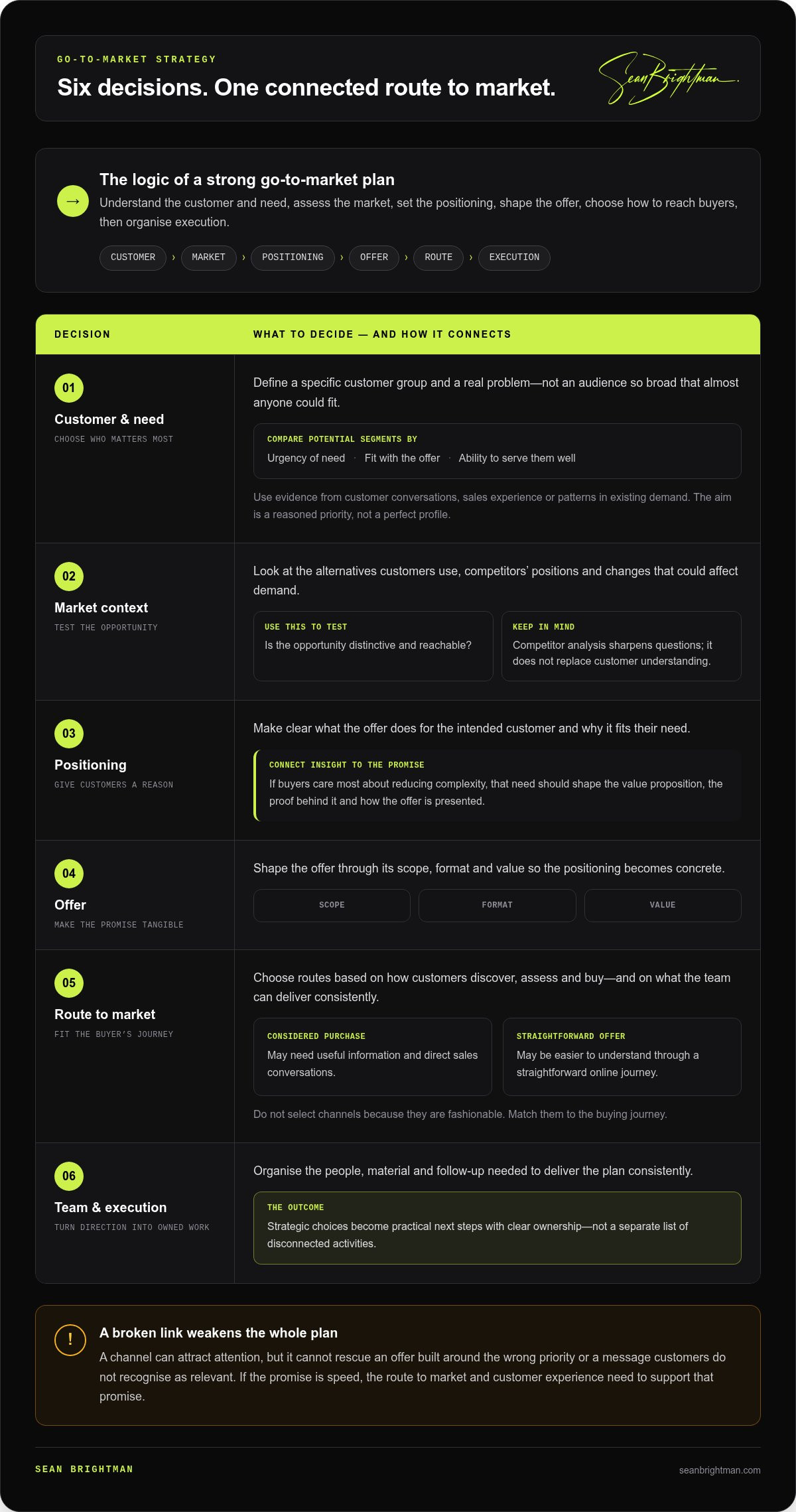
Go-to-market planning isn’t a pile of separate choices. Each decision should sharpen the next: understand the customer and their need, assess the market, set the positioning, shape the offer, choose how to reach buyers, then organise execution.
A go-to-market strategy works when every choice reinforces the next, from the customer’s need to the team’s delivery. If one link breaks, the rest lose force. A channel can attract attention, but it won’t rescue an offer built around the wrong priority or a message customers don’t recognise as relevant.
How should a business define its target customer and market?
Start with a specific customer group and a real problem, not an audience so broad that almost anyone could fit. Compare potential segments by the urgency of their need, their fit with the offer and the business’s ability to serve them well. Evidence might come from customer conversations, sales experience or patterns in existing demand. The aim is a reasoned priority, not a perfect profile.
Then add market context. Look at the alternatives customers use, competitors’ positions and changes that could affect demand. This helps test whether the opportunity is distinctive and reachable. Competitor analysis can’t tell you what customers value in your offer, though. Use it to sharpen questions, not replace customer understanding.
Customer insight should shape the value proposition itself. If buyers care most about reducing complexity, that need should influence the promise, the proof that supports it and the way the offer is presented. Research belongs in the decision, not in a separate document that nobody uses.
How do positioning, offer and channels connect?
Positioning gives the intended customer a clear reason to pay attention: what the offer does for them and why it fits their need. The offer makes that promise concrete through its scope, format and value. If the positioning promises simplicity but the buying process feels complicated, the experience contradicts the message.
Choose routes to market by looking at how customers discover, assess and buy, alongside what your team can deliver consistently. A considered purchase may need useful information and direct sales conversations; another offer may be easier to understand through a straightforward online journey. Don’t select channels because they’re fashionable. Match them to the buying journey, then make sure the right people, material and follow-up are in place.
For a go-to-market strategy consultant uk businesses engage, the test is whether these choices form one usable system, rather than disconnected recommendations. The marketing operations growth-engine guide explores how execution systems support that joined-up direction.
When customer insight, positioning and delivery need to be aligned, Sean Brightman’s strategic support can help turn those choices into a practical direction for the team.
How to assess a UK go-to-market strategy consultant
Start with the gap, not the job title. Do you need a focused set of strategic decisions, a sounding board to keep priorities on track, or senior marketing leadership working alongside your team? The right support depends on what’s missing. A go-to-market strategy consultant uk businesses engage should make the work, decisions and ownership clear before activity begins.
What should a useful GTM strategy deliver?
Look for a clear customer focus, positioning choices, route-to-market logic and a short list of priorities. Recommendations should help leadership decide where to focus and give marketing and sales a direction they can act on. A long document isn’t proof of quality. Neither is a channel inventory. Ask whether the work explains why a choice makes sense and what the team should do with it.
Useful support also makes ownership visible. Who will lead each priority? What needs a decision from leadership, and what can the team execute? A strategy that stops at recommendations leaves the hard work of translation to your people. The output should connect direction to practical next steps, while making clear who is responsible for carrying them out.
Consultant, agency or internal team: which role fits the gap?
A consultant brings strategic direction and helps resolve questions of alignment, positioning and priority. An agency service is generally focused on delivering agreed marketing activity; an internal team carries out work within the business. These roles can complement one another, but they solve different problems. More campaign activity won’t fix a leadership gap or a lack of agreement about who the business needs to reach.
Use this simple comparison to identify the type of support that fits your current need:
| Business need | Type of support | Typical output | Involvement |
|---|---|---|---|
| Decisions are unclear, but the team can execute once aligned | Defined strategy session | Priorities and an actionable direction | Focused, one-off input |
| The team needs regular challenge and accountability | Ongoing advice | Reviewed priorities and continued guidance | Regular strategic involvement |
| Leadership, team direction and marketing activity need to work together | Embedded senior marketing leadership | Strategy connected to team direction and execution | Ongoing involvement within the business |
Match the scope to the real bottleneck. If the team knows what to do but lacks capacity, strategic advice alone won’t provide that capacity. If people are active but pulling in different directions, adding more production may simply create more disconnected activity. A distinct Fractional CMO strategy guide explains how ongoing senior marketing leadership differs from a defined strategy engagement.
Sean Brightman’s Roadmapping provides a focused strategy session with a 90-day action roadmap and priorities ranked by impact. For teams that need continuing direction and accountability, Sean Brightman’s strategic support provides ongoing strategic involvement.
Turn go-to-market strategy into a practical, accountable plan
A strategy only earns its keep when it changes what the business decides and does. Turn the direction into a plan that separates the choices to make from the work that follows, then give each priority a clear owner. Otherwise, even a sharp strategy can dissolve into a list of activity nobody is responsible for delivering.
Use this sequence to move from the commercial problem to coordinated action:
- Agree the commercial problem. State what needs to change, such as reaching a more suitable customer group or making the value of an offer clearer. Keep the problem specific enough to guide decisions.
- Prioritise customers. Choose which group to focus on using evidence about their needs, fit with the offer and your ability to serve them. Record the assumptions behind that choice.
- Sharpen the offer. Make clear what you’re offering, what customer need it addresses and why it’s relevant to the chosen group.
- Choose the route. Select routes to market that fit how those customers find, assess and buy, as well as the team’s ability to deliver the experience.
- Assign ownership. Name who will lead each decision and follow through on the work. Make dependencies visible so one team’s activity supports the next step, rather than running in isolation.
An actionable go-to-market plan is a set of connected decisions with owners, not an unowned list of tactics.
How do you prioritise go-to-market actions?
Rank proposed actions by how directly they support the chosen customer, offer and route to market. A sales message, for instance, should reflect the positioning; the channel should give that message a credible way to reach buyers. If an action can’t be tied to one of those choices, challenge its place in the plan.
Map dependencies before work starts. If sales needs clearer offer language before using new materials, agree the language first. If a channel requires a customer journey the team can’t yet support, address that gap before adding more activity. This keeps execution connected without imposing arbitrary deadlines or promising a particular result.
How can leadership keep teams aligned after the strategy is set?
Alignment needs active ownership, not a launch meeting followed by silence. Leadership should own the major choices; marketing and sales should know who is responsible for turning them into coordinated work. Set regular review points to compare the plan with relevant business evidence, hear what teams are learning and revisit assumptions that no longer hold.
Use those reviews to make decisions: keep a priority, refine it or stop it. That’s more useful than reporting activity without agreeing what it means. If the business needs continuing strategic direction and accountability, an ongoing marketing advisory retainer provides a structure for regular review and priority setting.
For help turning go-to-market choices into owned next steps, explore Sean Brightman’s Roadmapping support.
How Sean Brightman can support your go-to-market direction
Sean Brightman’s work connects the decisions that shape a go-to-market direction: positioning, messaging, offers, customer journeys and marketing leadership. The right level of support depends on the gap. You might need a focused session to settle priorities, regular strategic input to keep a team aligned, or embedded leadership that connects strategy with delivery.
For businesses considering a go-to-market strategy consultant uk, the useful question is not simply what advice you’ll receive. It’s what decisions the work will clarify, what the team can act on and how much ongoing direction the business needs.
When is Roadmapping the right starting point?
Roadmapping suits leaders who need sharper positioning, clearer priorities and a practical plan, without committing to ongoing leadership. It’s a one-off strategy session that includes sharpened positioning and messaging, priorities ranked by impact, and a 90-day action roadmap. The roadmap is yours to run, with or without Sean.
The one-off price is £2,997 – £4,997. The value is in getting the key choices out of discussion and into a ranked plan the team can use. That gives leaders a clear basis for deciding what to act on, what to defer and where more support may be useful.
When might ongoing marketing leadership make more sense?
If the team needs a recurring strategic sounding board, Advisory CMO includes monthly strategy and review sessions, priority setting, async access and accountability. It gives leaders a structure for reviewing decisions and keeping priorities visible as the work progresses. The price is £1,200 / month.
Where the business needs more embedded senior direction, Fractional CMO engagements cover strategy, team direction, campaign planning, agency management and growth-system design. Engagement levels range from ½ day to 8 days per month, at £700 – £8,400 / month. This is a different level of involvement from a one-off roadmap or advisory support.
Each option addresses a different need: a defined plan, continued advice or leadership integrated with the team. Sean’s role is to connect go-to-market choices to practical marketing direction, with the scope shaped around the business challenge rather than a generic checklist.
If you’re weighing up the right starting point, discuss your go-to-market challenge with Sean. Bring the decision that’s stuck, the customers you’re trying to reach and the gap you need to solve. From there, you can explore which level of strategic support fits.
Make your next growth decision count
Your next move doesn’t need to be another campaign. Start with the decision that would make the biggest difference if it were clearer: which customer to pursue, how to explain the offer, or what the team needs to own. A go-to-market strategy consultant uk businesses work with should help turn that uncertainty into a useful conversation and a direction your people can act on.
Sean Brightman’s work is reflected in testimonials from Matthew Harvey of Cowen Landscapes, Bianca Grassi of Gen Digital, and Viv Groskop, Author & Podcaster. The right support starts with your challenge, not a pre-set answer. Bring the assumption you want to test or the decision your team can’t settle, and use that as the starting point for deciding what comes next.
Talk through your go-to-market challenge with Sean. You don’t need every answer before you start. A clearer next decision is a strong place to begin.
Frequently Asked Questions
What does a go-to-market strategy consultant do?
A go-to-market strategy consultant uk businesses engage helps leaders resolve commercial choices that teams can’t settle alone. For example, if sales hears prospects repeatedly misunderstand a service, a consultant can help determine whether the issue sits with the audience, offer or explanation. They can also challenge assumptions before they become costly commitments. Start with the decision to make, then define what input and output will help move it forward.
When should a business hire a go-to-market strategy consultant?
Consider strategic support when an unresolved commercial decision is slowing progress or creating friction between teams. You might have several customer groups competing for attention, or sales may be adapting the offer differently in each conversation. Write down what’s uncertain and what evidence you already have. That gives the work a clear starting point and helps identify whether strategic input, additional delivery capacity or stronger internal ownership is the real need.
Is a go-to-market strategy consultant the same as a marketing agency?
No. A consultant’s central role is to bring strategic judgement to decisions and priorities; an agency may be engaged to deliver agreed work, such as a campaign or channel activity. The distinction matters if your team is already producing plenty but lacks agreement on what to prioritise. In that case, more production may add noise. If direction is settled but delivery capacity is limited, execution support may be the more relevant gap.
What should a go-to-market strategy include?
It should show how the business will connect a customer need to a relevant offer and a workable way to reach buyers. In practice, that means explaining the reasoning behind choices, not just naming a target audience or listing channels. For example, a plan should make clear why a particular customer group matters and how the offer answers its need. It should also identify where teams may need to adjust if new evidence challenges an assumption.
How do you know whether a go-to-market strategy is working?
Look for evidence that the plan is changing decisions and improving coordination, not simply generating activity. Check whether sales conversations reflect the agreed offer, whether marketing priorities still fit the chosen customer and whether teams can explain their responsibilities. Then review relevant business evidence against the goals leadership set. If the evidence points to a mismatch, investigate and adapt rather than assuming a particular outcome was guaranteed.
Can a go-to-market consultant help with an existing product, not just a launch?
Yes. An existing offer may need a focused adjustment rather than a full relaunch. For instance, customer feedback might show that buyers value a different part of the service than the business currently emphasises. A consultant can help assess what that means for messaging, customer priorities or the buying journey. Keep the work centred on the specific issue, so the business doesn’t reopen decisions that remain sound.