
Ethical AI marketing requires informed consent, meaningful human review and clear accountability for every decision. The risks and ethics of AI in marketing become tangible when personal data is used without clear permission, biased outputs shape who sees an advert, or AI-generated claims mislead customers. Consumers should be able to opt out in most cases.
AI can speed up marketing work, but speed is no defence when a campaign breaches trust. The challenge is ensuring that data use, creative decisions and advertising claims withstand scrutiny, not simply that the technology works.
This guide explains how privacy, consent, bias and human oversight affect ethical campaigns, and why safeguards should reflect your industry and audience. You’ll learn what responsible review involves, how to keep claims evidence-based and who is accountable when AI contributes to the work.
Key Takeaways
- Look for bias in AI-generated content and targeting before it excludes audiences or produces insensitive messaging.
- Make data use transparent, secure informed consent and give people a clear way to opt out where appropriate.
- Set human review and accountability rules so AI outputs are tested, documented and owned by people.
- Match campaign safeguards to your industry, audience and claims, and use AI Consulting or Roadmapping when you need a clearer governance plan.
Q: What are the biggest ethical implications for marketers?
Bias, unfair targeting and misleading creative are central ethical risks. A campaign can exclude people through its audience settings or reproduce stereotypes in generated images.
Bias in marketing and hiring
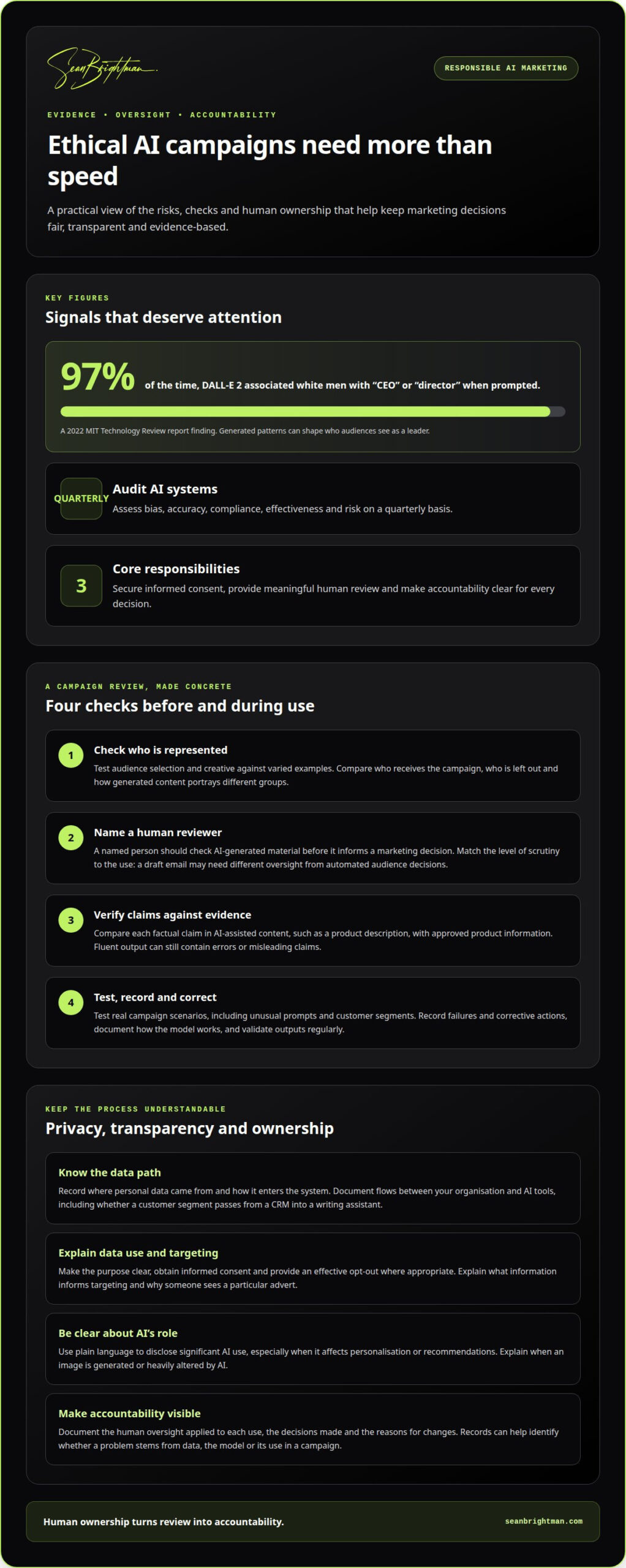
Bias in AI-generated marketing and hiring occurs when a system repeats patterns in its training data. A recruitment tool trained on past hiring decisions, for example, may favour profiles resembling previous hires. Marketing teams face a similar risk when AI reproduces stereotypes in copy or imagery. A 2022 MIT Technology Review report found DALL-E 2 associated white men with “CEO” or “director” 97% of the time when prompted. That can shape who audiences see as a leader.
Fairness in algorithmic decisions
Algorithmic fairness means checking whether automated decisions treat different groups equitably, rather than assuming a system is neutral. Traditional marketing can also exclude audiences through human judgement, limited research or blunt segmentation. AI increases the risk by applying a biased pattern quickly and repeatedly. A flawed targeting rule can affect an entire campaign before anyone notices. Review both the criteria and the outcomes.
Bias in advertising
Bias in advertising occurs when targeting or creative choices unfairly exclude a group or portray people through harmful stereotypes. For example, an audience model might repeatedly show a high-value product to one demographic while overlooking another with similar interests. Generated imagery might also depict certain jobs, roles or lifestyles narrowly. These outcomes matter because ad delivery shapes who receives information and who feels represented. Even a technically accurate campaign can cause harm if its distribution or message reinforces an unfair assumption.
Preventing discrimination in AI campaigns
To reduce discrimination, test audience selection and creative against varied examples before launch. Compare who receives the campaign, who is left out and how generated content portrays different groups. If a recruitment-related campaign depicts only one type of candidate, revise the prompts and review the material. Human reviewers should challenge stereotypes, inspect targeting criteria and record why they made changes. This cannot eliminate every risk, but it can make bias easier to identify and correct before the campaign reaches its audience.
Data privacy, transparency and informed consent
AI tools can combine customer data, infer preferences and shape what people see. Marketers need clear purposes, informed consent and visibility into how these systems use information.
Privacy and informed consent
Data privacy is the responsible handling of personal information; informed consent means people understand and agree to its use. The distinction matters when an AI system uses browsing behaviour to personalise product recommendations. Consumers should be able to opt out in most cases. Record where data came from and how it enters the system so teams can trace the information behind a campaign.
Transparency from AI vendors
Vendor transparency means understanding what data an AI supplier uses, how its system processes inputs and what happens to submitted information. Without those details, a marketing team cannot properly assess whether customer records or campaign data enter a model’s training process. Document data flows between your organisation and each AI tool. For example, map whether a customer segment passes from a CRM into a writing assistant.
Disclosure of AI use
Transparency in AI use means making the technology’s role clear when it affects marketing content or decisions. A product image generated or heavily altered by AI can create a different impression from a genuine photograph. Explain significant uses in plain language, especially when automation shapes personalisation or recommendations. Clear disclosure helps audiences understand how content was created and judge its claims with context.
ICO guidance on profiling and targeted advertising
The UK ICO’s guidance identifies transparency about profiling and targeted advertising as an important consideration for organisations using personal data. Profiling can use behaviour, such as pages viewed, to decide which adverts someone receives. Explain what information informs targeting and why someone sees a particular advert. Informed consent and an effective opt-out matter when personal data supports targeting. Document the data’s origins and movement through each system so the process remains understandable.
Human review and accountability for AI outputs
AI outputs need human ownership, not just a final glance. A documented review process connects testing, escalation and accountability when a campaign goes wrong.
Reviewing AI-generated outputs
Human review means a named person checks AI-generated material before it informs a marketing decision. This matters because fluent output can still contain errors, misleading claims or unsuitable recommendations. For example, a reviewer checking a product description can compare each factual claim with approved product information. Teams should also document the level of human oversight applied to each use. A draft email may need different scrutiny from automated audience decisions with broader effects.
Testing and auditing AI systems
Testing checks whether an AI system performs accurately and consistently; audits examine its wider risks and effects. Run AI audits quarterly to assess bias, accuracy, compliance, effectiveness and risk. Test outputs against real campaign scenarios, including unusual prompts and customer segments, then record failures and corrective actions. Document how the model works and validate outputs regularly. These records help teams identify whether a problem stems from the data, the model or its use in a campaign.
AI accountability initiatives
AI accountability initiatives create shared methods for examining how AI affects people and organisations. The Pulitzer Center’s AI Accountability Fellowships have supported reporters across five continents since 2022, showing how scrutiny can extend across industries and regions. Inside a marketing team, assign responsibility for approving outputs, logging incidents and deciding when a system needs review. Refresh the accountability framework annually as regulations change. Clear ownership means concerns reach someone empowered to act, rather than disappearing between teams.
Ethical AI marketing campaigns
An ethical campaign starts before anyone writes a prompt. Assess the AI system, the market and the people affected, then decide whether its use suits the campaign’s purpose. A personalised offer for existing customers raises different concerns from an automated decision about who sees a financial promotion. The same tool can pose different risks in different industries, so set safeguards for the specific use, not the technology alone.
Build every campaign around claims your organisation can support. For each AI-generated product benefit, identify the evidence behind it and remove wording that overstates what the product does. For example, keep a generated claim that a service guarantees a result only if your organisation can substantiate it. Treat AI as a drafting tool, not as proof. Even a polished sentence needs evidence before it reaches customers.
Industry context affects what needs scrutiny. A health-related campaign could influence wellbeing decisions, while a recruitment advert could affect access to work. Map the audience, the decision the campaign may influence and the potential harm from inaccurate or incomplete messaging. Then tailor the review to that exposure. A playful caption and a consequential financial claim should not go through identical approval checks.
Governance needs people with the authority to stop or amend a campaign. Involve legal teams when developing and maintaining AI governance policies, and make campaign owners responsible for applying them. Record the system’s intended use, audience, supporting evidence and approval decision. If the campaign changes market or purpose, revisit the risk assessment instead of relying on an old sign-off. This keeps oversight connected to the work.
Judge AI marketing by the full campaign, not the content generator alone. Assess its purpose, audience, claims and likely impact before release. Develop a practical AI campaign roadmap to turn those checks into a workable governance approach.
Sean Brightman
Sean Brightman helps organisations turn ethical AI principles into practical marketing decisions. If your team needs to govern AI use, assess campaign risks or assign accountability, AI Consulting can help bring structure to the challenge. Roadmapping can clarify priorities and set a workable direction, while an Advisory Retainer supports ongoing strategic decisions as your use of AI develops.
The focus is practical: connect AI use to business goals, identify where human judgement matters and build governance that fits your organisation. This is useful when policies exist on paper but teams need clarity on day-to-day decisions, or when AI activity has grown faster than oversight.
Contact Sean Brightman to discuss the AI marketing challenges your organisation is working through.
Make responsible AI part of the way you work
The risks and ethics of AI in marketing should shape decisions before a campaign reaches customers, not appear as a late-stage compliance check. Make ethical judgement part of how your organisation designs its marketing, measures its effects and learns from mistakes.
The next step is turning principles into decisions teams can make under pressure. Decide who owns an AI-assisted campaign, what evidence supports its claims and what triggers a pause or review. These choices give people a working standard, rather than a policy that sits unused.
Start with one live marketing workflow. Map where AI changes decisions and identify what must remain accountable to a person. Build on that practical baseline as your use of AI evolves. That is how responsible adoption becomes repeatable rather than a one-off exercise.
If you’re ready to make that work concrete, contact Sean Brightman to discuss your next step.
Frequently Asked Questions
Are there any industry-specific considerations when it comes to AI ethics?
Yes. Ethical safeguards should reflect what a campaign can influence in its sector. A retailer’s product recommendation differs from a health-related message or financial promotion, where misleading wording may affect consequential choices. Map the audience, the decision being influenced and the potential harm, then set the review accordingly. In recruitment marketing, consider whether imagery or targeting could narrow who sees an opportunity.
How can marketers start the conversation about ethical AI?
Start with a cross-functional discussion involving marketing, legal, data and customer-facing teams. Choose a real campaign and ask who could be affected, what assumptions the AI makes and who has authority to intervene. Turn the answers into practical guidance, then hold monthly hands-on AI sessions where employees can raise concerns and work through examples. Concrete cases make the discussion useful rather than abstract.
Why is there a push to define “responsible” AI?
“Responsible” can mean different things to different teams, so a shared definition gives everyone a basis for decisions. Without clear criteria, one team might prioritise speed while another focuses on customer impact, leaving ownership blurred. Define acceptable use for your organisation, who approves exceptions and how concerns are escalated. This turns a broad principle into a standard people can apply consistently.
What are AI ethics?
AI ethics are the principles used to judge how AI should be designed and used, and whose interests it serves. In marketing, this means considering not only whether a tool can generate a persuasive message, but also whether that message treats its audience fairly. For example, assess a personalised offer for its effects on different customer groups, not just its conversion potential.
What are the main risks of using AI in marketing?
The risks and ethics of AI in marketing include biased decisions, privacy failures, inaccurate content and unclear accountability. A generated product description might invent a feature, while an automated system could direct spend away from an audience without a sound reason. AI can also make errors harder to trace if teams do not record which tools shaped a decision. The practical risk is deploying output without understanding its basis or impact.
What ethical principles should guide AI marketing?
Use fairness, respect for privacy, transparency, accountability and human judgement as decision-making principles. Apply them across the customer experience: make recommendations understandable, avoid casual use of sensitive information and provide a route to human support when automation gets it wrong. These principles work best when teams connect them to specific campaign decisions, rather than treating them as slogans detached from daily marketing.