Agile marketing for small teams works through a repeating cycle: prioritise a backlog, choose a focused batch of work, launch it, measure the results, then review and adapt. A visible Kanban workflow and clear work-in-progress limits keep tasks moving without burying a lean team in parallel projects. The aim isn’t more activity. It’s to deliver customer value early and often, then change course when the evidence points to a better approach.
A full calendar can look productive while campaigns stall, priorities shift and nobody knows what’s working. Agile replaces a rigid plan with a manageable flow of work and regular feedback. That doesn’t mean abandoning strategy. It means linking each task to a business goal and using results to decide what to do next.
This guide explains how the process works, how to organise backlogs, workflows and planning, and how to choose KPIs that show progress rather than just output. You’ll also learn how short feedback loops help identify what’s gaining traction, what needs adjusting and where a small team should focus next.
Key Takeaways
- Focus marketing work on customer value and business goals, not the volume of tasks completed.
- Make the workflow visible with a Kanban board, and limit work in progress to keep priorities moving.
- Use a prioritised backlog and focused sprints to turn larger initiatives into manageable work.
- Choose KPIs that connect campaign activity to outcomes, then use the results to decide what to adjust next.
- Build a test-and-learn rhythm so the team can adapt its plans as customer feedback and performance data emerge.
What Is the Agile Marketing Process?
Agile marketing is a way to plan, deliver and refine marketing work through short feedback loops. For a small team, its principles connect each task to customer value and business outcomes.
Agile Marketing Principles and Values
Agile marketing applies principles that favour customer value, early delivery, experimentation and responding to change. The Agile Marketing Manifesto was created in 2012 and revised in 2021, giving teams values to guide decisions rather than a rigid script. That matters when priorities shift: the team can test a functional piece of work, learn from feedback and adjust without waiting for a perfect campaign.
The core practice is to set a clear business goal, deliver a small piece of work, measure its effect and use the result to choose the next step. Agile teams build quickly, test their work and iterate based on regular feedback, according to UK Government. For example, a team could test an email subject line before refining the wider campaign.
Customer Focus in Agile Marketing
Customer focus means using feedback and observed behaviour to shape what the team creates next. A team might publish a short guide, review readers’ questions, then update the next version to address their needs. Activity alone doesn’t show whether marketing is useful. Linking each experiment to a customer problem gives the team a clearer basis for deciding what to continue, change or stop.
Agile and Traditional Marketing Compared
Traditional marketing often organises work around a fixed plan, while agile marketing reviews progress and responds as new information arrives. A campaign calendar can still provide direction; agile changes how the team manages delivery within it. Rather than waiting until every asset is complete, the team can release a suitable first version, gather feedback and improve the next iteration. Success is measured by outcomes, not just completed tasks.
UK small businesses can build required advertising, data protection and email marketing checks into each campaign workflow. Assign a reviewer to check claims, audience permissions and campaign materials before release. Agile changes the pace of work, not the need to follow applicable rules.
Team Roles and Responsibilities
An agile marketing team needs someone to set priorities, people to create and deliver the work, and someone to clear blockers and support the process. In a small business, one person may hold several roles, but responsibilities still need to be explicit. Who approves the campaign? Who reviews customer feedback? Clear ownership keeps a fast workflow from becoming a confusing one.
For agile marketing to work, the team needs a shared goal, authority to organise its work and regular communication about progress. A brief check-in can surface a delayed approval or missing input before it stalls a launch. Keep roles practical, not ceremonial: each responsibility should help the team deliver, learn or make a decision.
Kanban workflows and work-in-progress limits
A Kanban workflow makes marketing work visible as it moves through clear stages, from idea to completion. For a small team, that visibility exposes bottlenecks and helps protect focus.
Kanban Boards and Principles
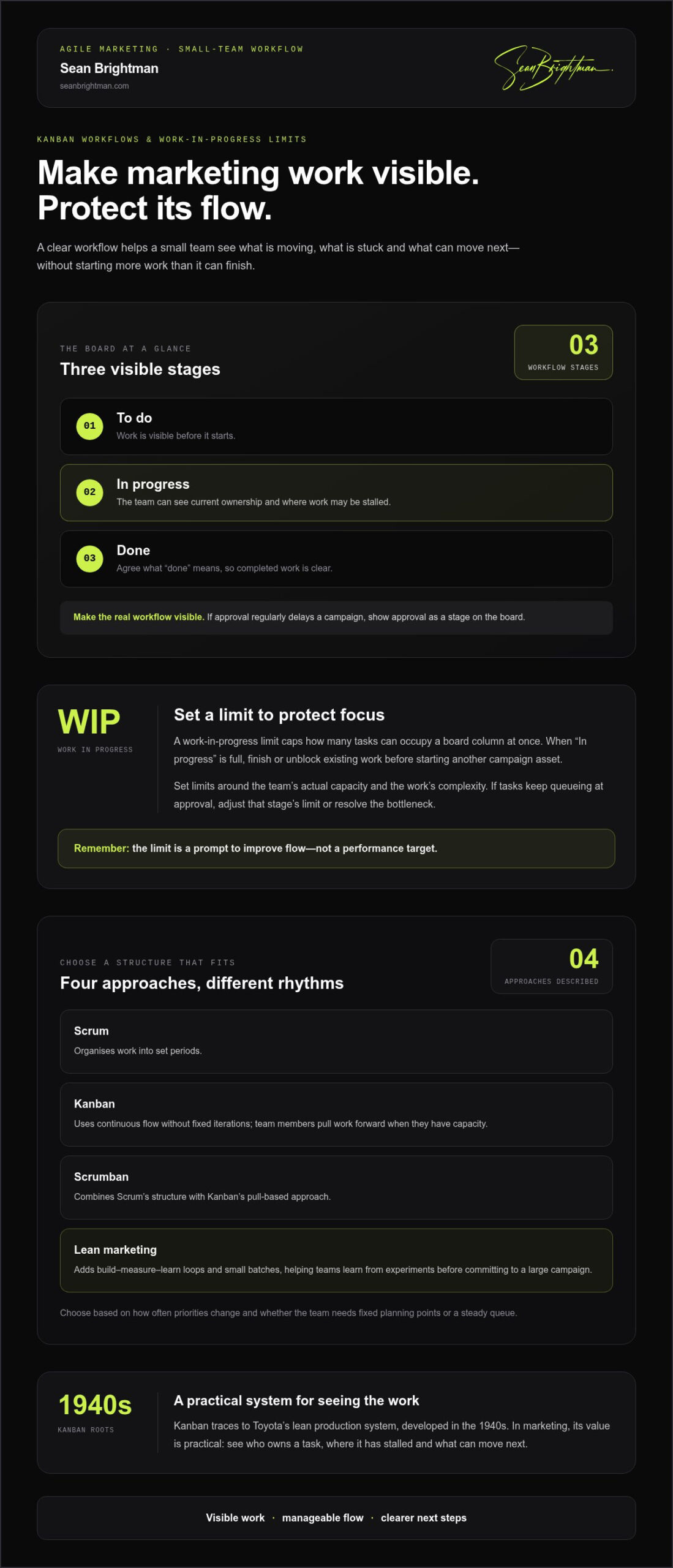
A Kanban board shows each work item moving through stages such as “To do”, “In progress” and “Done”. Kanban traces to Toyota’s lean production system, developed in the 1940s. The board’s value is practical: everyone can see who owns a task, where work has stalled and what can move next. A campaign card might track a landing page from draft through review to publication.
Keep the board aligned with the real workflow, not an idealised process. If legal review regularly delays a promotion, make approval a visible stage. That helps the team spot recurring friction and improve the process, rather than adding more tasks to an already crowded queue.
Managing Continuous Workflow
Kanban supports continuous delivery: team members pull new work forward when they have capacity, rather than waiting for a fixed sprint to end. That suits recurring tasks such as publishing social posts or updating a campaign page. The team can respond to feedback as it arrives, while the board shows whether urgent requests are displacing planned work.
To use this framework, define the stages, agree what “done” means and make blocked work visible. For example, a social post might move from draft to approval, then scheduling and publication. Review the workflow regularly and adjust stages when hand-offs cause delays. The aim is smoother progress, not a more elaborate board.
Setting Work-in-Progress Limits
Work-in-progress limits cap how many tasks can occupy a board column at once. If “In progress” is full, the team finishes or unblocks existing work before starting another campaign asset. Kanban uses these limits to manage the process and improve efficiency. They make overload visible and stop half-finished tasks competing for the same people.
Set limits around the team’s actual capacity and the work’s complexity. A designer handling a landing page and several social assets may need protected focus before accepting another request. If work repeatedly queues at approval, adjust that stage’s limit or resolve the bottleneck. The limit is a prompt to improve flow, not a performance target.
Scrum, Kanban and Scrumban offer different structures. Scrum organises work into set periods, while Kanban uses continuous flow without fixed iterations. Scrumban combines Scrum’s structure with Kanban’s pull-based approach. Lean marketing adds build-measure-learn loops and small batches, helping teams learn from experiments without committing to a large campaign first. Choose based on how often priorities change and whether the team needs fixed planning points or a steady queue.
For a small team, the useful framework is the one people can follow consistently. Start with a board for one campaign, make ownership clear and watch where work piles up. Then refine the process using evidence from actual delivery. To connect workflow design with business priorities, explore aligning marketing work with strategic goals.
Backlogs, prioritisation and sprint planning
A marketing backlog gathers campaign ideas, tasks and improvements in one prioritised queue. Sprint planning selects focused work the team can complete, review and learn from.
Managing the Marketing Backlog
A backlog is an ordered list of marketing work that gives the team a transparent view of what matters next. It might include a landing page, an email sequence and customer research. Make each item specific enough to estimate, assign and review. “Improve the welcome email” is less actionable than “rewrite the opening to explain the product’s main benefit”.
Prioritise work against the business goal, customer value, dependencies and effort. If a campaign relies on a landing page, that page may need to come first. Review the queue regularly: new customer feedback can change the order, while outdated ideas can be removed. This keeps planning grounded in current evidence, not whoever last requested a task.
Sprint Duration and Daily Stand-Ups
A sprint is a fixed period for delivering a chosen batch of work and reviewing its results. Scrum plans work in set increments called sprints, typically 2-4 weeks in duration, according to UK Government. Keep the sprint goal clear, such as testing a campaign message and publishing its landing page. A defined endpoint makes progress easier to assess.
Daily stand-ups help the team coordinate work, surface blockers and agree immediate priorities. Agile marketing teams are advised to keep these meetings to no more than 15 minutes. Each person can report progress, name a blocker and state the next action. A stand-up should support functional collaboration, not become a lengthy status report.
During sprint planning, compare the team’s capacity with the proposed work. Select tasks that support a shared outcome, then define what completion means. For a product campaign, that might include approved copy, a published page and a planned review of audience response. Clear acceptance criteria prevent “nearly finished” work from quietly rolling into the next cycle.
Iterative releases let marketers test a campaign in manageable parts. A team could publish one content asset, study engagement and use what it learns to shape the next release. Weekly campaign iterations can replace waiting until a quarterly review to adjust direction. Smaller tests make experimentation practical, while regular feedback helps refine the message before the team invests further effort.
Not every team needs Scrum’s fixed cadence. Kanban supports continuous work, while Scrumban combines Scrum’s structure with Kanban’s pull-based approach. Choose based on how work arrives and how often priorities shift. Whichever framework you use, record decisions and blockers where everyone can see them. That transparency connects sprint plans to actual delivery and makes each review useful.
Benefits of Agile marketing
Agile marketing can help a small team deliver sooner, learn from real responses and change direction with less friction. The benefits come from improving how work flows, not simply asking people to produce more.
Speed, Productivity and Flexibility
Short feedback loops help a marketing team spot delays and make useful changes before a campaign is finished. For example, a business launching a new service can publish a focused landing page, review customer responses and refine its message before producing more campaign material. That can reduce time spent polishing work that misses the audience.
Agile also makes capacity visible. If a designer is waiting for copy approval, the team can unblock that task instead of assigning another design. A 2025 State of Agile Marketing Report found that more than 60% of surveyed marketing leaders reported faster delivery times and stronger alignment with business strategy after adopting agile ways of working. Speed matters most when it improves delivery towards a clear business goal.
Benefits for Teams and Organisations
Shared priorities help a team see how daily work supports organisational goals. A campaign writer, designer and analyst can coordinate around one release, rather than handing work across departments with competing deadlines. This creates practical collaboration: each person contributes a distinct skill, while the team shares responsibility for progress.
Regular reviews also turn completed work into learning. If a campaign attracts attention but few enquiries, the team can examine its message, audience and next step before repeating the approach. The 2026 State of Agile Marketing Report found that 95% of marketers applying agile ways of working reported a very positive experience. That finding describes respondents’ experience, not a guaranteed result for every organisation.
Customer experience can improve when teams act on feedback instead of waiting for a distant planning cycle. If customers repeatedly struggle to understand a product feature, for instance, the team can clarify the website copy and test whether the explanation helps. Small changes to customer-facing processes can remove friction without rebuilding an entire campaign.
Agile practices can also support improvement across channels. A team can compare customer questions from support with responses to social content, then adjust its next campaign message. The value lies in connecting those signals to a practical decision, not collecting data for its own sake. A clear review question, such as “Did this change help customers take the next step?”, keeps learning focused.
For UK teams choosing software, a shared Kanban board, analytics platform and email marketing tool can support planning, measurement and campaign delivery. Costs depend on factors such as user numbers, features and integrations. Choose tools to support the workflow rather than buying a large suite before the team needs it.
Agile marketing metrics and KPIs
Agile marketing KPIs connect team activity to customer behaviour and business outcomes. Choose measures that help the team decide what to continue, change or stop, rather than tracking numbers just because the software displays them.
Start with the outcome
Start with the business result a campaign should support, such as qualified enquiries, completed purchases or repeat bookings. Then choose a KPI that reflects progress towards that result. For a landing-page experiment, the team might track completed enquiry forms, not just page views. Views show attention; form completions show whether visitors took the intended next step.
Make the link between the measure and the campaign explicit. If the goal is to increase product awareness, track a relevant audience response, such as visits to a product page from a campaign. If the goal is sales, measure purchases or qualified leads. This gives collaboration a clear purpose and stops team members interpreting success in incompatible ways.
Balance outcome and workflow measures
Outcome KPIs show what marketing achieved; workflow measures show how work moved. A team could track campaign-generated enquiries alongside the time a landing page spends awaiting approval. If enquiries remain steady while approval delays grow, the workflow points to a process issue. That doesn’t prove the delay caused the result, but it gives the team a specific area to investigate.
Useful workflow signals include blocked tasks, completed work and time from brief to publication. A Kanban board or project-management software can make these visible. Interpret them in context: more completed tasks don’t automatically mean progress if those tasks don’t support the campaign goal. Use the figures to prompt discussion, not to rank people.
Build a continuous review loop
At each campaign review, compare the result with the intended outcome, note what changed and agree on the next action. If an email gets opens but few clicks, inspect the subject line, message and call to action before changing everything at once. A focused adjustment makes the next test easier to interpret.
Record the campaign, audience, change and KPI result together. This gives the team a useful history for future planning. If a result shifts, check whether the audience, offer or channel also changed before drawing conclusions. A short review note can turn one experiment into learning that informs later campaigns.
A small team doesn’t need a dashboard crowded with measures. Choose a small, relevant set: an outcome KPI, a customer-response measure and a workflow signal. Review them at the same point in each campaign cycle, then adjust priorities based on what the evidence shows. That keeps metrics tied to decisions and makes continuous improvement part of the workflow, not an extra reporting exercise.
Sean Brightman: AI Consulting
Sean Brightman’s AI Consulting can help your team assess how AI could support marketing workflows, analysis and decision-making. The focus is practical: identify where AI fits your priorities rather than adding software without a clear purpose.
If the bigger challenge is connecting campaign goals, work and KPIs, Roadmapping can help shape a clearer direction. An Advisory Retainer offers ongoing strategic input as priorities and results develop. These options suit teams that understand agile principles but need help applying them to their operating model.
Bring your current workflow, marketing goals and measurement challenges into the conversation. Visit seanbrightman.com to contact Sean Brightman.
Make your next marketing move deliberate
Choose an upcoming campaign as a focused pilot. Before work begins, agree what decision the results should help you make. That gives your team a practical starting point for agile marketing for small teams, without forcing a full operational change before you learn what fits.
If priorities feel disconnected or nobody owns the wider direction, Sean Brightman’s Roadmapping can help shape a clearer path. AI Consulting can help you assess where AI fits your marketing work, while Fractional CMO support provides senior marketing leadership. The right next step depends on the challenge you need to solve, not on adding more activity.
Bring your goals and current sticking points into a conversation, then decide what would make the greatest difference. Contact Sean Brightman to discuss your needs. Start with one clear decision, and give your team room to make progress.
Frequently Asked Questions
What is the difference between Scrum and Kanban marketing?
Scrum organises marketing work into fixed sprints; Kanban moves tasks through a continuous workflow. For a launch with coordinated assets and a shared deadline, Scrum can help the team plan a defined batch. For ongoing requests, such as website updates and social content, Kanban makes incoming work visible. The practical choice depends on whether work arrives in planned releases or continuously.
What is agile marketing and how does it work for small teams?
Agile marketing for small teams organises work around customer value and business goals, then uses feedback to shape what happens next. A small team might test two versions of a product message with a focused audience, review the response and apply what it learns to the next campaign. It doesn’t need a separate agile department; clear ownership and a shared goal can make the approach practical for a lean team.
How can a small marketing team implement agile marketing step by step?
To put agile marketing for small teams into practice, choose a campaign with a clear business goal and identify the people and approvals it needs. Break it into deliverables, assign ownership and decide what evidence will inform the next decision. Track work on a shared board, review progress regularly and record lessons after launch. Expand the approach only after the team sees which practices improve its workflow.
Which agile marketing frameworks work best for small teams: Scrum, Kanban or Scrumban?
Choose Scrum when the team can plan a focused batch of campaign work and review it at regular intervals. Choose Kanban when requests arrive continuously and priorities shift during delivery. Scrumban can suit a team that wants planned reviews but needs flexibility between them. Map a typical month of work: frequent interruptions point towards flow, while coordinated releases may suit sprint planning.
How should small teams plan sprints, prioritise marketing work and manage backlogs?
Before planning, clarify which business goal takes priority and identify dependencies, such as copy approval before design. Write backlog items as specific deliverables with an owner and a clear definition of completion. During planning, select work that fits the team’s actual capacity, leaving room for necessary interruptions. At review, carry forward only unfinished work that still matters, rather than automatically rolling every item into the next sprint.
What agile marketing metrics and KPIs should small teams track?
Track measures that inform a decision, not every number available. For a lead-generation campaign, compare qualified enquiries with the page visits that produced them; for retention, examine repeat purchases or renewal behaviour. Pair the outcome with a process signal, such as approval delays, to identify where work may be getting stuck. Compare like with like, keeping audience, offer and channel context beside each result.
What are common challenges and risks when adopting agile marketing, and how can teams avoid them?
Common problems include treating every request as urgent, holding meetings without decisions and measuring output instead of impact. Set a shared priority, make ownership visible and use check-ins to resolve specific blockers. Keep campaign approval and compliance reviews in the workflow, so speed doesn’t bypass necessary scrutiny. If the board fills with unfinished work, pause new tasks and find the bottleneck before adding another process or tool.
How can a small team compare agile marketing with traditional marketing planning?
Compare how each approach handles a real campaign, rather than debating labels. Traditional planning can set strategic direction and key milestones; agile practices can help the team adjust delivery as audience feedback comes in. Review how quickly decisions change, how approvals move and whether campaign learning shapes later work. The best fit may preserve an annual plan while giving the team room to adapt individual activities.