
Tag: marketing agencies

  • Reasons to Fire Your Marketing Agency When Goals and Results Fall Short

    Reasons to Fire Your Marketing Agency When Goals and Results Fall Short

    A bigger marketing budget won’t fix a strategy aimed at the wrong business goal. The reasons to fire your marketing agency include persistent underperformance, poor reporting and a strategy that no longer fits your business. Assess whether the problem has lasted several months, not just one poor month, then set clear benchmarks and a defined timeline for improvement.

    You’re right to expect more than busywork, impressive-looking charts or a steady push to spend more. Your agency should connect its work to your goals, explain what the results mean and set out a credible plan to improve.

    This guide explains how to assess alignment, reporting and strategic progress, then review contract terms before deciding whether to stay or move on. You’ll also learn how to manage the decision with less disruption, so changing agencies doesn’t leave a gap in your marketing.

    Key Takeaways

    • Judge the partnership by how well the agency’s priorities connect to your business goals, not by activity or spend alone.
    • Use clear, outcome-focused reporting to spot weak performance and decide whether the strategy needs to change.
    • Review notice periods, renewal clauses and ownership of accounts and assets before ending the relationship.
    • Look for a pattern of warning signs, gather feedback from the teams affected and agree a practical improvement window before making your decision.

    1. Alignment between agency and business goals

    An agency relationship works when its priorities support your commercial goals, not simply its own activity. If you want qualified enquiries, for example, a plan focused on increasing advertising spend needs a clear rationale. Ask how each campaign supports sales, customer retention or another agreed business outcome.

    Fit matters more than a low fee. An agency should use evidence about your audience before recommending a social platform, and explain who manages the account and whether execution is outsourced. Salesforce or HubSpot CRM records can show purchase histories and customer interactions, helping you shape more relevant campaigns.

    Changing agencies can disrupt active campaigns, access to advertising accounts, analytics, creative files and customer data. A rushed exit may leave your team without the information or permissions needed to keep marketing moving.

    Manage the transfer with a documented handover. Request data exports, campaign details, creative files and written confirmation of account ownership. Keep administrator access under your control, transfer permissions deliberately, and remove the outgoing agency’s access once the handover is complete.

    To replace an agency with less disruption, map active projects, dependencies and deadlines before giving notice. Arrange a transition meeting, agree who owns each open deliverable and keep essential marketing activity running throughout the change.

    Start with a candid performance discussion, internal feedback and a clear account of unmet expectations. Set specific benchmarks and an improvement timeline, then assess progress against those measures rather than one disappointing month. If the agency still pushes spend without connecting its work to your goals, the relationship may be misaligned.

    Plan the transition early. Overlap the incoming team with the outgoing agency’s final two weeks where practical. Request exports and ownership confirmations on day one of the notice period, rather than waiting until day 25. Agree a 90-day performance baseline with the incoming team before its first invoice. Those steps give the new team a usable starting point and reduce avoidable gaps.

    2. Assessing reporting accuracy and strategic stagnation

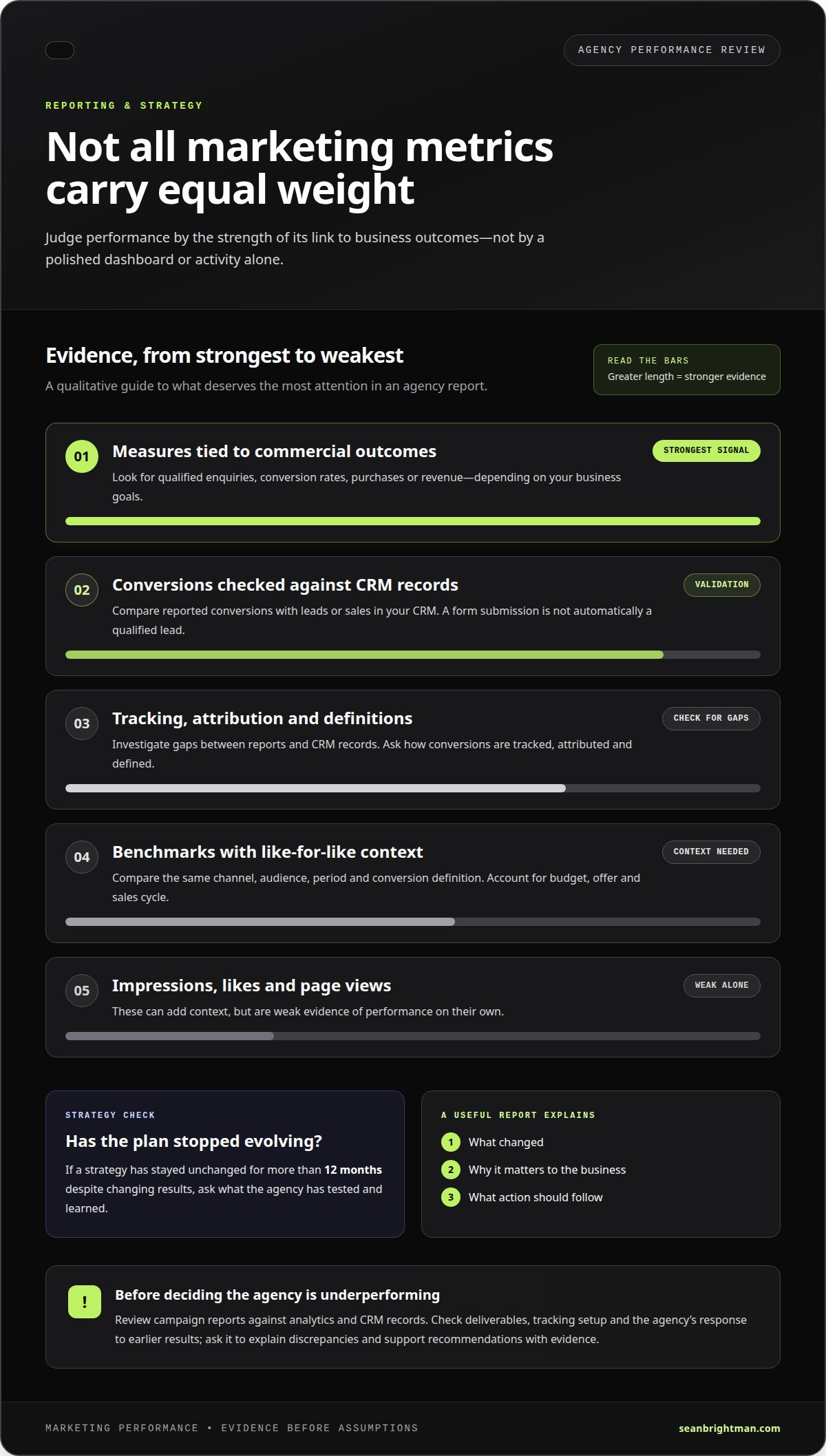
    A polished dashboard proves little if it cannot explain business outcomes. Compare reported conversions with leads or sales recorded in your CRM, and investigate gaps in tracking, attribution or definitions. A form submission, for example, is not automatically a qualified lead.

    Useful reporting links campaign activity to conversions, lead generation and return on investment. Impressions, likes and page views can add context, but they are weak evidence on their own. Ask for regular reports explaining what changed, why it matters and what action should follow.

    When comparing performance with industry benchmarks or competitors, use like-for-like measures: the same channel, audience, period and conversion definition. Account for differences in budget, offer and sales cycle, too. Broad comparisons can raise useful questions, but without that context they cannot prove an agency is underperforming.

    For a UK business, relevant KPIs depend on its goals and marketing activity. Lead generation may focus on qualified enquiries and conversion rates; an online retailer may track purchases and revenue. Ask the agency to show how each measure relates to agreed commercial outcomes.

    Audit the work before deciding to end the relationship. Compare campaign reports with analytics and CRM records, then review deliverables, tracking setup and what the agency did in response to earlier results. Ask it to explain discrepancies and support its recommendations with evidence.

    Strategy should evolve when evidence or business conditions change. If a plan remains unchanged for more than 12 months despite changing results, ask what the agency has tested and learned. A capable partner should challenge assumptions constructively, not recycle the same activity without a reason.

    Record the gaps, share them with the agency and set clear measures for improvement. A strategic review can help clarify priorities when reporting and direction need a sharper assessment.
    Reasons to Fire Your Marketing Agency When Goals and Results Fall Short

    3. Contract details and renewal clauses

    Before ending an agency relationship, read the signed agreement, not just the latest invoice. Check the notice period, renewal date, termination process and any fees for ending early. Most marketing agency contracts have notice periods of 30 days, so leaving notice too late can extend the commitment or delay a planned change.

    Review the contract’s terms for deliverables, payment dates and outstanding work. If your budget covers a defined campaign or monthly activity, compare that scope with the agency’s obligations. Look for automatic renewal wording and note the deadline for giving notice. A calendar reminder can help you avoid an unintended renewal.

    Ownership terms matter as much as the exit clause. Identify who owns creative files, strategy documents, website content, advertising accounts and analytics data. Check how the agreement says those assets will be transferred and whether the agency can retain copies. Before giving notice, map each asset to its owner and record the access needed to keep the business running.

    Review intellectual property provisions, confidentiality terms, unpaid invoices and other obligations, too. Ask legal counsel to review unclear termination clauses, fees, ownership rights and responsibilities before making a final decision. This can clarify the contract’s wording and flag issues that could affect the handover.

    For a prospective agency, ask what happens if performance does not improve in the first 30 days. Get agreed outcomes and responsibilities in writing before funds change hands. Clear commitments make accountability easier to assess than a vague promise of growth. They also give both sides a shared reference point for later reviews.

    Use a concise exit plan: confirm the notice deadline, settle outstanding obligations, document asset ownership and list work in progress. Agree on handover dates and access changes in writing. The signed contract sets the boundaries, while a practical transition plan protects campaigns, data and your team’s time.

    4. What are the warning signs of an underperforming marketing agency?

    Look for repeated patterns, not one awkward meeting or a single poor month. An agency bringing 10 people to a client call may signal unclear ownership, especially when nobody can explain who handles decisions or delivery. Ask for a named lead and clear responsibilities. If senior agency staff have been absent from calls for two quarters, assess whether strategic oversight has weakened.

    Watch for activity that grows while business outcomes stay flat. More advertising spend doesn’t necessarily produce better results. If the agency’s answer to falling conversions is simply to increase the budget, ask what evidence supports that recommendation. A strategy unchanged for more than 12 months deserves scrutiny when results or market conditions have shifted.

    Low fees alone don’t prove poor service, but a price far below comparable proposals can mean limited account attention or a one-size-fits-all approach. Assess the work itself: does each campaign speak to your audience, use relevant evidence and adapt when performance changes? Repeating generic creative across audiences is a concrete warning sign.

    Impressions, likes and page views need to lead somewhere meaningful. If social posts attract likes but generate no website visits, newsletter sign-ups or purchases, reports may be spotlighting vanity metrics. Ask how each figure relates to the campaign’s intended outcome and whether tracking captures that journey.

    Involve the teams that rely on the agency’s work. Ask sales, customer service and internal marketing colleagues about responsiveness, missed deadlines, deliverable quality and support gaps. Three familiar warning signs call for a serious review, not an automatic firing. Consider whether problems have persisted for several months, then discuss specific examples and set a defined improvement window.

    If the evidence points to a deeper strategic gap, review your marketing direction before deciding what comes next.

    Sean Brightman

    Sean Brightman helps business leaders make clearer marketing decisions when agency results and expectations diverge. If the evidence points to unclear priorities or a strategy that needs rebuilding, Roadmapping can help create a more focused direction. An Advisory Retainer provides ongoing strategic input as you assess progress and decide what comes next. AI Consulting can help you determine where AI fits your business, rather than adding tools without a clear purpose.

    The goal is a sound decision, not change for its own sake. If you’re weighing whether to stay, reset expectations or move on, contact Sean Brightman to discuss the challenge.

    Make your next marketing decision with intent

    Ending an agency relationship isn’t the only decisive option. You could reset expectations, change who makes strategic decisions or bring in different leadership. Strong reasons to fire your marketing agency may point to a problem with the setup, not just the provider.

    The reasons to fire your marketing agency can also raise a broader question: what needs to change for marketing to work better? Use the decision to clarify priorities, accountability and marketing’s role in growth. Sean Brightman offers Fractional CMO support to businesses that need senior marketing direction without defaulting to another agency arrangement.

    Make your next step a focused conversation about the issue you need to solve, whether that’s direction, accountability or a workable transition. Contact Sean Brightman to discuss your agency, and move forward with a clearer plan.

    Frequently Asked Questions

    How long should I wait for my agency to improve before considering firing?

    Set a review window that reflects the campaign cycle and the changes required, rather than reacting to one poor month. Reasons to fire your marketing agency may become clearer through missed milestones, such as unresolved tracking issues or no improvement in lead quality. If progress remains weak and the agency cannot explain why, use that evidence to decide whether further time is justified.

    Is switching agencies going to be costly?

    Switching agencies can involve more than the new agency’s fee. Consider your team’s onboarding time, any overlap between providers, unfinished work and possible downtime. A campaign with an upcoming launch, for example, may need extra coordination to stay on track. Map these operational demands against the value of changing, then plan the handover to limit duplicated work and keep essential activity running.

    What if my agency is slow to respond?

    Slow replies become a serious problem when they repeatedly block decisions, approvals or time-sensitive work. Record missed responses and their practical impact, such as a delayed campaign sign-off. Then agree who handles urgent issues, which channels to use and what response expectations apply to routine requests. If delays continue after that discussion, include them in your assessment of the working relationship.

    Will firing my agency hurt my SEO rankings?

    Changing agencies doesn’t automatically remove search rankings, but a poorly managed handover can interrupt the work that supports them. Keep publishing, technical fixes and planned site changes moving during the transition. Before access changes, make sure the incoming team understands current priorities and can access relevant performance history. Don’t remove essential platform access until responsibilities and account control have transferred.

    How can you measure whether a marketing agency is delivering results?

    Start with the business outcome the work should produce, then connect campaign activity to that measure. A service business might track qualified enquiries through to booked work; an online retailer might follow purchases and revenue. One reason to fire your marketing agency may be a persistent gap between reported activity and commercial impact. Use consistent definitions and tracking to assess the difference.

    What contract terms and notice periods apply when ending a UK marketing agency agreement?

    The signed agreement sets the terms, so review its notice period, renewal date, termination process and any early-exit fees. Most marketing agency contracts have notice periods of 30 days, but your own contract determines the applicable notice. Check how notice must be given and whether renewal is automatic. For unclear clauses or disputed obligations, have legal counsel review the agreement before you act.

  • Marketing agency alternatives in the UK for business growth

    Marketing agency alternatives in the UK for business growth

    A bigger agency isn’t automatically the better choice. Smaller UK agencies can be just as capable when their expertise matches the work, so it’s worth considering marketing agency alternatives in the UK before committing to a large firm.

    Looking beyond the pitch makes sense. A large team can bring broad expertise, but it may also add layers between strategy and delivery. A smaller specialist can offer closer senior involvement, while a freelancer, an in-house hire or external marketing leadership may better suit a different need.

    This guide compares those options by business size, priorities and internal capacity. You’ll see what each model can handle, where its limits lie and how to decide whether you need campaign execution, a clearer marketing plan or strategic direction. The goal is a practical fit, not a bigger agency name for its own sake.

    Key Takeaways

    • Match the agency model to the work you need done, not the size of its name.
    • Assess specialisms, senior involvement and delivery approach against your marketing priorities.
    • Use your budget, in-house capacity and growth stage to judge which agency relationship is likely to fit.
    • When the main gap is strategic direction, consider whether roadmapping or advisory support would help you move forward.

    UK alternatives to large digital marketing agencies

    Marketing agency alternatives in the UK include specialist agencies, freelancers and in-house teams. They can take on work you might otherwise give a large firm when their skills, scope and coordination needs fit.

    Freelance marketing platforms and directories

    LinkedIn and freelance marketplaces help UK businesses find support in SEO, content, social media or digital PR. Search by specialism, then compare relevant work, communication and reporting. A directory can help build a shortlist, but it won’t coordinate separate freelancers. Set the task, required outputs and working arrangements before appointing anyone.

    Managing digital marketing in-house

    A small business can manage focused digital marketing by assigning an owner, choosing priorities and using tools suited to the work. A practical setup might include analytics, a content calendar, social scheduling and a shared reporting dashboard. Track leads, engagement, search visibility and conversions. For SEO and digital PR, assign clear responsibility for research, writing, outreach and measurement.

    Risks of replacing agencies with freelancers or staff

    The main risk is fragmented delivery. A freelancer may cover one specialism, while in-house staff may lack the time or expertise to manage every channel. Without a clear owner, content, SEO and reporting can work against each other. Document workflows, approvals, account access and reporting before a handover. Keep ownership of business accounts and performance data within the organisation.

    A UK marketing services contract should set out scope, deliverables, fees, payment terms, ownership, reporting, data handling, termination and notice. Notice periods depend on the agreement, so put the agreed period and handover duties in writing before work begins.

    Use reports to guide decisions, not decorate presentations. We Are Social listed its Digital 2027 report for 21 October 2026 and Think Forward 2026 for 22 January 2026. Measure SEO through organic ranking and qualified enquiries, creator marketing through engagement and audience response, and digital PR through referral traffic. When weighing marketing agency alternatives in the UK, connect each activity to a measurable business outcome.

    What to look for when choosing an agency

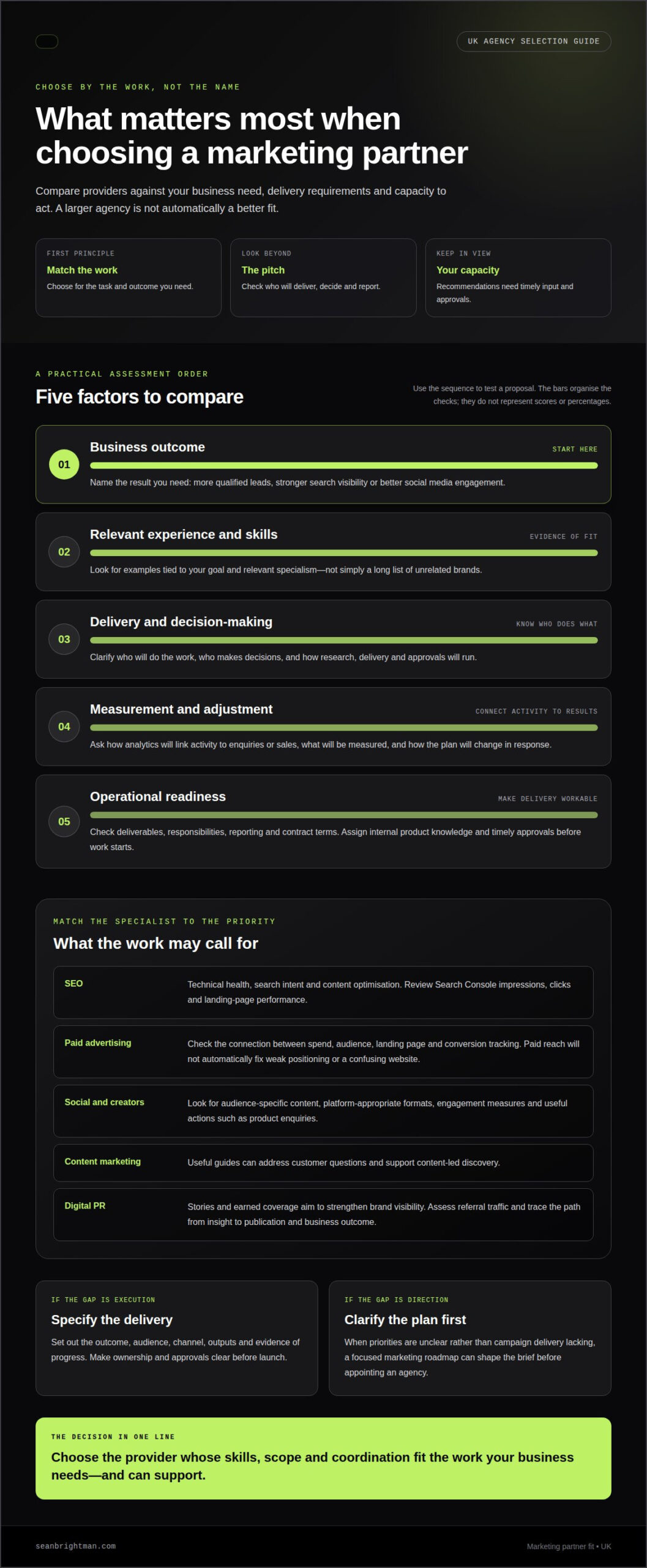
    Choose a partner based on the work your business needs, not the polish of its pitch. The right marketing agency alternatives in the UK should match your priorities, delivery requirements and capacity to act on recommendations.

    Agency selection criteria

    Start with the business outcome: more qualified leads, stronger search visibility or better social media engagement. Then assess whether the agency’s experience and skills fit that goal. One response recommends over 3 years of experience for a startup marketing specialist. Look for relevant examples, not a long list of unrelated brands.

    Clarify who will do the work and make decisions. A digital marketing agency should explain its process for research, delivery, approvals and reporting. Ask how it uses analytics to connect activity with enquiries or sales, and how it adjusts work in response. Apply the same criteria to any other provider and the task they’ll own.

    Evaluating agency fit

    Test the proposed approach against a specific priority. If the goal is more qualified enquiries, the plan should identify suitable channels, what to measure and how the team will adjust. For example, a social media programme should define its audience and engagement signals rather than rely on generic reach. Comparing these details makes marketing agency alternatives in the UK easier to assess on substance.

    Use the proposal to identify operational gaps before work starts. Check that deliverables, responsibilities, reporting and contract terms are clear, including the agreed notice period. If the plan depends on product knowledge or timely approvals from your team, assign those responsibilities before launch.

    Separate strategic direction from execution. If the central issue is unclear priorities, not a shortage of campaign delivery, a focused marketing roadmap can help shape the brief before you appoint an agency. That keeps the decision anchored to the business need rather than a supplier’s preferred package.

    Comparing agency specialisms

    Specialist agencies focus on a channel or capability, while full-service firms coordinate several. Compare the work behind each proposal. A brand seeking stronger organic visibility, for example, has a different brief from one launching a product campaign across multiple platforms.

    An SEO agency works on technical health, search intent and content optimisation. Ask how it will connect recommendations with Google Search Console data, including impressions, clicks and landing-page performance. Organic search can support long-term discovery, but it won’t replace a campaign designed for immediate reach.

    A paid advertising specialist plans and manages campaigns on platforms such as Google Ads or Meta. Look for a clear link between spend, audience, landing page and conversion tracking. This option suits businesses seeking paid reach, but it won’t automatically fix weak product positioning or a confusing website.

    Social media and creator agencies develop content for specific audiences and channels. Their plans should explain how creative formats fit each platform and how they’ll measure engagement and useful actions, such as product enquiries. Traditional media buying and creator partnerships need different briefs, approval processes and performance measures.

    Content marketing and digital PR can overlap, but they address different needs. A content specialist might create useful guides around customer questions, while digital PR develops stories and earns coverage to strengthen brand visibility. Ask for an example campaign and trace its intended path from insight to publication, audience response and business outcome.

    Use a simple comparison before choosing a specialism. Write down the business outcome, audience, channel and evidence that would show progress. Then match those needs to the agency’s actual deliverables. If search visibility is the priority, assess SEO capability first; if a launch needs attention across several platforms, look for joined-up campaign planning. Don’t mistake a broad service list for depth. A specialist can offer focused expertise, while a wider team may coordinate connected work. Choose based on the problem, not the label.

    Marketing agency alternatives in the UK for business growth

    Agency fit by business size and marketing priorities

    The right agency depends on the gap between your growth goals and your team’s capacity. Match the support to the work, the decision-makers and the results you need.

    A business spending £3,000 a month can be a lower priority at a large agency than an account spending £30,000 a month. For a smaller company, a specialist or freelancer can provide focused channel support; a larger team can coordinate several campaigns. Neither model fixes unclear priorities or weak conversion tracking.

    Hire a freelancer for a defined task, such as improving landing-page copy or managing one social channel. Choose an agency when several connected activities need delivery. A consultant suits a strategic problem without ongoing execution, while an in-house team fits continuous work that relies on internal product knowledge. Make the choice based on the work and ownership required.

    Before committing, map the customer journey from traffic source to conversion. If organic search brings visitors but few enquiries, investigate the landing page before trying to attract more traffic. If repeated tasks consume staff time, automation can streamline routine activity, but it won’t replace positioning or sound judgement. Tie each channel to a business outcome.

    UK businesses handling customer data for marketing need processes aligned with UK GDPR and PECR. The Information Commissioner’s Office covers data protection, while the Advertising Standards Authority sets advertising standards. Build clear data handling, permissions and campaign approval into the process. Compliance isn’t the agency’s responsibility alone.

    Grant support for marketing depends on location, sector, scheme criteria and eligible spending. Check current local and national business-support routes before building a growth plan around funding. Grants aren’t a guaranteed budget line.

    When the bottleneck is unclear priorities rather than campaign capacity, sharpen the growth plan before choosing a delivery model. Clarify your marketing priorities and align the next move with your team’s actual needs.

    Sean Brightman

    Sean Brightman can help when your business needs sharper marketing priorities before choosing an agency, freelancer or in-house approach. Roadmapping turns growth goals into a clearer sequence of decisions, while an Advisory Retainer provides ongoing strategic input as priorities change. If AI is part of the challenge, AI Consulting can help you assess how it fits your marketing work.

    This is a useful next step when activity feels fragmented, channel choices lack a clear rationale or your team needs direction before commissioning delivery. The focus is on structuring the decision, not adding another layer of campaigns.

    To discuss which kind of support fits your situation, contact Sean Brightman.

    Set your next marketing move in motion

    Turn your agency decision into a clear operating brief. Define the business outcome, the work that needs doing, who owns each decision and how you’ll assess progress. This gives your team a practical basis for choosing between marketing agency alternatives in the UK, or changing direction when the current setup no longer fits.

    If the real gap is senior marketing leadership, Sean Brightman offers Fractional CMO support. Roadmapping can help organise priorities and actions, while AI Consulting addresses the role of AI in your marketing. Choose the support that tackles the constraint you’ve identified, not an option that adds activity without direction.

    Ready to turn that decision into a focused next step? Discuss your marketing priorities with Sean Brightman. You can move forward with a clearer plan and a stronger basis for growth.

    Frequently Asked Questions

    Are smaller agencies as capable as large ones?

    Yes, when their expertise and capacity match the work. A smaller agency may give a business direct access to the people shaping and delivering its work, while a large firm may bring broader teams for complex programmes. A focused SEO project, for example, may not need a large agency structure. Assess capability by relevant experience, the proposed team and its approach to your specific brief.

    Is it disruptive to switch agencies mid-year?

    Changing providers can be disruptive, but a planned handover can limit the impact. First, document active campaigns, upcoming deadlines, account access, reporting definitions and outstanding decisions. Then agree who owns each item during the transition. A business launching a seasonal campaign may need continuity in approvals and tracking before changing delivery teams. Check the current contract’s termination and notice terms before setting a switch date.

    What should I expect to pay for a quality alternative to a large agency?

    Costs depend on the work and are usually set out in a proposal. Scope, specialist expertise, delivery frequency, the number of channels and the level of strategic involvement can all affect the fee. A defined project differs from ongoing delivery across several platforms. Set the outcome and responsibilities first, then compare proposals by what they include, not just their headline fees.

    What are the best alternatives to marketing agencies for UK businesses?

    There’s no single best alternative. The right option depends on the gap you need to fill. A freelancer can handle a defined task, such as editing a product guide. An in-house employee suits work that requires daily company knowledge. A consultant can provide strategic direction, while a specialist agency can manage a particular discipline. Combine options only when someone owns coordination.

    How much does a UK marketing agency cost compared with freelancers or in-house staff?

    Compare the full cost of getting the work done, not just the invoice or salary. Agency proposals may bundle several skills; freelancers usually charge for specific work, while in-house staffing also requires management time and delivery tools. Define the workload, expertise and oversight required, then compare equivalent outputs. The cheapest option can cost more if coordination or rework falls to your team.

    How do UK businesses assess and compare marketing agencies and alternative providers?

    Give each option the same brief and ask for a clear approach to one business priority, such as improving demo enquiries. Compare the proposed work, named responsibilities, reporting and how the provider will respond if results stall. Check that examples demonstrate relevant work, not just impressive creative. Finally, record contract terms, account ownership and handover arrangements so operational details aren’t lost in the pitch.