
Tag: marketing agency

  • My Marketing Agency Is Not Strategic Enough: What to Do Next

    My Marketing Agency Is Not Strategic Enough: What to Do Next

    What if your agency isn’t the first thing that needs replacing? If you’re thinking, “my marketing agency is not strategic enough,” you’re probably seeing plenty of campaigns and deliverables, but little connection to business priorities. The agency waits for instructions. You’re left wondering what success actually looks like.

    That frustration is real. But a tactical relationship doesn’t always mean the agency can’t think strategically. Sometimes the brief lacks clear goals, a defined audience or meaningful measures of success. Sometimes the agency is executing poorly. Those are different problems, and they need different fixes.

    This article will help you diagnose which one you’re dealing with, reset the brief around commercial priorities and decide whether your business needs senior marketing direction beyond agency delivery. You’ll see what to ask of your agency, how to set clearer measures of progress and when a roadmap or Fractional CMO leadership can align marketing activity with business goals, without requiring a full-time hire.

    Key Takeaways

    • If you’re thinking “my marketing agency is not strategic enough”, separate weak strategy from poor execution before deciding what to change.
    • Use a sharper brief to connect marketing priorities with commercial goals, audience needs and clear measures of progress.
    • Choose the right next step: reset the relationship, add senior strategic leadership or replace the agency.
    • Record key assumptions, constraints and decisions so your agency has a clear direction to work from.
    • A Fractional CMO can provide part-time senior leadership to set priorities and align agency activity with business goals.

    My marketing agency is not strategic enough: what does that actually mean?

    Campaigns are going live. Content is being produced. Reports arrive on schedule. Yet you’re still unsure which business priority all that work is meant to move. That frustration is real: plenty of output can keep a marketing team busy without giving the business a clear direction.

    Strategy is the set of choices behind the activity: what the business wants to achieve, which audiences matter, how the brand should stand out, what to prioritise and where to commit resources. A useful overview of marketing strategy can help frame the distinction. A campaign calendar shows what’s planned. It doesn’t explain why those activities deserve time and budget, or how they support business goals.

    Strategy connects marketing choices to business outcomes. That’s the diagnostic sentence to keep in view. If an agency can list deliverables but can’t explain the objective, audience or intended commercial contribution behind them, the work may be tactical rather than strategic.

    Signs your agency is delivering activity without direction

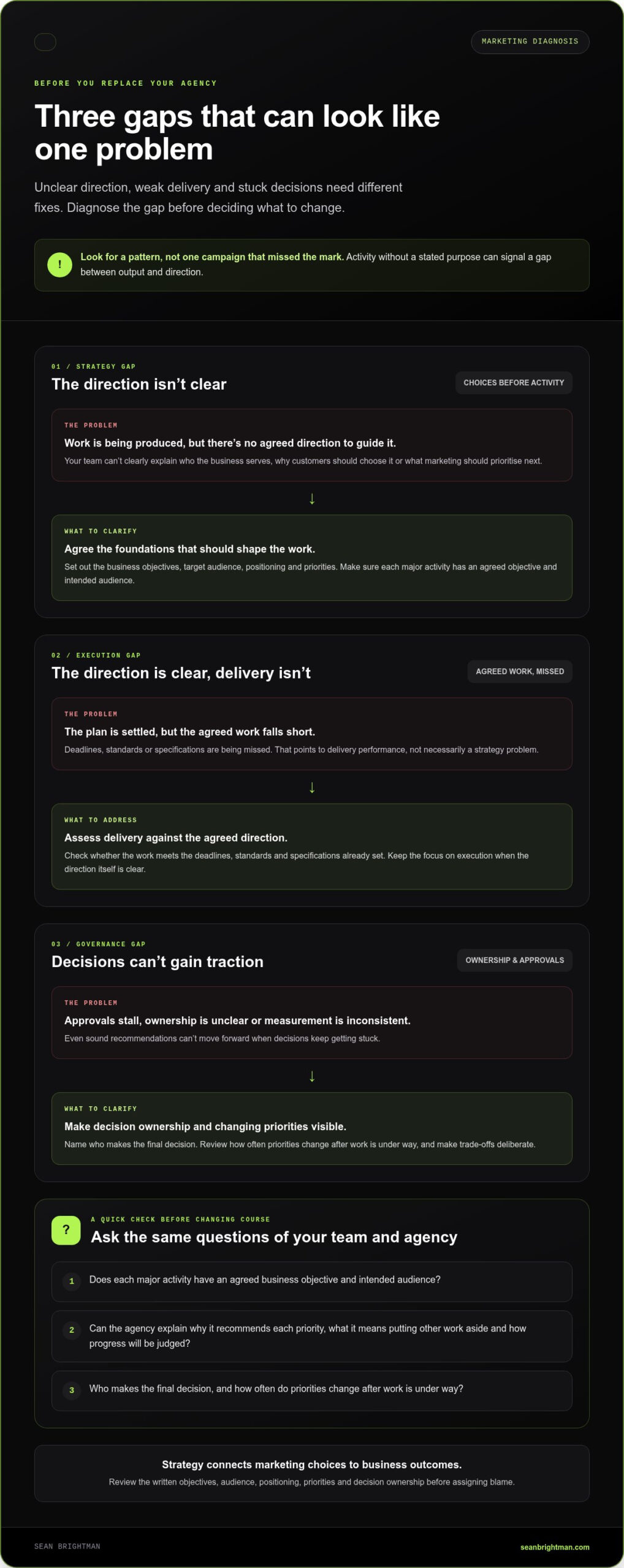
    Look for a pattern, not one campaign that missed the mark. Recurring activity without a stated purpose can signal a gap between output and direction:

    • Campaigns repeat because they’re on the calendar, not because there’s a clear business objective or audience rationale.
    • Reports count posts, clicks or completed tasks but don’t explain what the results mean for the business or what should change next.
    • Urgent requests keep taking over, pushing agreed priorities aside without a deliberate decision about the trade-off.

    These signs don’t prove the agency is incapable. They do show that the work isn’t being tied clearly enough to choices and outcomes.

    What a strategic agency relationship should give you

    A strategic partner uses your objectives, positioning and understanding of customers to shape recommendations. Channel choices should follow the goal and audience, not habit or whatever happens to be easiest to produce.

    Good recommendations also come with a rationale: why this activity, why now, what it asks you to deprioritise and how you’ll judge progress. You should hear a clear point of view, not automatic agreement with every request. For example, if a new campaign would pull resource away from a priority already in motion, the agency should flag the conflict and help you make an informed choice.

    Strategic direction doesn’t mean every recommendation will be right. It means the thinking is visible, the trade-offs are discussed and the work has a reason to exist. That gives you something concrete to assess before deciding whether the issue sits with the agency, the brief or the way decisions are made inside the business.

    Is the agency the problem or is your strategy unclear?

    If you’re thinking “my marketing agency is not strategic enough”, pause before deciding who’s at fault. The problem could sit in the strategy, the agency’s capability, the quality of delivery or the way decisions get made inside your business. These gaps can look similar from the outside, but each needs a different fix.

    Start by checking the foundations: are your objectives, target audience, positioning and priorities clear? Does everyone know who has authority to approve work and change direction? If those answers shift between meetings, the agency may be responding to mixed signals rather than ignoring a settled plan.

    A quick diagnostic: strategy gap or execution gap?

    • Strategy gap: Your team can’t explain who the business serves, why customers should choose it or what marketing should prioritise next. The agency may be producing work, but there’s no agreed direction to guide it.
    • Execution gap: The direction is clear, yet agreed work misses deadlines, standards or specifications. That points to delivery performance, not necessarily a strategy problem.
    • Governance gap: Approvals stall, ownership is unclear or measurement is inconsistent. Even sound recommendations can’t gain traction if decisions keep getting stuck.

    These gaps can overlap. A brief that asks for more leads, greater brand awareness and a new audience all at once, without ranking those goals, gives the agency no clear basis for trade-offs. If different people then give conflicting feedback, the next version may swing in another direction. Before assigning blame, review the written objectives, audience, positioning, priorities and decision ownership.

    Questions that expose the real source of the problem

    Use the same questions with your team and agency. The answers, and where they differ, will show what needs attention:

    • Does each major activity have an agreed business objective and intended audience?
    • Can the agency explain why it recommends each priority, what it means putting other work aside and how progress will be judged?
    • Who makes the final decision, and how often do priorities change after work is under way?

    The U.S. Bureau of Labor Statistics outlines marketing managers’ responsibilities, including assessing trends and choosing strategies, in its Duties of Marketing Managers overview. That’s a useful reference point: strategic direction involves judgement and choices, not simply carrying out a list of requests.

    If the answers point to a wider disconnect between planning, people and processes, examine your marketing operations growth engine. A structured roadmap can help turn the diagnosis into clear priorities, owners and decisions. Explore senior marketing leadership if you need an experienced lead to align that direction with agency activity.

    Should you replace your marketing agency or reset the relationship?

    Changing agencies can feel like a clean break. But a new supplier won’t solve unclear goals, shifting priorities or missing decision ownership. If you’re thinking “my marketing agency is not strategic enough”, base the decision on evidence: what the agency can do, what it has actually delivered, what your business needs next and how both sides behave when problems surface.

    There are three routes. Choose the one that addresses the real gap, not simply the one that promises a fresh start.

    Route Best fit when What to establish
    Reset the brief The agency delivers competently, but objectives, priorities or success measures are vague. Clear goals, audiences, responsibilities, recommendations and review measures.
    Add strategic leadership The business needs someone to set direction and coordinate internal teams or multiple specialists. Who owns the strategy, makes trade-offs and keeps activity aligned with business priorities.
    Replace the agency There’s evidence of a capability or delivery gap, or agreed direction repeatedly fails to shape the agency’s work. The requirements for the next relationship, including scope, ownership and measures of progress.

    When a reset is worth trying

    Try a reset when the agency can deliver the work but hasn’t had a clear enough operating brief. Put the commercial objective, target audience, priority activity and success measures in writing. Then agree a defined review period with specific outcomes, rather than accepting open-ended promises to “be more strategic”.

    Make the expectations two-sided. Set out what the agency will recommend, what it will deliver and what its reporting should explain. The reset is also a test: can the agency turn clearer direction into relevant proposals and consistent work? If yes, you may have fixed the brief, not needed a new supplier.

    When a change or senior leadership is justified

    Consider a change if clear, agreed direction still doesn’t influence recommendations or delivery. Repeatedly missing standards, deadlines or agreed priorities points to a problem the brief alone may not fix. Look at the pattern, not one disappointing result.

    If the business uses several specialists or agencies, the missing piece may be someone on your side to set priorities, make trade-offs and keep everyone moving in the same direction. A Fractional CMO provides part-time senior marketing leadership; it’s a strategic lead, not another delivery supplier. And before bringing in anyone new, settle unresolved choices about positioning and commercial priorities. Otherwise, the same uncertainty follows you into the next relationship.
    My Marketing Agency Is Not Strategic Enough: What to Do Next

    How to reset an under-strategic agency with a sharper brief

    If you’ve concluded that “my marketing agency is not strategic enough”, don’t send another vague request to “think bigger”. Give the agency a brief it can use to make decisions, then judge the recommendations and work against it.

    Build the reset in sequence:

    1. Set the commercial goal. State the business outcome marketing needs to support and how you’ll recognise progress.
    2. Clarify the audience. Describe the customers you need to reach and the problem they need solved.
    3. Choose priorities. Rank what matters now. Make clear what should pause or stop if new work takes its place.
    4. Assign owners. Name who leads the work, who approves it and who makes the final call if priorities conflict.
    5. Review the evidence. Agree which measures you’ll use, how often you’ll discuss them and what decisions the results should inform.

    Build a brief that gives the agency strategic context

    Put the business objective, customer problem and target audience in plain language. Add your positioning, the proof points that support it, commercial constraints and decisions already made. Record assumptions too, such as an untested belief about why customers choose you. Mark it as an assumption, not a fact.

    This stops the agency from treating every request as a fresh instruction. A strategic brand roadmapping approach can help turn those choices into a usable plan, with priorities and accountable decisions rather than a disconnected task list.

    Create accountability without measuring activity alone

    Agree an outcome measure that reflects the goal, alongside leading indicators that show whether the work is moving in the right direction. The right measures depend on the objective. Don’t judge a positioning project by the same measures as a lead-generation campaign.

    Ask the agency to explain what the evidence suggests, what it recommends doing next and what the team expects to learn. Keep a regular review rhythm focused on progress, learning and decisions, not just a tour through completed tasks. Results can move alongside a campaign without proving that the campaign caused them, so treat performance data as evidence to interpret, not automatic proof.

    Capture changes to assumptions, constraints and priorities as they happen. That record makes it easier to understand why the plan shifted and whether the shift was deliberate. For senior support turning a diagnosis into priorities and an accountable roadmap, explore strategic roadmapping support.

    When strategic marketing leadership is the missing piece

    An agency can deliver strong work and still lack the authority to decide what the business should prioritise. That isn’t necessarily an agency failure. Agencies work within the direction they’re given; someone on the business side needs to connect marketing choices to commercial goals, make trade-offs and keep the whole system aligned.

    If you’re still thinking “my marketing agency is not strategic enough” after clarifying the brief, ask a different question: who owns marketing direction across the business? Without that senior ownership, internal teams and external specialists can each do their part whilst pulling towards different goals.

    What senior strategic direction changes

    A senior marketing leader turns business objectives into practical choices. They connect positioning and customer priorities to channel decisions, resource allocation and the work agencies are asked to deliver. They also give the agency a clear strategic brief and a decision-maker who can maintain focus when new requests compete for attention.

    That leadership doesn’t stop at campaign delivery. It creates accountability for what the business is learning, whether the direction still makes sense and what should change next. A Fractional CMO provides this senior marketing leadership on a part-time basis. They lead strategy and align agency and internal activity, rather than acting as another delivery supplier or requiring a full-time hire.

    Choose the right next step for your situation

    The right support depends on the gap you’ve identified:

    • Use a roadmap when the business needs clear priorities, direction and accountable decisions. It gives the team and agency a shared plan to work from.
    • Use ongoing advisory when leaders have a direction but need continued challenge, guidance and accountability as decisions arise.
    • Consider Fractional CMO leadership when marketing needs senior ownership across teams, agency partners and business priorities.

    These options solve different problems. A roadmap sets out the direction; an advisory retainer provides ongoing input; a Fractional CMO takes part-time senior leadership across marketing. The point isn’t to add another layer of activity. It’s to put clear ownership above delivery, so specialists know what they’re working towards and leaders can make decisions with the wider business in view.

    If you’ve identified a need for that direction, explore strategic marketing direction as a practical next step.

    Give your marketing a clearer direction

    If you’re thinking “my marketing agency is not strategic enough”, don’t jump straight to replacing it. First work out whether the gap is unclear goals, weak execution or missing senior ownership. A sharper brief can reveal whether the agency can respond to clear commercial priorities.

    Set out what the business needs marketing to achieve, who it needs to reach and how you’ll assess progress. If activity still lacks direction, the business may need someone to own strategy across internal teams and agency partners. A Fractional CMO provides part-time senior marketing leadership, whilst roadmapping and advisory support bring structure, direction and accountability.

    You don’t need to solve everything at once. Make the next decision based on evidence, then give the team a clear route forward. Explore senior marketing direction with Sean Brightman and take the next step towards marketing that works in service of your business goals.

    Frequently Asked Questions

    How do I know if my marketing agency is not strategic enough?

    Look for repeated activity without a clear link to business goals, audiences or positioning. If you’re asking “my marketing agency is not strategic enough”, check whether recommendations explain why a campaign or channel matters, what it means prioritising it and how success will be judged. One missed report isn’t proof of a strategy problem. A persistent inability to explain the direction behind the work is a stronger warning sign.

    Should I fire my marketing agency if it is not strategic enough?

    Not automatically. First check whether the agency has a clear brief, access to the right information and a decision-maker who can maintain priorities. Reset the objectives, responsibilities and review measures, then assess the agency’s response over an agreed period. Consider changing providers if strategic gaps persist despite clear direction, or if the agency can’t meet the capabilities your business needs. A new agency won’t fix unclear goals or ownership by itself.

    Can a marketing agency be good at execution but weak at strategy?

    Yes. Campaign production and channel management are different capabilities from setting strategic direction. An agency may deliver work competently whilst relying on you to define the audience, positioning, priorities and measures of success. The useful question isn’t whether the agency is good or bad overall. It’s whether its strengths match the role you expect it to play, and whether someone in the business owns the decisions around that work.

    What should I ask my marketing agency to improve its strategy?

    Ask how each recommendation connects to a business objective, target audience and positioning. Request the evidence behind its priorities, the trade-offs involved and the measures it will use to learn. Clarify what should stop, who owns final decisions and when you’ll review the plan. These questions help create a sharper working brief. They won’t replace clear leadership, so make sure someone in your business can set priorities and make decisions.

    How long should I give a marketing agency to improve?

    Set a review period that fits the work and the decisions involved, rather than relying on an arbitrary industry-wide timeframe. Agree the changes you expect to see, such as clearer recommendations, aligned priorities, defined measures or improved delivery. Use regular checkpoints to assess evidence and decide what happens next. Make the reset time-bound and observable, but don’t demand guaranteed commercial results by a fixed date.

    Do I need a Fractional CMO or a new marketing agency?

    A new agency may help if your current provider lacks the capabilities or working approach your business needs. A Fractional CMO may be more relevant when you lack senior marketing ownership to set direction, coordinate suppliers and connect activity to commercial goals. The role provides part-time senior marketing leadership, not another delivery supplier. Diagnose the gap first: replacing execution without addressing missing leadership can reproduce the same problem with a different agency.

    What should a strategic marketing agency report include?

    A useful report connects performance to agreed objectives, explains what the evidence does and doesn’t show, and recommends what to do next. It should make priorities and trade-offs clear, not just list posts, clicks or completed tasks. Choose measures that fit the goal, then use them to guide decisions and learning. Treat results as evidence to interpret, not proof that a campaign caused an outcome unless the analysis supports that conclusion.

  • Cost of Fractional CMO vs Agency: The Brutal Truth for UK Scale-ups

    Cost of Fractional CMO vs Agency: The Brutal Truth for UK Scale-ups

    You think hiring an agency is the safe, cost-effective way to scale. It isn’t. It’s often the fastest way to burn cash on “activity” that lacks a soul. Most UK scale-ups obsess over the monthly invoice whilst ignoring the strategic debt piling up in the background.

    You’ve likely felt the frustration. You’re paying for “account managers” who need your constant oversight just to keep the lights on. You see reports filled with vanity metrics, but your bank balance doesn’t move. You want a growth engine; instead, you’re getting a list of tasks. When you weigh up the cost of fractional cmo vs agency, you shouldn’t just look at the bottom line of the quote. You need to look at who owns the outcome.

    The true cost of marketing isn’t the fee you pay. It’s the wasted spend caused by poor strategy. This article breaks down the brutal reality of both models. I’ll show you why clarity beats capacity every time and how to build a scalable system that doesn’t require the CEO to play part-time marketing director. We’re moving from managing people to owning results.

    Key Takeaways

    • Stop acting as an unpaid project manager for your own agency. Learn to reclaim the hours lost to micromanaging external teams that should be managing themselves.
    • Understand the real cost of fractional cmo vs agency models by looking at strategic value rather than just the monthly retainer. A fractional leader provides the senior accountability an agency lacks.
    • Shift your focus from buying “capacity” to buying “clarity.” Discover how to build a growth engine that runs on systems and AI rather than just uncoordinated, tactical activity.
    • Audit your marketing ROI by identifying “strategic debt.” Learn to spot uncoordinated tasks that feel like progress but fail to build long-term business value.

    The Invisible Cost of Agency-First Marketing

    Scale-ups often treat agencies like a “set and forget” solution. It is a myth. You don’t just pay an agency; you pay to manage them. Most founders realise too late that hiring an agency to “fix” marketing usually results in a new full-time job for the CEO. This is the hidden friction that kills growth and drains your most valuable resource: your time.

    Agencies sell capacity. They sell hours, clicks, and output. They are the hands of your marketing operation. But hands without a brain just flail. When you evaluate the cost of fractional cmo vs agency, you must account for the strategic vacuum left behind when you only hire “hands.” This vacuum creates strategic debt. It is the long-term cost of uncoordinated, tactical activity that fails to align with your business model.

    The CEO Management Tax

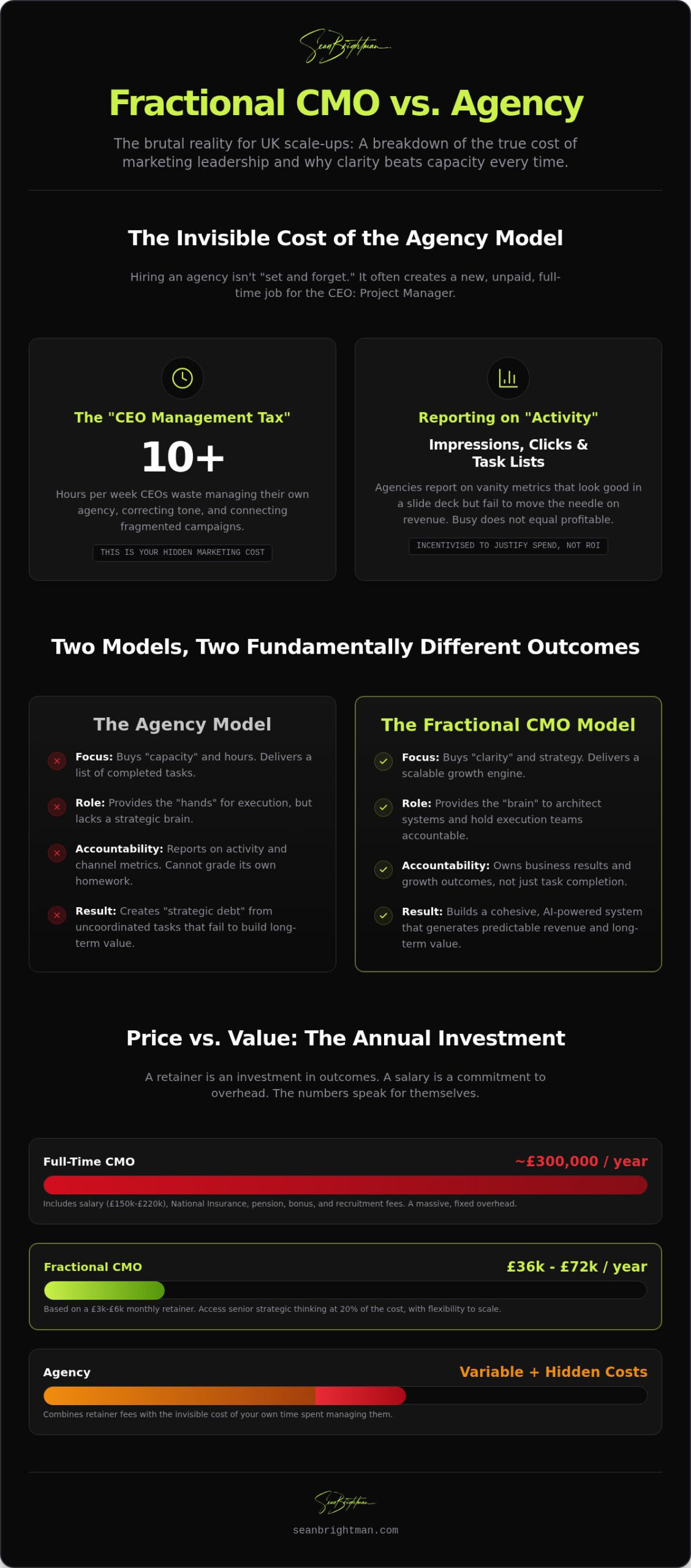
    If you’re spending 10 hours a week explaining your business model to an “account manager,” you’re failing. You’ve become a de facto Marketing Manager. This “outsourcing” actually increases your internal workload. You end up chasing deadlines, correcting tone, and trying to connect the dots between fragmented campaigns.

    Calculate your hourly rate. Multiply it by 40 hours a month. That is the invisible surcharge on your agency invoice. You aren’t paying for growth; you’re paying to be a supervisor. This activity feels like progress, but it rarely moves the needle on revenue. It just keeps the wheels spinning whilst you do the heavy lifting of strategic planning.

    Why Agencies Can’t Grade Their Own Homework

    An agency’s primary goal is to keep you spending. Their business model relies on retainers and ad spend percentages. This creates a fundamental conflict of interest. They cannot objectively audit their own performance because they are incentivised to justify their existence, not to keep your operation lean.

    They report on vanity metrics because vanity metrics look good in a slide deck. You get reports filled with impressions that don’t lead to intent and clicks that don’t convert. These numbers mask a lack of strategic direction. They show you are busy, not that you are profitable.

    You need a senior partner who owns the results, not just the tasks. The Fractional executive model places an architect in your business. This partner holds execution teams accountable. They don’t care about “activity.” They care about the growth engine. They ensure every pound spent is an investment, not just another cost of doing business. Agencies provide hands; a Fractional CMO provides the brain.

    Price vs Value: Decoding the Fractional CMO Model

    Scaling a business requires senior leadership. Most UK scale-ups think they only have two choices: hire a full-time heavyweight or dump the problem on an agency. Both are expensive mistakes. A full-time CMO in the UK carries a basic salary between £150,000 and £220,000. When you add National Insurance, private health, pension contributions, and bonuses, that seat costs you nearly £300,000 before they’ve even opened their laptop. That is a massive overhead for a business that needs to stay agile.

    The cost of fractional cmo vs agency models becomes clear when you look at the middle ground. Typical UK market rates for a Fractional CMO sit between £3,000 and £6,000 per month. You get the same calibre of strategic thinking as a full-time hire but at 20% of the cost. It’s a plug-and-play solution. You aren’t paying for their career development or office politics. You’re paying for their years of battle-hardened experience to be applied directly to your growth engine.

    The Retainer vs The Salary

    A retainer is an investment in outcomes. A salary is a commitment to overhead. By choosing the fractional model, you strip away the hidden costs of employment. There are no recruitment fees, no notice periods that paralyse your strategy, and no equipment costs. You gain the ability to scale the engagement up or down based on your business velocity. If you need a heavy push for a product launch, they’re there. If you need to stabilise, you dial back. This flexibility is essential for any business navigating the debate of in-house vs. outsourced marketing. A fractional leader isn’t an “outsourced” vendor; they are an internal partner with an external perspective.

    AI as a Force Multiplier

    The modern CMO isn’t just a brand-builder. They are a systems architect. By working with a Marketing operations consultant, you’re building a scalable engine that uses AI to replace bloated agency teams. AI consulting reduces the need for expensive, manual execution. We use AI to build “automated accountability” into your marketing systems. This ensures every pound is tracked and every channel is optimised without needing a dozen junior agency staff to “manage” the process. A modern CMO must be an AI-integrator. If they aren’t looking at how to make your marketing leaner through technology, they aren’t doing their job. If you want to see how these systems fit together, you can explore my advisory retainer services to see how we build these engines.

    Fractional CMO vs Agency: The Direct Comparison

    Agencies are external vendors. A Fractional CMO is an internal partner. This isn’t just a semantic difference; it is a fundamental shift in how your business functions. When you examine the cost of fractional cmo vs agency, you are comparing the price of “doing” against the value of “directing.” One adds to your to-do list. The other removes items from it.

    Agencies sell hours and output. They profit from the volume of work they perform. A Fractional CMO sells outcomes and strategy. They profit from the efficiency of your growth engine. If you want to understand why this shift is happening across the UK, read about why you should Stop Hiring Full-Time CMOs to see the full scope of the fractional revolution.

    Who Owns the Strategy?

    Agencies execute a brief. They are reactive by design. If your brief is poor, their results will be poor. They won’t challenge your assumptions because challenging the client puts the retainer at risk. A Fractional CMO writes the brief. They are proactive. They sit on your side of the table and ensure marketing strategy aligns with the CEO’s exit goals or long-term scaling plans.

    An agency-led strategy often looks like “more of the same.” They recommend the channels they are comfortable managing, not necessarily the ones your business needs. A senior partner doesn’t care about channel loyalty. They care about the machinery of growth. They provide the “this, not that” clarity that keeps you from wasting budget on tactical dead ends.

    Transparency and Mark-ups

    The “messy middle” of marketing spend is where profit goes to die. Agencies often hide their margins in media buying mark-ups or software “recommendations” that provide them with kickbacks. These are hidden costs that never appear on your main invoice but drain your ROI. They make the system complex to remain indispensable.

    A Fractional CMO provides total transparency. They audit the spend and cut the fat. They identify where an agency is overcharging for junior staff or marking up tools you could own directly. You get direct accountability. There is one throat to choke when things go wrong and one person responsible for ensuring every pound is working. You aren’t just buying capacity; you’re buying an insurance policy against marketing wastage.

    Cost of Fractional CMO vs Agency: The Brutal Truth for UK Scale-ups

    Calculating Your Real Marketing ROI

    Most scale-ups track the wrong numbers. They look at the monthly invoice and call it a day. That is lazy. To understand the true cost of fractional cmo vs agency models, you have to look at the leaks in your system. ROI isn’t just what you make; it’s what you stop losing. You need to calculate the total investment, not just the fees.

    • Step 1: Audit current spend. Identify the “wastage.” If a pound isn’t clearly attributed to a conversion or a strategic milestone, it is a donation to your agency’s office rent.
    • Step 2: Factor in your time. We’ve discussed the CEO management tax. Now, quantify it. If your time is worth £500 an hour and you spend five hours a week fixing agency mistakes, that is £10,000 a month in lost leadership value.
    • Step 3: Evaluate opportunity cost. How long does it take your agency to pivot? If they take three months to adjust to a market shift, you’ve lost a quarter of growth. A senior partner pivots in hours.
    • Step 4: Compare overheads. Contrast the cost of a Marketing advisory retainer against the combined total of your agency fees, your management time, and your wasted ad spend.

    The 90-Day Reset

    ROI starts with a Strategic brand roadmapping session. This isn’t a polite workshop. It is a tactical audit. We strip away the fluff. We kill the campaigns that feel good but do nothing. We set hard, non-negotiable KPIs. Your execution partners must meet these numbers to stay on the roster. We move from hoping it works to knowing it works.

    Efficiency over Activity

    Activity is a vanity metric. Efficiency is a business metric. I don’t care about a high volume of leads if your sales team thinks they are rubbish. We focus on pipeline quality. A Fractional CMO fixes the Sales-Marketing handoff. They build a clean, AI-powered marketing machine that prioritises conversion over clicks. This is how you build a scalable engine that doesn’t require constant CEO oversight. If you are ready to audit your current marketing engine, book a consultation to find your hidden ROI.

    The Sean Brightman Approach: Advisory over Activity

    I don’t sell activity. I sell direction. Most UK scale-ups are drowning in “stuff” but starving for strategy. My approach is built on battle-hardened expertise, not agency-style fluff. We focus on the architecture of your growth engine, not just the paint job. If your engine is broken, no amount of shiny new ads will fix it. You need a partner who knows how to fix the machinery, not just someone who can change the oil.

    We build for 2026, not 2016. That means deep AI integration. We use technology to automate the mundane and amplify the strategic. This isn’t about replacing people; it’s about making your team ten times more effective. When you evaluate the cost of fractional cmo vs agency, you have to consider the future-proofing of your business. An agency wants to keep you using their manual, billable processes. I want to build you a machine that runs without them. My Advisory Retainer provides the direction, accountability, and straight-talking partnership you need to move fast.

    Building Smarter Systems

    Tools aren’t a strategy. Having a CRM isn’t a strategy. Knowing how to organise those tools into a scalable, buyer-coveted engine is where the value lies. My methodology strips away corporate politeness. I provide blunt honesty about what is working and what is a waste of cash. We move from “messy marketing” to a clinical system. We organise your stack so that data flows, accountability is automated, and results are visible. We stop guessing and start measuring.

    Your Next Move

    Your first hire shouldn’t be a £200k full-time CMO. It’s too risky and too slow. You don’t need a career-focused executive yet; you need a plug-and-play strategist who has seen your problems before. The path to scaling is simple. We start with a roadmap to identify the gaps. We then move to an advisory retainer for ongoing direction and accountability. This is the ultimate tool for CEOs who want to reclaim their time and stop being the bottleneck.

    The cost of fractional cmo vs agency is ultimately measured in strategic velocity. You can keep paying for uncoordinated tasks, or you can invest in a partner who owns the outcome. Stop wasting spend on tactical noise. It’s time to build a system that scales. Contact me today to start building your growth engine.

    Own Your Growth Architecture

    The choice isn’t just about the invoice. It’s about who owns the number. Agencies provide the hands, but without a senior brain, you’re just paying for uncoordinated activity. By weighing up the cost of fractional cmo vs agency models, you’ve seen that the real expense is the strategic debt of “messy marketing.” You don’t need more reports. You need an engine that runs without you.

    I specialise in building “buyer-coveted” growth engines for UK founders who value blunt honesty over corporate fluff. As the author of the definitive guide to AI-powered marketing strategy, I help you integrate the systems that make your business scalable and attractive for exit. Stop acting as a part-time marketing manager. It’s time to install a senior partner who builds machinery, not just campaigns.

    Ready to find your hidden ROI? Book a Strategic Roadmapping Session with Sean Brightman to strip away the noise and start building a system that actually scales. Your growth engine is waiting for the right architect.

    Frequently Asked Questions

    How much does a Fractional CMO cost per day in the UK?

    UK day rates for a Fractional CMO typically range from £700 to £2,500. Senior specialists in high-growth sectors like fintech often sit at the top of that range. Outside London, rates usually start around the £700 mark. You aren’t just paying for time. You’re paying for a decade of senior leadership delivered in a concentrated burst. This model removes the overhead of a £200k full-time salary whilst retaining the same strategic calibre.

    Is a Fractional CMO better than a marketing agency for a startup?

    It depends on what you lack. If you have no hands to do the work, you need an agency. If you have plenty of activity but no revenue growth, you need a Fractional CMO. A startup often burns cash on uncoordinated agency tasks. A fractional leader builds the strategy first. They ensure your agency is actually delivering. One provides capacity; the other provides clarity. You need a brain before you hire hands.

    Can a Fractional CMO manage my existing marketing agency?

    Yes. This is often the primary reason scale-ups hire one. A Fractional CMO acts as your internal leader. They hold execution partners accountable. They stop agencies from grading their own homework with vanity metrics. They ensure the agency’s output aligns with your business goals. You stop acting as the middleman. They take over the technical management so you can focus on leading the company. They are the architect; the agency is the builder.

    What is the typical length of a Fractional CMO engagement?

    Engagements usually last between six and eighteen months. It isn’t a permanent fixture. The goal is to build a scalable growth engine and then either hand it over to a full-time hire or an internal team. Some founders prefer long-term advisory retainers to maintain strategic oversight without the full-time cost. It is a flexible, results-oriented partnership that scales with your business velocity. You buy the impact, not the person.

    Do I need a Fractional CMO if I already have a Marketing Manager?

    Probably. A Marketing Manager executes. A CMO strategises. If your manager is overwhelmed or lacks the senior experience to build a board-level growth plan, they need a mentor. A Fractional CMO provides the senior architecture that a mid-level manager can then implement. This combination is often the most cost-effective way to scale. You get senior leadership without the senior salary. It turns a tactical role into a strategic asset.

    What is the ROI of hiring a Fractional CMO vs an agency?

    The ROI of a Fractional CMO is measured in efficiency and strategic debt reduction. When calculating the cost of fractional cmo vs agency, look at the waste. A fractional leader can save over £150,000 annually compared to a full-time hire. They identify unattributed ad spend and kill underperforming campaigns. An agency’s ROI is tactical; a CMO’s ROI is structural. They fix the engine that generates the leads. They optimise the entire system.

    How does an Advisory Retainer differ from a Fractional CMO role?

    An Advisory Retainer is a “light” version of the fractional role. It focuses on high-level direction and accountability rather than day-to-day management. You might meet monthly for strategic resets and have on-call support for critical decisions. It is ideal for CEOs who have a competent team but need a battle-hardened strategist to keep them on track. It is about strategic velocity, not tactical execution. It provides a straight-talking partner without the management overhead.

    Will a Fractional CMO help me implement AI in my marketing?

    A modern one will. AI consulting is now a core part of the cost of fractional cmo vs agency debate. We use AI to build automated accountability and replace bloated manual processes. If your CMO isn’t an AI-integrator, they are obsolete. We build systems that use AI to handle the mundane tasks, allowing your team to focus on high-impact strategy. It makes your operation leaner, faster, and built for 2026.