Tag: marketing analytics

  • Reducing Marketing Budget Waste: Find the Leaks Before You Cut

    Reducing Marketing Budget Waste: Find the Leaks Before You Cut

    Cutting the marketing budget can make the spreadsheet look healthier whilst quietly weakening growth. If you’re reducing marketing budget waste, start by finding where spend loses momentum, not by slashing activity that may be working.

    The frustration is familiar: marketing uses budget, but its contribution to revenue is hard to pin down. Teams, agencies, channels and tools each tell a different success story. Under pressure, it’s tempting to cut what’s difficult to measure, even when it supports the business.

    This article shows you how to separate avoidable waste from useful investment, then decide what to fix first. You’ll learn to examine measurement gaps, targeting, messaging, tools and budget ownership using evidence and commercial context rather than guesswork.

    The goal isn’t a smaller budget for its own sake. It’s a clearer decision system: one that links marketing choices to business priorities, turns findings into a prioritised plan and builds regular accountability. That way, each review improves the next decision instead of resetting the conversation every quarter.

    Key Takeaways

    • Spot leaks across measurement, channel choices, tools and hand-offs, not just visible campaign spend.
    • For reducing marketing budget waste, assess performance against commercial outcomes rather than relying on a single metric.
    • Reconcile spend and reporting over a period that fits your sales cycle before acting on apparent underperformance.
    • Prioritise changes by evidence, likely impact, reversibility and how quickly you can learn from them.
    • Keep a decision log with owners, assumptions and review points so each budget decision informs the next.

    Reducing marketing budget waste starts with finding the real leak

    Pressure to cut spend often arrives before anyone can explain what the budget is doing. An across-the-board reduction may look decisive, but it can remove effective investment alongside genuine inefficiency. Disciplined optimisation starts by tracing the leak and fixing its cause. It doesn’t treat every unclear result as proof that activity should stop.

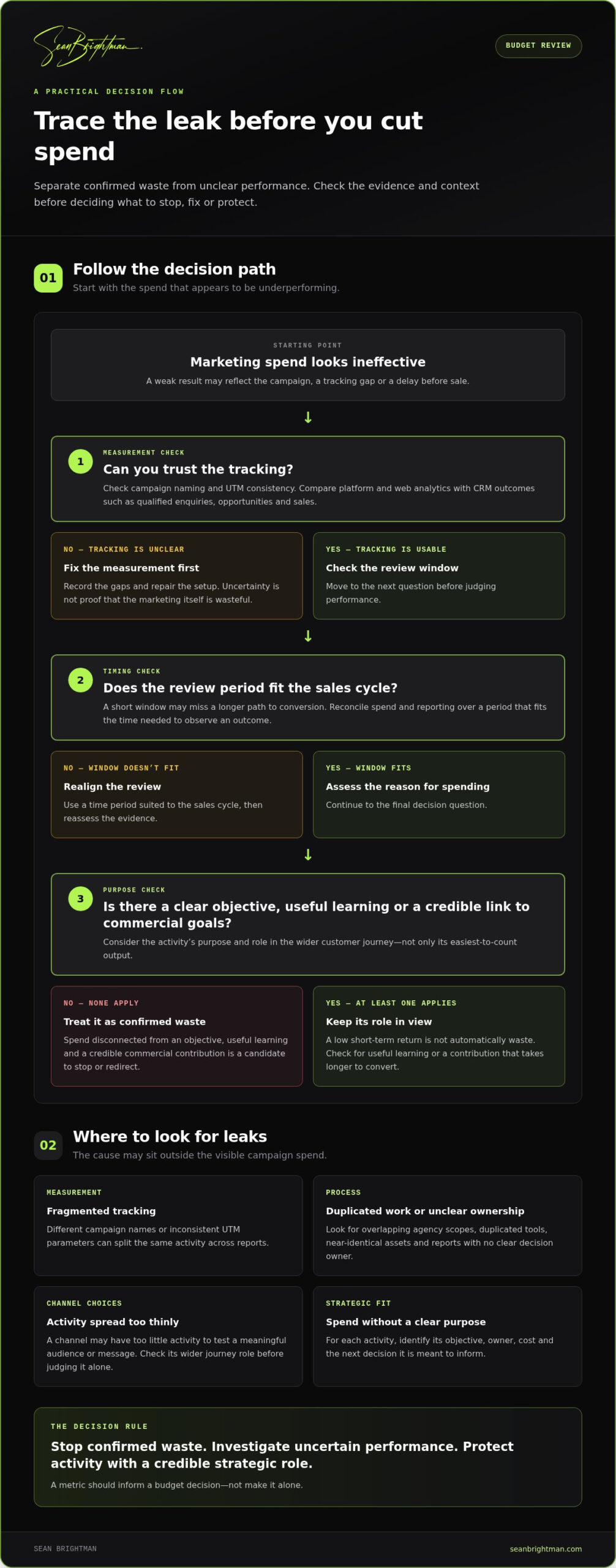
    Marketing budget waste is spend disconnected from a clear objective, useful learning or a credible contribution to commercial goals. That definition matters because weak measurement creates uncertainty, not a verdict. If a campaign’s results aren’t tracked properly, the first problem may be the measurement setup, not the campaign itself. Understanding marketing effectiveness means judging activity against its purpose and role in the wider marketing effort, not just its easiest-to-count output.

    What counts as marketing budget waste?

    Look for avoidable spend in the machinery around marketing as well as in channels. A team might pay for a tool no one uses, commission separate teams to produce near-identical assets, or run campaigns without agreeing who owns the outcome. These are different problems: process waste, channel underperformance and weak strategic fit each call for a different fix.

    A low short-term return isn’t automatically waste. A test that rules out a weak message can provide useful learning; brand activity may also support a customer journey that takes longer to convert. Ask whether there was a clear reason to spend, a way to learn and a sensible link to business priorities.

    Why cutting the budget is not the same as reducing waste

    Equal percentage cuts ignore differences in purpose and performance. They can shrink a proven source of demand just as readily as they remove duplicated work. Cheap leads can also distract from lead quality, whilst activity metrics such as clicks say little on their own about commercial contribution.

    Judge investment against the business goal, the customer journey and the time needed to observe an outcome. A short reporting window may miss a longer sales cycle; a longer one may hide a problem that needs attention now. Make the distinction clear: stop confirmed waste, investigate uncertain performance, and protect activity with a credible strategic role. That’s the starting point for reducing marketing budget waste without cutting growth potential by guesswork.

    Where marketing budgets leak: measurement, hand-offs, and misplaced activity

    Budget leaks rarely sit in one neat line on a report. They build where strategy, channel choices, measurement and delivery fail to connect. A campaign may have a clear objective, but if its results don’t reach the team planning the next activity, the learning gets lost. One team may pay for a tool whilst another buys a similar platform. An agency and an internal team may both produce reports without anyone owning the decision those reports are meant to inform.

    Fragmented tracking makes budget comparisons less reliable because teams may be measuring different activity, outcomes and time periods. That uncertainty is a measurement problem to investigate, not automatic proof that the marketing itself is wasteful.

    How weak measurement hides useful signals

    Attribution is an imperfect view of contribution, not a complete account of cause and effect. A platform may claim credit for a conversion that involved several other interactions, whilst a channel that helped build awareness may receive no direct credit at all. Use measurement to guide investigation, not to declare a winner from one dashboard. Harvard Business School Online’s guidance on how to measure marketing effectiveness offers a broader perspective than relying on a single metric.

    Start by checking the tracking basics. If one team names a campaign “spring_launch” and another uses “Spring-Launch”, or UTM parameters vary between links, reports can split the same activity into separate entries. Compare platform and web analytics with CRM outcomes: qualified enquiries, opportunities and sales can show whether apparent performance translates into business value. Record gaps rather than filling them with assumptions.

    How process and channel choices create avoidable spend

    Next, trace the work between planning and reporting. Look for overlapping agency scopes, duplicated tools, unclear briefs and manual reports that teams rebuild separately. For each activity, identify its objective, owner, cost and next decision. If nobody can explain what a task supports or who acts on its result, that’s a process leak worth investigating.

    Channel sprawl creates another trap. Spreading a budget thinly across multiple channels can leave each with too little activity to test a meaningful audience or message. But consolidation should follow evidence and strategic fit, not convenience. A channel with limited immediate conversions may still play a useful role in the customer journey; check how it supports other activity before judging it in isolation.

    For a deeper look at how joined-up processes support growth, explore marketing operations for a scalable growth engine. A focused marketing roadmapping discussion can also help turn these findings into clear priorities for reducing marketing budget waste.

    How to diagnose wasted marketing spend without trusting one metric

    Move from suspicion to evidence with a repeatable review. A metric should inform a budget decision, not make it alone. A low conversion figure might signal a weak campaign, a tracking gap or a delay between first contact and sale. Separate those possibilities before changing investment.

    Build a useful view of spend and outcomes

    Choose one reporting period that reflects your sales cycle, then use it consistently across the review. Group investment by objective, audience, channel, campaign and internal or external owner. Reconcile planned budget with actual spend, then compare platform and web analytics with CRM outcomes where available. Select the business outcome that fits the objective, such as qualified pipeline, revenue, retention or another meaningful measure.

    Flag missing tracking, inconsistent campaign names, differing attribution windows and gaps between platforms and CRM. Don’t hide incomplete evidence inside a single performance score.

    Use five steps to diagnose the leak

    • Set the outcome: State what the activity was meant to achieve and how that connects to a business priority.
    • Reconcile spend: Check planned allocation against actual spend across teams, channels and suppliers.
    • Compare evidence: Review the chosen outcome alongside relevant platform, website and CRM signals.
    • Investigate variance: Trace unexpected results to possible causes, such as a tracking change, audience shift, delivery issue or a genuine performance decline.
    • Record confidence: Note what the evidence supports, what remains uncertain and what check or test could improve the picture.

    Warning sign | Evidence to investigate | Possible explanation

    Spend rises, but qualified pipeline doesn’t | CRM stages, lead quality and campaign changes | Lower-quality demand, a longer conversion path or a tracking gap

    Two reports show different results | Reporting period, attribution window and campaign definitions | Different measurement rules, not necessarily different performance

    Activity is hard to connect to an objective | Brief, owner and intended audience | Unclear strategy or work that has lost its purpose

    Look for repeated patterns across comparable activity, not a verdict from one campaign or reporting period. Check results against the intended customer journey and the time it takes for outcomes to appear. A short-term dip may matter, but it needs context before it triggers a cut.

    This method makes reducing marketing budget waste more rigorous: it distinguishes a confirmed problem from an incomplete signal and points to the next decision rather than pretending every answer is already in the data.
    Reducing Marketing Budget Waste: Find the Leaks Before You Cut

    What to fix first: prioritise marketing budget changes by evidence

    Start with changes where the waste is visible and the downside is limited. Duplicate subscriptions, overlapping work or activity with no accountable owner are stronger clean-up candidates than a campaign that simply lacks reliable measurement. Don’t cut a channel by default. First weigh the evidence, likely business impact, reversibility and time needed to learn.

    Decision type | Evidence strength | Likely impact | Reversibility | Time to learn

    Immediate clean-up: duplicated tool or repeated task | Clear and verifiable | Usually contained | High | Short

    Test: campaign with mixed results | Partial or inconsistent | Could affect demand | Often high | Depends on the sales cycle

    Tracking fix: activity with incomplete attribution | Insufficient to judge | Unclear until measured | High | Depends on data availability

    Strategic review: investment affecting key audiences or positioning | Requires broader context | Potentially substantial | Lower | Longer-term

    Which budget leaks should you address first?

    Remove confirmed duplication and resolve ownership gaps first. Treat weakly measured activity as an investigation or test candidate, not an automatic cancellation. Escalate choices that could reshape how you reach key audiences, express your positioning or support longer-term growth. The harder a change is to reverse, the stronger the evidence and business case should be.

    How to test a change without damaging growth

    Change one meaningful variable where practical, such as the audience or message, and write down what evidence would change your decision. Set a review point that fits the sales cycle and gives the relevant data time to emerge. If several elements change at once, you may not know what caused the result.

    Example: A team finds two subscriptions that appear to serve the same purpose, whilst one campaign has weak lead tracking but supports an important audience. It can verify and remove the duplicate, then improve tracking and test the campaign before deciding whether to reduce its allocation. The example is illustrative, not a client result.

    If the evidence points beyond channel adjustments to priorities around positioning or growth, use strategic brand roadmapping to shape the next decisions. For senior-level direction on turning findings into a prioritised plan, explore strategic marketing guidance. That’s how reducing marketing budget waste becomes a controlled decision, not a blunt cut.

    Make marketing budget control an ongoing leadership system

    A one-off budget review finds leaks. A leadership system helps stop them returning. Tie each marketing investment to a business outcome, a clear owner and an assumption that can be revisited. Then review what changed, what the evidence says and what decision comes next. This keeps the budget connected to commercial priorities, not just last quarter’s activity.

    Set a budget review cadence that drives decisions

    Set review points around business planning and the sales cycle, not an arbitrary reporting ritual. At each review, look at business outcomes, committed spend, key assumptions and any changes in customer behaviour, team capacity or commercial priorities. If an assumption no longer holds, update the plan rather than allowing old allocations to roll forward by default.

    Keep a decision log that makes accountability visible. Record what changed, why it changed, the expected effect, the person responsible and when the decision will be reviewed. That record helps the team distinguish a deliberate test from unplanned drift in spend.

    Make sure the parts of the system reinforce one another. Positioning shapes which audiences matter; channel choices determine how you reach them; measurement shows what the activity contributes; and operating capacity determines what the team can deliver well. A mismatch between any of these can undermine the rest.

    When strategic marketing support can help

    If priorities keep fragmenting, ownership remains unclear or measurement problems recur, the issue may need senior strategic direction rather than another reporting template. Fractional CMO leadership and ongoing advisory support can connect budget choices to positioning and business goals, and bring accountability to regular reviews. This is strategic oversight, not advertising execution.

    Sean Brightman’s advisory retainer provides ongoing strategic direction and accountability. For senior marketing leadership on a part-time basis, explore Fractional CMO support.

    Start with one action: map current spend against its objective, then identify the biggest evidence gap. Assign someone to close it and bring the finding into your next review. That’s how reducing marketing budget waste becomes an ongoing discipline, not another round of reactive cuts.

    Make your next marketing budget decision count

    Reducing marketing budget waste isn’t about cutting spend evenly. It’s about finding where investment loses momentum, separating confirmed waste from uncertain performance, and choosing changes that fit your business goals.

    Use consistent evidence to guide decisions, not a single metric. Give each investment a clear objective and owner, then record what changes and when you’ll review it. That turns budget control into an ongoing leadership system, not another reactive round of cuts.

    When priorities or accountability are unclear, Fractional CMO leadership brings part-time senior marketing direction. Roadmapping creates structured marketing and brand direction, whilst an advisory retainer supports ongoing strategic oversight and accountability.

    Build a sharper marketing decision system with Sean Brightman. Start with the evidence, make the next decision with confidence, and protect the investment that can support growth.

    Frequently Asked Questions

    What does reducing marketing budget waste actually mean?

    Reducing marketing budget waste means removing or redesigning spend without a clear purpose, accountable owner, useful evidence or credible connection to business outcomes. It doesn’t mean cutting every activity with weak short-term attribution. Some investment supports learning, awareness or longer buying journeys. First diagnose why performance appears weak. Then decide whether to stop, fix, measure or test the activity, based on its intended role and the evidence available.

    How can I tell whether marketing spend is being wasted?

    Map spend to its objectives, owners, campaign activity and relevant outcomes. Check that reporting uses consistent definitions, then compare platform results with CRM or sales information where available. Look for repeated signs such as duplicated work, unused tools or activity without a defined purpose. If tracking is missing or unreliable, treat that as an evidence gap to investigate. Weak measurement alone doesn’t prove that the activity is wasteful.

    Should I cut marketing spend if I cannot measure its return?

    No, not automatically. Start by clarifying the outcome the activity was meant to support and checking whether your tracking captures it. Consider the customer journey, sales cycle and missing data before deciding. If the evidence remains weak, improve measurement or run a bounded test with a clear review point. Preserve investment that has a credible strategic role, and decide in advance what evidence would justify changing it.

    How much marketing budget should a business allocate to each channel?

    There’s no universal channel split that suits every business. Allocation depends on commercial goals, audience behaviour, sales-cycle length, existing evidence and your capacity to execute well. Define the outcome each channel should support, then compare its contribution and the uncertainty around that evidence. Keep room to test and learn. Review the allocation when results, customer behaviour or business priorities change, rather than copying another organisation’s budget mix.

    Which marketing metrics should I use to find wasted spend?

    Choose measures that match the activity’s objective and connect, where possible, to commercial outcomes. Depending on the goal, these could include qualified pipeline, revenue, customer acquisition, retention or meaningful engagement. Use platform metrics as diagnostic signals, not final proof of business impact. Before comparing campaigns or channels, check that definitions, attribution windows and tracking are consistent, and compare platform data with CRM outcomes where available.

    Can AI help reduce marketing budget waste?

    AI can help organise data, surface patterns and speed up analysis when the inputs and definitions are reliable. It can’t resolve unclear objectives, inconsistent tracking or poor judgement by itself. Use it to support investigation, not to make unreviewed budget decisions. Keep a named person accountable for validating the evidence, weighing commercial context and deciding what to change. The quality of the decision still depends on the quality of the information and oversight.

    How often should a business review its marketing budget?

    Set review frequency to fit your sales cycle, business planning rhythm and pace of change. Use regular checkpoints to compare actual spend with objectives and outcomes, then schedule a deeper review when assumptions shift or evidence raises a concern. Don’t change investment so frequently that activity has no time to produce useful learning. Record each decision, its rationale and a proportionate review date so you can assess the effect.

  • Creating a Cohesive Martech Stack: The Operational Blueprint for 2026

    Creating a Cohesive Martech Stack: The Operational Blueprint for 2026

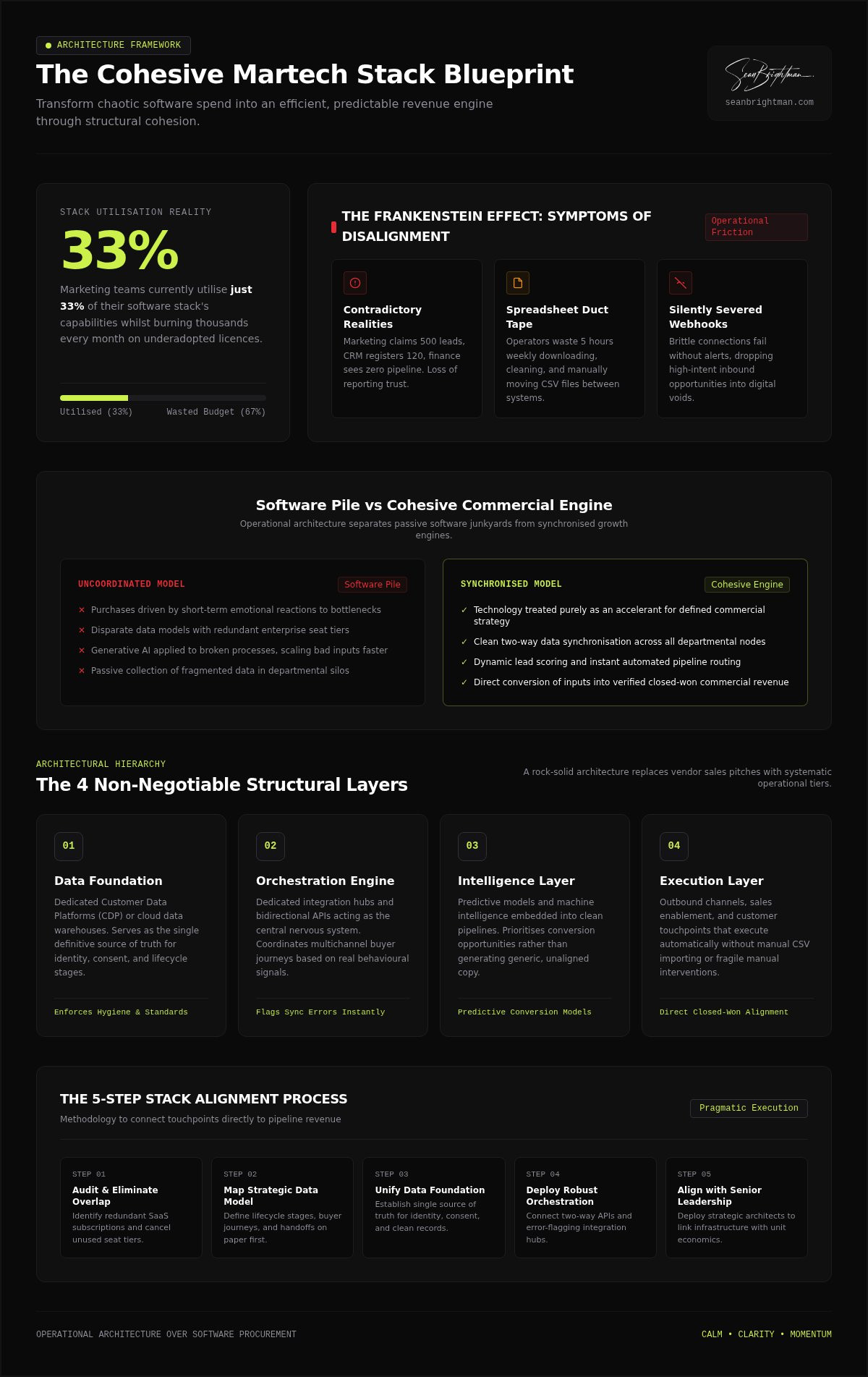
    Marketing teams currently utilise just 33% of their software stack’s capabilities, whilst burning thousands of pounds every month on subscriptions nobody adopts. Stack cohesion isn’t a software procurement problem; it’s an operational architecture failure. You already feel the daily friction. Customer data remains trapped in isolated departmental silos, commercial forecasting is crippled by inaccurate attribution, and your team wastes valuable hours manually moving CSV files between disconnected platforms. Creating a cohesive martech stack demands operational discipline, not another software demo.

    You don’t need more tools; you need a system that actually speaks to itself. In this guide, you’ll discover how to eliminate expensive bloat, unify customer data across every touchpoint, and architect a high-converting tech stack that drives measurable commercial revenue. We will map the operational blueprint for clean two-way data synchronisation, rigorous attribution from first engagement through to closed-won deals, and intelligent automations that execute without human intervention. Here is how you turn chaotic software spend into an efficient, predictable revenue engine.

    Key Takeaways

    • Pinpoint and eliminate SaaS subscription overlap to stop burning budget on underutilised software licences.
    • Establish an unshakeable architectural blueprint across data, orchestration, execution, and analytics layers to eliminate operational friction.
    • Execute a pragmatic five-step methodology for creating a cohesive martech stack that connects customer touchpoints directly to pipeline revenue.
    • Resolve the monolithic suite versus composable stack dilemma based on your internal capabilities and commercial growth velocity.
    • Deploy senior strategic leadership rather than junior operators to align marketing infrastructure directly with unit economics.

    The Anatomy of Martech Bloat: Why Modern Stacks Break Down

    Most commercial organisations do not possess a technology architecture. They possess a software junkyard. Creating a cohesive martech stack means building a synchronised commercial engine where data flows bidirectionally between systems to drive measurable revenue, not collecting point solutions to soothe short-term operational anxiety.

    Modern marketing stacks break down because procurement is treated as an emotional reaction rather than an architectural discipline. A team member encounters a workflow bottleneck, submits an expense request for a point solution, and leaves the company twelve months later. The subscription renews automatically. Multiply this across five departments, and you are bleeding thousands of pounds on redundant licences, unused enterprise seat tiers, and unmanaged integrations that generate fatal data silos.

    Worse, slapping generative AI platforms onto disjointed pipelines only accelerates the damage. AI does not fix broken foundational processes; it scales bad inputs faster. Without architectural cohesion, you are simply automating chaos at an enterprise scale.

    The Frankenstein Effect: Symptoms of an Unaligned Stack

    When software is stitched together haphazardly, operational friction turns lethal to commercial growth. Look for these clear warning signals within your daily operations:

    • Contradictory realities: Marketing dashboards claim 500 qualified leads, sales CRM records 120, and finance sees zero pipeline impact. Nobody trusts the reporting.
    • Spreadsheet duct tape: Highly paid operators spend five hours every week manually downloading, cleaning, and uploading CSV files because two core databases refuse to talk to each other.
    • Silently severed webhooks: Brittle, multi-step connections break without alerting anyone, dropping high-intent inbound opportunities into a digital black hole between systems.

    Software Pile vs Cohesive Engine: The Critical Difference

    A software pile collects passive inputs. An engine converts inputs into closed-won revenue through tight operational synchronisation.

    When you purchase point solutions in isolation, you inherit disparate data models, overlapping feature sets, and fragile integrations. Conversely, creating a cohesive martech stack relies on a unified data layer that powers foundational marketing automation, dynamic lead scoring, and instant pipeline routing. Technology is purely an accelerant for commercial strategy. If the strategic data model, buyer journey stages, and commercial handoffs are undefined on paper, purchasing another software licence will merely amplify your operational dysfunction.

    The 4 Structural Layers of a High-Performing Martech Architecture

    Stop looking for a single silver-bullet tool. High-growth organisations build on operational architecture, not software vendor sales pitches. Creating a cohesive martech stack requires four distinct, non-negotiable structural layers: data foundation, orchestration, execution, and intelligence. When these components connect properly, customer data flows freely, attribution becomes undeniable, and pipeline converts predictably.

    The Data Foundation: Warehouses, CDPs, and Clean Records

    Your CRM is not the centre of the universe. The foundational layer belongs to a centralised data store, whether a dedicated Customer Data Platform (CDP) or a structured cloud data warehouse. This layer acts as the definitive single source of truth for customer identity, regulatory consent, and lifecycle stages. It strips out duplicate records, enforces property standards across systems, and ensures pristine data hygiene before records feed into downstream commercial tools. If this foundation is cracked, your entire stack crumbles.

    The Orchestration Engine: Workflow Automation and Integration Hubs

    Orchestration operates as the central nervous system of your business. It connects raw records to active customer-facing campaigns. High-performing architectures abandon brittle, consumer-grade zaps in favour of dedicated integration hubs and bidirectional APIs. This layer coordinates multichannel buyer journeys based on verified behavioural signals, manages data mapping protocols, and flags sync errors immediately. When an enterprise prospect requests pricing, sales enablement and email sequences trigger in lockstep, zero manual imports required.

    The Intelligence Layer: Embedding AI and Predictive Models

    Generic generative copy tools do not create commercial leverage. True competitive advantage comes from embedding predictive models directly into your clean operational data. This layer handles dynamic account scoring, real-time intent routing, and churn probability warnings before accounts churn.

    Operationalising this intelligence requires methodical alignment. Senior commercial teams regularly deploy targeted ai consulting to build bespoke workflows that eliminate friction rather than introducing technical debt. Done right, creating a cohesive martech stack ensures your intelligence layer drives execution automatically. If your infrastructure lacks this cohesive coordination, partnering with an experienced strategic advisor at seanbrightman.com can help map the technical blueprint your commercial engine requires.

    How to Build a Cohesive Martech Stack: The 5-Step Process

    Fixing a fragmented commercial stack is not about buying fresh software. It is a systematic teardown and rebuild. Creating a cohesive martech stack demands operational discipline across five clear phases: auditing licences, mapping buyer journeys, pruning waste, enforcing taxonomy, and securing robust API integrations.

    Steps 1 and 2: The Ruthless Systems Audit and Journey Mapping

    Start by auditing every software licence across the business. Pull credit card statements, review departmental expenses, and catalogue contract renewal dates alongside actual seat utilisation. Most leadership teams discover paid accounts untouched for months.

    Next, trace the end-to-end journey of an inbound lead from initial anonymous visit through to payment processing. Document every digital handoff between platforms:

    • Where do leads sit unassigned due to broken webhook delays?
    • Which touchpoints require an operator to manually re-enter contact fields?
    • Where does attribution tracking fail between campaign interaction and CRM deal creation?

    Mark every point of human intervention. Those friction points are where commercial pipeline leaks.

    Steps 3 and 4: Pruning Redundancy and Enforcing Data Hygiene

    With your operational bottlenecks visible, cut the excess. Identify functional overlap across platforms. Your email automation tool, CRM, and customer success platform might all offer survey functionality or lead scoring. Choose one definitive system for each capability and cancel the redundant licences.

    Once you strip away the bloat, establish ironclad data governance. Standardise UTM parameters, custom properties, and lifecycle status definitions across departments. Sales, marketing, and finance must agree on what constitutes a qualified lead and where that status updates. Without unified definitions, creating a cohesive martech stack is impossible.

    Step 5: Engineering Resilient Integrations and API Governance

    Eliminate fragile third-party automations bridging critical commercial paths. Direct, bidirectional API integrations or enterprise middleware must handle primary data pipelines between your CDP, CRM, and marketing platforms.

    Implement real-time error logging and automated failure alerts. If a sync fails between your lead capture forms and your sales queue, your operations team must know within minutes, not weeks later after missed quarterly targets. Finally, record every integration in an accessible data dictionary. When architectures are properly documented, institutional knowledge stays protected regardless of staff turnover.

    Creating a Cohesive Martech Stack: The Operational Blueprint for 2026

    All-in-One Suites vs Best-of-Breed: Choosing Your Core Strategy

    Every commercial leader hits the same architectural fork in the road. Do you buy a single monolithic suite that promises to handle everything passably, or do you assemble a composable stack of specialised tools that excel at specific tasks? The answer dictates your operating margins, integration overhead, and agility for years. When creating a cohesive martech stack, neither choice is inherently superior. The decision comes down to your internal technical maturity and commercial growth velocity.

    The Monolithic Advantage: Simplicity, Governance, and Native Sync

    Monolithic platforms win on administrative simplicity. A single contract, unified user permissions, and native data models eliminate the integration headaches that plague fragmented environments. Data moves seamlessly between marketing campaigns and sales pipelines because it lives in the same relational database. The trade-off is functionality depth. Monolithic suites provide broad operational coverage, but their individual modules frequently offer shallower capabilities than dedicated point solutions. If your commercial execution demands sophisticated multichannel orchestration, an all-in-one suite will eventually feel like a straitjacket.

    The Composable Stack: Custom Depth, Modularity, and API Freedom

    Composable architectures give you absolute tactical freedom. Your growth team can select the best analytics engine, the most capable email platform, and the sharpest enrichment software available. You avoid vendor lock-in because underperforming components can be swapped without ripping out your entire infrastructure.

    Yet freedom carries a steep price. Composable stacks incur significant hidden maintenance costs:

    • Retaining dedicated technical operators to maintain custom webhooks and API endpoints.
    • Managing vendor price escalations and overlapping feature sets across multiple software agreements.
    • Resolving data schema mismatches whenever a vendor alters its underlying database architecture.

    Solving the Human Adoption Bottleneck

    The most elegant software architecture fails if your commercial team refuses to use it. Technology does not solve execution problems; human behaviour does. Leaders routinely spend six figures on platform subscriptions, only to watch sales reps revert to personal spreadsheets because the CRM requires twenty mandatory fields per contact record.

    Operational discipline requires clear, documented standard operating procedures and simplified interfaces. Workflows must serve the revenue team, not the other way around. Engaging a battle-tested marketing operations consultant ensures your systems are engineered around frontline reality rather than theoretical ideals. If you are ready to evaluate your software architecture and align your tools with your commercial pipeline, explore strategic options at seanbrightman.com to eliminate waste and establish an engine built for measurable scale.

    Operationalising the Stack: Why Senior Architectural Leadership Wins

    You cannot delegate enterprise architecture to junior operators or generalist marketing agencies. Tactical marketers know how to build email sequences and run paid campaigns. They do not know how to design data governance models, negotiate software enterprise tier caps, or audit webhook latency across five integrated platforms. Creating a cohesive martech stack requires architectural vision tied directly to unit economics and commercial growth.

    Technology should mirror commercial reality, not shape it arbitrarily. When procurement is unguided, software decisions become reactive, leading to overlapping capabilities and runaway operational costs. Senior architectural leadership brings order to this friction. A seasoned strategist interrogates vendor proposals, strips out unused platform features before signing, and ensures that every software expenditure maps directly to accelerated pipeline velocity.

    Connecting Martech Investments to Commercial Revenue Metrics

    Stop reporting vanity metrics to your executive team. The board does not care about click-through rates, open percentages, or platform activity logs. They care about customer acquisition cost (CAC), pipeline velocity, net revenue retention, and customer lifetime value (LTV).

    Operational maturity means building real-time dashboards that connect upstream campaign engagement directly to pipeline creation and closed revenue. Achieving this level of operational cohesion demands structured alignment before touching software settings. Exploring dedicated strategic brand roadmapping enables organisations to define commercial goals clearly so their marketing infrastructure reinforces overarching business objectives.

    The Fractional Advantage: Senior Leadership Without the Full-Time Overhead

    Hiring a permanent marketing director to fix technical operations creates significant financial drag. Between executive search fees, equity packages, and recruitment delays, you are committed before seeing a single process improve.

    High-growth scale-ups bypass these bottlenecks by engaging an experienced fractional cmo. This plug-and-play model delivers decisive, battle-tested strategic oversight without the £120k+ overhead of a permanent hire. An experienced fractional leader audits current software, cuts redundant subscriptions, and restructures core integrations rapidly. When you establish veteran architectural oversight, creating a cohesive martech stack shifts from an ongoing headache into a distinct commercial advantage.

    Transform Your Disconnected Tools into a Commercial Growth Engine

    Software doesn’t generate commercial revenue; disciplined operational architecture does. Creating a cohesive martech stack requires shifting away from impulsive tool purchases toward a clean, synchronised infrastructure where customer data flows effortlessly from initial discovery to deal close.

    Fixing fractured pipelines demands strategic clarity before another software licence renews. You need an unshakeable data foundation, strict integration governance, and operational buy-in across your commercial teams. Most importantly, you need experienced architectural leadership that bridges brand strategy, data integrity, and commercial execution.

    You don’t have to carry the £120k+ overhead of a permanent executive hire to build a scalable foundation. Deploy battle-tested frameworks that eliminate tool fatigue, streamline pipeline velocity, and turn messy software into a predictable revenue system. Book a Strategic Roadmapping Session today to audit your current architecture, cut operational bloat, and engineer an integrated growth engine designed for sustained scale.

    Frequently Asked Questions

    What is the first step in creating a cohesive martech stack?

    The first step is conducting an exhaustive systems and licence audit across your entire business. Review credit card statements, software contracts, and actual seat utilisation rather than relying on departmental assumptions. Identify what you pay for versus what your team actually logs into every week. Creating a cohesive martech stack begins by stripping out redundant subscriptions, not by purchasing another tool.

    How many tools should an effective modern martech stack contain?

    An effective stack contains only as many tools as your business model requires to generate commercial pipeline. Mid-market companies typically operate efficiently with 8 to 15 core platforms covering data, orchestration, execution, and analytics. Enterprise stacks often bloat beyond 40 tools, driving unnecessary operational friction. Prioritise deep adoption and clean integration across a handful of essential engines over sheer tool volume.

    Is an all-in-one marketing platform better than a best-of-breed stack?

    Neither architecture is universally superior; the right model depends on your internal technical capability. All-in-one platforms provide administrative simplicity, native data synchronization, and unified billing, making them ideal for lean teams. Best-of-breed composable stacks offer superior feature depth but require continuous engineering maintenance to avoid data corruption. Choose an all-in-one suite for simplicity, or composable tools for custom tactical execution.

    How do you measure the return on investment of marketing technology?

    Measure return on investment through commercial pipeline velocity and customer acquisition efficiency, never through vanity engagement metrics. Calculate your total cost of ownership, including software subscriptions, implementation fees, and internal maintenance hours. Balance that expense against pipeline creation, deal cycle speed, and manual labour saved through automated workflows. If a platform doesn’t demonstrably accelerate revenue, it represents pure overhead.

    Why do marketing automation and CRM integrations frequently fail?

    Integrations fail because of conflicting lifecycle definitions and mismatched property fields, not software bugs. When marketing and sales define an opportunity differently, or when custom data fields aren’t mapped identically, records duplicate and corrupt. Relying on brittle consumer zaps without automated failure alerts guarantees silent sync breakdowns. Durable integrations require standardised data taxonomy and disciplined cross-functional governance.

    Can modern AI replace our existing marketing and sales software stack?

    No. AI functions as an intelligence layer that accelerates existing infrastructure, not a standalone replacement for core operational systems. Predictive algorithms and generative tools still require clean relational databases to deliver accurate outputs. Layering AI on top of disconnected spreadsheets simply automates bad data faster. Use AI to improve segmentation and scoring, while keeping your foundational database and orchestration tools intact.

    Who should be responsible for managing and governing the martech stack?

    Stack governance belongs to senior commercial leadership, not disconnected IT departments or junior campaign operators. Creating a cohesive martech stack requires aligning technical architecture directly with commercial unit economics. A dedicated marketing operations leader or Fractional CMO must oversee software procurement, integration health, and data standards. Without centralised executive ownership, departmental software sprawl quickly returns.

  • Marketing Performance Framework: A Leader’s Guide 2026

    Marketing Performance Framework: A Leader’s Guide 2026

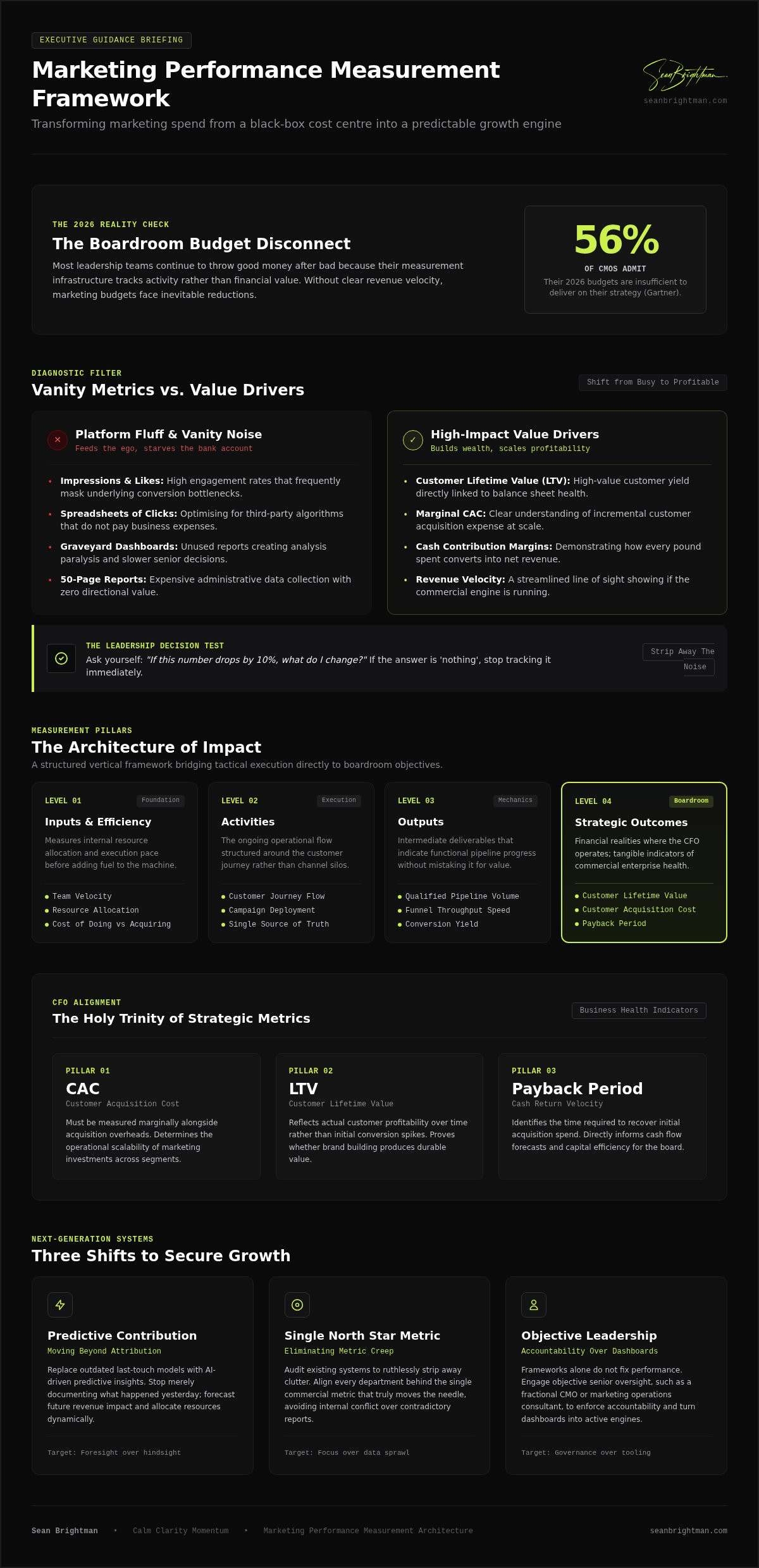
    56% of CMOs admit their 2026 budgets are insufficient to deliver on their strategy. It’s a staggering figure from the latest Gartner data, yet most leaders continue to throw good money after bad because their marketing performance measurement framework is broken. You feel the squeeze. Marketing spend often looks like a black box to the board, and your current dashboard is likely a graveyard of vanity metrics. You have plenty of data but zero clarity on what actually moves the needle. It is frustrating. It is inefficient. It is a recipe for budget cuts.

    You need a system that translates activity into outcomes. This guide shows you how to build a measurement framework that functions as a high-precision growth engine, not just a spreadsheet of clicks. We are talking about business value, not platform-reported fluff. You will learn how to create a clear line of sight from every pound spent to the revenue it generates. We will move your department from a messy cost centre to a structured system built on accountability and predictable results. It is time to stop guessing and start measuring what matters.

    Key Takeaways

    • Stop chasing vanity metrics that stall growth. Learn to build a marketing performance measurement framework that prioritises high-value outcomes like LTV and CAC over simple clicks.
    • Bridge the gap between tactical execution and board-level strategy. Use a four-level measurement architecture to ensure every activity translates into a tangible business result.
    • Replace outdated attribution models with predictive contribution. Use AI-driven insights to forecast future performance instead of merely documenting what happened yesterday.
    • Simplify your data landscape by identifying a single North Star Metric. Audit your current systems to strip away the noise and focus on the one number that truly moves the needle.
    • Drive accountability through expert leadership. Understand why a fractional CMO provides the objective oversight needed to turn a measurement framework into a functional growth engine.

    Stop Measuring Noise: Why Most Frameworks Fail to Drive Growth

    Most dashboards are a graveyard of dead data. They distract rather than direct. You don’t need more charts; you need a better marketing performance measurement framework. If your current report doesn’t trigger a specific action, it is noise. Plain and simple. Leaders fall into the ‘more is better’ trap. They are wrong. Data is cheap, but clarity is expensive.

    In 2026, the volume of data available is overwhelming. More data usually leads to slower decisions amongst senior leadership. It creates a fog of analysis paralysis. Real leadership requires the ‘Decision Test’. Ask yourself: if this number drops by 10%, what do I change? If the answer is ‘nothing’, stop tracking it. You are wasting resources on a metric that has no pulse. Focus on movement, not just maintenance.

    Vanity Metrics vs. Value Drivers

    Stop tracking activity. Start measuring impact. There is a massive difference between a high engagement rate and a high Customer Lifetime Value (LTV). Likes and clicks are cheap. They feed the ego but starve the bank account. High engagement often masks a broken sales funnel. You might be ‘optimising for the algorithm’, but the algorithm doesn’t pay the bills. The customer does.

    A robust modern marketing effectiveness measurement strategy focuses on business outcomes. It prioritises Marginal CAC and cash contribution margins. This is the shift from feeling busy to being profitable. It is the foundation of a scalable growth engine. You want a system that builds wealth, not just one that generates noise.

    The Cost of Measurement Friction

    Complexity is the enemy of execution. When your tracking is too heavy, your marketing operations grind to a halt. You hit a point of diminishing returns. The cost of collecting data outweighs the value of the insight. Your board doesn’t want a 50-page report. They want a streamlined, senior-level view of revenue velocity. They need to know if the engine is running or if it’s stalled.

    A streamlined marketing performance measurement framework removes the friction that keeps your team stuck in spreadsheets. Efficiency isn’t about seeing everything. It is about seeing the right things at the right time. Strip away the fluff. Build a system that gives you a clear line of sight from spend to revenue. Anything else is just expensive admin.

    The Architecture of Impact: Defining Your Measurement Pillars

    A marketing performance measurement framework isn’t a collection of spreadsheets. It is a bridge. It connects the daily grind of tactical activity to the high-level objectives in the boardroom. If your board doesn’t see how a campaign affects the bottom line, the campaign failed. You must translate marketing speak into financial value. This requires a structured architecture built on four distinct levels: Inputs, Activities, Outputs, and Outcomes.

    Organise your framework around the customer journey. Don’t build it around channels. Channels are just pipes; the journey is the flow. When you measure by channel, you create silos. When you measure by journey, you create clarity. You also need a single source of truth. Internal debates over which data is ‘correct’ are a massive waste of time. Pick a source. Stick to it. Move on.

    Level 1: Efficiency and Input Metrics

    Efficiency is about how you use your resources. You need to track team velocity and resource allocation. It isn’t just about what you spend; it’s about how fast you move. A marketing operations consultant ensures these internal levers are tuned for performance. They help you distinguish the ‘cost of doing’ from the ‘cost of acquiring’. If your operational overhead is ballooning whilst your acquisition slows, you have a structural problem. Fix the machine before you add more fuel.

    Level 2: Strategic Outcomes and Business Value

    This is where the CFO lives. You need the holy trinity of metrics: Customer Acquisition Cost (CAC), Lifetime Value (LTV), and Payback Period. These aren’t marketing metrics; they are business health indicators. A full-funnel measurement framework links brand building to these hard numbers. It proves that brand equity isn’t just a ‘feeling’, it’s a financial asset that lowers CAC and increases LTV.

    Ultimately, your marketing performance dictates your business exit valuation. High-growth engines with predictable returns are worth more than chaotic departments. If you want to increase the value of the firm, you must prove your marketing is a predictable revenue driver. For leaders looking to turn their messy department into a structured system, strategic roadmapping provides the necessary blueprint for growth.

    AI and Attribution: Moving from Tracking to Predictive Contribution

    Tracking is a rearview mirror. Contribution is the road ahead. In 2026, looking at what happened last month is no longer enough to justify your budget. You need to know what will happen next. Traditional attribution models have collapsed under the weight of signal loss and privacy regulations. A modern marketing performance measurement framework must shift from simple tracking to predictive contribution. It is about understanding the incremental value of every pound spent, not just documenting the final click.

    AI models now bridge the gap between digital activity and the ‘dark social’ interactions that influence decisions behind closed doors. They measure the offline impact of your brand positioning that standard analytics miss. This isn’t a vague theory; it is a functional component of a modern growth engine. You are moving from manual reporting to an automated system that identifies growth opportunities in real-time. It is less about counting leads and more about forecasting revenue velocity.

    The End of Last-Click Attribution

    Last-click is a lie. It credits the final touchpoint whilst ignoring the months of brand building that made the sale possible. If you optimise for the last click, you kill your long-term growth. You end up over-funding bottom-of-funnel tactics and starving the very activities that fill the funnel. It is a slow death for any brand. It rewards the order-taker and ignores the rainmaker.

    Instead, leaders are turning to Marketing Mix Modelling (MMM) to gain a holistic view. This approach uses a marketing metrics road map to weigh multiple touchpoints without drowning in complexity. It provides the ‘ground truth’ that platform-reported data lacks. You see the whole machine, not just the last gear to turn. This is the difference between counting clicks and measuring commercial momentum.

    Predictive Analytics for Marketing Leaders

    Forecasting is the new accountability. AI allows you to predict revenue based on current lead velocity and market trends. You can spot the early warning signs of campaign fatigue weeks before the budget is wasted. This isn’t just about data; it’s about survival. If a campaign is stalling, the system should tell you before the CFO asks why. You need a dashboard that acts as an early warning system, not a historical archive.

    Strategic AI consulting helps you build these predictive models into your daily operations. It enables real-time budget reallocation. You move money from failing channels to high-performing ones instantly. You aren’t just measuring the engine; you are tuning it whilst it runs. This is how you transform marketing from an abstract expense into a predictable, high-impact revenue driver.

    Marketing Performance Framework: A Leader’s Guide 2026

    How to Build Your Marketing Performance Measurement Framework

    Building a marketing performance measurement framework isn’t about buying a new tool. It is about stripping away the rot. You cannot build a high-performance engine on a swamp of bad data. Most leaders start with the ‘how’ before they define the ‘what’. This is a mistake. Follow a clinical, step-by-step process to move from a messy department to a structured system.

    Step 1: Audit your current data. Most marketing teams are drowning in redundant tools and broken tracking pixels. Step 2: Define your North Star Metric. This is the one number that matters most to the board, usually linked to margin or revenue velocity. Step 3: Map the customer journey. Identify critical ‘value-exchange’ points where a prospect trades their attention or data for your expertise. Step 4: Select your tech stack based on strategy, not the other way around. Step 5: Establish a rhythm of accountability through regular advisory reviews. This is where the framework becomes a leadership tool.

    Auditing the Mess

    Most CRMs are a disaster zone. You likely have redundant tools doing the same job and broken pixels sending false signals to your ad platforms. Identifying these leaks is your first priority. Data hygiene is the bedrock of a scalable growth engine that turns marketing spend into predictable revenue. If your data is garbage, your attribution is a fantasy. Clean the CRM to ensure your framework actually reflects reality. Stop guessing and start fixing the pipes.

    Setting the Reporting Cadence

    Discipline is the difference between a dashboard and a decision. You need a split cadence. Use weekly tactical checks to keep the team on track. Use monthly strategic sessions to look at the big picture. A marketing advisory retainer provides the external pressure needed to maintain this discipline. It keeps the framework from becoming another forgotten spreadsheet.

    When you present to the board, kill the 50-slide deck. They don’t want a data dump; they want clarity. Show them the line of sight from spend to revenue. Focus on the outcomes, not the activities. If you are ready to stop tracking noise and start driving value, build your strategic roadmap today. It is the only way to ensure your marketing performance measurement framework actually drives the business forward instead of just documenting its stagnation.

    Leadership, Not Dashboards: Driving Accountability with Your Framework

    A marketing performance measurement framework is only as good as the person wielding it. Data doesn’t make decisions; leaders do. If you have a dashboard but no one is held accountable for the numbers, you have an expensive hobby, not a business strategy. You need a senior voice to interpret the signals and pull the levers. This is about moving from a culture of ‘doing things’ to a culture of ‘achieving things’. Dashboards are passive. Leadership is active.

    The mental shift is simple but profound. You must transition from viewing marketing as a cost centre to treating it as a profit engine. In a cost centre, you look for ways to spend less. In a profit engine, you look for ways to invest more for a higher return. Every pound spent is a strategic investment in the firm’s future valuation. If you cannot prove the return, you aren’t investing; you are gambling. A robust framework provides the proof you need to justify every penny to the board.

    The Fractional Advantage in Measurement

    Objectivity is the primary asset of an external leader. A fractional CMO has no interest in hiding poor results or protecting legacy projects. They are there to fix the machine, not to play office politics. They bring battle-hardened expertise from multiple successful scale-ups, allowing you to bypass the expensive learning curve that stalls most internal teams. You get senior-level authority and a proven marketing performance measurement framework without the £150,000 plus overhead of a full-time hire. It is a plug-and-play solution for strategic accountability.

    Next Steps for Your Growth Engine

    The transition from a messy department to a structured profit engine happens in stages. It begins with a strategic brand roadmapping session to define your North Star and audit the existing data rot. The first 90 days are critical. You move from no framework to a predictable system by cleaning the CRM, fixing the tracking pixels, and establishing a rigid reporting cadence. By the end of three months, your marketing spend is no longer a black box. It is a clear line of sight to revenue growth.

    Accountability is not about blame. It is about clarity and velocity. When everyone knows exactly how their work contributes to the bottom line, the team moves faster and with more purpose. You stop chasing vanity metrics and start chasing business value. Ready to fix your measurement and build a scalable growth engine? Book a roadmapping session with Sean Brightman today. Stop measuring noise and start driving results.

    Build Your Profit Engine Today

    Your marketing spend shouldn’t be a black box. You have seen how a robust marketing performance measurement framework transforms a messy department into a structured, high-impact system. It is about replacing vanity metrics with business outcomes like LTV and CAC. It is about using AI to predict contribution instead of just tracking the past. Most importantly, it is about leadership. A framework without accountability is just a spreadsheet. You need a battle-hardened expert to enforce the discipline that drives growth.

    Sean Brightman provides the Fractional CMO expertise and direct strategic advice needed to build an AI-powered growth engine that actually delivers. We strip away the corporate fluff to focus on what moves the needle. Stop measuring noise. Start driving value. It is time to treat your marketing as a profit engine, not a cost centre. Book a Strategic Roadmapping Session with Sean Brightman and turn your marketing into a predictable revenue driver. You have the tools. Now you need the execution.

    Frequently Asked Questions

    What is a marketing performance measurement framework?

    A marketing performance measurement framework is a structured system that connects tactical activities directly to commercial business value. It is the machinery that translates marketing spend into revenue growth. Unlike a static report, it provides a clear line of sight from every pound spent to the financial outcome it generates. This framework ensures your team focuses on high-impact work instead of getting lost in the noise of vanity metrics.

    How do I choose the right KPIs for my framework?

    You choose the right KPIs by working backwards from your board-level objectives. If a metric doesn’t influence a commercial decision, it doesn’t belong in your framework. Focus on outcomes like Customer Acquisition Cost (CAC), Lifetime Value (LTV), and cash contribution margins. Stop tracking activity for the sake of feeling busy. Your framework should prioritise metrics that prove marketing is a profit engine, not just a department that spends money.

    Can a measurement framework work for a small marketing team?

    Yes, a structured framework is even more critical for small teams with limited resources. It prevents you from wasting time on low-yield activities that don’t move the needle. By defining a clear North Star Metric, a small team can operate with the precision of a much larger department. It is about efficiency, not headcount. A well-built system ensures every hour and every pound is invested where it generates the most impact.

    Is AI necessary for marketing measurement in 2026?

    AI is essential in 2026 due to pervasive signal loss and the collapse of traditional tracking. You need AI-driven Marketing Mix Modelling (MMM) to bridge the gaps that standard analytics miss. It moves your measurement from backward-looking tracking to predictive contribution. Without AI consulting to build these growth engines, you are essentially flying blind. It allows you to forecast revenue velocity and identify campaign fatigue before you waste your budget.

    How often should I review my marketing performance framework?

    You should review your performance on a split cadence. Tactical checks happen weekly to keep execution on track. Strategic reviews should occur monthly to ensure you are still aligned with commercial goals. Many leaders use an advisory retainer to maintain this discipline. Regular reviews prevent your reporting from becoming a forgotten spreadsheet. It keeps your strategy agile and ensures you reallocate budget to the highest-performing channels.

    What is the difference between a dashboard and a framework?

    A dashboard is a passive historical archive; a marketing performance measurement framework is an active leadership tool. Dashboards tell you what happened in the past, often through a lens of vanity metrics like clicks or impressions. A framework tells you what to do next to drive business value. It includes the logic, the accountability, and the decision-making process required to turn data into growth. One is a report; the other is a functional component of your strategy.

    How much does it cost to implement a professional measurement framework?

    The cost depends on the complexity of your current data rot and the scale of your operations. However, the real question is the cost of operating without one. Most businesses waste a significant percentage of their budget on activities that don’t drive revenue. Implementing a professional system is a strategic investment in your firm’s valuation. It is far cheaper to fix your measurement than to continue throwing good money after bad in a black box.

    Why is my current attribution model giving me conflicting data?

    Your current model is likely failing because platforms like Google and Meta each over-claim credit for the same conversion. This deterministic tracking has collapsed under privacy regulations and signal loss. You are seeing a fragmented view of the customer journey. Moving to a holistic measurement framework resolves this by using incrementality testing and MMM. It provides a single source of truth that cuts through the conflicting data provided by individual ad platforms.