
More leads won’t fix a growth engine that attracts the wrong buyers. Customer acquisition is the set of strategies and processes a business uses to gain customers and build a sustainable pipeline. A customer acquisition strategy consultant brings structure to that work, starting with a clear picture of who you want to reach.
Growth can look like adding another channel or increasing marketing activity. A better starting point is to find where prospects drop off, what prompts the right customers to act and whether the revenue they bring justifies the effort to win them.
This article explains how the acquisition funnel works, how to define your ideal audience and how to choose between inbound and outbound channels. It shows how those choices support sustainable growth, so you can focus on attracting customers who fit, rather than simply filling the pipeline.
Key Takeaways
- Measure acquisition against customer lifetime value, not lead volume alone; a ratio near 3:1 or better is a common long-term target.
- Define your ideal customer by fit, buying behaviour and willingness to pay, so growth focuses on profitable, lasting relationships.
- Map the journey from first contact to purchase to spot where prospects drop off and what needs to change.
- Choose inbound and outbound channels around your audience, then coordinate them instead of spreading effort across disconnected tactics.
- Reduce friction in the buying journey: attracting the right prospects matters, but making it easy for them to act matters too.
What is Customer Acquisition?
Customer acquisition is the work of turning prospects into paying customers through a repeatable process. Don’t chase lead volume alone: weak qualification, neglected retention and untracked spending can make growth costly without generating lasting revenue.
Acquisition Cost and Customer Lifetime Value
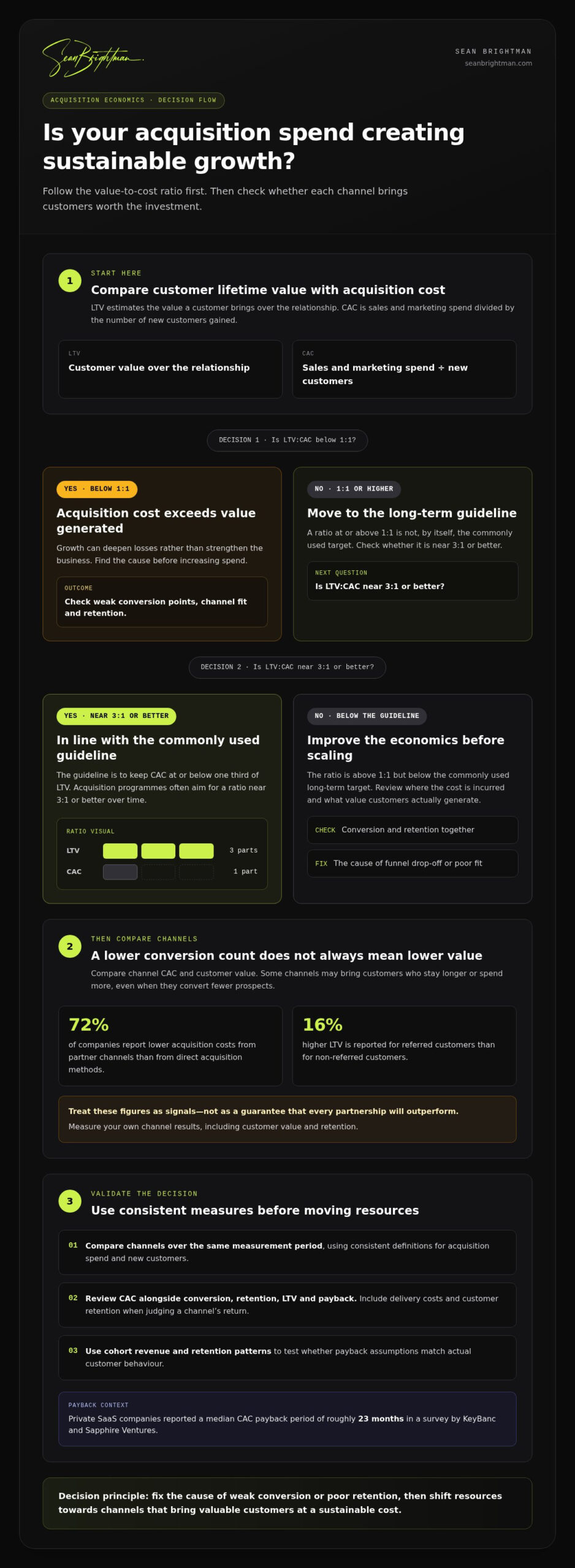
Customer acquisition cost (CAC) is sales and marketing spend divided by the number of new customers gained. Customer lifetime value (LTV) estimates the value a customer brings over the relationship. Comparing LTV with CAC helps show whether acquisition can support profitable growth.
A commonly used guideline is to keep CAC at or below one third of LTV. Acquisition programmes often aim for an LTV:CAC ratio near 3:1 or better over time. A ratio below 1:1 means the acquisition cost exceeds the value generated, so growth can deepen losses rather than strengthen the business.
Channel-Level Acquisition Economics
Channel-level economics compare the CAC and customer value generated by each route, such as referrals, partnerships or direct outreach. A channel with fewer conversions may still bring customers who stay longer or spend more, so conversion volume alone can be misleading.
72% of companies report lower customer acquisition costs from partner channels than from direct acquisition methods. Referred customers are reported to have a 16% higher LTV than non-referred customers. Treat those figures as signals to measure your own channels, not as a reason to assume every partnership will outperform.
Cost, Payback and Return Metrics
Acquisition metrics show how efficiently spending turns into revenue and how long that investment takes to return. Track CAC alongside conversion and retention: conversion shows how prospects move towards purchase, while retention indicates whether acquired customers continue to contribute value.
Payback modelling estimates when customer revenue covers the cost of acquisition. Private SaaS companies reported a median CAC payback period of roughly 23 months in a survey by KeyBanc and Sapphire Ventures. Use cohort revenue and retention patterns to test whether your payback assumptions match actual customer behaviour.
ROI metrics compare the return generated with the investment made. Include delivery costs and customer retention when deciding whether a channel earns its place.
To reduce CAC, find where prospects leave the funnel before increasing spend. A weak conversion point may need clearer information or a simpler path to purchase. Poor retention may indicate that a channel attracts the wrong customers. Fix the cause rather than cutting activity blindly.
Compare channel results over the same measurement period, using consistent definitions for acquisition spend and new customers. Then the CAC calculation is meaningful. Review conversion, retention, LTV and payback together, and shift resources towards channels that bring valuable customers at a sustainable cost.
Defining an ideal client profile and target audience
A useful acquisition plan starts with a precise target, not a broad market label. Define who is most likely to buy, benefit from your offer and generate profitable, lasting revenue.
Ideal Customer Profile Research
An ideal customer profile describes the people or organisations most likely to become valuable customers. Build it from evidence about existing customers: compare purchase patterns, retention, needs, willingness to pay and the problems your offer solves.
Then separate strong-fit customers from poor-fit prospects. Businesses with buyer personas exceed their sales goals 65% of the time. Use that as a prompt to test whether your profile helps teams focus, not as a guarantee of growth.
Targeting and Value Proposition
A value proposition explains why your best-fit audience should choose your solution to a specific problem. Connect each profile trait to a practical benefit, such as easing a difficult process or addressing a costly bottleneck.
That connection sharpens targeting, messaging and qualification. Segment by willingness to pay and the value you can deliver. A large audience is of little use if few people can buy profitably or remain customers.
Customer acquisition consultant vs marketing agency: which is better? A consultant typically diagnoses the growth problem, sets priorities and shapes a strategy; an agency generally focuses on executing marketing activity. Choose according to the gap you need to fill: strategic direction, campaign delivery or both.
How much does a customer acquisition strategy consultant cost in the UK? The fee depends on scope, data quality and the work involved, and is given after a quote request. A focused review of one channel differs from work spanning several markets, teams and acquisition stages.
What does a customer acquisition strategy consultant do? They assess the audience, proposition, funnel and channel performance, then identify where to invest and what to change. The work should connect commercial goals to clear priorities and measures.
What are the steps in a customer acquisition strategy audit? Review customer and revenue data, define the target profile, map the journey, assess channels and conversion points, then prioritise fixes. Tie each recommendation to an owner, a success measure and a decision date.
For example, UK businesses with turnover of £500,000 to £10m are identified as a target market for growth and profit improvement. Businesses spending £3,000 or more a month on marketing without knowing which channels produce customers have a specific diagnostic need. A fixed-fee review can give that work a defined scope, with the boundaries set by the questions, data and channels assessed.
Consultant profiles vary. Some bring deep subject expertise; others focus on strategy, commercial decisions or long-term client relationships. Match expertise to the constraint: unclear positioning calls for sharper customer research, while weak channel economics call for stronger performance analysis.
Once the audience and value proposition are clear, a structured growth roadmap can turn those choices into prioritised work.
Customer acquisition definition and funnel stages
Customer acquisition turns a potential buyer into a paying customer through connected actions. The goal is a predictable, sustainable pipeline, not a pile of disconnected leads.
Acquisition Meaning and Goals
Customer acquisition is the set of strategies and processes a business uses to gain new customers. It matters because consistent acquisition supports revenue planning and helps teams judge whether demand can become repeatable sales.
For example, a consultancy might attract a prospect through an article, discuss their needs on a call and agree a paid project. The goal isn’t simply to secure that first purchase. The business also needs customers whose needs it can meet, creating a sound basis for continued revenue and lifetime value.
Customer Acquisition Strategy
A customer acquisition strategy sets out how a business will attract, convert and retain its chosen audience. It connects commercial goals with the actions, channels, communications and measures used to reach them.
For example, a software company aiming to grow recurring revenue could align educational content, product demonstrations and sales follow-up around one buyer journey. A strategy clarifies why each action exists, who owns it and which result signals progress. Without that connection, separate campaigns can generate activity without moving prospects towards a purchase.
Audience Definition and Targeting
A target audience is the group of potential customers a business intends to reach with a specific offer. Define it through shared needs, buying situations and decision criteria, rather than relying on a broad label such as “small businesses”.
For instance, a payroll platform might target UK employers reviewing their payroll processes, rather than every organisation with employees. That distinction shapes the message, the information prospects need and the next action offered. It also helps teams judge whether communication attracts relevant enquiries or merely more attention from people unlikely to buy.
Funnel Stages
The acquisition funnel maps the stages between a prospect’s first contact and their purchase. Mapping the customer journey matters because it can reveal where prospects drop off and why.
A practical funnel might move through awareness, consideration, evaluation and conversion. At awareness, a prospect encounters a useful article; during consideration, they explore the problem and possible approaches. In evaluation, they compare the offer with their needs, then decide whether to buy.
Give each stage a visible action and measure. An article view shows initial attention; a completed enquiry signals intent; a signed agreement records conversion. If prospects read but don’t enquire, review whether the next step is relevant and clear. If enquiries stall before purchase, examine what information or follow-up is missing.
The analysis shouldn’t end at conversion. Track what happens after purchase, including whether customers continue using the product or service. Those outcomes show whether acquisition attracts the right audience and connect initial communication with longer-term customer value.
Inbound and outbound acquisition channels
Inbound channels attract prospects through useful content and experiences. Outbound channels put a targeted message directly in front of potential buyers. The right mix depends on how your audience discovers options and makes decisions.
Channel Selection and Mix
Channel selection means choosing routes that reach your audience and generate meaningful engagement. Activity across unsuitable channels can waste attention and weaken relationships with potential buyers.
For example, a specialist consultancy might use practical articles to build inbound interest, then follow up with tailored emails to relevant decision-makers. Give each channel a clear role: create awareness, answer questions or prompt a sales conversation. This creates a connected path for marketing and sales instead of disconnected campaigns.
Inbound options include content marketing, search, email, social media, webinars, events and referrals. A UK software firm could publish guidance on a customer problem, share it through LinkedIn, then invite interested readers to a webinar. Each touchpoint adds context and gives prospects a reason to continue the conversation.
Outbound options include targeted email, direct outreach and calls to selected prospects. They can help businesses reach a defined group rather than wait to be discovered. For instance, a leadership team entering a new market could identify organisations with a relevant need, send personalised messages and use the responses to refine its message.
Choose channels based on audience behaviour, buying complexity, internal capacity and the time needed to build trust. A considered business purchase may require several useful interactions before a prospect acts; a simple offer may convert through a more direct route. Assess channels by qualified engagement and sales outcomes, not impressions alone.
Acquisition Economics by Channel
Channel acquisition economics compare the effort and resources invested with the customers and revenue each route generates. This matters because a busy channel isn’t automatically a productive one.
Compare channel performance using consistent measures, such as qualified enquiries, conversion and customer value. Include the work involved in creating content, managing outreach and supporting sales. A channel that looks inexpensive on media spend may still consume substantial team time or generate prospects who rarely buy.
Channel coordination can strengthen results. McKinsey research found that 83% of B2B decision-makers considered omnichannel sales as effective as or more effective than traditional single-channel approaches. A 2021 McKinsey study also found that buyers regularly use 10 or more channels when interacting with suppliers. Prospects may discover a business through search, review its social content and then speak with sales.
That behaviour makes consistency essential. Align the message across an article, email and sales conversation, so each interaction builds on the last. B2B companies using three or more coordinated channels can see conversion rates increase by up to 287%. Treat this as a reason to coordinate relevant channels, not to add more channels without a clear audience and purpose.
Review the mix as evidence accumulates. If webinars attract attendees but few qualified conversations, adjust the topic or follow-up. If targeted outreach starts useful discussions, build on them with relevant insights. Keep channels that help prospects take a meaningful next step, and rework those that only create activity.
Why customer acquisition matters to business growth
Customer acquisition matters because growth needs new revenue, not simply more marketing activity. A clear acquisition system helps leaders decide which prospects to pursue, which tactics to fund and how to connect campaigns with lasting customer relationships.
The distinction shows up in the numbers. Gartner reported that 96% of customers experiencing high friction are likely not to sign up for a brand’s offerings. If a UK business makes prospects repeat information or struggle to understand its offer, campaign reach cannot fix the broken buying experience.
Acquisition also shows whether demand can support a company’s plans. A growing pipeline gives sales teams prospects to qualify and helps leaders assess whether current capacity can deliver what buyers need. For example, a consultancy expecting more enquiries needs to check that its team can respond promptly and fulfil the work it sells.
Growth isn’t simply a race to win more customers. Retention affects the value of each acquisition: customers who continue buying can contribute revenue beyond their first transaction. Compare customer groups by acquisition source, purchase behaviour and continued engagement. If a campaign brings many first-time buyers but few return, it may be attracting the wrong fit.
Acquisition decisions should also be weighed against the value of other growth levers. For a business with a 15% net margin, £50,000 in operating-cost savings has the same effect on profit as £333,000 in extra sales. That comparison shows why leaders should assess acquisition alongside margin, delivery costs and customer retention, rather than treating sales growth as the only route to stronger profit.
Evidence can change which tactic deserves investment. A fintech client achieved a 15% increase in new customer acquisition after using buying personas, behavioural economics and personalised marketing tactics. The lesson is practical: sharpen the audience, understand the decision behind each purchase, then tailor campaigns to that context. Personalisation without customer insight is just a different-looking guess.
Use a simple decision sequence: identify the business outcome, trace which prospects become customers, examine conversion and retention, then adjust the campaign or buying journey. If qualified prospects disappear after an enquiry, improve follow-up before expanding reach. If customers leave quickly, revisit the offer and how well it matches audience expectations.
That discipline connects acquisition to durable growth. A company can see which campaigns generate suitable customers, where friction blocks action and whether revenue supports continued investment. To turn those findings into a focused growth plan, map your next acquisition priorities.
Sean Brightman: AI Consulting
Sean Brightman’s AI Consulting is a practical next step when acquisition decisions raise questions about where AI could fit. Assess potential applications against real business priorities, customer needs and work already happening across your organisation. The aim is sound judgement, not adopting technology for its own sake.
If the challenge is turning acquisition priorities into a clear plan, Roadmapping can help structure the next decisions. An Advisory Retainer offers a route for continued strategic input as those decisions develop. The right starting point depends on whether you need to assess AI, shape a roadmap or maintain ongoing advice.
For a practical conversation about your growth priorities, contact Sean Brightman or visit seanbrightman.com.
Turn your next growth decision into action
The next move isn’t another campaign by default. Choose one acquisition decision that could unlock progress, such as refining your positioning, improving follow-up or exploring where AI could support the work. Give it an owner and a clear commercial reason. That keeps strategy connected to decisions your team can act on.
A customer acquisition strategy consultant can bring focus when priorities compete or the route to growth feels unclear. Sean Brightman offers Fractional CMO services for strategic marketing leadership, AI Consulting for practical AI systems and Roadmapping to organise priorities into a clear plan. The right fit depends on the decision your business needs to make next.
Make that decision concrete, then take the next step. Contact Sean Brightman about your strategy and start a conversation about what should move forward.
Frequently Asked Questions
What are acquisition strategies?
Acquisition strategies are the coordinated choices a business makes to attract and convert suitable buyers. They can include referral programmes, useful content, direct prospecting, partnerships and product demonstrations. For example, a specialist software firm might publish guidance for finance teams, then offer a tailored demonstration to interested organisations. The strategy should fit how buyers research, compare and decide, rather than copy another company’s tactics.
What are the 7 steps to attracting new customers?
Use these seven connected steps to turn attention into a customer relationship:
- Set a commercial objective.
- Identify the buyer and their need.
- Shape a clear reason to choose your offer.
- Select channels your audience uses.
- Create a useful first interaction.
- Follow up with relevant information.
- Review results and improve the weak point.
For example, a training provider could use a practical guide to attract HR leaders, then invite interested readers to discuss a specific skills gap.
What is the difference between CAC and CPA?
CAC measures the average cost of acquiring a new customer, while CPA measures the cost of a defined action. That action might be a form submission, booked demonstration or completed purchase. A campaign can therefore have a low CPA for enquiries but a high CAC if few enquiries become customers. Define the action clearly, then track whether it leads to paid business.
How can a consultant develop a customer acquisition strategy?
A consultant can develop the strategy by connecting commercial objectives with customer evidence and practical execution. They can review sales records, interview customers, examine lost opportunities and identify barriers in the buying process. From there, they can recommend priority audiences, messages, channels and measures. A useful output assigns responsibility and clarifies what the team should learn from each campaign, rather than offering a channel list without context.
How to choose a customer acquisition consultant in the UK?
Choose a consultant who can explain how they’ll diagnose your specific growth problem before prescribing tactics. Look for a clear approach, relevant commercial understanding and recommendations your team can act on. Discuss how they’ll use your customer and sales information, involve internal teams and define progress. A good fit makes decisions clearer, not more complicated with jargon or a generic plan.
What experience and qualifications should a customer acquisition consultant have?
Prioritise evidence of relevant work over credentials alone. A consultant should understand your sales model, buyer behaviour and the practical demands of your market. Ask how they’ve approached a comparable challenge, what they learned and how they adapted the plan when evidence changed. They should explain their analysis in plain language and distinguish observed results from assumptions. The right expertise depends on your particular acquisition bottleneck.
What customer acquisition channels should UK businesses consider?
UK businesses can consider search-led content, email, professional social networks, events, referrals, partnerships, webinars and direct outreach. The right options depend on where buyers seek advice and how they prefer to engage. For example, a business selling complex services might combine expert articles with industry events and personal follow-up. A consumer brand may favour searchable product information, email and customer referrals. Choose channels your team can manage consistently.
How do consultants measure customer acquisition cost, conversion rates and ROI?
Consultants define each measure first, then align sales and marketing records around the same customer journey. They calculate acquisition cost using agreed acquisition spending and new customers, and conversion rates between named stages, such as enquiry and sale. ROI compares the return attributable to activity with its investment. Results can also be separated by channel and customer group to show whether apparent efficiency leads to retained revenue.