Tag: marketing director

  • Hiring a marketing director vs consultant: compare costs and fit

    Hiring a marketing director vs consultant: compare costs and fit

    The more senior hire is not automatically the better investment. Hiring a marketing director vs consultant comes down to the work you need: a consultant typically tackles a defined project, while a marketing director provides ongoing oversight of the marketing function.

    It is easy to focus on the job title and miss the practical difference. A director brings continuing leadership and accountability; a consultant can bring targeted expertise for a specific challenge, with the commitment shaped around the work.

    This comparison will help you weigh cost, availability and fit against your business’s needs and existing team. You will see when ongoing leadership makes sense, when project-based support is a better match, and how each option can work alongside the people already doing your marketing.

    Key Takeaways

    • Choose ongoing director-level leadership when marketing needs sustained ownership; use a consultant for a defined challenge that calls for targeted expertise.
    • Match the role to the work: strategy, budget accountability and team direction call for broader leadership than a standalone project.
    • An external marketing leader can work alongside your existing team or agency, bringing direction without replacing the people doing the delivery.
    • Compare the full commitment, not just the headline rate: salary, working days, duration and the level of responsibility all affect the cost and fit.

    What is an interim Marketing Director?

    An interim Marketing Director temporarily leads a company’s marketing function, usually until a permanent replacement joins. Compared with a marketing consultant, a director owns ongoing team delivery, while a consultant typically tackles a defined project.

    Marketing director responsibilities and competencies

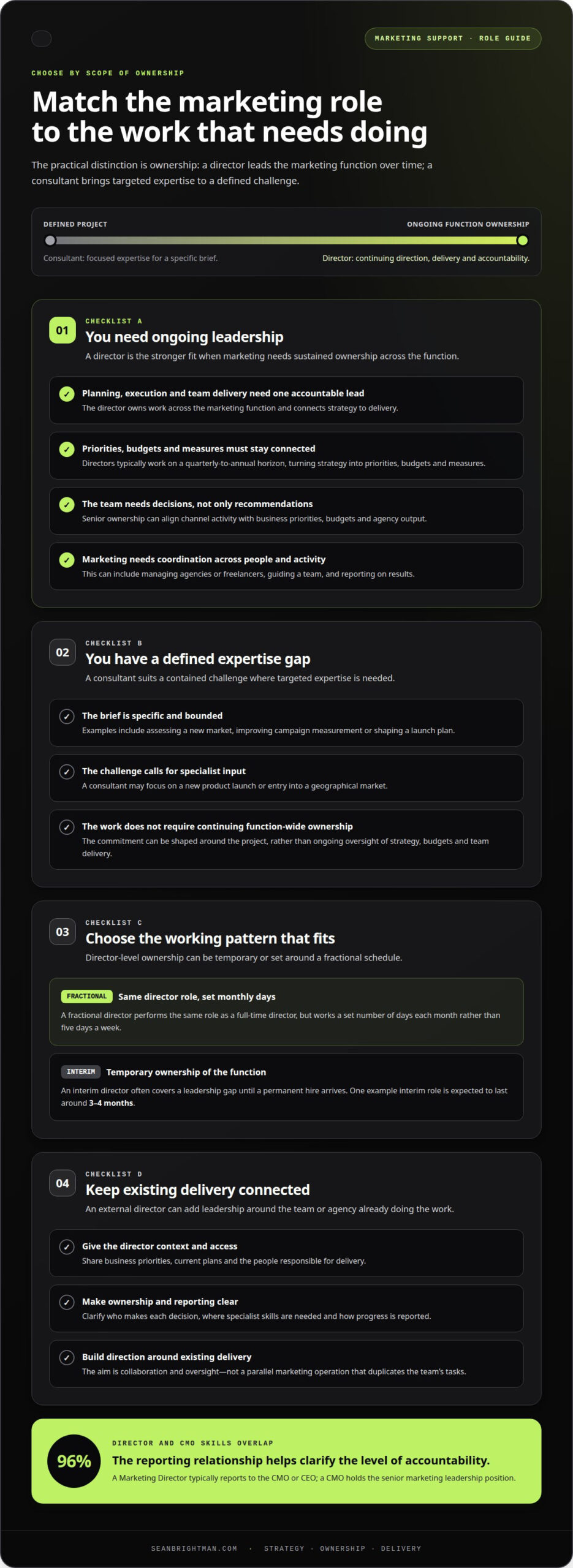
    A marketing director owns planning, execution and team delivery across the marketing function. They typically work on a quarterly-to-annual horizon, turning strategy into priorities, budgets and measures. This matters when digital marketing, research and a product launch need one accountable lead. Directors report to the CMO or CEO and sit on the senior leadership team. Strong candidates show they have set budgets and been accountable for them, rather than only managing approved spending.

    Fractional and interim director responsibilities

    A fractional director performs the same role as a full-time director, but works a set number of days each month rather than five days a week. They can set marketing strategy, allocate budget, manage agencies or freelancers, and report on results. An interim director also takes temporary ownership, often covering a gap until a permanent hire arrives. One example interim role is expected to last around 3-4 months. These options give businesses leadership without assuming the same working pattern or duration.

    CMO responsibilities

    A CMO leads marketing at executive level, connecting the marketing strategy with the company’s wider direction. That can include setting priorities, aligning investment with business goals and overseeing the marketing function. The distinction matters because a Marketing Director typically reports to the CMO or CEO, while a CMO holds the senior marketing leadership position. Marketing Director skills overlap with CMO skills by 96%, but the reporting relationship helps clarify which level of accountability the business needs.

    Director and consultant role differences

    A marketing director provides ongoing oversight; a consultant typically delivers a defined project using targeted expertise. A consultant may help with a new product launch or entry into a geographical market, while a director keeps strategy, budgets and team delivery connected over time. The distinction matters when choosing support: a project brief points towards consultancy, while continued ownership of the marketing function points towards a director. Let the work required, not the title alone, drive the choice.

    Is a marketing consultant the right choice for your business?

    A consultant suits a contained expertise gap; interim leadership fits a wider need for senior ownership across the marketing function. In the UK, tax treatment depends on the engagement and working arrangements; IR35 may apply to some off-payroll engagements, so assess status for the specific contract.

    Recognising the need for senior marketing direction

    Senior direction matters when marketing activity lacks a clear link to business priorities, or nobody can make decisions across channels. For example, if sales needs stronger lead quality but digital marketing is measured only by clicks, a senior lead can connect the measures to commercial goals.

    An interim Marketing Director can also cover a leadership gap while a permanent appointment is pending. This is useful when a marketing team needs decisions on priorities, budget or agency output, rather than another set of recommendations. The key sign is a need for someone to own decisions and align delivery with leadership.

    Marketing support without an in-house team

    A business without a marketing team can still need senior oversight before hiring specialists. A director-level lead can set the function’s priorities, decide which capabilities to bring in and give external professionals a clear brief. For example, a business preparing a product launch may need coordinated messaging, digital activity and sales materials.

    Clear direction helps prevent disconnected tasks from becoming the strategy. The business owner or senior leadership team retains ownership of its goals, while external expertise can help plan or deliver the work. This model is particularly useful when nobody internally has the ability or time to coordinate marketing activity.

    When to seek marketing expertise

    Use targeted expertise when the need is specific, such as assessing a new market, improving campaign measurement or shaping a launch plan. A consultant can focus on that challenge; ongoing senior leadership is a better fit when priorities, budgets and delivery need continued coordination.

    Start by defining the business outcome, the decision that needs support and who will act on the work. If the issue is unclear strategy rather than one specialist task, senior marketing direction can help clarify the next move and organise the function around business priorities.
    Hiring a marketing director vs consultant: compare costs and fit

    What if you already have a marketing team or an agency?

    An external Marketing Director can add leadership around existing delivery rather than replace the people doing the work. Their impact depends on how clearly they connect priorities, skills and accountability.

    Embedding an external director in the team

    Embedding means giving an external director a defined role in the team’s decisions and working rhythm. They need access to business priorities, current plans and the people responsible for delivery. For example, regular planning meetings can connect sales targets with campaign choices and deadlines.

    This structure matters because an outside perspective only helps when it reflects the realities of existing work. The director can clarify who owns each decision, where specialist skills are needed and how progress is reported. Staff should expect direction and collaboration, not a parallel marketing operation that duplicates their tasks.

    Oversight for teams and agencies

    A Marketing Director can review work from employees, new recruits, agencies or freelancers against the strategy and business goals. That gives each contributor a shared brief, decision-maker and measure of success. For example, they can assess whether an agency’s campaign supports the same priorities as the in-house team’s content.

    Effective oversight is not simply approving every deliverable. The director identifies what is working, resolves competing priorities and adjusts direction when results or business needs change. This helps senior leaders see how activity connects to outcomes, while specialists focus on execution. Clear ownership also reduces conflicting instructions.

    Team size and marketing direction

    A marketing director typically leads a team of three to 15 people. That range shows why the role is about setting direction as well as managing individuals. A smaller team may need help prioritising work; a larger group may need clearer coordination across specialist skills and external partners.

    One interim role involves leading a team of five. In that setting, the director can connect each person’s responsibilities to shared priorities, rather than treating every channel separately. For a successful arrangement, define decision rights, reporting and how the director works with existing staff. This also helps establish whether to build capability internally or recruit for a specific gap.

    Marketing Director versus fractional consultant cost and availability

    A full-time director offers ongoing ownership but commits the business to a salary; a consultant brings expertise for an agreed scope, with less continuous oversight. When hiring a marketing director vs consultant, compare return on investment against the same business outcome, such as qualified leads, revenue or campaign performance, and include the time and resources needed to execute.

    Advantages and disadvantages of each option

    That investment buys sustained leadership across budgets, channels and reporting, but also creates an ongoing employment commitment. Hiring can take 8-12 weeks, depending on how specific the requirements are.

    A consultant can be engaged for a contract, project or longer-term arrangement, making it easier to focus spending on a defined need. Consultants are usually paid a day rate, and hiring them for more days can reduce the cost. The trade-off is that project support does not automatically provide continued ownership of the marketing function.

    Fractional Marketing Directors can work 3-4 days per week. This offers more regular availability than a short project, without a five-day-a-week schedule. Match the arrangement to the workload: ongoing campaign oversight needs dependable leadership, while a contained specialist task may need fewer days.

    Comparing return on investment

    A useful way to assess hiring a marketing director vs consultant is to start with one business outcome and a baseline. For a lead-generation campaign, compare qualified leads and resulting sales before and after the work. For a market-entry project, track progress towards the agreed launch goals. Use the same measures for either option, and include the budget, internal time and external delivery costs.

    Then assess what each role contributes to that result. A director may improve coordination across channels, prioritise work and maintain reporting over time. A consultant may bring focused expertise to a specific challenge. Account for how long each result takes to emerge, and whether the business needs someone to keep improving performance afterwards.

    Choose the model that fits the required ownership and duration, not just the initial outlay. Clarify your marketing investment against the outcomes your business needs.

    Sean Brightman

    Sean Brightman can help you turn the comparison into a clearer decision about marketing direction, priorities and the support your business needs. If the main gap is a plan, Roadmapping can shape the direction; if you need ongoing strategic input, an Advisory Retainer offers continued guidance.

    For businesses assessing how AI fits their marketing plans, AI Consulting provides a related option. The right next step depends on the challenge: clarify the direction first, then decide what leadership or specialist input will move the work forward.

    Contact Sean Brightman to discuss your marketing priorities.

    Turn the decision into a workable plan

    Use your decision to define what happens next: who owns decisions, what success looks like and how the work connects to your business priorities. The real test is whether your marketing leadership can keep direction and delivery joined up as the business changes. Map your choice against the constraint behind it, such as unclear ownership, a capability gap or a change in strategic direction.

    The decision about hiring a marketing director versus a consultant should lead to action, not another round of title comparisons. Sean Brightman’s Fractional CMO support provides senior marketing leadership; AI Consulting and Roadmapping can address specific strategic needs. The right starting point depends on whether you need ongoing direction, a clearer plan or focused expertise.

    You don’t need to solve every marketing challenge at once. A useful first conversation starts with the outcome you need, not a job title. Set the priority that matters most, then build the right support around it. Discuss your next marketing move with Sean Brightman and take a confident step forward.

    Frequently Asked Questions

    How much does it cost to hire a Marketing Consultant?

    Consultant costs depend on experience, days required and the scope of work. A contained assignment can therefore be budgeted by its expected days, while ongoing support depends on the agreed frequency. Treat the fee as one part of the project cost: internal time, campaign spend and implementation resources also affect the total.

    How much does a marketing director cost in the UK, including salary, National Insurance and benefits?

    Those additional employment costs raise the total beyond the headline salary. The final budget also depends on the package and the responsibilities attached to the role. Compare the full annual employment cost with the cost of the leadership time you actually need, rather than comparing a salary with a consultant’s day rate alone.

    What are typical UK marketing consultant day rates and project fees?

    Project fees vary with the brief, specialist expertise, deliverables and how much implementation the consultant handles. For a campaign review, for example, define whether the work ends with recommendations or includes execution support. That distinction shapes the days required and makes a project fee easier to assess against its deliverables.

    When should a UK business hire an in-house marketing director rather than use a consultant?

    Hire an in-house director when the business needs continuous leadership embedded in its decisions, rather than expertise for a bounded task. This can suit a company whose marketing priorities change regularly and require one accountable owner across departments. A consultant is more suited to a defined requirement, such as evaluating a campaign or entering a new market. The deciding factor is whether ownership must remain inside the business after the work is delivered.

    Can a marketing consultant provide strategic leadership and manage an internal marketing team?

    Yes, a consultant can provide strategic leadership and oversee an internal team if the engagement clearly includes those responsibilities. Agree who sets priorities, approves work and reports progress, then give the consultant access to the relevant decision-makers. For example, they could coordinate an in-house content specialist and an external agency around one campaign objective. A consultant’s title alone does not establish authority; the scope and working arrangement do.

    How long does it take to recruit a marketing director in the UK compared with engaging a consultant?

    Recruiting a Marketing Director in the UK can take 8-12 weeks, depending on how specific the requirements are. Consultant engagements can be arranged on a contract, project or longer-term basis, so the timing depends on the brief and agreed start. For an urgent leadership gap, weigh the recruitment process against the work that must begin immediately. A defined consultancy scope can provide a route to focused support while recruitment continues.

  • Freelance marketing director services in the UK

    Freelance marketing director services in the UK

    You don’t need a permanent marketing director to get senior-level direction. A freelance marketing director in the UK can shape your strategy, align marketing with commercial priorities and help move the work forward. The point isn’t another report. It’s clear direction and practical action.

    Hiring freelance can still raise real questions. What should you expect to pay? Where do you find clients, or how do you build a freelance career yourself? And when does fractional director expertise make more sense than bringing in someone full-time?

    This guide tackles those decisions directly. You’ll learn how freelance marketing day rates vary, practical ways to find work and the steps involved in becoming a freelancer. You’ll also see what a fractional marketing director can contribute: senior expertise focused on the decisions and actions your business needs, without adding a permanent executive role.

    Key Takeaways

    • Build client relationships through your professional network, and make your expertise and the problems you solve easy to understand.
    • Set a day rate around your seniority, responsibilities and the value of the work, not just the hours involved.
    • Plan your move into freelancing around your business structure, cash flow and tax obligations; HM Revenue & Customs sets the UK VAT registration threshold at £90,000 in turnover.
    • Fractional marketing director expertise gives a business senior strategic direction without a permanent executive role; AI Consulting can help when the challenge centres on AI.

    Finding clients through networks and agencies

    LinkedIn lists more than 7,000 freelance marketing jobs in the United Kingdom. Treat that as a starting point, not proof every listing suits senior directors. Set alerts for terms such as “interim marketing director” and “fractional CMO”.

    Freelancers also find work through former colleagues, clients, professional contacts and specialist recruitment agencies. Ask trusted contacts for introductions to businesses facing a clear marketing challenge. Agencies can connect you with temporary assignments; direct networks can lead to longer-term advisory work.

    Fixed-term roles show where organisations need extra marketing capacity. CMSPI advertised a 12-month Digital Marketing Manager role in Manchester, whilst OLIVER | The Brandtech Group advertised a six-month Product Marketing Manager role in London. These aren’t director posts, but they show how interim and contract opportunities are described.

    Freelancers should make their expertise easy to assess. Update your LinkedIn profile with the business problems you solve, the sectors you know and examples of your work. Publish useful insights consistently; building visibility through LinkedIn can take 6 to 12 months.

    • Ask former colleagues for introductions to decision-makers with a specific marketing need.
    • Contact agencies with a concise profile, relevant case studies and the roles you want.
    • Approach potential clients with one tailored observation and a practical next step.

    Compared with an agency, a freelance director usually gives the business direct access to one senior strategic lead, rather than a wider delivery team. An in-house director is embedded in the organisation; a freelancer can bring focused expertise without becoming a permanent employee.

    When choosing a freelance marketing director, ask: “Which business problem would you tackle first?”, “How will you measure progress?” and “What will you personally deliver?” Ask for a relevant example that shows how their approach moved from strategy into action.

    Freelance marketing day rates

    These arrangements can overlap because “freelance” and “interim” describe ways of working, not identical responsibilities.

    The right benchmark depends on whether you need team leadership, strategic decisions or hands-on delivery.

    Compare scope before comparing rates. One director may set priorities and guide a team; another may also take responsibility for delivery. Agree on expected outputs, decision-making authority, working days and review points before the engagement starts. A clear brief makes proposals easier to assess.

    Hiring a freelancer can give your business direct access to senior expertise and flexible capacity, without a permanent appointment. The trade-off is less continuity than with an in-house director. Agree on ownership, reporting and handover arrangements to keep work moving if the engagement ends.

    UK freelance marketing contracts may fall within IR35, legislation that determines whether a contract is treated as employment for tax purposes. For hiring decisions, consider the contract and how the working relationship operates, rather than relying on the job title alone.

    Becoming a freelance marketer in the UK

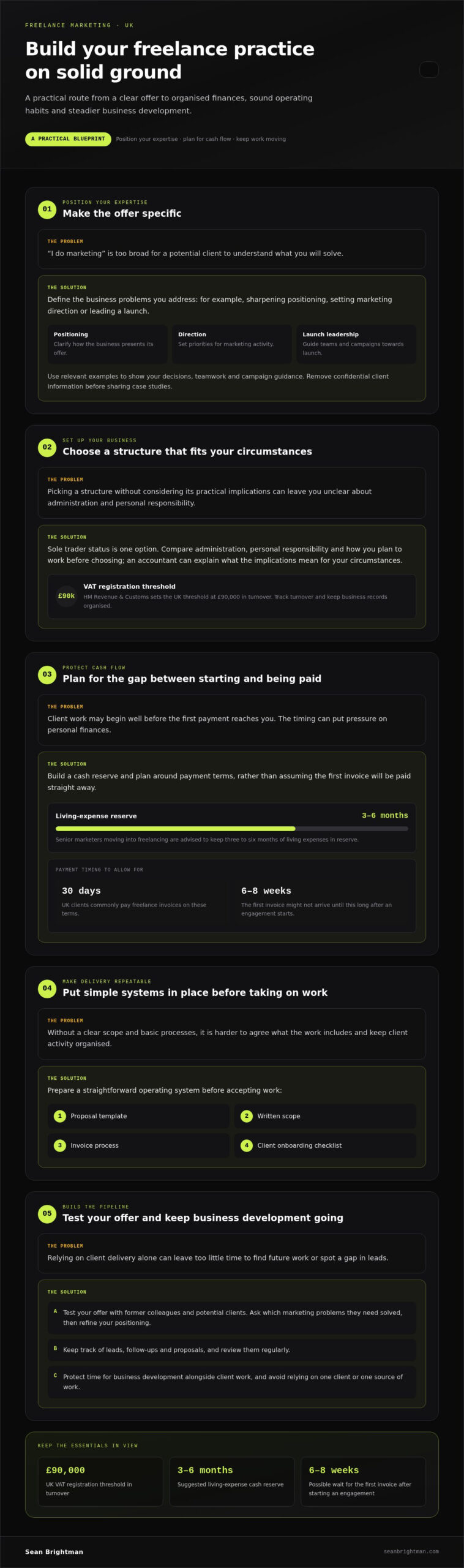
    Start with a clear offer, not a vague promise to “do marketing”. Define the business problems you solve, such as sharpening positioning, setting marketing direction or leading a launch. Use relevant examples to show how you made decisions, worked with teams and guided campaigns. Remove confidential client information before sharing case studies.

    Next, choose how to operate. Sole trader status is one structure to consider. Compare administration, personal responsibility and how you plan to work before choosing; an accountant can explain the implications for your circumstances.

    Tax needs a place in your setup from day one. The UK VAT registration threshold is £90,000 in turnover, according to HM Revenue & Customs. Track your turnover and keep business records organised, so you can see how your position changes.

    • Build a cash reserve: Senior marketers moving into freelancing are advised to keep three to six months of living expenses in reserve.
    • Plan for payment timing: UK clients commonly pay freelance invoices on 30-day terms. Your first invoice might not arrive until six to eight weeks after starting an engagement.
    • Set a simple operating system: Prepare a proposal template, written scope, invoice process and client onboarding checklist before accepting work.

    Then test your offer with former colleagues and potential clients. Ask which marketing problems they need solved and use their answers to refine your positioning. A focused service makes it easier to explain your value and agree on clear deliverables.

    Finally, protect time for business development alongside client work. Keep track of leads, follow-ups and proposals, then review them regularly. This helps you spot gaps early and avoid relying on one client or source of work.

    Freelance marketing director services in the UK

    Fractional marketing director expertise

    A fractional marketing director provides senior marketing leadership on a part-time basis. They set priorities, connect marketing activity to commercial goals and help teams turn plans into action.

    In practice, that might mean identifying why a product launch is missing its audience, then sharpening the positioning, channel plan and measures of progress. The director can guide internal staff and suppliers, while specialist tasks still need people to deliver them.

    For a UK small business or startup, fractional expertise can fill a leadership gap without adding a permanent executive role. It helps founders replace scattered marketing activity with a clear plan, make sharper investment decisions and build internal capability as the business grows.

    The value comes from connecting strategy to execution. A useful engagement might cover:

    • Diagnosis: Review the offer, customer evidence, sales process and current marketing activity.
    • Priorities: Choose the audiences and commercial objectives that deserve attention first.
    • Roadmap: Turn those priorities into owned actions, timelines and measures.
    • Leadership: Align staff and external specialists around decisions and delivery.
    • Review: Use performance data to refine the plan rather than continuing activity by habit.

    Fractional support works best when a business can name the decisions it needs help making and assign people to carry out the agreed work. It is less suitable when the immediate need is a full-time operator to complete every marketing task, or when leaders won’t set clear priorities and involve decision-makers.

    Choose a starting point before engaging: a stalled launch, unclear positioning or disconnected marketing activity. Then define the decisions, outputs and internal owners the work must connect. That keeps senior expertise focused on the business bottleneck, not abstract strategy.

    For businesses that need senior marketing direction in a flexible format, explore Sean Brightman’s Fractional CMO offering as a practical next step.

    Sean Brightman: AI Consulting

    Sean Brightman’s AI Consulting can help you decide how AI fits into your marketing operation. Explore where practical AI systems, content engines, knowledge bases and automated workflows could support your priorities, and where they might add complexity without solving a real problem.

    If the wider issue is direction, Roadmapping turns business priorities into a structured plan. An Advisory CMO retainer offers ongoing strategic guidance, priority setting and accountability as decisions and priorities shift.

    Start with the challenge in front of you: an unclear AI opportunity, disconnected marketing priorities or a need for continuing strategic input. Choose the service that fits the decision you need to make.

    To discuss your needs, contact Sean Brightman or visit seanbrightman.com.

    Turn marketing priorities into your next move

    The right freelance marketing director in the UK should help you move from a pressing business challenge to clear decisions and accountable action. Before bringing in senior support, define the decision you need to make and what progress would look like. That gives the work a sharp starting point.

    If you need senior marketing leadership, Sean Brightman’s Fractional CMO service can help set direction, guide teams and build marketing systems. AI Consulting supports practical AI implementation, while Roadmapping turns priorities into a clear plan. Start with the problem you need to solve, not another layer of activity.

    Bring your current challenge, the decisions on your desk and the outcome you want to discuss. Contact Sean Brightman to discuss your needs, and take the next step with a clearer direction.

    Frequently Asked Questions

    How much does a freelance marketing director charge per day or hour in the UK?

    Hourly fees vary with scope and commitment, so agree on the rate and billing unit before work begins. A strategy review and ongoing leadership are different briefs. Compare deliverables, decision-making responsibility and availability, not just the headline rate.

    What is the average salary or annual cost of a freelance marketing director in the UK?

    A freelance marketing director in the UK doesn’t have a fixed annual salary; annual spend depends on the days booked, engagement length and agreed scope. Estimate the cost from the proposed work rather than treating it like a permanent role. For example, a business planning a launch should budget separately for leadership input and the internal or specialist resources needed to deliver it.

    Where can UK businesses find and hire freelance marketing directors?

    Start with LinkedIn, professional contacts and specialist recruitment agencies. To make outreach productive, write a short brief describing the business challenge, expected outcomes and who will make decisions. For example, a company with unclear product positioning can seek someone with relevant positioning experience. Ask for a focused discussion of their proposed approach before agreeing a scope.

    What experience and qualifications should a UK freelance marketing director have?

    Prioritise relevant leadership experience and evidence of sound commercial judgement. Ask how they have handled a challenge similar to yours, such as entering a new market or aligning marketing with sales. Look for clear explanations of their decisions, their role and what changed. Qualifications can add context, but practical evidence should connect directly to your needs.

    How do you hire a freelance marketing director in the UK, and what should a contract include?

    Define the problem, agree the director’s responsibilities, then document the engagement before work starts. Set out scope, deliverables, working arrangements, fees, invoicing, confidentiality, ownership of work, review points and how either party can end the agreement. UK freelance marketing contracts may fall within IR35, which determines whether contracts are treated as employment for tax purposes.

  • On-demand CMO services: senior marketing direction when you need it

    On-demand CMO services: senior marketing direction when you need it

    What if your business doesn’t need another campaign, but a senior person to decide which marketing moves are worth making? On-demand CMO services can provide strategic direction without a full-time hire. The support should fit the decisions your business faces, not just a job title.

    If marketing activity feels busy but disconnected, advice alone may not be enough. Senior support should bring focus, clarify priorities and make responsibilities visible, rather than leave your team with a polished plan and no one accountable for moving it forward.

    This guide explains what on-demand CMO support can cover and how it differs from a one-off roadmap, an advisory retainer or Fractional CMO leadership. You’ll learn how to choose a model that suits your needs, what outcomes and responsibilities to agree upfront, and how to assess whether the support is working. Start by identifying the marketing decision you need help with, then match the level and duration of support to that need.

    Key Takeaways

    • Use on-demand CMO services to address a specific business need with senior marketing direction, rather than hiring against a title.
    • Choose between a focused roadmap, ongoing advice and Fractional CMO leadership by assessing the decisions and support required.
    • Compare a CMO, consultant and agency by who will lead, provide continuity and deliver specialist work.
    • Before engaging support, define the business challenge, the decisions to make and how you’ll recognise progress.
    • Match the support to the job: roadmapping for a clear plan, an advisory retainer for ongoing direction, or Fractional CMO leadership for senior input.

    What are on-demand CMO services, and when does a business need them?

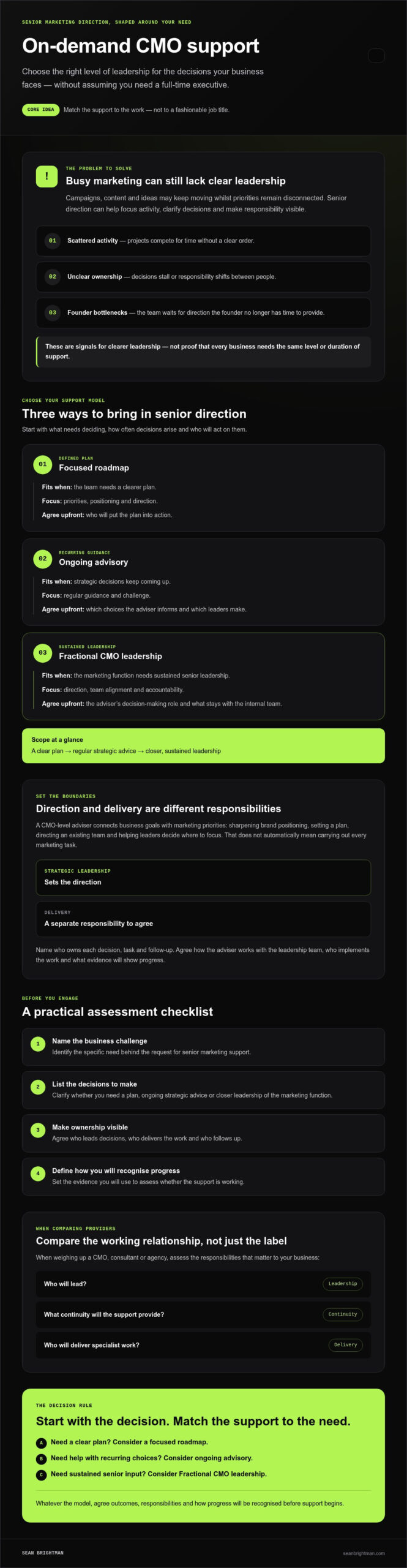
    Marketing can be busy without being well led. Campaigns, content and new ideas keep moving, but nobody owns the priorities, connects activity to business goals or makes the hard calls. That’s the gap on-demand CMO services are designed to address: access to senior marketing direction when the business needs it, without assuming it needs a full-time executive.

    The support can take different forms: a focused roadmap, ongoing strategic advice or Fractional CMO leadership working more closely with the team. The right option depends on the decisions to make and the level of responsibility required, not a standard package or fashionable job title.

    A CMO’s role is broader than managing promotional activity. A Chief Marketing Officer (CMO) typically leads marketing strategy and helps align it with the organisation’s wider direction. On-demand support brings some of that senior perspective in a form shaped around the business’s needs.

    What does an on-demand CMO actually do?

    A CMO-level adviser connects business goals with marketing priorities. That can mean sharpening brand positioning, setting a plan, directing an existing team and helping leaders decide where to focus. It doesn’t automatically mean carrying out every marketing task. Strategic leadership sets the direction; delivery is a separate responsibility to agree.

    Make the boundaries clear upfront. Decide which decisions the adviser will lead, who owns implementation, how they’ll work with the leadership team and what evidence will show progress. Clear ownership helps prevent recommendations from landing in a document with no one responsible for acting on them.

    Which signals suggest you need senior marketing direction?

    Look for friction in the system, not just a lack of activity. Work may be scattered across channels, teams may be unsure who makes the final call, or every new idea may displace the previous priority. The result is motion without a shared plan.

    Another common shift comes as a business grows beyond founder-led marketing. The founder may have set the early direction, but a growing team now needs consistent priorities, clearer decision-making and someone to connect marketing choices to business objectives. If you’re weighing up this wider model, explore the fractional CMO revolution.

    • Scattered activity: projects compete for time without a clear order.
    • Unclear ownership: decisions stall or responsibility shifts between people.
    • Founder bottlenecks: the team waits for direction the founder no longer has time to provide.

    These signals point to a need for clearer leadership. They don’t automatically mean you need the same level or duration of support as another business.

    How on-demand CMO services work: choose the right level of support

    The right model depends on what needs deciding, how often those decisions arise and who will act on them. A one-off roadmap can set direction. An advisory relationship can help leaders revisit priorities. Fractional CMO leadership brings senior direction closer to the marketing function. Match the cadence to the work rather than assuming there’s a universal template.

    Before agreeing a model, separate strategic responsibility from delivery. An adviser may set priorities or guide the team, while your staff or external delivery partners carry out agreed work. Name who owns each decision, task and follow-up so the plan doesn’t become a substitute for clear accountability.

    Focused roadmap
    Trigger: The team needs a clearer plan. Focus: Priorities, positioning and direction. Ownership to agree: Who will put the plan into action.

    Ongoing advisory
    Trigger: Strategic decisions keep coming up. Focus: Regular guidance and challenge. Ownership to agree: Which choices the adviser informs and which leaders make.

    Fractional CMO leadership
    Trigger: The marketing function needs sustained senior leadership. Focus: Direction, team alignment and accountability. Ownership to agree: The adviser’s decision-making role and what stays with the internal team.

    When is a one-off marketing roadmap enough?

    A roadmap may fit when leaders understand the business challenge but need help choosing priorities and turning them into a structured plan. For example, a team with several competing growth ideas could use a roadmap to agree what to focus on, what to defer and how marketing supports business goals.

    A plan creates direction, not automatic implementation. Your team or delivery partners still need to take responsibility for agreed actions. For a deeper planning guide, read about strategic brand roadmapping.

    When does ongoing CMO or advisory support make sense?

    Choose ongoing support when important decisions recur and the team needs a regular senior perspective. An advisory retainer offers guidance and challenge to business leaders. Fractional CMO leadership takes a more embedded role in directing the marketing function. Clarify the expected cadence, access and decision rights rather than assuming the titles mean the same thing.

    Sean Brightman offers roadmapping, advisory retainers and Fractional CMO leadership as distinct forms of support. If you’re weighing which fits, explore the marketing advisory retainer and Sean Brightman’s marketing support.

    On-demand CMO services vs a full-time hire, consultant or agency

    These options address different gaps. A business may lack someone to set marketing direction, a specialist to resolve a defined problem, or the hands-on capacity to deliver work. Identify what’s missing, then agree who owns decisions and follow-through. Fill the leadership gap with a CMO, the expertise gap with a consultant, and the delivery gap with an agency.

    On-demand CMO support or a full-time CMO?

    On-demand CMO services can suit a business that needs senior judgement for a defined challenge or whose need for leadership may change over time. This arrangement can provide strategic input without adding a permanent executive role, but it won’t automatically cover every responsibility a full-time CMO might hold.

    A permanent CMO may be more appropriate when the business needs sustained, day-to-day executive leadership: someone consistently embedded with the leadership team, accountable for the marketing function and closely involved in decisions as they arise. The distinction isn’t simply flexible versus permanent. It’s whether the business needs periodic senior direction or a dedicated executive presence.

    On-demand CMO, marketing consultant or agency?

    A CMO-level adviser connects marketing choices to business priorities and helps set direction. A consultant may focus on a specific question, such as positioning or a particular marketing challenge. An agency commonly brings specialist delivery capacity, such as carrying out agreed campaign or creative work. These roles can complement each other, but they aren’t interchangeable. Sean Brightman’s work centres on strategic leadership and advisory, not advertising execution.

    Operational problems call for a closer look at how work is organised and supported. If processes, roles or systems are the sticking point, explore marketing operations and scalable growth systems.

    Full-time CMO: Choose this when the business needs sustained internal executive leadership. Agree the role’s authority, team responsibilities and connection to business decisions.

    On-demand CMO support: Choose this when senior marketing direction is needed without assuming a permanent role. Set the scope, decision rights and continuity required.

    Consultant: Choose this when a specific area needs expert advice. Define the question to resolve and how the team will use the recommendations.

    Agency: Choose this when the business needs specialist delivery capacity. Set the brief, internal point of contact and who approves the work.

    Don’t compare options by job title alone. Value depends on scope, seniority, internal capacity and the business requirement. Start with the gap, then agree responsibilities and evidence of progress before work begins. To explore Sean Brightman’s strategic support, visit Sean Brightman’s marketing services.

    On-demand CMO services: senior marketing direction when you need it

    How to assess on-demand CMO services before you engage

    A strong engagement starts with a clear brief, not a list of requested tasks. Before comparing on-demand CMO services, work through four points: the business challenge, the decisions senior support must help resolve, the team available to act, and the level of guidance you need. For example, a team may have people to deliver marketing but lack agreement on which audience or priority to focus on. That calls for a different brief from one where nobody owns the marketing function.

    Agree the intended outcome and how you’ll assess progress before discussing activity or deliverables. Otherwise, a full calendar of meetings and recommendations can look like progress without showing whether the underlying problem is being addressed.

    What should the brief and success measures include?

    Keep the brief grounded in your business. State the priority, the current constraint and the decisions you expect senior support to inform. Then choose indicators that fit the work. A positioning challenge might call for agreement on the target audience and message; a planning brief might focus on whether the team has clear priorities and owners. There’s no universal benchmark that suits every engagement.

    Set review points to check what has changed, what remains unresolved and what the team will do next. Ask how recommendations will become decisions, and what evidence the adviser will use to assess progress. Be cautious of broad promises without a clear link to your challenge, or reports that count activity without showing what it means for the business.

    How should responsibilities and accountability be agreed?

    Write down who owns each part of the work. Clarify who sets or advises on strategy, who handles internal delivery, whether specialist execution sits with another partner, and who makes final business decisions. Agree access to relevant information, the meeting cadence and how urgent decisions will be raised between scheduled discussions.

    Accountability works both ways. The adviser should be clear about their responsibilities and reporting; your leadership team should identify who will make decisions and act on recommendations. If the brief is still fuzzy, explore strategic marketing direction as a first step towards defining the support your business actually needs.

    How Sean Brightman’s on-demand CMO services turn uncertainty into direction

    Senior marketing support should fit the problem, not force your business into a pre-set package. Sean Brightman’s work centres on strategic direction, brand positioning, marketing systems and accountability. It’s advisory and leadership, not recruitment or advertising execution. The useful question is which decision or gap needs attention now, and what level of support would help address it.

    Which Sean Brightman service fits the problem?

    Roadmapping suits a leadership team that needs a structured plan for marketing and brand direction. It helps clarify priorities, but doesn’t automatically include ongoing implementation.

    An advisory retainer may fit when business owners face recurring marketing decisions and want continued guidance and accountability. Fractional CMO support is for a business that needs part-time senior marketing leadership, with a more active role in setting direction and aligning the marketing function.

    If your challenge is specifically how to integrate AI into marketing systems in a practical way, AI consulting may also be relevant. It isn’t a default add-on; the need should come from the business problem.

    What happens after the first conversation?

    Start with the facts that shape the decision: what the business is trying to achieve, where marketing is stuck, what the team can own internally and which choices need senior input. A useful discussion should help distinguish a need for a focused plan from a need for ongoing advice or embedded leadership.

    Then agree the scope around the actual need. Clarify responsibilities, decision rights, how recommendations will be reviewed and what evidence will show progress. The goal isn’t to buy activity for its own sake. It’s to make sure the support addresses the uncertainty that prompted the conversation, without assuming one model fits every business.

    If marketing priorities feel scattered or the team lacks a clear direction, discuss your marketing priorities with Sean Brightman and identify a suitable next step.

    Turn marketing uncertainty into a clear next step

    The right senior support starts with the gap you need to fill. If your team needs a clear plan, roadmapping can set direction. If key decisions keep recurring, an advisory retainer can provide ongoing guidance. If marketing needs senior leadership, Fractional CMO support offers a more embedded option. The best fit depends on the decisions, responsibilities and follow-through your business needs.

    That’s the practical value of on-demand CMO services: access to strategic direction shaped around your business, without assuming every company needs the same model. Sean Brightman offers one-off roadmapping, ongoing advisory and Fractional CMO leadership. AI consulting is also available when practical AI integration is the challenge.

    Start by naming the marketing issue that’s slowing decisions or scattering effort. Then consider your priorities, team capacity and the level of support that could bring focus. Discuss your marketing priorities with Sean Brightman and identify a suitable next step. Clearer direction starts with a sharper question.

    Frequently Asked Questions

    What are on-demand CMO services?

    On-demand CMO services give a business access to senior marketing direction without automatically requiring a full-time executive. The support can take different forms, from a one-off roadmap to regular strategic advice or part-time leadership of the marketing function. The right form depends on the decisions the business needs help with, the team available to act and how much ongoing leadership is required.

    Is an on-demand CMO the same as a Fractional CMO?

    Not always. “On-demand CMO” is a broad description for senior marketing support accessed as needed, whilst “Fractional CMO” usually refers to part-time marketing leadership. A business might use a focused roadmap or advisory support without needing an embedded leadership role. Agree the adviser’s responsibilities, decision-making authority and level of involvement rather than relying on the title alone.

    Can a small business use on-demand CMO services?

    Yes, if the business has a clear need for senior marketing direction and a way to act on it. A small business might need help setting priorities, aligning marketing with business goals or guiding an existing team, without requiring a permanent executive role. Consider whether the available team can carry out agreed work, and define which decisions and outcomes the support should address.

    How do I choose between an on-demand CMO and a marketing agency?

    Choose based on the gap. An on-demand CMO focuses on senior direction, priorities and leadership; a marketing agency commonly provides specialist delivery capacity. If you know what work needs doing but lack the people to do it, an agency may fit. If the work itself lacks direction, clarify the strategy first. Some businesses may need strategic guidance and separate delivery support, with responsibilities agreed between them.

    What should an on-demand CMO engagement include?

    Agree the business challenge, objectives, scope and responsibilities before work begins. Clarify which decisions the CMO will lead or advise on, who owns internal delivery, what specialist work sits elsewhere, and who makes final business decisions. Set expectations for access to the team, meeting cadence, review points and how recommendations will be handled. The details should reflect your needs, not a standard template.

    How can I tell whether on-demand CMO support is working?

    Check progress against indicators agreed at the start, not activity alone. Depending on the brief, this might include clearer marketing priorities, named owners for key actions or faster resolution of a specific strategic decision. Review what has changed, what remains blocked and what the team will do next. Don’t treat more meetings or recommendations as proof of impact without connecting them to the agreed objectives.

    Does an on-demand CMO provide marketing execution?

    Not necessarily. CMO-level support centres on strategy, leadership and decision-making; execution may remain with your internal team or a specialist delivery partner. Confirm this before engaging, including who will carry out agreed work and how progress will be tracked. Sean Brightman’s offering focuses on strategic leadership and advisory, including Fractional CMO support, roadmapping and ongoing advice, rather than advertising execution.