Tag: marketing KPIs

  • How to get senior marketing expertise affordably through adaptable hires

    How to get senior marketing expertise affordably through adaptable hires

    You don’t need a full-time specialist for every marketing challenge. A practical way to get senior marketing expertise affordably is to bring in an adaptable generalist who can plan and deliver work across channels. Assess their portfolio and case studies by how clearly they connect campaign activity to business objectives and KPIs.

    Senior experience doesn’t have to mean a permanent role or a specialist for every function. A Fractional CMO can bring strategic direction across positioning, priorities, campaigns and marketing systems, helping you connect the work to business goals without coordinating separate advisers yourself.

    Start by defining the decisions and outcomes you need help with. Then assess whether a one-off roadmap, ongoing advisory or embedded leadership fits the work. Look for clear strategic thinking, relevant experience and accountability, rather than choosing based on a title alone.

    Key Takeaways

    • Review portfolios for a clear link between campaign activity, business goals and meaningful KPIs, not just polished creative work.
    • Compare the full commitment of a permanent hire with the specific expertise and scope your business needs.
    • Define the outcomes and responsibilities before seeking part-time marketing leadership, so you can assess experience against the actual work.
    • Explore whether local business support or grant programmes fit your needs, and check their eligibility criteria and what they cover.

    2. Portfolio and case study analysis

    A portfolio should show how a marketer thinks, not just what they made. If you’re deciding how to get senior marketing expertise affordably, look for evidence of relevant decisions and delivery. A useful case study explains the business problem, audience, strategy and execution, then connects the activity to business objectives. Ask which KPIs mattered, how the results shaped decisions and what changed as a result.

    Look for the full chain from activity to outcome. An email case study, for example, should explain its purpose, audience and success measures, not simply display a polished template. Check whether the marketer distinguishes activity, such as sending emails, from results that support a business objective. Ask what the data showed and what they would change next time. Their answer can reveal strategic thinking and practical judgement.

    Assess breadth against the work your business needs. An adaptable generalist may contribute across digital, content, email and brand marketing, while planning and delivering campaigns end to end. If repeat customers matter, look for CRM and lifecycle marketing experience that can support stronger customer engagement and long-term value. A varied career can be useful, but the portfolio still needs relevant examples, clear ownership and evidence of delivery.

    Use a consistent review process for every portfolio. Match each case study to a business priority, identify its KPIs, then note the marketer’s role and decisions. Separate their contribution from work completed by an agency or wider team. If they use AI, assess whether they apply it critically and ethically as support, rather than a substitute for marketing expertise. To get senior marketing expertise affordably, compare evidence of relevant judgement and delivery, not job titles or presentation polish.

    3. What are the typical costs of hiring a full-time senior marketing director in the UK?

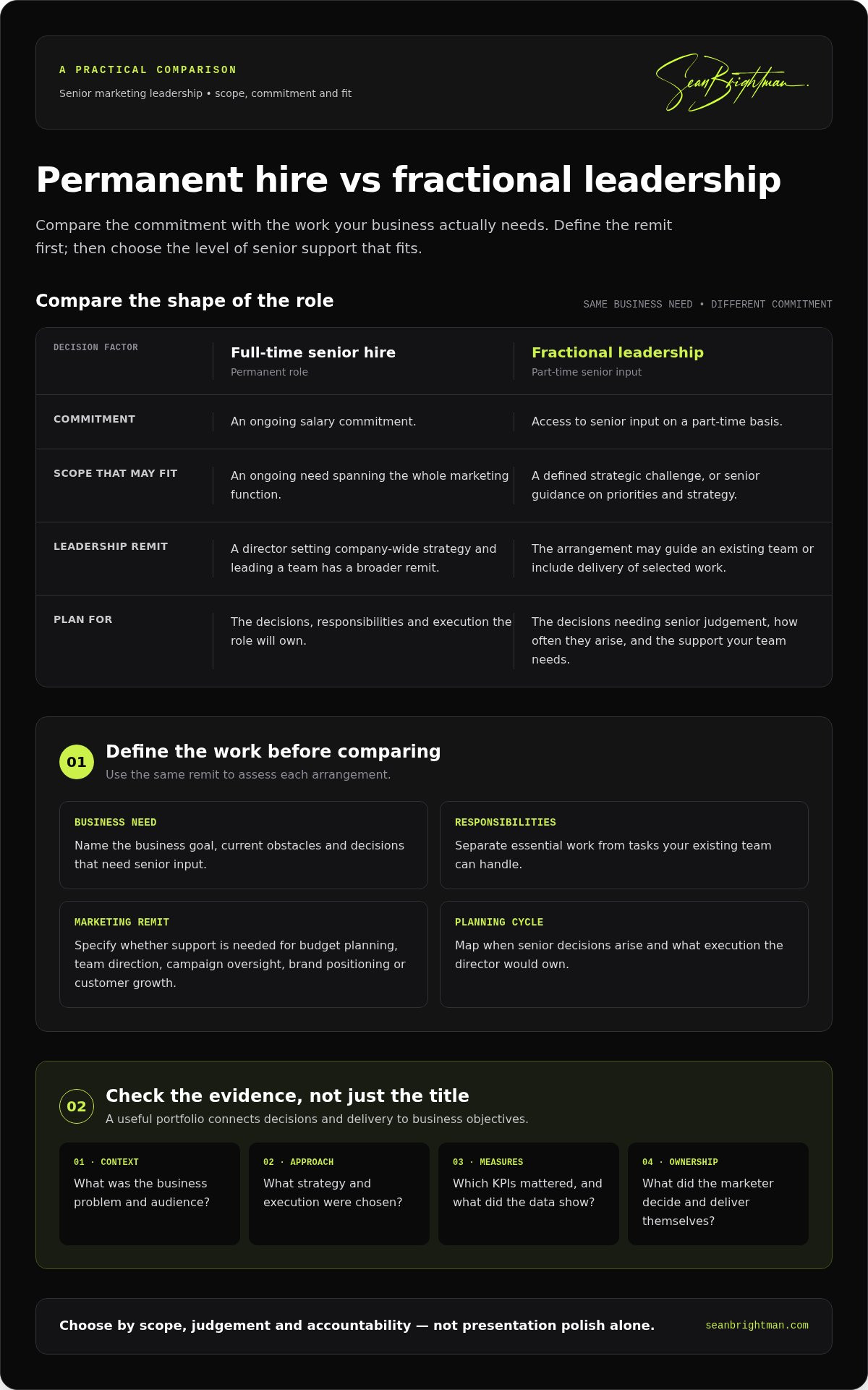
    Compare the cost of a full-time role with the scope of support you actually need. A permanent senior hire brings an ongoing salary commitment, while fractional leadership gives you access to senior input on a part-time basis. Define the decisions, responsibilities and level of involvement required before comparing options.

    Start by defining the work. A director setting company-wide strategy and leading a team has a different remit from someone guiding a focused marketing function. Specify whether you need support with budget planning, team direction, campaign oversight, brand positioning or customer growth. Then separate essential responsibilities from work your existing team can handle. This gives you a clearer basis for assessing the level of commitment.

    Compare like with like. A full-time role and fractional leadership differ in time commitment, responsibilities and how the work is delivered. For example, a business that needs someone to lead a team day to day may require a different arrangement from one seeking senior guidance on priorities and strategy. Be clear about the work, the decisions involved and the support your team needs.

    To decide whether a permanent hire makes sense, map the work across a typical planning cycle. Identify which decisions require senior judgement, how often they arise and what execution the director would own. If the need is ongoing and spans the whole marketing function, a full-time role may fit. If it centres on a defined strategic challenge, consider whether a narrower remit would meet the need. A clear marketing roadmap can help sharpen that scope before you commit.

    A Level 3 marketing apprenticeship typically takes 15-18 months in the UK. For businesses planning future capability, this offers a longer-term route to consider alongside an immediate senior hire.

    Marketing professionals can progress into management and director roles, or work as freelance consultants. That progression may help you assess whether your organisation needs senior leadership now or can develop capability over time. Use the remit you have defined to guide the decision: if you need strategic direction immediately, focus on support that can provide it; if the need is evolving, include development in your workforce plan.
    How to get senior marketing expertise affordably through adaptable hires

    4. How can a small business find an experienced part-time marketing director in the UK?

    Start with the problem, not the job title. Write a brief that names the business goal, current obstacles and decisions needing senior input. For example, a retailer might need a clearer customer acquisition plan, not someone to manage every daily post. Define the outcomes, responsibilities and how the senior marketer will work with existing staff. A focused brief helps you identify support that matches the actual need.

    Search for people with part-time, fractional or interim marketing leadership experience. Ask trusted business contacts for introductions, and use professional networks to find candidates with relevant sector knowledge. Review their portfolios and case studies against the brief. Look for evidence they have set direction, prioritised activity and worked with teams to put plans into action. A director who has led a similar challenge may be more relevant than one with an impressive title alone.

    Use a structured conversation to test judgement. Give each shortlisted candidate the same practical scenario, such as slow repeat purchases or an unclear brand position. Ask how they would diagnose the issue, what information they would need and which actions they would prioritise. Strong answers connect the proposed work to a business objective, explain trade-offs and identify how progress would be measured.

    Before agreeing a working arrangement, set out its boundaries. Specify decision-making authority, key deliverables, internal contacts and how updates will happen. Clarify whether the senior marketer will guide an existing team or personally deliver selected work. Agree how you’ll review priorities as business needs shift. This keeps the role focused and prevents part-time leadership from becoming an undefined catch-all. Look for someone who can make senior-level decisions and work constructively with the people handling day-to-day tasks.

    4. Can UK businesses access affordable marketing advice through Growth Hubs, business support programmes or grants?

    Yes, these routes can help businesses find advice or fund defined projects, but support depends on the scheme and location. Start with your local Growth Hub and describe the business challenge in practical terms. For example, explain whether you need a clearer route to market, stronger customer retention or a plan for digital activity. Ask what support covers, who can apply and what outcomes the programme expects. That conversation helps you distinguish useful marketing guidance from general business support.

    Compare any available support programmes with the work you need done. Some focus on advice, while others support a specific project or business objective. Read the eligibility rules, application process, covered activities and reporting requirements. If you’re considering a grant, check whether marketing strategy, research or campaign delivery qualifies as an eligible cost. Prepare a short project outline with its objectives, proposed work and measures of progress, then compare it with the scheme’s criteria.

    Keep the limits clear. A grant is not a general marketing budget, and advice does not automatically include implementation. A programme might help you refine a growth plan, while your business still needs to assign someone to carry it out. Record what the support will deliver, what your team must provide and how you’ll measure progress. This makes it easier to compare a funded project with other ways of addressing the same need.

    Use public support to sharpen the decision, not to outsource ownership of the strategy. Once you understand the available help, identify the gaps it leaves: direction, prioritisation or a workable plan for delivery. If you need to turn scattered marketing activity into a focused programme, map your marketing priorities into clear objectives and next steps.

    CRM and lifecycle marketing are useful skills for businesses seeking to deepen customer engagement and increase long-term customer value. Choosing a manager and team that support career progression and nurture talent can help professionals advance.

    Sean Brightman: AI Consulting

    Sean Brightman’s AI Consulting is a practical next step when you need senior guidance on AI’s role in marketing. Use it to assess where AI could support your work, how it fits your business priorities and which decisions still need human judgement. The aim is a clearer direction, not adopting tools for their own sake.

    If your wider challenge is setting marketing priorities, Roadmapping provides a one-off strategy session and a structured plan. An Advisory Retainer offers ongoing strategic input, while Fractional CMO support provides senior leadership on a part-time basis. Choose the option that matches the decision in front of you, rather than adding complexity before you know what needs solving.

    To discuss your marketing challenge, email Sean Brightman at sean@seanbrightman.com.

    Turn your marketing gap into a clear next step

    Getting senior marketing expertise affordably comes down to matching the support to the decision your business needs to make. Before taking action, write a short brief: identify the priority, the decision holding progress back and what your team can deliver. That gives the conversation a useful starting point and keeps the focus on the work, not a job title.

    Sean Brightman offers Fractional CMO, AI Consulting and Roadmapping. Each addresses a different need, from senior marketing direction to practical AI guidance or a clearer plan. Be precise about the challenge you want to solve, then choose the kind of input that will move it forward.

    Contact Sean Brightman to discuss your marketing expertise needs. A focused next step can make the path ahead easier to act on.

    Frequently Asked Questions

    How can a business assess a senior marketer’s experience and verify results before hiring?

    Ask the marketer to walk through a project and explain their personal contribution, the starting position and how the outcome was measured. Then, with their permission, request a relevant reference who can speak to that work. For example, if they claim to have improved lead quality, ask how the team defined a qualified lead and what else could have influenced the result. This tests whether they can substantiate claims and explain context.

    What are the risks of hiring a low-cost marketing consultant or relying on a generalist?

    A generalist may not have experience that matches your specific priorities, so review case studies for clear ownership, meaningful KPIs and results linked to business goals. An unclear brief can also turn a part-time role into an undefined catch-all. Set responsibilities and deliverables before agreeing on the support.

  • Agile marketing process for small teams, from workflow to KPIs

    Agile marketing process for small teams, from workflow to KPIs

    Agile marketing for small teams works through a repeating cycle: prioritise a backlog, choose a focused batch of work, launch it, measure the results, then review and adapt. A visible Kanban workflow and clear work-in-progress limits keep tasks moving without burying a lean team in parallel projects. The aim isn’t more activity. It’s to deliver customer value early and often, then change course when the evidence points to a better approach.

    A full calendar can look productive while campaigns stall, priorities shift and nobody knows what’s working. Agile replaces a rigid plan with a manageable flow of work and regular feedback. That doesn’t mean abandoning strategy. It means linking each task to a business goal and using results to decide what to do next.

    This guide explains how the process works, how to organise backlogs, workflows and planning, and how to choose KPIs that show progress rather than just output. You’ll also learn how short feedback loops help identify what’s gaining traction, what needs adjusting and where a small team should focus next.

    Key Takeaways

    • Focus marketing work on customer value and business goals, not the volume of tasks completed.
    • Make the workflow visible with a Kanban board, and limit work in progress to keep priorities moving.
    • Use a prioritised backlog and focused sprints to turn larger initiatives into manageable work.
    • Choose KPIs that connect campaign activity to outcomes, then use the results to decide what to adjust next.
    • Build a test-and-learn rhythm so the team can adapt its plans as customer feedback and performance data emerge.

    What Is the Agile Marketing Process?

    Agile marketing is a way to plan, deliver and refine marketing work through short feedback loops. For a small team, its principles connect each task to customer value and business outcomes.

    Agile Marketing Principles and Values

    Agile marketing applies principles that favour customer value, early delivery, experimentation and responding to change. The Agile Marketing Manifesto was created in 2012 and revised in 2021, giving teams values to guide decisions rather than a rigid script. That matters when priorities shift: the team can test a functional piece of work, learn from feedback and adjust without waiting for a perfect campaign.

    The core practice is to set a clear business goal, deliver a small piece of work, measure its effect and use the result to choose the next step. Agile teams build quickly, test their work and iterate based on regular feedback, according to UK Government. For example, a team could test an email subject line before refining the wider campaign.

    Customer Focus in Agile Marketing

    Customer focus means using feedback and observed behaviour to shape what the team creates next. A team might publish a short guide, review readers’ questions, then update the next version to address their needs. Activity alone doesn’t show whether marketing is useful. Linking each experiment to a customer problem gives the team a clearer basis for deciding what to continue, change or stop.

    Agile and Traditional Marketing Compared

    Traditional marketing often organises work around a fixed plan, while agile marketing reviews progress and responds as new information arrives. A campaign calendar can still provide direction; agile changes how the team manages delivery within it. Rather than waiting until every asset is complete, the team can release a suitable first version, gather feedback and improve the next iteration. Success is measured by outcomes, not just completed tasks.

    UK small businesses can build required advertising, data protection and email marketing checks into each campaign workflow. Assign a reviewer to check claims, audience permissions and campaign materials before release. Agile changes the pace of work, not the need to follow applicable rules.

    Team Roles and Responsibilities

    An agile marketing team needs someone to set priorities, people to create and deliver the work, and someone to clear blockers and support the process. In a small business, one person may hold several roles, but responsibilities still need to be explicit. Who approves the campaign? Who reviews customer feedback? Clear ownership keeps a fast workflow from becoming a confusing one.

    For agile marketing to work, the team needs a shared goal, authority to organise its work and regular communication about progress. A brief check-in can surface a delayed approval or missing input before it stalls a launch. Keep roles practical, not ceremonial: each responsibility should help the team deliver, learn or make a decision.

    Kanban workflows and work-in-progress limits

    A Kanban workflow makes marketing work visible as it moves through clear stages, from idea to completion. For a small team, that visibility exposes bottlenecks and helps protect focus.

    Kanban Boards and Principles

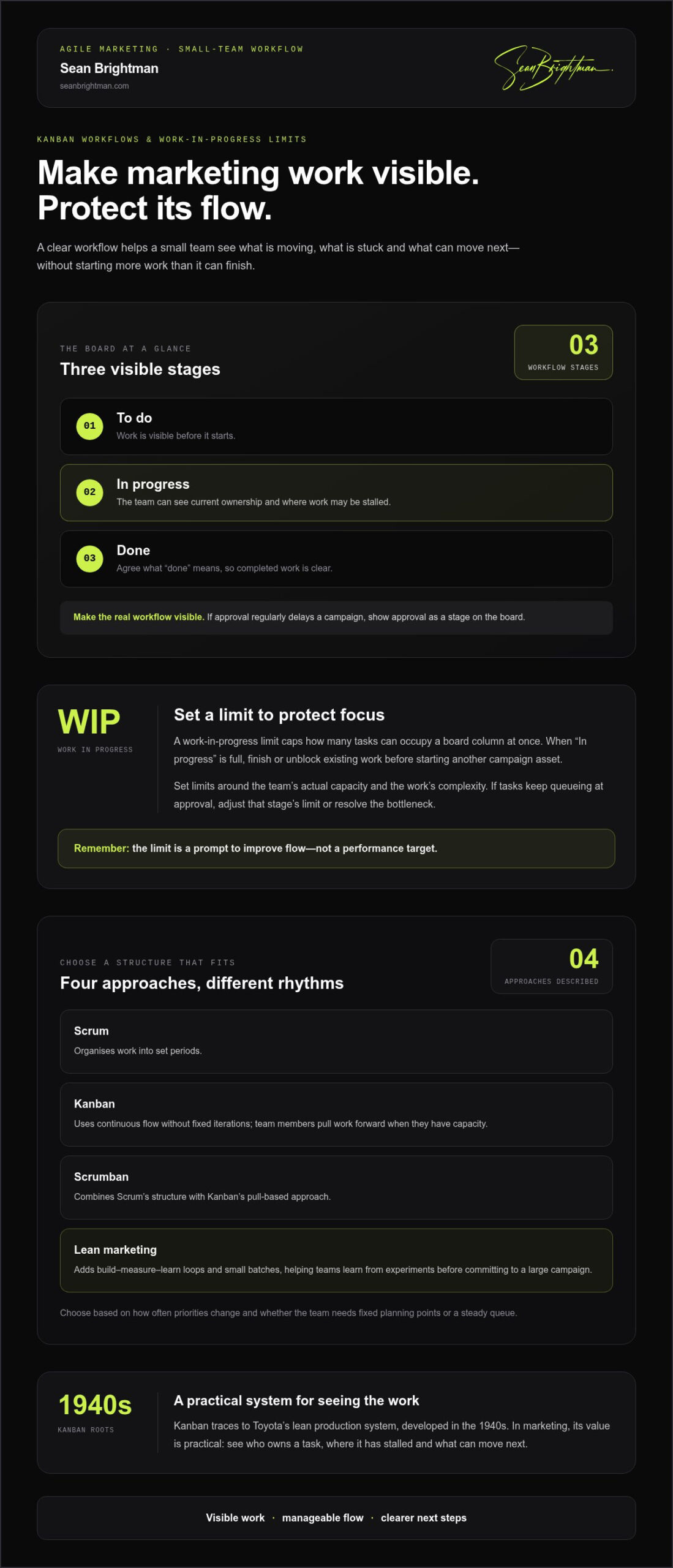
    A Kanban board shows each work item moving through stages such as “To do”, “In progress” and “Done”. Kanban traces to Toyota’s lean production system, developed in the 1940s. The board’s value is practical: everyone can see who owns a task, where work has stalled and what can move next. A campaign card might track a landing page from draft through review to publication.

    Keep the board aligned with the real workflow, not an idealised process. If legal review regularly delays a promotion, make approval a visible stage. That helps the team spot recurring friction and improve the process, rather than adding more tasks to an already crowded queue.

    Managing Continuous Workflow

    Kanban supports continuous delivery: team members pull new work forward when they have capacity, rather than waiting for a fixed sprint to end. That suits recurring tasks such as publishing social posts or updating a campaign page. The team can respond to feedback as it arrives, while the board shows whether urgent requests are displacing planned work.

    To use this framework, define the stages, agree what “done” means and make blocked work visible. For example, a social post might move from draft to approval, then scheduling and publication. Review the workflow regularly and adjust stages when hand-offs cause delays. The aim is smoother progress, not a more elaborate board.

    Setting Work-in-Progress Limits

    Work-in-progress limits cap how many tasks can occupy a board column at once. If “In progress” is full, the team finishes or unblocks existing work before starting another campaign asset. Kanban uses these limits to manage the process and improve efficiency. They make overload visible and stop half-finished tasks competing for the same people.

    Set limits around the team’s actual capacity and the work’s complexity. A designer handling a landing page and several social assets may need protected focus before accepting another request. If work repeatedly queues at approval, adjust that stage’s limit or resolve the bottleneck. The limit is a prompt to improve flow, not a performance target.

    Scrum, Kanban and Scrumban offer different structures. Scrum organises work into set periods, while Kanban uses continuous flow without fixed iterations. Scrumban combines Scrum’s structure with Kanban’s pull-based approach. Lean marketing adds build-measure-learn loops and small batches, helping teams learn from experiments without committing to a large campaign first. Choose based on how often priorities change and whether the team needs fixed planning points or a steady queue.

    For a small team, the useful framework is the one people can follow consistently. Start with a board for one campaign, make ownership clear and watch where work piles up. Then refine the process using evidence from actual delivery. To connect workflow design with business priorities, explore aligning marketing work with strategic goals.

    Backlogs, prioritisation and sprint planning

    A marketing backlog gathers campaign ideas, tasks and improvements in one prioritised queue. Sprint planning selects focused work the team can complete, review and learn from.

    Managing the Marketing Backlog

    A backlog is an ordered list of marketing work that gives the team a transparent view of what matters next. It might include a landing page, an email sequence and customer research. Make each item specific enough to estimate, assign and review. “Improve the welcome email” is less actionable than “rewrite the opening to explain the product’s main benefit”.

    Prioritise work against the business goal, customer value, dependencies and effort. If a campaign relies on a landing page, that page may need to come first. Review the queue regularly: new customer feedback can change the order, while outdated ideas can be removed. This keeps planning grounded in current evidence, not whoever last requested a task.

    Sprint Duration and Daily Stand-Ups

    A sprint is a fixed period for delivering a chosen batch of work and reviewing its results. Scrum plans work in set increments called sprints, typically 2-4 weeks in duration, according to UK Government. Keep the sprint goal clear, such as testing a campaign message and publishing its landing page. A defined endpoint makes progress easier to assess.

    Daily stand-ups help the team coordinate work, surface blockers and agree immediate priorities. Agile marketing teams are advised to keep these meetings to no more than 15 minutes. Each person can report progress, name a blocker and state the next action. A stand-up should support functional collaboration, not become a lengthy status report.

    During sprint planning, compare the team’s capacity with the proposed work. Select tasks that support a shared outcome, then define what completion means. For a product campaign, that might include approved copy, a published page and a planned review of audience response. Clear acceptance criteria prevent “nearly finished” work from quietly rolling into the next cycle.

    Iterative releases let marketers test a campaign in manageable parts. A team could publish one content asset, study engagement and use what it learns to shape the next release. Weekly campaign iterations can replace waiting until a quarterly review to adjust direction. Smaller tests make experimentation practical, while regular feedback helps refine the message before the team invests further effort.

    Not every team needs Scrum’s fixed cadence. Kanban supports continuous work, while Scrumban combines Scrum’s structure with Kanban’s pull-based approach. Choose based on how work arrives and how often priorities shift. Whichever framework you use, record decisions and blockers where everyone can see them. That transparency connects sprint plans to actual delivery and makes each review useful.

    Agile marketing process for small teams, from workflow to KPIs

    Benefits of Agile marketing

    Agile marketing can help a small team deliver sooner, learn from real responses and change direction with less friction. The benefits come from improving how work flows, not simply asking people to produce more.

    Speed, Productivity and Flexibility

    Short feedback loops help a marketing team spot delays and make useful changes before a campaign is finished. For example, a business launching a new service can publish a focused landing page, review customer responses and refine its message before producing more campaign material. That can reduce time spent polishing work that misses the audience.

    Agile also makes capacity visible. If a designer is waiting for copy approval, the team can unblock that task instead of assigning another design. A 2025 State of Agile Marketing Report found that more than 60% of surveyed marketing leaders reported faster delivery times and stronger alignment with business strategy after adopting agile ways of working. Speed matters most when it improves delivery towards a clear business goal.

    Benefits for Teams and Organisations

    Shared priorities help a team see how daily work supports organisational goals. A campaign writer, designer and analyst can coordinate around one release, rather than handing work across departments with competing deadlines. This creates practical collaboration: each person contributes a distinct skill, while the team shares responsibility for progress.

    Regular reviews also turn completed work into learning. If a campaign attracts attention but few enquiries, the team can examine its message, audience and next step before repeating the approach. The 2026 State of Agile Marketing Report found that 95% of marketers applying agile ways of working reported a very positive experience. That finding describes respondents’ experience, not a guaranteed result for every organisation.

    Customer experience can improve when teams act on feedback instead of waiting for a distant planning cycle. If customers repeatedly struggle to understand a product feature, for instance, the team can clarify the website copy and test whether the explanation helps. Small changes to customer-facing processes can remove friction without rebuilding an entire campaign.

    Agile practices can also support improvement across channels. A team can compare customer questions from support with responses to social content, then adjust its next campaign message. The value lies in connecting those signals to a practical decision, not collecting data for its own sake. A clear review question, such as “Did this change help customers take the next step?”, keeps learning focused.

    For UK teams choosing software, a shared Kanban board, analytics platform and email marketing tool can support planning, measurement and campaign delivery. Costs depend on factors such as user numbers, features and integrations. Choose tools to support the workflow rather than buying a large suite before the team needs it.

    Agile marketing metrics and KPIs

    Agile marketing KPIs connect team activity to customer behaviour and business outcomes. Choose measures that help the team decide what to continue, change or stop, rather than tracking numbers just because the software displays them.

    Start with the outcome

    Start with the business result a campaign should support, such as qualified enquiries, completed purchases or repeat bookings. Then choose a KPI that reflects progress towards that result. For a landing-page experiment, the team might track completed enquiry forms, not just page views. Views show attention; form completions show whether visitors took the intended next step.

    Make the link between the measure and the campaign explicit. If the goal is to increase product awareness, track a relevant audience response, such as visits to a product page from a campaign. If the goal is sales, measure purchases or qualified leads. This gives collaboration a clear purpose and stops team members interpreting success in incompatible ways.

    Balance outcome and workflow measures

    Outcome KPIs show what marketing achieved; workflow measures show how work moved. A team could track campaign-generated enquiries alongside the time a landing page spends awaiting approval. If enquiries remain steady while approval delays grow, the workflow points to a process issue. That doesn’t prove the delay caused the result, but it gives the team a specific area to investigate.

    Useful workflow signals include blocked tasks, completed work and time from brief to publication. A Kanban board or project-management software can make these visible. Interpret them in context: more completed tasks don’t automatically mean progress if those tasks don’t support the campaign goal. Use the figures to prompt discussion, not to rank people.

    Build a continuous review loop

    At each campaign review, compare the result with the intended outcome, note what changed and agree on the next action. If an email gets opens but few clicks, inspect the subject line, message and call to action before changing everything at once. A focused adjustment makes the next test easier to interpret.

    Record the campaign, audience, change and KPI result together. This gives the team a useful history for future planning. If a result shifts, check whether the audience, offer or channel also changed before drawing conclusions. A short review note can turn one experiment into learning that informs later campaigns.

    A small team doesn’t need a dashboard crowded with measures. Choose a small, relevant set: an outcome KPI, a customer-response measure and a workflow signal. Review them at the same point in each campaign cycle, then adjust priorities based on what the evidence shows. That keeps metrics tied to decisions and makes continuous improvement part of the workflow, not an extra reporting exercise.

    Sean Brightman: AI Consulting

    Sean Brightman’s AI Consulting can help your team assess how AI could support marketing workflows, analysis and decision-making. The focus is practical: identify where AI fits your priorities rather than adding software without a clear purpose.

    If the bigger challenge is connecting campaign goals, work and KPIs, Roadmapping can help shape a clearer direction. An Advisory Retainer offers ongoing strategic input as priorities and results develop. These options suit teams that understand agile principles but need help applying them to their operating model.

    Bring your current workflow, marketing goals and measurement challenges into the conversation. Visit seanbrightman.com to contact Sean Brightman.

    Make your next marketing move deliberate

    Choose an upcoming campaign as a focused pilot. Before work begins, agree what decision the results should help you make. That gives your team a practical starting point for agile marketing for small teams, without forcing a full operational change before you learn what fits.

    If priorities feel disconnected or nobody owns the wider direction, Sean Brightman’s Roadmapping can help shape a clearer path. AI Consulting can help you assess where AI fits your marketing work, while Fractional CMO support provides senior marketing leadership. The right next step depends on the challenge you need to solve, not on adding more activity.

    Bring your goals and current sticking points into a conversation, then decide what would make the greatest difference. Contact Sean Brightman to discuss your needs. Start with one clear decision, and give your team room to make progress.

    Frequently Asked Questions

    What is the difference between Scrum and Kanban marketing?

    Scrum organises marketing work into fixed sprints; Kanban moves tasks through a continuous workflow. For a launch with coordinated assets and a shared deadline, Scrum can help the team plan a defined batch. For ongoing requests, such as website updates and social content, Kanban makes incoming work visible. The practical choice depends on whether work arrives in planned releases or continuously.

    What is agile marketing and how does it work for small teams?

    Agile marketing for small teams organises work around customer value and business goals, then uses feedback to shape what happens next. A small team might test two versions of a product message with a focused audience, review the response and apply what it learns to the next campaign. It doesn’t need a separate agile department; clear ownership and a shared goal can make the approach practical for a lean team.

    How can a small marketing team implement agile marketing step by step?

    To put agile marketing for small teams into practice, choose a campaign with a clear business goal and identify the people and approvals it needs. Break it into deliverables, assign ownership and decide what evidence will inform the next decision. Track work on a shared board, review progress regularly and record lessons after launch. Expand the approach only after the team sees which practices improve its workflow.

    Which agile marketing frameworks work best for small teams: Scrum, Kanban or Scrumban?

    Choose Scrum when the team can plan a focused batch of campaign work and review it at regular intervals. Choose Kanban when requests arrive continuously and priorities shift during delivery. Scrumban can suit a team that wants planned reviews but needs flexibility between them. Map a typical month of work: frequent interruptions point towards flow, while coordinated releases may suit sprint planning.

    How should small teams plan sprints, prioritise marketing work and manage backlogs?

    Before planning, clarify which business goal takes priority and identify dependencies, such as copy approval before design. Write backlog items as specific deliverables with an owner and a clear definition of completion. During planning, select work that fits the team’s actual capacity, leaving room for necessary interruptions. At review, carry forward only unfinished work that still matters, rather than automatically rolling every item into the next sprint.

    What agile marketing metrics and KPIs should small teams track?

    Track measures that inform a decision, not every number available. For a lead-generation campaign, compare qualified enquiries with the page visits that produced them; for retention, examine repeat purchases or renewal behaviour. Pair the outcome with a process signal, such as approval delays, to identify where work may be getting stuck. Compare like with like, keeping audience, offer and channel context beside each result.

    What are common challenges and risks when adopting agile marketing, and how can teams avoid them?

    Common problems include treating every request as urgent, holding meetings without decisions and measuring output instead of impact. Set a shared priority, make ownership visible and use check-ins to resolve specific blockers. Keep campaign approval and compliance reviews in the workflow, so speed doesn’t bypass necessary scrutiny. If the board fills with unfinished work, pause new tasks and find the bottleneck before adding another process or tool.

    How can a small team compare agile marketing with traditional marketing planning?

    Compare how each approach handles a real campaign, rather than debating labels. Traditional planning can set strategic direction and key milestones; agile practices can help the team adjust delivery as audience feedback comes in. Review how quickly decisions change, how approvals move and whether campaign learning shapes later work. The best fit may preserve an annual plan while giving the team room to adapt individual activities.

  • Developing Marketing KPIs That Matter: A Practical Guide

    Developing Marketing KPIs That Matter: A Practical Guide

    A dashboard full of clicks, impressions and engagement can still leave one question unanswered: is marketing helping the business grow? Developing marketing kpis that matter starts with that question, not with another metric to squeeze onto a report. The goal is to connect activity to a commercial outcome leaders care about.

    If your reporting feels busy but doesn’t help leadership or finance make decisions, the problem isn’t a lack of data. It’s a lack of focus, clear ownership and agreed follow-up. Marketing needs measures the whole business can understand, not a separate language of its own.

    This guide shows you how to build a lean KPI system around business priorities. You’ll learn to choose useful indicators, assign an owner to each one and link every measure to a decision and review. The result is reporting that does more than describe what happened. It helps your team see what’s working, what needs attention and what to do next.

    Key Takeaways

    • Developing marketing kpis that matter means starting with a business priority, then tracing how marketing can contribute to it.
    • Build a clear KPI chain from goal to measurable outcome, so each metric has a reason to exist.
    • Choose indicators that help someone make a decision. If a metric can’t inform action or link to an objective, leave it out.
    • Give every KPI a shared definition, accountable owner and trusted data source to make reporting useful across teams.
    • Set regular reviews to act on what the measures show, then refine the system when priorities or evidence change.

    Developing marketing KPIs that matter starts with the business problem

    A dashboard can show that website visits rose, email engagement improved and social posts reached more people. Yet leaders may still be asking the same question: what did marketing contribute to the business? The gap isn’t necessarily missing data. It’s often a missing connection between the numbers being reported and the commercial problem the business needs to solve.

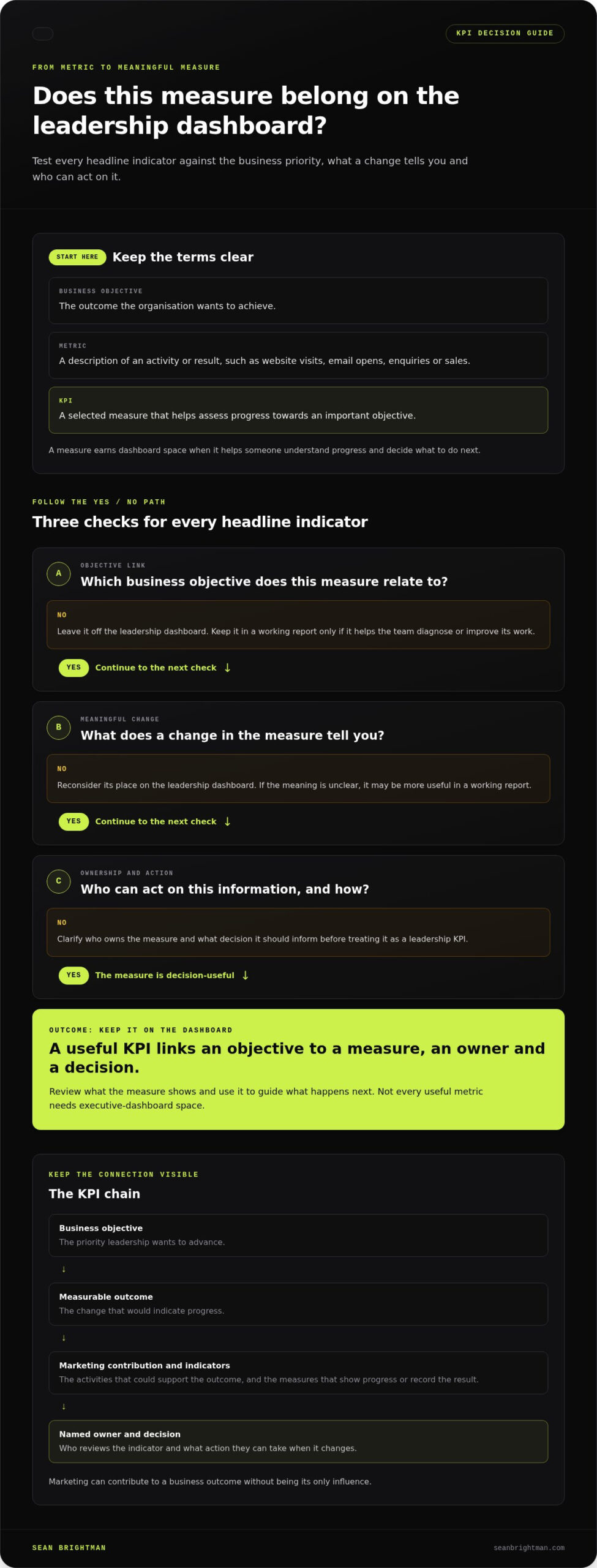
    Start with the objective. Is the business trying to grow qualified pipeline, improve customer retention or enter a new market? Until that priority is clear, choosing KPIs is guesswork. A Key Performance Indicator (KPI) is a measure used to assess progress towards an important objective, but its value depends on how it informs action.

    A decision-useful KPI measures progress towards a business objective and helps its owner decide what to do next.

    How to tell a KPI from a metric

    A metric describes an activity or result: website visits, email opens, enquiries or sales. A KPI is a measure selected because it helps assess progress against a priority. A business objective is the outcome the organisation wants to achieve. These terms connect, but they aren’t interchangeable. And not every useful metric needs a place on an executive dashboard.

    Illustrative example: A business wants to increase qualified sales opportunities. Website visits may help the marketing team understand audience interest, but visits alone don’t show whether the objective is advancing. The number of qualified opportunities generated through marketing could be a KPI, if the business has agreed what counts as qualified and can use the result to adjust its plans.

    The test is practical. If the measure changes, could someone make a sensible decision in response? For example, a team might investigate whether a source is bringing in relevant prospects, or shift effort towards activity more closely connected to the objective. The figures here illustrate the logic; they aren’t performance benchmarks.

    Signs your marketing measures have lost their purpose

    Some dashboards are museum pieces. They carry measures from an old campaign, channel or reporting habit, even though the strategy has moved on. Others reward what’s easy to count. Engagement figures can look encouraging whilst leaders remain unable to answer whether marketing is supporting pipeline, revenue or another agreed priority.

    That doesn’t make engagement or channel metrics useless. They can help teams diagnose performance and improve execution. The problem starts when these measures take up leadership attention without explaining what they mean for the objective, or what decision should follow.

    Run this quick test on every headline indicator:

    • Which business objective does it relate to?
    • What does a change in the measure tell you?
    • Who can act on that information, and how?

    If the answers are vague, the measure may belong in a working report rather than the leadership dashboard. Developing marketing kpis that matter means keeping the measures that sharpen decisions, not simply carrying forward every number the team can collect.

    Build a marketing KPI chain from business goal to measurable outcome

    A KPI shouldn’t start with the data your tools happen to collect. It should start with a business priority, then trace a credible route from that priority to marketing’s contribution, the measure someone owns and the decision it informs. That chain stops reporting from becoming a disconnected list of numbers.

    Use this sequence to build it:

    1. Clarify the business goal. Name the priority leadership wants to advance, such as growing revenue from a particular market.
    2. Define the outcome. Specify what change would indicate progress, such as more revenue from that market or a stronger pipeline of suitable opportunities.
    3. Identify marketing’s contribution. Map the activities that could support the outcome, without treating marketing as the only influence on it.
    4. Choose indicators. Select measures that show progress or record the final result, and make their relationship to the goal explicit.
    5. Assign ownership and a decision. Name who reviews each indicator and what action they can take when it changes.

    A useful KPI chain runs from business objective to measurable outcome, through a named owner, to a decision that can change the work.

    Translate a business objective into marketing outcomes

    Start with leadership’s priority, then ask what needs to change for the business to move towards it. If the aim is growth in a new market, the desired outcome might be a stronger flow of relevant enquiries or sales opportunities from that market. Those are outcomes to assess, not activities to count.

    Next, map how marketing could contribute: for example, by improving awareness with the intended audience or supporting demand generation. Keep the distinction clear. A campaign, event or content programme is an activity; reach and responses are possible indicators; the commercial outcome is the result the business cares about. Sales capacity, pricing and market conditions can also affect that result, so don’t claim marketing controls it alone.

    Pair early signals with final outcomes

    Some outcomes take time to show up. Leading indicators can offer earlier signals that a plan is gaining traction. For a new-market push, these might include engagement from the intended audience or relevant enquiries. They help teams spot patterns and decide whether to investigate or adjust, but they don’t prove that a final business result will follow.

    Lagging indicators record outcomes after they happen, such as revenue or pipeline created. They show what the business achieved, but rarely explain the cause on their own. Read leading and lagging measures together: if early signals shift but the outcome doesn’t, investigate other influences before changing course. The relationship is evidence to examine, not a causal claim to assume.

    This is where developing marketing kpis that matter becomes an operating discipline, not a dashboard exercise. If leadership needs help turning priorities into a workable measurement and accountability system, senior marketing roadmapping and advisory can bring structure to the decisions.

    Choose marketing KPIs that guide decisions, not vanity reporting

    A measure isn’t a KPI just because it appears on a dashboard. It earns that place when it connects to a current objective and helps someone decide what to do. A crowded report can hide the signal. A short, well-chosen set of measures makes priorities easier to see and follow up.

    Use this comparison to test candidate measures before promoting them into leadership reporting. The examples are illustrative, not benchmarks.

    Candidate measure Objective served Decision enabled Owner Data source
    Qualified opportunities from a target segment Develop demand in that segment Review targeting or the offer if the flow changes Marketing lead CRM, with an agreed qualification definition
    Email click-through rate Improve engagement with a priority audience Test the message or call to action Email manager Email platform
    Customer satisfaction after onboarding Improve the early customer experience Investigate friction in onboarding Customer experience lead Post-onboarding survey

    Apply a practical test to each candidate KPI

    Before including a measure, check three things: does it connect to a current objective, can the team define and source it consistently, and would a change prompt a different action? If the answer to the last question is no, it may be useful for analysis but doesn’t need to be a headline KPI. If nobody owns it, it’s unlikely to trigger follow-up.

    A vanity metric isn’t inherently worthless. It becomes vanity reporting when it’s presented as proof of progress without a clear link to an objective or a decision. Reach, impressions and clicks can help diagnose channel activity. On their own, they don’t establish commercial contribution. Keep them in working reports when they help a team improve execution; leave them out of senior reporting if they add no decision value.

    Balance commercial and customer indicators

    Choose categories to fit the objective, not to complete a checklist. Business measures might include revenue contribution, return on investment (ROI), return on ad spend (ROAS), customer acquisition cost (CAC) or customer lifetime value (CLV). Engagement measures can help assess whether an audience is responding; satisfaction measures can reveal how customers experience the relationship. Each belongs only when it helps answer a relevant question.

    Channel figures need context. A change in ROAS, for example, may reflect spend, conversion value, attribution settings or changes elsewhere in the customer journey. Don’t leap from a channel result to a strategic conclusion without examining what the measure includes and what it leaves out.

    There’s no universal KPI count for every team. Choose enough to cover the priorities that matter, but not so many that ownership and follow-up disappear in the noise. In developing marketing kpis that matter, relevance beats volume: retain indicators with clear definitions, usable evidence and a decision attached.

    Developing Marketing KPIs That Matter: A Practical Guide

    Make marketing KPI measurement reliable, owned and actionable

    A KPI can look precise and still mislead. If marketing and finance define “qualified lead” differently, their reports may show different results while both teams believe they’re right. Reliable measurement starts with shared rules, a trusted source and a person responsible for interpreting what the number means.

    Measurement creates value only when someone can interpret the evidence and act on it.

    Set definitions, sources and ownership before reporting

    Write each KPI definition in plain English before it goes into a report. Record what the measure includes, what it excludes, the period it covers and any filters applied. For example, define what makes an enquiry “qualified” and whether the count includes only new opportunities. Shared rules let teams compare like with like, rather than debate whose calculation is correct.

    Then document the source and name an accountable owner. The source might be a CRM, analytics platform or customer survey; the owner is responsible for checking the measure and raising questions, not necessarily doing every task that affects it. If data is missing, duplicated or shaped by attribution limits, flag that context alongside the result. Don’t dress uncertainty up as certainty.

    A lightweight KPI record can capture:

    • The objective and plain-English definition
    • What is included, excluded and counted, and over what period
    • The source, accountable owner and relevant data limitations
    • Who uses the measure and what decisions it may inform

    This simple record gives new team members a shared reference and makes changes easier to spot. If a definition or source changes, note when and why. Otherwise, a shift in the reported figure could reflect a new counting method rather than a change in performance.

    Turn KPI reviews into decisions and follow-up

    Set the review rhythm to match how quickly the measure changes and when a decision is needed. A fast-moving campaign may need closer attention than a longer-term commercial outcome. Don’t review a figure more often than the data can support, and don’t wait so long that a useful adjustment arrives too late.

    Make the meeting about interpretation, not dashboard presentation. For each KPI, ask what moved, what might explain it, what the movement means for the objective and what action follows. Separate observed facts from possible explanations. A change may coincide with a campaign, but that alone doesn’t prove the campaign caused it.

    Finish by recording the decision, the person responsible and when the team will revisit the action. If there’s no decision to make, note why the indicator remains under observation. This turns reporting into a working loop: evidence, interpretation, action, follow-up. It also helps leaders see where accountability sits without confusing ownership of a measure with sole control of the outcome.

    Developing marketing kpis that matter requires this discipline beyond the dashboard: clear definitions, honest context and follow-through. If you want strategic support to turn measurement into a workable system, explore strategic marketing support.

    Put a useful KPI system into practice with clear marketing leadership

    A KPI framework only earns its keep when the team uses it. Put it into operation with a clear rollout, then adjust it as priorities and evidence change. A new growth target may require different indicators; a change in data quality may mean an existing measure needs a fresh definition. Keep the system stable enough to compare progress, but never so rigid that it stops reflecting the business.

    Use this sequence to get it working:

    1. Agree the priority. Make sure leaders and marketing are working towards the same business objective.
    2. Map the KPI chain. Connect the objective to the outcome, relevant marketing contribution and indicators.
    3. Assign owners. Make responsibility for each measure and its follow-up explicit.
    4. Establish reviews. Set a rhythm for interpreting changes and agreeing actions.
    5. Refine the system. Remove measures that no longer inform decisions and investigate gaps in the evidence.

    Leadership matters at every step. Senior marketing direction can align priorities, clarify accountability and keep measurement connected to decisions. It can’t guarantee a commercial result, particularly where other teams and market conditions influence the outcome. Its job is to make the plan coherent and the next action clear.

    Choose support that matches the work to be done

    For a focused reset, Roadmapping is a one-off strategic engagement that produces a 90-day action roadmap the business can run. Advisory CMO provides ongoing strategic direction through monthly strategy and review sessions, priority setting, async access and accountability. Fractional CMO support offers senior leadership across strategy, team direction, campaign planning and growth-system design. The right fit depends on whether the business needs a defined plan, continuing guidance or broader leadership involvement.

    Keep the KPI system connected to the wider growth engine

    Measures won’t fix disconnected operations by themselves. Connect them to the way work moves across marketing: who owns each activity, how teams share information and which decisions leaders need to make. A clear marketing operations and scalable growth system helps keep reporting tied to execution, rather than leaving the dashboard as a separate exercise.

    Ongoing direction can also help keep priorities, reviews and responsibilities aligned as the business develops. A marketing advisory retainer can provide a continuing structure for that strategic oversight.

    Developing marketing kpis that matter isn’t a one-off dashboard project. It’s a working system of priorities, evidence, ownership and decisions. If you’re ready to put that system under clear senior direction, plug in a senior marketing brain.

    Make your next KPI decision count

    The next step doesn’t need to be a complete reporting overhaul. Pick one business priority and use it to pressure-test the measures your team already tracks. Keep what supports a decision. Retire what only fills space. Then use the next review to see whether the information helped someone act with greater clarity.

    That’s how developing marketing kpis that matter becomes part of how the business works, rather than another project that fades after a dashboard update. The system should evolve as priorities shift and better evidence emerges. Stay curious, challenge assumptions and keep the measures connected to real choices.

    If you want experienced strategic support to turn measurement into clearer direction and accountability, plug in a senior marketing brain. Start with the decision you need to make. Build the measurement around it, and give your team a stronger basis for moving forward.

    Frequently Asked Questions

    Can a marketing KPI be shared between marketing and sales?

    Yes. A shared KPI can align marketing and sales around an outcome both teams influence, such as progressing suitable enquiries into sales opportunities. Agree what counts and which system provides the figures, then spell out each team’s part. Marketing might review whether enquiries match the agreed profile; sales might examine how promptly and consistently they’re followed up. Shared accountability should encourage collaboration, not leave either team unsure who owns the next action.

    What happens if a marketing KPI improves but revenue does not?

    Treat the gap as a reason to investigate, not as proof that either measure is pointless. Check whether revenue may follow the indicator later, whether the audience is commercially relevant and where prospects are dropping out. Review sales follow-up and make sure both figures use stable definitions. Then decide whether the indicator still helps assess the intended objective. Two measures moving differently, or together, don’t by themselves establish what caused the change.

    Can brand awareness be measured with marketing KPIs?

    Yes, provided the measure reflects the awareness goal. If the aim is to reach a defined audience, survey responses about brand recognition may be more informative than total impressions alone. Use the same question, audience and method across reviews so changes can be interpreted fairly. Where possible, compare awareness evidence with later signals such as branded enquiries. Keep the distinction clear: visibility can indicate exposure, but it doesn’t prove preference, purchase intent or revenue.

    How do you set marketing KPI targets without reliable historical data?

    Start by recording what you can measure now and where the evidence is incomplete. In developing marketing kpis that matter, an initial target can be provisional: tie it to the business priority, write down the assumptions and set a point to review it. For example, a team entering a new market might use early campaign results to establish a working baseline. Label estimates clearly, then revise them as consistent evidence builds. Don’t present a first estimate as an established benchmark.

    Should every marketing channel have its own KPI?

    No. Give a channel its own KPI only if it has a defined role and the measure helps guide a decision. If a webinar supports consideration, registrations from the intended audience may be more useful than a general view count. A separate channel report can still help the people managing that work, but it needn’t become an executive KPI. Start with the business question, then use channel figures as supporting evidence where they add insight.

    Can a small business develop useful marketing KPIs without a large analytics team?

    Yes. A small business can begin with information it already handles, such as enquiries recorded in a spreadsheet or sales tracked in its existing system. Choose measures the team can update consistently, rather than building a complex dashboard first. For example, agree how to record an enquiry’s source and what makes it relevant. Give someone responsibility for maintaining that record, then use it to inform a specific decision. Simple, dependable evidence beats elaborate reporting nobody can sustain.