Tag: marketing management

  • The Marketing Advisory Retainer: A CEO’s Guide to Strategic Velocity

    The Marketing Advisory Retainer: A CEO’s Guide to Strategic Velocity

    Most CEOs are the biggest bottleneck in their own marketing department. You’re likely tired of babysitting agencies that under-deliver whilst you struggle to find a clear path forward. Securing a marketing advisory retainer is the quickest way to stop the bleed. It gives you the senior leadership you need to own the results without the £150,000 overhead of a full-time hire.

    You want a scalable growth engine, not another project to manage. We agree that your time is better spent on high-level strategy than on chasing campaign updates. This guide promises to show you how to install a “plug-and-play” leader who brings absolute accountability to your team.

    We’ll break down the mechanics of strategic velocity, from AI-powered efficiency to building an exit-ready marketing roadmap. It’s time to cut the fluff and start focusing on tactical precision. You’ll learn how to move from confusion to a clear, high-impact system that allows you to optimise your resources and scale with confidence.

    Key Takeaways

    • Break the “busy-ness trap” by identifying why high agency activity often fails to deliver tangible ROI for your business.
    • Secure senior leadership through a marketing advisory retainer to gain strategic direction without the £150k overhead of a full-time hire.
    • Distinguish between “the brain” and “the hands” to ensure your marketing is driven by high-level strategy, not just mindless execution.
    • Implement a clear diagnostic roadmap that prioritises pipeline velocity and lead quality over vanity metrics that do not move the needle.
    • Leverage AI-powered efficiency to build a scalable, exit-ready growth engine that removes the CEO as the primary bottleneck for decisions.

    The Marketing Busy-ness Trap: Why Your Current Strategy is Stalling

    You’re busy. Your team is busy. Your agencies are definitely busy. Yet, the numbers aren’t moving. This is the marketing busy-ness trap. It’s a state of high activity and low ROI that eventually leads to CEO burnout. You feel like you’re babysitting every campaign. You’ve become the bottleneck. When every decision, from a headline change to a budget shift, has to cross your desk, growth stops. You become the single point of failure.

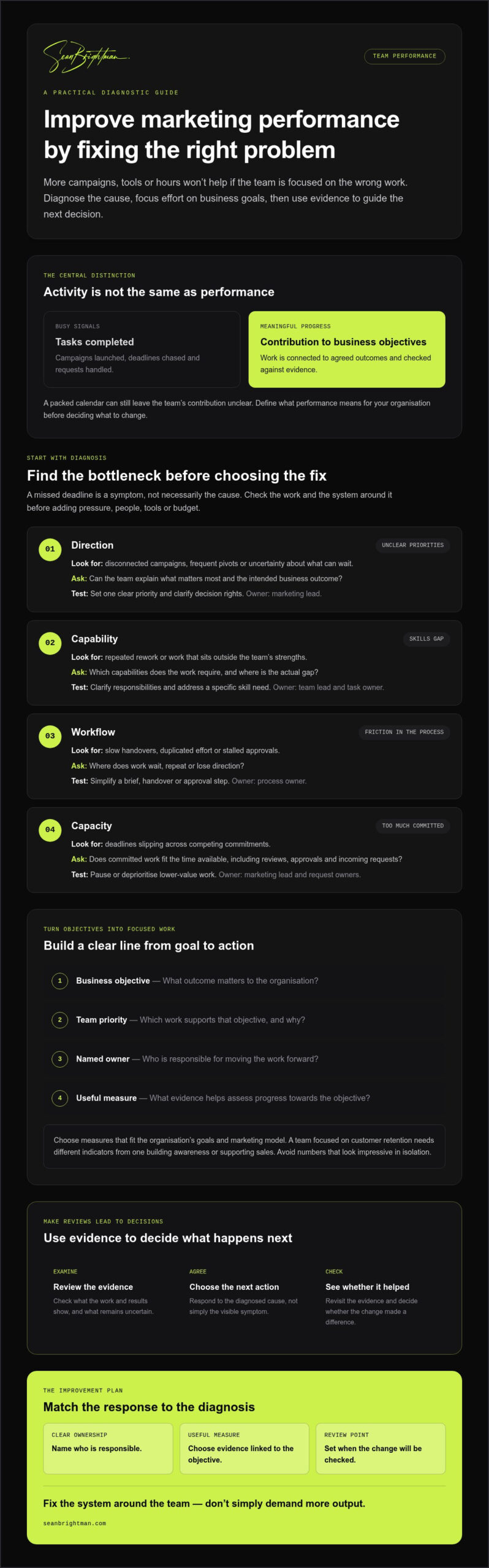
    A marketing advisory retainer isn’t about adding more tasks to your list. It’s about removing the friction. Most businesses confuse “doing things” with “achieving outcomes.” Sending three emails a week is activity. Increasing your pipeline velocity by 20% is an outcome. If your marketing feels like a series of disconnected projects, you’re just burning cash to keep the lights on. You need a system, not a to-do list.

    The Agency Execution Gap

    Agencies are built to execute. They sell capacity, not necessarily growth. Because they lack your internal context, they often operate in a vacuum. This creates “tactical whiplash” where you jump from one trend to another because an account manager suggested it. You need a bridge. Agencies are incentivised to spend your budget, not necessarily grow your business. They thrive on billable hours, which often leads to a focus on volume over value.

    A strategic advisor doesn’t just manage the agency; they align the agency’s output with your commercial goals. They ensure the Retainer agreement you signed with your providers actually produces a return, rather than just filling a timesheet. This partnership ensures that every pound spent on execution is backed by a senior-level “why.” It moves your team from reactive fire-fighting to proactive market leadership.

    The High Cost of Senior Vacancy

    Hiring a junior marketer to “do social media” won’t fix a broken positioning strategy. Junior hires lack the battle-hardened perspective to challenge the status quo or navigate complex AI implementations. When no one owns the high-level strategy, the business drifts. There is a hidden drain on your resources when you have no one “owning” the marketing roadmap. This isn’t just about missing targets; it’s about the cost of standing still.

    Securing a marketing advisory retainer provides the senior leadership required to fix these structural issues. Without this oversight, you pay a heavy price in missed opportunities. The vacancy tax is the lost revenue from delayed strategic decisions and missed market opportunities. You don’t need more hands on deck. You need a better captain.

    What is a Marketing Advisory Retainer (and What it is Not)?

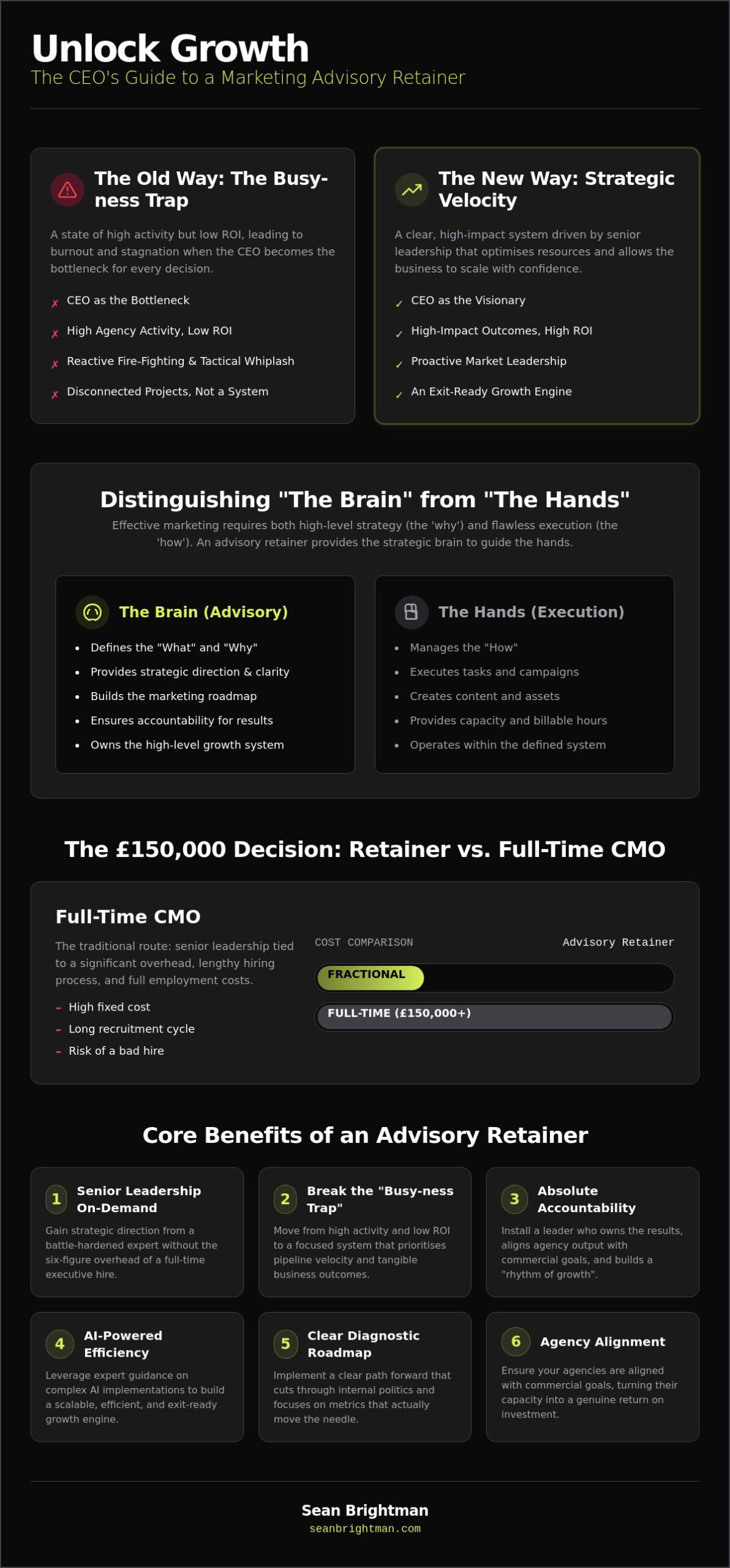
    A marketing advisory retainer is not a commodity purchase of billable hours. It’s an “outsourced brain” for your business. Unlike an agency that sells capacity, an advisor sells clarity. It’s a high-leverage partnership designed to provide ongoing strategic direction, oversight, and absolute accountability. You aren’t paying for someone to manage your LinkedIn posts; you’re paying for someone to ensure those posts actually contribute to your exit strategy. This is the brain, not the hands. This is the architect, not the bricklayer.

    The distinction is simple. Execution is about “how.” Advisory is about “what” and “why.” If your team is busy running in the wrong direction, they’re just getting lost faster. An advisory retainer fixes the compass. It focuses on three core pillars: brand positioning, systems architecture, and team leadership. This model prioritises long-term, sustainable growth over short-term “hacks” that leave your brand hollow. It’s about building a machine that works, even when you aren’t in the room.

    Direction, Not Just Execution

    Most internal teams are too close to the coalface. They can’t see the systemic issues because they’re part of them. An advisor provides an outside-in perspective that cuts through internal politics and identifies the real bottlenecks. They set the “North Star” for the entire marketing department, ensuring every penny spent on execution is working toward a singular goal. This is why the choice between a B2B Marketing Advisor vs Agency: Why Strategy Trumps Execution in 2026 is becoming the standard for scale-ups looking for strategic velocity.

    The Accountability Framework

    Strategy without execution is just a hallucination. A marketing advisory retainer ensures that the roadmap actually gets built. It creates a “rhythm of growth” for the entire business. This isn’t a one-off report that gathers dust on a shelf. It involves monthly reviews, tactical pivots based on live data, and holding both internal teams and external agencies to a higher standard. If you’re ready to stop guessing and start scaling, you can review my advisory services to see how this framework fits your specific business model. It’s about creating a culture of performance where results are the only metric that matters.

    Advisory Retainer vs. Full-Time CMO: The £120k Decision

    Hiring a full-time CMO is a high-stakes gamble. In the UK, a top-tier marketing leader expects a base salary north of £150,000. By the time you factor in National Insurance, pension contributions, and bonuses, that figure climbs toward £200,000. That’s a heavy anchor for a growing business. You’re paying for a full-time presence when you might only need part-time brilliance. It’s a resource allocation error that kills cash flow.

    The marketing advisory retainer flips this script. It gives you access to battle-hardened expertise at a fraction of the cost. You aren’t buying a body in a chair; you’re buying the results that person produces. It’s the difference between owning a jet and booking a private flight. You get the speed without the maintenance fees. You secure senior-level thinking without the C-suite baggage or the equity dilution. For growing businesses, accessing senior marketing leadership on demand delivers the same executive-level impact without the permanent overhead that strangles cash flow.

    Recruitment is slow. Finding, vetting, and hiring a C-suite executive can take six months. An advisor can be integrated into your business in less than a week. Risk mitigation is the hidden benefit here. Pivoting an advisory relationship is simple. Firing a full-time director is a legal and cultural nightmare. One is a flexible partnership; the other is a permanent commitment that’s difficult to unwind if the fit isn’t perfect.

    When to Go Fractional

    If your revenue is between £2m and £15m, you likely have a complexity problem, not a capacity problem. You need a leader to build the systems, not just manage the people. A fractional leader prepares your business for a future full-time hire by cleaning up the mess first. They install the growth engine so the next person just has to drive. Learn why it’s time to Stop Hiring Full-Time CMOs: The Fractional Revolution in 2026.

    The Efficiency of Senior Oversight

    Four days of high-level strategy will always outperform twenty days of junior execution. A senior advisor has seen your specific problems before. They don’t need to “learn” your industry; they just need to apply proven frameworks to your data. It’s plug-and-play leadership. Strategic ROI is the value generated per hour of senior-level decision-making. If one hour of a marketing advisory retainer prevents a £50,000 mistake in your ad spend, the relationship has already paid for itself ten times over.

    The Marketing Advisory Retainer: A CEO’s Guide to Strategic Velocity

    How to Structure Your Marketing Retainer for Maximum ROI

    A marketing advisory retainer is a strategic investment, not a recurring expense. To extract maximum ROI, you must treat the engagement like an engineering project. This starts with a Roadmap. Every retainer must begin with a diagnostic phase. If an advisor tries to prescribe a solution before they’ve performed surgery on your data, walk away. You need a clear baseline of your current performance before you can attempt to accelerate it.

    Define the metrics that actually move the needle. Stop looking at impressions. Start looking at lead quality and pipeline velocity. These are the clinical indicators of a healthy business. A high-level advisor focuses on brand equity because it lowers your customer acquisition cost over time. It’s about building a permanent asset, not just renting a temporary audience. You want a growth engine, not a series of expensive experiments. Establishing a clear strategic marketing direction is what separates businesses that scale predictably from those that remain trapped in a cycle of high spend and low visibility.

    Communication must be clinical and efficient. Establish a rhythm that respects your time. Weekly tactical syncs keep the momentum high. Monthly strategic deep-dives ensure the “North Star” hasn’t drifted. This cadence creates a heartbeat for your marketing team. It provides the absolute accountability that most internal departments lack when left to their own devices.

    The ultimate goal is a self-sustaining system. A truly effective advisor builds the machinery so they can eventually step back. They document the processes, install the AI-powered workflows, and train the team. If they aren’t planning their own exit strategy, they aren’t an advisor; they’re just an expensive contractor. You are paying for a solution, not a dependency.

    Due Diligence: Questions to Ask

    Don’t be polite. Be thorough. You need to know exactly what you’re buying before you commit. Ask about the specific growth engines they have built for businesses at your revenue stage. Enquire how they bake AI into the marketing stack to reduce manual labour and increase output. Ensure they prioritise brand positioning as the foundation for lead generation, rather than just chasing the latest tactical trend.

    The “Red Flags” of Poor Retainers

    The market is full of pretenders. Spot them early. Vague reporting is the first sign of trouble. If your monthly report is a list of “vanity metrics” like likes, shares, or impressions, you’re being sold a lie. These numbers don’t pay the bills. Lack of direct access is another warning sign. If you’re sold a senior lead but end up talking to a junior account manager, the value has vanished. You’re paying for expertise you aren’t receiving.

    Ready to stop the guesswork and start scaling? Book a roadmapping session to define your strategic velocity and build a marketing engine that actually delivers.

    The Sean Brightman Approach: Strategy, AI, and Accountability

    Sean Brightman isn’t a theorist who hands over a 50-page slide deck and disappears. He’s a battle-hardened operator for UK scale-ups who understands that strategy without execution is a waste of capital. His methodology is clinical and designed for speed: Roadmapping, Systems Architecture, and then Ongoing Advisory. This isn’t about maintaining the status quo. It’s about building a marketing engine that makes your business “Exit-Ready.” Investors don’t buy activity; they buy predictable, scalable systems that don’t depend on the CEO’s daily input.

    A marketing advisory retainer with Sean provides the senior-level friction needed to stop bad ideas before they cost you six figures. It’s about installing absolute accountability into your department. Most businesses have a collection of tools and people. Sean turns them into a machine. This approach prioritises enterprise value by ensuring your marketing is a functional component of your business growth, not a disconnected cost centre.

    AI-Powered Growth Engines

    AI isn’t just a tool in Sean’s arsenal; it’s a fundamental shift in how he organises marketing operations. He uses AI roadmapping to automate the mundane and supercharge the strategic. This eliminates manual friction and allows your team to focus on high-leverage tasks that move the needle. By acting as a Marketing Operations Consultant: Building a Scalable Growth Engine for 2026, Sean ensures your tech stack is an asset that drives efficiency rather than a burden that drains resources.

    Your Next Step: From Chaos to Clarity

    You don’t have to accept messy marketing as the cost of doing business. You don’t have to be the bottleneck for every decision. The solution is a 90-day strategic sprint to reset your direction and install the systems you’ve been missing. It’s a concentrated burst of senior-level energy that replaces confusion with clarity and activity with outcomes. You can secure the strategic velocity your business deserves without the overhead of a traditional hire.

    Ready to stop the bleed and start scaling? Book a discovery call to discuss your Marketing Advisory Retainer and find out how to turn your marketing department into a high-performance growth engine.

    Claim Your Strategic Velocity

    Your marketing department should be a predictable machine, not a source of constant frustration. We have established that high activity without senior oversight is a “busy-ness trap” that simply drains your budget. You now understand the massive cost difference between a permanent hire and a high-leverage partnership. By choosing a marketing advisory retainer, you install the “outsourced brain” required to navigate AI implementation and brand positioning with tactical precision.

    Sean Brightman brings battle-hardened experience as a Fractional CMO for UK scale-ups. As a published author on marketing strategy and an expert in AI-powered growth engines, he replaces chaos with a clinical roadmap. It’s time to remove yourself as the bottleneck. Build an exit-ready business that thrives on systems, not individual effort. The path from confusion to clarity starts with a single decision. Stop babysitting agencies and start leading a scalable growth engine today.

    Secure your senior marketing leadership with an Advisory Retainer

    Frequently Asked Questions

    What is the difference between a marketing consultant and an advisory retainer?

    A consultant typically solves a specific, project-based problem whilst a marketing advisory retainer provides ongoing strategic leadership and oversight. Consultants deliver a report and leave. Advisors stay to ensure the strategy is executed, the team is held accountable, and the growth engine actually produces results. It’s the difference between a one-off repair and a permanent system upgrade.

    How long is a typical marketing advisory retainer agreement?

    Most agreements run for six to twelve months to allow enough time for strategic changes to compound and show measurable ROI. This timeframe allows for a full diagnostic phase, the installation of new systems, and the optimisation of your growth engine. It’s a medium-term partnership designed to prepare your business for a future exit or a permanent C-suite hire.

    Do I need a marketing advisor if I already have a marketing agency?

    Yes, because agencies are built to execute tasks, not necessarily to own your commercial strategy. An advisor acts as the bridge between your business goals and the agency’s tactical output. They provide the “outside-in” perspective needed to hold agencies accountable and ensure they are moving the needle, not just filling timesheets with low-impact activity.

    What results can I expect in the first 90 days of an advisory retainer?

    You can expect a completed diagnostic roadmap and the immediate identification of wasted marketing spend. Within the first three months, we install the core systems architecture and define clear, outcome-based KPIs. You will move from a state of marketing chaos to having a clinical, data-driven understanding of your pipeline velocity and lead quality.

    Can an advisory retainer help with AI implementation in my marketing team?

    AI implementation is a fundamental part of a modern marketing advisory retainer. We don’t just suggest tools; we re-engineer your marketing operations to automate mundane tasks and supercharge strategic output. This reduces manual friction and allows your team to focus on high-leverage activities that directly contribute to your brand equity and revenue growth.

    Is a marketing advisory retainer suitable for small businesses or just scale-ups?

    Scale-ups with revenue between £2m and £15m see the highest ROI because they face complexity that smaller firms haven’t encountered. Small businesses often need “hands” for basic execution. Scale-ups need a “brain” to organise their resources, manage multiple agencies, and build the scalable systems required for a significant market expansion or eventual sale.

    How does an advisory retainer improve my marketing team’s accountability?

    Accountability improves through the installation of objective, outcome-based metrics that remove emotional bias from performance reviews. We establish a clinical communication rhythm, including monthly deep-dives and weekly tactical syncs. This ensures that every team member and agency knows exactly what they are responsible for and how their performance is being measured against commercial goals.

    What happens if I need more execution support than the retainer provides?

    Your advisor will help you source, vet, and manage the right agencies or internal staff to handle the extra workload. The advisor remains the architect who designs the system, whilst the execution support provides the “hands” to build it. This ensures that even as you scale your execution, the strategic integrity of your marketing remains intact.

  • Marketing Team Accountability: How to Drive Commercial Outcomes, Not Just Activity

    Marketing Team Accountability: How to Drive Commercial Outcomes, Not Just Activity

    Activity is not an outcome. Your team might be the busiest department in the building, but if their “wins” don’t show up on the P&L, you don’t have a marketing department; you have an expensive hobby. True marketing team accountability isn’t about counting clicks; it’s about owning the bottom line.

    You’re likely tired of seeing reports packed with vanity metrics whilst the bank balance remains stubbornly flat. You’ve had enough of the culture of excuses that surfaces whenever a target is missed. You need a team that owns their numbers, not a team that explains them away. It’s a common frustration, but it’s one that costs you growth every single day.

    This guide will show you how to bridge that gap. You’ll learn how to transform your department into a high-performance profit centre that delivers measurable ROI. We’ll break down the frameworks for transparent reporting that the C-suite actually trusts and show you how to build a team that proactively solves performance dips before they become disasters.

    Key Takeaways

    • Stop rewarding “busy” work and start measuring what hits the P&L by swapping vanity metrics for commercial outcomes.
    • Build a framework for marketing team accountability by defining North Star metrics that align tactical execution with business growth.
    • Deploy a scorecard system to provide the C-suite with transparent reporting that eliminates the “black box” of marketing activity.
    • Leverage the objective authority of a Fractional CMO to cut through internal politics and drive high performance without micro-management.
    • Execute a 90-day roadmap to audit existing inefficiencies and install a permanent engine for measurable ROI.

    The Accountability Crisis: Why Marketing Teams Default to Activity Over Outcomes

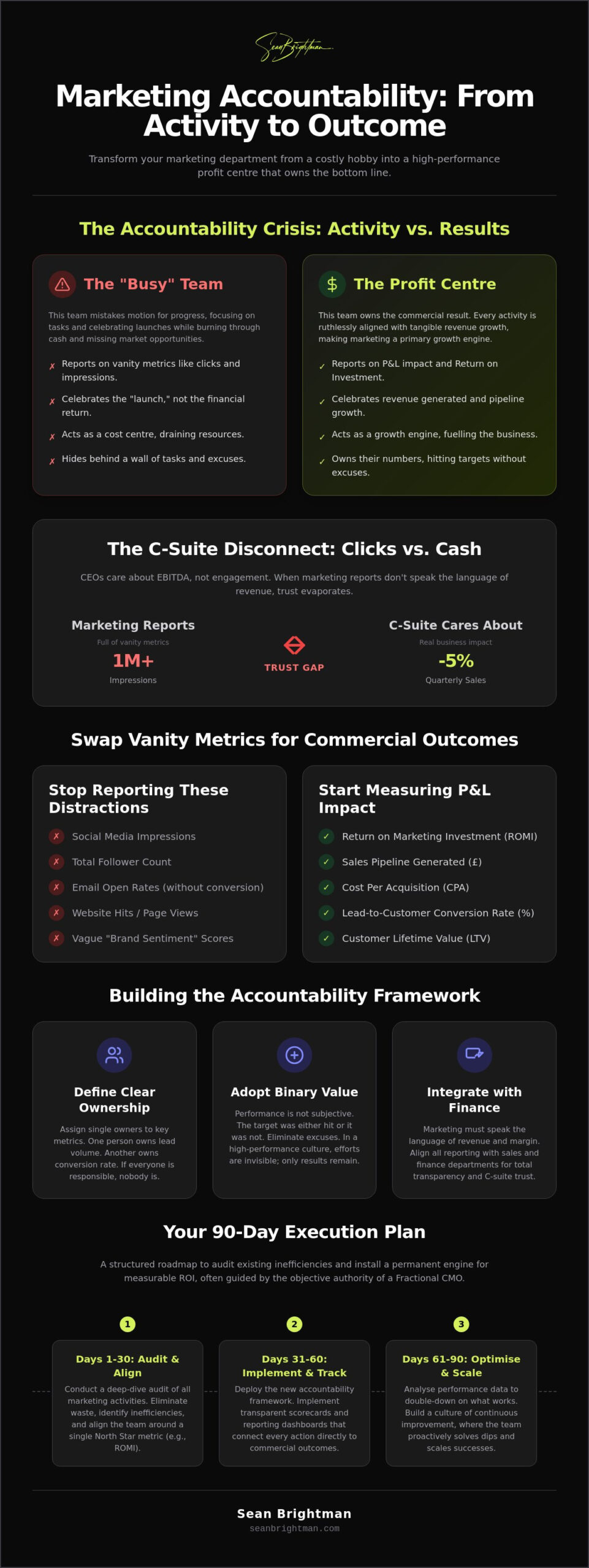
    Marketing isn’t a cost centre. It’s a growth engine. Or at least, it should be. Most businesses suffer from a fundamental misunderstanding of marketing team accountability. They mistake motion for progress. They mistake a busy Slack channel for a successful campaign. This is the accountability crisis: a culture where teams are obsessed with doing things rather than achieving things.

    Accountability means owning the commercial result. It’s not about whether the ad looked pretty or the copy was clever. It’s about whether the phone rang. If your team is hiding behind a wall of tasks, they aren’t being accountable; they’re being busy. A messy marketing department burns through cash whilst missing market windows that your competitors are currently jumping through. A busy team is often a failing team.

    The cost of this inefficiency is staggering. It’s not just the wasted salary or the ad spend that doesn’t convert. It’s the opportunity cost of a market that moves whilst you’re still debating the hex code of a button. Activity-based cultures celebrate the “launch”. Outcome-based cultures celebrate the “return”. One is a hobby; the other is a business. Ownership is binary. You either hit the number or you didn’t.

    The C-Suite Disconnect: Clicks vs. Cash

    CEOs don’t care about click-through rates. They care about EBITDA. When a marketing manager presents a deck full of graphs showing “engagement” whilst sales are down, trust evaporates instantly. Trust is built on revenue, not rainbows. Creative freedom is vital, but without commercial constraints, it’s just self-indulgence. You need a team that understands that their primary job is to sell, not just to create. Commercial Marketing is the ruthless alignment of brand expenditure with tangible revenue growth.

    Vanity Metrics: The Shield for Underperformance

    Vanity metrics are the comfort blanket of the underperformer. They provide a false sense of security whilst the business starves. To fix this, you must pivot. Don’t tell me you sent four emails; tell me you generated £50k in pipeline. Transparency is the only cure for a team hiding in the weeds. If you cannot track the path from a click to a customer, you aren’t managing a department; you’re gambling with the company’s future.

    Stop reporting on these five distractions today:

    • Social media impressions
    • Total follower count
    • Email open rates (without conversion data)
    • Website hits
    • Vague “brand sentiment” scores

    Focus instead on your Return on Marketing Investment (ROMI). This is the only number that proves your department is a profit centre rather than a drain on resources. Marketing team accountability requires a shift in mindset where every team member views themselves as a commercial stakeholder. If the activity doesn’t move the needle on the bank balance, it’s noise. Cut the noise. Focus on the numbers.

    Building the Framework: Defining Ownership and Commercial Metrics

    Accountability isn’t a vague feeling. It’s a structural choice. If you want marketing team accountability, you must stop treating the department as a creative black box. You need clear lines of ownership. One person owns lead volume. Another owns lead quality. A third owns the conversion rate. If everyone is responsible for “growth”, then nobody is actually responsible when the numbers tank.

    The Binary Value concept is non-negotiable. It’s a brutal, effective way to look at performance. Either the target was hit, or it wasn’t. There is no “we worked really hard” or “the creative was award-winning”. In a high-performance engine, efforts are invisible; only results remain. This level of rigour is why organisations like the Marketing Accountability Standards Board push for standardised financial linkages. Marketing must integrate with sales and finance. It must speak in the language of revenue and margin, not clicks and likes.

    If your current structure feels like it’s drifting, a Fractional CMO can provide the external force needed to redefine these boundaries and install a culture of ownership.

    OKRs vs KPIs: Choosing the Right Measuring Stick

    KPIs are your dashboard. They tell you if the car is running. OKRs are your GPS. They tell you where you’re going. Use KPIs to keep the lights on. Use OKRs to drive the structural shifts that move the business forward. Most teams fail because they confuse the two, measuring their success by how many tasks they completed whilst the business stays stationary.

    Activity Metric (The Busy Trap) Outcome Metric (The Commercial Goal)
    Published 12 LinkedIn posts Generated £150k in qualified pipeline
    Sent 50,000 cold emails Achieved a 12% lead-to-opportunity rate
    Increased website traffic by 20% Reduced Customer Acquisition Cost (CAC) by 15%

    The North Star Metric: One Number to Rule Them All

    You need one number that rules them all. For a scale-up, it might be new customer acquisition. For an established firm, it might be net revenue retention. Whatever it is, every person in the team must know exactly how their daily tasks pull that specific lever. This is commercial ownership. It’s the difference between a team that asks “what should I do today?” and a team that asks “how do we hit the number?”. When the North Star is clear, the fluff disappears. Every meeting, every budget request, and every campaign is filtered through a single question: does this drive our primary commercial outcome?

    The Manager’s Toolkit: Systems for Driving Results, Not Just Clicks

    Systems are the plumbing of performance. Without them, your framework is just a wish list. To drive marketing team accountability, you need a live scorecard. Not a static PDF that gets emailed once a month. A real-time dashboard that shows exactly where you are against the target. If the data is 30 days old, it’s an autopsy, not a management tool. You need to see the pulse of the business whilst there is still time to change the outcome.

    This is where a Marketing Operations Consultant earns their keep. They build the machinery that connects your CRM to your reporting suite. They ensure that measuring the success of marketing efforts is automated and bulletproof. You want a system that flags a performance dip on Tuesday so you can fix it by Thursday. Waiting for the end of the quarter to realise a campaign failed is a luxury you cannot afford. Your budget is too precious to waste on lag time.

    Standardise your reporting rhythms immediately. Implement daily pulses for tactical execution. Establish weekly loops for milestone tracking. Schedule monthly deep dives for strategic adjustment. These loops create a drumbeat of ownership that makes it impossible for underperformance to hide in the shadows. Accountability is a habit, not an event.

    The Weekly Accountability Loop

    High-impact teams don’t sit in hour-long meetings. They use 15-minute stand-ups. The structure is simple: what was the target, what was the result, and what is the blocker? Radical candour is the foundation of team accountability. If a target is missed, we don’t look for a scapegoat. We look for a solution. The culture must be safe enough to admit failure but rigorous enough to demand a fix. You aren’t punishing people for missing numbers; you’re challenging them to solve the problem before it hits the bottom line.

    AI-Powered Performance Monitoring

    AI is the ultimate accountability partner. It doesn’t get tired. It doesn’t have biases. It just looks at the data. Use predictive analytics to hold the team accountable for future forecasts. If the AI suggests you’ll miss the month-end target based on current velocity, the team must act now. This shifts the culture from manual reporting to automated insight generation. It’s about being proactive, not reactive. AI flags the smoke so your team can put out the fire before the whole house burns down. Predictive models now allow marketers to see the commercial impact of their work weeks before the final invoice is raised, ensuring every pound spent is working as hard as possible.

    Marketing Team Accountability: How to Drive Commercial Outcomes, Not Just Activity

    The Fractional Edge: Maintaining High Performance Without Micro-management

    Dashboards don’t manage people. Leadership does. For most founders, managing a marketing department feels like herding cats. You don’t have the time to check every campaign. You shouldn’t have to. This is where marketing team accountability breaks down. You hire for talent but fail because of a lack of professional oversight. You end up micro-managing tactical tasks because you don’t trust the strategic outcomes.

    A Fractional CMO provides the “External Force” effect. They aren’t there to climb the corporate ladder or win popularity contests. They’re there to deliver a result. Because they operate outside your internal politics, they can be ruthlessly objective. They see the “busy trap” that full-time managers often become part of. An advisor sees the waste that your team has become blind to. They identify the work that feels productive but delivers zero commercial value. This objectivity is the fastest way to drive marketing team accountability without the friction of internal power struggles.

    This isn’t about checking emails. It’s about system-management. A senior leader builds the framework, sets the expectations, and then holds the line. They don’t do the work; they ensure the work is done to a standard that drives the bank balance. They focus on building engines that run without them, rather than becoming a bottleneck for every creative decision. Before committing to this model, understanding Fractional CMO pricing UK will help you build a budget framework that prioritises commercial outcomes over activity costs.

    Leadership Without the Overhead

    A Fractional CMO installs the accountability framework and then gets out of the way. They act as an accountability partner, not a traditional boss. This creates a permanent shift in the team’s behaviour. They stop performing for the person and start performing for the metrics. Senior-level strategy is the only cure for tactical mess. It provides the clarity your team needs to stop guessing and start executing with precision. You get the impact of a heavy-hitting executive without the bloated salary and long-term commitment of a full-time hire.

    The Advisory Retainer: Consistent Direction

    Strategy drift is the silent killer of ROI. Teams naturally gravitate toward comfortable, low-impact tasks. An Advisory Retainer prevents this. Monthly sessions act as a structural reset, forcing the team to justify their activity against the roadmap. It’s having a battle-hardened expert on speed dial to kill bad ideas before they cost you money. This consistent oversight ensures that the systems installed actually stick, turning accountability from a one-off project into a permanent culture.

    If your team is stuck in a cycle of activity without outcomes, you need an external force to restore order. Deploy a Fractional CMO to turn your marketing department into a high-performance profit centre.

    Implementing an Accountability Engine: Your 90-Day Execution Plan

    Culture doesn’t shift because you sent a memo. It shifts because you installed a new operating system. To drive marketing team accountability, you need a structured, 90-day rollout that moves from diagnosis to discipline. This is not a “soft launch”. It is a fundamental rewiring of how your department justifies its existence. You are moving from a culture of effort to a culture of effect.

    Step 1: The Brutal Audit (Days 1-30)

    Start with a cold, hard look at the current state. Evaluate your tools, your talent, and your reporting accuracy. Most founders discover their marketing data is 40% noise and 60% guesswork. You must identify the “activity-to-outcome” ratio for every team member. If an executive spends 30 hours a week on “brand awareness” whilst the sales pipeline is bone dry, you’ve found a leak. Define the gaps in your growth engine now. You cannot fix what you haven’t measured. This audit is about finding the truth, no matter how uncomfortable it feels.

    Step 2: Setting the New Standard (Days 31-60)

    Architecture follows audit. Communicate the shift in expectations clearly. The era of “being busy” is over. Install the primary North Star metric and the supporting OKRs that we defined in the framework section. Provide the team with the automated tools they need to succeed. If you expect data-driven ownership, you must provide the data. This is the phase where you build the scorecards and establish the reporting loops that make performance visible to everyone. You are giving them a map and a compass; there are no more excuses for being lost.

    Phase 3 (Days 61-90) is about execution and refinement. This is where the weekly stand-ups and daily pulses become muscle memory. By the end of this period, marketing team accountability should be the default setting. The team should no longer wait for you to ask why a target was missed. They should be arriving at the meeting with the reason and the remedy already prepared. You are moving from a reactive department to a proactive profit centre that owns its numbers.

    Expect resistance. Some people prefer the “messy” way because it provides cover for mediocrity. Be unapologetically direct about this. Accountability is a filter. It rewards your high performers and exposes those who are merely taking up space. If team members cannot adapt to a culture of commercial ownership, they are a liability to your growth. You aren’t managing a social club; you’re running a business. Hire for the new standard, or watch the old one drag you down.

    Stop Measuring Motion, Start Measuring Money

    Activity is a cost; results are a currency. Your marketing department should be a high-performance engine, not a black box of unexplained spend. True marketing team accountability requires a fundamental shift from tracking tasks to owning the bottom line. By implementing real-time scorecards, leveraging AI-powered monitoring, and installing senior-level oversight, you replace a culture of excuses with a culture of clinical execution.

    You have the 90-day roadmap. You understand the framework. Now, you need the machinery to drive it. Whether you require a Fractional CMO to overhaul a messy department or an Advisory Retainer for consistent, senior-level direction, the objective remains the same: commercial outcomes. This is how UK scale-ups move from tactical noise to a scalable growth engine that the C-suite finally trusts. Strategic brand positioning provides the clear direction your team needs to stop guessing and start delivering.

    Don’t let another quarter slip away in a fog of vanity metrics. Book an AI Roadmapping Session to build your accountability engine and transform your marketing into a profit centre today. You have the plan. It’s time to build the engine.

    Frequently Asked Questions

    What is the best way to track marketing team accountability?

    The best way is through a live, CRM-integrated scorecard that tracks commercial outcomes in real time. Static monthly reports are historical autopsies. You need a dashboard that shows exactly how current activity influences the sales pipeline today, allowing you to manage the engine whilst it is still running.

    How do I tell my marketing team their current reporting is useless?

    Be blunt. Tell them their reports don’t show up on the P&L. If they are presenting engagement rates whilst revenue is flat, explain that you are paying for profit, not popularity. Demand a reporting structure that links every pound spent to a specific stage of the customer journey.

    Can creative teams really be held accountable for revenue?

    Absolutely. Creative work is a tool for conversion, not an end in itself. Hold them accountable for the performance of the assets, such as click-through rates and landing page conversion. If a “beautiful” ad doesn’t convert, it’s a failure of marketing team accountability.

    What are the best tools for marketing accountability in 2026?

    The best tools are those that integrate your entire tech stack into a single source of truth. Look for predictive analytics platforms that flag performance dips before they hit your bank balance. Automation is key. If your team is manually building spreadsheets, they aren’t managing the commercial engine.

    How often should I review marketing performance with my team?

    Conduct a 15-minute tactical stand-up every week and a deep-dive commercial review every month. The weekly pulse keeps the team focused on the immediate roadmap. The monthly review ensures your strategy is actually moving the North Star metric rather than just generating noise.

    What happens if the marketing team misses their commercial targets?

    Identify whether the failure was in the strategy or the execution. If the strategy was sound but the team didn’t own the result, you have an ownership crisis. Use a “blocker” framework to see if they need better tools or if they simply aren’t suited for a high-performance culture.

    Is a Fractional CMO responsible for team accountability?

    A Fractional CMO is the architect of the system. They don’t just “oversee” the team. They install the frameworks and scorecards that make marketing team accountability possible. They provide the senior-level authority to challenge the status quo and kill low-impact activity before it wastes your budget. If you’re evaluating this model, reviewing the Fractional CMO pricing UK 2026 guide will give you a clear picture of market rates and how to structure a budget around commercial outcomes rather than activity costs.

    How does AI improve marketing team accountability?

    AI removes the “gut feeling” from performance management. It provides objective, data-driven insights into which campaigns are actually driving ROI and which are burning cash. Predictive models allow you to see a missed target weeks before it happens. This forces the team to pivot early and take ownership of the future result.