
Tag: marketing measurement

  • How to Align Marketing Strategy with Campaigns

    How to Align Marketing Strategy with Campaigns

    Campaigns don’t become strategy just because they perform. You know when to move from tactical to strategic marketing when activity no longer connects clearly to business goals, or when the goals themselves have shifted. Tactical work runs over weeks or months; strategic marketing looks further ahead and steers decisions towards outcomes that matter.

    It’s easy to get pulled into the next campaign, content deadline or channel report. Execution matters, but without a clear commercial purpose, a busy marketing team can struggle to show what its work is changing.

    This article explains how to make the shift: start with business goals, choose measurable outcomes and connect each campaign to the customer journey. You’ll also learn when to revisit your strategy, what to measure and how to keep marketing focused on impact, not just output.

    Key Takeaways

    • Start with the business outcome, then connect each campaign to the customer journey and the result it should drive.
    • Separate short-term execution from longer-term direction so campaigns support a clear plan, not just a busy calendar.
    • Revisit strategy once or twice a year, and use regular performance reviews to adjust tactics based on evidence.
    • Look for signs that activity isn’t producing meaningful business impact, then reset priorities, measures and ownership.

    How do you move from tactical to strategic marketing?

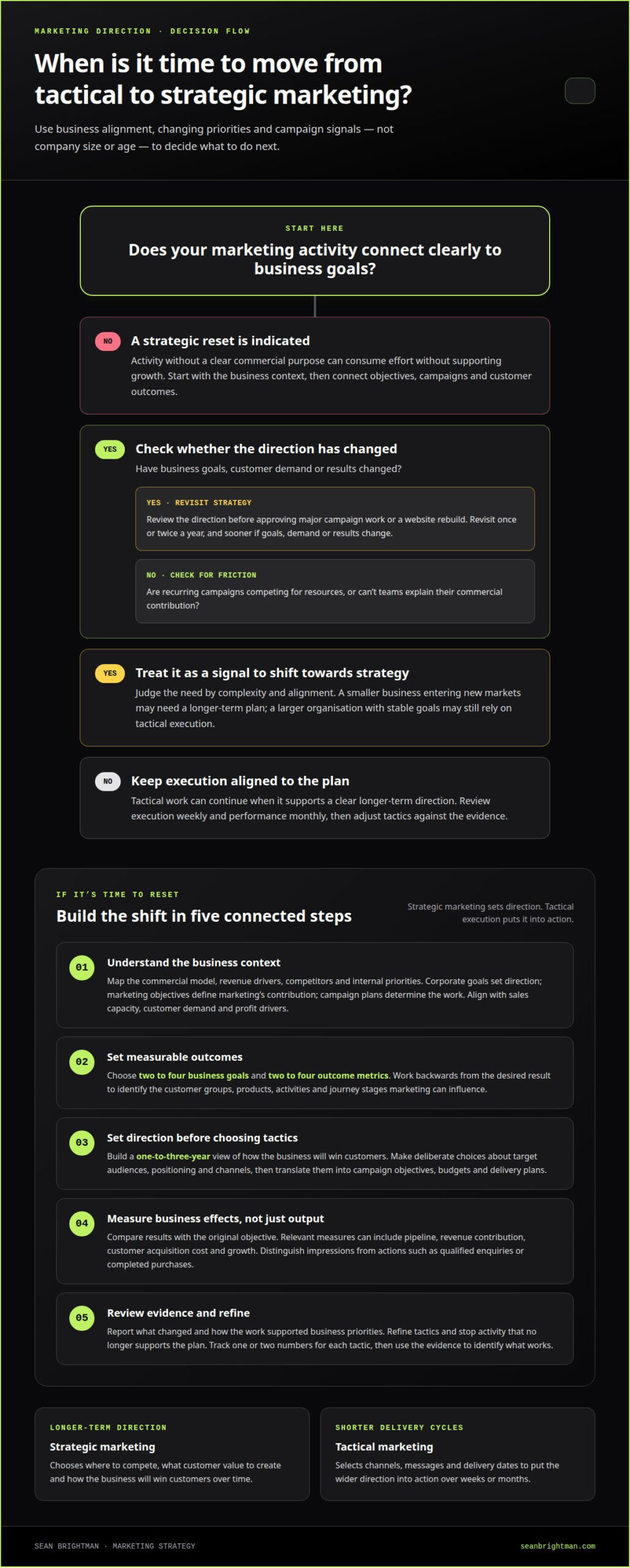
    Move towards strategic marketing when campaign choices need to support wider commercial priorities, not just immediate delivery. There’s no fixed growth stage for making the shift. Assess the business context, set outcomes, choose activity and measure the results.

    1. Understand the business context

      Map the organisation’s commercial model, revenue drivers, competitors and internal priorities. Then connect business planning to marketing: corporate goals set the direction, marketing objectives define its contribution, and campaign plans determine the work. Check that teams share the same priorities. Avoid planning channels in isolation from sales capacity, customer demand or profit drivers.

    2. Identify signs and growth stages

      Look for signs that recurring campaigns are competing for resources, teams can’t explain their commercial contribution, or business priorities have changed. These are stronger signals than company size or age. A smaller business entering new markets may need a longer-term plan, while a larger organisation with stable goals may still rely on tactical execution. Judge the shift by complexity and alignment.

    3. Set two to four measurable business goals, then choose two to four outcome metrics. For example, if the objective is to increase profit by 10%, assess which customer groups, products and activities can contribute. Work backwards from the desired result to define the customer journey, then identify where marketing can influence it. This replaces activity targets with business outcomes.
    4. Build a strategic plan around a one-to-three-year view of how the business will win customers. Make deliberate choices about target audiences, positioning and channels, then translate them into campaign objectives, budgets and delivery plans. Publishing two blog posts per month, for example, belongs in the plan only when its purpose and intended contribution are clear.
    5. Measure results against the original objective, not just completed outputs. Track relevant commercial effects, such as pipeline, revenue contribution, customer acquisition cost and growth. Report what changed and how the work supported business priorities. Review the evidence, refine tactics and stop activity that no longer supports the plan. Strategic marketing sets direction; tactical execution puts it into action.

    Strategic marketing versus tactical marketing

    Separate long-term choices from short-term actions. Strategic marketing sets the direction that tactical marketing serves.

    1. Compare planning time frames

      Set a longer planning horizon for strategic choices, then organise campaigns into shorter delivery cycles. Strategic marketing can define how the business will win customers over a one-to-three-year period, while tactics respond over weeks or months. A monthly email newsletter, for example, may support customer retention, but it isn’t the strategy itself. Check that each short cycle advances the longer-term direction.

    2. Distinguish planning approaches

      Start with the business position, target audience and intended outcome; choose tactics afterwards. Strategic planning decides where to compete and what customer value to create. Tactical planning selects channels, messages and delivery dates. Posting project photos on social media every week is an action, not a commercial objective. Before judging its value, connect it to a measure such as quote requests or conversions.

    3. Balance long-term plans with immediate needs

      Protect capacity for immediate demand whilst reserving deliberate effort for longer-term improvements. A small business might keep responding to current enquiries while improving its customer journey or positioning. Don’t let urgent tasks consume every planning session; equally, don’t pause useful activity for an abstract strategy exercise. For example, a tactical goal to increase quote requests by 25 percent this quarter can guide immediate work within the wider plan.

    4. Allow for the shift between approaches

      Build the change into existing planning and reporting rather than setting an arbitrary deadline. There’s no fixed duration for the shift: it depends on how quickly leaders agree priorities, teams connect activities to outcomes, and useful performance evidence becomes available. Review execution weekly and performance monthly, then adjust tactics against results. A clear marketing roadmap can help keep immediate decisions pointed toward longer-term goals.
    How to Align Marketing Strategy with Campaigns

    When to revisit strategy before campaigns or a website

    Review the direction before committing to major campaign work or a website rebuild. Revisit it once or twice a year, and sooner if business goals, customer demand or results change.

    Consider the risks of tactical focus

    Diagnose weak campaigns before adding more activity. Tactical work without a clear strategic link can consume effort without supporting growth, and reach alone doesn’t show whether people took action. Check whether campaigns attract the intended audience, convert leads into closed business and produce a return on investment. If results fall short, find where the customer journey breaks before changing channels.

    1. Compare performance with the campaign’s objective. For example, distinguish impressions from actions such as qualified enquiries or completed purchases.
    2. Track one or two numbers for each tactic. Use the evidence to identify what works, then refine or stop actions that miss their purpose.

    Revisit strategy before new activity

    Review the strategy before approving a campaign or website if its audience, offer or business goal has shifted. A new design can’t fix unclear positioning, and another campaign won’t repair a customer journey that loses people. Check that the proposed work supports the brand promise and addresses the right customer need.

    1. Map the customer journey across relevant touchpoints. Check whether each stage delivers on the promise and gives customers a clear next action.
    2. Build a repeatable campaign system: review execution weekly, assess performance monthly and record decisions. Scale effective work with clear ownership and governance, rather than relying on individual memory.
    3. Reassess the strategy once or twice a year, or when evidence points to a material change. Connect each campaign’s results to the strategic plan, then update priorities before committing further effort.

    What signs indicate a business should move from tactical to strategic marketing?

    Use these signals to decide whether marketing needs clearer direction, not simply more activity. One weak campaign isn’t enough; look for patterns across priorities, customers and commercial results.

    1. Check whether campaign briefs start with channels or business priorities. If teams repeatedly launch activity without agreeing on its purpose, reset the planning process. For example, content needs a clear connection to customer demand, not just a place in the calendar.
    2. Compare marketing targets with actual market capacity. One example sets a target of selling 1,000 more products in Market A within 12 months. The same example says demand cannot support 2,000 additional sales. That gap calls for strategic choices, not simply more campaign output.
    3. Test whether growth plans account for operational needs. In the Market A example, selling 1,000 more products would increase profits by 7%, but requires three new sales team members. If marketing plans ignore delivery capacity, expected growth and commercial reality can pull apart.
    4. Review whether customer targeting reflects who buys and why. A defined audience, such as professional women over 45 who pay for childcare, gives campaigns a sharper focus. Revisit strategy when teams cannot explain who they want to reach or what those customers value.
    5. Look beyond reach when judging campaign performance. Impressions show exposure; actions show whether people respond. Track pipeline created, conversion by stage, customer acquisition cost or cost per pipeline. If reports show activity but leaders can’t see its commercial effect, strengthen the link between marketing and business outcomes.
    6. Check whether the organisation’s priorities still match its marketing choices. A change in target market, competitive position or internal priorities can make yesterday’s campaign plan obsolete. Bring forward a strategy review when teams keep adjusting tactics without a shared reason for the changes.
    7. Assess whether marketing contributes ideas, not just completed briefs. Strategic teams raise opportunities, challenge assumptions and recommend actions proactively. If marketers spend all their time executing requests, make room for commercial analysis and stakeholder discussions before approving the next campaign.

    Sean Brightman

    Sean Brightman helps businesses turn marketing priorities into clear direction and practical next steps. If campaigns keep moving but their connection to commercial goals remains uncertain, Roadmapping can bring those priorities into focus. An Advisory Retainer provides ongoing strategic input as business needs and marketing decisions evolve.

    For businesses exploring how AI fits their marketing approach, AI Consulting can help assess the opportunity against wider objectives. The right next step depends on the challenge: clarify the direction, make better-informed decisions or keep strategic thinking connected to execution.

    If you’re ready to discuss your marketing direction, contact Sean Brightman.

    Make the next campaign a strategic choice

    Before approving your next campaign, write down the business decision it needs to support. Name the customer behaviour you want to influence, the evidence that would show progress and what you’ll change if the response falls short. This short test turns strategy into a working tool, not another document on a shelf.

    Deciding when to move from tactical to strategic marketing is only the start. The real test is whether leadership can keep priorities clear while campaigns adapt to customer behaviour. If direction, execution and accountability are pulling apart, Sean Brightman can help bring them back into alignment. A Fractional CMO provides strategic leadership; Roadmapping clarifies priorities and next steps; AI Consulting helps assess how AI fits your business objectives.

    Contact Sean Brightman to discuss your marketing direction. Make the next move with purpose, then put it to work.

    Frequently Asked Questions

    Which metrics matter most for strategic marketing?

    Prioritise metrics that reveal where commercial progress stalls. Pipeline contribution can show whether marketing creates sales opportunities; conversion by stage can reveal where prospects drop away. Retention and expansion contribution help assess ongoing customer value. If opportunity numbers rise but fewer progress to sale, for example, investigate that stage before increasing lead-generation activity.

    What Actually Changes When Marketing Becomes Strategic?

    Decision-making changes first. Teams bring commercial context and recommendations into planning instead of waiting for a campaign brief. Leaders discuss trade-offs, agree on ownership and use results to decide what continues. For example, a marketing review might recommend pausing a familiar activity to test a stronger customer proposition. The shift is from completing requests to influencing choices and taking responsibility for outcomes.

    What causes teams to fall back into tactical mode?

    Urgent requests, fragmented ownership and pressure to show visible activity can crowd out strategic work. Teams may default to producing deliverables because output is easy to report, while cross-functional decisions take longer. For example, sales may request a new campaign before agreeing which customer problem it should address. Protect time for planning and commercial discussion, or short-term requests will set the agenda.

    What is tactical marketing in simple terms?

    Tactical marketing is the specific work a team carries out to reach customers or prompt an action. A limited landing-page test, for example, can compare two messages for the same offer. It has a defined audience, channel and task. The tactic describes what the team will do; it doesn’t, by itself, explain why that action deserves priority.

    What is the difference between tactical and strategic marketing?

    Strategic marketing makes the choices that guide the work; tactical marketing puts those choices into action. For example, a business might choose to compete through specialist expertise, then develop proof points and customer communications to demonstrate it. The strategic choice shapes what the team says and to whom. Without that direction, separate campaigns can send inconsistent signals.

    How do you assess whether marketing tactics are supporting long-term business goals?

    Trace each tactic from its intended customer response to a business outcome, then review the evidence. For a product launch, map how a prospect discovers the offer, evaluates it and reaches a purchase decision. Check whether the tactic supports a relevant step and whether the results available show progress. If the link is unclear, revise the activity or its purpose before repeating it.

  • Marketing Accountability Frameworks That Connect Activity to Outcomes

    Marketing Accountability Frameworks That Connect Activity to Outcomes

    Marketing activity only earns its place when you can connect it to business results. A marketing accountability framework links what marketing does and measures to financially relevant outcomes, from revenue and retention to growth over time. It moves the conversation beyond clicks and impressions.

    That doesn’t mean every campaign must prove its value through a single headline figure. It means choosing useful measures, understanding how they relate to commercial performance and reviewing them consistently. Clear accountability gives teams a stronger basis for decisions, not just a fuller report.

    This article explains how reporting can connect activity to outcomes, what measurement standards add and how the Marketing Metric Audit Protocol (MMAP) tests the links between marketing measures and financial performance. It also explores why accountability matters during digital transformation, when teams need clear ownership and the freedom to act in alignment.

    Key Takeaways

    • Set measures that connect marketing activity to commercial outcomes, then review whether they still reflect business priorities.
    • Separate campaign performance from business-system problems, such as tracking gaps or approval delays, so teams can act on the real constraint.
    • Use MMAP to examine how marketing measures link to cash-flow drivers and test the assumptions behind those connections.
    • Make ownership and team dependencies visible during digital transformation, giving people room to act without losing alignment.

    What is a marketing accountability framework?

    A marketing accountability framework connects marketing activity to commercial outcomes, including revenue, acquisition and retention. It assigns responsibility for results, not just for reporting impressions.

    Marketing metrics and performance benchmarks

    Metrics track activity or results; benchmarks put those figures in context against a baseline, target or earlier period. Set them by starting with the business objective, choosing measures that reflect it, then assigning an owner and review point. Performance measurement frameworks report what happened; accountability frameworks also connect results to business objectives and decisions. This distinction helps teams judge whether activity merits further investment.

    Lead costs and customer acquisition

    Cost per lead compares marketing spend with the number of leads generated, while customer acquisition cost measures the cost of gaining a customer. Read them together: a low-cost lead has little value if it rarely becomes a paying customer. Assign responsibility for lead quality and track conversion through sales stages. This shows where costs rise, where prospects drop out and which changes could improve acquisition.

    Connecting metrics to business outcomes

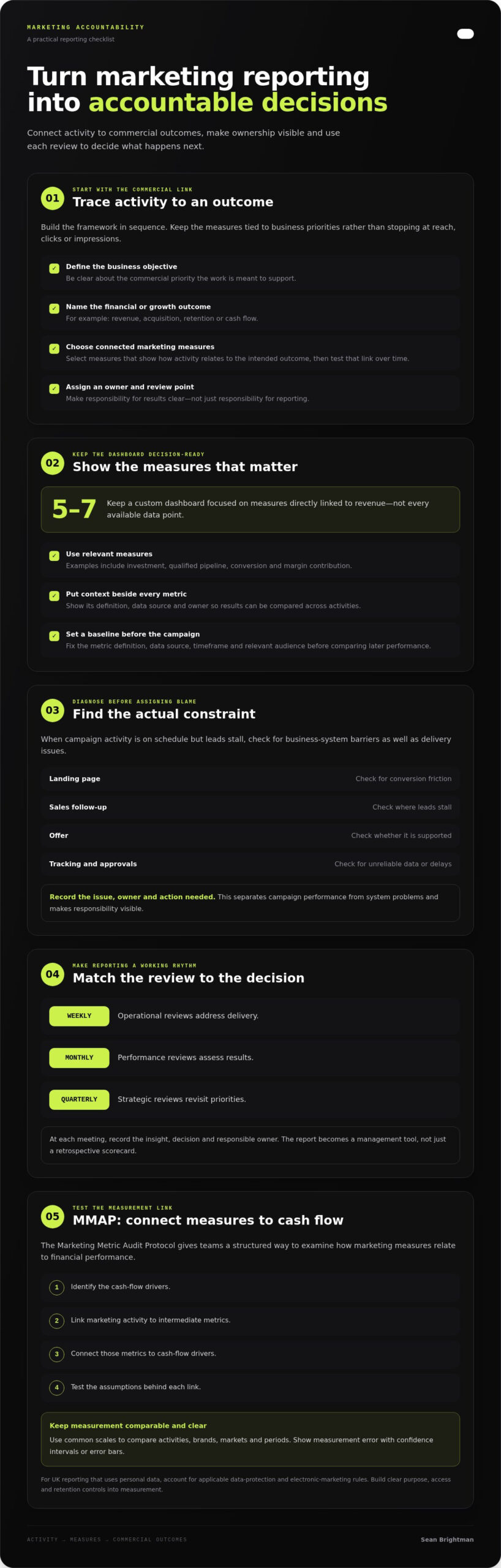
    Outcome measures show how marketing contributes to commercial performance, rather than stopping at reach or clicks. Build the framework in sequence: define the business objective, identify the cash-flow or growth outcome, select the marketing measures connected to it, then test those connections over time. Examples include return on marketing investment, acquisition cost and retention. Effective frameworks combine these measures with clear ownership and regular management reviews, so results inform the next decision.

    Sales and marketing metric alignment

    Sales and marketing alignment means both teams use shared definitions and measures across the customer journey. Agree what counts as a qualified lead, who owns follow-up and how progress is recorded. Then compare marketing’s lead and conversion measures with sales outcomes, such as new-customer revenue. This makes responsibility visible: if leads fail to progress, teams can identify the stage causing friction instead of arguing over separate dashboards.

    How should a report connect marketing activity to business outcomes?

    UK reporting that uses personal data should account for applicable data-protection and electronic-marketing rules. Build clear purpose, access and retention controls into measurement, then connect each activity to a financial outcome and an owner.

    Marketing investment and financial performance

    Linking investment to financial performance means tracing how marketing spend contributes to revenue, margin or cash flow. It matters because activity counts alone cannot show whether investment supports commercial priorities. For each programme, record its cost, the intermediate result, such as qualified demand, and the financial outcome it is expected to influence. Compare those measures over time and state the assumptions behind the link. This gives leaders insight into contribution, not just output.

    Diagnosing agency and business-system performance

    Diagnosis separates delivery issues from business-system barriers that prevent results. If campaign activity is on schedule but leads stall, examine the landing page, sales follow-up, offer and tracking before blaming the agency. Record the issue, its owner and the action needed. An agency performance review should also surface unsupported offers, conversion friction, unreliable data or approval delays while there is time to respond. This structured view makes responsibility clear and directs attention to the actual constraint.

    A custom dashboard should reflect the organisation’s strategic priorities, not every available data point. Keep it focused on five to seven measures directly linked to revenue, such as investment, qualified pipeline, conversion and margin contribution. Show definitions, data sources and owners beside each metric. That makes reporting comparable across activities and helps readers spot whether a change reflects performance or a tracking problem.

    Set a review rhythm that turns reporting into decisions: weekly operational reviews address delivery, monthly performance reviews assess results, and quarterly strategic reviews revisit priorities. Use each meeting to record the insight, decision and responsible owner. The report then becomes a working management tool, not a retrospective scorecard.

    Marketing Accountability Frameworks That Connect Activity to Outcomes

    Marketing measurement standards and MMAP

    Standards make campaign results more comparable and show how much confidence to place in them. MMAP gives teams a structured way to test how marketing measures connect to financial performance.

    Measurement standards and standardised measures

    Marketing measurement standards define consistent methods for assessing activity, outcomes and the reliability of results. The Marketing Accountability Standards Board provides the Marketing Metric Audit Protocol (MMAP), which identifies cash-flow drivers, links marketing activity to intermediate metrics, connects those metrics to cash-flow drivers and tests the assumptions behind each link. This matters because a campaign measure only supports a business decision when its meaning and relationship to financial performance are clear. Use common scales to compare activities, brands, markets and periods; show measurement error with confidence intervals or error bars.

    Establishing baseline measurements

    A baseline is a recorded starting point for comparing later performance. Establish it by fixing the metric definition, data source, timeframe and relevant audience before a campaign begins. For example, record existing customer acquisition and retention measures using the same definitions planned for evaluation. Gather outcome measures continuously over time; repeated observations help identify changes associated with marketing initiatives and shifting customer needs. A consistent baseline makes growth visible without confusing a change in measurement with a change in performance.

    Industry measurement practices

    Industry practice includes benchmarking return on investment and testing whether measurement methods produce valid results. The American Productivity and Quality Center and the Advertising Research Foundation conducted return-on-investment benchmarking surveys in 2001 and 2003. The Chief Marketing Officers Council carried out a survey on marketing accountability and measurement in 2004. The Association of National Advertisers and Forrester conducted surveys on those topics in 2002, 2004 and 2006. These examples show why shared definitions matter: comparisons need consistent measures, not merely familiar labels. For your own campaigns, document methodology and uncertainty alongside results, then compare like with like.

    Accountability frameworks and digital transformation

    Digital transformation spreads work across teams, platforms and customer-facing services. MIT Sloan Center for Information Systems Research identifies accountability as one of digital transformation’s five building blocks. Without defined ownership, teams can launch connected digital offerings but lose sight of their purpose, decisions and commercial contribution.

    An accountability framework connects leadership priorities to the people making product, data and channel decisions. For example, a team responsible for a customer portal can manage its design independently while agreeing shared service standards with sales and support. That balance protects local initiative and keeps the customer experience aligned. It also clarifies who can resolve a dependency when another team controls a required system or approval.

    RACI matrices make those relationships explicit by assigning responsibility, accountability, consultation and information-sharing roles. Apply the roles to a specific outcome, such as launching a digital service or changing its customer journey. One person or team needs clear accountability for the result; others need defined roles in delivery, input or updates. This prevents a common failure: everyone contributes, but no one can make the decision.

    Budget decisions need the same clarity. Define who can move investment between digital activities, who approves changes and which business purpose guides those choices. For example, a team running digital advertising may report campaign performance, while leadership decides whether the activity supports growth priorities. Visualising dependencies helps teams see how budget, data access and approvals affect delivery before delays become entrenched.

    Make the framework operational with shared tools that show ownership, decision rights and cross-team dependencies. Review those links as digital services or priorities change, rather than treating the structure as permanent. This turns accountability into a working system: teams can act with autonomy, leadership can see how decisions connect, and obstacles have an owner. Turn digital accountability into a practical operating plan.

    Sean Brightman: AI Consulting

    Sean Brightman’s AI Consulting helps leaders assess where AI fits their business priorities and decision-making. It’s relevant when your team is exploring AI but lacks a clear purpose, ownership or way to measure its contribution. Tie any proposed use to a defined outcome, accountable owner and agreed measure before committing resources.

    For broader planning, Roadmapping can clarify priorities and the sequence of work. An Advisory Retainer provides ongoing strategic guidance as decisions and business needs evolve. The right starting point depends on the challenge: AI Consulting for AI questions, Roadmapping for direction or an Advisory Retainer for continued advice.

    If you’d like to discuss your priorities, contact Sean Brightman or visit seanbrightman.com.

    Make accountability part of the next decision

    A marketing accountability framework should keep pace as your business priorities, teams and channels change. Treat it as a working management tool, not a dashboard you build once and leave untouched. Start by identifying where decisions still rely on activity counts, disconnected data or unclear ownership, then decide what needs to change.

    That work may call for strategic leadership as well as measurement discipline. Sean Brightman offers Fractional CMO support, AI Consulting and Roadmapping to help businesses tackle leadership, technology and planning challenges. The right focus depends on the gap: leadership direction, a clearer path forward or considered AI decisions.

    Start with the decision you need marketing to support. Make the commercial purpose clear, then give the team a way to learn and adjust as evidence changes. Contact Sean Brightman to discuss your framework, and take the next step towards marketing decisions grounded in business outcomes.

    Frequently Asked Questions

    How does a framework improve CMO tenure and team performance?

    A framework can support CMO continuity by making priorities, decision rights and progress visible to leadership and the team. It can reduce avoidable friction: a new CMO can inherit agreed definitions, reporting history and named owners instead of rebuilding the measurement system. Reviews that examine causes and next actions, rather than blame, also help teams learn from results and improve their decisions.

    How long does it take to implement the framework?

    Implementation time depends on data readiness and how much of the customer journey needs tracking. Basic tracking can take 2-3 weeks when the business has the right technology stack; comprehensive customer-journey tracking typically takes 4-6 weeks to deploy and validate. Allow time to define metrics, connect data, test outputs and train owners. A dashboard is only useful once its inputs are reliable.

    How should accountability be divided between the agency and the business?

    Divide accountability by decision and dependency, not by who appears on a report. An agency can own agreed campaign delivery, measurement quality and early warnings about tracking or conversion barriers. The business should own commercial objectives, its offer, approvals, internal data access and timely sales follow-up. If a launch stalls, record the blocker, decision-maker and next action so each party can address what it controls.

    What are the key components of a marketing accountability framework?

    Define the business objective, each metric’s calculation, its data source, an owner, a review rhythm and the decision it informs. A marketing accountability framework should also document how a measure is expected to influence customer behaviour and commercial results. For example, name who validates CRM lead stages and who can change a campaign if qualified prospects stop progressing.

    Which marketing KPIs and metrics should an accountability framework include?

    Choose KPIs that fit the business model and decision. A subscription business may focus on acquisition cost, payback and retention; a retailer may track new-customer revenue, repeat purchases and contribution margin. Pair an early signal, such as qualified enquiries, with a later result, such as revenue. Treat impressions as diagnostic context, not the sole evidence that marketing investment is working.

    How can marketing activity be linked to revenue, profit and business outcomes?

    Map each activity through a customer response to an economic driver: advertising generates qualified demand, sales converts that demand, and revenue contributes to margin after relevant costs. Use consistent time periods and account for influences such as price changes before assigning credit. The Marketing Metric Audit Protocol provides a structured way to test assumptions linking marketing measures with cash-flow drivers.