
A dashboard full of clicks, impressions and engagement can still leave one question unanswered: is marketing helping the business grow? Developing marketing kpis that matter starts with that question, not with another metric to squeeze onto a report. The goal is to connect activity to a commercial outcome leaders care about.
If your reporting feels busy but doesn’t help leadership or finance make decisions, the problem isn’t a lack of data. It’s a lack of focus, clear ownership and agreed follow-up. Marketing needs measures the whole business can understand, not a separate language of its own.
This guide shows you how to build a lean KPI system around business priorities. You’ll learn to choose useful indicators, assign an owner to each one and link every measure to a decision and review. The result is reporting that does more than describe what happened. It helps your team see what’s working, what needs attention and what to do next.
Key Takeaways
- Developing marketing kpis that matter means starting with a business priority, then tracing how marketing can contribute to it.
- Build a clear KPI chain from goal to measurable outcome, so each metric has a reason to exist.
- Choose indicators that help someone make a decision. If a metric can’t inform action or link to an objective, leave it out.
- Give every KPI a shared definition, accountable owner and trusted data source to make reporting useful across teams.
- Set regular reviews to act on what the measures show, then refine the system when priorities or evidence change.
Developing marketing KPIs that matter starts with the business problem
A dashboard can show that website visits rose, email engagement improved and social posts reached more people. Yet leaders may still be asking the same question: what did marketing contribute to the business? The gap isn’t necessarily missing data. It’s often a missing connection between the numbers being reported and the commercial problem the business needs to solve.
Start with the objective. Is the business trying to grow qualified pipeline, improve customer retention or enter a new market? Until that priority is clear, choosing KPIs is guesswork. A Key Performance Indicator (KPI) is a measure used to assess progress towards an important objective, but its value depends on how it informs action.
A decision-useful KPI measures progress towards a business objective and helps its owner decide what to do next.
How to tell a KPI from a metric
A metric describes an activity or result: website visits, email opens, enquiries or sales. A KPI is a measure selected because it helps assess progress against a priority. A business objective is the outcome the organisation wants to achieve. These terms connect, but they aren’t interchangeable. And not every useful metric needs a place on an executive dashboard.
Illustrative example: A business wants to increase qualified sales opportunities. Website visits may help the marketing team understand audience interest, but visits alone don’t show whether the objective is advancing. The number of qualified opportunities generated through marketing could be a KPI, if the business has agreed what counts as qualified and can use the result to adjust its plans.
The test is practical. If the measure changes, could someone make a sensible decision in response? For example, a team might investigate whether a source is bringing in relevant prospects, or shift effort towards activity more closely connected to the objective. The figures here illustrate the logic; they aren’t performance benchmarks.
Signs your marketing measures have lost their purpose
Some dashboards are museum pieces. They carry measures from an old campaign, channel or reporting habit, even though the strategy has moved on. Others reward what’s easy to count. Engagement figures can look encouraging whilst leaders remain unable to answer whether marketing is supporting pipeline, revenue or another agreed priority.
That doesn’t make engagement or channel metrics useless. They can help teams diagnose performance and improve execution. The problem starts when these measures take up leadership attention without explaining what they mean for the objective, or what decision should follow.
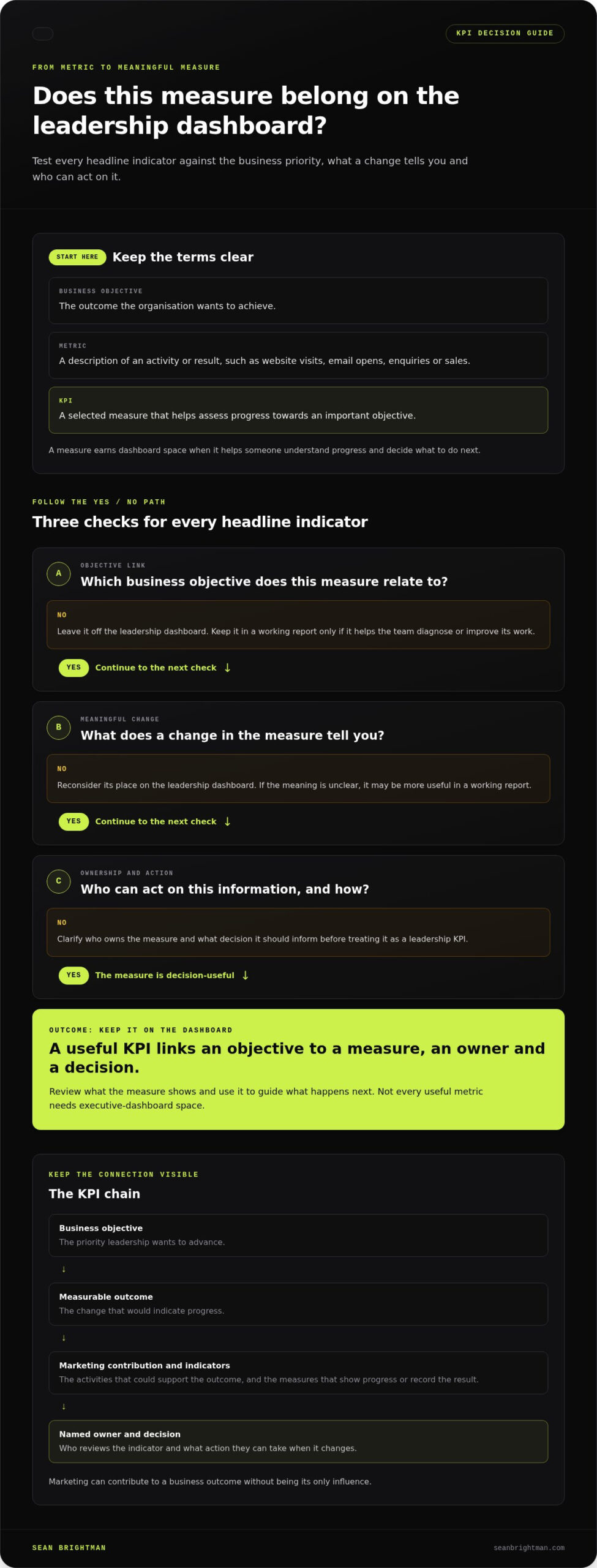
Run this quick test on every headline indicator:
- Which business objective does it relate to?
- What does a change in the measure tell you?
- Who can act on that information, and how?
If the answers are vague, the measure may belong in a working report rather than the leadership dashboard. Developing marketing kpis that matter means keeping the measures that sharpen decisions, not simply carrying forward every number the team can collect.
Build a marketing KPI chain from business goal to measurable outcome
A KPI shouldn’t start with the data your tools happen to collect. It should start with a business priority, then trace a credible route from that priority to marketing’s contribution, the measure someone owns and the decision it informs. That chain stops reporting from becoming a disconnected list of numbers.
Use this sequence to build it:
- Clarify the business goal. Name the priority leadership wants to advance, such as growing revenue from a particular market.
- Define the outcome. Specify what change would indicate progress, such as more revenue from that market or a stronger pipeline of suitable opportunities.
- Identify marketing’s contribution. Map the activities that could support the outcome, without treating marketing as the only influence on it.
- Choose indicators. Select measures that show progress or record the final result, and make their relationship to the goal explicit.
- Assign ownership and a decision. Name who reviews each indicator and what action they can take when it changes.
A useful KPI chain runs from business objective to measurable outcome, through a named owner, to a decision that can change the work.
Translate a business objective into marketing outcomes
Start with leadership’s priority, then ask what needs to change for the business to move towards it. If the aim is growth in a new market, the desired outcome might be a stronger flow of relevant enquiries or sales opportunities from that market. Those are outcomes to assess, not activities to count.
Next, map how marketing could contribute: for example, by improving awareness with the intended audience or supporting demand generation. Keep the distinction clear. A campaign, event or content programme is an activity; reach and responses are possible indicators; the commercial outcome is the result the business cares about. Sales capacity, pricing and market conditions can also affect that result, so don’t claim marketing controls it alone.
Pair early signals with final outcomes
Some outcomes take time to show up. Leading indicators can offer earlier signals that a plan is gaining traction. For a new-market push, these might include engagement from the intended audience or relevant enquiries. They help teams spot patterns and decide whether to investigate or adjust, but they don’t prove that a final business result will follow.
Lagging indicators record outcomes after they happen, such as revenue or pipeline created. They show what the business achieved, but rarely explain the cause on their own. Read leading and lagging measures together: if early signals shift but the outcome doesn’t, investigate other influences before changing course. The relationship is evidence to examine, not a causal claim to assume.
This is where developing marketing kpis that matter becomes an operating discipline, not a dashboard exercise. If leadership needs help turning priorities into a workable measurement and accountability system, senior marketing roadmapping and advisory can bring structure to the decisions.
Choose marketing KPIs that guide decisions, not vanity reporting
A measure isn’t a KPI just because it appears on a dashboard. It earns that place when it connects to a current objective and helps someone decide what to do. A crowded report can hide the signal. A short, well-chosen set of measures makes priorities easier to see and follow up.
Use this comparison to test candidate measures before promoting them into leadership reporting. The examples are illustrative, not benchmarks.
| Candidate measure | Objective served | Decision enabled | Owner | Data source |
|---|---|---|---|---|
| Qualified opportunities from a target segment | Develop demand in that segment | Review targeting or the offer if the flow changes | Marketing lead | CRM, with an agreed qualification definition |
| Email click-through rate | Improve engagement with a priority audience | Test the message or call to action | Email manager | Email platform |
| Customer satisfaction after onboarding | Improve the early customer experience | Investigate friction in onboarding | Customer experience lead | Post-onboarding survey |
Apply a practical test to each candidate KPI
Before including a measure, check three things: does it connect to a current objective, can the team define and source it consistently, and would a change prompt a different action? If the answer to the last question is no, it may be useful for analysis but doesn’t need to be a headline KPI. If nobody owns it, it’s unlikely to trigger follow-up.
A vanity metric isn’t inherently worthless. It becomes vanity reporting when it’s presented as proof of progress without a clear link to an objective or a decision. Reach, impressions and clicks can help diagnose channel activity. On their own, they don’t establish commercial contribution. Keep them in working reports when they help a team improve execution; leave them out of senior reporting if they add no decision value.
Balance commercial and customer indicators
Choose categories to fit the objective, not to complete a checklist. Business measures might include revenue contribution, return on investment (ROI), return on ad spend (ROAS), customer acquisition cost (CAC) or customer lifetime value (CLV). Engagement measures can help assess whether an audience is responding; satisfaction measures can reveal how customers experience the relationship. Each belongs only when it helps answer a relevant question.
Channel figures need context. A change in ROAS, for example, may reflect spend, conversion value, attribution settings or changes elsewhere in the customer journey. Don’t leap from a channel result to a strategic conclusion without examining what the measure includes and what it leaves out.
There’s no universal KPI count for every team. Choose enough to cover the priorities that matter, but not so many that ownership and follow-up disappear in the noise. In developing marketing kpis that matter, relevance beats volume: retain indicators with clear definitions, usable evidence and a decision attached.
Make marketing KPI measurement reliable, owned and actionable
A KPI can look precise and still mislead. If marketing and finance define “qualified lead” differently, their reports may show different results while both teams believe they’re right. Reliable measurement starts with shared rules, a trusted source and a person responsible for interpreting what the number means.
Measurement creates value only when someone can interpret the evidence and act on it.
Set definitions, sources and ownership before reporting
Write each KPI definition in plain English before it goes into a report. Record what the measure includes, what it excludes, the period it covers and any filters applied. For example, define what makes an enquiry “qualified” and whether the count includes only new opportunities. Shared rules let teams compare like with like, rather than debate whose calculation is correct.
Then document the source and name an accountable owner. The source might be a CRM, analytics platform or customer survey; the owner is responsible for checking the measure and raising questions, not necessarily doing every task that affects it. If data is missing, duplicated or shaped by attribution limits, flag that context alongside the result. Don’t dress uncertainty up as certainty.
A lightweight KPI record can capture:
- The objective and plain-English definition
- What is included, excluded and counted, and over what period
- The source, accountable owner and relevant data limitations
- Who uses the measure and what decisions it may inform
This simple record gives new team members a shared reference and makes changes easier to spot. If a definition or source changes, note when and why. Otherwise, a shift in the reported figure could reflect a new counting method rather than a change in performance.
Turn KPI reviews into decisions and follow-up
Set the review rhythm to match how quickly the measure changes and when a decision is needed. A fast-moving campaign may need closer attention than a longer-term commercial outcome. Don’t review a figure more often than the data can support, and don’t wait so long that a useful adjustment arrives too late.
Make the meeting about interpretation, not dashboard presentation. For each KPI, ask what moved, what might explain it, what the movement means for the objective and what action follows. Separate observed facts from possible explanations. A change may coincide with a campaign, but that alone doesn’t prove the campaign caused it.
Finish by recording the decision, the person responsible and when the team will revisit the action. If there’s no decision to make, note why the indicator remains under observation. This turns reporting into a working loop: evidence, interpretation, action, follow-up. It also helps leaders see where accountability sits without confusing ownership of a measure with sole control of the outcome.
Developing marketing kpis that matter requires this discipline beyond the dashboard: clear definitions, honest context and follow-through. If you want strategic support to turn measurement into a workable system, explore strategic marketing support.
Put a useful KPI system into practice with clear marketing leadership
A KPI framework only earns its keep when the team uses it. Put it into operation with a clear rollout, then adjust it as priorities and evidence change. A new growth target may require different indicators; a change in data quality may mean an existing measure needs a fresh definition. Keep the system stable enough to compare progress, but never so rigid that it stops reflecting the business.
Use this sequence to get it working:
- Agree the priority. Make sure leaders and marketing are working towards the same business objective.
- Map the KPI chain. Connect the objective to the outcome, relevant marketing contribution and indicators.
- Assign owners. Make responsibility for each measure and its follow-up explicit.
- Establish reviews. Set a rhythm for interpreting changes and agreeing actions.
- Refine the system. Remove measures that no longer inform decisions and investigate gaps in the evidence.
Leadership matters at every step. Senior marketing direction can align priorities, clarify accountability and keep measurement connected to decisions. It can’t guarantee a commercial result, particularly where other teams and market conditions influence the outcome. Its job is to make the plan coherent and the next action clear.
Choose support that matches the work to be done
For a focused reset, Roadmapping is a one-off strategic engagement that produces a 90-day action roadmap the business can run. Advisory CMO provides ongoing strategic direction through monthly strategy and review sessions, priority setting, async access and accountability. Fractional CMO support offers senior leadership across strategy, team direction, campaign planning and growth-system design. The right fit depends on whether the business needs a defined plan, continuing guidance or broader leadership involvement.
Keep the KPI system connected to the wider growth engine
Measures won’t fix disconnected operations by themselves. Connect them to the way work moves across marketing: who owns each activity, how teams share information and which decisions leaders need to make. A clear marketing operations and scalable growth system helps keep reporting tied to execution, rather than leaving the dashboard as a separate exercise.
Ongoing direction can also help keep priorities, reviews and responsibilities aligned as the business develops. A marketing advisory retainer can provide a continuing structure for that strategic oversight.
Developing marketing kpis that matter isn’t a one-off dashboard project. It’s a working system of priorities, evidence, ownership and decisions. If you’re ready to put that system under clear senior direction, plug in a senior marketing brain.
Make your next KPI decision count
The next step doesn’t need to be a complete reporting overhaul. Pick one business priority and use it to pressure-test the measures your team already tracks. Keep what supports a decision. Retire what only fills space. Then use the next review to see whether the information helped someone act with greater clarity.
That’s how developing marketing kpis that matter becomes part of how the business works, rather than another project that fades after a dashboard update. The system should evolve as priorities shift and better evidence emerges. Stay curious, challenge assumptions and keep the measures connected to real choices.
If you want experienced strategic support to turn measurement into clearer direction and accountability, plug in a senior marketing brain. Start with the decision you need to make. Build the measurement around it, and give your team a stronger basis for moving forward.
Frequently Asked Questions
Can a marketing KPI be shared between marketing and sales?
Yes. A shared KPI can align marketing and sales around an outcome both teams influence, such as progressing suitable enquiries into sales opportunities. Agree what counts and which system provides the figures, then spell out each team’s part. Marketing might review whether enquiries match the agreed profile; sales might examine how promptly and consistently they’re followed up. Shared accountability should encourage collaboration, not leave either team unsure who owns the next action.
What happens if a marketing KPI improves but revenue does not?
Treat the gap as a reason to investigate, not as proof that either measure is pointless. Check whether revenue may follow the indicator later, whether the audience is commercially relevant and where prospects are dropping out. Review sales follow-up and make sure both figures use stable definitions. Then decide whether the indicator still helps assess the intended objective. Two measures moving differently, or together, don’t by themselves establish what caused the change.
Can brand awareness be measured with marketing KPIs?
Yes, provided the measure reflects the awareness goal. If the aim is to reach a defined audience, survey responses about brand recognition may be more informative than total impressions alone. Use the same question, audience and method across reviews so changes can be interpreted fairly. Where possible, compare awareness evidence with later signals such as branded enquiries. Keep the distinction clear: visibility can indicate exposure, but it doesn’t prove preference, purchase intent or revenue.
How do you set marketing KPI targets without reliable historical data?
Start by recording what you can measure now and where the evidence is incomplete. In developing marketing kpis that matter, an initial target can be provisional: tie it to the business priority, write down the assumptions and set a point to review it. For example, a team entering a new market might use early campaign results to establish a working baseline. Label estimates clearly, then revise them as consistent evidence builds. Don’t present a first estimate as an established benchmark.
Should every marketing channel have its own KPI?
No. Give a channel its own KPI only if it has a defined role and the measure helps guide a decision. If a webinar supports consideration, registrations from the intended audience may be more useful than a general view count. A separate channel report can still help the people managing that work, but it needn’t become an executive KPI. Start with the business question, then use channel figures as supporting evidence where they add insight.
Can a small business develop useful marketing KPIs without a large analytics team?
Yes. A small business can begin with information it already handles, such as enquiries recorded in a spreadsheet or sales tracked in its existing system. Choose measures the team can update consistently, rather than building a complex dashboard first. For example, agree how to record an enquiry’s source and what makes it relevant. Give someone responsibility for maintaining that record, then use it to inform a specific decision. Simple, dependable evidence beats elaborate reporting nobody can sustain.