
Tag: marketing roles

  • Defining Roles in a Marketing Team Around Business Needs

    Defining Roles in a Marketing Team Around Business Needs

    There’s no single marketing team structure that fits every business. Defining roles in a marketing team means matching ownership to business priorities, then adapting as work becomes more specialised. Early-stage businesses often start with one or two generalist marketers; growing teams may organise around functions, products or channels.

    When roles blur, campaigns stall, priorities clash and gaps stay hidden. Adding job titles won’t fix the problem. Clear responsibilities and decision rights help people act while keeping marketing aligned with commercial goals.

    This article explains common team structures, which responsibilities need clear owners and how to spot capability gaps. You’ll also see how roles can change as a business grows, so you can build around the work ahead rather than copy someone else’s org chart.

    Key Takeaways

    • Choose a team structure around how the business serves its markets, products and channels, not a fashionable org chart.
    • Separate job titles from responsibilities: define who owns outcomes, makes decisions and collaborates across functions.
    • Assess skills gaps against business goals, channel performance and existing capability before deciding what expertise the team needs.
    • As marketing work becomes more specialised, protect shared priorities and clear hand-offs so expertise doesn’t create silos.

    What is a marketing team structure?

    A marketing team structure groups work by function, product, market or channel and clarifies who makes decisions. In-house staff work within the business; agencies provide external teams, while freelancers deliver defined specialist work independently.

    Function, discipline and product structures

    Functional structures group people by marketing discipline; product structures bring different disciplines together around one product or service. Functional teams might separate content, social media and paid media, while channel-specific teams assign ownership for email, websites or social platforms. Geographical structures organise teams around markets, which can suit businesses serving international audiences. The choice matters: a focused team can build expertise, while a smaller firm might use one generalist and external specialists to cover gaps.

    Centralised, pod-based and hybrid models

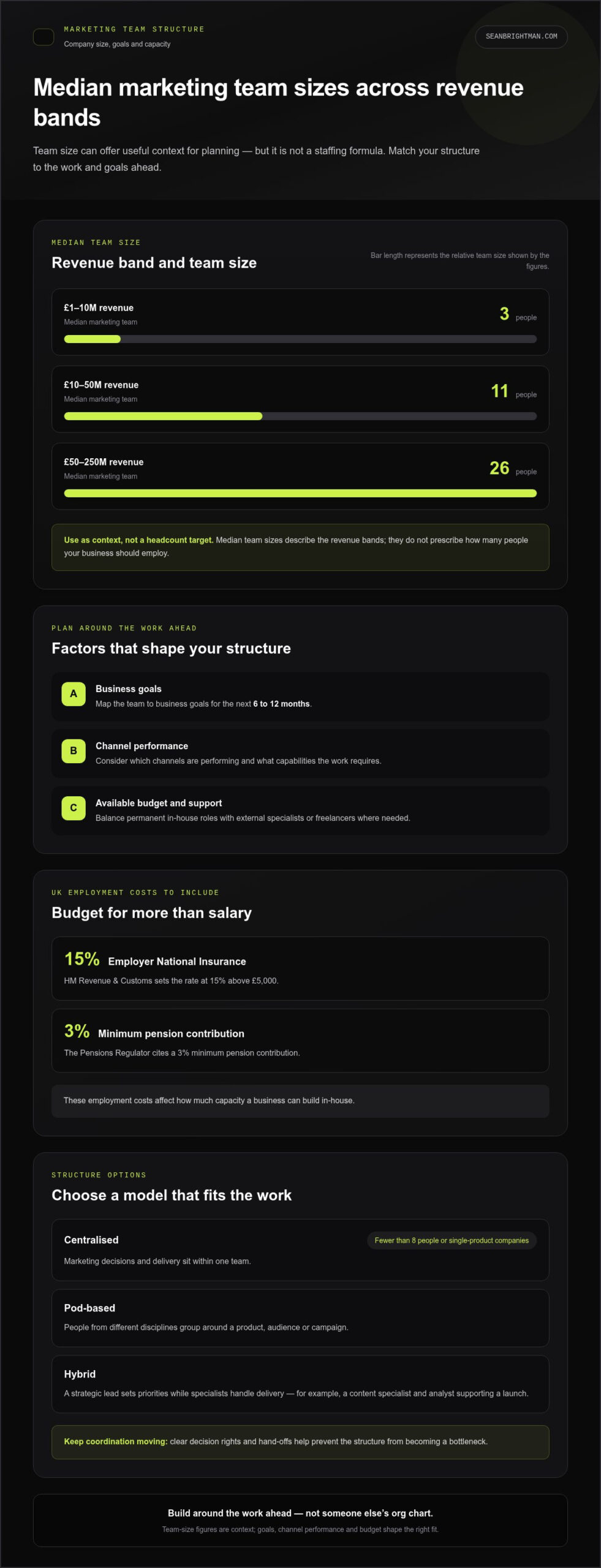
    A centralised structure keeps marketing decisions and delivery within one team. It can suit teams with fewer than 8 people or single-product companies. Pod-based structures group people from different disciplines around a product, audience or campaign. A hybrid model combines a strategic lead with specialists who handle delivery. For example, a lead could set priorities while a content specialist and analyst support a launch. Clear decision rights and hand-offs keep coordination moving instead of creating a bottleneck.

    Structure by company size and goals

    Company size, revenue and goals shape how much specialisation a team can support. Median team sizes are 3, 11 and 26 people for businesses in the £1-10M, £10-50M and £50-250M revenue bands, respectively. Treat these as context, not a staffing formula. Map the structure to business goals for the next 6 to 12 months, channel performance and the budget for permanent or external support. Include employment costs: HM Revenue & Customs sets employer National Insurance at 15% above £5,000, and The Pensions Regulator cites a 3% minimum pension contribution. These costs affect the capacity a business can build in-house.

    Defining marketing roles and responsibilities: what needs to be clear?

    Defining roles in a marketing team starts with separating a job title from the work and decisions attached to it. Connect each role to the functions and business outcomes it supports, so people understand how their contribution fits.

    Roles, responsibilities and functions

    A function is a body of work, a role is who carries it, and responsibilities are the tasks and decisions they own. This distinction helps growing teams collaborate without leaving work stranded between job titles. For example, a content strategist might plan topics while a copywriter drafts them. Record scope, decision rights and hand-offs so colleagues know who can move campaigns forward. Clear definitions make defining roles in a marketing team practical, not a paperwork exercise.

    Core marketing role categories

    Marketing roles bring expertise together across strategy, content, digital delivery and customer growth. A digital marketing manager may oversee SEO, website performance, paid media, email, automation and tracking; content marketers create written and visual material. Social media owners manage platforms and monitor brand reputation. These responsibilities may sit with one generalist or several specialists, depending on capacity.

    SEO, content and social media can sit with dedicated specialists or broader digital and content roles. Assign ownership by task: who plans content, optimises pages and publishes posts? Marketing and sales should agree on lead definitions, handover points and feedback. Marketing typically generates and nurtures leads; sales follows up prospects, with both teams aligning on lead quality and conversion.

    Ownership and leadership responsibilities

    Ownership names the person accountable for an outcome, even when several colleagues contribute. For each campaign, assign a lead, approvers and contributors; clarify who controls the brief, budget decisions, launch and results review. This prevents duplicated work and stalled approvals. Boundaries should enable collaboration, not turn every task into a permission request.

    A head of marketing defines strategy, aligns activity with commercial goals, manages investment and shapes the team. A marketing manager coordinates campaigns around those goals. When priorities or working arrangements change, revisit role scope and decision rights. This keeps accountability connected to current work, not an outdated org chart.
    Defining Roles in a Marketing Team Around Business Needs

    Assessing marketing needs and skills gaps

    Assess capability against the work needed to meet business priorities, not job titles alone. UK qualifications vary by role; evaluate relevant skills through work samples, platform experience and evidence of results.

    AI-related marketing roles and skills

    AI-related marketing roles apply AI tools to research, content, analysis or campaign delivery. As marketing work changes, assess practical ability rather than chasing a fashionable title. An AI-skilled marketer should verify and edit generated outputs, recognise where human oversight matters, and connect tool use to useful outcomes.

    Test those skills with a realistic task: ask a candidate to review an AI-assisted campaign draft, identify unsupported claims and improve its accuracy. Then ask what the tool contributed and where human judgement was needed. Strong answers show how AI supports a business decision, acquisition or paid media activity, rather than automation for its own sake. Build development plans around demonstrated gaps.

    Capability shortages can affect hiring: 82% of marketing and creative managers report challenges finding skilled talent. Separate a genuine skills gap from unclear priorities or limited capacity before deciding to recruit.

    Skills and qualifications for UK marketing roles

    Common marketing roles call for different evidence. A content marketer should show clear writing and audience understanding; an SEO specialist should explain how they improve search visibility. A paid media marketer needs to interpret campaign performance, while a marketing manager should demonstrate planning, coordination and sound decision-making. Relevant qualifications can support a candidate’s case, but assess them alongside practical work and role-specific experience.

    Start with the outcome the role must deliver. For example, if acquisition relies on organic search, assess research, technical understanding and content optimisation. If campaigns depend on paid media, test budget prioritisation and performance analysis. Compare those requirements with the team’s current capabilities, then decide whether to develop existing staff, reshape responsibilities or hire to address a persistent gap.

    • Review recent work samples against the role’s actual responsibilities.
    • Use a practical exercise to test judgement, analysis and communication.
    • Record which skills the team can deliver and where support is needed.

    How marketing roles specialise as businesses grow

    Growth changes the work before it changes the org chart. Small businesses often rely on one or two generalist marketers to cover content, email, social media and website updates. Large organisations can split those responsibilities into specialist positions, adding depth but requiring stronger shared direction.

    The difference is scope: generalists switch between connected tasks, while specialists focus on a narrower discipline or business need. An enterprise may have 20 or more marketing team members in specialised roles. That structure creates expertise, but without shared priorities, separate teams can pull campaigns in different directions.

    Hiring should address the work that is breaking down, not follow a standard ladder of job titles. When activity becomes fragmented, a marketing manager can coordinate campaigns and connect delivery to business goals. If a growing technology stack exceeds three tools, a marketing operations manager can help manage the systems and processes behind delivery.

    As a team expands, the leadership challenge shifts from doing marketing to directing specialists. The transition becomes a critical inflection point when a team has between 8 and 15 marketers. Leaders need to establish priorities, decision rights and hand-offs, so expertise strengthens the whole operation rather than creating isolated functions.

    Product-led SaaS companies may allocate 22-25% of marketing headcount to product marketing specialists. That reflects the need to align product positioning, launches and sales enablement as offerings multiply. It is a context-specific model, not a headcount target for every business.

    For small firms, keep positions broad while demand stays connected; specialise when recurring work needs deeper ownership. For large organisations, preserve a common direction across specialists, products and markets. Plan the next stage of your marketing team around the work growth will create.

    Sean Brightman: AI Consulting

    Sean Brightman’s AI Consulting can help your team assess where AI fits, which skills it needs and where human oversight remains essential. The focus is practical application, not adding tools for their own sake.

    For broader team changes, Roadmapping can connect business priorities with marketing capabilities and the roles needed to deliver them. An Advisory Retainer provides ongoing strategic input as priorities shift and responsibilities evolve.

    Bring a clear challenge: perhaps your team is testing AI, struggling to assign ownership or deciding which capability to develop next. That gives the discussion a useful starting point and keeps the focus on business needs, not job titles alone.

    Contact Sean Brightman to discuss the marketing challenge you’re working through.

    Make your next team decision count

    The real test of defining roles in a marketing team is what changes when ownership becomes clear. Choose one business priority that needs stronger marketing support, then identify the capability, authority and time required to move it forward. This gives your next decision a practical anchor, whether you’re reshaping responsibilities, developing existing talent or setting a new direction.

    If the challenge sits at leadership level, Sean Brightman’s Fractional CMO offering can provide strategic direction. For a team working out how AI fits into its marketing activity, AI Consulting is a relevant next step. Roadmapping can connect business priorities with a clear direction for action. The right focus depends on the challenge you need to solve.

    Contact Sean Brightman to discuss your marketing team and the next decision in front of you. A clearer structure starts with one useful move, and you can build from there.

    Frequently Asked Questions

    Should a growing business hire a marketing generalist or specialists?

    Hire a generalist when the immediate need is broad, connected delivery; add specialists when specific work requires deeper expertise. For example, a generalist may coordinate a campaign across email, website and social content. If search optimisation or analytics repeatedly demands more technical attention, assign dedicated ownership to that discipline. Base the decision on the work accumulating, not on copying another company’s org chart.

    What is the role of a marketing department?

    A marketing department connects the organisation with its audiences and helps communicate what the business stands for. Its work can extend beyond customer-facing campaigns. For example, a team might share company priorities with employees through an internal newsletter or intranet, and prepare executives for media queries. These responsibilities help align public messaging and internal understanding as products and priorities evolve.

    What does a marketing org chart look like at each company size?

    There’s no fixed org chart, but business stage offers a useful starting point. Early-stage companies may have one to three marketers; growth-stage businesses with £10-30M revenue may have 4-8. Mid-market organisations with £30-100M revenue may have 9-20, whilst enterprises at £100M or more may have 20 or more. Treat these as reference points, then organise positions around products, audiences and delivery needs.

    What does a head of marketing do?

    A head of marketing sets the function’s direction and ensures its investment supports commercial priorities. This includes deciding which activities deserve budget, shaping the team as needs change and connecting marketing plans with wider business decisions. Before a new product launch, for instance, the head of marketing can align research, positioning and campaign resources with the launch’s commercial purpose.

    What is the difference between marketing responsibility and accountability?

    Responsibility describes the work someone carries out; accountability identifies who answers for the outcome. For a campaign, a copywriter may be responsible for producing the landing-page text, while the campaign lead is accountable for coordinating the launch and reviewing its results. Several people can contribute, but naming one accountable owner prevents decisions and follow-up from falling between roles.

    When can a generalist own several marketing responsibilities?

    A generalist can own several responsibilities when the work is related, the workload is manageable and specialist depth isn’t essential for every task. For example, one marketer might coordinate email content, website updates and campaign calendars for the same audience. Make the arrangement workable by clarifying priorities and decision authority. Revisit it when deadlines collide or specialist work starts limiting delivery.

  • How to Structure a Modern Marketing Team in 2026

    How to Structure a Modern Marketing Team in 2026

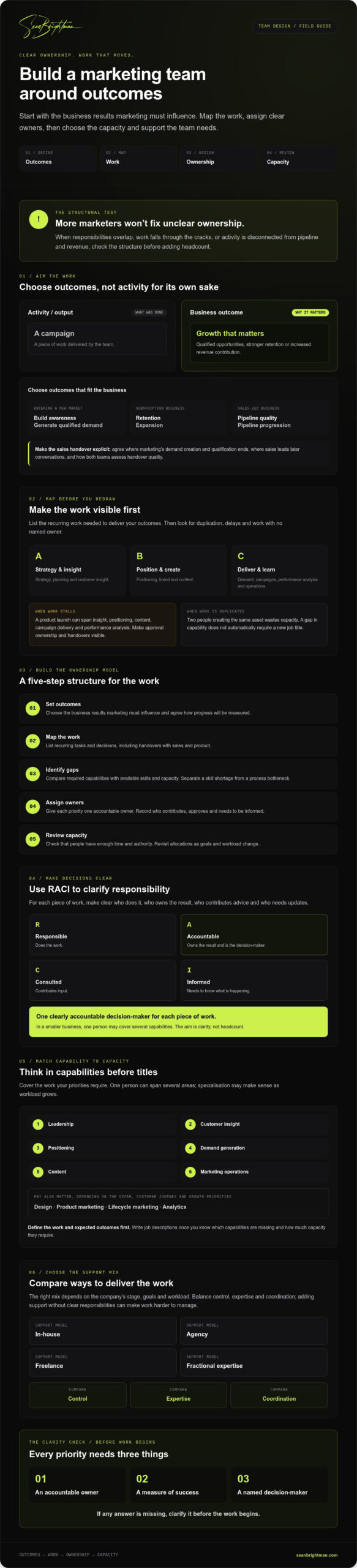
    More marketers won’t fix a team where nobody owns the outcome. When responsibilities overlap, important work falls through the cracks and activity doesn’t connect to pipeline or revenue, the issue may be the structure, not the headcount. Learning how to structure a modern marketing team starts with the work that drives growth, then gives each part a clear owner.

    Marketing needs a mix of skills, but the harder question is whether to hire, outsource or bring in fractional expertise, and how to combine those choices without creating confusion. Adding people without clear responsibilities and decision rights can make work harder to manage, not easier.

    This guide shows how to build a structure that fits your company’s stage, goals and workload. You’ll learn how roles can evolve as the team grows, how to combine employees with specialist partners and senior advisory support, and how to set measures tied to business outcomes. The aim isn’t a complicated org chart. It’s a team with clear accountability and the capacity to deliver.

    Key Takeaways

    • Learn how to structure a modern marketing team by starting with the business outcomes it needs to deliver, not a list of job titles.
    • Map the capabilities and recurring work your goals require, then make ownership and decision rights explicit.
    • Compare in-house, agency, freelance and fractional support to find the right balance of control, expertise and coordination.
    • Check workload and dependencies before changing reporting lines or creating new roles.
    • Review outcomes, campaign learning and capacity regularly to identify what the team needs next.

    How to structure a modern marketing team around business outcomes

    A modern marketing team isn’t defined by its org chart. It’s a group with the capabilities and decision rights to influence the business outcomes that matter. The right structure depends on your goals, customers and workload, not a template copied from another business.

    An org chart shows who reports to whom, but it can’t resolve competing priorities, duplicated tasks or work nobody owns. Marketing management covers strategy, planning and implementation. Team design needs to connect those disciplines to clear priorities and responsibility.

    Start with the outcomes marketing must influence

    Translate company goals into a small set of marketing outcomes. Choose measures that reflect how your business grows, rather than tracking activity for its own sake. A campaign is an output; qualified opportunities, stronger retention or increased revenue contribution are outcomes.

    The emphasis depends on your business. A company entering a new market may need to build awareness and generate qualified demand. A subscription business might focus on retention and expansion, whilst a sales-led business may prioritise pipeline quality and progression. Choose outcomes that fit your model and stage, then agree how marketing and sales will share responsibility. For example, marketing may create and qualify demand while sales leads later conversations. Define the handover and how both teams will assess its quality.

    Use this test for every priority: Does it have an accountable owner, a measure of success and a named decision-maker? If any answer is missing, clarify it before the work begins.

    Map work before drawing reporting lines

    Before deciding who reports to whom, list the work needed to deliver your outcomes. Include recurring activities across strategy, insight, demand, brand, content and operations. Mark what’s duplicated, where work gets stuck and what has no named owner. A gap may call for a new capability, but it doesn’t automatically mean you need a new job title.

    Make handovers visible. A product launch, for example, may involve product insight, positioning, content, campaign delivery and performance analysis. If everyone assumes someone else owns approval, the work stalls. If two people create the same asset, capacity is wasted.

    The RACI concept can clarify responsibilities. Identify who is Responsible for doing the work, who is Accountable for the result, who should be Consulted and who needs to be Informed. Give each piece of work one clearly accountable decision-maker. In a smaller business, one person may cover several capabilities. The goal is clarity, not headcount.

    That’s the practical starting point for how to structure a modern marketing team: define the outcomes, map the work and assign ownership before redrawing the org chart.

    How to design marketing roles, responsibilities and decision rights

    Turn your priorities into a working ownership model. This five-step sequence shows how to structure a modern marketing team without assuming every capability needs its own hire or job title.

    1. Set outcomes. Choose the business results marketing must influence and agree how you’ll measure progress.
    2. Map the work. List the recurring tasks and decisions needed to deliver those results, including handovers with sales and product.
    3. Identify gaps. Compare required capabilities with the skills and capacity available. Separate a genuine skill shortage from a process bottleneck.
    4. Assign owners. Give each priority one accountable owner. Record who contributes, who approves and who needs to be informed.
    5. Review capacity. Check whether people have enough time and authority to meet their responsibilities. Revisit the allocation as goals and workload change.

    Which marketing roles and capabilities should a team cover?

    Think in capabilities before titles. Most teams need some form of leadership, customer insight, positioning, demand generation, content and marketing operations. Design, product marketing, lifecycle marketing or analytics may also be important, depending on the offer, customer journey and growth priorities.

    One person might cover several areas in a smaller business. As workload grows, specialisation may make sense. Define the work and expected outcomes first. Write job descriptions once you know which capabilities are missing and how much capacity they require.

    How should a marketing team assign ownership?

    Separate three responsibilities that are often muddled: strategic ownership sets direction and is accountable for the result; specialist contribution brings the skills needed to deliver; approval authority makes the final call. These may sit with different people, but everyone should know who holds each responsibility.

    For example, a marketing lead could be accountable for a product launch outcome, with specialists contributing positioning and content and a named decision-maker approving claims or investment. Document handovers and dependencies with product and sales. Shared delivery should not mean unclear accountability.

    Set measures that match each person’s remit. Assess a content specialist on whether content reaches the intended audience and supports qualified demand, not simply on the number of pieces published. A marketing operations owner might focus on data quality, useful reporting and reliable handovers. Activity counts can help diagnose workload, but on their own they’re weak measures of impact.

    Clear processes help responsibilities hold up as work scales. Explore marketing operations and scalable growth systems for more on building the supporting structure. If priorities or accountability remain unclear, Fractional CMO leadership can provide senior direction without a full-time appointment.

    In-house, agency or fractional support: compare marketing team models

    There’s no prize for building the biggest team. Choose a resourcing model that matches the work: how often it’s needed, the expertise it requires and how closely it must connect to your customers and product. A smaller team can cover more ground when priorities are clear and external support is chosen selectively.

    Model Control Continuity Specialist depth Coordination load Best suited to
    In-house hire High High Depends on the hire Internal management and onboarding Steady work needing product or customer context
    Agency Shared Set by the engagement Can span several specialisms Briefing, feedback and approvals Defined delivery needs or capacity gaps
    Freelancer Shared Varies by arrangement Focused expertise Scoping and coordination Specific tasks or short-term specialist input
    Fractional senior leadership Strategic direction with internal delivery Ongoing or agreed support Senior marketing perspective Works best with a clear internal point of contact Setting priorities and accountability without a full-time CMO

    When does in-house marketing capacity make sense?

    Bring work in-house when it’s steady, central to growth and relies on close knowledge of your product, customers or internal teams. Before creating a permanent role, check whether the workload is likely to remain consistent and who will manage, onboard and support the person. A specialist can add capability, but the role needs a clear remit and enough work to justify it.

    When should a business use agency or fractional support?

    Agency support can suit a defined specialist delivery need or a temporary capacity gap. Freelancers can add focused expertise without creating a permanent role. Fractional leadership is different: it provides senior direction when the business needs sharper priorities and accountability, but not a full-time CMO. It doesn’t replace the people responsible for day-to-day delivery.

    Mixed models work best when one internal owner joins the pieces together. Without that person, briefs, approvals and handovers can create more coordination work than the external support removes. Before work begins, agree the scope, decision rights, dependencies and measures of success.

    If the gap is senior direction rather than hands-on capacity, consider fractional CMO leadership without a full-time role. The right answer to how to structure a modern marketing team isn’t choosing one model for everything. It’s keeping ownership inside the business and matching specialist support to the work that needs it.

    How to Structure a Modern Marketing Team in 2026

    How to build a marketing team structure step by step

    Don’t start with new job titles or reporting lines. First check what the business needs, what work already happens and where it gets stuck. This sequence turns those findings into a structure you can test, rather than a permanent reorganisation based on assumptions.

    1. Start with business goals. Choose the outcomes marketing must support and identify the work needed to influence them.
    2. Audit capabilities and capacity. Compare that work with current skills, available time and competing priorities.
    3. Map ownership. Name an accountable owner for each priority, then document contributors, decision-makers and dependencies.
    4. Choose how to resource gaps. Decide whether to build internal capability, adjust existing responsibilities or use specialist external support.
    5. Pilot and review. Test the proposed responsibilities against agreed measures before making lasting changes to roles or reporting lines.

    How can you identify capability gaps before hiring?

    Not every gap calls for a new hire. Separate three problems: a skills gap means the team lacks a capability; a capacity gap means the skill exists but there isn’t enough time; a decision-making problem means work is stalled by unclear authority or approvals. Each requires a different response.

    Rank gaps by business impact, urgency and the cost of leaving them unresolved. A simple capability matrix can make the trade-offs visible:

    • Capability: Customer insight. Current coverage: occasional input. Gap: no regular customer research. Urgency: medium. Proposed owner: assign an existing lead, then review capacity.
    • Capability: Marketing operations. Current coverage: reporting assembled manually. Gap: process and ownership are unclear. Urgency: high if it delays decisions. Proposed owner: name a process lead before adding resource.

    Use these examples as prompts, not assumptions. Fill the matrix with your own evidence: workload, skills, bottlenecks and links to priority outcomes. Check dependencies too. A new role won’t solve a delay caused by missing product input or slow approvals.

    How should you phase changes and measure progress?

    Before changing responsibilities, record a baseline: which priorities have owners, where handovers break down and how current work performs against its intended outcomes. Set a review date once the new arrangement has had enough time to operate. Check results, workload and decision delays, not just completed tasks.

    If ownership is clearer but outcomes haven’t shifted, investigate the work, dependencies and measures before adding another role. A pilot lets you adjust the structure while the change is still manageable. For help turning priorities into a practical sequence, read building a marketing strategy roadmap that works.

    Need a structured way to assess priorities and capability gaps? Explore strategic roadmapping support before committing to a new team design.

    How to lead a modern marketing team as it grows

    As the team changes, the leader’s job shifts from personally pushing every task forward to keeping the system clear. Strategy, priorities and decision rights must remain visible, especially when employees and external specialists share the work. That’s how you stop new capacity creating new confusion.

    Knowing how to structure a modern marketing team is only part of the work. The structure also needs a management rhythm that checks whether priorities still fit the business, responsibilities remain clear and the team has capacity to deliver.

    What management rhythm keeps the team aligned?

    Use planning sessions to choose priorities for the next working period and state what the team will not do. That trade-off protects focus. Then review progress against business outcomes, what campaigns have taught you, where work is blocked and whether workload is manageable.

    Involve sales, product or senior leadership when their decisions or customer insight affect delivery. Keep a simple decision log with the decision, who made it and what happens next. This helps prevent teams reopening settled questions or guessing who has approval.

    Review four things together:

    • Outcomes: Are marketing priorities influencing the results they were designed to support?
    • Learning: What did campaign and customer evidence reveal, and what should change?
    • Capacity: Is priority work progressing, or are people overloaded or waiting on others?
    • Capability: Has a new gap emerged, or would clearer ownership solve the problem?

    Where does AI fit as the team grows?

    AI may help with repeatable tasks such as organising information, supporting analysis or speeding up early content drafts. Treat it as a capability within a managed workflow, not a replacement for strategy or accountability. Assign someone to check accuracy, context, brand fit and approval before AI-assisted work reaches customers or informs a decision. For practical guidance, explore practical AI consulting for scalable marketing growth.

    When can fractional leadership support the team?

    If the team can deliver but lacks senior direction, a fractional CMO or adviser can help set priorities, clarify accountability and maintain focus without a full-time CMO. This support guides the operating model; it doesn’t replace every specialist or remove the need for internal owners.

    Need to connect team responsibilities with business priorities? Discuss a practical team and marketing roadmap to define what the structure needs to deliver next.

    Build a team that can grow with the business

    The strongest marketing structure isn’t the most elaborate. It connects business goals to clear ownership, gives people decision-making authority and matches in-house capacity with the specialist support the work requires. That’s the practical answer to how to structure a modern marketing team.

    Start with outcomes, map the capabilities and workload needed to influence them, then review whether the structure is working. Keep priorities visible as the team grows, and adjust roles when evidence shows a genuine gap, not just because the org chart looks untidy.

    If senior direction is the missing piece, fractional CMO and advisory support can provide strategic guidance on a part-time basis. Roadmapping can help turn business goals into a structured marketing and brand direction, with clearer priorities and next steps.

    Talk through your marketing team structure and next steps. A clear plan can help your team focus its effort, own the work and build momentum with confidence.

    Frequently Asked Questions

    How do you structure a modern marketing team?

    Structure it around the business outcomes marketing needs to influence, then assign clear owners to the work and decisions required. To decide how to structure a modern marketing team, map the necessary capabilities, check current skills and capacity, and identify gaps before creating roles. Give each priority an accountable owner, a measure of success and a named decision-maker. Review the arrangement as business goals and workload change.

    What roles should a modern marketing team include?

    Cover the capabilities your priorities require, which may include marketing leadership, customer insight, positioning, demand generation, content and marketing operations. Add design, product marketing, lifecycle marketing or analytics when the business needs them. These are capability areas, not a mandatory list of job titles. In a smaller team, one person may cover several. Define the responsibilities and expected outcomes first, then decide whether they need dedicated roles.

    How should a small business structure its marketing team?

    A small business should keep the structure lean: name an owner for each priority, make responsibilities explicit and avoid creating roles before confirming the work and capacity required. One marketer may cover several capabilities, while specialist or senior external support can fill specific gaps. Keep decision-making simple. For each priority, clarify who leads, who contributes and who approves, then review whether the arrangement is delivering against business goals.

    Should marketing teams be organised by channel or by function?

    Neither model fits every business. Organising by function, such as content or demand generation, can build specialist expertise. Organising around outcomes or customer journeys can help teams connect work across channels. Avoid creating channel silos where each team optimises its own activity without shared goals. Start with the outcomes and recurring work, then choose the arrangement that gives each priority clear ownership and makes cross-team decisions straightforward.

    When should a business hire in-house rather than use an agency?

    Consider an in-house hire when the work is ongoing, the capability is consistently needed and close product or customer knowledge matters. Check that there’s enough sustained workload, as well as management and onboarding capacity to support the role. An agency may suit a defined specialist requirement or a delivery gap. Compare the options by control, continuity, expertise and coordination effort, then set scope and measures before work begins.

    Can a fractional CMO lead an existing marketing team?

    Yes. A fractional CMO can provide senior marketing leadership on a part-time basis, helping an existing team clarify priorities, direction and accountability. This is strategic leadership, not a replacement for every specialist or a promise to take over all delivery. Agree decision rights with the business and team, including who owns execution and approvals. It can suit a company that needs senior direction but not a full-time CMO.

    How should AI change the structure of a marketing team?

    AI should influence how work gets done, not remove the need for clear roles or accountable decisions. Identify suitable workflows, such as organising information or supporting early analysis, then name who checks the output for accuracy, relevance and brand fit. Assign responsibility for approving work before it informs decisions or reaches customers. Build practical AI capability into existing roles or add specialist support where needed, without treating tools as a substitute for strategy.