
Tag: marketing spend

  • Reducing Marketing Budget Waste: Find the Leaks Before You Cut

    Reducing Marketing Budget Waste: Find the Leaks Before You Cut

    Cutting the marketing budget can make the spreadsheet look healthier whilst quietly weakening growth. If you’re reducing marketing budget waste, start by finding where spend loses momentum, not by slashing activity that may be working.

    The frustration is familiar: marketing uses budget, but its contribution to revenue is hard to pin down. Teams, agencies, channels and tools each tell a different success story. Under pressure, it’s tempting to cut what’s difficult to measure, even when it supports the business.

    This article shows you how to separate avoidable waste from useful investment, then decide what to fix first. You’ll learn to examine measurement gaps, targeting, messaging, tools and budget ownership using evidence and commercial context rather than guesswork.

    The goal isn’t a smaller budget for its own sake. It’s a clearer decision system: one that links marketing choices to business priorities, turns findings into a prioritised plan and builds regular accountability. That way, each review improves the next decision instead of resetting the conversation every quarter.

    Key Takeaways

    • Spot leaks across measurement, channel choices, tools and hand-offs, not just visible campaign spend.
    • For reducing marketing budget waste, assess performance against commercial outcomes rather than relying on a single metric.
    • Reconcile spend and reporting over a period that fits your sales cycle before acting on apparent underperformance.
    • Prioritise changes by evidence, likely impact, reversibility and how quickly you can learn from them.
    • Keep a decision log with owners, assumptions and review points so each budget decision informs the next.

    Reducing marketing budget waste starts with finding the real leak

    Pressure to cut spend often arrives before anyone can explain what the budget is doing. An across-the-board reduction may look decisive, but it can remove effective investment alongside genuine inefficiency. Disciplined optimisation starts by tracing the leak and fixing its cause. It doesn’t treat every unclear result as proof that activity should stop.

    Marketing budget waste is spend disconnected from a clear objective, useful learning or a credible contribution to commercial goals. That definition matters because weak measurement creates uncertainty, not a verdict. If a campaign’s results aren’t tracked properly, the first problem may be the measurement setup, not the campaign itself. Understanding marketing effectiveness means judging activity against its purpose and role in the wider marketing effort, not just its easiest-to-count output.

    What counts as marketing budget waste?

    Look for avoidable spend in the machinery around marketing as well as in channels. A team might pay for a tool no one uses, commission separate teams to produce near-identical assets, or run campaigns without agreeing who owns the outcome. These are different problems: process waste, channel underperformance and weak strategic fit each call for a different fix.

    A low short-term return isn’t automatically waste. A test that rules out a weak message can provide useful learning; brand activity may also support a customer journey that takes longer to convert. Ask whether there was a clear reason to spend, a way to learn and a sensible link to business priorities.

    Why cutting the budget is not the same as reducing waste

    Equal percentage cuts ignore differences in purpose and performance. They can shrink a proven source of demand just as readily as they remove duplicated work. Cheap leads can also distract from lead quality, whilst activity metrics such as clicks say little on their own about commercial contribution.

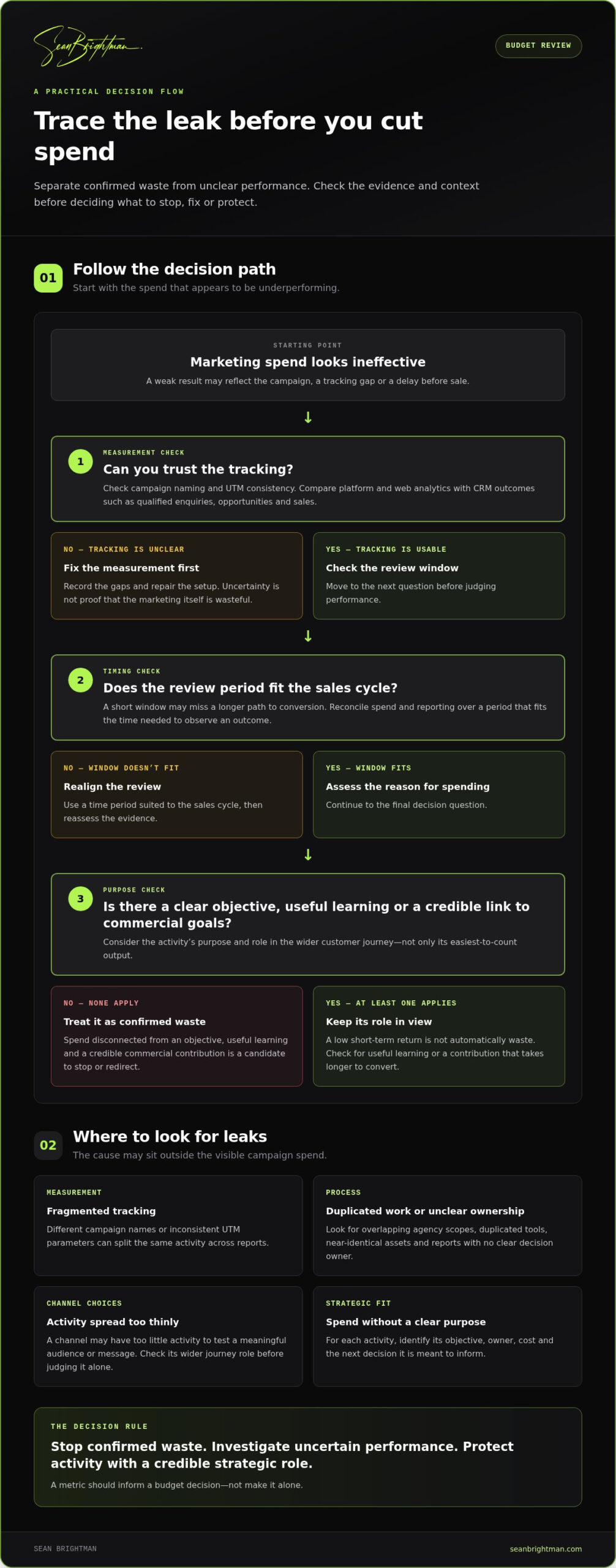
    Judge investment against the business goal, the customer journey and the time needed to observe an outcome. A short reporting window may miss a longer sales cycle; a longer one may hide a problem that needs attention now. Make the distinction clear: stop confirmed waste, investigate uncertain performance, and protect activity with a credible strategic role. That’s the starting point for reducing marketing budget waste without cutting growth potential by guesswork.

    Where marketing budgets leak: measurement, hand-offs, and misplaced activity

    Budget leaks rarely sit in one neat line on a report. They build where strategy, channel choices, measurement and delivery fail to connect. A campaign may have a clear objective, but if its results don’t reach the team planning the next activity, the learning gets lost. One team may pay for a tool whilst another buys a similar platform. An agency and an internal team may both produce reports without anyone owning the decision those reports are meant to inform.

    Fragmented tracking makes budget comparisons less reliable because teams may be measuring different activity, outcomes and time periods. That uncertainty is a measurement problem to investigate, not automatic proof that the marketing itself is wasteful.

    How weak measurement hides useful signals

    Attribution is an imperfect view of contribution, not a complete account of cause and effect. A platform may claim credit for a conversion that involved several other interactions, whilst a channel that helped build awareness may receive no direct credit at all. Use measurement to guide investigation, not to declare a winner from one dashboard. Harvard Business School Online’s guidance on how to measure marketing effectiveness offers a broader perspective than relying on a single metric.

    Start by checking the tracking basics. If one team names a campaign “spring_launch” and another uses “Spring-Launch”, or UTM parameters vary between links, reports can split the same activity into separate entries. Compare platform and web analytics with CRM outcomes: qualified enquiries, opportunities and sales can show whether apparent performance translates into business value. Record gaps rather than filling them with assumptions.

    How process and channel choices create avoidable spend

    Next, trace the work between planning and reporting. Look for overlapping agency scopes, duplicated tools, unclear briefs and manual reports that teams rebuild separately. For each activity, identify its objective, owner, cost and next decision. If nobody can explain what a task supports or who acts on its result, that’s a process leak worth investigating.

    Channel sprawl creates another trap. Spreading a budget thinly across multiple channels can leave each with too little activity to test a meaningful audience or message. But consolidation should follow evidence and strategic fit, not convenience. A channel with limited immediate conversions may still play a useful role in the customer journey; check how it supports other activity before judging it in isolation.

    For a deeper look at how joined-up processes support growth, explore marketing operations for a scalable growth engine. A focused marketing roadmapping discussion can also help turn these findings into clear priorities for reducing marketing budget waste.

    How to diagnose wasted marketing spend without trusting one metric

    Move from suspicion to evidence with a repeatable review. A metric should inform a budget decision, not make it alone. A low conversion figure might signal a weak campaign, a tracking gap or a delay between first contact and sale. Separate those possibilities before changing investment.

    Build a useful view of spend and outcomes

    Choose one reporting period that reflects your sales cycle, then use it consistently across the review. Group investment by objective, audience, channel, campaign and internal or external owner. Reconcile planned budget with actual spend, then compare platform and web analytics with CRM outcomes where available. Select the business outcome that fits the objective, such as qualified pipeline, revenue, retention or another meaningful measure.

    Flag missing tracking, inconsistent campaign names, differing attribution windows and gaps between platforms and CRM. Don’t hide incomplete evidence inside a single performance score.

    Use five steps to diagnose the leak

    • Set the outcome: State what the activity was meant to achieve and how that connects to a business priority.
    • Reconcile spend: Check planned allocation against actual spend across teams, channels and suppliers.
    • Compare evidence: Review the chosen outcome alongside relevant platform, website and CRM signals.
    • Investigate variance: Trace unexpected results to possible causes, such as a tracking change, audience shift, delivery issue or a genuine performance decline.
    • Record confidence: Note what the evidence supports, what remains uncertain and what check or test could improve the picture.

    Warning sign | Evidence to investigate | Possible explanation

    Spend rises, but qualified pipeline doesn’t | CRM stages, lead quality and campaign changes | Lower-quality demand, a longer conversion path or a tracking gap

    Two reports show different results | Reporting period, attribution window and campaign definitions | Different measurement rules, not necessarily different performance

    Activity is hard to connect to an objective | Brief, owner and intended audience | Unclear strategy or work that has lost its purpose

    Look for repeated patterns across comparable activity, not a verdict from one campaign or reporting period. Check results against the intended customer journey and the time it takes for outcomes to appear. A short-term dip may matter, but it needs context before it triggers a cut.

    This method makes reducing marketing budget waste more rigorous: it distinguishes a confirmed problem from an incomplete signal and points to the next decision rather than pretending every answer is already in the data.
    Reducing Marketing Budget Waste: Find the Leaks Before You Cut

    What to fix first: prioritise marketing budget changes by evidence

    Start with changes where the waste is visible and the downside is limited. Duplicate subscriptions, overlapping work or activity with no accountable owner are stronger clean-up candidates than a campaign that simply lacks reliable measurement. Don’t cut a channel by default. First weigh the evidence, likely business impact, reversibility and time needed to learn.

    Decision type | Evidence strength | Likely impact | Reversibility | Time to learn

    Immediate clean-up: duplicated tool or repeated task | Clear and verifiable | Usually contained | High | Short

    Test: campaign with mixed results | Partial or inconsistent | Could affect demand | Often high | Depends on the sales cycle

    Tracking fix: activity with incomplete attribution | Insufficient to judge | Unclear until measured | High | Depends on data availability

    Strategic review: investment affecting key audiences or positioning | Requires broader context | Potentially substantial | Lower | Longer-term

    Which budget leaks should you address first?

    Remove confirmed duplication and resolve ownership gaps first. Treat weakly measured activity as an investigation or test candidate, not an automatic cancellation. Escalate choices that could reshape how you reach key audiences, express your positioning or support longer-term growth. The harder a change is to reverse, the stronger the evidence and business case should be.

    How to test a change without damaging growth

    Change one meaningful variable where practical, such as the audience or message, and write down what evidence would change your decision. Set a review point that fits the sales cycle and gives the relevant data time to emerge. If several elements change at once, you may not know what caused the result.

    Example: A team finds two subscriptions that appear to serve the same purpose, whilst one campaign has weak lead tracking but supports an important audience. It can verify and remove the duplicate, then improve tracking and test the campaign before deciding whether to reduce its allocation. The example is illustrative, not a client result.

    If the evidence points beyond channel adjustments to priorities around positioning or growth, use strategic brand roadmapping to shape the next decisions. For senior-level direction on turning findings into a prioritised plan, explore strategic marketing guidance. That’s how reducing marketing budget waste becomes a controlled decision, not a blunt cut.

    Make marketing budget control an ongoing leadership system

    A one-off budget review finds leaks. A leadership system helps stop them returning. Tie each marketing investment to a business outcome, a clear owner and an assumption that can be revisited. Then review what changed, what the evidence says and what decision comes next. This keeps the budget connected to commercial priorities, not just last quarter’s activity.

    Set a budget review cadence that drives decisions

    Set review points around business planning and the sales cycle, not an arbitrary reporting ritual. At each review, look at business outcomes, committed spend, key assumptions and any changes in customer behaviour, team capacity or commercial priorities. If an assumption no longer holds, update the plan rather than allowing old allocations to roll forward by default.

    Keep a decision log that makes accountability visible. Record what changed, why it changed, the expected effect, the person responsible and when the decision will be reviewed. That record helps the team distinguish a deliberate test from unplanned drift in spend.

    Make sure the parts of the system reinforce one another. Positioning shapes which audiences matter; channel choices determine how you reach them; measurement shows what the activity contributes; and operating capacity determines what the team can deliver well. A mismatch between any of these can undermine the rest.

    When strategic marketing support can help

    If priorities keep fragmenting, ownership remains unclear or measurement problems recur, the issue may need senior strategic direction rather than another reporting template. Fractional CMO leadership and ongoing advisory support can connect budget choices to positioning and business goals, and bring accountability to regular reviews. This is strategic oversight, not advertising execution.

    Sean Brightman’s advisory retainer provides ongoing strategic direction and accountability. For senior marketing leadership on a part-time basis, explore Fractional CMO support.

    Start with one action: map current spend against its objective, then identify the biggest evidence gap. Assign someone to close it and bring the finding into your next review. That’s how reducing marketing budget waste becomes an ongoing discipline, not another round of reactive cuts.

    Make your next marketing budget decision count

    Reducing marketing budget waste isn’t about cutting spend evenly. It’s about finding where investment loses momentum, separating confirmed waste from uncertain performance, and choosing changes that fit your business goals.

    Use consistent evidence to guide decisions, not a single metric. Give each investment a clear objective and owner, then record what changes and when you’ll review it. That turns budget control into an ongoing leadership system, not another reactive round of cuts.

    When priorities or accountability are unclear, Fractional CMO leadership brings part-time senior marketing direction. Roadmapping creates structured marketing and brand direction, whilst an advisory retainer supports ongoing strategic oversight and accountability.

    Build a sharper marketing decision system with Sean Brightman. Start with the evidence, make the next decision with confidence, and protect the investment that can support growth.

    Frequently Asked Questions

    What does reducing marketing budget waste actually mean?

    Reducing marketing budget waste means removing or redesigning spend without a clear purpose, accountable owner, useful evidence or credible connection to business outcomes. It doesn’t mean cutting every activity with weak short-term attribution. Some investment supports learning, awareness or longer buying journeys. First diagnose why performance appears weak. Then decide whether to stop, fix, measure or test the activity, based on its intended role and the evidence available.

    How can I tell whether marketing spend is being wasted?

    Map spend to its objectives, owners, campaign activity and relevant outcomes. Check that reporting uses consistent definitions, then compare platform results with CRM or sales information where available. Look for repeated signs such as duplicated work, unused tools or activity without a defined purpose. If tracking is missing or unreliable, treat that as an evidence gap to investigate. Weak measurement alone doesn’t prove that the activity is wasteful.

    Should I cut marketing spend if I cannot measure its return?

    No, not automatically. Start by clarifying the outcome the activity was meant to support and checking whether your tracking captures it. Consider the customer journey, sales cycle and missing data before deciding. If the evidence remains weak, improve measurement or run a bounded test with a clear review point. Preserve investment that has a credible strategic role, and decide in advance what evidence would justify changing it.

    How much marketing budget should a business allocate to each channel?

    There’s no universal channel split that suits every business. Allocation depends on commercial goals, audience behaviour, sales-cycle length, existing evidence and your capacity to execute well. Define the outcome each channel should support, then compare its contribution and the uncertainty around that evidence. Keep room to test and learn. Review the allocation when results, customer behaviour or business priorities change, rather than copying another organisation’s budget mix.

    Which marketing metrics should I use to find wasted spend?

    Choose measures that match the activity’s objective and connect, where possible, to commercial outcomes. Depending on the goal, these could include qualified pipeline, revenue, customer acquisition, retention or meaningful engagement. Use platform metrics as diagnostic signals, not final proof of business impact. Before comparing campaigns or channels, check that definitions, attribution windows and tracking are consistent, and compare platform data with CRM outcomes where available.

    Can AI help reduce marketing budget waste?

    AI can help organise data, surface patterns and speed up analysis when the inputs and definitions are reliable. It can’t resolve unclear objectives, inconsistent tracking or poor judgement by itself. Use it to support investigation, not to make unreviewed budget decisions. Keep a named person accountable for validating the evidence, weighing commercial context and deciding what to change. The quality of the decision still depends on the quality of the information and oversight.

    How often should a business review its marketing budget?

    Set review frequency to fit your sales cycle, business planning rhythm and pace of change. Use regular checkpoints to compare actual spend with objectives and outcomes, then schedule a deeper review when assumptions shift or evidence raises a concern. Don’t change investment so frequently that activity has no time to produce useful learning. Record each decision, its rationale and a proportionate review date so you can assess the effect.

  • Justifying Marketing Spend to Investors: The Scale-up Strategy for 2026

    Justifying Marketing Spend to Investors: The Scale-up Strategy for 2026

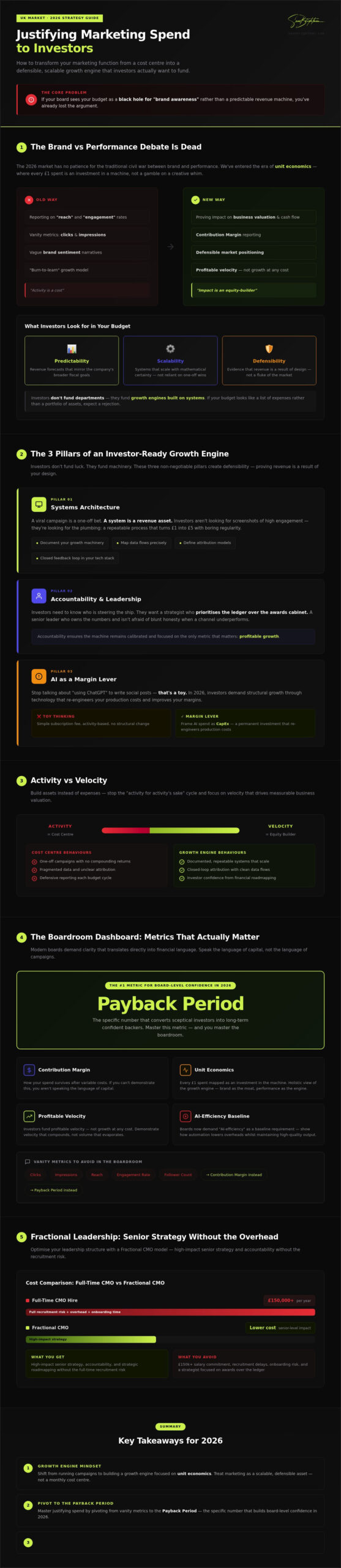
    Investors don’t hate marketing; they hate gambling with their capital. If your board sees your budget as a black hole for “brand awareness” rather than a predictable revenue machine, you’ve already lost the argument. In the current UK market, justifying marketing spend to investors requires more than just a deck of vanity metrics and fragmented data. You’re likely facing intense pressure to integrate AI whilst struggling to prove the ROI of your existing channels. It’s a frustrating cycle of defensive reporting that does nothing to secure your next round of funding.

    It’s time to stop defending a cost centre and start building a growth engine. This guide will show you how to transform your marketing function into a defensible, scalable system that investors actually want to fund. We’ll move past the “brand vs performance” binary and focus on mechanical precision. You’ll learn how to align your 2026 strategy with board-level expectations, implement AI with tactical purpose, and create a roadmap that turns investor scepticism into long-term confidence. This is about building a system, not just running a campaign.

    Key Takeaways

    • Shift your perspective from running campaigns to building a growth engine focused on unit economics. Learn to treat marketing as a scalable, defensible asset rather than a monthly cost centre.
    • Master the art of justifying marketing spend to investors by pivoting from vanity metrics to the “Payback Period”. This is the specific number that builds board-level confidence in 2026.
    • Stop the “activity for activity’s sake” cycle and focus on velocity. Build systems architecture that integrates AI with tactical precision to drive measurable business valuation.
    • Optimise your leadership structure by utilising a Fractional CMO and strategic roadmapping. This model delivers high-impact senior strategy and accountability without the recruitment risk of a £150k+ full-time hire.

    Why the Brand vs Performance Debate is Dead in 2026

    The 2026 market has no patience for the traditional civil war between brand and performance. Investors have stopped listening to pleas for “brand awareness” that can’t be mapped to a ledger. We’ve entered the era of unit economics. Justifying marketing spend to investors now requires a holistic view of the growth engine; where every £1 spent is an investment in a machine, not a gamble on a creative whim.

    This isn’t about choosing between long-term reputation and short-term clicks. It’s about defensible market positioning versus vague sentiment. Investors today fund profitable velocity, not growth at any cost. They want to see a system that scales with mathematical certainty, where the brand acts as the moat and performance acts as the engine.

    The Death of Vanity Metrics

    Clicks are cheap. Impressions are noise. In a high-stakes boardroom, these numbers are met with scepticism. Modern boards demand a clear view of marketing effectiveness that translates directly into Contribution Margin. If you can’t demonstrate how your spend survives after variable costs, you aren’t speaking the language of capital.

    • Old Way: Reporting on “reach” and “engagement” rates.
    • New Way: Proving the impact on business valuation and cash flow.

    Activity is a cost; impact is an equity-builder.

    Investor Expectations in the 2026 Market

    The economic shift of the last few years killed the “burn-to-learn” model for UK scale-ups. Boards now demand “AI-efficiency” as a baseline requirement. They want to see how you’re using automation to lower overheads whilst maintaining high-quality output. Your marketing strategy cannot be a collection of tactics. It must be a financial roadmap that mirrors the company’s broader fiscal goals.

    Investors look for three things in your budget: predictability, scalability, and defensibility. They don’t fund departments; they fund growth engines built on systems. If your budget looks like a list of expenses rather than a portfolio of assets, expect a rejection. You need a strategy that treats every marketing activity as a functional component of a larger revenue-generating machine.

    The 3 Pillars of an Investor-Ready Growth Engine

    Investors don’t fund luck. They fund machinery. If you want to secure your budget for 2026, you must stop presenting “ideas” and start presenting a growth engine. This engine relies on three non-negotiable pillars: Systems Architecture, Accountability, and AI Integration. Together, these pillars create defensibility. They prove that your revenue isn’t a fluke of the market, but a result of your design. Justifying marketing spend to investors becomes a clinical, mathematical exercise once these pillars are in place.

    Systems over Campaigns

    A viral campaign is a one-off bet. A system is a revenue asset. When investors conduct due diligence, they aren’t looking for screenshots of high engagement; they’re looking for the plumbing. They want to see a repeatable process that turns £1 into £5 with boring regularity. This is where a marketing operations consultant becomes an essential hire for a scale-up.

    Building this engine requires you to document your growth machinery. You need to map your data flows and define your attribution models with surgical precision. Show the board how your tech stack integrates to create a closed loop of feedback and execution. This documentation isn’t just “admin”; it’s evidence of a scalable business model. It’s the difference between a department that asks for money and a department that generates value.

    Accountability & Leadership: The second pillar is the human element. Investors need to know who is steering the ship. They want a strategist who prioritises the ledger over the awards cabinet. Accountability means having a senior leader who owns the numbers and isn’t afraid of blunt honesty when a channel underperforms. This leadership ensures the machine remains calibrated and focused on the only metric that matters: profitable growth.

    AI as a Margin Lever, Not a Toy

    Stop talking about “using ChatGPT” to write social posts. That’s a toy. In 2026, investors demand structural growth through technology. They want to see AI consulting that re-engineers your production costs and improves your margins.

    Frame your AI spend as a capital expenditure (CapEx) rather than a simple subscription fee. You’re investing in a permanent efficiency gain that reduces the cost of customer acquisition whilst increasing the quality of your output. When you demonstrate how AI lowers your overheads, justifying marketing spend to investors shifts from a request for cash to a proposal for margin expansion. If you need to define your technological path, a strategic roadmapping session can clarify exactly where AI will deliver the highest ROI.

    Activity vs Velocity: Building Assets Instead of Expenses

    Investors don’t fund busywork. They fund velocity. Activity is just noise; velocity is movement with direction. If your marketing budget looks like a list of monthly bills, you’re failing the boardroom test. You need to shift the conversation from “what we’re doing” to “what we’re building”. Justifying marketing spend to investors becomes effortless when you prove that your budget is creating a permanent increase in Enterprise Value.

    This requires a binary shift in how you define value. It’s about building assets, not just paying for exposure. Consider these contrasts:

    • Strategic clarity, not tactical noise.
    • Revenue machinery, not simple lead generation.
    • Repeatable assets, not disposable campaigns.

    A well-positioned brand isn’t just a logo. It’s a competitive moat. It lowers your future CAC and increases your customer lifetime value. It makes the business easier to scale and, eventually, easier to sell. This is the core of a marketing strategy for business exit. You’re building a growth engine that buyers covet, not a PPC account they have to fix.

    The Exit-Ready Marketing Audit

    Late-stage investors and buyers look for “clean” growth. They want to see that your revenue isn’t dependent on a single person or a lucky algorithm change. A messy marketing department suggests risk. Risk leads to a “haircut” on your valuation. To avoid this, you need a strategic brand roadmapping process. This creates a documented, defensible path that proves your marketing is a calculated engine of growth. It shows the board you know exactly where your next £1m is coming from.

    Defensibility and Competitive Moats

    Anyone can outbid you on Google Ads. That isn’t a moat; it’s a bidding war. A true moat is your positioning. It’s the psychological space you own in the market that competitors cannot simply buy their way into. Strategic clarity creates a defensible position that protects your margins even when the market gets crowded.

    When justifying marketing spend to investors, highlight how your spend builds this long-term ROI. You’re moving away from tactical noise and towards a structural advantage. Strategic positioning is the ultimate asset. It ensures that your marketing spend isn’t just “maintenance” but is actively building a business that is harder to compete with and more valuable to own.

    Justifying Marketing Spend to Investors: The Scale-up Strategy for 2026

    The Boardroom Dashboard: Metrics That Actually Matter

    Investors don’t care about your LTV/CAC ratio if the LTV is based on a three-year projection that might never happen. In 2026, cash is king. Justifying marketing spend to investors requires you to lead with the “Payback Period”. This is the time it takes to recoup the acquisition cost in cold, hard cash. If your payback period is under six months, you have a growth engine. If it’s over eighteen, you have a liability. You aren’t just justifying marketing spend to investors; you’re proving the fiscal health of the entire operation.

    Stop hiding behind blended CAC. Investors want to see the granularity of your acquisition costs by channel. A low blended CAC often masks a failing paid search account propped up by organic referrals. Be blunt about what’s working and what isn’t. Presenting these numbers with honesty builds more board-level confidence than a polished deck of averages.

    CFOs don’t buy “brand feel”. They buy “price elasticity” and “direct traffic”. To present brand equity effectively, show the board how your brand strength allows you to maintain higher prices than the competition. Demonstrate how your direct-to-site traffic reduces your reliance on expensive paid channels. This isn’t about being liked; it’s about being efficient.

    The Truth About Attribution

    Last-click attribution is a convenient lie. It credits the shop door for the sale while ignoring the billboard that brought the customer to the street. Move towards incrementality testing to prove spend effectiveness. Prove what happens to revenue when you turn a channel off. Use a balanced scorecard of leading indicators like pipeline velocity and lagging indicators like closed revenue to provide a complete picture.

    Predictive Growth Modelling

    Investors want a financial roadmap. You must present a model that says: “If we spend £X, we get £Y.” Maintaining this predictability requires senior oversight. A marketing advisory retainer keeps the engine calibrated. When an experiment fails, don’t bury it. Present it as a “cost of learning” that narrows your focus on what scales. Investors trust leaders who own their data.

    If you’re ready to build a dashboard that actually secures your budget, book a strategic briefing here.

    Fractional Leadership: Securing Spend Without the Overhead

    Hiring a full-time CMO for a UK scale-up is often a premature move that burns through runway. A senior leader with a £150k+ base salary, plus National Insurance and benefits, creates a heavy fixed cost before your growth engine is even built. Investors see this as a high-risk gamble on a single individual. Justifying marketing spend to investors is much simpler when you decouple senior strategy from full-time headcount. You need the brainpower, not the overhead.

    The fractional cmo model offers a leaner, more surgical alternative. It provides immediate board-level credibility without the recruitment risk or the long-term equity drain. This is about buying expertise in blocks, focusing on high-impact strategic shifts rather than administrative presence. An external advisor brings the brutal honesty your board craves; they aren’t incentivised to sugar-coat failing channels or protect a bloated budget.

    The “Plug-and-Play” Strategist

    Most scale-ups suffer from a “messy middle” where tactical execution and high-level strategy never meet. A Fractional CMO organises this chaos. They don’t just “manage” the team; they architect the systems we discussed in earlier sections. Within 90 days, you should have a documented roadmap that turns your marketing budget into a defensible financial asset. This rapid-fire delivery of clarity is exactly what justifies marketing spend to investors during a funding round. They want to see a strategist who can diagnose a problem and deploy a fix without a six-month onboarding period.

    Building the In-House Team

    A senior leader’s job is to build a machine that eventually functions without them. The Fractional CMO focuses on upskilling your existing team, turning “doers” into strategic executors. This allows you to allocate more of your budget to active growth levers whilst keeping the strategy at a senior level. It’s a binary choice of efficiency:

    • Directing: Senior-level strategic oversight on a variable cost basis.
    • Doing: Internal team execution focused on high-velocity output.

    This structure allows you to prove the system before committing to a full-time hire. You only scale the headcount once the revenue machine is predictable and the unit economics are solid. This pragmatic approach shows investors that you are a steward of their capital, prioritising scalable systems over corporate ceremony. It’s the difference between a department that looks busy and one that drives business valuation.

    Turn Your Marketing Budget into a Defensible Asset

    The era of “burn and learn” is over. In 2026, the boardroom only rewards precision. You’ve seen why the old brand versus performance debate is a distraction. Success now depends on building a documented growth engine that prioritises unit economics and cash flow over vanity metrics. By shifting to a fractional leadership model whilst focusing on systems architecture, you remove the recruitment risk that makes investors nervous. You aren’t just asking for money anymore; you’re proposing a scalable revenue machine.

    Mastering the art of justifying marketing spend to investors requires a pivot from defensive reporting to strategic offensive. It means presenting a dashboard that CFOs respect and a roadmap that buyers covet. This is how you transform marketing from a black hole for cash into your most valuable enterprise asset. My approach combines battle-hardened senior leadership with AI-powered growth engine expertise to deliver direct, no-fluff strategic advisory.

    Ready to build a machine that scales? Book a Strategic Roadmapping session to justify your 2026 growth plan. Let’s get to work.

    Frequently Asked Questions

    How do I justify brand awareness spend to a sceptical investor?

    Stop using the term “brand awareness” and start talking about price elasticity and direct-to-site traffic. Sceptical investors care about how your brand positioning reduces your reliance on expensive paid channels. Show them that a strong brand allows you to maintain higher margins than competitors whilst lowering your future customer acquisition costs. It’s about building a defensible moat that survives algorithm changes and bidding wars. Brand is a financial asset, not a creative luxury.

    What is the most important marketing metric for a Series A board?

    The “Payback Period” is the most critical metric for a cash-flow-conscious Series A board. Whilst CAC and LTV are standard, they are often based on optimistic projections that boards find hard to trust. The payback period tells investors exactly how many months it takes to recoup their capital in cash. If you can prove a payback period under six months, you are demonstrating a highly efficient growth engine that is ripe for further investment.

    Should I hire a marketing agency or a Fractional CMO to justify spend?

    An agency executes tactics; a Fractional CMO architects the strategy. If your primary goal is justifying marketing spend to investors, you need a senior leader who understands the ledger, not just the creative. A Fractional CMO provides the senior oversight and accountability required to build a defensible roadmap. Once the system is architected, you can use agencies or internal teams to execute the specific tasks whilst the CMO focuses on strategic direction.

    How does AI impact the way I should present my marketing budget?

    Present AI spend as a structural efficiency gain rather than a simple subscription expense. Use AI consulting to show the board how you are re-engineering production costs and improving margins across the board. You should frame these implementations as capital expenditures that provide permanent improvements to your output quality and velocity. Investors want to see that you are using technology to lower your overheads whilst maintaining a scalable, high-speed growth machine.

    What happens if our marketing spend doesn’t show immediate ROI?

    Frame “failed” spend as a calculated cost of learning within a predictive growth model. Investors understand that not every experiment wins, but they have no patience for unmonitored waste. Use a balanced scorecard of leading indicators, such as pipeline velocity and lead quality, to show that the engine is moving in the right direction even if the revenue hasn’t hit the ledger yet. This proves you are building a repeatable system, not just gambling.

    Can a Fractional CMO help with my next funding round?

    A Fractional CMO provides the immediate board-level credibility that scale-ups often lack during a raise. They help you organise the “messy middle” of your marketing department and create a 90-day roadmap specifically designed for due diligence. Having a battle-hardened strategist who can speak the language of unit economics gives investors confidence that their capital won’t be wasted on unproven tactics or premature, expensive full-time hires that the business doesn’t yet need.

    How do I prove that our CAC is sustainable in the long term?

    Prove sustainability by showing the granularity of your acquisition costs by channel rather than relying on a blended average. You must demonstrate that your CAC isn’t propped up by a single, volatile source that could disappear. Use incrementality testing to prove spend effectiveness and show how your brand moat is organically lowering your long-term acquisition costs. This logical, data-driven approach removes the guesswork from your growth projections and builds long-term investor trust.

    What is a “defensible” marketing budget in 2026?

    A defensible marketing budget is one built on repeatable systems rather than individual, lucky campaigns. It must be supported by a clear systems architecture and a strategic roadmap that links every £1 spent to a specific business outcome. Defensibility comes from predictability. If you can show the board that your marketing function is a functional component of the revenue machine with high-confidence modelling, your budget becomes an investment they actually want to fund.