Tag: marketing strategy

  • UK Tech Startup Marketing Consultant: 2026 Buying Guide

    UK Tech Startup Marketing Consultant: 2026 Buying Guide

    A long list of marketing services won’t fix a startup’s growth problem. Choosing a marketing consultant for tech startups uk means looking beyond the menu to the decisions they can help you make: what to prioritise, how marketing supports business goals and who will keep the plan accountable.

    If your activity feels fragmented, you’re right to want more than another batch of tactics. But you may not need a full-time marketing executive either. The right support depends on your stage, your team and whether you need a clear strategy, senior leadership or help maintaining momentum.

    This guide will help you identify the support that fits, assess a consultant’s approach and scope an engagement around real business priorities. You’ll also see how strategic roadmapping can turn competing ideas into a focused plan, and how Fractional CMO leadership or an advisory retainer can provide senior direction without a full-time hire. The test isn’t how many services someone lists. It’s whether they can bring focus and accountability to your growth.

    Key Takeaways

    • Assess a marketing consultant for commercial understanding, strategic judgement and fit with your team.
    • Match the support to the gap: specialist advice for a defined question, an agency for execution, or a Fractional CMO for senior marketing leadership.
    • Before engaging a consultant, define the business problem, the decisions you need help with, the scope and the points for reviewing progress.
    • Share clear context on your customers, product, current marketing and team capacity to make recommendations more practical.
    • Compare options by the decisions they can own, then consider whether roadmapping or ongoing advisory support best suits your needs.

    When does a UK tech startup need a marketing consultant?

    Marketing is happening, but it isn’t adding up. Product launches, content and channel activity run in parallel, priorities shift every few weeks, and nobody senior owns the decisions behind them. That’s a reason to diagnose the problem before adding more activity.

    A marketing consultant examines what the business needs and brings focused expertise to address it. That might mean sharpening positioning, setting priorities or improving how the marketing team works. The role should connect Marketing strategy to commercial objectives, not simply produce a list of tactics.

    Be clear about the type of help involved. Some consultants provide strategic advice; others may also work hands-on in particular channels. A startup with a clear plan but limited delivery capacity may need execution support, whilst a team unsure which audience or market to prioritise needs direction first.

    What problems should a marketing consultant for a tech startup solve?

    Start with the business constraint, not the channel. Is the challenge that the product’s value is hard to explain, the target audience is unclear, the team lacks relevant expertise, or marketing operations are too fragmented to support a consistent plan? Each points to a different gap.

    For example, if a SaaS team publishes regularly but can’t explain how that work supports its commercial goals, more content may not be the answer. The priority could be clearer positioning, audience focus or a better way to choose and review marketing activity.

    • Which marketing decisions are stuck or repeatedly revisited?
    • Who owns those decisions, and who will act on them?
    • What can the internal team deliver with its current skills and capacity?

    The answers help define whether you need specialist advice, channel execution or an experienced person to guide the overall direction.

    When is external senior marketing direction a better fit than a full-time hire?

    External senior direction can make sense when marketing decisions carry real weight, but the business isn’t ready to create a permanent executive role. Perhaps the founder is still setting priorities, a small team needs a clearer framework, or several activities need to come under one accountable plan. The right moment depends on the business’s objectives and capabilities, not a fixed funding stage, headcount or revenue figure.

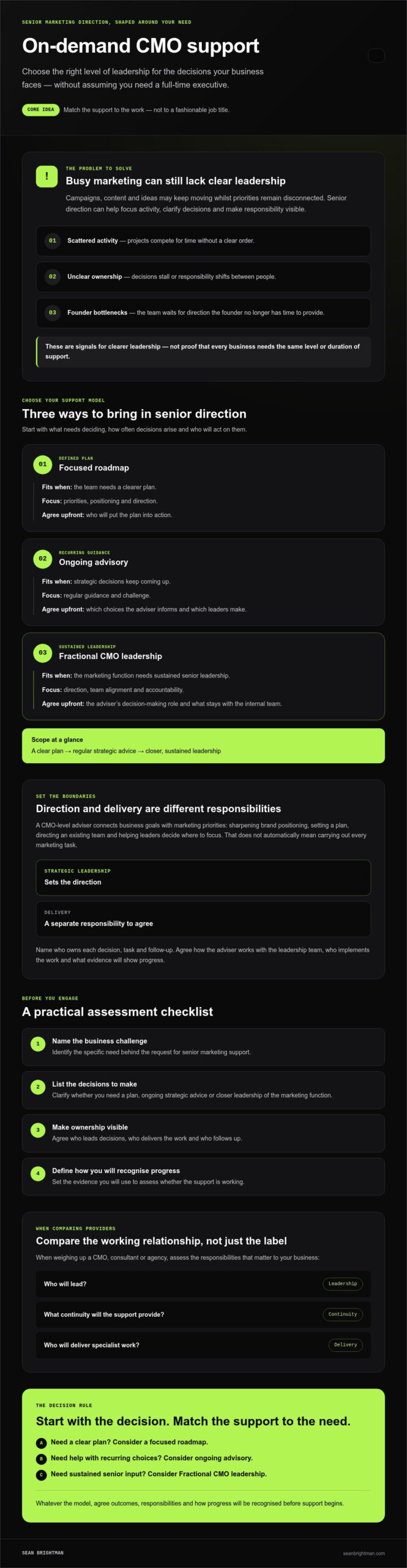
    A Fractional CMO provides part-time senior marketing leadership. It brings strategic direction and accountability without a full-time CMO. Sean’s Fractional CMO work can help establish priorities and marketing systems. Strategic roadmapping offers a structured plan when the immediate need is clarity. Choose the support that matches the gap, not the most impressive-sounding title.

    How to assess a marketing consultant’s fit for a technology startup

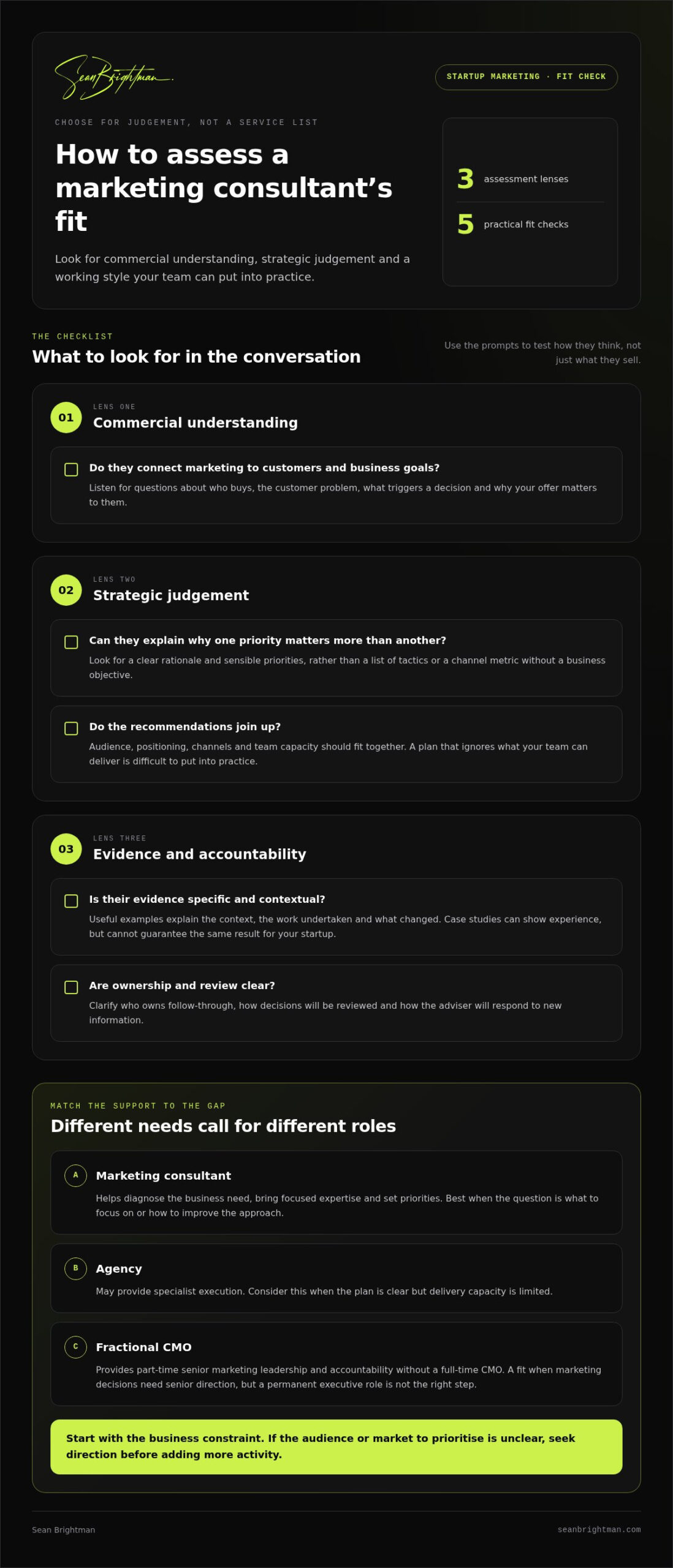
    A polished service page tells you what a consultant sells, not how they think. To assess a marketing consultant for tech startups uk, look for three things: commercial understanding, strategic judgement and a working style your team can put into practice.

    Can they make the product matter to buyers?

    Technology can be complex, but buyers still need a clear reason to care. A strong adviser should look beyond product features, understand the customer problem and connect that insight to positioning and marketing priorities. Listen for questions about who buys, what triggers a decision and what makes your offer relevant, not just which channels you want to use.

    Then test whether the recommendations join up. If they propose a new audience, can they explain how the positioning should speak to it, which channels could reach it and what the team needs to deliver? A strategy that ignores internal capacity is a plan on paper, not a workable direction.

    Do the evidence and accountability stand up?

    Ask for relevant examples and the thinking behind them. Useful evidence explains the context, the work undertaken and what changed. A channel metric without a business objective or starting point proves little. Case studies can show experience, but they can’t guarantee the same result for your startup.

    Look for recommendations with a clear rationale, sensible priorities and measures tied to business objectives. Clarify how decisions will be reviewed, who owns follow-through and how the adviser will respond to new information. For more prompts to shape an assessment, see how to hire a marketing consultant.

    Use this checklist to compare advisers:

    • Commercial understanding: Do they connect marketing priorities to customer needs and business goals?
    • Strategic judgement: Can they explain why one priority matters more than another?
    • Joined-up thinking: Do positioning, audience, channels and team capacity fit together?
    • Relevant evidence: Are examples specific and contextual, without promising identical results?
    • Working style: Are decision ownership, review and accountability clear?

    If you’re looking for senior direction grounded in strategy, positioning and accountability, explore Sean Brightman’s marketing approach to see how that support could fit your startup.

    Marketing consultant, agency or Fractional CMO: which fits your startup?

    These roles can overlap, but they solve different problems. A consultant helps diagnose and prioritise. An agency may provide specialist execution. A Fractional CMO takes on senior marketing leadership part-time. The right choice depends on whether your gap is direction, delivery or ongoing ownership.

    Role Primary responsibility Best-fit need Typical working relationship
    Independent consultant Diagnose needs, challenge assumptions and recommend priorities A defined strategic question or need for specialist advice Project-based or ongoing advice, depending on the brief
    Specialist agency Deliver agreed work within its area of expertise Internal direction is clear, but the team needs specialist delivery capacity Scoped work or a continuing delivery relationship
    Fractional CMO Provide part-time senior leadership and guide marketing direction Decisions, priorities and accountability need ongoing senior ownership Part-time leadership, often supported by continued advisory

    These are working models, not rigid rules. Some consultants also support implementation; some agencies contribute strategic thinking. Get specific about responsibilities: who sets priorities, who makes decisions and who carries out the work? A marketing consultant for tech startups uk may sharpen the plan, but that doesn’t automatically mean they’ll deliver every channel activity.

    What does a consultant do that a marketing agency may not?

    A consultant-led engagement often starts with diagnosis: understand the business problem, identify what’s getting in the way and decide what deserves attention first. An agency engagement may instead centre on specialist delivery, such as a defined channel programme. There’s no universal model, so compare the actual scope, not the label.

    For a technology startup, recommendations should fit the product, buyers and operating capacity. Academic research on tech startup marketing can add useful context, but a research finding or marketing system is not a strategy by itself. It must serve the startup’s objectives.

    When does a startup need a Fractional CMO rather than a one-off adviser?

    A roadmapping engagement can suit a defined need: align priorities and leave with a structured plan. But if the business needs senior input as decisions unfold, a one-off document may not be enough. A Fractional CMO provides ongoing, part-time leadership; an advisory retainer can add continued direction and accountability. Choose the model based on how much ownership the work needs after the initial recommendations.

    Sean Brightman’s Fractional CMO and roadmapping support offers distinct routes to strategic direction, from a structured plan to ongoing senior guidance.
    UK Tech Startup Marketing Consultant: 2026 Buying Guide

    How to scope a marketing consulting engagement before you commit

    A useful engagement starts with a business problem, not a shopping list of tactics. Before you bring in a marketing consultant for tech startups uk, get clear on what needs to change, which decisions are stuck and what your team can realistically take forward. This gives the work a solid brief and keeps it tied to business priorities.

    What should a startup include in a marketing consulting brief?

    Share enough context to make the advice specific: your business objective, target customers, product and current positioning. Add a concise picture of current marketing activity, who is responsible for it and the constraints that matter, such as limited team capacity or competing priorities. Keep the brief centred on the questions leadership needs answered. Don’t prescribe a channel or solution before understanding the underlying problem.

    Then scope the work in four steps:

    • Define the business problem. State what isn’t working or what decision the business needs to make. For example, are you struggling to explain the product’s value, or unsure which customer group to prioritise?
    • Clarify the decisions. Identify what the consultant should help leadership decide, such as positioning, priority audiences or where to focus existing resources.
    • Agree the scope. Set out the work, deliverables, responsibilities and what sits outside the engagement. A strategic recommendation isn’t automatically hands-on channel delivery.
    • Set review points. Agree when you’ll assess progress, discuss new information and decide whether priorities need to change.

    What should the roadmap and review rhythm make clear?

    A useful roadmap turns decisions into an ordered plan. It should show which actions matter most, what needs to happen first, who owns each next step and where the team must make a decision. Priorities should reflect available capacity. A plan that assumes work your team can’t deliver won’t help. Agree how you’ll review progress without treating any commercial outcome as guaranteed.

    That’s the difference between a strategic deliverable and a document full of recommendations. A long list can look thorough whilst leaving the founder to work out what comes first. A practical roadmap makes choices visible, highlights dependencies and gives the team a basis for review. If you need guidance after the initial plan, clarify how ongoing advice and accountability will work.

    For structured direction tailored to your priorities, Explore strategic marketing support with Sean.

    Choose a consultant who brings senior direction, not another layer of noise

    Don’t choose by the length of the service list. Choose by the decisions your startup needs someone to own. If the problem is unclear positioning, scattered priorities or no senior marketing lead, another channel tactic may only add activity. You need direction that connects the work to business goals and gives your team a clear way forward.

    That’s the test for a marketing consultant for tech startups uk: can they help you decide what matters, why it matters and how the business will act on it? The right engagement depends on the gap. A defined need for clarity may call for a roadmap. A need for continued senior input calls for ongoing leadership and accountability.

    How does Sean Brightman support tech startups with strategic marketing?

    Sean Brightman offers several ways to bring senior strategic direction into a business. Fractional CMO support provides part-time leadership focused on marketing strategy and direction. Strategic roadmapping turns competing priorities into a structured plan. An advisory retainer provides continued guidance as decisions and priorities evolve.

    AI consulting can also help when the question is how to make marketing more efficient. The aim is a practical application tied to the business’s needs, not adopting another tool without a clear purpose. Each form of support addresses a different requirement; the value lies in matching the work to the decision in front of you.

    What is the clearest next step for a founder?

    Name the constraint. Is your team struggling to explain the product’s value, choose a priority audience, focus its marketing activity or make effective use of its capacity? Write down the decision you need to make and what’s preventing progress. That gives a strategic conversation or roadmap a concrete starting point.

    If you’re comparing models of senior marketing leadership, read about the Fractional CMO approach. Then decide whether you need a defined plan or a senior partner to provide direction over time. A strategy document can clarify priorities, while ongoing leadership helps keep decisions connected as the business moves forward.

    Ready to focus your next marketing decision? Talk to Sean about the right marketing direction for your startup.

    Give your startup’s marketing a clearer direction

    The right marketing consultant for tech startups uk isn’t simply the one with the longest list of services. Choose based on the decisions you need help making, whether that means sharpening your strategy, building a practical roadmap or securing ongoing senior leadership.

    Be clear about the gap before you commit. A defined strategic challenge may call for roadmapping; continued direction and accountability may suit an advisory retainer or Fractional CMO support. A useful plan connects business priorities to what your team can actually deliver.

    Sean Brightman provides part-time senior marketing leadership through his Fractional CMO service, alongside strategic roadmapping and advisory retainers. He’s also the author of a published book on strategic marketing methodology. Each offers a different way to bring focus to marketing decisions.

    Start by naming the decision or growth constraint holding your marketing back. Then use it to shape a focused conversation about the support that fits. Talk to Sean about the right marketing direction for your startup.

    Frequently Asked Questions

    What does a marketing consultant do for a tech startup?

    A marketing consultant diagnoses where marketing needs focus and provides expertise to address it. For a tech startup, that might mean clarifying the product’s value, identifying priority customers, setting strategic priorities or improving marketing systems. The scope varies: some consultants advise on strategy, whilst others also deliver specific work. Agree which decisions and deliverables the engagement covers, and who will put recommendations into action.

    How do I choose a marketing consultant for a tech startup in the UK?

    Choose a marketing consultant for tech startups UK based on their ability to connect commercial goals, customer needs and practical priorities. Look for clear reasoning, relevant evidence and recommendations that match your team’s capacity. Ask how they’d approach your specific challenge and how progress would be reviewed. Be wary of broad promises without context. The strongest fit is someone who can explain what matters first and why.

    Is a marketing consultant the same as a marketing agency?

    No. A consultant typically diagnoses a problem, advises on priorities or provides strategic guidance. An agency often focuses on delivering specialist marketing work, although its scope can vary. Neither label guarantees a particular way of working. Clarify who will set direction, make decisions and carry out each task. A startup may need one type of support or a combination, depending on whether its main gap is strategy, leadership or execution.

    When should a startup hire a Fractional CMO?

    Consider a Fractional CMO when the business needs experienced marketing leadership and ongoing direction, but a full-time CMO isn’t the right fit. A Fractional CMO provides senior leadership on a part-time basis, helping guide strategy, positioning, priorities and accountability. It can suit a team facing important marketing decisions without a senior owner. The trigger is the leadership gap, not a particular funding stage, headcount or revenue level.

    What should a marketing strategy roadmap for a startup include?

    A useful roadmap should connect business objectives to marketing priorities and show what happens next. It can set out the audience and positioning to focus on, the main strategic priorities, dependencies, owners and decision points. It should reflect the team’s capacity, so the plan is workable rather than a wish list. Agree how progress will be reviewed and how priorities can be adjusted as the business learns.

    Can a marketing consultant help with AI strategy?

    Yes. AI consulting can help a startup identify practical ways to apply AI to marketing efficiency and output. Start with a business need, such as reducing repetitive work or improving a marketing process, then assess whether AI is appropriate. Tool adoption alone isn’t a strategy. The work should connect the proposed use to clear objectives, suitable inputs and the team’s ability to integrate it into existing marketing systems.

    How much does a marketing consultant for a tech startup cost?

    The cost depends on the consultant’s experience, the work required and the engagement model. A defined roadmapping project, occasional strategic advice and ongoing senior leadership involve different scopes, so there isn’t one figure that applies to every startup. Set out the decisions you need help with, the expected deliverables and the level of continuing support. That gives you a clearer basis for understanding and comparing proposals.

    What happens if my startup needs both strategy and marketing execution?

    Separate the responsibilities, then make sure they connect. A consultant or Fractional CMO can help set strategic direction, whilst execution may sit with your internal team or a specialist agency, depending on your needs. Agree who owns priorities, delivery and review so recommendations don’t stall between teams. Sean Brightman’s strategic leadership focuses on direction and accountability, not advertising or campaign execution.

  • Reducing Marketing Budget Waste: Find the Leaks Before You Cut

    Reducing Marketing Budget Waste: Find the Leaks Before You Cut

    Cutting the marketing budget can make the spreadsheet look healthier whilst quietly weakening growth. If you’re reducing marketing budget waste, start by finding where spend loses momentum, not by slashing activity that may be working.

    The frustration is familiar: marketing uses budget, but its contribution to revenue is hard to pin down. Teams, agencies, channels and tools each tell a different success story. Under pressure, it’s tempting to cut what’s difficult to measure, even when it supports the business.

    This article shows you how to separate avoidable waste from useful investment, then decide what to fix first. You’ll learn to examine measurement gaps, targeting, messaging, tools and budget ownership using evidence and commercial context rather than guesswork.

    The goal isn’t a smaller budget for its own sake. It’s a clearer decision system: one that links marketing choices to business priorities, turns findings into a prioritised plan and builds regular accountability. That way, each review improves the next decision instead of resetting the conversation every quarter.

    Key Takeaways

    • Spot leaks across measurement, channel choices, tools and hand-offs, not just visible campaign spend.
    • For reducing marketing budget waste, assess performance against commercial outcomes rather than relying on a single metric.
    • Reconcile spend and reporting over a period that fits your sales cycle before acting on apparent underperformance.
    • Prioritise changes by evidence, likely impact, reversibility and how quickly you can learn from them.
    • Keep a decision log with owners, assumptions and review points so each budget decision informs the next.

    Reducing marketing budget waste starts with finding the real leak

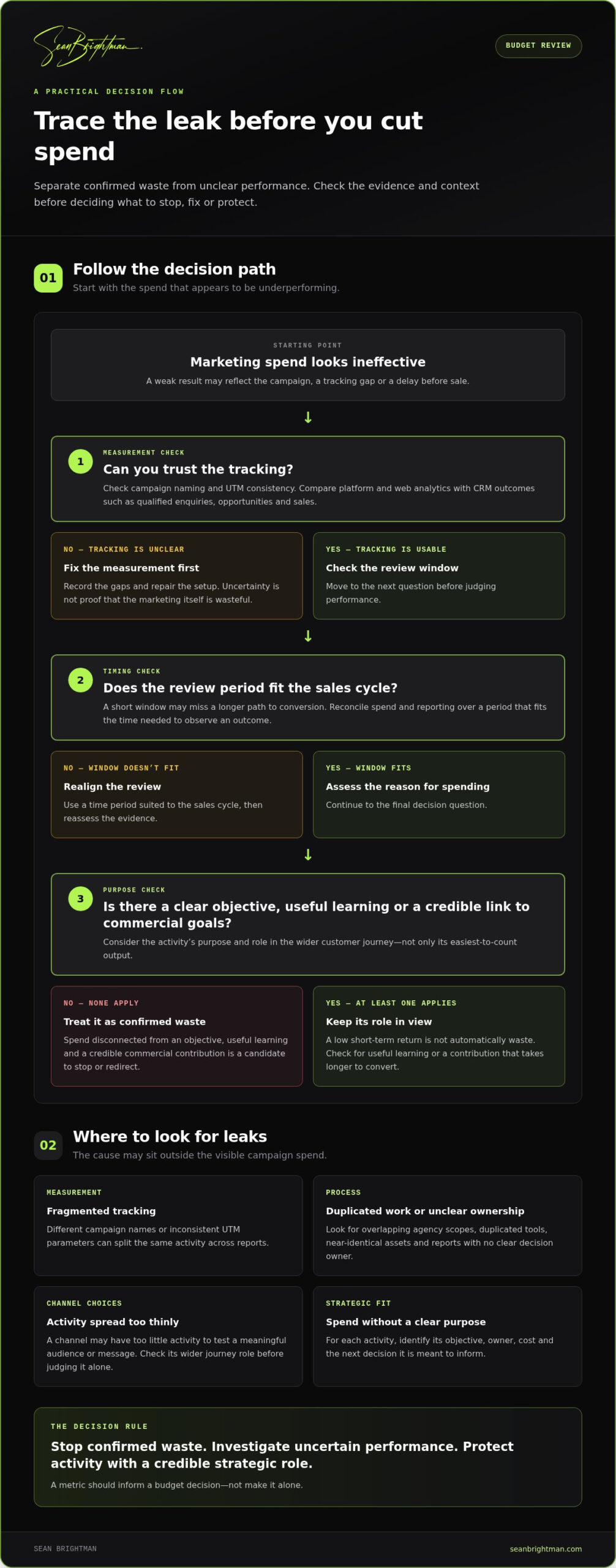
    Pressure to cut spend often arrives before anyone can explain what the budget is doing. An across-the-board reduction may look decisive, but it can remove effective investment alongside genuine inefficiency. Disciplined optimisation starts by tracing the leak and fixing its cause. It doesn’t treat every unclear result as proof that activity should stop.

    Marketing budget waste is spend disconnected from a clear objective, useful learning or a credible contribution to commercial goals. That definition matters because weak measurement creates uncertainty, not a verdict. If a campaign’s results aren’t tracked properly, the first problem may be the measurement setup, not the campaign itself. Understanding marketing effectiveness means judging activity against its purpose and role in the wider marketing effort, not just its easiest-to-count output.

    What counts as marketing budget waste?

    Look for avoidable spend in the machinery around marketing as well as in channels. A team might pay for a tool no one uses, commission separate teams to produce near-identical assets, or run campaigns without agreeing who owns the outcome. These are different problems: process waste, channel underperformance and weak strategic fit each call for a different fix.

    A low short-term return isn’t automatically waste. A test that rules out a weak message can provide useful learning; brand activity may also support a customer journey that takes longer to convert. Ask whether there was a clear reason to spend, a way to learn and a sensible link to business priorities.

    Why cutting the budget is not the same as reducing waste

    Equal percentage cuts ignore differences in purpose and performance. They can shrink a proven source of demand just as readily as they remove duplicated work. Cheap leads can also distract from lead quality, whilst activity metrics such as clicks say little on their own about commercial contribution.

    Judge investment against the business goal, the customer journey and the time needed to observe an outcome. A short reporting window may miss a longer sales cycle; a longer one may hide a problem that needs attention now. Make the distinction clear: stop confirmed waste, investigate uncertain performance, and protect activity with a credible strategic role. That’s the starting point for reducing marketing budget waste without cutting growth potential by guesswork.

    Where marketing budgets leak: measurement, hand-offs, and misplaced activity

    Budget leaks rarely sit in one neat line on a report. They build where strategy, channel choices, measurement and delivery fail to connect. A campaign may have a clear objective, but if its results don’t reach the team planning the next activity, the learning gets lost. One team may pay for a tool whilst another buys a similar platform. An agency and an internal team may both produce reports without anyone owning the decision those reports are meant to inform.

    Fragmented tracking makes budget comparisons less reliable because teams may be measuring different activity, outcomes and time periods. That uncertainty is a measurement problem to investigate, not automatic proof that the marketing itself is wasteful.

    How weak measurement hides useful signals

    Attribution is an imperfect view of contribution, not a complete account of cause and effect. A platform may claim credit for a conversion that involved several other interactions, whilst a channel that helped build awareness may receive no direct credit at all. Use measurement to guide investigation, not to declare a winner from one dashboard. Harvard Business School Online’s guidance on how to measure marketing effectiveness offers a broader perspective than relying on a single metric.

    Start by checking the tracking basics. If one team names a campaign “spring_launch” and another uses “Spring-Launch”, or UTM parameters vary between links, reports can split the same activity into separate entries. Compare platform and web analytics with CRM outcomes: qualified enquiries, opportunities and sales can show whether apparent performance translates into business value. Record gaps rather than filling them with assumptions.

    How process and channel choices create avoidable spend

    Next, trace the work between planning and reporting. Look for overlapping agency scopes, duplicated tools, unclear briefs and manual reports that teams rebuild separately. For each activity, identify its objective, owner, cost and next decision. If nobody can explain what a task supports or who acts on its result, that’s a process leak worth investigating.

    Channel sprawl creates another trap. Spreading a budget thinly across multiple channels can leave each with too little activity to test a meaningful audience or message. But consolidation should follow evidence and strategic fit, not convenience. A channel with limited immediate conversions may still play a useful role in the customer journey; check how it supports other activity before judging it in isolation.

    For a deeper look at how joined-up processes support growth, explore marketing operations for a scalable growth engine. A focused marketing roadmapping discussion can also help turn these findings into clear priorities for reducing marketing budget waste.

    How to diagnose wasted marketing spend without trusting one metric

    Move from suspicion to evidence with a repeatable review. A metric should inform a budget decision, not make it alone. A low conversion figure might signal a weak campaign, a tracking gap or a delay between first contact and sale. Separate those possibilities before changing investment.

    Build a useful view of spend and outcomes

    Choose one reporting period that reflects your sales cycle, then use it consistently across the review. Group investment by objective, audience, channel, campaign and internal or external owner. Reconcile planned budget with actual spend, then compare platform and web analytics with CRM outcomes where available. Select the business outcome that fits the objective, such as qualified pipeline, revenue, retention or another meaningful measure.

    Flag missing tracking, inconsistent campaign names, differing attribution windows and gaps between platforms and CRM. Don’t hide incomplete evidence inside a single performance score.

    Use five steps to diagnose the leak

    • Set the outcome: State what the activity was meant to achieve and how that connects to a business priority.
    • Reconcile spend: Check planned allocation against actual spend across teams, channels and suppliers.
    • Compare evidence: Review the chosen outcome alongside relevant platform, website and CRM signals.
    • Investigate variance: Trace unexpected results to possible causes, such as a tracking change, audience shift, delivery issue or a genuine performance decline.
    • Record confidence: Note what the evidence supports, what remains uncertain and what check or test could improve the picture.

    Warning sign | Evidence to investigate | Possible explanation

    Spend rises, but qualified pipeline doesn’t | CRM stages, lead quality and campaign changes | Lower-quality demand, a longer conversion path or a tracking gap

    Two reports show different results | Reporting period, attribution window and campaign definitions | Different measurement rules, not necessarily different performance

    Activity is hard to connect to an objective | Brief, owner and intended audience | Unclear strategy or work that has lost its purpose

    Look for repeated patterns across comparable activity, not a verdict from one campaign or reporting period. Check results against the intended customer journey and the time it takes for outcomes to appear. A short-term dip may matter, but it needs context before it triggers a cut.

    This method makes reducing marketing budget waste more rigorous: it distinguishes a confirmed problem from an incomplete signal and points to the next decision rather than pretending every answer is already in the data.

    Reducing Marketing Budget Waste: Find the Leaks Before You Cut

    What to fix first: prioritise marketing budget changes by evidence

    Start with changes where the waste is visible and the downside is limited. Duplicate subscriptions, overlapping work or activity with no accountable owner are stronger clean-up candidates than a campaign that simply lacks reliable measurement. Don’t cut a channel by default. First weigh the evidence, likely business impact, reversibility and time needed to learn.

    Decision type | Evidence strength | Likely impact | Reversibility | Time to learn

    Immediate clean-up: duplicated tool or repeated task | Clear and verifiable | Usually contained | High | Short

    Test: campaign with mixed results | Partial or inconsistent | Could affect demand | Often high | Depends on the sales cycle

    Tracking fix: activity with incomplete attribution | Insufficient to judge | Unclear until measured | High | Depends on data availability

    Strategic review: investment affecting key audiences or positioning | Requires broader context | Potentially substantial | Lower | Longer-term

    Which budget leaks should you address first?

    Remove confirmed duplication and resolve ownership gaps first. Treat weakly measured activity as an investigation or test candidate, not an automatic cancellation. Escalate choices that could reshape how you reach key audiences, express your positioning or support longer-term growth. The harder a change is to reverse, the stronger the evidence and business case should be.

    How to test a change without damaging growth

    Change one meaningful variable where practical, such as the audience or message, and write down what evidence would change your decision. Set a review point that fits the sales cycle and gives the relevant data time to emerge. If several elements change at once, you may not know what caused the result.

    Example: A team finds two subscriptions that appear to serve the same purpose, whilst one campaign has weak lead tracking but supports an important audience. It can verify and remove the duplicate, then improve tracking and test the campaign before deciding whether to reduce its allocation. The example is illustrative, not a client result.

    If the evidence points beyond channel adjustments to priorities around positioning or growth, use strategic brand roadmapping to shape the next decisions. For senior-level direction on turning findings into a prioritised plan, explore strategic marketing guidance. That’s how reducing marketing budget waste becomes a controlled decision, not a blunt cut.

    Make marketing budget control an ongoing leadership system

    A one-off budget review finds leaks. A leadership system helps stop them returning. Tie each marketing investment to a business outcome, a clear owner and an assumption that can be revisited. Then review what changed, what the evidence says and what decision comes next. This keeps the budget connected to commercial priorities, not just last quarter’s activity.

    Set a budget review cadence that drives decisions

    Set review points around business planning and the sales cycle, not an arbitrary reporting ritual. At each review, look at business outcomes, committed spend, key assumptions and any changes in customer behaviour, team capacity or commercial priorities. If an assumption no longer holds, update the plan rather than allowing old allocations to roll forward by default.

    Keep a decision log that makes accountability visible. Record what changed, why it changed, the expected effect, the person responsible and when the decision will be reviewed. That record helps the team distinguish a deliberate test from unplanned drift in spend.

    Make sure the parts of the system reinforce one another. Positioning shapes which audiences matter; channel choices determine how you reach them; measurement shows what the activity contributes; and operating capacity determines what the team can deliver well. A mismatch between any of these can undermine the rest.

    When strategic marketing support can help

    If priorities keep fragmenting, ownership remains unclear or measurement problems recur, the issue may need senior strategic direction rather than another reporting template. Fractional CMO leadership and ongoing advisory support can connect budget choices to positioning and business goals, and bring accountability to regular reviews. This is strategic oversight, not advertising execution.

    Sean Brightman’s advisory retainer provides ongoing strategic direction and accountability. For senior marketing leadership on a part-time basis, explore Fractional CMO support.

    Start with one action: map current spend against its objective, then identify the biggest evidence gap. Assign someone to close it and bring the finding into your next review. That’s how reducing marketing budget waste becomes an ongoing discipline, not another round of reactive cuts.

    Make your next marketing budget decision count

    Reducing marketing budget waste isn’t about cutting spend evenly. It’s about finding where investment loses momentum, separating confirmed waste from uncertain performance, and choosing changes that fit your business goals.

    Use consistent evidence to guide decisions, not a single metric. Give each investment a clear objective and owner, then record what changes and when you’ll review it. That turns budget control into an ongoing leadership system, not another reactive round of cuts.

    When priorities or accountability are unclear, Fractional CMO leadership brings part-time senior marketing direction. Roadmapping creates structured marketing and brand direction, whilst an advisory retainer supports ongoing strategic oversight and accountability.

    Build a sharper marketing decision system with Sean Brightman. Start with the evidence, make the next decision with confidence, and protect the investment that can support growth.

    Frequently Asked Questions

    What does reducing marketing budget waste actually mean?

    Reducing marketing budget waste means removing or redesigning spend without a clear purpose, accountable owner, useful evidence or credible connection to business outcomes. It doesn’t mean cutting every activity with weak short-term attribution. Some investment supports learning, awareness or longer buying journeys. First diagnose why performance appears weak. Then decide whether to stop, fix, measure or test the activity, based on its intended role and the evidence available.

    How can I tell whether marketing spend is being wasted?

    Map spend to its objectives, owners, campaign activity and relevant outcomes. Check that reporting uses consistent definitions, then compare platform results with CRM or sales information where available. Look for repeated signs such as duplicated work, unused tools or activity without a defined purpose. If tracking is missing or unreliable, treat that as an evidence gap to investigate. Weak measurement alone doesn’t prove that the activity is wasteful.

    Should I cut marketing spend if I cannot measure its return?

    No, not automatically. Start by clarifying the outcome the activity was meant to support and checking whether your tracking captures it. Consider the customer journey, sales cycle and missing data before deciding. If the evidence remains weak, improve measurement or run a bounded test with a clear review point. Preserve investment that has a credible strategic role, and decide in advance what evidence would justify changing it.

    How much marketing budget should a business allocate to each channel?

    There’s no universal channel split that suits every business. Allocation depends on commercial goals, audience behaviour, sales-cycle length, existing evidence and your capacity to execute well. Define the outcome each channel should support, then compare its contribution and the uncertainty around that evidence. Keep room to test and learn. Review the allocation when results, customer behaviour or business priorities change, rather than copying another organisation’s budget mix.

    Which marketing metrics should I use to find wasted spend?

    Choose measures that match the activity’s objective and connect, where possible, to commercial outcomes. Depending on the goal, these could include qualified pipeline, revenue, customer acquisition, retention or meaningful engagement. Use platform metrics as diagnostic signals, not final proof of business impact. Before comparing campaigns or channels, check that definitions, attribution windows and tracking are consistent, and compare platform data with CRM outcomes where available.

    Can AI help reduce marketing budget waste?

    AI can help organise data, surface patterns and speed up analysis when the inputs and definitions are reliable. It can’t resolve unclear objectives, inconsistent tracking or poor judgement by itself. Use it to support investigation, not to make unreviewed budget decisions. Keep a named person accountable for validating the evidence, weighing commercial context and deciding what to change. The quality of the decision still depends on the quality of the information and oversight.

    How often should a business review its marketing budget?

    Set review frequency to fit your sales cycle, business planning rhythm and pace of change. Use regular checkpoints to compare actual spend with objectives and outcomes, then schedule a deeper review when assumptions shift or evidence raises a concern. Don’t change investment so frequently that activity has no time to produce useful learning. Record each decision, its rationale and a proportionate review date so you can assess the effect.

  • Strategic Marketing Advisor for Hire: Find the Right Fit in 2026

    Strategic Marketing Advisor for Hire: Find the Right Fit in 2026

    More marketing activity won’t fix unclear priorities. If campaigns are running but their commercial contribution is hard to see, a strategic marketing advisor for hire should help you make sharper choices and agree who will act on them, not simply deliver another polished strategy deck.

    You may already know the business needs senior direction. The challenge is finding support that fits without committing to a full-time leadership hire, and making sure recommendations keep moving once the adviser leaves. Before comparing people, identify the decision you need help with and what is currently stopping you from making it.

    This guide explains what a strategic marketing adviser should solve, how to assess their experience and working style, and what to agree before you hire. It also compares advisory support with consultants, agencies and fractional marketing leadership, and explains when a one-off roadmap or ongoing advice may be a better fit. You’ll learn how to define a practical scope, working rhythm and measures of progress, so the work connects to business decisions rather than ending as a document gathering dust.

    Key Takeaways

    • Before choosing a strategic marketing advisor for hire, pinpoint the business decision or marketing problem you need them to address.
    • Look for practical direction and agreed priorities, not a strategy document that nobody owns or acts on.
    • Compare an adviser, consultant, agency and fractional CMO by the leadership, execution and accountability your business actually needs.
    • Assess fit by asking how the adviser thinks, what they’ll take responsibility for and how you’ll review progress together.
    • Choose support that matches the challenge, from a focused roadmap to ongoing advice, Fractional CMO support or AI consulting.

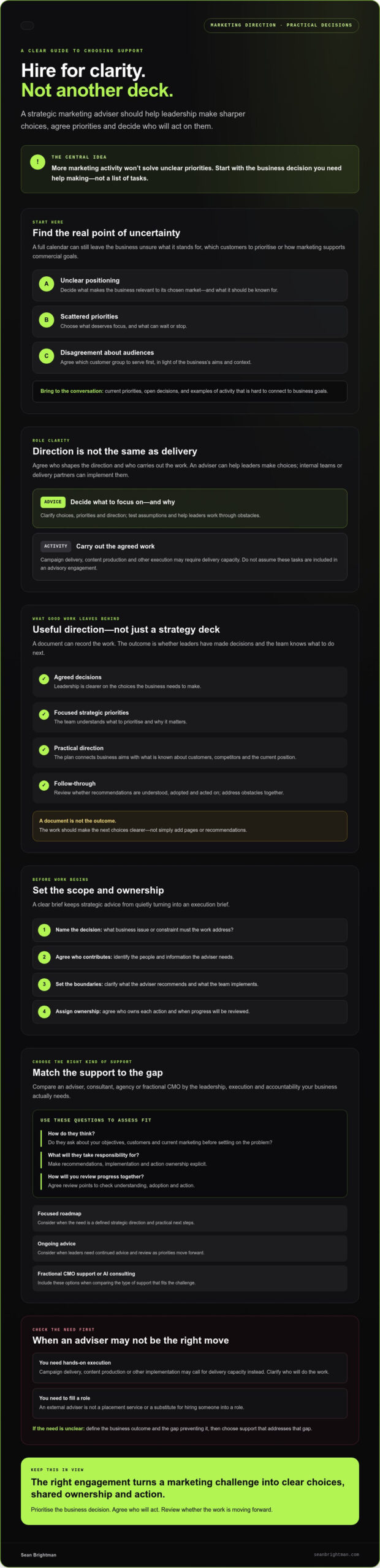
    Strategic marketing adviser: what to look for?

    A full calendar can still hide a failure to make the decisions that matter. Campaigns, content and meetings keep moving, while the business remains unsure what it stands for, which customers to prioritise or how marketing supports its commercial goals.

    A strategic marketing advisor helps a leadership team clarify its marketing choices, priorities and direction. Strategic marketing advice helps a business decide what to focus on and why; tactical marketing activity carries out the agreed work. The adviser shapes the direction, while internal teams or delivery partners implement it.

    Marketing strategy provides a framework for connecting business goals with markets and choices. In practice, an adviser should help turn that broad idea into decisions your team can use, rather than simply adding more activity to the plan.

    If you’re looking for a strategic marketing advisor for hire, start with the decision you need help making, not a list of marketing tasks. The right starting point depends on your business context, so agree the problem with the adviser before defining the work.

    What problems should a strategic marketing advisor solve?

    Look for a specific point of uncertainty that leadership can resolve. For example:

    • Unclear positioning: decide what makes the business relevant to its chosen market and what it should be known for.
    • Scattered priorities: choose which marketing priorities deserve focus, and which can wait or stop.
    • Disagreement about audiences: agree which customer group to serve first, based on the business’s aims and context.

    These are decisions, not requests for a longer activity list. A useful adviser will ask about your objectives, customers and current marketing before settling on the problem to address. You can make that conversation more productive by bringing examples of current priorities, open decisions and activity that is proving difficult to connect to business goals.

    When is hiring an adviser the wrong move?

    If the immediate need is hands-on campaign delivery, content production or other execution, you may need delivery capacity rather than strategic advice. An adviser can help set direction, but don’t assume that includes carrying out the work. Clarify who owns implementation before agreeing the scope.

    Recruitment is a separate need, too. An external marketing adviser isn’t a placement service or a substitute for hiring someone into a role. If you’re unsure whether you need strategy, execution or a new team member, define the business outcome and the gap preventing it. Then choose support that addresses that gap.

    What a strategic marketing advisor should deliver beyond a strategy deck

    A strategy deck can record the work, but it can’t prove that the business has made a decision or that the team is acting on it. A useful engagement leaves leaders clearer on what to prioritise, why it matters and what the team should do next.

    Expect agreed decisions, a focused set of strategic priorities and practical direction the team can apply. That might mean choosing which market to focus on, stopping activity that no longer fits or identifying what evidence would change the plan. The document captures those choices; it is not the outcome itself.

    A useful plan connects business aims with what the team knows about its customers, competitors and current position. The adviser should help leaders weigh that information and decide what it means for the business. The result should make the next choices clearer, not simply add pages or recommendations.

    Good advice includes challenge and follow-through, not taking over every task. The adviser can test assumptions, check whether agreed priorities are being adopted and help leaders address obstacles. Your team or delivery partners can own implementation, with responsibilities agreed upfront. If you’re considering a strategic marketing advisor for hire, make that boundary explicit before work begins.

    How to define the work before the engagement starts

    Start with the business decision or constraint the engagement must address. Agree who needs to contribute, what information the adviser needs and which decisions leadership expects to make. Then set the boundaries: what the adviser will recommend, what your team will implement and who owns each action. This helps prevent a strategy brief quietly turning into an execution brief.

    What accountability should look like in practice

    Agree review points to check whether recommendations have been understood, adopted and acted on. Choose progress measures with the adviser that fit the business challenge; avoid generic targets and don’t assume a particular result. If new evidence undermines the original plan, decide how you’ll revisit priorities rather than pushing ahead by default.

    For ongoing direction and review, explore the marketing advisory retainer guide. It can help you consider whether continuing advice fits better than a defined, one-off piece of roadmapping.

    Strategic marketing advisor, consultant, agency or fractional CMO: compare the fit

    These labels can overlap, and a title alone won’t tell you who owns the work. Compare support by its purpose, decision-making role, delivery capacity and likely engagement shape. For an overview of a consultant’s possible responsibilities and specialisms, see What Is a Marketing Consultant, then confirm the actual scope with each provider.

    The right option depends on the gap you need to fill: clearer decisions, defined expertise, delivery capacity or sustained senior marketing leadership.

    Support Main purpose Leadership ownership Execution capacity and likely shape
    Strategic marketing adviser Clarify choices, priorities and direction. Informs decisions; leadership remains with your business. Doesn’t automatically include implementation. May be a focused piece of work or ongoing advice.
    Marketing consultant Bring specialist analysis or recommendations to a defined challenge. Usually advises rather than taking ongoing leadership ownership. Scope can range from a discrete project to continuing support. Confirm whether implementation is included.
    Agency Deliver agreed marketing work within its contracted remit. Your business retains strategic ownership unless leadership responsibilities are explicitly agreed. May provide delivery capacity; channels, tasks and ownership depend on the agreement.
    Fractional CMO Provide part-time senior marketing leadership. Can take sustained responsibility for marketing direction and leadership, as agreed. Typically an ongoing, part-time arrangement; confirm the remit, authority and responsibilities.

    Don’t assume every consultant or agency works the same way. Ask what they’ll own, what your team must provide and whether the engagement covers recommendations, delivery or both. The distinction matters: an adviser informs decisions, while a fractional CMO can provide part-time senior leadership across teams and priorities.

    When an adviser is a better fit than an agency

    Choose advisory support when the main gap is diagnosis, prioritisation or an independent view of a difficult choice, rather than a shortage of people to deliver campaigns. An adviser can help define what work should happen and why. Someone still needs to own implementation, whether that’s your internal team or a separately commissioned delivery partner. An agency may be the right fit when delivery itself is the need.

    When fractional marketing leadership may be the better fit

    If priorities need a senior owner who can stay involved across teams and decisions, explore fractional leadership rather than assuming an advisory scope will cover it. Advisory and fractional CMO responsibilities can differ, so agree decision rights, accountability and time commitment before starting. Read the Fractional CMO guide for a deeper explanation.

    Strategic Marketing Advisor for Hire: Find the Right Fit in 2026

    How to assess a strategic marketing advisor before you hire

    A strong proposal should show how the adviser will move from your business challenge to a decision you can act on. Don’t judge fit on confidence or polished slides alone. Test the thinking, responsibilities and working rhythm before you commit.

    Use this process to assess a strategic marketing advisor for hire:

    • 1. Define the issue. State the decision or constraint you need help with. “We need better marketing” is too broad; explain what leadership can’t currently decide or what is holding progress back.
    • 2. Assess the adviser’s thinking. Ask how they would learn about your business before recommending priorities. Look for relevant questions, clear reasoning and an approach that fits your situation. You’re assessing how they think, not asking them to promise results or disclose another client’s confidential work.
    • 3. Scope responsibilities. Write down the decisions and outputs expected, who from your team needs to contribute and who owns implementation. Make clear what sits outside the engagement, too.
    • 4. Agree review points. Decide how you’ll check whether recommendations are understood and used, which business measures are relevant and how you’ll revisit the plan if its assumptions don’t hold.

    Questions to ask before agreeing a scope

    Ask: “What information would you need before recommending priorities?” “Which decisions and outputs would this engagement cover?” “What will you need from our team?” “How will we review progress, and what happens if new evidence challenges the original assumptions?” Clear answers should make the boundaries visible. If success measures or ownership are vague, or promises are made without context, pause and ask for specifics.

    Signals that the advisor fits your business

    Good fit shows up in the conversation. The adviser explains their reasoning, asks questions that sharpen the brief and is willing to challenge your starting assumptions respectfully. They can describe a working rhythm that suits how your leadership team makes decisions. Check that the proposed scope matches your actual need; don’t infer expertise or delivery capacity that hasn’t been confirmed.

    If the central need is a structured roadmap, explore this strategic brand roadmapping guide. It may help you decide whether a defined roadmap is the right shape of support before discussing an engagement.

    Ready to turn a marketing challenge into a scoped next step? Discuss strategic marketing support with Sean Brightman.

    Hiring Sean Brightman: turn your marketing challenge into a clear next step

    Start with the business challenge, not a preselected service. Be clear about the decision you need to make, the support that could help and how you’ll review progress. That gives you a firmer basis for discussing fit and scope, without assuming every problem needs the same kind of engagement.

    Sean Brightman provides strategic marketing support through roadmapping, advisory retainers, Fractional CMO support and AI consulting. These options address different needs. The right place to start depends on the challenge, the leadership involvement required and whether you need a defined piece of guidance or continuing support.

    Which type of support should you explore?

    A one-off roadmap may suit a business that needs clearer direction and a practical set of priorities. An advisory retainer may fit when leaders need ongoing strategic input and accountability as they make decisions. Fractional CMO support is worth exploring if the gap is part-time senior marketing leadership. Consider AI consulting when the challenge specifically involves applying AI to marketing. Confirm the available scope and responsibilities before agreeing an engagement.

    These are strategic support options, not a recruitment route or outsourced advertising service. Sean doesn’t provide full-time CMO placement, recruitment or advertising execution. If you need someone to deliver campaigns or fill an employee role, clarify that requirement separately rather than expecting an advisory engagement to cover it.

    Prepare for a useful first conversation

    Describe the business challenge in plain terms. Note your current marketing priorities, the decisions still open, what you’ve already tried and where progress stalls. You don’t need a perfect brief, but you do need enough context to explain what’s getting in the way and what leadership needs to resolve.

    Use the conversation to test fit, not to chase a promised outcome. Discuss which type of support might match the challenge, what the scope could include, what your team would need to contribute and how accountability would work. A useful next step is clarity on whether the proposed support fits, what remains to be defined and how to proceed.

    If you’re looking for a strategic marketing advisor for hire, discuss your strategic marketing challenge with Sean Brightman. Bring the decision you’re trying to make and use the conversation to establish whether roadmapping, ongoing advice, Fractional CMO support or AI consulting is the right fit.

    Make your next marketing decision count

    The right support starts with a clear business challenge, not a wish list of marketing activity. Define the decision you need to make, then choose support that fits: a focused roadmap for clearer direction, ongoing advisory for continued guidance, or Fractional CMO support when you need part-time senior leadership. Agree responsibilities and review points before work begins.

    A strategy document only matters if your team uses it. Look for clear priorities, practical direction and accountability, with measures that make sense for your business. If AI is central to the challenge, AI consulting may be relevant, but it isn’t the answer by default.

    If you’re considering a strategic marketing advisor for hire, Sean Brightman offers roadmapping, advisory retainers, Fractional CMO services and AI consulting. Start by explaining the challenge, what you’ve tried and where progress stalls. Then you can establish whether the support and scope fit, without assuming a particular outcome.

    Discuss your strategic marketing challenge and take the next step with greater clarity and confidence.

    Frequently Asked Questions

    What does a strategic marketing advisor do?

    A strategic marketing advisor helps a business make clearer marketing decisions. They assess the situation, challenge assumptions and help leaders set priorities and direction. For example, they might help clarify which audience to focus on or how marketing should support business objectives. Their role is advisory unless the agreed scope includes leadership responsibilities. Your team or delivery partners may still own implementation, so confirm who is responsible for turning recommendations into action.

    When should a business hire a strategic marketing advisor?

    Hire an adviser when an important marketing decision is unclear or activity isn’t adding up to a coherent direction. You might be weighing different audiences, struggling to prioritise initiatives or unsure what marketing should contribute to business goals. A strategic marketing advisor for hire can help define the issue and guide decisions, but first clarify what you need: advice, senior leadership, implementation capacity or recruitment. The right support depends on the gap.

    How is a strategic marketing advisor different from a marketing consultant?

    The titles can overlap, so compare the proposed work rather than relying on the label. A strategic marketing adviser typically focuses on choices, priorities and direction. A marketing consultant may bring specialist expertise to a defined problem and could provide recommendations or other agreed work. Neither title guarantees implementation or ongoing leadership. Ask what the person will deliver, what decisions they’ll inform and who owns follow-through before agreeing a scope.

    Should I hire a strategic marketing advisor or a fractional CMO?

    Choose an adviser if you mainly need help thinking through marketing choices and setting direction. Consider a fractional CMO if you need part-time senior marketing leadership with sustained ownership across teams and decisions. The distinction depends on the responsibilities you need, not just the job title. Agree decision-making authority, accountability, working rhythm and implementation expectations before engaging either option, as advisory and fractional leadership scopes can differ.

    Can a strategic marketing advisor help with implementation?

    They can help connect strategic decisions to implementation, but that doesn’t mean they’ll personally deliver campaigns or marketing activity. Some scopes may include ongoing guidance, progress reviews or senior leadership; others focus on advice and a roadmap. Ask what support is included, who will carry out the work and who is accountable for delivery. If hands-on execution is your main need, identify that capacity separately rather than assuming advisory support covers it.

    What should I ask before hiring a marketing advisor?

    Ask how they’ll understand your business before recommending priorities, what decisions and outputs the engagement covers, and what they’ll need from your team. Clarify who owns implementation and how you’ll review progress. Ask what happens if new evidence challenges the original assumptions. Look for clear reasoning and relevant questions, not vague success measures or promises without context. The answers should help you judge both strategic fit and whether the working arrangement is practical.

    How much involvement does a strategic marketing advisor provide?

    Involvement varies with the agreed scope. A focused roadmapping engagement may centre on setting direction, while an advisory retainer provides continuing strategic input and accountability. Fractional CMO support can involve broader part-time marketing leadership. Before starting, agree how often you’ll meet, who will take part, what decisions the adviser will support and how progress will be reviewed. Don’t assume a particular level of access or execution is included unless it’s confirmed.

  • How to Improve Marketing Team Performance: A Practical Guide

    How to Improve Marketing Team Performance: A Practical Guide

    More activity won’t fix a marketing team that’s focused on the wrong work. If you’re asking how to improve marketing team performance, resist the easy answer: add campaigns, tools or hours. A packed calendar can still leave the team’s contribution to business goals unclear, especially when priorities keep shifting and every request seems urgent.

    When results stall, the cause might be strategy, skills, process or capacity. Treating every problem as an effort problem only adds pressure and noise. Better performance comes from fixing the system around the team, not simply demanding more output.

    This guide will help you diagnose what’s holding your team back, set priorities and measures people can act on, and build an improvement plan with clear ownership and review points. You’ll learn how to distinguish meaningful progress from activity and focus the team on work that supports business goals.

    Key Takeaways

    • Learn how to improve marketing team performance by tracing weak results to the cause, rather than assuming the team needs to work harder.
    • Identify whether unclear direction, skills gaps, workflow problems or limited capacity are slowing progress, then choose a proportionate response.
    • Connect business objectives to a small set of team priorities, named owners and useful measures, rather than a scoreboard of vanity metrics.
    • Make regular performance reviews lead to decisions: examine the evidence, agree the next action and check whether it made a difference.
    • Build a focused improvement plan that matches the diagnosis, with a clear owner, measure and review date.

    How to improve marketing team performance starts with diagnosing the real problem

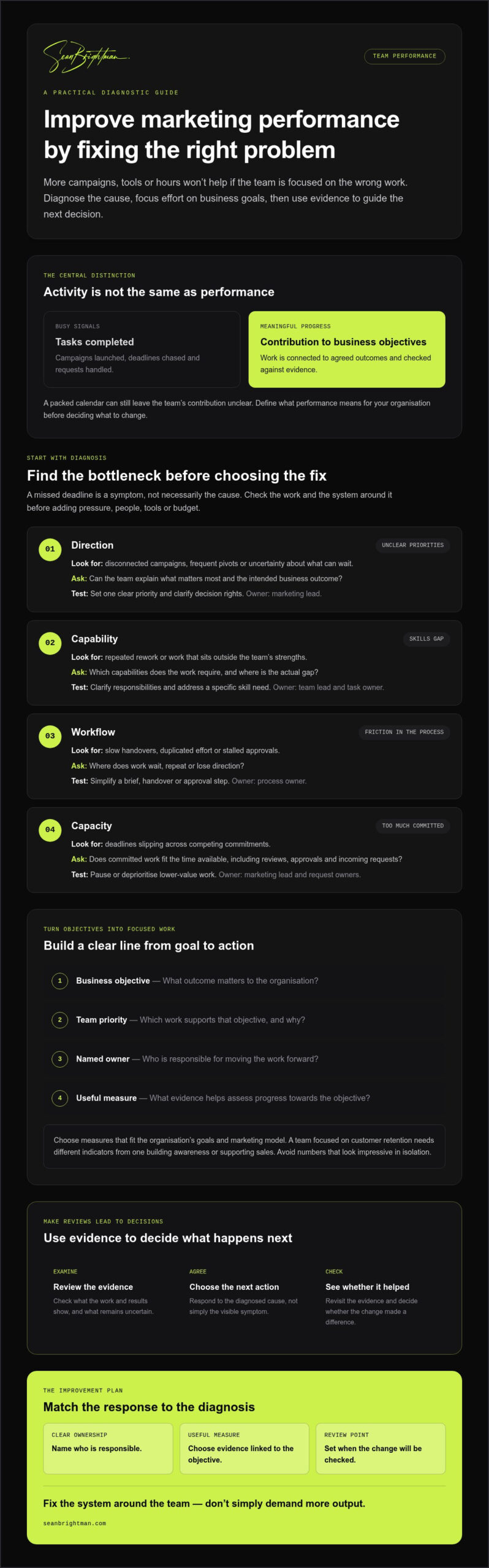
    The team is busy. Campaigns are moving, deadlines are being chased and the request queue keeps growing. Yet if nobody can explain how that work supports business results, more activity won’t solve the problem. To work out how to improve marketing team performance, define what performance means for your organisation, then identify the gap between that goal and what the team is delivering.

    Marketing performance isn’t a tally of tasks completed or campaigns launched. It’s the team’s contribution to agreed business objectives. The discipline of Marketing management covers the analysis, planning, implementation and control of marketing programmes. Apply that thinking to your team: connect work to a business outcome, check whether it’s being delivered, then assess what the evidence shows.

    Separate symptoms from causes. A missed deadline is a symptom. The cause might be conflicting priorities, unclear approvals, a capability gap or insufficient time. Changing people, buying tools or adding budget before checking the cause risks treating the visible problem while the real one remains.

    What does strong marketing team performance actually look like?

    Strong performance starts with a small number of current business objectives that marketing can influence. The team should be able to explain which priorities support those objectives and why. Ownership is clear, delivery is dependable, and decisions respond to evidence rather than habit or the loudest request.

    Measures depend on the organisation’s goals and marketing model. A team focused on customer retention needs different indicators from one building awareness or supporting sales. Choose measures that help assess progress towards the agreed objective, not numbers that look impressive in isolation.

    How can you tell whether the problem is strategy, skills or capacity?

    Start with questions, not assumptions. Ask each team member to name the priorities and explain why they matter. Compare the capabilities those priorities require with the team’s current skills and responsibilities. Then compare available time with committed work, including reviews, approvals and incoming requests.

    Use this quick diagnostic before proposing a restructure or new investment:

    • Direction: Can the team explain what matters most and what can wait?
    • Capability: Are the necessary skills available, or is a specific gap blocking delivery?
    • Capacity: Does the workload fit the time available, or are priorities routinely competing?
    • Evidence: Can the team connect its work to outcomes and identify what remains uncertain?

    Test the answers against actual work and results. If priorities conflict, clarify direction first. If one skill is missing, identify that gap before concluding the whole team needs to change. If capacity looks tight, check whether lower-priority work can stop. Diagnose first, then choose the intervention.

    Find the performance bottleneck: direction, skills, workflow or capacity

    A missed target doesn’t automatically mean someone failed to perform. The cause may sit upstream: priorities keep changing, a task lacks a clear brief, approvals stall or the team has more work than available time. Pinpoint the constraint before adding training, headcount or another tool.

    Use this comparison to focus your investigation. Choose one small change to test, then check whether it removes the obstacle.

    Symptom Question to investigate Action to test Owner
    Disconnected campaigns or frequent pivots Can the team explain the audience, offer and intended business outcome? Set one clear priority and decision rights. Marketing lead
    Repeated rework or work outside the team’s strengths Which capabilities does the work require, and where is the actual gap? Clarify responsibilities; address a specific skill need. Team lead and task owner
    Slow handovers, duplicated effort or stalled approvals Where does work wait, repeat or lose direction? Simplify a brief, handover or approval step. Process owner
    Deadlines slipping across competing commitments Does committed work exceed the time available? Pause or deprioritise lower-value work. Marketing lead and request owners

    Is the team executing without a clear strategic direction?

    Ask team members to describe the target audience, offer and business outcome in their own words. If their answers conflict, or campaigns pull in different directions, the issue may be leadership and alignment rather than execution. Frequent priority changes and unclear decision rights are further clues.

    Use a focused planning process to connect strategic choices to practical priorities. The strategic brand roadmapping guide explores how to turn direction into a plan. If senior oversight is missing, fractional CMO leadership is one option to consider.

    Are skills and workflows matched to the work?

    Map a recurring task from brief to delivery. Note the skills it needs, each handover and every approval. If capable people are reworking vague briefs or waiting for decisions, fix the process before prescribing training. If the workflow is clear but a specific skill is missing, address that capability gap directly.

    Check capacity separately. Compare actual commitments with available time, including unplanned requests and review work. A team that can’t protect time for agreed priorities may need fewer competing demands, not a performance warning.

    How people communicate can reveal hidden friction. The New Science of Building Great Teams examines team interaction, a useful reminder to look beyond task lists and inspect how decisions and handovers happen. To improve marketing team performance, fix the constraint, not just the visible symptom.

    Set sharper priorities and measures that improve marketing team performance

    Once the bottleneck is clear, turn the diagnosis into a working agreement. A priority without an owner is a wish. A metric without a business outcome is noise. This five-step process shows how to improve marketing team performance by aligning the work, accountability and evidence.

    • 1. Agree the outcome. Start with a current business objective, such as improving customer retention or supporting sales of a particular offer. Be clear about what success would mean to the organisation.
    • 2. Choose the priorities. Select the marketing work most likely to contribute to that outcome. Keep the list short enough for the team to act on, and state what won’t be prioritised.
    • 3. Assign owners. Give each priority one accountable owner, even if several people contribute. Name who approves the work and who resolves clashes between requests.
    • 4. Select measures. Pair a leading indicator the team can influence with a lagging outcome that shows wider impact. For example, track a relevant step in the customer journey alongside the resulting change in enquiries or retention, where those outcomes fit the objective.
    • 5. Set a review point. Agree when to check progress and what decision the evidence should inform: continue, adjust or stop.

    If new work becomes a priority, make the trade-off explicit. Decide which existing task will pause or move down the list. Otherwise, priorities multiply while capacity stays fixed.

    Which marketing performance measures should a team track?

    Choose measures that fit the objective, channel and customer journey. A measure useful for assessing awareness may tell you little about retention. Activity counts, such as emails sent or posts published, show what the team did, not whether it contributed to a business outcome.

    Keep a compact scorecard: the objective, priority, owner, one or two leading indicators, the relevant lagging outcome and the next review date. Avoid universal targets. What’s useful depends on the organisation, its starting point and marketing model. Record attribution limits too. If several factors influence an outcome, explain what the data can and can’t show instead of presenting an uncertain connection as proof.

    How should leaders turn priorities into clear ownership?

    For each priority, define the expected result, who is accountable, who can approve delivery and when progress will be reviewed. Team members need room to execute, but decision rights must be clear enough to prevent work stalling in a queue or competing requests quietly taking over.

    Use the scorecard to make decisions, not to police activity. If the indicator moves but the outcome doesn’t, investigate the assumption or the customer journey step. If neither moves, decide whether to change the approach or release capacity. Clear ownership turns measures into action, while review dates stop priorities from drifting.

    How to Improve Marketing Team Performance: A Practical Guide

    Build a review rhythm that turns marketing data into better decisions

    A dashboard won’t improve results by itself. Its value comes from what the team decides after looking at it. Build a recurring review around evidence and action, not a tour of completed tasks.

    • Prepare the evidence: Bring the agreed measures, relevant context and any known data limitations.
    • Discuss the variance: What changed against the expected result? What might explain the difference?
    • Decide the action: Continue, adjust, pause or run a limited experiment to test an uncertain assumption.
    • Assign ownership: Record who will act and by when.
    • Revisit: Check the action and its results at the next review, then update the plan.

    Keep the discussion focused on the work and the evidence. A missed target isn’t a verdict on an individual; it’s a reason to investigate. If you need to discuss someone’s development or performance, do that separately and privately, with the right context. Mixing the two can turn a useful review into a meeting people attend to defend themselves.

    How can a marketing performance review avoid becoming a status meeting?

    Ask three questions: what changed, what does the evidence suggest, and what decision is now required? Skip updates everyone can read beforehand. Record the decision, action, owner and review date so the learning doesn’t disappear when the meeting ends.

    Before adding work, check whether current priorities still fit business needs. If the cause of a result is uncertain, run a contained experiment with a clear hypothesis and review point. This creates a chance to learn without committing the team to a large change based on a hunch. Better decisions, not more reporting, are how to improve marketing team performance.

    When should you bring in senior marketing leadership?

    Consider additional senior direction when no one clearly owns strategy, prioritisation or accountability. A Fractional CMO provides part-time senior marketing leadership. The role is to set direction and create priorities, ownership and review mechanisms, not to recruit a full-time leader or replace the team’s execution.

    For a closer look at the model, read the Fractional CMO leadership guide. If your team needs clearer strategic direction and accountability, explore Fractional CMO leadership as one option.

    Turn the diagnosis into a focused improvement plan for your marketing team

    A diagnosis only matters if it changes what happens next. Turn the evidence into a small plan: name the bottleneck, choose an intervention that addresses it, assign an owner, decide how you’ll measure progress and set a review date. That’s how to improve marketing team performance without defaulting to another tool, a new hire or simply more campaigns.

    Keep the team responsible for execution. Strategic guidance can sharpen direction and create accountability, but it shouldn’t replace the people doing the work. Make that boundary clear in the plan from the start.

    What should a practical 30-day improvement plan include?

    Choose one or two priorities that address the diagnosed constraint. For example, if approvals stall delivery, test a clearer decision route before investing in more capacity. If the team lacks direction, agree which work supports the current business objective and what can wait. Keep the intervention proportionate to the problem.

    For each priority, record the baseline, the evidence you’ll collect, the person responsible and the date you’ll review progress. A baseline might be the current number of approval stages or the present level of a relevant outcome. Don’t invent a target before you know what the evidence can support.

    • Diagnosis: What is holding progress back?
    • Intervention: What specific change will you test?
    • Owner: Who will lead the action, and who needs to contribute?
    • Measure: What baseline and evidence will show whether it’s helping?
    • Review date: When will you decide to keep, adjust or stop the change?

    At the review, use what the team has learned to make the next decision. If the intervention hasn’t addressed the cause, revise the plan rather than layering on extra work.

    How can strategic marketing advice support the team?

    Roadmapping can turn strategic questions into a structured direction and plan. An advisory retainer can provide ongoing strategic direction and accountability, while the internal team retains ownership of delivery. This can help when no one internally clearly owns priorities or the review process.

    If an outside perspective would help clarify your next move, discuss strategic marketing support. An initial conversation can help you explore whether roadmapping, Fractional CMO leadership or ongoing advice fits the challenge. The aim is a clearer plan and stronger ownership, not a promise of guaranteed results.

    Make your next marketing decision count

    Improving performance doesn’t mean keeping everyone busier. It means identifying what’s blocking progress, choosing priorities that support business goals and giving the team a clear way to measure and review its work. That’s the practical answer to how to improve marketing team performance: fix the cause, then focus effort where it can make a difference.

    If strategy, prioritisation or accountability lacks a clear owner, senior support can help bring structure. Fractional CMO services provide part-time marketing leadership, while roadmapping and advisory support can turn strategic questions into direction, ownership and review. Where a diagnosed workflow issue calls for it, AI consulting focuses on practical marketing implementation.

    Discuss a clearer strategic direction for your marketing team and explore what kind of support fits your needs. Your team already has the capacity to make progress. Give it a sharper plan and a clear next step.

    Frequently Asked Questions

    How can I improve marketing team performance?

    Start by identifying what’s limiting results, then match your response to that cause. Check whether the team has clear priorities, the skills and time to deliver them, and a workable process. Agree the business outcome, assign an owner and choose evidence to review. The best way to improve marketing team performance isn’t to demand more activity; it’s to remove the obstacle stopping valuable work from contributing to agreed goals.

    What are the most important marketing team performance measures?

    Choose measures that reflect the business objective, channel and stage of the customer journey. Pair a leading indicator the team can influence, such as completing a relevant customer journey step, with a lagging outcome, such as enquiries or retention where appropriate. Campaigns launched or posts published show activity, not commercial contribution. Record attribution limits clearly, and avoid targets that aren’t grounded in your organisation’s context.

    How often should marketing team performance be reviewed?

    Review progress often enough to make timely decisions, but don’t create meetings that outpace the evidence. A regular operational check-in can surface delivery blockers, while a broader review can assess whether priorities and outcomes still fit business needs. Set the rhythm around the pace of your work and how quickly useful data becomes available. Every review should end with a decision, an owner and a date to revisit it.

    Can a marketing team improve performance without hiring more people?

    Yes, if the main constraint isn’t a genuine lack of capacity or capability. Clarify priorities, remove low-value work, reduce unnecessary handovers or address slow approvals before assuming you need another hire. Check how much time goes to unplanned requests and rework. If the workload still exceeds available capacity after those changes, you’ll have stronger evidence to decide whether additional resource is needed.

    Why is my marketing team busy but not getting results?

    Activity may be disconnected from business priorities, or the team may lack the direction, workflow or capacity to turn effort into outcomes. Frequent changes, unclear briefs and delayed decisions can keep people occupied without moving important work forward. Trace activities to their intended business objective, then inspect where delivery gets stuck. Also check whether your measures show outcomes or merely count tasks completed.

    Should I use a Fractional CMO to improve marketing team performance?

    A Fractional CMO may help when your organisation needs senior marketing direction but lacks clear strategic ownership or leadership capacity. The role provides part-time senior leadership to shape priorities and accountability; the internal team remains responsible for execution. It isn’t a recruitment service or a substitute for advertising execution. First identify the leadership gap, then decide whether part-time strategic oversight fits the need.

    How do you set realistic goals for a marketing team?

    Start with a current business objective, then define the marketing contribution the team can reasonably influence. Check the baseline, available skills and capacity, and the time needed for evidence to emerge. Set a leading indicator for progress alongside the relevant business outcome, and name an owner and review date. Avoid copying targets from another organisation; realistic goals depend on your starting point, model and resources.

  • Marketing Planning Process for SMEs: A Practical 2026 Guide

    Marketing Planning Process for SMEs: A Practical 2026 Guide

    Your marketing plan shouldn’t be a document you write once and ignore. A practical marketing planning process for SMEs is a short decision cycle: set priorities, take action, check the evidence and adjust. It’s not another list of tactics to squeeze into an already packed week.

    If your marketing feels scattered or reactive, you’re not short of ideas. You need a clearer link between what the business wants to achieve and what your team can realistically deliver. With limited time and budget, trying to reach everyone on every channel can quickly waste effort.

    This guide will help you build a focused plan your small business can execute, measure and adapt. You’ll connect marketing priorities to commercial goals, choose the audiences and channels that deserve attention, and turn decisions into practical actions with owners and measures. You’ll also set a review rhythm to help you spot what’s working, what isn’t and when to change course. The result isn’t a strategy that gathers dust. It’s a working plan your team can use to make better decisions week by week.

    Key Takeaways

    • The marketing planning process for SMEs should connect commercial goals to a short cycle of decisions, actions and reviews, not end with a document.
    • Start with business priorities, evidence and constraints before choosing audiences, setting objectives or brainstorming campaigns.
    • Compare potential channels by audience fit, evidence, effort, team capability and how easily you can measure results.
    • Turn priorities into clear actions with an owner, deadline and required inputs, then set a review rhythm that fits your team and buying cycle.
    • Run planning internally when direction and accountability are clear. Consider a focused roadmap or senior advisory support when they aren’t.

    What should an SME marketing planning process actually produce?

    A marketing planning process for SMEs is a repeatable way to connect business goals with marketing choices, practical actions, clear ownership and regular reviews. It should help your team decide what to do, why it matters, who will do it and how you’ll judge progress. The output isn’t a polished document to file away. It’s a working set of decisions that can change when evidence or business priorities change.

    The connection matters. If the business needs more repeat purchases, marketing priorities might focus on keeping in touch with existing customers. That choice should shape the activity, such as a planned email programme, and the measure, such as repeat enquiries or orders. A plan makes the reasoning visible, so activity isn’t mistaken for progress.

    Keep the plan proportionate. A founder-led business with a long sales cycle has different capacity, customer relationships and measurement needs from a growing team selling directly online. Build around your sales model, available skills and current growth stage. Use enough structure to make decisions and follow through, not an enterprise-sized template that creates unnecessary admin.

    How is a marketing plan different from a marketing strategy?

    Strategy sets direction: which audience to prioritise, how the business wants to be positioned and where it will focus. Marketing strategy provides useful context for that higher-level role. Planning turns those choices into work the team can carry out, with owners, resources, measures and review points.

    For example, a small consultancy might focus on established businesses that need specialist advice. Its plan could assign someone to refine the website’s service pages, prepare useful email content and record relevant enquiries. Strategy says where to compete; the plan sets out the next steps.

    What belongs in a small-business marketing plan?

    Include the decisions and details your team needs to act, without copying a large organisation’s paperwork. A useful plan covers:

    • Objectives: the business outcome marketing should support and how you’ll measure it.
    • Priority audiences and positioning: who you want to reach and why they should choose you.
    • Channels and planned activity: where you’ll show up and what you’ll do there.
    • Owners and resources: who is responsible, plus the time, skills and budget available.
    • Assumptions and review dates: what you’re relying on and when you’ll check whether it still holds.

    Keep the detail usable. If one person owns several tasks, make the workload realistic and the responsibilities clear. The right plan is one your team can understand, deliver and revisit.

    How to build an SME marketing plan: diagnose, choose and set objectives

    Start with the business, not a brainstorm. A marketing planning process for SMEs should begin with the commercial result the business needs, then account for its capacity, constraints and evidence before selecting activity. Otherwise, it’s easy to create a busy plan that doesn’t solve the real problem.

    Turn diagnosis into a planning priority by identifying the commercial outcome you need, the audience most likely to support it and a feasible marketing action you can measure.

    What should an SME review before setting marketing objectives?

    Gather the information you can access: customer feedback, sales patterns, enquiries and results from existing channels. Look for useful signals. Are enquiries coming from the customers you want? Which routes appear to bring relevant prospects? Separate what you know from evidence and what you believe as an assumption to test.

    A light-touch SWOT analysis can organise the discussion. Note strengths and weaknesses inside the business, then opportunities and threats in the market. Keep it grounded: a strength might be a clear specialist offer; a weakness could be limited time to create content. SWOT is a prompt for better questions, not proof of what customers want.

    How can small businesses set useful marketing objectives?

    Use your diagnosis to work through these decisions:

    • Business context: Define the commercial priority, such as generating more suitable enquiries or supporting repeat purchases.
    • Evidence: Review available customer, sales and channel information. Record gaps rather than presenting guesses as facts.
    • Audience: Choose the customer group most relevant to that priority.
    • Objective: Set an outcome and timeframe. Apply SMART criteria: specific, measurable, achievable, relevant and time-bound.
    • Choices: Select the positioning, channels and activity that fit the audience and your team’s capacity.
    • Assumptions: Write down what you’re relying on and how you’ll test it.

    For example, a specialist consultancy might aim to increase relevant enquiries from a defined client group by the end of a quarter. It could track qualified enquiries and their sources, measures the team can review and influence. Avoid objectives such as “post more” unless that activity clearly supports a business outcome.

    If the diagnosis raises deeper questions about brand direction or market position, explore strategic brand roadmapping. A focused roadmapping engagement can help clarify choices when internal priorities remain unresolved.

    How should SMEs prioritise audiences, channels and marketing resources?

    Limited capacity makes prioritisation essential. The marketing planning process for SMEs shouldn’t try to cover every audience and platform. It should identify where the business can reach the right people, offer something relevant and learn whether its effort is working.

    How can an SME choose which audience to prioritise?

    Compare potential audiences by their needs, fit with your offer, buying context and how reachable they are. Use customer conversations, sales patterns and enquiry details where available. If you don’t know what a group values or how it makes buying decisions, record that as a gap to investigate, not a fact.

    Choose an initial audience narrowly enough to shape your message and channel choices. For example, “businesses that need advice” is too broad to guide much. A defined group with a shared need gives the team a clearer starting point without pretending other customers don’t matter.

    How should a small team compare marketing channels?

    Assess each channel against the same practical criteria. A simple table can show trade-offs without creating a false sense of precision.

    Criteria Question to ask
    Audience fit Can you reach the priority audience there, in a context that suits your offer?
    Evidence Do customer feedback, enquiries or sales patterns suggest this channel is relevant?
    Effort What time and resources will it take to create and maintain useful activity?
    Capability Does someone have the skills and capacity to do it consistently?
    Measurement access Can you track a useful signal, such as relevant enquiries or customer responses?

    Channel suitability depends on audience behaviour and the business model. A consultancy with a considered buying journey may need a different mix from a retailer whose customers make quicker decisions. Don’t choose a channel just because it’s popular or sounds attractive. Choose it because there’s a reason to believe your audience is there and your team can sustain the work.

    Separate established activity from experiments. Protect activity supported by evidence, then set aside realistic capacity to test one new idea at a time. Define what you’ll learn and when you’ll review it. If processes and systems are the main bottleneck, explore marketing operations planning. If priorities or accountability remain difficult to resolve, senior marketing advisory support may help clarify the next move. Learn more at Sean Brightman’s marketing advisory support.

    Marketing Planning Process for SMEs: A Practical 2026 Guide

    How can an SME turn its marketing plan into accountable weekly action?

    A plan earns its place when someone acts on it. Turn each priority into a task with a named owner, deadline and required inputs. “Improve the website” is too vague. “Update the service page to answer the three questions sales hears most often” gives someone a clear task and a reason to do it.

    Keep the action list manageable. For each task, record:

    • Action: the specific work to complete.
    • Owner and deadline: one person accountable, with a realistic completion date.
    • Inputs: information, decisions or approvals needed to start.
    • Measure: the signal that will show whether the task contributed to the objective.

    The right review rhythm depends on your team and buying cycle. A business with a short sales cycle may be able to assess useful signals more often than one where decisions take longer. Set check-ins that give the team time to act and allow evidence to emerge. Don’t change course just because a task hasn’t produced an immediate sale.

    What should an SME marketing scorecard track?

    Choose a small set of measures tied to your objectives. Where the data supports it, pair leading indicators, such as relevant enquiries or responses to an email, with commercial outcomes, such as qualified opportunities or sales. Activity counts can help you diagnose progress, but they aren’t results by themselves.

    Useful progress measures show whether marketing is moving a business outcome closer, not simply whether the team has stayed busy.

    Google Analytics 4 or a CRM can help, provided tracking is configured appropriately and the team knows what each measure means. If the data is incomplete, say so. A clear limitation is more useful than false certainty.

    When should a small business change its marketing plan?

    At each review, check three things: did the planned actions happen, what evidence emerged and which assumptions have changed? If an action stalled, find out whether the cause was lack of capacity, a missing input or a weak priority. If the business context or customer evidence has shifted, adjust the plan deliberately.

    Record what changed and why. That gives the team a learning trail, rather than forcing it to start from scratch whenever results disappoint. The marketing team accountability page offers a related perspective on keeping attention on results, not activity.

    If priorities or ownership keep slipping despite a clear plan, explore senior marketing advisory support as an option for adding strategic direction and accountability.

    When should an SME get outside help with marketing planning?

    You don’t need a consultant just to write a plan. If the owner or marketing lead can access useful business evidence, make decisions and keep actions moving, the team can run the process internally. Outside support becomes relevant when the same issues keep blocking progress: priorities conflict, nobody clearly owns decisions, or the business can’t agree which audience or direction to back.

    Before seeking input, write down the specific questions you can’t resolve. For example:

    • Which commercial priority should marketing support first?
    • What evidence is missing, and how could the team gather it?
    • Who can approve priorities and keep agreed actions on track?

    This turns “we need help with marketing” into a defined need. It also makes it easier to decide whether you need one-off direction or continuing support.

    Can an SME create a marketing plan without a consultant?

    Yes. A capable owner or marketing lead can start with accessible sales, enquiry and customer information, then build a proportionate plan around the team’s capacity. Keep assumptions visible and review them as you learn. If decisions remain stuck or actions repeatedly lose ownership, the issue may be less about the template and more about direction, authority or accountability.

    What can a Fractional CMO or marketing adviser add?

    A Fractional CMO or marketing adviser can provide senior strategic direction, help focus priorities and support accountability without implying a full-time appointment. A focused, one-off roadmap may suit a business that needs clearer direction; an advisory retainer may fit when leaders want ongoing strategic input. This is strategic guidance, not recruitment or outsourced advertising execution.

    Use this simple decision test:

    • Run it internally when priorities are clear, someone owns the process and the team can act on its decisions.
    • Consider a focused roadmap when the business needs help resolving direction or setting a coherent course.
    • Consider ongoing advice when strategic decisions and accountability need continued attention.

    The marketing planning process for SMEs should stay with the business, even when an adviser contributes. Your team still owns the decisions and delivery. For more detail on continuing strategic support, read the marketing advisory retainer guide.

    If unresolved priorities or ownership are slowing your planning, discuss strategic marketing support with Sean Brightman.

    Put your marketing plan to work

    A useful marketing planning process for SMEs turns commercial priorities into focused choices, owned actions and regular decisions about what to keep or change. Start with evidence, choose audiences and channels your team can realistically serve, then track measures that connect activity to business outcomes.

    The plan doesn’t need to be elaborate. It needs to help your team act consistently and learn from what happens. If direction or accountability remains unclear, the right support can help you move forward without handing over ownership of the business’s decisions.

    Sean Brightman offers senior Fractional CMO leadership and ongoing advisory support. If you need clearer direction before committing to continuing advice, one-off strategic roadmapping is also available.

    Get clear strategic direction for your marketing plan, then put the next practical step on the calendar. You don’t need to do everything at once. Start with a priority your team can act on, measure and improve.

    Frequently Asked Questions

    What are the steps in the marketing planning process for SMEs?

    The marketing planning process for SMEs starts with the business context, then uses evidence to choose audiences, objectives and marketing activity. First, clarify the commercial priority and constraints. Review sales, enquiries, customer feedback and existing channel results where available. Choose a priority audience, set a measurable objective and select activity the team can deliver. Record assumptions, name owners and agree how you’ll review progress and adjust the plan.

    How often should a small business review its marketing plan?

    Review your marketing plan often enough to spot problems and make decisions, but don’t force a universal timetable. The right rhythm depends on your team’s capacity, the type of activity and how long customers take to decide. Check whether planned work is happening, then assess results when enough evidence is available. Revisit the overall direction when business priorities, customer needs or available resources change.

    What should an SME marketing plan include?

    An SME marketing plan should connect a business objective to clear marketing choices and accountable work. Include the outcome and timeframe, priority audiences, positioning, selected channels and planned activity. Name an owner for each action, note the resources and skills required, and choose measures that relate to the objective. Record important assumptions and set review dates. Keep the document lean enough for the team to use and update.

    How much should an SME spend on marketing?

    There’s no single marketing budget that suits every SME. Start with the business objective, the resources available and the cost of delivering the activity you’ve chosen. Separate planned spend from internal time, and consider whether the expected value justifies both. Set a limit the business can sustain, then track spend alongside relevant outcomes. Avoid choosing a budget solely by copying a percentage or figure that doesn’t fit your business model.

    Which marketing channels are best for SMEs?

    The best channel is one that fits your audience, buying journey, offer and team capacity. A business may use search to reach people actively looking for a solution, whilst another may rely more on referrals, email or social media to build relationships. Compare options by audience fit, available evidence, effort, team capability and access to useful measures. Start with a manageable shortlist, then test and review rather than trying to appear everywhere.

    Can a small business create a marketing plan without a consultant?

    Yes. An owner or marketing lead can build a practical plan using accessible sales information, customer feedback and enquiry patterns. Start with a clear commercial priority, document what you know and mark assumptions that need testing. Outside help may be useful if priorities keep clashing, nobody owns decisions or the business can’t resolve its audience and positioning. Write down the unanswered questions first so any support can focus on the real gaps.

    What is the difference between a marketing strategy and a marketing plan?

    A marketing strategy sets direction: which audience to prioritise, how to position the offer and where the business should focus. A marketing plan turns that direction into practical work, including channels, actions, owners, resources and measures. For example, a strategy might prioritise repeat business from existing customers; the plan would specify how the team will communicate with them and how it will assess whether that activity supports the objective.

  • On-demand CMO services: senior marketing direction when you need it

    On-demand CMO services: senior marketing direction when you need it

    What if your business doesn’t need another campaign, but a senior person to decide which marketing moves are worth making? On-demand CMO services can provide strategic direction without a full-time hire. The support should fit the decisions your business faces, not just a job title.

    If marketing activity feels busy but disconnected, advice alone may not be enough. Senior support should bring focus, clarify priorities and make responsibilities visible, rather than leave your team with a polished plan and no one accountable for moving it forward.

    This guide explains what on-demand CMO support can cover and how it differs from a one-off roadmap, an advisory retainer or Fractional CMO leadership. You’ll learn how to choose a model that suits your needs, what outcomes and responsibilities to agree upfront, and how to assess whether the support is working. Start by identifying the marketing decision you need help with, then match the level and duration of support to that need.

    Key Takeaways

    • Use on-demand CMO services to address a specific business need with senior marketing direction, rather than hiring against a title.
    • Choose between a focused roadmap, ongoing advice and Fractional CMO leadership by assessing the decisions and support required.
    • Compare a CMO, consultant and agency by who will lead, provide continuity and deliver specialist work.
    • Before engaging support, define the business challenge, the decisions to make and how you’ll recognise progress.
    • Match the support to the job: roadmapping for a clear plan, an advisory retainer for ongoing direction, or Fractional CMO leadership for senior input.

    What are on-demand CMO services, and when does a business need them?

    Marketing can be busy without being well led. Campaigns, content and new ideas keep moving, but nobody owns the priorities, connects activity to business goals or makes the hard calls. That’s the gap on-demand CMO services are designed to address: access to senior marketing direction when the business needs it, without assuming it needs a full-time executive.

    The support can take different forms: a focused roadmap, ongoing strategic advice or Fractional CMO leadership working more closely with the team. The right option depends on the decisions to make and the level of responsibility required, not a standard package or fashionable job title.

    A CMO’s role is broader than managing promotional activity. A Chief Marketing Officer (CMO) typically leads marketing strategy and helps align it with the organisation’s wider direction. On-demand support brings some of that senior perspective in a form shaped around the business’s needs.

    What does an on-demand CMO actually do?

    A CMO-level adviser connects business goals with marketing priorities. That can mean sharpening brand positioning, setting a plan, directing an existing team and helping leaders decide where to focus. It doesn’t automatically mean carrying out every marketing task. Strategic leadership sets the direction; delivery is a separate responsibility to agree.

    Make the boundaries clear upfront. Decide which decisions the adviser will lead, who owns implementation, how they’ll work with the leadership team and what evidence will show progress. Clear ownership helps prevent recommendations from landing in a document with no one responsible for acting on them.

    Which signals suggest you need senior marketing direction?

    Look for friction in the system, not just a lack of activity. Work may be scattered across channels, teams may be unsure who makes the final call, or every new idea may displace the previous priority. The result is motion without a shared plan.

    Another common shift comes as a business grows beyond founder-led marketing. The founder may have set the early direction, but a growing team now needs consistent priorities, clearer decision-making and someone to connect marketing choices to business objectives. If you’re weighing up this wider model, explore the fractional CMO revolution.

    • Scattered activity: projects compete for time without a clear order.
    • Unclear ownership: decisions stall or responsibility shifts between people.
    • Founder bottlenecks: the team waits for direction the founder no longer has time to provide.

    These signals point to a need for clearer leadership. They don’t automatically mean you need the same level or duration of support as another business.

    How on-demand CMO services work: choose the right level of support

    The right model depends on what needs deciding, how often those decisions arise and who will act on them. A one-off roadmap can set direction. An advisory relationship can help leaders revisit priorities. Fractional CMO leadership brings senior direction closer to the marketing function. Match the cadence to the work rather than assuming there’s a universal template.

    Before agreeing a model, separate strategic responsibility from delivery. An adviser may set priorities or guide the team, while your staff or external delivery partners carry out agreed work. Name who owns each decision, task and follow-up so the plan doesn’t become a substitute for clear accountability.

    Focused roadmap
    Trigger: The team needs a clearer plan. Focus: Priorities, positioning and direction. Ownership to agree: Who will put the plan into action.

    Ongoing advisory
    Trigger: Strategic decisions keep coming up. Focus: Regular guidance and challenge. Ownership to agree: Which choices the adviser informs and which leaders make.

    Fractional CMO leadership
    Trigger: The marketing function needs sustained senior leadership. Focus: Direction, team alignment and accountability. Ownership to agree: The adviser’s decision-making role and what stays with the internal team.

    When is a one-off marketing roadmap enough?

    A roadmap may fit when leaders understand the business challenge but need help choosing priorities and turning them into a structured plan. For example, a team with several competing growth ideas could use a roadmap to agree what to focus on, what to defer and how marketing supports business goals.

    A plan creates direction, not automatic implementation. Your team or delivery partners still need to take responsibility for agreed actions. For a deeper planning guide, read about strategic brand roadmapping.

    When does ongoing CMO or advisory support make sense?

    Choose ongoing support when important decisions recur and the team needs a regular senior perspective. An advisory retainer offers guidance and challenge to business leaders. Fractional CMO leadership takes a more embedded role in directing the marketing function. Clarify the expected cadence, access and decision rights rather than assuming the titles mean the same thing.

    Sean Brightman offers roadmapping, advisory retainers and Fractional CMO leadership as distinct forms of support. If you’re weighing which fits, explore the marketing advisory retainer and Sean Brightman’s marketing support.

    On-demand CMO services vs a full-time hire, consultant or agency

    These options address different gaps. A business may lack someone to set marketing direction, a specialist to resolve a defined problem, or the hands-on capacity to deliver work. Identify what’s missing, then agree who owns decisions and follow-through. Fill the leadership gap with a CMO, the expertise gap with a consultant, and the delivery gap with an agency.

    On-demand CMO support or a full-time CMO?

    On-demand CMO services can suit a business that needs senior judgement for a defined challenge or whose need for leadership may change over time. This arrangement can provide strategic input without adding a permanent executive role, but it won’t automatically cover every responsibility a full-time CMO might hold.

    A permanent CMO may be more appropriate when the business needs sustained, day-to-day executive leadership: someone consistently embedded with the leadership team, accountable for the marketing function and closely involved in decisions as they arise. The distinction isn’t simply flexible versus permanent. It’s whether the business needs periodic senior direction or a dedicated executive presence.

    On-demand CMO, marketing consultant or agency?

    A CMO-level adviser connects marketing choices to business priorities and helps set direction. A consultant may focus on a specific question, such as positioning or a particular marketing challenge. An agency commonly brings specialist delivery capacity, such as carrying out agreed campaign or creative work. These roles can complement each other, but they aren’t interchangeable. Sean Brightman’s work centres on strategic leadership and advisory, not advertising execution.

    Operational problems call for a closer look at how work is organised and supported. If processes, roles or systems are the sticking point, explore marketing operations and scalable growth systems.

    Full-time CMO: Choose this when the business needs sustained internal executive leadership. Agree the role’s authority, team responsibilities and connection to business decisions.

    On-demand CMO support: Choose this when senior marketing direction is needed without assuming a permanent role. Set the scope, decision rights and continuity required.

    Consultant: Choose this when a specific area needs expert advice. Define the question to resolve and how the team will use the recommendations.

    Agency: Choose this when the business needs specialist delivery capacity. Set the brief, internal point of contact and who approves the work.

    Don’t compare options by job title alone. Value depends on scope, seniority, internal capacity and the business requirement. Start with the gap, then agree responsibilities and evidence of progress before work begins. To explore Sean Brightman’s strategic support, visit Sean Brightman’s marketing services.

    On-demand CMO services: senior marketing direction when you need it

    How to assess on-demand CMO services before you engage

    A strong engagement starts with a clear brief, not a list of requested tasks. Before comparing on-demand CMO services, work through four points: the business challenge, the decisions senior support must help resolve, the team available to act, and the level of guidance you need. For example, a team may have people to deliver marketing but lack agreement on which audience or priority to focus on. That calls for a different brief from one where nobody owns the marketing function.

    Agree the intended outcome and how you’ll assess progress before discussing activity or deliverables. Otherwise, a full calendar of meetings and recommendations can look like progress without showing whether the underlying problem is being addressed.

    What should the brief and success measures include?

    Keep the brief grounded in your business. State the priority, the current constraint and the decisions you expect senior support to inform. Then choose indicators that fit the work. A positioning challenge might call for agreement on the target audience and message; a planning brief might focus on whether the team has clear priorities and owners. There’s no universal benchmark that suits every engagement.

    Set review points to check what has changed, what remains unresolved and what the team will do next. Ask how recommendations will become decisions, and what evidence the adviser will use to assess progress. Be cautious of broad promises without a clear link to your challenge, or reports that count activity without showing what it means for the business.

    How should responsibilities and accountability be agreed?

    Write down who owns each part of the work. Clarify who sets or advises on strategy, who handles internal delivery, whether specialist execution sits with another partner, and who makes final business decisions. Agree access to relevant information, the meeting cadence and how urgent decisions will be raised between scheduled discussions.

    Accountability works both ways. The adviser should be clear about their responsibilities and reporting; your leadership team should identify who will make decisions and act on recommendations. If the brief is still fuzzy, explore strategic marketing direction as a first step towards defining the support your business actually needs.

    How Sean Brightman’s on-demand CMO services turn uncertainty into direction

    Senior marketing support should fit the problem, not force your business into a pre-set package. Sean Brightman’s work centres on strategic direction, brand positioning, marketing systems and accountability. It’s advisory and leadership, not recruitment or advertising execution. The useful question is which decision or gap needs attention now, and what level of support would help address it.

    Which Sean Brightman service fits the problem?

    Roadmapping suits a leadership team that needs a structured plan for marketing and brand direction. It helps clarify priorities, but doesn’t automatically include ongoing implementation.

    An advisory retainer may fit when business owners face recurring marketing decisions and want continued guidance and accountability. Fractional CMO support is for a business that needs part-time senior marketing leadership, with a more active role in setting direction and aligning the marketing function.

    If your challenge is specifically how to integrate AI into marketing systems in a practical way, AI consulting may also be relevant. It isn’t a default add-on; the need should come from the business problem.

    What happens after the first conversation?

    Start with the facts that shape the decision: what the business is trying to achieve, where marketing is stuck, what the team can own internally and which choices need senior input. A useful discussion should help distinguish a need for a focused plan from a need for ongoing advice or embedded leadership.

    Then agree the scope around the actual need. Clarify responsibilities, decision rights, how recommendations will be reviewed and what evidence will show progress. The goal isn’t to buy activity for its own sake. It’s to make sure the support addresses the uncertainty that prompted the conversation, without assuming one model fits every business.

    If marketing priorities feel scattered or the team lacks a clear direction, discuss your marketing priorities with Sean Brightman and identify a suitable next step.

    Turn marketing uncertainty into a clear next step

    The right senior support starts with the gap you need to fill. If your team needs a clear plan, roadmapping can set direction. If key decisions keep recurring, an advisory retainer can provide ongoing guidance. If marketing needs senior leadership, Fractional CMO support offers a more embedded option. The best fit depends on the decisions, responsibilities and follow-through your business needs.

    That’s the practical value of on-demand CMO services: access to strategic direction shaped around your business, without assuming every company needs the same model. Sean Brightman offers one-off roadmapping, ongoing advisory and Fractional CMO leadership. AI consulting is also available when practical AI integration is the challenge.

    Start by naming the marketing issue that’s slowing decisions or scattering effort. Then consider your priorities, team capacity and the level of support that could bring focus. Discuss your marketing priorities with Sean Brightman and identify a suitable next step. Clearer direction starts with a sharper question.

    Frequently Asked Questions

    What are on-demand CMO services?

    On-demand CMO services give a business access to senior marketing direction without automatically requiring a full-time executive. The support can take different forms, from a one-off roadmap to regular strategic advice or part-time leadership of the marketing function. The right form depends on the decisions the business needs help with, the team available to act and how much ongoing leadership is required.

    Is an on-demand CMO the same as a Fractional CMO?

    Not always. “On-demand CMO” is a broad description for senior marketing support accessed as needed, whilst “Fractional CMO” usually refers to part-time marketing leadership. A business might use a focused roadmap or advisory support without needing an embedded leadership role. Agree the adviser’s responsibilities, decision-making authority and level of involvement rather than relying on the title alone.

    Can a small business use on-demand CMO services?

    Yes, if the business has a clear need for senior marketing direction and a way to act on it. A small business might need help setting priorities, aligning marketing with business goals or guiding an existing team, without requiring a permanent executive role. Consider whether the available team can carry out agreed work, and define which decisions and outcomes the support should address.

    How do I choose between an on-demand CMO and a marketing agency?

    Choose based on the gap. An on-demand CMO focuses on senior direction, priorities and leadership; a marketing agency commonly provides specialist delivery capacity. If you know what work needs doing but lack the people to do it, an agency may fit. If the work itself lacks direction, clarify the strategy first. Some businesses may need strategic guidance and separate delivery support, with responsibilities agreed between them.

    What should an on-demand CMO engagement include?

    Agree the business challenge, objectives, scope and responsibilities before work begins. Clarify which decisions the CMO will lead or advise on, who owns internal delivery, what specialist work sits elsewhere, and who makes final business decisions. Set expectations for access to the team, meeting cadence, review points and how recommendations will be handled. The details should reflect your needs, not a standard template.

    How can I tell whether on-demand CMO support is working?

    Check progress against indicators agreed at the start, not activity alone. Depending on the brief, this might include clearer marketing priorities, named owners for key actions or faster resolution of a specific strategic decision. Review what has changed, what remains blocked and what the team will do next. Don’t treat more meetings or recommendations as proof of impact without connecting them to the agreed objectives.

    Does an on-demand CMO provide marketing execution?

    Not necessarily. CMO-level support centres on strategy, leadership and decision-making; execution may remain with your internal team or a specialist delivery partner. Confirm this before engaging, including who will carry out agreed work and how progress will be tracked. Sean Brightman’s offering focuses on strategic leadership and advisory, including Fractional CMO support, roadmapping and ongoing advice, rather than advertising execution.

  • Marketing Engines for Predictable Growth: CEO Guide 2026

    Marketing Engines for Predictable Growth: CEO Guide 2026

    Marketing isn’t a creative experiment. It’s a mechanical function. If your current strategy feels like a series of expensive “random acts” with no clear ROI, you’re not alone. Most UK CEOs are watching nearly 8% of their revenue vanish into a black hole of unmeasured campaigns and vague promises. You’re likely exhausted by the lack of accountability and the constant noise of AI tools that don’t actually move the needle. Building a marketing engine for predictable growth requires a shift from chasing trends to architecting a system. It’s about moving from “hope” to “hardware.”

    This guide cuts through the fluff. You’ll learn how to stop the bleed and start constructing a growth engine that delivers consistent, documented revenue. We’ll look at the 2026 landscape, from navigating the transparency requirements of the EU AI Act to mastering first-party data in a world without reliable cookies. You’ll get a clear roadmap to turn your marketing department into a well-oiled machine that runs on logic, not luck. It’s time to stop guessing and start engineering.

    Key Takeaways

    • Stop funding “random acts” and start building a marketing engine for predictable growth by treating your strategy as a mechanical architecture rather than a creative experiment.
    • Move beyond AI tool fatigue by integrating structured systems that automate high-volume execution whilst keeping your team focused on high-level strategic direction.
    • Recognise that agencies are the fuel for your engine, not the architects; you need a documented roadmap and internal systems before you outsource execution.
    • Leverage the Fractional CMO model to secure senior-level accountability and strategic oversight without the overhead or recruitment delays of a full-time executive hire.
    • Transition from a “more leads” mindset to a focus on unit economics and closed-loop attribution to ensure every pound of budget generates a measurable return.

    The Death of Random Acts of Marketing

    Most UK marketing departments are running on caffeine and chaos. They mistake motion for progress. “Random Acts of Marketing” are tactical lunges made without a strategic foundation. It’s a LinkedIn post here, a sporadic newsletter there, and a disconnected ad campaign that nobody tracked. It is activity without strategy. In 2026, with average marketing budgets flatlining at roughly 7.7% of revenue, you cannot afford to “spray and pray.”

    The “more leads” mindset is the primary trap. CEOs often demand more volume, but volume on a broken system is just expensive noise. If your conversion rates are poor, doubling your lead flow simply doubles your waste. Predictable growth isn’t a lucky strike; it’s the mechanical output of a structured engine. You don’t need more ideas. You need a machine that processes capital into revenue with clinical precision.

    Activity vs Impact: Why Your Budget is Bleeding

    Busy-work is the silent killer of ROI. Your team might be “busy” producing content, but if that content doesn’t map to a specific stage of the buyer journey, it’s just fluff. You need a revenue signal, not just social media engagement. Identifying “busy-work” is simple: if a task doesn’t directly contribute to lead quality or pipeline velocity, it’s a distraction.

    Stop hiring junior executioners to “do the marketing” before you have a blueprint. A junior cannot build a machine; they can only pull levers. Without a senior architect to design the workflow, you’re just paying for someone to make noise more efficiently. You must prioritise high-level strategy over low-level execution if you want to stop the bleed.

    The Predictable Growth Myth

    Scaling spend on a broken system doesn’t bring more revenue; it just accelerates failure. Building a marketing engine for predictable growth requires you to fix the plumbing before you turn on the taps. This means integrating robust marketing automation systems to handle lead scoring, CRM integration, and nurture workflows. If these aren’t in place, your data is a lie.

    True predictability relies on sharp market positioning that creates demand before the “buy” button is even clicked. You must move from hope-based marketing to data-led machinery. In this model, every £1 spent has a clear, documented path to a return. This isn’t about being “creative.” It’s about being architectural. When the engine is built correctly, growth becomes a choice, not a gamble.

    Defining the Architecture: What is a Marketing Engine?

    A marketing engine is a functional assembly, not a list of creative ideas. It consists of three core components: Strategy, Systems, and AI. Think of strategy as your blueprint, systems as your plumbing, and AI as the supercharger. Most CEOs focus on the fuel, such as ad spend, whilst ignoring the engine’s internal mechanics. This is a mistake. Building a marketing engine for predictable growth requires you to treat your go-to-market plan like a piece of industrial hardware. When you commit to building a marketing engine for predictable growth, you are moving away from the chaos of “random acts” and toward a system that produces revenue by design.

    Strategy: The Engine’s Blueprint

    Positioning is often dismissed as “fluff” by technical leaders. This is a tactical error. Sharp positioning is the lever that creates market demand. It defines exactly who you serve and why your competitors are irrelevant. You need a Strategic brand roadmapping process that identifies the specific triggers that make buyers act. In a saturated 2026 market, your Unique Selling Proposition must be visceral. It should be something your customers covet. Without this blueprint, your execution team is just guessing.

    Operations: The Engine’s Machinery

    Operations are the physical plumbing of your growth engine. This is where building a predictable growth engine becomes an engineering task. Your CRM, lead scoring, and automated workflows must function without manual intervention. Prioritise a clean, integrated tech stack over a collection of “shiny object” tools. If your tools don’t share data, you have silos, not a system. Mechanical alignment between marketing and sales is non-negotiable. Marketing generates the pressure; sales directs the flow. If you want to scale, you must invest in a scalable growth engine built on operational discipline.

    AI acts as the supercharger in this architecture. It provides predictive power, identifying which leads are likely to close before a human ever looks at the data. It handles the high-volume execution tasks that used to bog down your team. But remember: AI cannot fix a broken strategy. It only amplifies what is already there. If your architecture is sound, AI makes it unstoppable. If you’re ready to stop guessing, consider an advisory retainer to help audit your current machinery.

    How to Build Your Growth Engine: A 5-Step Roadmap

    Forget growth hacks. They are a temporary fix for a permanent problem. You need a blueprint, not a shortcut. Building a marketing engine for predictable growth starts with a cold, hard look at your current waste. Most UK firms are burning budget on activities that look good in a report but never hit the bank account. You must move from “feeling” to “fixing.”

    The roadmap is a five-step mechanical process:

    • Audit the mess: Identify every leak in your funnel.
    • Define the strategy: Lock in your positioning and messaging.
    • Architect the systems: Build the data feedback loops.
    • Integrate AI: Automate the low-value execution tasks.
    • Install leadership: Put an architect in charge of the machinery.

    Phase 1: The Strategic Audit and Roadmap

    Perform a brutal efficiency audit on your budget. If you can’t tie an activity to a revenue signal, stop doing it. This isn’t about being mean; it’s about being effective. You need a 90-day plan for immediate marketing transformation. This plan should prioritise fixing the “plumbing” before you buy more “water.” Building a marketing engine for predictable growth requires you to value long-term stability over short-term spikes.

    Set KPIs that actually correlate with business value. McKinsey’s research on marketing-driven growth shows that companies integrating data with creative purpose grow revenue twice as fast as their peers. Don’t track “brand awareness” if you can’t track its impact on pipeline velocity. Every metric must justify its existence on your dashboard.

    Phase 2: Building the Infrastructure

    Select the right tools for your specific business model. Do not buy a complex software suite just because it’s popular. A bloated tech stack is an operational liability that creates data silos. Your infrastructure must be integrated, ensuring data flows from the first click to the final sale without manual intervention. This is where you turn your CRM from a digital Rolodex into a revenue generator.

    Document every process. The engine must not be person-dependent. If your marketing fails because a key employee leaves, you don’t have an engine. You have a hostage situation. Organise the team for maximum output and clear accountability. In a well-oiled machine, every team member owns a specific metric. When everyone knows exactly which lever they are responsible for pulling, the machine runs smoothly. Once the infrastructure is solid, layer in AI to handle high-volume tasks. This frees your team to focus on the next strategic pivot whilst the engine maintains its own velocity.

    Marketing Engines for Predictable Growth: CEO Guide 2026

    AI Consulting: Supercharging the Machinery

    Most CEOs are stuck “playing” with ChatGPT. They treat it like a magic trick rather than a tactical component. This is how you fail. To win in 2026, you must transition to AI consulting for growth. This means integrating intelligence into the very fabric of your funnel. AI is the supercharger that makes your engine run faster with less manual effort. It handles the high-volume execution whilst your team focuses on the blueprint. Building a marketing engine for predictable growth is impossible without this level of automation.

    AI for Marketing Efficiency

    Content production used to be a labour-intensive cost centre. Now, it’s an automated workflow. Research indicates that 40% of marketing leaders achieve ROI via reduced costs and agency rationalisation through AI. You can scale your lead processing capacity without hiring more staff. AI isn’t just for writing copy. Use it for deep market research and competitor analysis. It scans thousands of data points to find the revenue “signal” your competitors are missing. Implementing AI-driven lead scoring ensures your sales team only talks to buyers, not tyre-kickers. This saves time. It saves money. It creates precision.

    Automating Accountability

    You need a real-time “health check” of your machinery. AI-powered dashboards don’t just report numbers; they identify bottlenecks. If leads aren’t converting, the AI tells you why. It might be a messaging mismatch or a technical glitch in the plumbing. This removes the guesswork from your weekly briefings. It replaces “I think” with “I know.” The machine identifies the failure point before it becomes a crisis. Building a marketing engine for predictable growth requires this level of clinical oversight. An Advisory Retainer ensures a senior strategist is monitoring these AI outputs, making sure the machine stays on track. Don’t let your AI run wild. Guide it with senior leadership. If you are ready to stop playing with prompts and start engineering results, book an AI Consulting session to audit your stack.

    The Driver: Leadership vs Execution

    An agency cannot build your engine. They are fuel, not the machine. If you outsource your entire strategy to an external execution house, you are abdicating your responsibility as a CEO. You need an internal architect to design the systems we have discussed. Building a marketing engine for predictable growth requires senior oversight that understands your board-level objectives. Agencies are specialists in channels. They are not specialists in your business architecture. Specialists create silos. Architects create systems. If you want a well-oiled machine, you need someone who owns the blueprint, not just the tools.

    The Fractional CMO: The Engine’s Architect

    You need a strategist, not a “head of marketing” who just manages social media. In 2026, the Fractional CMO revolution has changed the game for UK scale-ups. You get senior-level authority without the £150,000 plus salary of a full-time hire. This is about cost-benefit. You pay for the brain, not the desk space. A Fractional CMO ensures the marketing strategy aligns with your vision. They bridge the gap between high-level theory and the grounded reality of execution. This is senior leadership on demand. It provides the “Chief Architect” role necessary to keep the machinery moving toward a clear ROI. It is about impact, not headcount.

    Maintaining Velocity with Advisory Support

    Building the engine is only half the battle. You have to keep it tuned. A Marketing Advisory Retainer provides the external accountability your team needs to maintain speed. It is easy for internal teams to get bogged down in the day-to-day noise. Quarterly reviews act as a mechanical check-up. They keep the engine tuned for performance and prevent tactical drift. This isn’t just about growth. It is about exit readiness. A documented, mechanical engine is an asset that adds significant value to your business valuation. Investors buy systems, not luck. They want to see a machine that produces revenue regardless of who is pulling the levers.

    If your marketing department currently feels like a series of disconnected parts, it is time to bring in a driver. Stop paying for activity and start investing in an architecture that scales. Ready to build? Book a Strategic Brand Roadmapping session to begin the transformation and turn your marketing into a predictable revenue generator.

    Engineered Growth: From Chaos to Architecture

    Stop treating your marketing budget like a gamble. Predictable revenue isn’t a byproduct of luck; it’s the mechanical result of a well-designed system. By ditching random acts of marketing and installing a structured framework of strategy, systems, and AI, you secure your company’s future. Building a marketing engine for predictable growth means moving from hope-based tactics to a documented roadmap that scales with your ambition.

    Sean Brightman, author of the definitive book on marketing strategy and a battle-hardened Fractional CMO for UK high-growth brands, specialises in these AI-powered systems. You’ve seen the roadmap. You know the components. Now you need the architect to start the assembly. Don’t let your budget bleed for another quarter whilst your competitors automate their advantage. It’s time to stop guessing and start engineering.

    Book a Strategic Brand Roadmapping session with Sean Brightman to turn your marketing department into a high-velocity revenue machine. Your growth engine is waiting.

    Frequently Asked Questions

    What is a marketing engine for predictable growth?

    A marketing engine is a permanent assembly of strategy, systems, and AI designed to produce revenue by design. It’s not a one-off campaign or a series of social media posts. Building a marketing engine for predictable growth involves creating a mechanical workflow where every £1 spent has a documented path to a return. It’s the difference between hoping for leads and engineering them through a closed-loop system that scales with your business goals.

    How long does it take to build a marketing engine?

    Most businesses can install the core architecture of an engine within 90 days. The first 30 days are dedicated to a brutal audit and roadmapping. The following 60 days focus on implementing the tech stack and documenting processes. It’s not an overnight transformation. You are building a permanent asset, not a temporary hack. Once the plumbing is fixed, the engine requires ongoing tuning through an advisory retainer to maintain its peak velocity.

    Do I need a full-time CMO to manage my marketing engine?

    You don’t need a full-time executive to manage a well-designed engine. In 2026, many UK companies are ditching the £150,000 plus full-time CMO salary in favour of fractional leadership. A Fractional CMO acts as the architect, providing the senior strategy and accountability required to drive the machine without the massive overhead. This model allows you to invest more in the actual machinery and AI tools whilst keeping high-level expertise on demand.

    How much does it cost to build a marketing growth engine in the UK?

    Investment levels depend on your current revenue and growth targets. Industry data shows that high-performing companies typically allocate around 7.7% of total revenue to their marketing budget. This spend is split between in-house labour, martech, and external execution. Building a marketing engine for predictable growth focuses on reallocating wasted ad spend into permanent systems. You aren’t just spending money; you’re investing in an internal asset that increases your business’s valuation for a future exit.

    Can AI really help predict marketing growth?

    AI provides the predictive power that traditional marketing lacks. It scans vast datasets to identify high-intent buyers and forecast pipeline health with increasing accuracy. It acts as a supercharger for your lead scoring and content distribution. By removing human bias and manual bottlenecks, AI ensures your engine reacts to market signals in real-time. It’s not about replacing your team; it’s about giving them the intelligence to make better strategic decisions.

    What is the difference between a marketing engine and a marketing agency?

    An engine is your internal infrastructure, whilst an agency is the fuel. Agencies are specialists in specific channels like SEO or PPC. They shouldn’t own your strategy or your data. If you outsource the “brain” of your marketing, you lose control of your growth. You need an internal architecture that you own. Use agencies to execute specific tasks once your blueprint and systems are firmly in place under senior strategic guidance.

    How do I know if my current marketing is ‘random’ or ‘systematic’?

    If you can’t trace a sale back to a specific set of actions, your marketing is random. Random marketing relies on “gut feel” and reactive tactics. Systematic marketing is documented and measurable. It uses closed-loop attribution to show exactly how every lead entered the funnel and why they converted. If your team is constantly chasing the latest “shiny object” tool without a roadmap, you are running on chaos, not a machine.

    Why is positioning so important for a growth engine?

    Positioning is the tactical blueprint for your entire engine. It defines exactly why you are the only logical choice for your ideal customer. Without sharp positioning, your engine is just a high-speed delivery system for a weak message. It’s the lever that creates demand before a prospect even talks to sales. Effective roadmapping locks this in first, ensuring every automated workflow and AI-generated campaign is hitting the right psychological triggers in your market.

  • Presenting Marketing Plans: Guide to Boardroom Buy-in

    Presenting Marketing Plans: Guide to Boardroom Buy-in

    Only 2.6% of board directors have an executive marketing background, whilst 100% of boards have designated finance experts. That’s a massive literacy gap. When you walk in with a slide deck full of “brand sentiment” and “social reach,” you aren’t speaking their language. You’re simply confirming their suspicion that marketing is a discretionary cost centre. It’s time to stop the “colouring-in” charade.

    Successfully presenting a marketing plan to the board requires a shift from tactical fluff to clinical capital allocation. You’ve likely felt the heat of aggressive questioning on long-term ROI whilst the CFO stares at your budget like it’s a leak in the boat. You know that marketing drives growth, but the board only sees a line item they’d rather cut to protect EBITDA.

    This guide will show you how to transform your list of tactics into a risk-mitigated growth engine that commands respect and secures your £ budget. We’ll break down the shift from vanity metrics to commercial alignment, navigate 2026 data privacy risks, and provide a step-by-step framework for a pitch that wins. You’ll move from being a cost to being the engine.

    Key Takeaways

    • Stop treating marketing as a cost centre. Frame your budget as capital allocation for a growth engine that protects EBITDA.
    • Master the art of presenting a marketing plan to the board by using a 15-minute framework focused on commercial logic.
    • Purge the vanity fluff. Trade “likes” and “impressions” for the holy trinity of board-grade metrics: CAC, LTV, and payback period.
    • Build for scale. Ensure your operational systems and AI-powered engines are built to handle aggressive growth without breaking.
    • Establish accountability. Use a 90-day strategic velocity plan to prove your impact and maintain boardroom respect.

    Why Boards Ignore Marketing Plans (and How to Fix It)

    Boards don’t care about your TikTok engagement or the “vibe” of your new creative campaign. They care about risk mitigation and EBITDA growth. Most marketing leaders fail because they fall into the “fluff trap.” They present a shopping list of tactics and call it a strategy. Tactics are just things you do; strategy is how you win. When you’re presenting a marketing plan to the board, you’re usually pitching a cost. You should be pitching an investment.

    The board’s primary concern is fiduciary responsibility. They want to know how every pound spent protects the business or scales it. If your plan doesn’t explicitly link to the balance sheet, it’s noise. You need to move from a “Cost Centre” mindset to a “Growth Engine” mindset. One costs money to maintain; the other generates a return that outweighs the input. It’s a binary choice.

    The Disconnect Between Marketing and the C-Suite

    The board thinks you’re just spending money. They’re often right. If your narrative is built on “getting our name out there,” you’ve already lost the room. Boards are supply-side thinkers. They understand operations, finance, and legal risk. They don’t understand “brand love.” This disconnect creates a culture where marketing is the first budget to be slashed during a downturn.

    Stop obsessing over raw lead volume. High lead counts without a scalable system behind them are just a drain on sales resources. You need to move from activity to outcome. Instead of saying “we’re running ads,” say “we’re building a predictable customer acquisition machine.” Presenting a marketing plan to the board is about proving you have control over the machinery of growth, not just the steering wheel.

    Speaking the Language of the Board

    You need to translate marketing jargon into financial reality. “Brand awareness” is actually market share protection. It’s defensive. It’s about ensuring competitors don’t eat your lunch. To gain credibility, you must ground your talk in the return on marketing investment (ROMI) framework. This isn’t just about spreadsheets; it’s about showing you understand capital allocation.

    Focus on unit economics. If your Customer Acquisition Cost (CAC) is climbing whilst Lifetime Value (LTV) stays flat, you’re a liability. However, if you can demonstrate how Strategic brand roadmapping builds a long-term business asset, you’re an expert. This is where a Fractional CMO adds value. They act as the bridge between the creative engine and the boardroom, stripping away the fluff to focus on what actually moves the needle for the business.

    The Three Pillars of a Board-Ready Marketing Strategy

    Boards don’t want a narrative; they want a blueprint. When presenting a marketing plan to the board, you must demonstrate that your strategy is built on three unbreakable pillars. These pillars move the conversation from “what are we doing?” to “how are we scaling?”. Without this structure, you’re just another department asking for more cash. It’s about building a machine, not just running a department.

    Pillar 1: Financial Alignment and Exit Readiness

    Marketing should be an equity play. If you aren’t showing how your activity increases the company’s valuation, you’re failing. A McKinsey analysis on C-suite marketing alignment confirms that only 3% of board members have a marketing background. They don’t speak your language; you must speak theirs. This means developing a marketing strategy for business exit. You are building a growth engine that a buyer would covet because it’s predictable and documented. Every pound spent should be an investment in the company’s future sale price.

    Pillar 2: Building the Scalable Growth Engine

    Most marketing teams are a collection of silos and manual workarounds. That’s a recipe for operational drag. You need to show the board the machinery behind the leads. This isn’t about which shiny new tools you use. It’s about how those tools are integrated into a functional, scalable system. Bringing in a Marketing operations consultant is the fastest way to fix the plumbing. They ensure your data flows from the first touchpoint to the final sale without manual intervention. Boards love systems; they hate “heroics” that can’t be replicated.

    Pillar 3: AI Integration and Future-Proofing

    By 2026, AI is no longer an experiment. It’s a fundamental requirement for operational efficiency. Research from the Gartner 2026 CMO Spend Survey shows that leading organisations are now allocating over 21% of their budgets to AI initiatives. Boards expect you to use these tools to lower your Customer Acquisition Cost (CAC) and increase your speed to market. This isn’t about replacing your team. It’s about augmenting the machine to produce more output with less waste. If you need help building this architecture, a Fractional CMO can provide the high-level oversight needed to integrate these systems into your 12-month roadmap.

    Metrics That Matter vs Vanity Fluff

    If you walk into a boardroom and start talking about “impressions” or “social engagement,” you’ve already lost the CFO. These are vanity metrics. They belong in the graveyard of marketing credibility. They don’t pay the bills. They don’t drive EBITDA. Presenting a marketing plan to the board requires a ruthless focus on commercial unit economics. It’s about showing the board you understand how cash moves through the business.

    The board wants the “Holy Trinity” of metrics. This is the only language they respect. Focus on Customer Acquisition Cost (CAC), Customer Lifetime Value (LTV), and the Payback Period. If your CAC is £500 and your LTV is £5,000, you have a business. If the payback period is under six months, you have a growth engine. McKinsey research on proving marketing ROI to the board shows that CMOs face heightened pressure to substantiating these numbers with rigour. Don’t hide behind brand sentiment. Bring the data.

    Accountability isn’t a one-off event. It’s a continuous process. Establishing a Marketing advisory retainer provides the ongoing oversight needed to keep these metrics aligned with business goals. It ensures you aren’t just hitting targets, but hitting the right targets that drive valuation.

    The EBITDA-Aligned Dashboard

    When you’re presenting a marketing plan to the board, your dashboard should be a one-page summary. CFOs don’t want to dig through 50 slides. They want to see the 80/20 of your performance. What are the 20% of activities driving 80% of the revenue? Focus on your “North Star” metric. This is the single value that indicates the health of your growth engine. It might be net revenue retention or pipeline velocity. If it doesn’t impact EBITDA, it doesn’t belong on the page.

    AI and Efficiency: The 2026 Performance Play

    AI isn’t just for making content faster. It’s a margin-improvement tool. When you report on AI, don’t talk about “cool tools.” Talk about operational speed and cost reduction. Professional ai consulting helps you measure the actual hours saved and the reduction in manual overhead. Boards love efficiency. Show them how automated growth engines are lowering your cost per lead whilst increasing your output. AI is about capital efficiency. It’s about doing more with less.

    Presenting Marketing Plans: Guide to Boardroom Buy-in

    The 15-Minute Pitch: A Step-by-Step Delivery Framework

    You have 15 minutes. Don’t waste ten of them on creative mood boards or font choices. Boards operate on a high-velocity briefing model. They want the bottom line first. When you’re presenting a marketing plan to the board, you have exactly 15 minutes to prove you aren’t a liability. Mastery is about controlling the narrative through five clinical steps.

    • Step 1: Contextualise. Where is the market moving? Research indicates that 62.6% of enterprise media spending is now concentrated at the funnel ends. Show the board where the competitors are missing the middle.
    • Step 2: The Problem. Define the commercial bottleneck. It isn’t “low awareness.” It’s an inefficient CAC payback period or a stalled pipeline velocity.
    • Step 3: The Engine. Don’t show ads. Show the machinery. This is the operational architecture that powers the growth.
    • Step 4: Investment and Risk. State the £ requirement clearly. Detail the data governance guardrails protecting the business from regulatory fines and brand risk.
    • Step 5: The Ask. Never end with “any questions?”. End with a specific budget and milestone approval request. Be decisive.

    Mastering the delivery of presenting a marketing plan to the board is about moving from a supplicant asking for money to a partner offering a solution. If you need a battle-hardened expert to help refine this delivery, consider a Advisory Retainer to ensure your strategy is boardroom-proof.

    Handling Boardroom Objections with Confidence

    Expect the “it’s too expensive” objection. Don’t defend the price; reframe it as opportunity cost. Show them what the business loses in market share by doing nothing. When they say “we tried this before,” don’t take it personally. Explain that the previous system failed because the plumbing was broken, not because the strategy was wrong. Use blunt honesty. Boards respect a leader who admits where the old machine leaked and shows exactly how the new one is sealed.

    The Power of the ‘This, Not That’ Structure

    Define value through binary choices. It’s the fastest way to create clarity. Contrast your new plan with the messy status quo. You aren’t just “improving marketing.” You’re moving from manual chaos to automated precision. You’re trading vanity fluff for commercial reality. This structure creates a sense of urgency without the need for corporate fluff. It forces the board to choose between stagnation and velocity. Most will choose velocity every time.

    Securing Accountability: The Post-Presentation Roadmap

    Winning the room is the easy part. Delivering the results is where most CMOs fail. After presenting a marketing plan to the board, you have a brief window of peak confidence. Don’t waste it. The presentation is only 10% of the battle. The remaining 90% is about establishing a rigorous accountability loop. You need to move from the vision phase into the execution phase with clinical precision. This isn’t about hope. It’s about machinery.

    Success requires a shift in visibility. The board doesn’t need to know every tactical tweak. They need to know the growth engine is running according to the blueprint. You must maintain board-level visibility without inviting micromanagement. This is achieved through a structured roadmap that prioritises commercial velocity over departmental activity. It’s about results, not busywork.

    The 90-Day Implementation Sprint

    The first 90 days are critical. Given that the average CMO tenure has dropped to 4.1 years, you don’t have time for a slow build. You need a strategic velocity plan. Set immediate, unarguable milestones that prove the concept. If you promised a reduction in CAC, show a downward trend by day 60. If you promised pipeline velocity, show the movement by day 90.

    Reporting back to the board should be rapid and data-heavy. Keep the momentum high by showing how the initial investment is already being deployed into the machine. This builds a culture of accountability within your own team. They need to see that the board isn’t just a hurdle to clear, but a partner to report to. When the team knows the CFO is watching the LTV:CAC ratio, the fluff disappears naturally.

    Leveraging External Advisory for Internal Success

    Internal teams often get bogged down in politics and legacy processes. This is why an external voice carries more weight in the boardroom. Bringing in a fractional cmo provides that necessary third-party validation. They aren’t there to play office games. They are there to ensure the growth engine stays on track amongst internal distractions. They provide the blunt honesty that internal leaders sometimes feel they have to soften.

    Using an Advisory Retainer ensures that the strategic roadmap remains the North Star. It provides the board with a sense of security. They know a battle-hardened expert is auditing the performance and holding the department to the promised unit economics. This third-party oversight prevents the strategy from diluting over time. It keeps the focus on EBITDA, equity, and scalable growth. You aren’t just running marketing; you’re managing a business asset.

    Stop Asking for Budget, Start Delivering Equity

    Successful marketing is not a creative exercise. It’s a capital allocation strategy. By purging vanity fluff and focusing on the “Holy Trinity” of unit economics, you transform from a cost centre into a growth engine. You’ve seen the framework: translate your tactics into financial reality, build a scalable machine, and maintain accountability through a 90-day velocity sprint. This is how you win the boardroom.

    Successfully presenting a marketing plan to the board requires a shift in mindset. You’re no longer asking for permission to spend money; you’re offering a risk-mitigated path to increased valuation. Boards respect results, systems, and blunt honesty. They have no patience for ambiguity. Give them a blueprint they can actually bank on.

    Ready to bridge the gap between creative activity and commercial reality? Build your board-ready growth engine with Sean Brightman. With over 20 years of strategic experience as a Fractional CMO, Sean specialises in building AI-powered growth systems through direct, results-oriented advisory. It’s time to stop the colouring-in and start building a business asset. You’ve got the roadmap. Now, go execute.

    Frequently Asked Questions

    What should be included in a marketing plan for the board?

    A board-ready plan must include a clear link to enterprise goals, unit economics like CAC and LTV, and a risk mitigation strategy. Skip the social media schedule and the font choices. Focus on the machinery of growth and the financial outcomes. You need to show how marketing spend protects market share and drives EBITDA. It’s a capital allocation document, not a creative mood board.

    How do I justify a marketing budget to a sceptical board?

    Justify your budget by reframing it as an investment in a growth engine rather than a discretionary cost. When presenting a marketing plan to the board, use “this, not that” logic to show the opportunity cost of inaction. Present a clear mathematical path to ROI and payback periods. If you can’t prove the financial return, the board will treat your budget as a leak that needs plugging.

    What are the most important marketing KPIs for board-level reporting?

    Boards care about the “Holy Trinity” of metrics: Customer Acquisition Cost (CAC), Lifetime Value (LTV), and the Payback Period. They don’t want to hear about impressions or engagement rates. Focus on Marketing-Sourced Pipeline Value and Contribution Margin by channel. These metrics speak the language of finance and demonstrate that you are managing the marketing department as a value-generating asset rather than a vanity project.

    How do I explain the value of brand building to the CFO?

    Explain brand building as a defensive asset that protects market share and reduces long-term CAC. CFOs view brand as abstract fluff unless you frame it as “demand insurance.” Show how a strong brand creates pricing power and lowers the cost of future customer acquisition. It’s about building equity in the business, which directly impacts company valuation and exit readiness. Brand is the engine’s durability; performance is the fuel.

    Should I include AI in my marketing plan for 2026?

    Yes, but frame it as a margin-improvement tool rather than a novelty. By 2026, AI integration is a boardroom mandate for operational efficiency. Focus on how AI-powered growth engines reduce manual overhead and increase speed to market. Don’t just list tools; show the architecture of how AI lowers your cost per output. Boards want to see that you are future-proofing the business against rising labour costs and competitive disruption.

    How long should a marketing presentation to the board be?

    Keep your delivery to a 15-minute high-velocity briefing. Boards have no patience for long-winded introductory clauses or tactical deep dives. Spend three minutes on financial context, four minutes on the demand thesis, four minutes on unit economics, and four minutes on the specific “ask” and risk mitigation. This pace respects their time and projects the confidence of a leader who knows exactly how to fix a situation.

    What is the difference between a marketing plan and a growth engine?

    A marketing plan is a list of activities; a growth engine is a scalable, predictable system. Plans are often static and tactical, whilst a growth engine is a functional component integrated into the business machinery. When presenting a marketing plan to the board, you should be pitching the engine’s architecture. One relies on heroics and manual effort; the other relies on automated systems and data-driven accountability.

    How can a Fractional CMO help with board-level presentations?

    A Fractional CMO acts as the bridge between the board’s financial objectives and the marketing team’s execution. They bring senior-level authority and a “battle-hardened” perspective that internal teams often lack. By using an Advisory Retainer, you gain an external voice that can provide blunt honesty and third-party validation. They ensure your strategy is boardroom-proof and that your growth engine remains aligned with EBITDA targets amongst internal distractions.

  • Interim Marketing Director Rates UK: 2026 Pricing and ROI Guide

    Interim Marketing Director Rates UK: 2026 Pricing and ROI Guide

    Most businesses treat marketing spend like a leaky bucket and hope the next expensive hire finally plugs the hole. It’s a strategy rooted in desperation, not data. You’re likely here because you need senior leadership now, but you can’t justify the baggage or the lead time of a permanent executive search. You’ve looked at interim marketing director rates uk and felt the immediate sting of price tags that seem disconnected from reality. It’s a common frustration. You need a fixer, not a seat-filler.

    You’ve seen the marketing team drift without accountability. You’re tired of wasted spend and the blurred lines between interim, fractional, and agency models. This guide provides a brutal breakdown of 2026 pricing to help you stop paying for time and start investing in strategic velocity. We’ll examine current market benchmarks, provide a framework to justify the investment to your board, and map out a clear roadmap for marketing stability. It’s time to distinguish between a temporary cost and a high-impact growth engine.

    Key Takeaways

    • Benchmark the 2026 market range of £800 to £2,000+ per day to ensure you aren’t overpaying for a glorified manager.
    • Identify how AI consulting and strategic brand positioning have become the new gold standards for driving senior marketing rates upward.
    • Evaluate the financial trade-offs between traditional full-time interim roles and high-impact Fractional CMO retainers to find your best fit.
    • Use our ROI framework to justify interim marketing director rates uk by measuring the “Cost of Inaction” instead of just the payroll expense.
    • Shift your focus from hiring a temporary placeholder to securing a “plug-and-play” strategist who builds scalable marketing systems.

    Understanding Interim Marketing Director Rates in the UK for 2026

    An interim marketing director isn’t a temporary fix. They’re a strategic injection. In the 2026 UK market, these leaders don’t just manage teams; they rebuild systems. You pay for the ability to land on day one and stop the bleeding. If you’re looking at interim marketing director rates uk, expect a range from £800 to over £2,000 per day. This isn’t a random number. It’s a reflection of strategic depth and technical mastery.

    The 2026 landscape has split the market into two camps. There are placeholders who keep the lights on whilst you search for a permanent hire. Then there are transformational leaders who rewire your entire growth engine. The latter costs more because they bring a “get-your-hands-dirty” authority that saves you years of trial and error. You’re buying their past failures and successes so you don’t have to fund your own.

    The 2026 Market Benchmark

    Rates vary by scale and complexity. SMEs typically see rates between £800 and £1,200. Large enterprises or high-growth scale-ups often pay £1,500 to £2,000+ for experts with niche sector experience. IR35 legislation remains a massive factor. “Inside IR35” roles often command a 20% to 30% premium to offset the contractor’s tax and NI burden. “Outside IR35” contracts are still common for genuine project-based work, offering better value for businesses with a clearly defined roadmap.

    Why Rates Aren’t Salaries

    Stop comparing day rates to annual salaries. It’s a false equivalence. A £1,000 day rate doesn’t mean a £250k salary. You’re buying results, not attendance. When you calculate the true cost of interim marketing director rates uk, you must factor in the lack of long-term baggage. You aren’t paying for pension contributions, private healthcare, or six-month notice periods. You’re paying for a surgical strike.

    • Zero overheads: No employer NI, holiday pay, or bonus schemes.
    • Speed to impact: An interim delivers in three months what a permanent hire often takes a year to organise.
    • Business costs: The interim covers their own professional indemnity insurance and operational overheads.

    The 2026 premium is increasingly driven by AI literacy. You aren’t just hiring a brand person. You’re hiring someone who can build an AI-powered growth engine. This is the difference between a placeholder who maintains the status quo and a strategist who builds a scalable machine.

    Factors That Drive Senior Marketing Rates Upward

    Senior rates aren’t a flat fee. They’re a sliding scale based on the fires you need extinguished. If you need a placeholder to keep the chair warm, you pay the market base. If you need a turnaround specialist to fix a failing department, you pay for the scars and the speed. Strategic depth is the primary lever here. You’re choosing between tactical execution and brand positioning that actually moves the needle.

    In 2026, the gap between average and elite interim marketing director rates uk is widening. It’s no longer just about sector experience. It’s about the ability to architect systems that don’t rely on constant manual intervention. This shift from “manager” to “architect” is what justifies the top-tier day rates you’ll see in the market. High-calibre leaders bring a “get-your-hands-dirty” attitude that transforms abstract strategy into functional machinery.

    AI-Powered Growth Engines

    AI is the new gold standard for senior leadership. Leaders who can build comprehensive AI roadmaps now command a 20% to 30% premium over their peers. This isn’t about knowing which chatbot to use. It’s about reducing headcount through intelligent automation and moving from tool fatigue to scalable growth systems. You’re paying for the technical foresight to integrate AI consulting into your core strategy, turning a bloated marketing budget into a lean, high-velocity machine.

    Operational Complexity and Team Size

    Managing an internal team is one thing. Restructuring a messy department whilst navigating a complex agency ecosystem is another. This is where “battle-hardened” expertise pays for itself. Elite interims bring accountability frameworks that drive results, not just activity. They don’t just attend meetings; they install the machinery required for the next permanent hire to succeed. This “plug-and-play” leadership is essential for scale-ups facing high-pressure pivots or crisis management scenarios.

    • Systems Architecture: Building the tech stack and data flows that ensure marketing actually talks to sales.
    • Turnaround Capabilities: The ability to diagnose a failing strategy in 48 hours and pivot within a week.
    • Accountability: Moving the team from “we’re busy” to “we’ve hit our targets” through rigorous KPIs.

    The cost of these experts reflects the “Cost of Inaction.” Every month you spend with a mediocre leader is a month of wasted ad spend and missed revenue. High-impact leadership is an investment in strategic velocity, not just another line item on the payroll. It’s the difference between buying time and buying growth.

    Day Rates vs Retainers: Choosing the Right Financial Model

    Choosing a financial model shouldn’t be a guessing game. It’s a strategic decision based on the complexity of your problems. The traditional interim model relies on a day rate for full-time availability. You pay for a leader to be in the building five days a week. This works for heavy lifting, such as launching a new product or managing a massive departmental restructure. However, you often end up paying for presence rather than performance.

    When evaluating interim marketing director rates uk, you’ll find that full-time availability carries a heavy premium. You’re competing with permanent salaries and high-demand contracts. If your marketing engine is already running but needs a better architect, five days a week is overkill. You’re paying for meetings that don’t need to happen and bureaucracy that doesn’t need to exist. There is a better way to buy expertise.

    The Fractional CMO Advantage

    The Fractional CMO model flips the script. You hire high-level strategic depth for one or two days a week. This gives you the seniority of a £150k+ executive without the associated overheads or long-term commitment. It’s about strategic impact, not desk time. You get the roadmap, the systems architecture, and the accountability without the placeholder filler. Transitioning to this model is part of The Fractional Revolution occurring in 2026, where businesses prioritise strategic velocity over headcount.

    This model suits scale-ups that need a battle-hardened strategist to guide an existing team. You aren’t paying for someone to manage the day-to-day social media posts. You’re paying for the person who ensures those posts actually lead to revenue. It’s surgical. It’s efficient. It’s results-oriented.

    The Advisory Retainer Model

    For established businesses with a competent marketing manager but no senior strategic direction, an advisory retainer is the sharpest tool in the box. This isn’t about doing the work. It’s about providing the CEO with a high-velocity sounding board and ensuring the marketing team stays on track. It’s a low-drag, high-impact model that provides consistent accountability.

    According to The Advisory Retainer Guide, this approach often delivers the highest ROI. You aren’t paying for a full day rate. You’re paying for access to a seasoned brain that has solved your specific problems a dozen times before. It’s the ultimate insurance policy against wasted marketing spend. You get the clarity you need to make big decisions without the friction of a full-time interim hire.

    • Full-time Interim: Best for crisis management or massive projects.
    • Fractional CMO: Best for strategic growth and system building.
    • Advisory Retainer: Best for ongoing strategic alignment and CEO support.

    Interim Marketing Director Rates UK: 2026 Pricing and ROI Guide

    Calculating ROI: Why the Day Rate Is the Wrong Metric

    Fixating on interim marketing director rates uk is the quickest way to hire the wrong person. If you’re looking at a £1,000 day rate and seeing only a cost, you’ve already lost the game. You should be looking at the return. A senior interim doesn’t just manage; they audit. They find the hidden profit buried in your messy tech stack and underperforming agency contracts. It’s about value created versus the cost of doing nothing.

    The £120k mistake is common in UK SMEs. Businesses hire a “Marketing Director” on a permanent salary who is actually a glorified manager. They have the title but lack the strategic depth to build a system. You end up with a high-salaried employee who still needs an expensive agency for every tactical task. A battle-hardened interim strategist identifies these inefficiencies in weeks, not months. They stop the bleeding before they even start building.

    Consider the “Cost of Inaction” (COI). Every month your marketing spend remains unoptimised, you’re burning cash. If an interim saves you £5,000 a month in wasted ad spend or redundant software, their rate becomes an investment with an immediate payback. You aren’t paying for their time; you’re paying for the years of experience that allow them to spot a leak in 48 hours.

    From Cost Centre to Growth Engine

    Most marketing departments are black holes for cash because they lack a clear roadmap. A senior interim performs a marketing efficiency audit to stop the leaks and install accountability. They move your business away from “tool fatigue” and toward scalable growth engines that deliver predictable results. This isn’t about being busy; it’s about being effective. You pay for a strategy that turns marketing into a high-velocity revenue generator.

    Strategic Exit Preparation

    If you’re planning an exit, your marketing system is either an asset or a liability. Acquirers don’t want to see a business dependent on a single founder’s charisma or a disjointed team of juniors. They want to see machinery. Investing in marketing strategy for business exit ensures you build the growth engine that buyers actually covet. It’s about professionalising the entire marketing function to maximise your valuation.

    Stop paying for presence and start paying for progress. If you’re ready to move beyond the placeholder model, book a roadmapping session to define your strategic path and fix your marketing ROI once and for all.

    Hiring for Impact: Beyond the Interim Placeholder

    Hiring for seniority is easy. Hiring for impact is hard. Most businesses fall into the trap of hiring a placeholder to keep the engine idling whilst they search for a permanent fix. This is a waste of capital. When assessing interim marketing director rates uk, you must prioritise leaders who bring a plug-and-play mindset. You need a strategist who can diagnose your operational friction on day one and start building a high-velocity machine by day three.

    Managers maintain the status quo. Strategists destroy it to build something better. In a high-growth scale-up, you don’t have six months to wait for a new hire to get settled. You need someone who understands systems thinking and AI-powered automation. Vetting for AI competence is no longer optional in 2026. If your interim isn’t talking about integrated growth engines and automated lead-gen flows, they’re just a high-priced admin who happens to have a senior title. They should be building assets, not just managing tasks.

    The Strategic Brand Roadmap

    Sometimes, you don’t need a six-month contract. You need a reset. A one-off strategic brand roadmapping session often provides more value than a long-term interim placeholder. It sets the direction, identifies the leaks, and builds the blueprint for your future team to follow. You get the clarity required to lead your existing department without the baggage or the long-term commitment of a full-time senior hire. Fix the map before you hire the driver.

    Direct Accountability for CEOs

    CEOs don’t need corporate fluff or brand-speak. They need blunt honesty and measurable results. The straight-shooting strategist approach strips away the noise and focuses on pragmatic outcomes. You pay for the expertise that says no to bad ideas and yes to scalable systems. This level of accountability is what justifies the elite end of interim marketing director rates uk. It’s about strategic velocity, not just filling a gap in the org chart with a warm body.

    The next step isn’t another recruitment search. It’s a decision to build a growth engine that actually works. If you’re ready to stop the wasted spend and start scaling with precision, it’s time to book an AI marketing roadmap session. Get the roadmap, fix the system, and secure your strategic stability today.

    Secure Your Strategic Velocity

    Market benchmarks for 2026 prove that interim marketing director rates uk are an investment in machinery, not just a payroll expense. You’ve seen how the right leader identifies wasted agency spend and builds an AI-powered growth engine in weeks. Stop paying for presence and start paying for progress. You need a battle-hardened strategist who skips the corporate fluff and delivers pragmatic results without the overhead of recruitment fees.

    Whether you choose a full-time interim or a fractional model, the goal is stability and scale. As a published author on marketing strategy and an AI-powered growth specialist, I help CEOs turn messy departments into high-velocity systems. You don’t need a placeholder; you need a fixer who understands the gears of your business. It’s time to stop the bleeding and build a growth engine that actually delivers. Get strategic direction with a Marketing Advisory Retainer and take control of your marketing ROI today. The roadmap to stability is ready when you are.

    Frequently Asked Questions

    What is the average day rate for an interim marketing director in the UK?

    Current market benchmarks for 2026 place the average day rate between £800 and £2,000+. The lower end typically covers SME leadership or shorter tactical projects. The upper end is reserved for battle-hardened strategists in high-growth scale-ups or large enterprises. These interim marketing director rates uk reflect the high level of risk and speed to impact these professionals provide. You aren’t just paying for time; you’re paying for a senior leader to land and fix a messy department immediately.

    Is an interim marketing director usually inside or outside IR35?

    IR35 status depends entirely on the working relationship and the nature of the contract. Many interim roles that substitute a permanent position are deemed “Inside IR35,” requiring the professional to pay tax similar to an employee. However, project-based work or Fractional CMO services often fall “Outside IR35” because they focus on specific deliverables and strategic advisory rather than day-to-day management. Always seek a professional status determination before starting an engagement to avoid compliance headaches.

    What is the difference between an interim and a fractional CMO?

    An interim marketing director is usually a full-time, temporary replacement for a fixed period, often covering a vacancy or maternity leave. A Fractional CMO provides the same senior leadership but on a part-time basis, typically one or two days a week. This allows businesses to access high-level strategy and AI-powered growth engines without the £150k+ overhead of a full-time executive. It’s a shift from paying for presence to paying for strategic velocity.

    How long does a typical interim marketing director engagement last?

    Typical interim engagements last between three and nine months. This timeframe allows the leader to audit the current state, install a new roadmap, and potentially help hire a permanent successor. Fractional CMO or advisory retainer models often last longer, sometimes twelve months or more, because they focus on ongoing strategic alignment and accountability. The goal is always to build a scalable system that eventually functions without the interim’s constant manual intervention.

    Do interim marketing directors charge VAT on their rates?

    Yes, most professional interim marketing directors in the UK are VAT-registered and will charge 20% VAT on top of their quoted day rate or retainer. This is standard practice for limited company contractors and independent consultancies. Whilst this is a flow-through cost for VAT-registered businesses, it’s a factor to keep in mind for your cash flow and budgeting. Ensure your initial pricing discussions clarify whether the quoted rates are inclusive or exclusive of VAT.

    What qualifications should I look for in a senior marketing interim?

    Look for strategic depth and a get-your-hands-dirty attitude rather than just a list of certifications. A senior interim should demonstrate systems thinking and a track record of building growth engines. In 2026, AI competence is a non-negotiable requirement. You need a leader who has seen your specific problems before and knows exactly how to fix them. Prioritise battle-hardened experience and a clear methodology over corporate fluff or theoretical degrees.

    Why are interim rates higher than a pro-rata salary?

    Day rates are higher because they include the speed to impact premium and cover the professional’s business overheads. You don’t pay for pension contributions, employer National Insurance, private healthcare, or holiday pay. An interim also carries their own professional indemnity insurance and operational costs. Most importantly, you’re paying for a leader who delivers in three months what a permanent hire might take a year to organise. It’s an investment in strategic velocity.

    Can an interim marketing director help with AI implementation?

    Yes, a modern interim or Fractional CMO is essential for navigating AI implementation. They don’t just recommend tools; they architect AI-powered growth engines that improve marketing efficiency and reduce headcount costs. This involves building a strategic roadmap to integrate automation into your core operations. By leveraging AI consulting, they turn a bloated marketing budget into a lean, high-output machine. This technical foresight is what separates a transformational leader from a simple placeholder.

  • Avoiding Marketing Mistakes: A CEO’s 2026 Growth Guide

    Avoiding Marketing Mistakes: A CEO’s 2026 Growth Guide

    Your marketing budget isn’t a charitable donation to Silicon Valley. Most CEOs treat it like one. You’re likely watching thousands of pounds leak out of unproven ad sets whilst your team asks for yet another AI subscription. It’s exhausting. You’ve got tool fatigue, zero accountability, and a nagging suspicion that your growth has plateaued despite the spend.

    I get it. You want a scalable engine, not a series of expensive experiments. Understanding how to avoid common marketing mistakes in 2026 requires more than a new checklist. It requires a structural overhaul. This is about strategy, not just more noise. We’re moving away from “hope as a strategy” and towards a clinical, results-oriented framework that actually works.

    This guide provides the exact roadmap you need to identify and fix the failures stalling your business. We’ll strip away the corporate fluff and focus on building a growth engine that delivers a measurable ROI. You’ll discover how to diagnose your current failures and install a system that generates confidence. It’s time to stop guessing and start leading. Let’s get to work.

    Key Takeaways

    • Identify the “Activity Trap” and learn why being busy on social channels is often a mask for systemic growth failure.
    • Discover how to avoid common marketing mistakes by prioritising strategic brand positioning over the noise of uncoordinated tactics.
    • Stop budget leakage from tool fatigue by building a lean AI stack focused on scalable growth rather than just efficiency.
    • Implement a robust marketing operations framework that treats your growth engine as a machine to be managed through systems.
    • Gain senior-level accountability and cut through internal politics by leveraging a Fractional CMO instead of a costly full-time hire.

    The Anatomy of a Messy Marketing Department: Why Systems Fail

    A marketing mistake isn’t a broken link or a misspelt subject line. Those are glitches. A real mistake is systemic. It’s building a house on sand. If you want to know how to avoid common marketing mistakes, you must stop looking at tactics and start looking at the architecture. Most businesses operate with a collection of disconnected tools and tired staff. They don’t have a department. They have a mess.

    Many CEOs fall into the “Activity Trap.” They see their team posting daily on LinkedIn or tweaking ad copy and assume growth is happening. It isn’t. Activity is noise. Growth is movement. A marketing department is a cost centre that performs tasks. A growth engine is a calibrated machine that turns capital into predictable revenue. One is a drain on your balance sheet; the other is the heartbeat of your business.

    The cost of “random acts of marketing” in the competitive 2026 landscape is terminal. You cannot afford to throw £5,000 at Meta ads just to “see what happens.” Without foundational marketing strategy concepts in place, you’re just subsidising Big Tech’s share price. You’re paying for clicks that land on a page that won’t convert because your positioning is weak. That isn’t marketing. It’s gambling.

    Symptoms of a Systemic Leadership Void

    Budget leakage is the first sign of a leadership vacuum. You’re spending on premium ad placements whilst your core messaging is still “we provide great service.” It’s a waste of money. Then come the data silos. You have plenty of metrics, but zero actionable insights. You know how many people clicked, but you can’t tell me which £1 generated which £5. Finally, there is team friction. Your staff are busy, but there is a total lack of accountability and clear KPIs amongst the ranks. Everyone is “working,” but nobody is winning.

    The £120k Mistake: Misunderstanding Seniority

    Hiring a junior “doer” to solve a senior strategy problem is a recipe for disaster. It’s like hiring a bricklayer to design a skyscraper. They’ll work hard, but the building will eventually collapse. Many UK scale-ups fall for the fallacy of the “Unicorn Marketer.” They search for one person who can handle SEO, PPC, high-level positioning, and AI integration. This person doesn’t exist. When you hire for execution without providing strategic leadership, you aren’t fixing the problem. You’re just accelerating the failure. You need senior expertise to build the engine, but you don’t necessarily need the permanent overhead. Stop Hiring Full-Time CMOs and start looking for a strategist who can build the system instead of just managing the chaos.

    The Fatal Strategic Void: Strategy vs. Tactics

    Tactics without strategy is the noise before defeat. Most businesses are incredibly noisy. They’re busy posting, busy emailing, and busy burning through cash on PPC. But they’re standing still. If you want to know how to avoid common marketing mistakes, you have to stop obsessing over the “how” and start defining the “why.” Tactics are just tools. Strategy is the blueprint that tells you which tool to pick up and when to put it down.

    You can spot a tactics-first mindset a mile off. It’s the agency that suggests a “TikTok strategy” before they’ve even asked about your profit margins. It’s the team member who wants to “try” a new AI tool because they saw it on LinkedIn. These aren’t growth initiatives. They’re distractions. Research into common marketing mistakes confirms that failing to define a clear value proposition is a primary driver of wasted spend. Without strategic brand roadmapping, you’re just throwing mud at a wall and hoping some of it turns into gold. Spoilers: it won’t.

    Positioning: The Foundation You Probably Ignored

    If you sound like everyone else, you’re competing on price alone. That’s a race to the bottom. Poor positioning is the hidden tax on your lead generation. When your message is vague, your ads have to work twice as hard and cost twice as much to get a click. You need a binary “this, not that” value proposition. Don’t be “the leading provider of X.” Be the “only solution for Y that refuses to do Z.” This clarity acts as a filter. It attracts the right clients and repels the time-wasters. It’s about being a specialist in a world of mediocre generalists. If you’re ready to stop the generic noise, you might want to explore a more direct strategic approach.

    The Roadmap: Your 12-Month Growth Blueprint

    A five-year plan is a fantasy in the AI era. You need a 12-month blueprint broken into 90-day sprints. This keeps the team agile whilst maintaining a fixed heading. I call this “Commander’s Intent.” You don’t tell the team exactly how to move every muscle; you tell them what the finished landscape looks like. Every tactical pound spent must align with your long-term exit or growth goal. If a campaign doesn’t move the needle toward that specific outcome, kill it. No sentimentality. No “brand awareness” excuses. Just clinical execution against a documented plan. That’s how you build an engine that actually scales.

    AI Implementation Errors: Tool Fatigue vs. Growth Engines

    Shiny Object Syndrome is the most expensive disease in modern marketing. You don’t need 50 AI subscriptions; you need one coherent system. Most CEOs are currently drowning in tool fatigue, paying for a bloated tech stack that their team barely understands. Learning how to avoid common marketing mistakes in the AI era means looking beyond the dashboard. It requires distinguishing between “AI for efficiency” and “AI for growth.” One saves you ten minutes on a blog post; the other fundamentally changes how you acquire customers.

    The danger of automated mediocrity is real. AI-generated fluff is the new spam. If your brand starts sounding like a generic LLM, you’re trading long-term equity for a bit of short-term speed. It’s a bad trade. Customers in 2026 can smell unedited AI content a mile off, and they’ll punish you for it by ignoring your message. To build something that scales, you need AI Consulting in 2026 that focuses on mechanical integration rather than just buying more software.

    The Mistake of Tool-First Adoption

    Implementing ChatGPT without a prompt engineering framework is a waste of time. You’re just generating more noise. Most businesses fail because they don’t audit their existing workflows before adding AI “solutions.” They layer complex tech over broken processes. This creates the “Black Box” problem, where you lose control of your data and your customer journey. You shouldn’t be asking what AI can do; you should be asking what your business needs to achieve and whether AI is the right tool to accelerate that specific outcome. Stop chasing features and start fixing foundations.

    Building an AI-Powered Growth Engine Properly

    A real growth engine uses AI to augment senior decision-making, not just to write tweets. You should be building custom GPTs that actually understand your unique business roadmap and brand voice. This isn’t about replacement; it’s about leverage. The necessity of human oversight remains absolute. The “human-in-the-loop” model is non-negotiable if you want to maintain brand authority and strategic focus. AI is the engine, but a seasoned strategist must remain the driver. Without that senior hand on the wheel, you’re just accelerating in the wrong direction. Focus on high-impact integration that supports your 90-day sprints, and ignore the rest of the noise.

    Avoiding Marketing Mistakes: A CEO's 2026 Growth Guide

    A 5-Step Framework to Organise Your Marketing Operations

    Stop babysitting your team. Start managing the machinery. If you want to know how to avoid common marketing mistakes, you must stop managing people and start managing systems. People are unpredictable; systems are scalable. Your Marketing Operations act as the piping of your growth. If those pipes are blocked by inefficiency or lack of direction, it doesn’t matter how much budget you pour in. You’re just creating a bigger mess.

    Marketing efficiency in 2026 isn’t about doing more things faster; it’s about doing fewer things with mechanical precision. You need a framework that provides senior-level accountability without the need for constant micro-management. This is about building a self-sustaining engine that delivers predictable outcomes whilst you focus on high-level business strategy.

    Step 1-3: Audit, Position, and Roadmap

    Start with a brutal audit. Look at your current spend and identify “zombie” campaigns. These are the legacy ads or social strategies that have been running for months with zero ROI but “look busy.” Kill them. No sentimentality. Next, define your “Only-ness.” If you sound like your competitors, you’re a commodity. You must identify what only you can provide to the market. This binary clarity is the only way to win in a crowded field. Finally, design your first 90-day roadmap. This isn’t a vague wish list. It’s a technical blueprint with clear, binary success metrics. It either worked or it didn’t. There is no middle ground in a growth engine.

    Step 4-5: Systemise and Execute with Accountability

    Build your tech stack to support the strategy, not the other way around. Most CEOs buy a tool and then look for a problem to solve. That’s a mistake. Your AI and automation tools should be the last things you install, once the process is proven. To keep a remote or fractional team on track, you need a “Weekly Pulse.” This is where an advisory retainer ensures the roadmap stays on track. It provides the external force needed to maintain momentum. Shift your focus from lagging sales data to Lead Indicators. Sales data is a post-mortem. Lead indicators, such as qualified enquiry volume or strategic content reach, are your forecast. If you’re ready to stop guessing and start building, book a strategic roadmapping session today to get your operations in order.

    The Fractional Solution: Senior Leadership Without the Overhead

    Most CEOs think the solution to a messy marketing department is a full-time hire. It isn’t. A full-time CMO in 2026 often costs north of £150,000 once you factor in benefits and equity. That’s a massive overhead for a role that often gets bogged down in internal politics. The Fractional CMO model is different. It’s senior leadership on tap. You get the strategy, the accountability, and the “get-your-hands-dirty” attitude without the executive bloat. Understanding how to avoid common marketing mistakes starts with acknowledging that you don’t need more employees; you need better systems.

    A Fractional CMO acts as a straight-shooting strategist. They have no interest in your internal hierarchy or protecting their desk. Their only goal is to fix the engine. Sean Brightman provides this exact plug-and-play solution. As a battle-hardened expert and AI strategist, he steps in to diagnose the structural failures stalling your growth. This isn’t abstract consulting. It’s tactical precision. You’re paying for outcomes, not attendance.

    Getting Senior Eyes on the Problem

    There is immense value in an external perspective that isn’t afraid to be blunt. Internal teams often suffer from “groupthink” or a fear of challenging the status quo. An Advisory Retainer solves this. It’s the CEO’s best friend for marketing accountability. It moves the conversation from “I hope this works” to “I know this is the right direction.” You stop guessing. You start executing against a validated plan. It’s about having a seasoned professional who has seen these patterns before and knows exactly how to fix them. No fluff. No bureaucracy. Just results.

    Your Next Steps: Fixing the Engine

    The transition from chaos to a structured growth engine doesn’t happen by accident. It starts with a strategic roadmapping session. This is where we strip back the noise and define your “Only-ness.” We identify the budget leaks and the tool fatigue that are draining your resources. By the end of the session, you won’t just have a list of tasks. You’ll have a 90-day blueprint with binary success metrics. If you’re tired of watching your marketing budget vanish into unproven ad sets, it’s time to act. Book a strategic roadmapping session today to stop the leak and start building a scalable engine. The machinery of your growth is waiting.

    Build Your Engine and Stop the Leak

    Marketing isn’t a dark art. It’s a mechanical system. If your growth has stalled, it’s because your engine has a structural failure, not because you haven’t bought enough AI tools. You’ve seen that strategy must always precede tactics and that a systemic leadership void is the root of most budget leakage. Moving from a messy department to a calibrated growth engine requires a decisive shift from managing tasks to managing systems.

    Mastering how to avoid common marketing mistakes in 2026 isn’t about working harder; it’s about installing senior accountability. You don’t need a £150k full-time executive to fix these problems. You need a straight-shooting strategist who can build the roadmap and ensure the machine is humming. As the author of the definitive guide to brand and AI strategy, I’ve seen these failures before. I know exactly how to fix them.

    It’s time to stop guessing. Book Your Strategic Roadmap Session with Sean Brightman to gain direct access to senior Fractional CMO expertise and a proven methodology for building scalable engines. Your business deserves a roadmap that actually delivers. Let’s get your marketing back on track.

    Frequently Asked Questions

    What is the single biggest marketing mistake CEOs make?

    The biggest mistake is hiring for execution before defining the strategy. Most CEOs hire a junior manager to “run the ads” without a blueprint. This is why learning how to avoid common marketing mistakes starts with senior leadership. You’re trying to build a house without an architect. You’ll end up with a pile of expensive bricks and no foundation. Fix the strategy first, then hire the hands.

    How much budget should I allocate to marketing strategy versus execution?

    You should typically allocate 10% to 20% of your total marketing budget to strategy and senior oversight. This investment protects the remaining 80% spent on execution. Spending £10,000 a month on ads without £1,500 of strategic direction is a gamble, not a growth plan. Think of strategy as the insurance policy for your execution spend. It ensures every tactical pound moves the needle toward your 90-day goals.

    Is a Fractional CMO better than a marketing agency for fixing mistakes?

    A Fractional CMO is generally better for fixing structural failures because they are platform-agnostic. An agency often wants to sell you more of what they do, whether it is SEO or PPC. A Fractional CMO doesn’t sell advertising; they build growth engines. They provide the blunt, external perspective needed to cut through internal politics and fix the machine whilst the agency just tries to fuel it.

    How do I know if my marketing department is actually “messy”?

    Look for high activity but stagnant growth. If your team is “busy” but your revenue hasn’t moved in six months, your department is messy. Other signs include tool fatigue from too many AI apps and a total lack of accountability. If you cannot tell me exactly which channel is driving profit, you don’t have a growth engine. You have a collection of expensive hobbies.

    Can AI really help me avoid marketing mistakes or does it create new ones?

    AI is a force multiplier. It will accelerate your current direction. If your strategy is broken, AI will just help you make mistakes faster and at a larger scale. It creates “automated mediocrity” if you use it to churn out fluff. However, when integrated into a proven roadmap, AI consulting can drastically improve efficiency. Use it to augment senior decision-making, not to replace the need for a human-in-the-loop strategy.

    What should I do if my current marketing team is resistant to a new roadmap?

    Resistance is usually a symptom of a leadership void. When a team is used to “random acts of marketing,” a structured roadmap feels like a threat to their autonomy. You must shift the focus from managing people to managing systems. Establish “Commander’s Intent” and clear, binary success metrics. Once the team sees that a roadmap provides clarity and reduces chaos, the resistance usually evaporates.

    How long does it take to fix a broken marketing growth engine?

    You can diagnose the problem in a single strategic roadmapping session. Fixing the actual engine usually takes one to two 90-day sprints. The first 30 days are about the audit and positioning. The next 60 days focus on systemising the tech stack and establishing the “Weekly Pulse” for accountability. It’s a clinical process, not a multi-year transformation. You want maximum impact in a concentrated timeframe.