
AI training isn’t a tool demo. It’s practice that changes how marketing work gets done. The practical answer to how to train a marketing team on AI tools is to combine AI fundamentals, role-specific exercises and repeatable workflows, then build proficiency through applied practice over four to eight weeks.
That takes more than showing everyone the same prompts. Copywriters, designers and analysts need different use cases, while people remain accountable for strategy, brand judgement and final approval. AI can help with first drafts, research and data analysis, but adoption sticks when the work fits the team’s real campaigns.
This guide explains what AI marketing training involves, how marketing, IT and data teams can work together, and how to measure adoption, productivity and campaign output. You’ll learn how to turn tool access into practical skills, establish clear review habits and judge whether AI improves the work rather than adding another step.
Key Takeaways
- Build practical AI skills around real marketing tasks, with training tailored to each role rather than generic tool demonstrations.
- Pilot repeatable creative and reporting workflows before expanding them, keeping people responsible for brand judgement and approval.
- Bring marketing, IT and data specialists together to align customer data, tools and safeguards before AI workflows go live.
- Track tool use, time saved, output quality and campaign performance to see whether adoption is improving results.
How does an AI-first team change day-to-day marketing work?
An AI-first team redesigns tasks around human judgement and machine assistance. It tests workflows on lower-stakes work, then uses performance and feedback to decide what to improve or scale.
AI-assisted creative and reporting workflows
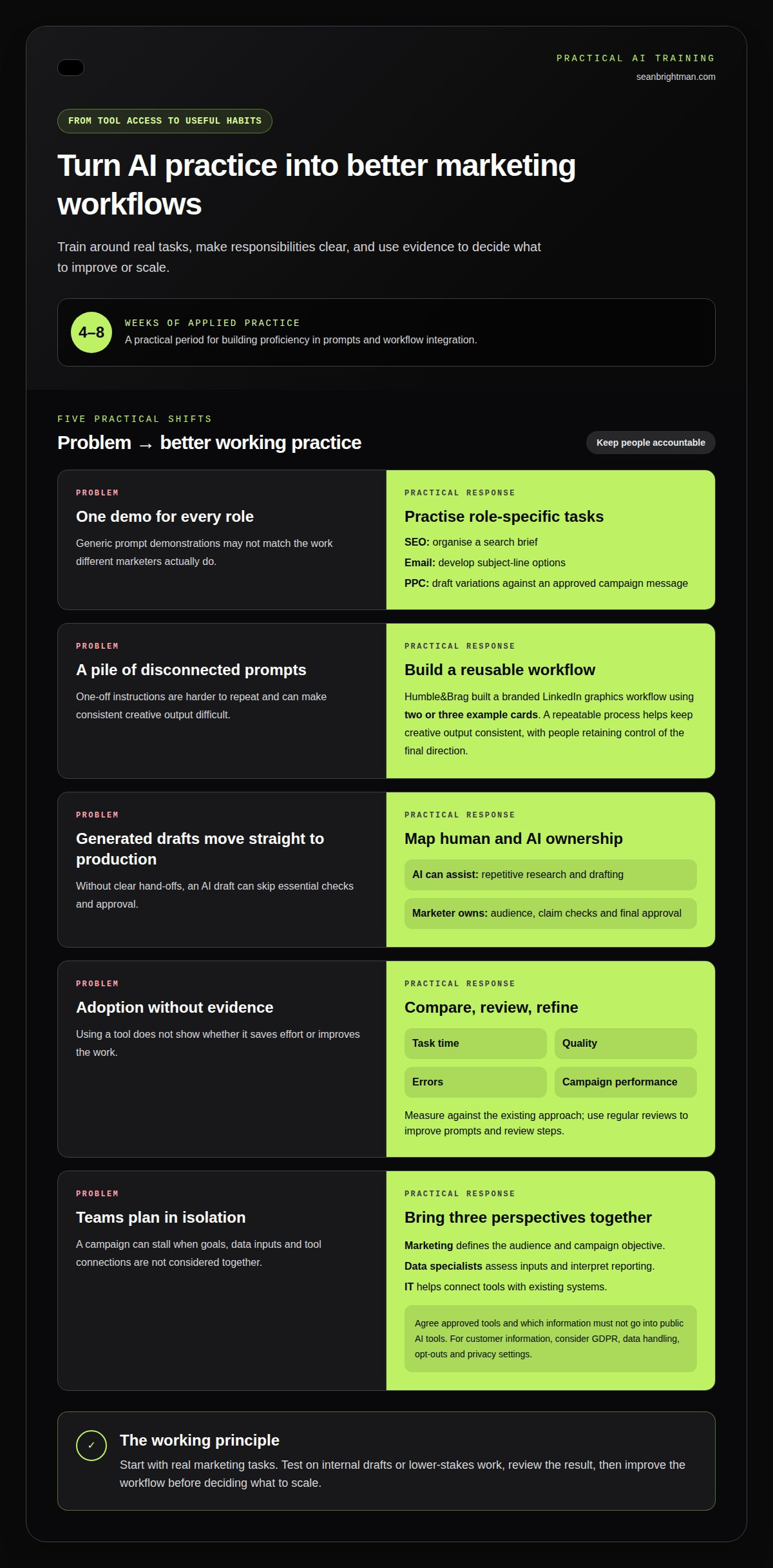
AI-assisted workflows use tools to generate early creative drafts and assemble reporting, while marketers direct and review the output. That creates a repeatable process, not a pile of disconnected prompts. For example, Humble&Brag built a branded LinkedIn graphics workflow using two or three example cards. A similar approach can help teams keep creative output consistent while people retain control of the final direction.
An experimental mindset for AI use
An experimental mindset means testing a defined use case, reviewing the result and changing the workflow based on what happens. Start with internal drafts or a lower-stakes campaign, then compare AI-assisted work with the existing process. Applied practice over four to eight weeks can build proficiency in prompts and workflow integration. Give a keen team member time to develop an initial workflow, document lessons and share reusable skills across the team.
ROI measurement and feedback loops
A feedback loop links a workflow’s intended benefit to evidence from its output. Track task time, quality, errors and campaign performance against the team’s existing approach. For example, compare AI-supported subject-line tests with previous campaign results, then refine prompts or review steps. Regular reviews show whether AI saves effort without weakening audience relevance, and help teams decide which workflows merit further investment.
Cross-functional fluency
Cross-functional fluency gives marketing, IT and data colleagues a shared understanding of what an AI workflow needs and produces. A marketer can define the audience and campaign objective; a data analyst can assess the inputs and interpret reporting; IT can help connect tools with existing systems. Working across roles makes implementation more practical. It also helps content strategists focus on editing and lifecycle marketers orchestrate journeys, while experienced marketers retain strategic and creative oversight.
Cross-functional collaboration between marketing, IT, and data science
AI work needs three perspectives: marketing defines the goal, IT connects the tools, and data specialists assess the inputs. For a retention campaign, marketing might set the audience and desired outcome; analysts can identify useful purchase patterns, while IT checks how the AI tool fits existing systems. This shared approach turns a campaign brief into a workable plan, rather than leaving each team to interpret the task alone.
Strategic planning starts with a marketing objective, not a tool. Teams can use AI to examine customer feedback, campaign results and market trends, then surface insights for planning. Data analysts should help select suitable sources and test whether an output reflects the evidence. For example, a recommendation about customer segments needs scrutiny before it shapes personalisation. Human judgement connects those findings to brand priorities and competitive decisions.
Governance makes that collaboration usable. Before implementation, teams should agree which information must not be entered into public AI tools and maintain a list of approved tools. They should also define how data is collected, stored and used, considering GDPR in workflows involving customer information. A quarterly governance review can revisit these decisions as tools and processes change. Clear ownership helps staff know who handles questions about access, data quality and output review.
Customer privacy requires more than a policy document. Teams should clean, organise and standardise customer data before using it in AI workflows, then respect customer opt-out requests and privacy settings when personalisation is involved. Analysts can validate data and AI-generated conclusions; marketing can assess relevance and tone; IT can support secure connections between systems. Together, these roles turn insights into decisions while keeping data handling visible and accountable.
What Is AI Marketing Training?
AI marketing training builds the skills to use tools in real marketing work, from planning through production and review. A practical answer to how to train a marketing team on AI tools is to teach around tasks the team already owns, not abstract demonstrations.
In the UK, training costs depend on scope, delivery format, team size and whether workflow design is included; pricing is provided after a quote request. The best courses use practical exercises, role-specific examples and reusable workflows. Prioritise those elements when deciding how to train a marketing team on AI tools effectively.
Training for marketing workflows
Workflow-based training applies AI to specific tasks in SEO, email, content and PPC, so marketing teams practise where the work happens. For SEO, use a prompt to organise a search brief; for email, develop subject-line options; for PPC, draft variations against an approved campaign message. This makes testing relevant to each role and reveals where AI fits without disrupting production.
Human and AI workflow ownership
Shared ownership defines which steps AI can support and which decisions remain human-led. First, map a workflow, such as turning a campaign brief into an email; then identify repetitive research or drafting tasks for AI assistance. A marketer still sets the audience, checks claims and approves the final copy. Clear hand-offs prevent a generated draft from moving straight into production.
Shared prompts and standard workflows
A shared prompt library gives marketing teams tested instructions for recurring tasks. Each entry can include the task, required inputs, preferred format and review criteria, such as a prompt for summarising a product brief into audience-specific content angles. Store the strongest examples alongside a standard workflow, then revise them when testing exposes weak output. This helps colleagues build consistent habits instead of starting from scratch.
AI workflows for content and social graphics
Content and graphic workflows connect generation with human editing and approval. A team might use AI to turn an approved article outline into social post drafts, then adapt the wording for each channel. For graphics, provide brand examples and a clear brief before generating concepts. A designer checks visual fit and accessibility before publication, keeping the creative direction accountable.
Measuring adoption, productivity and campaign output
Measure AI against a defined marketing objective, not the number of tools a team opens. A useful programme tracks adoption, work quality and campaign outcomes together.
Goals and measurable KPIs
Measurable KPIs connect an AI initiative to a specific marketing problem, such as improving retention or personalisation. Set a baseline before introducing automation, then choose indicators that reflect the task. For an email workflow, track time spent preparing campaigns, output quality and campaign performance. A dashboard can show these changes together, helping teams distinguish active tool use from useful results.
Include error rates and employee confidence alongside productivity measures. Standard operating procedures (SOPs) should define how staff record results and review generated output. This structure makes comparisons more consistent across teams and campaigns.
AI experiments and return on investment
An AI experiment compares a defined workflow with its existing alternative, so teams can judge whether the change creates value. Use an A/B test to compare an AI-driven campaign with a traditional approach, keeping the objective and audience clear. Review analytics for campaign response, output quality and time saved, rather than treating faster production as proof of ROI.
Record the effort required to implement and maintain the workflow, then weigh it against the observed benefits. If errors rise or quality drops, revise the process before expanding automation. Let the evidence guide the next decision.
Training duration and learning measurement
Applied practice to build AI proficiency typically takes four to eight weeks. Measure learning through observed performance: can staff use the workflow, assess its output and follow the SOP without prompting? Track tool use, task time, quality and confidence throughout the training period. These signals show whether skills are transferring into day-to-day marketing work.
Use the results to refine training and dashboard measures, then reassess campaign outcomes as the workflow matures. To connect AI goals with measurable business priorities, build an AI roadmap.
Sean Brightman
Sean Brightman helps organisations turn AI ambition into practical marketing direction. If your team has tools but lacks a clear plan for training, workflow ownership or measuring adoption, AI Consulting can help clarify the challenge and shape the next steps. Roadmapping can connect priorities to an implementation path, while an Advisory Retainer offers ongoing strategic guidance as the approach develops.
The right next step depends on what is holding progress back. Start with a defined business objective, such as improving campaign output or making AI use consistent across functions. Then focus on the capabilities and workflows that support it, rather than adding tools without a clear purpose. To discuss how Sean Brightman could help your team move forward, contact Sean Brightman.
Turn AI training into your next growth move
The next step is choosing a marketing challenge worth solving, then giving your team a clear reason to build the skills to address it. A practical answer to how to train a marketing team on AI tools starts with business priorities, not another tool demonstration. Make that priority visible in the work: what should change, who owns the decision, and what evidence will show progress?
Sean Brightman can connect AI adoption to wider marketing leadership through Fractional CMO support, AI Consulting and Roadmapping. This can help when the team needs strategic direction, a clearer implementation plan or support aligning AI with wider marketing priorities. The goal is not to add complexity. It’s to make the next move deliberate and useful.
Contact Sean Brightman to discuss training and identify a practical starting point for your team. Build the capability, put it to work and keep moving forward.
Frequently Asked Questions
How to prepare your marketing team for AI integration?
Prepare by defining the business problem and the boundaries for using AI before choosing a workflow. For example, a campaign brief can specify its audience, approved source material, intended output and who makes the final decision. Give the team a shared place to record useful prompts and recurring issues. That turns early experiments into usable working knowledge, rather than disconnected individual habits.
Can a non-IT person learn AI?
Yes. Marketers can use AI tools without learning to code; the essential skills are asking clear questions, judging output and knowing when to seek technical support. Start with a familiar task, such as turning a product brief into several audience-specific content angles. Compare the suggestions with the original brief, correct inaccuracies and note which instructions produced useful results.
Want your team running this in 90 days?
Use a 90-day rollout as a planning frame, not a promise of automatic success. Begin with one contained marketing task, document its current process and assign an owner. Expand only after the team can run and review that workflow reliably. By month three, assess whether it operates independently, what problems remain and whether another task is ready to enter the programme.
What AI tools are marketers using?
Marketers use generative chat tools, image generators, video editors and voice or narration tools. DALL·E and Midjourney are examples of image generators; Speechify and Murf are examples of voice tools. The right category depends on the work: a content team may need drafting support, whilst a design team may explore visual concepts. Set a clear task before selecting a tool.
What skills do marketers need to succeed with AI in 2026?
Marketers need prompt-writing, workflow design, data interpretation and editorial judgement. They must also recognise unsupported claims, assess whether generated material suits the audience and decide when human review is necessary. In practice, a content strategist might use AI to organise research, then shape the argument and verify the evidence. These skills keep human responsibility clear while tools support execution.
What AI tools should a marketing team learn first?
Start with a tool that addresses a frequent, well-defined task and fits the team’s existing workflow. A general-purpose generative tool can support early drafting or summarising, whilst analytics features may help teams interpret campaign information. Choose based on the task, data involved and review process, not novelty. Learn one use case thoroughly before adding another tool to the team’s routine.