
There’s no single marketing team structure that fits every business. Defining roles in a marketing team means matching ownership to business priorities, then adapting as work becomes more specialised. Early-stage businesses often start with one or two generalist marketers; growing teams may organise around functions, products or channels.
When roles blur, campaigns stall, priorities clash and gaps stay hidden. Adding job titles won’t fix the problem. Clear responsibilities and decision rights help people act while keeping marketing aligned with commercial goals.
This article explains common team structures, which responsibilities need clear owners and how to spot capability gaps. You’ll also see how roles can change as a business grows, so you can build around the work ahead rather than copy someone else’s org chart.
Key Takeaways
- Choose a team structure around how the business serves its markets, products and channels, not a fashionable org chart.
- Separate job titles from responsibilities: define who owns outcomes, makes decisions and collaborates across functions.
- Assess skills gaps against business goals, channel performance and existing capability before deciding what expertise the team needs.
- As marketing work becomes more specialised, protect shared priorities and clear hand-offs so expertise doesn’t create silos.
What is a marketing team structure?
A marketing team structure groups work by function, product, market or channel and clarifies who makes decisions. In-house staff work within the business; agencies provide external teams, while freelancers deliver defined specialist work independently.
Function, discipline and product structures
Functional structures group people by marketing discipline; product structures bring different disciplines together around one product or service. Functional teams might separate content, social media and paid media, while channel-specific teams assign ownership for email, websites or social platforms. Geographical structures organise teams around markets, which can suit businesses serving international audiences. The choice matters: a focused team can build expertise, while a smaller firm might use one generalist and external specialists to cover gaps.
Centralised, pod-based and hybrid models
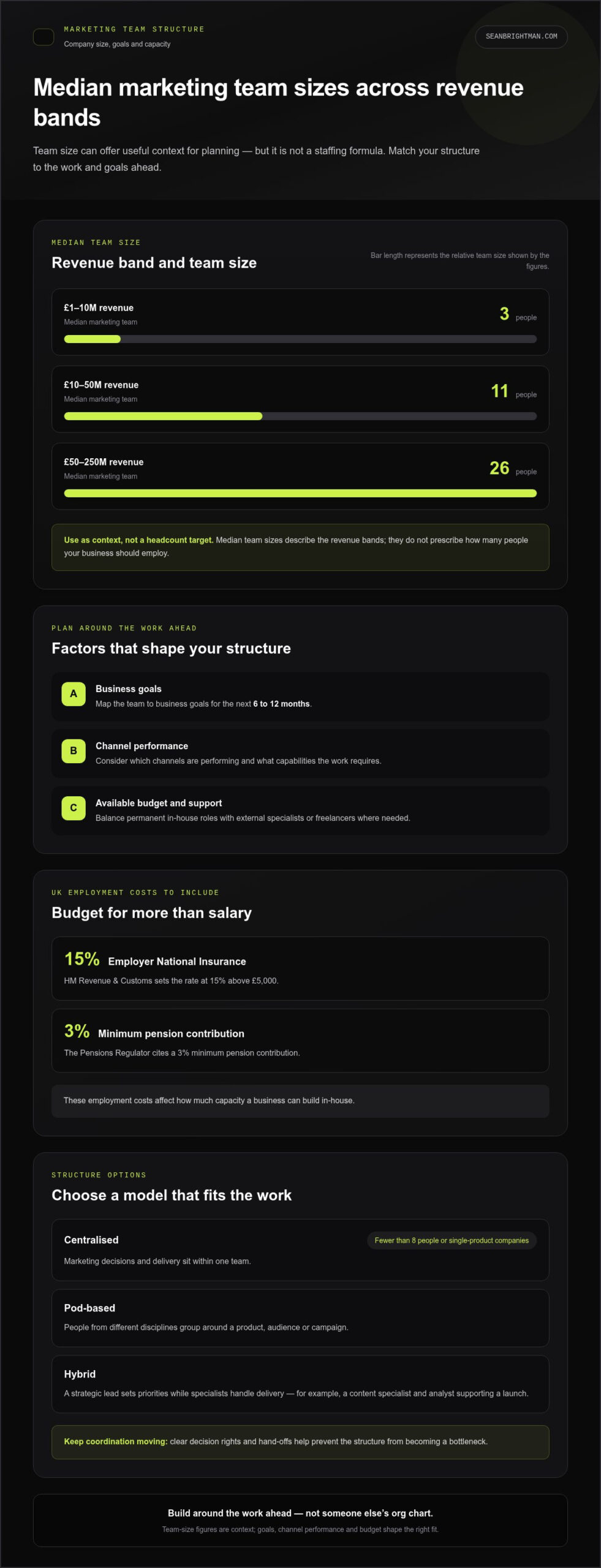
A centralised structure keeps marketing decisions and delivery within one team. It can suit teams with fewer than 8 people or single-product companies. Pod-based structures group people from different disciplines around a product, audience or campaign. A hybrid model combines a strategic lead with specialists who handle delivery. For example, a lead could set priorities while a content specialist and analyst support a launch. Clear decision rights and hand-offs keep coordination moving instead of creating a bottleneck.
Structure by company size and goals
Company size, revenue and goals shape how much specialisation a team can support. Median team sizes are 3, 11 and 26 people for businesses in the £1-10M, £10-50M and £50-250M revenue bands, respectively. Treat these as context, not a staffing formula. Map the structure to business goals for the next 6 to 12 months, channel performance and the budget for permanent or external support. Include employment costs: HM Revenue & Customs sets employer National Insurance at 15% above £5,000, and The Pensions Regulator cites a 3% minimum pension contribution. These costs affect the capacity a business can build in-house.
Defining marketing roles and responsibilities: what needs to be clear?
Defining roles in a marketing team starts with separating a job title from the work and decisions attached to it. Connect each role to the functions and business outcomes it supports, so people understand how their contribution fits.
Roles, responsibilities and functions
A function is a body of work, a role is who carries it, and responsibilities are the tasks and decisions they own. This distinction helps growing teams collaborate without leaving work stranded between job titles. For example, a content strategist might plan topics while a copywriter drafts them. Record scope, decision rights and hand-offs so colleagues know who can move campaigns forward. Clear definitions make defining roles in a marketing team practical, not a paperwork exercise.
Core marketing role categories
Marketing roles bring expertise together across strategy, content, digital delivery and customer growth. A digital marketing manager may oversee SEO, website performance, paid media, email, automation and tracking; content marketers create written and visual material. Social media owners manage platforms and monitor brand reputation. These responsibilities may sit with one generalist or several specialists, depending on capacity.
SEO, content and social media can sit with dedicated specialists or broader digital and content roles. Assign ownership by task: who plans content, optimises pages and publishes posts? Marketing and sales should agree on lead definitions, handover points and feedback. Marketing typically generates and nurtures leads; sales follows up prospects, with both teams aligning on lead quality and conversion.
Ownership and leadership responsibilities
Ownership names the person accountable for an outcome, even when several colleagues contribute. For each campaign, assign a lead, approvers and contributors; clarify who controls the brief, budget decisions, launch and results review. This prevents duplicated work and stalled approvals. Boundaries should enable collaboration, not turn every task into a permission request.
A head of marketing defines strategy, aligns activity with commercial goals, manages investment and shapes the team. A marketing manager coordinates campaigns around those goals. When priorities or working arrangements change, revisit role scope and decision rights. This keeps accountability connected to current work, not an outdated org chart.
Assessing marketing needs and skills gaps
Assess capability against the work needed to meet business priorities, not job titles alone. UK qualifications vary by role; evaluate relevant skills through work samples, platform experience and evidence of results.
AI-related marketing roles and skills
AI-related marketing roles apply AI tools to research, content, analysis or campaign delivery. As marketing work changes, assess practical ability rather than chasing a fashionable title. An AI-skilled marketer should verify and edit generated outputs, recognise where human oversight matters, and connect tool use to useful outcomes.
Test those skills with a realistic task: ask a candidate to review an AI-assisted campaign draft, identify unsupported claims and improve its accuracy. Then ask what the tool contributed and where human judgement was needed. Strong answers show how AI supports a business decision, acquisition or paid media activity, rather than automation for its own sake. Build development plans around demonstrated gaps.
Capability shortages can affect hiring: 82% of marketing and creative managers report challenges finding skilled talent. Separate a genuine skills gap from unclear priorities or limited capacity before deciding to recruit.
Skills and qualifications for UK marketing roles
Common marketing roles call for different evidence. A content marketer should show clear writing and audience understanding; an SEO specialist should explain how they improve search visibility. A paid media marketer needs to interpret campaign performance, while a marketing manager should demonstrate planning, coordination and sound decision-making. Relevant qualifications can support a candidate’s case, but assess them alongside practical work and role-specific experience.
Start with the outcome the role must deliver. For example, if acquisition relies on organic search, assess research, technical understanding and content optimisation. If campaigns depend on paid media, test budget prioritisation and performance analysis. Compare those requirements with the team’s current capabilities, then decide whether to develop existing staff, reshape responsibilities or hire to address a persistent gap.
- Review recent work samples against the role’s actual responsibilities.
- Use a practical exercise to test judgement, analysis and communication.
- Record which skills the team can deliver and where support is needed.
How marketing roles specialise as businesses grow
Growth changes the work before it changes the org chart. Small businesses often rely on one or two generalist marketers to cover content, email, social media and website updates. Large organisations can split those responsibilities into specialist positions, adding depth but requiring stronger shared direction.
The difference is scope: generalists switch between connected tasks, while specialists focus on a narrower discipline or business need. An enterprise may have 20 or more marketing team members in specialised roles. That structure creates expertise, but without shared priorities, separate teams can pull campaigns in different directions.
Hiring should address the work that is breaking down, not follow a standard ladder of job titles. When activity becomes fragmented, a marketing manager can coordinate campaigns and connect delivery to business goals. If a growing technology stack exceeds three tools, a marketing operations manager can help manage the systems and processes behind delivery.
As a team expands, the leadership challenge shifts from doing marketing to directing specialists. The transition becomes a critical inflection point when a team has between 8 and 15 marketers. Leaders need to establish priorities, decision rights and hand-offs, so expertise strengthens the whole operation rather than creating isolated functions.
Product-led SaaS companies may allocate 22-25% of marketing headcount to product marketing specialists. That reflects the need to align product positioning, launches and sales enablement as offerings multiply. It is a context-specific model, not a headcount target for every business.
For small firms, keep positions broad while demand stays connected; specialise when recurring work needs deeper ownership. For large organisations, preserve a common direction across specialists, products and markets. Plan the next stage of your marketing team around the work growth will create.
Sean Brightman: AI Consulting
Sean Brightman’s AI Consulting can help your team assess where AI fits, which skills it needs and where human oversight remains essential. The focus is practical application, not adding tools for their own sake.
For broader team changes, Roadmapping can connect business priorities with marketing capabilities and the roles needed to deliver them. An Advisory Retainer provides ongoing strategic input as priorities shift and responsibilities evolve.
Bring a clear challenge: perhaps your team is testing AI, struggling to assign ownership or deciding which capability to develop next. That gives the discussion a useful starting point and keeps the focus on business needs, not job titles alone.
Contact Sean Brightman to discuss the marketing challenge you’re working through.
Make your next team decision count
The real test of defining roles in a marketing team is what changes when ownership becomes clear. Choose one business priority that needs stronger marketing support, then identify the capability, authority and time required to move it forward. This gives your next decision a practical anchor, whether you’re reshaping responsibilities, developing existing talent or setting a new direction.
If the challenge sits at leadership level, Sean Brightman’s Fractional CMO offering can provide strategic direction. For a team working out how AI fits into its marketing activity, AI Consulting is a relevant next step. Roadmapping can connect business priorities with a clear direction for action. The right focus depends on the challenge you need to solve.
Contact Sean Brightman to discuss your marketing team and the next decision in front of you. A clearer structure starts with one useful move, and you can build from there.
Frequently Asked Questions
Should a growing business hire a marketing generalist or specialists?
Hire a generalist when the immediate need is broad, connected delivery; add specialists when specific work requires deeper expertise. For example, a generalist may coordinate a campaign across email, website and social content. If search optimisation or analytics repeatedly demands more technical attention, assign dedicated ownership to that discipline. Base the decision on the work accumulating, not on copying another company’s org chart.
What is the role of a marketing department?
A marketing department connects the organisation with its audiences and helps communicate what the business stands for. Its work can extend beyond customer-facing campaigns. For example, a team might share company priorities with employees through an internal newsletter or intranet, and prepare executives for media queries. These responsibilities help align public messaging and internal understanding as products and priorities evolve.
What does a marketing org chart look like at each company size?
There’s no fixed org chart, but business stage offers a useful starting point. Early-stage companies may have one to three marketers; growth-stage businesses with £10-30M revenue may have 4-8. Mid-market organisations with £30-100M revenue may have 9-20, whilst enterprises at £100M or more may have 20 or more. Treat these as reference points, then organise positions around products, audiences and delivery needs.
What does a head of marketing do?
A head of marketing sets the function’s direction and ensures its investment supports commercial priorities. This includes deciding which activities deserve budget, shaping the team as needs change and connecting marketing plans with wider business decisions. Before a new product launch, for instance, the head of marketing can align research, positioning and campaign resources with the launch’s commercial purpose.
What is the difference between marketing responsibility and accountability?
Responsibility describes the work someone carries out; accountability identifies who answers for the outcome. For a campaign, a copywriter may be responsible for producing the landing-page text, while the campaign lead is accountable for coordinating the launch and reviewing its results. Several people can contribute, but naming one accountable owner prevents decisions and follow-up from falling between roles.
When can a generalist own several marketing responsibilities?
A generalist can own several responsibilities when the work is related, the workload is manageable and specialist depth isn’t essential for every task. For example, one marketer might coordinate email content, website updates and campaign calendars for the same audience. Make the arrangement workable by clarifying priorities and decision authority. Revisit it when deadlines collide or specialist work starts limiting delivery.