Tag: Outsourced Marketing

  • Outsourced Marketing Director or In-House Hire: Which to Choose

    Outsourced Marketing Director or In-House Hire: Which to Choose

    A full-time hire may seem like the obvious choice, but it can be the wrong one. The pros and cons of an outsourced marketing director come down to the leadership your business needs: choose outsourced support for senior strategy and direction without a full-time hire; choose in-house when daily access, deep brand knowledge and hands-on control matter most. Either way, keep customer relationships and strategic ownership close to the business.

    That trade-off is easy to blur. An outsourced director can set strategy and budget, take ownership of agreed outcomes and coordinate other providers, but won’t be there for every day-to-day decision. An in-house hire offers closer involvement, although one person may not have every specialist skill your campaigns need.

    This comparison explains how the two models differ in responsibilities, reporting, accountability and campaign flexibility, and when a hybrid setup makes sense. Use it to assess your current capabilities and goals, then choose the leadership model that gives marketing clear ownership without adding unnecessary complexity.

    Key Takeaways

    • Choose leadership based on the work that needs ownership: strategic direction, day-to-day execution or both.
    • Set clear reporting rhythms and success measures so progress stays visible, whether leadership is internal or external.
    • Build flexibility into campaign plans, with clear decision-making and turnaround expectations when priorities shift.
    • Use the decision guide to match your marketing model to your team’s capabilities, goals and need for direct control.

    Reporting, data access, and accountability

    The benefits of an outsourced marketing director include senior strategic direction and access to specialist skills without building every capability in-house. An agency can bring expertise in areas such as SEO, analytics and digital marketing, while your business retains its customer relationships and core decisions.

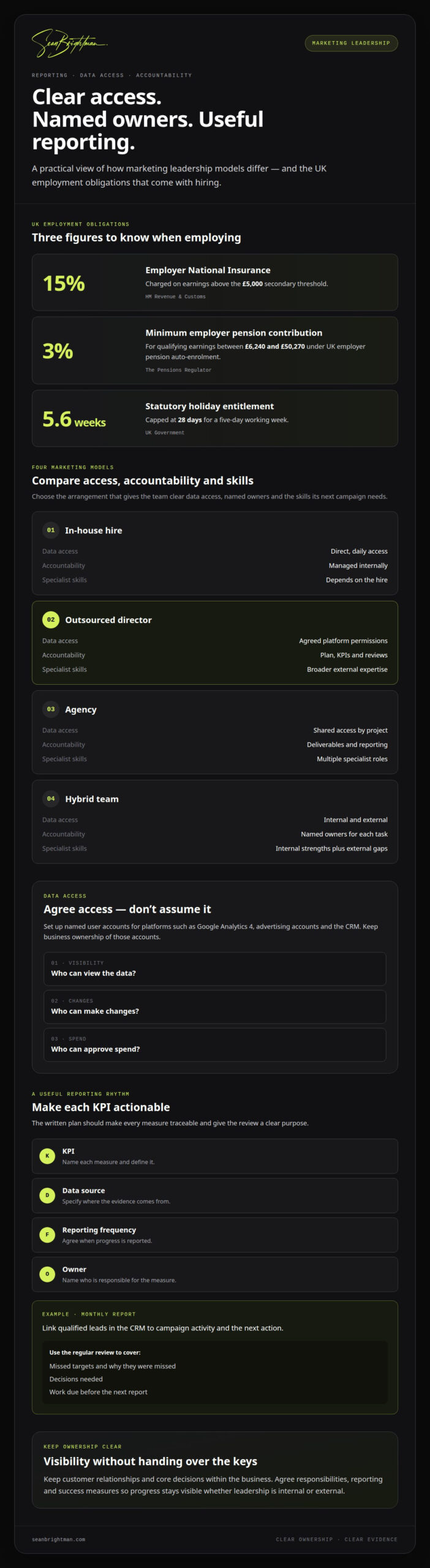
    Access must be agreed, not assumed. Set up named user accounts for platforms such as Google Analytics 4, your advertising accounts and CRM. Keep business ownership of those accounts, and define which people can view data, make changes and approve spend. That gives your house team visibility without handing over the keys.

    Make reporting useful for decisions. Agree a short written plan that names each KPI, its data source, reporting frequency and owner. For example, a monthly report could link qualified leads in the CRM to campaign activity and the next action. Use a regular review to explain missed targets, decisions needed and work due before the next report.

    Employment also carries specific UK obligations. HM Revenue & Customs states that employer National Insurance is charged at 15% on earnings above the £5,000 secondary threshold. The Pensions Regulator states that UK employer pension auto-enrolment requires a minimum 3% employer contribution on qualifying earnings between £6,240 and £50,270. According to the UK Government, statutory holiday entitlement is 5.6 weeks, capped at 28 days for a five-day working week.

    Option Data access Accountability Specialist skills
    In-house hire Direct, daily access Managed internally Depends on the hire
    Outsourced director Agreed platform permissions Plan, KPIs and reviews Broader external expertise
    Agency Shared access by project Deliverables and reporting Multiple specialist roles
    Hybrid team Internal and external Named owners for each task Internal strengths plus external gaps

    Choose the model that gives your team clear data access, named owners and the skills its next campaign actually needs.

    Flexibility and ability to pivot campaigns

    Outsourced support can flex with changing priorities, whilst an in-house team offers direct, day-to-day capacity. The trade-off is speed of access versus control over available time.

    Campaign flexibility

    An outsourced director can redirect campaigns when business priorities shift, then coordinate specialist work through an agency. For example, changing demand might lead a business to revise its digital campaign focus. The advantage is access to skills beyond one marketer’s remit; the constraint is that external teams divide their time across clients, which can slow delivery.

    Marketing scalability

    Outsourcing lets a business match marketing support to its needs and budget instead of hiring a full-time team before demand is steady. A business in an early, volatile stage can bring in external support for a defined campaign, then adjust the scope as priorities change. An in-house team offers more consistent daily availability, but scaling it means changing internal capacity.

    In-house marketing teams can move quickly because colleagues work closely together. Yet urgent client requests or short-term tasks can push long-term campaigns down the list. An external partner can add capacity, but the agency’s schedule still affects turnaround. Agree which decisions need immediate action and which can wait for the next planning review.

    A hybrid model combines a small in-house team with an external consultant for complex campaigns. Internal staff can manage customer insight and brand decisions, for example, while external specialists support a technical digital launch. A consultant can also help set priorities while the business builds its internal capability. Outsourcing and hiring do not have to be an all-or-nothing choice.

    To choose, map the campaigns you need, the skills available in-house and how quickly each task must move. If the gap is strategic direction, set a clear marketing roadmap before expanding delivery capacity.
    Outsourced Marketing Director or In-House Hire: Which to Choose

    Accountability, KPIs and reporting

    Strong accountability starts with shared ownership, not a supplier working in isolation. An external marketing partner brings delivery expertise; internal leaders retain decisions about priorities, customer relationships and brand direction. Treat the arrangement as a working partnership, with clear responsibilities and regular discussion of what results mean for the business.

    Choose KPIs that connect marketing activity to a business outcome. A social media engagement measure can show whether content prompts interaction, for example, but it doesn’t prove that engagement creates sales. Pair it with a relevant next-stage measure, such as enquiries recorded in the CRM. Agree how each measure is defined, where its data comes from and who explains changes.

    A practical way to assess the pros and cons of an outsourced marketing director is to see whether reporting leads to better decisions. A dashboard can show performance, while written commentary explains what changed, why it matters and what the team proposes next. If LinkedIn engagement rises but qualified enquiries stay flat, the external partner should explain the gap and recommend a test. You should be able to see the underlying data, not just a polished summary.

    Set the working rules before activity begins. Record the following in the marketing plan:

    • Ownership: name the internal decision-maker, external delivery lead and approver for campaign changes.
    • Evidence: define the data source for each KPI, including CRM records for leads and platform analytics for social media.
    • Response: agree how the team escalates a missed target, reports a tracking issue and records the action taken.

    The pros and cons of an outsourced marketing director become clearer when review meetings lead to decisions, not just dashboard readings. The partner presents evidence and options; internal leaders provide context such as sales feedback, product changes or customer objections. Record agreed actions, owners and deadlines in the same plan. This links campaign activity to business decisions and helps the team identify whether weak performance reflects execution, measurement or changing customer behaviour.

    Outsourced marketing director responsibilities

    An outsourced marketing director sets marketing strategy and budget, takes ownership of agreed outcomes and manages other providers. They turn business goals into priorities, then coordinate specialists such as designers, writers or SEO professionals. For example, a launch plan might connect the audience, message, channels, budget and delivery dates.

    The director should align that plan with senior leaders, who retain responsibility for the business’s overall strategy and customer relationships. They can brief the in-house marketing team, clarify decision rights and identify where training or development could strengthen internal capability. This is leadership and coordination, not simply a list of campaign tasks.

    The main risks are less day-to-day access, reduced direct control over execution and a learning curve while an external director gets to know the brand. Providers may also divide their attention across clients, delaying decisions or delivery. Mitigate those risks with agreed availability, clear approval limits and documented handovers for active campaigns.

    UK businesses may benefit when marketing complexity or spending is growing, but a full-time senior leader isn’t yet the right fit. Smaller firms with gaps in strategic or specialist skills can gain direction without building every role in-house. Businesses that need constant on-site leadership and immediate daily decisions may prefer an internal hire.

    A contract should define the work, decision-making authority, reporting expectations, data access, confidentiality, fees and exit arrangements. It should also distinguish strategic leadership from campaign execution, so neither party assumes the director will personally deliver every task.

    • Scope: name strategy, budget planning, provider management and any excluded delivery work.
    • Measures: specify agreed outcomes, data sources, reporting frequency and review meetings.
    • Authority: state who approves spend, campaign changes and external supplier work.
    • Working terms: record availability, information access, confidentiality and how either party ends the arrangement.

    Keep final business decisions with your leadership team, and give the director clear ownership of agreed marketing actions.

    Sean Brightman: AI Consulting

    Sean Brightman’s AI Consulting can help you assess where practical AI systems fit into marketing work and decision-making. It’s a relevant next step if your team sees potential uses but needs a clearer route from ideas to practical priorities.

    For broader marketing direction, Roadmapping can organise goals, priorities and next steps. An Advisory Retainer provides ongoing strategic input as plans develop. Each option meets a different need: AI-focused advice, a structured roadmap or continuing guidance.

    If choosing between outsourced and in-house leadership has revealed a gap in strategy or direction, contact Sean Brightman to discuss what would help your business move forward.

    Choose the leadership model that moves you forward

    The right choice is the one your business can support and act on. Before committing, define which decisions marketing leadership should own, what your internal team can deliver and where outside expertise would make a difference. That turns the pros and cons of an outsourced marketing director into a practical decision, not an abstract debate.

    Sean Brightman offers Fractional CMO support for senior marketing direction, alongside AI Consulting and Roadmapping. Each can address a different strategic need, from clarifying leadership priorities to shaping a plan for what comes next.

    You don’t need to solve every marketing challenge at once. Start with the gap holding back progress, then choose a model that gives it clear ownership and momentum.

    Contact Sean Brightman to discuss your options and take the next step with confidence.

    Frequently Asked Questions

    Which should you choose?

    Choose in-house leadership if marketing needs constant daily attention and close collaboration across departments. Choose outsourced direction if you need senior judgement but not a full-time director embedded in the business. A hybrid model can suit teams with strong internal delivery but a strategic gap. Start with the work that currently stalls, then match the leadership model to that bottleneck.

    What does an outsourced marketing director do?

    An outsourced marketing director turns business priorities into a marketing plan and aligns people around it. They might clarify the audience for a new service, shape its positioning, then coordinate the internal team and external specialists responsible for delivery. Their role is to steer priorities and decisions, not automatically create every asset or manage every customer interaction.

    How does an outsourced marketing director compare with a full-time marketing director?

    A full-time director works within the business every working day, building close familiarity with its people, products and routines. An outsourced director provides senior input on a part-time basis, which can suit a business that needs strategic direction without a permanent leadership role. The deciding factor is how much daily presence the organisation needs, not which title sounds more senior.

    How does an outsourced marketing director compare with a marketing agency or consultant?

    An outsourced director leads the marketing function and connects strategic choices with delivery across internal teams and suppliers. A marketing agency typically delivers agreed specialist work, such as web development or social media campaigns. A consultant may advise on a defined challenge without coordinating the wider function. For example, a director can set priorities before an agency produces campaign assets.

    How can a business assess and choose an outsourced marketing director?

    Start with a current business challenge, such as weak positioning or disconnected campaign activity. Assess whether the director can explain the decisions they would make, the information they need and how they would involve your team. Review relevant past work and discuss how they handle disagreement or changing priorities. A strong fit brings clear thinking and practical direction, not a generic presentation.

    How can businesses measure the performance and ROI of an outsourced marketing director?

    Connect agreed marketing objectives to commercial evidence. For example, track qualified opportunities from the CRM through to sales, then compare attributable revenue with marketing investment over the same reporting period. Also assess progress against strategic milestones, such as launching a new proposition or improving lead quality. Distinguish the director’s contribution from wider factors, including sales follow-up and changes in demand.

  • In-house marketing vs outsourced: Compare costs and fit

    In-house marketing vs outsourced: Compare costs and fit

    Outsource when you need specialist skills or extra capacity without building a larger team. Keep marketing in-house when brand knowledge, close collaboration and fast decisions matter most. The in-house marketing vs outsourced strategy choice is not automatically one or the other: a hybrid model can keep direction and brand stewardship inside the business while bringing in external expertise for specific work.

    It makes sense to weigh an external partner’s visible cost against salaries and the less obvious overheads of employing someone. But a fair comparison also considers hiring time, the skills you need and how closely the work must connect with your customers and operations.

    This guide explains where each model fits, what drives its cost and when a hybrid approach makes sense. You’ll get a practical way to assess your needs, protect valuable brand knowledge and choose a structure that can keep pace with the business.

    Key Takeaways

    • Outsource when specialist expertise or extra capacity is the bottleneck; keep work in-house when close brand and customer knowledge drives better decisions.
    • Factor UK employment costs beyond salary, including employer National Insurance and holiday entitlement, before comparing team models.
    • Use a hybrid structure to retain internal ownership of marketing priorities while bringing in external support for defined specialist work.
    • Choose the model against your growth plans, required skills and pace of decision-making, then set clear measures for judging its value.

    When is it best to outsource your marketing?

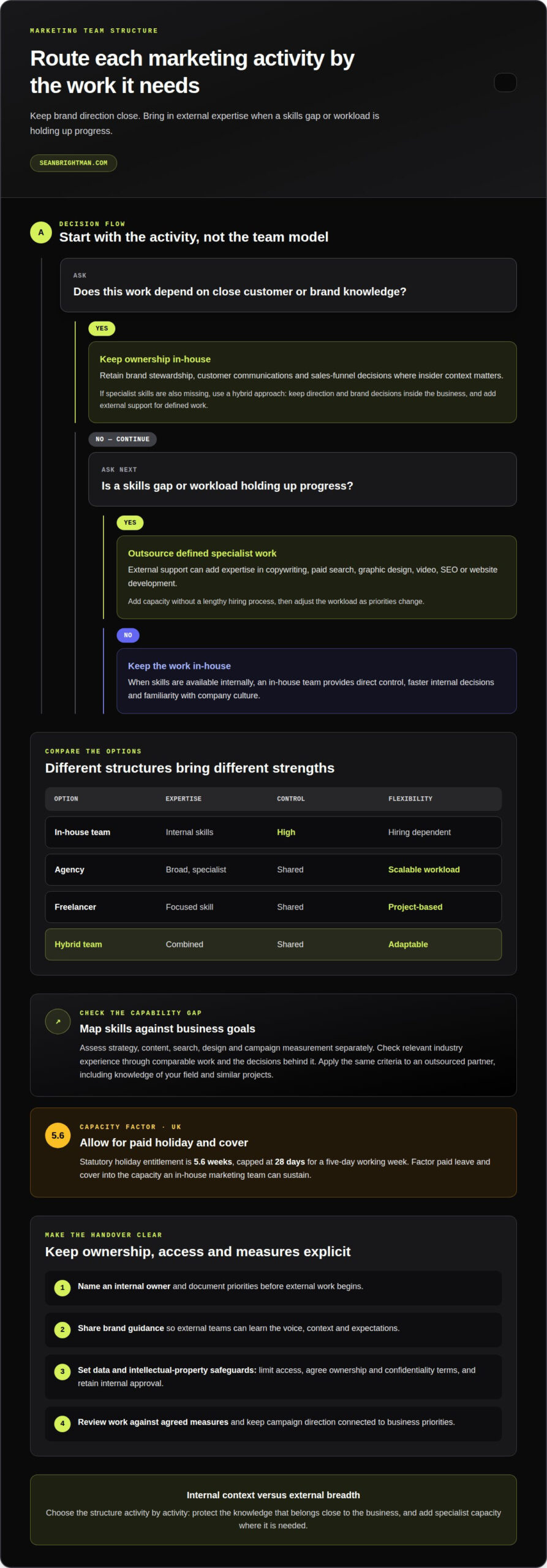
    Outsource when a skills gap or workload is holding up progress; keep control of work that depends on close customer and brand knowledge.

    UK statutory holiday entitlement is 5.6 weeks, capped at 28 days for a five-day working week, according to UK Government (GOV.UK). Factor paid leave and cover into the capacity an in-house marketing team can sustain.

    In-house limitations

    An in-house team offers direct control, faster internal decisions and familiarity with company culture. Its drawbacks include a narrower perspective, ongoing employment costs and gaps when specialist skills are missing. Agencies can bring fresh ideas and broader expertise, but need time to learn the brand. The trade-off is internal context versus external breadth.

    Assessing in-house talent

    Map current skills against business goals, assessing strategy, content, search, design and campaign measurement separately. Then evaluate relevant industry experience through examples of comparable work and the decisions behind it. Use the same criteria for an outsourced partner, including knowledge of your field and similar projects. This makes it clearer whether the gap calls for a hire or external support.

    Outsourced expertise and scalability

    An agency can bring specialist skills in areas such as copywriting, paid search, graphic design and video. That breadth helps when a project needs expertise the internal team does not use every day. Outsourcing also lets a business add capacity without a lengthy hiring process, then adjust the workload as priorities change. Internal staff retain closer control; external teams offer more flexibility across skills.

    Option Expertise Control Flexibility
    In-house team Internal skills High Hiring dependent
    Agency Broad, specialist Shared Scalable workload
    Freelancer Focused skill Shared Project-based
    Hybrid team Combined Shared Adaptable

    Choosing marketing activities to outsource

    Keep brand stewardship, customer communications and sales-funnel decisions in-house when they depend on insider knowledge. Outsource defined specialist work, such as SEO, website development or paid search, when the internal team lacks those skills. Manage data and intellectual-property risks by setting access limits, agreeing ownership and confidentiality terms, and retaining internal approval. For a smooth transition, name an internal owner, document priorities, share brand guidance, then review work against agreed measures.

    Choose by matching each activity to its required expertise, brand knowledge and decision speed.

    In-house marketing benefits: culture, brand knowledge, and speed

    An internal marketing team can keep campaigns close to company decisions and customer conversations. Established brands often benefit when their messaging depends on detailed product knowledge, consistent values and fast internal approvals.

    Culture and brand knowledge

    An in-house team sees how colleagues talk about the brand, handle customer concerns and make decisions. That daily contact helps marketers turn internal knowledge into authentic messaging instead of relying on a brief. For example, a retailer’s in-house marketers can hear recurring questions from sales staff and shape campaign language around them.

    That closeness also helps an established brand protect its voice across channels. Marketers can check a new campaign against past promises, product details and customer expectations before it goes live. The advantage is strongest when brand decisions depend on context that changes through regular conversations, rather than a static style guide.

    Consistency and alignment

    An in-house marketing team can build knowledge over time, keeping campaign decisions and brand history within the business. This supports continuity when priorities shift: an internal marketer can connect a new product launch with existing customer communications and sales activity. It also gives the business direct control over campaign direction and day-to-day work.

    Internal access can speed up responses to a customer issue or social media query, because a dedicated team member can raise it directly. But proximity alone does not guarantee alignment. Set a clear approval route: identify the decision-maker, agree who supplies product or sales updates, then define who signs off each campaign. This helps prevent conflicting instructions across departments.

    To maintain brand consistency, record practical guidance that survives staff changes: approved messages, audience needs, product language and examples of on-brand work. Review it when the offer or customer expectations change. If the team lacks time to cover every specialist channel, retain internal ownership of brand decisions and add external capacity where needed. This keeps brand knowledge close without expecting one team to cover every skill.

    In-house marketing vs outsourced: Compare costs and fit

    In-house marketing salaries and overhead costs

    A salary is only the starting point when budgeting for an in-house marketing department. Add employment costs, recruitment, equipment, software and training before comparing it with an agency retainer.

    Agency and employee costs

    The average UK marketing manager salary is roughly £44,500.

    Employer National Insurance is part of the calculation: UK employers pay 15% on earnings above the £5,000 secondary threshold, according to HM Revenue & Customs. The Pensions Regulator says employers must contribute a minimum 3% of qualifying earnings to a worker’s auto-enrolment pension. A marketing agency retainer, by contrast, is a service cost rather than a salary with employment overheads. Compare the support and work covered, not just the headline figure.

    Total cost of ownership

    Build a like-for-like comparison over the same period. For a hire, include salary, employer National Insurance, pension contributions, recruitment, software, equipment, training and management time. For an agency, include its retainer or project fees, internal time spent briefing and reviewing work, and any tools the business still pays for.

    Then connect each model’s total cost to the outcomes it supports. Track attributable revenue or qualified leads against the full cost, using the same attribution window and conversion definitions. ROI compares the return generated with the total investment; do not credit one team alone for results produced jointly.

    Hiring creates an ongoing commitment, even when campaign demand changes. An agency can work to a defined scope or project arrangement, while an employee builds knowledge inside the business. The right comparison depends on whether the business needs ongoing capacity, specialist input or both.

    For a sound decision, calculate the in-house cost for the period you expect to need the role, then compare it with the external support and internal management time required for the same priorities. Separate fixed employment costs from those that vary with workload.

    Comparing the affordability of in-house and outsourced marketing

    The cheaper model depends on how consistently you can use its capacity. An in-house marketer’s cost continues between campaigns, while external support can be scoped around specific demand. Compare the work delivered and its business impact, not just the invoice or salary.

    Map upcoming campaigns against the skills already available internally. If social media needs steady attention every week, an employee may provide continuity and faster access to product knowledge. If demand rises mainly for a launch or seasonal push, external specialists can add targeted capacity without creating a permanent role around a temporary workload.

    Separate recurring work from occasional projects. List ongoing tasks such as planning, customer communications and reporting, then identify specialist work such as a website redesign or paid-search campaign. This shows whether there is enough consistent work to justify more in-house capacity, or whether defined external projects better match the workload.

    Next, compare the full resources each option requires. Include internal briefing and approval time for an agency, alongside the tools, management and training needed to support an employee. For example, a social media campaign may look affordable externally, but repeated revisions can consume internal time. A clear brief, named approver and agreed measures help make that hidden workload visible.

    Finally, judge affordability against useful outcomes. Set a baseline for each campaign, then track relevant results such as qualified enquiries, conversion rate or cost per lead. Compare those results with the complete investment over the same measurement period. This avoids treating activity, such as posts published, as proof of commercial value.

    Choose the structure that fits your demand pattern: keep recurring, brand-critical work close; bring in external support for defined gaps or peaks. To pressure-test that decision against your priorities, use an advisory retainer.

    Sean Brightman

    Sean Brightman helps business leaders bring structure to marketing decisions when costs, capabilities and growth priorities point in different directions. Use Roadmapping to clarify priorities, sequence the work and identify where internal ownership or external expertise fits. An Advisory Retainer provides ongoing strategic guidance as needs evolve, while AI Consulting can help assess where AI fits into marketing operations.

    The next step is to clarify the work your business needs, the skills it already has and the gaps holding back progress. That gives you a practical basis for choosing a model, rather than defaulting to a hire or outsourcing everything.

    For a direct conversation about your marketing structure, contact Sean Brightman.

    Turn your choice into a working plan

    The in-house marketing vs outsourced strategy decision matters only if it changes how work gets done. Set a clear owner for priorities, agree who approves campaigns and define how internal and external contributors share information. That operating rhythm keeps decisions moving after the team structure is settled.

    Next, turn business direction into a practical sequence of marketing decisions. Sean Brightman offers Roadmapping to shape that sequence, alongside Fractional CMO support for strategic leadership and AI Consulting where AI fits the operating picture. The right starting point depends on the gap you need to close, not a template.

    Bring the decision, current priorities and biggest obstacle into a conversation. Contact Sean Brightman to discuss your options, then move forward with a structure your team can actually run. You don’t need a perfect organisation chart before you start; you need a clear next move.

    Frequently Asked Questions

    Is in-house marketing a financial risk?

    Yes, if you commit to a permanent role before confirming there is enough ongoing work. Payroll continues during quieter periods, while campaign demand can rise and fall. Before hiring, map the responsibilities that need regular attention and consider what would happen if priorities changed. A role with clear, continuing ownership is easier to justify than one built around a single launch.

    What challenges could you face?

    Common challenges include slow decisions, competing internal priorities and over-reliance on one marketer. For example, a product launch can stall if the marketer is waiting for several teams to approve basic claims. Set one decision owner, agree response expectations and document the latest product information. This gives the team a clear approval route without adding another layer of meetings.

    When does it make sense to hire in-house marketing help instead?

    Hire in-house when marketing needs frequent involvement in everyday business decisions, not just occasional campaign delivery. A changing product range, regular customer feedback and close work with sales can create a steady stream of tasks that benefit from an embedded marketer. Define the role around those recurring responsibilities, then judge its contribution by business priorities rather than the number of activities completed.

    Which should you choose?

    The in-house marketing vs outsourced strategy choice depends on whether your main constraint is continuity, specialist capability or variable demand. Choose in-house support for sustained work that needs regular access to colleagues and customers; choose outsourced help for a defined skills gap or project. A hybrid arrangement can split ownership, with internal leaders setting direction and external specialists handling selected tasks.

    What is the difference between in-house marketing and outsourced marketing?

    In-house marketing is carried out by people employed within the business; outsourced marketing is commissioned from an external agency or specialist. An employee is part of internal workflows and leadership structures. An external partner works to an agreed scope. For example, a business might employ someone to coordinate ongoing customer insight, then commission a specialist for a one-off website project.

    How much does it cost to hire an in-house marketing team in the UK?

    The average UK marketing manager salary is roughly £44,500. That figure is a salary benchmark, not the full cost of employing a team. The final budget depends on the number and seniority of roles, the breadth of responsibilities and the support each person needs. A single manager and a multi-role department are different staffing decisions, so scope the work before setting a budget.

  • Alternatives to a Full-Time CMO for Growing Businesses

    Alternatives to a Full-Time CMO for Growing Businesses

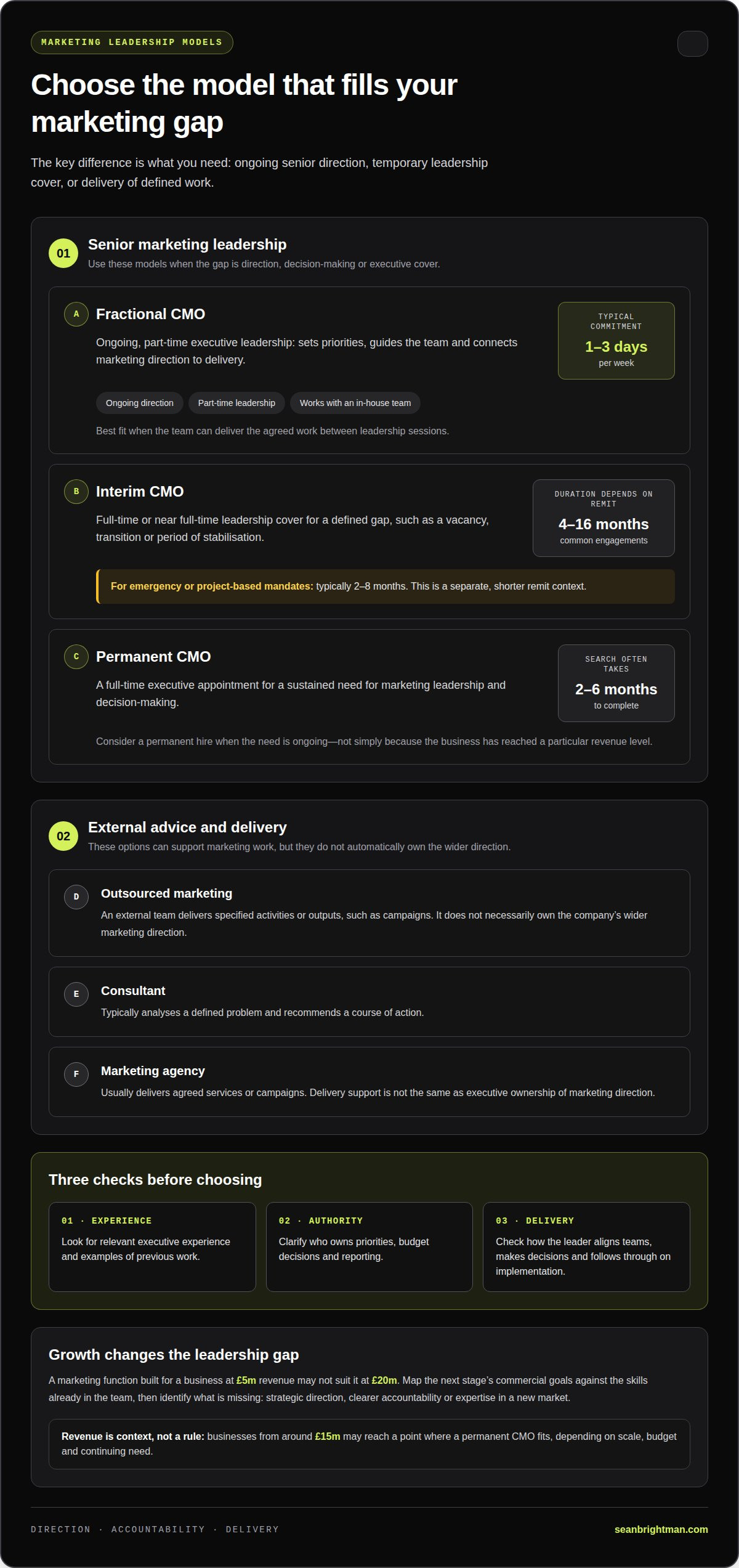
    A full-time CMO isn’t the only way to get senior marketing direction. The strongest alternatives to hiring a full-time CMO include fractional leadership, interim cover and a senior in-house marketer supported by specialists. The right option depends on whether you need ongoing strategy, temporary leadership or hands-on delivery.

    It makes sense to want experienced leadership without adding a permanent executive role before the business is ready. But lower-cost support isn’t automatically a better fit: strategy, accountability and execution still need to work together.

    This guide compares the main options, explains what fractional marketing leadership involves and shows how to assess external support. You’ll come away with a clearer sense of which model fits your growth stage, workload and need for senior decision-making.

    Key Takeaways

    • Match marketing leadership to the business’s current growth stage, strategic workload and need for hands-on execution.
    • Use fractional leadership for ongoing senior direction; consider interim cover when a leadership gap has a clear end point.
    • Assess external support by its executive experience, real-world results and ability to connect strategy with delivery.
    • Compare the options by the gap you need to fill, then choose a model that gives your team clear priorities and accountability.

    Can You Trust an External CMO?

    A CMO can be permanent, interim, fractional or part-time. The right commitment depends on whether leadership needs to be continuous or time-bound. Look for relevant executive experience, clear decision-making authority and evidence of previous work.

    Integrating Fractional Leadership with an In-House Team

    A fractional CMO should set direction with the people responsible for delivery. Agree who owns priorities, budget decisions and reporting, then connect those responsibilities to the in-house team’s workflow. For example, the CMO might shape positioning and channel priorities while internal marketers manage campaigns. This works best when the team has delivery capacity and a clear way to raise blockers. Look for practical collaboration, not a strategy document that gets handed over and forgotten.

    Fractional and Outsourced Marketing Leadership

    Fractional leadership means a senior marketer takes an ongoing, part-time leadership role, joining planning and decisions without becoming a full-time employee. Outsourced marketing usually assigns specific activities or outputs to an external team, such as campaign delivery, without necessarily owning the company’s wider marketing direction. Interim leadership is usually full-time or near full-time cover for a defined gap; engagements commonly last four to sixteen months. Choose based on the work: leadership for priorities and accountability, outsourced execution for defined delivery, or interim cover when a senior post is temporarily vacant.

    Consultants, Agencies and Fractional CMOs

    A consultant typically analyses a defined problem and recommends a course of action. A marketing agency usually delivers agreed services or campaigns. A fractional CMO takes executive responsibility for marketing direction and connects decisions to implementation. In practice, that means aligning the team, setting priorities and tracking progress, rather than stopping at advice or a campaign brief. In the UK, the Consumer Duty has been in force for closed products since July 2024, according to the Financial Conduct Authority. Financial services marketing therefore needs leadership that understands the organisation’s responsibilities and how its communications are managed.

    Use evidence, not a polished pitch, to assess an external leader. Ask for examples of previous executive work and case studies showing how they made decisions, aligned teams and handled delivery. Permanent CMO searches often take two to six months, while Business Talent Group’s 2024 global survey found a 23% annual increase in demand for experienced interim leaders. Match the model to the gap: fractional support for ongoing part-time direction, interim cover for a vacancy, or a permanent hire for a sustained full-time need.

    What is fractional marketing leadership?

    Fractional marketing leadership brings senior direction into a business part-time, rather than through a full-time appointment. A fractional CMO can set priorities, guide an existing team and connect marketing activity to business growth.

    The need for leadership shifts as a business grows. A marketing function built for a company at £5m revenue may not suit it at £20m revenue. At each transition, map the next stage’s commercial goals against the skills already in the team. Then identify what’s missing: strategic direction, clearer accountability, or expertise in a new market. This makes finding the right leadership model a practical decision, not a job-title exercise.

    CMO and Marketing Director Roles

    A chief marketing officer usually owns the wider strategic agenda, including positioning, investment priorities and how marketing supports business outcomes. A marketing director may lead the function’s plans and delivery, translating business priorities into work for the team. Titles vary between organisations, so compare decision-making authority and scope. If the gap is commercial direction, a director focused on execution may not fill it. If the strategy is already set, that director may be the right lead.

    Benefits of Part-Time Marketing Leadership

    A fractional CMO typically works one to three days per week on an ongoing basis. That commitment can give an existing team access to senior judgement without requiring a full-time role. The leader can challenge the plan, help sequence priorities and establish how progress is reported. The model fits best when the team can deliver agreed work between leadership sessions. If execution capacity is the real gap, part-time strategic guidance alone won’t supply it.

    When the CMO seat is vacant, interim cover can keep decisions moving while the business plans its next step. It can suit a defined transition, such as maintaining marketing direction while responsibilities are reassigned. Set the interim leader’s remit around immediate priorities, decision-making authority and handover needs. This keeps temporary cover focused instead of letting it become open-ended by default.

    If part-time senior direction fits your growth stage, explore fractional CMO leadership as a way to bring strategy closer to day-to-day decisions.

    Alternatives to a Full-Time CMO for Growing Businesses

    Are more businesses choosing Fractional CMOs?

    Interim or fractional leadership can be an alternative to a permanent hire when the need is temporary or part-time. Compare the required commitment and decision-making scope, and consider whether the business also needs a full-time executive presence.

    Between permanent CMOs, interim cover can keep priorities moving without forcing a rushed appointment. Emergency or project-based interim CMO mandates typically last two to eight months. That window can cover a leadership vacancy, a defined transformation or a period of stabilisation. Set the remit around decisions that cannot wait, such as approving priorities, aligning teams and maintaining oversight of marketing activity.

    A permanent CMO search makes more sense when the need for executive marketing leadership is sustained. Businesses from around £15m in revenue may reach a point where a permanent appointment fits, depending on scale, budget and continuing need. Revenue alone doesn’t settle the question. The decisive challenge is whether strategic decisions and team leadership require a consistent full-time owner.

    Vetting an interim CMO means assessing executive judgement, not just reviewing a polished presentation. Ask for relevant case studies and examples of previous work, then explore the decisions behind those outcomes. Clarify reporting lines, authority over priorities and how the leader will work with the existing team. A strong interim should explain how they’ll move from diagnosis to action and how progress will be measured.

    A virtual CMO can provide senior direction remotely, while an interim CMO may take on a broader temporary leadership remit. Either model can involve a smaller commitment than a permanent appointment, particularly when the business needs strategy but not full-time executive cover. The value comes from matching time and responsibility to the actual gap, not assuming remote support is automatically cheaper.

    Check that the engagement’s status and working arrangements are clear. Build that into the engagement process alongside the role’s responsibilities, working arrangements and contract. The right model is clear when the business can define the gap, its duration and the decisions the external executive must own.

    Alternatives to hiring a full-time CMO

    A permanent CMO is only one way to build senior marketing capability. The best alternative depends on the gap: strategic direction, delivery capacity, specialist expertise or clearer accountability. Compare the commitment with the work the business actually needs.

    Start by separating leadership from execution. If the team has capable marketers but lacks a clear growth plan, bring in senior strategic direction. If the plan is sound but campaigns are stalling, add delivery capacity instead. This distinction helps avoid hiring an expensive generalist when the real need is a specialist or stronger project ownership.

    • Fractional leadership: Use a part-time executive to set priorities, align marketing with commercial goals and guide the team’s decisions.
    • Senior in-house marketer: Hire a marketing director or senior marketing lead when daily team management and implementation matter most.
    • Agency or specialist support: Assign defined work, such as content production or campaign delivery, when the strategy already exists.
    • Consultant: Bring in focused expertise to diagnose a specific challenge and recommend a practical course of action.

    These models can also work together. For example, a fractional leader can set the direction while an agency delivers a defined campaign and an in-house marketer manages day-to-day coordination. Keep one person accountable for priorities, deadlines and measured outcomes. Without that link, separate suppliers can produce activity without a joined-up plan.

    Choose by writing down the business outcome first, followed by the decisions and work needed to reach it. Identify what the current team can own, where senior judgement is missing and which tasks need specialist delivery. Review progress against agreed measures, such as qualified leads or campaign contribution, rather than counting activity alone.

    Need to turn that gap into a workable marketing plan? Map your senior marketing needs before committing to a permanent structure.

    Sean Brightman

    Sean Brightman helps growing businesses decide what kind of marketing leadership their next stage requires. If the challenge is unclear priorities, disconnected activity or a team without strategic direction, Roadmapping can turn the problem into a focused plan. A Fractional CMO can provide senior marketing leadership alongside the existing team, while an Advisory Retainer offers ongoing direction and accountability.

    For businesses considering how AI could support their marketing systems, AI Consulting offers practical guidance on AI systems, content operations and workflow automation. The right starting point depends on the gap: strategic direction, a practical roadmap, continued advice or AI-focused support. The aim is to match the input to the business need, not add a role for its own sake.

    If you’re weighing these options, email Sean Brightman at sean@seanbrightman.com to discuss your marketing leadership needs.

    Make your next marketing move deliberate

    Turn your decision into a working brief before changing the team structure. Set out the business priority, the decisions marketing leadership must own and the work your current team can deliver. This gives you a practical test for the alternatives to hiring a full-time CMO: do they fill the actual gap, or simply add another layer?

    Sean Brightman can help shape that next step through Fractional CMO support, AI Consulting or Roadmapping. The focus is on matching support to your business priorities, whether you need senior direction, a clearer plan or practical guidance on AI systems. Start with the challenge slowing progress, then decide what kind of input would move it forward.

    Ready to discuss your options? Contact Sean Brightman and take the next step with a clearer brief.

    Frequently Asked Questions

    Hiring a CMO: Full-Time vs Fractional, What’s the Better Option?

    Choose an arrangement that fits the rhythm of decisions your business makes. Map upcoming marketing approvals, budget reviews and leadership meetings against who currently has authority to act. If decisions repeatedly wait for one person’s input, that signals a gap in availability or ownership. Use the map to define the role’s access to senior meetings and internal information before agreeing its scope.

    Need to hire a CMO, what are your options?

    You can appoint a permanent executive, bring in interim or fractional leadership, or divide responsibilities across existing leaders and external specialists. Before choosing, define which decisions need a single accountable owner, such as budget approval, brand direction or team priorities. Then clarify how that person will work with the chief executive and other department leads. This helps prevent a title change from leaving the same decision-making gaps in place.

    What is a CMO on demand?

    A CMO on demand is a flexible label for accessing CMO-level input when a business needs it, rather than creating a conventional permanent post. The arrangement might focus on a particular planning need or ongoing access, so the phrase alone doesn’t define the work. Set out which decisions the person can influence, what information they’ll receive and how their input connects with the leadership team.

    What is an interim CMO?

    An interim CMO is a temporary executive appointment. To make the transition useful, prepare a concise handover covering current campaigns, active supplier commitments, key performance measures and decisions awaiting approval. Agree who will receive that information when the assignment ends. A clear record preserves context for the next leader and gives the interim executive a practical starting point, rather than leaving them to piece together the marketing operation from scattered updates.

    What’s the best way to look for a Fractional CMO?

    Start with a brief describing the business situation and the decisions the role must support. Use it to compare proposed approaches: ask each person to identify likely priorities, dependencies and the information they’d need from your team. This reveals how they think about your specific challenge, not just how they describe their service. Also agree how recommendations and decisions will be recorded for the team.

    Why hire a Fractional CMO?

    A Fractional CMO can offer an external perspective when senior leaders need to challenge assumptions about the brand, customer experience or marketing priorities. For example, a leadership team preparing to revise its offer may want an experienced voice to examine how the change affects messaging and customer journeys. The value is sharper decision-making around that defined challenge, not another layer of activity for the marketing team.

  • Integrating a Fractional CMO into Your Team: The CEO’s Guide to Strategic Velocity

    Integrating a Fractional CMO into Your Team: The CEO’s Guide to Strategic Velocity

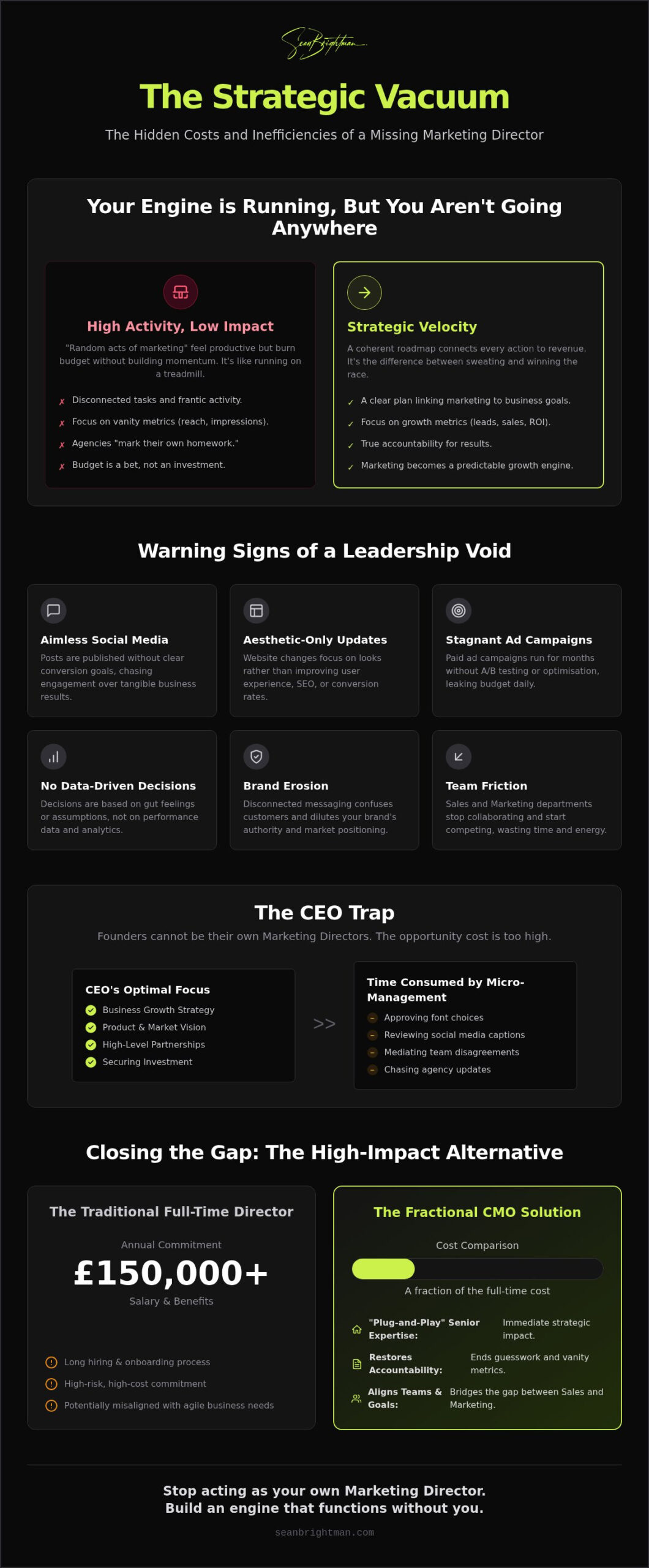
    Most CEOs are paying for expensive marketing advice that evaporates the moment the consultant leaves the Zoom call. It’s a frustrating cycle of high fees and zero momentum. Successfully integrating a fractional cmo into your team isn’t about adding another person to your payroll; it’s about installing a strategic engine that drives velocity. You need a builder, not a talker.

    You probably feel like your current marketing activity is random and unmeasured. Your team is working hard, but they lack the senior direction to turn that effort into equity. It feels like a cost centre because it lacks a battle-hardened architect to own the results. You want accountability for every pound spent, not just more creative ideas that never launch. This friction is what stops a good business from becoming a market leader.

    This guide provides the blueprint to turn your marketing function into a scalable growth engine. You’ll learn how to embed a high-impact leader who builds a plug-and-play system rather than just a list of tasks. We are moving from chaos to a clinical roadmap that prepares your business for massive scale or a lucrative exit. It is time to stop guessing and start executing with precision.

    Key Takeaways

    • Stop hiring for activity and start building for architecture. Treat your marketing function as a system to be installed, not just another seat to fill.
    • Follow a clinical 90-day roadmap that moves you from a brutal initial audit to a state of high-velocity strategic growth.
    • Discover why successfully integrating a fractional cmo into your team requires a clinical data handshake to align your senior leadership with an AI-powered tech stack.
    • Learn to relinquish the role of de facto marketing manager by implementing accountability systems that drive results without the need for corporate fluff.
    • Build a growth engine that doesn’t just generate leads but actively increases your business valuation in preparation for a future exit.

    Why Integration Fails: Moving from “Activity” to “Architecture”

    Most CEOs treat a Fractional CMO like a high-end freelancer. They wait for the “new hire” to ask what needs doing. This is a fundamental mistake. Successfully integrating a fractional cmo into your team is a system installation, not a recruitment win. If you view this as just filling a seat, you’ve already lost the battle for strategic velocity.

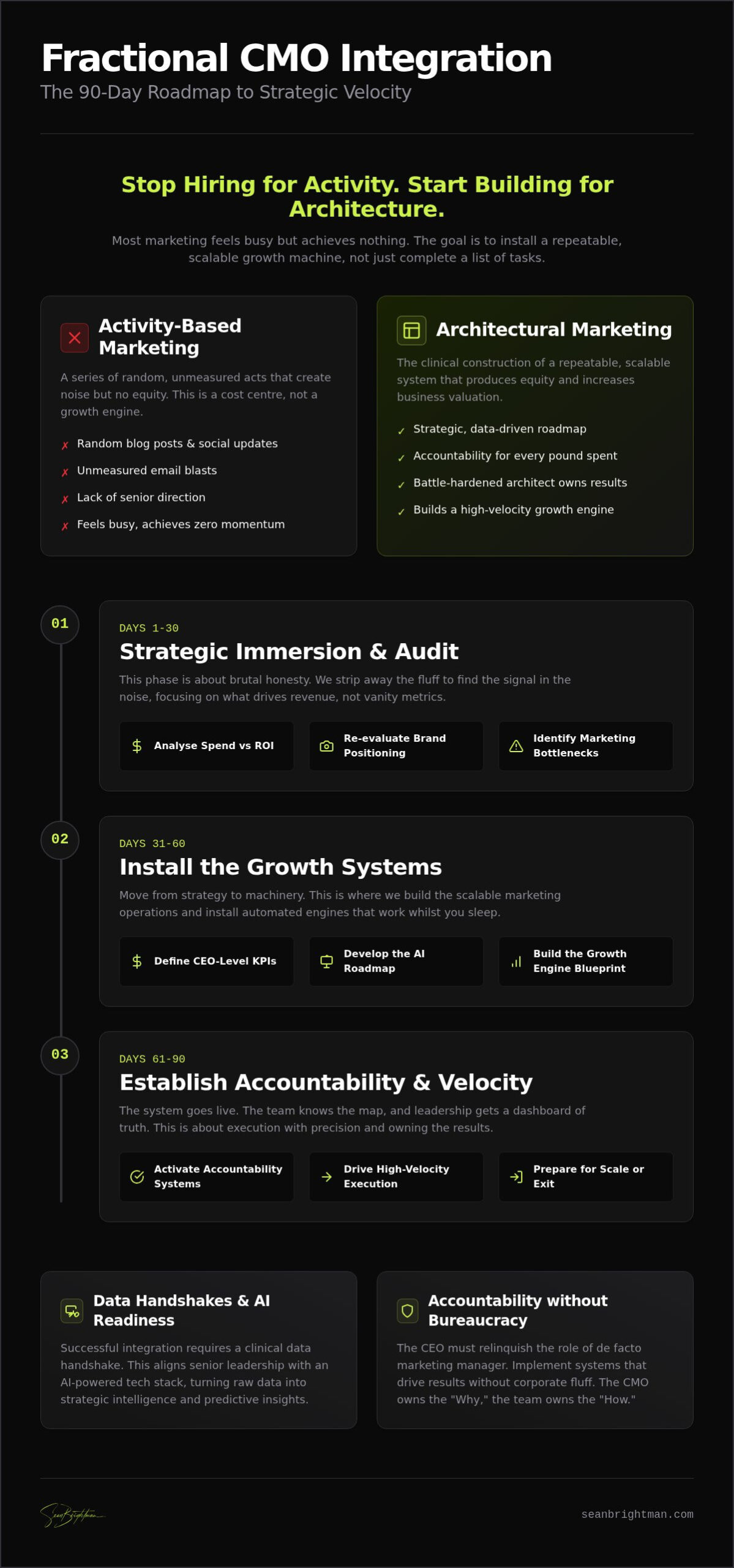
    The failure usually starts with a focus on activity rather than architecture. Activity-Based Marketing is a series of random acts: a weekly blog post, a few LinkedIn updates, or an unmeasured email blast. It feels busy but achieves nothing. Architectural Marketing is different. It’s the construction of a repeatable, scalable growth machine. One produces noise; the other produces equity.

    The “freelancer mindset” kills value. A freelancer takes orders to complete tasks. A Fractional CMO gives direction to achieve objectives. If you’re paying for senior leadership but using them to “help out” with copywriting, you’re burning cash. You need a head, not just more hands. This requires a shift in how you view the role from day one.

    Your job as CEO is simple but difficult. You must provide the keys to the engine, not just a seat at the table. If the CMO doesn’t have the authority to challenge your current team or scrap failing projects, they’re just a decorative addition to your C-suite. Integrating a fractional cmo into your team requires you to step back so they can step up.

    The “Plug-and-Play” Leadership Mindset

    A Fractional CMO must be treated as a senior partner from the first hour. You face a binary choice: do you want a “doer” or a “designer” of growth? A doer follows your lead. A designer builds the path. Set the expectation for blunt honesty over corporate politeness. You aren’t paying for a “yes man”; you’re paying for the “battle-hardened expert” who knows where the bodies are buried in your current strategy.

    Defining the Scope of the Growth Engine

    Clear boundaries prevent senior leaders from becoming overpaid project managers. The CMO owns the “Why” whilst the team owns the “How”. This distinction is the bedrock of a successful Marketing advisory retainer. They define the market position and the strategic roadmap. They don’t spend their time tweaking Google Ads. By separating strategic advisory from tactical execution, you ensure your investment goes toward building the machine, not just oiling the gears.

    The 90-Day Integration Roadmap: From Audit to Velocity

    Velocity is not about moving fast; it is about moving in the right direction at speed. Most marketing departments are just busy. When integrating a fractional cmo into your team, the first 90 days must be clinical. You aren’t here to “settle in”. You are here to rebuild. A structured Strategic brand roadmapping session is the non-negotiable first step. Without it, you are just painting a house that has no foundation.

    Phase 1: The Strategic Immersion and Audit

    Days 1 to 30 are about brutal honesty. We look at the bank account first, then the creative. This phase is designed to strip away the fluff and find the signal in the noise. We focus on three critical areas:

    • Spend vs ROI: We analyse every pound spent. If a channel isn’t contributing to the pipeline, it gets cut or fixed. No sacred cows.
    • Brand Positioning: We re-evaluate how you speak to the market. Most businesses talk about themselves. We ensure you are saying what your customers actually need to hear.
    • Messy Marketing Bottlenecks: We identify the manual processes and unclear briefs that slow your team down. These are the friction points that kill momentum.

    Phase 2: Installing the Systems

    Days 31 to 60 move from strategy to machinery. We stop relying on spreadsheets and start building scalable marketing operations. This is where we create your AI roadmap. We move from playing with tools to installing automated growth engines that work whilst you sleep. We define the KPIs that actually matter to a CEO. We don’t care about “likes” or “shares”. We care about pipeline velocity and customer acquisition cost. This phase delivers the “Growth Engine” blueprint. It gives your internal team a map and gives you a dashboard of truth.

    Days 61 to 90 are about establishing accountability. The system is live. The team knows their roles. The Fractional CMO ensures everyone stays on the roadmap. This isn’t about micromanagement; it is about discipline. By day 90, marketing is no longer a mystery or a cost centre. It is a predictable, scalable part of your business machinery. You can see exactly how the integration has turned random activity into strategic velocity.

    If you want to see how this roadmap fits your specific business model, you can explore the Fractional CMO options available today to begin the process.

    Data Handshakes and AI Readiness: The Technical Integration

    A strategic roadmap is useless if the engine has no fuel. In 2026, that fuel is data. Integrating a fractional cmo into your team requires more than a login to Slack and a seat at the monthly board meeting. It demands a clinical “Data Handshake” between your senior leader and your entire tech stack. If the CMO cannot see the raw numbers, they cannot drive growth. They are simply guessing with your budget.

    This is where AI consulting becomes a functional necessity rather than a corporate trend. Most teams are currently “playing with tools” like ChatGPT for basic social media copy. A Fractional CMO moves you toward scalable growth by automating the machinery. We audit your tech stack to determine if it is fuel for the engine or just expensive overhead. If a tool does not contribute to the data handshake or provide actionable insights, it is dead weight that belongs in the bin.

    Establishing the Single Source of Truth

    The CMO needs unfiltered access to your CRM and financial data from day one. You cannot hide the “messy” parts of the business if you want them fixed. Data cleanliness is the first hurdle in any AI implementation. If your CRM is a graveyard of dead leads and unmapped fields, your AI will hallucinate. We clean the pipes so the engine can run. The final output is a dashboard that the CEO actually understands. We ignore vanity metrics. We focus on the truth about your pipeline and your customer acquisition cost.

    The AI Roadmap: Efficiency vs Innovation

    We integrate AI into daily operations for immediate cost-saving. This is not just about content generation. It is about using AI for strategic insights that humans simply miss. We build an AI-powered growth engine that reduces your reliance on increasing headcount. Your existing team is trained to work alongside these systems, not fear them. We move from manual labour to mechanical precision. Integrating a fractional cmo into your team means giving them the keys to the data so they can build a lean, high-output asset. This is how you achieve strategic velocity without the bloat of a traditional marketing department.

    Integrating a Fractional CMO into Your Team: The CEO’s Guide to Strategic Velocity

    Managing the Fractional Leader: Accountability Without Bureaucracy

    Your biggest bottleneck is likely staring at you in the mirror. CEOs often struggle with integrating a fractional cmo into your team because they cannot stop being the de facto marketing manager. You need to let go. You aren’t hiring a helper; you’re hiring an architect. If you’re still approving social media posts or tweaking ad copy, you’re failing to lead. You’re also burning the very strategic velocity you’re paying to create.

    To drive true team discipline, consider the role of a Marketing operations consultant. They manage the plumbing. The Fractional CMO manages the strategy. This setup ensures accountability without you needing to dive into the weeds. It creates a buffer that allows you to focus on the business whilst the marketing engine runs on a clinical, pre-defined schedule. Accountability is about results, not hours logged.

    Establish a staccato rhythm of reporting. Reports are for bureaucrats; briefings are for leaders. You don’t need a fifty-page slide deck once a month. You need a ten-minute high-impact briefing once a week. What’s the pipeline? What’s the blocker? What’s the fix? If the CMO isn’t challenging your assumptions, they aren’t doing their job. A “battle-hardened expert” maintains strategic integrity by saying “no” to the CEO’s distractions.

    The “Advisory vs Execution” Divide

    The Fractional CMO manages external agencies and internal staff without micromanaging. They own the “Why” so the team can own the “How”. This requires a binary rule: the CEO sets the destination; the CMO builds the vehicle. When targets are missed, we don’t look for excuses. We look for the mechanical failure in the system. Accountability is built into the architecture, not added as an afterthought. If you want to see how this leadership model scales, you can enquire about an Advisory Retainer to start the transition.

    Breaking the “Agency” Habit

    Stop treating the CMO like an external consultant. Your team will follow your lead. If you treat them like a vendor, the team will treat them like an intruder. Integrating a fractional cmo into your team means giving them a seat in your internal comms. Put them in Slack. Give them a company email. They must be present for high-level board or strategy discussions. If they aren’t in the room when the big decisions are made, they can’t align the marketing engine to your commercial goals. They are a partner, not a provider.

    Scaling for Exit: The Long-term Value of Fractional Leadership

    A business is a machine. If the machine breaks the moment you walk away, it isn’t a business; it’s a high-stress job. Integrating a fractional cmo into your team is the most effective way to build a marketing strategy for business exit that actually moves the needle on valuation. Buyers don’t buy your personality. They buy your systems. They buy the certainty that revenue will continue to flow without the founder’s personal network or a “hero” employee.

    A proven growth engine is the most valuable asset on your balance sheet. It is not just about leads today. It is about the documented, automated infrastructure that guarantees leads tomorrow. A Fractional CMO builds this from the ground up, ensuring that the marketing function is a functional component of the business rather than an abstract theory. This is about building equity, not just chasing quarterly targets.

    Valuation Through Systems, Not People

    Buyers pay a premium for documented, automated marketing machines. They want to see that your growth is a result of machinery, not magic. Reducing “Key Person Dependency” is critical for a lucrative exit. If the founder is the primary rainmaker, the business has a glass ceiling. By proving scalability through historical data and AI-driven efficiency, you turn marketing from a cost into an investment-ready asset. You are selling a predictable future, not a chaotic past.

    • Systems over Sweat: Documented processes mean the business runs without you.
    • Data over Guesswork: Historical ROI data provides the proof buyers demand.
    • AI Efficiency: A lean, AI-powered team is more attractive than a bloated, manual department.

    The Fractional-to-Full-Time Handover

    The transition from a Fractional leader to a full-time hire is a strategic move, not an emotional one. It usually happens much later than you think. You only need a full-time CMO when the engine is so large that it requires forty hours a week just to keep the gears turning. Until then, stay lean and high-impact. Avoid the £120k to £150k overhead of a full-time hire until the revenue justifies the permanent seat.

    When the time comes, use your Fractional CMO to hire and train their full-time successor. They know the plumbing. They know exactly what the role requires because they built the roadmap. This ensures zero loss in momentum during the transition. However, many CEOs choose to stay with the fractional model indefinitely. They realise they don’t need a full-time executive; they need the strategic velocity that only a concentrated, battle-hardened expert provides. Integrating a fractional cmo into your team is not just a temporary fix; it is a long-term play for business maturity.

    Build Your Growth Engine Today

    Activity is a cost. Architecture is an asset. You’ve seen why most marketing fails: it lacks the senior direction to turn random acts into repeatable revenue. Integrating a fractional cmo into your team isn’t about adding a consultant; it’s about installing a battle-hardened expert who owns the “Why” whilst your team masters the “How”.

    We’ve covered the 90-day roadmap to velocity and the technical data handshakes required for AI-powered growth. This isn’t about more meetings; it’s about more momentum. You need a system that increases your business valuation and prepares you for a lucrative exit. Marketing shouldn’t be a mystery; it should be machinery.

    Sean Brightman is the author of “The Growth Engine” methodology and a specialist in AI-powered marketing transformation. With a proven track record in UK scale-up growth, he helps CEOs stop guessing and start scaling. It’s time to turn your marketing from a cost centre into a clinical growth machine.

    Book a Strategic Roadmapping Session with Sean Brightman to install your growth engine today. Your future valuation depends on the systems you build now.

    Frequently Asked Questions

    How many days per month does a Fractional CMO typically work?

    Most engagements range from two to eight days per month. It depends on the complexity of your roadmap and the speed of growth you require. A Fractional CMO isn’t a full-time employee; they are a high-impact strategic force. They focus on outcomes rather than clocking hours. This model provides senior leadership at a fraction of the £120k to £150k cost of a full-time UK hire. You get strategy without the executive bloat.

    Will a Fractional CMO manage my existing marketing team?

    Yes, they provide the senior direction your current team lacks. Successfully integrating a fractional cmo into your team means they own the “Why” and the strategy. Your internal staff or external agencies own the “How” and the execution. They install accountability and discipline, ensuring every team member knows their role in the growth engine. This prevents random acts of marketing and focuses everyone on your commercial exit or scale goals.

    How is a Fractional CMO different from a marketing agency?

    An agency sells services; a Fractional CMO sells strategy and results. Agencies are often “doers” focused on specific channels like SEO or paid media. A Fractional CMO is a “designer” who sits on your side of the table. They manage the agencies and ensure their activity aligns with your business objectives. They are your internal advocate, not an external vendor looking to upsell more billable hours or creative projects.

    Does a Fractional CMO help with AI implementation?

    Modern leadership requires moving from manual labour to AI-powered efficiency. A Fractional CMO audits your tech stack and builds an AI roadmap to automate repetitive tasks. This isn’t just about using tools for basic content. It is about using AI for strategic insights and data analysis. They ensure your team works alongside AI systems to increase output without increasing your permanent headcount. They turn technology from a toy into a growth engine.

    What is the typical cost of a Fractional CMO in the UK?

    Costs vary based on the scope of the engagement and the seniority of the expert. However, a Fractional CMO is significantly more cost-effective than a full-time hire, which currently averages between £120k and £150k in the UK. You pay for high-level strategic velocity rather than a full-time salary and benefits package. This allows you to invest the savings back into your actual marketing spend or AI infrastructure to drive faster results.

    How do I know if my business is ready for a Fractional CMO?

    You are ready when marketing feels random and unmeasured. If you have a team but no senior strategic direction, you’re likely burning cash on activity that doesn’t scale. Most businesses with annual revenues between £1 million and £30 million are in the “sweet spot”. You need the expertise to grow but don’t yet need the overhead of a permanent C-suite executive. It is about your readiness to install systems over activity.

    Can a Fractional CMO help prepare my business for an exit?

    Yes, by reducing “Key Person Dependency” and building documented systems. Buyers pay a premium for a business that runs on a growth engine rather than the founder’s personal effort. Integrating a fractional cmo into your team ensures that your marketing is an automated, scalable asset on your balance sheet. They provide the historical data and ROI proof points that sophisticated buyers demand during the due diligence process to justify a higher valuation.

    What data does a Fractional CMO need to get started?

    They need a clinical data handshake with your entire tech stack. This includes unfiltered access to your CRM, financial reports, and current marketing performance metrics. They look for the signal in the noise to identify where your budget is being wasted. You must be prepared to share the messy reality of your numbers. Only with clear data can they build a clinical roadmap that leads to strategic velocity and measurable commercial growth.

  • The Fractional CMO Retainer Model UK: Strategic Leadership Without the Full-Time Overhead

    The Fractional CMO Retainer Model UK: Strategic Leadership Without the Full-Time Overhead

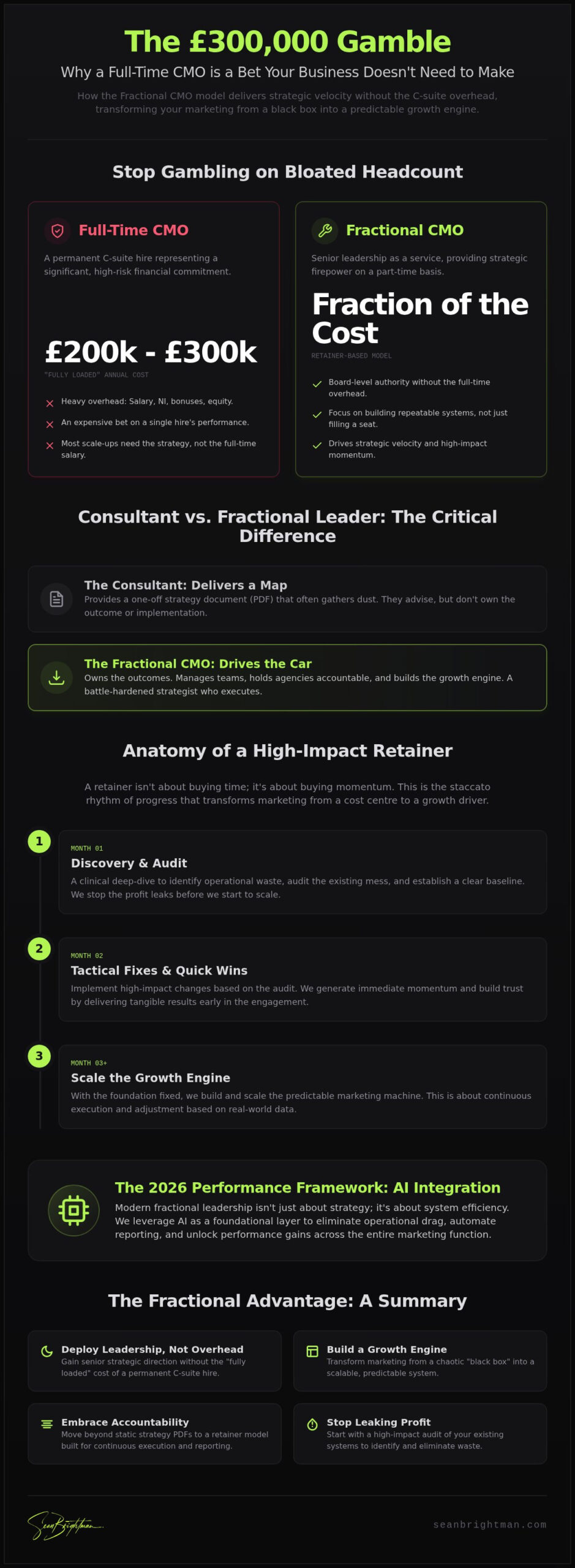
    A full-time CMO is a £300,000 gamble your balance sheet doesn’t need. It’s an expensive bet on a single hire when what you actually require is a repeatable system. You’ve got a solid product, but marketing feels like a black box. If you’re wondering what does a fractional cmo do month to month to fix this, the answer isn’t more meetings; it’s more momentum. You’re the founder. You’re the only salesperson. It’s a recipe for burnout.

    You need strategic velocity, not more headcount. This article explains how to deploy senior leadership through a fractional model to drive AI-powered growth. We’ll show you how to transform stalled results into an optimised engine. No corporate fluff. No ego. Just high-impact advisory. This is about senior-level authority combined with a get-your-hands-dirty attitude.

    We’ll look at how the retainer structure provides board-level reporting and clear strategic direction. You’ll discover how to install a plug-and-play leader who delivers results through tactical precision. It’s about building machinery that works, even when you’re not in the room. Expect a briefing on driving growth without the traditional overhead.

    Key Takeaways

    • Stop gambling on bloated full-time hires; learn how to deploy senior strategic leadership without the heavy “fully loaded” overhead.
    • Get a clear breakdown of what does a fractional cmo do month to month to transform your marketing from a black box into a scalable growth engine.
    • Discover how to leverage AI consulting as a foundational efficiency layer to eliminate operational drag across your entire marketing function.
    • Move beyond static strategy PDFs; embrace a high-accountability retainer model designed for continuous execution and board-level reporting.
    • Identify where you are leaking profit by starting with a high-impact Roadmapping session and a comprehensive audit of your existing systems.

    What is the Fractional CMO Retainer Model in the UK?

    The fractional model is a clinical solution to a messy problem. It’s senior leadership on a part-time, ongoing basis. Think of it as high-calibre strategic firepower on tap. This isn’t about hiring a pair of hands to execute ads. It’s about installing a brain to architect your entire growth engine.

    For UK scale-ups, the financial logic is undeniable. A full-time CMO in 2026 carries a “fully loaded” cost often exceeding £200,000. That includes salary, employer National Insurance, and hefty bonuses. Most mid-market firms don’t need that overhead. They need the results. By using a Fractional executive, you get the same board-level authority at a fraction of the price. It’s about strategic velocity, not just filling a seat.

    The core value lies in systems design and accountability. Founders often ask, what does a fractional cmo do month to month? they don’t just “check-in.” They define the roadmap, audit the operational waste, and ensure the team hits their KPIs. They turn marketing from a black box into a predictable machine. It is high-level thinking combined with a get-your-hands-dirty attitude.

    Fractional CMO vs Marketing Consultant: The Critical Difference

    Consultants give you a map and wish you luck. Fractional CMOs get in the car and drive. A consultant delivers a strategy PDF that usually gathers dust. A fractional leader owns the outcomes. They manage your internal team and external agencies. They are battle-hardened strategists who don’t need hand-holding. If you’re still spending CEO time managing marketing tactics, you haven’t hired a leader; you’ve hired a chore. This is about plug-and-play authority, not another meeting in your diary.

    The 2026 UK Market Context for Senior Marketing Hires

    The UK market has shifted. In 2026, smart businesses have stopped hiring for “activity” and started hiring for “strategy.” There’s a national demand for senior leadership that can navigate complex AI integration and tightening data regulations. The fractional model solves the “messy marketing department” syndrome. It provides a sharp-minded external force that brings order to internal complexity. You get high-level thinking combined with practical execution. It is the efficient choice for companies that have outgrown ad-hoc tactics but aren’t ready for a permanent C-suite salary.

    What Does a Fractional CMO Do Month to Month? The Anatomy of a High-Impact Retainer

    Retainers aren’t about buying a block of time. They’re about buying momentum. If you’re asking what does a fractional cmo do month to month, you’re looking for a rhythm, not a timesheet. It’s a methodical process of identifying waste and installing efficiency. The model is designed to provide senior-level authority exactly when it’s needed, without the bloat of a full-time salary.

    The retainer model creates a staccato rhythm of progress and reporting. Month one focuses on discovery and auditing the existing mess. Month two is about tactical fixes and quick wins. By month three, we’re scaling the growth engine. This ongoing commitment beats one-off project work because strategy is a living thing. It needs constant adjustment based on real-world data, not a static PDF that gathers dust on a hard drive.

    The Advisory Retainer: Direction and Accountability

    The Marketing advisory retainer is for the founder who needs a navigator, not just a map. It’s built for strategic velocity. I act as a sounding board for the CEO whilst driving the marketing team toward clear objectives. This isn’t about operational drag. It’s about clinical oversight. You get the expertise of a battle-hardened strategist to challenge your assumptions and keep your budget focused on what actually moves the needle. It’s high-level direction without the friction of a permanent hire.

    The Fractional CMO Engagement: Systems and Leadership

    When the engagement deepens into a full Fractional CMO role, the focus shifts to building the machinery. This is about deeper integration. I take ownership of the roadmap and manage your internal teams and external agencies to ensure total alignment. If your agencies are pulling in different directions, I’m the one who reins them in. The New Wave Of Fractional Leaders demonstrates that this model is about immediate expertise and tangible impact. I own the “Roadmap to Exit” strategy, ensuring every pound spent increases the business valuation. If your marketing feels like a black box, it’s time to install a Fractional CMO who knows how to fix the plumbing.

    This role is about accountability. I provide the board-level reporting you need to understand exactly where your growth is coming from. We don’t just look at vanity metrics; we look at commercial results. By managing the day-to-day strategic decisions, I free up the CEO to focus on the bigger picture. It’s a plug-and-play leadership solution that scales as your business grows.

    The Project Trap: Why Ongoing Retainers Outperform One-Off Strategy

    Buying a one-off strategy is often a polite way of wasting money. You receive a polished PDF, the consultant leaves, and the document gathers dust on a shared drive. Within three months, your team has drifted back to comfortable, low-impact habits. This is the project trap. It offers the illusion of progress without the machinery of execution. Real growth requires a living strategy that evolves with your data.

    When founders ask what does a fractional cmo do month to month, they are asking about the antidote to strategic drift. A retained leader provides the filter you lack. They stop “tool fatigue” by killing unnecessary SaaS subscriptions and focusing on high-leverage activities. It’s about strategic velocity, not just having a plan. This ongoing presence ensures that your marketing strategy for business exit remains a priority, not a secondary thought. Buyers don’t want to see a one-time spike; they want to see a repeatable, scalable engine.

    Accountability is the missing ingredient in most UK marketing departments. Without a senior leader to hold the line, “busy-ness” replaces results. The retainer model installs a battle-hardened expert who isn’t afraid to challenge the status quo. As noted in the Harvard Business Review regarding Part-Time Senior Leaders, this model allows businesses to fill critical talent gaps with high-level expertise that would otherwise be out of reach. It is a clinical approach to leadership that prioritises commercial outcomes over corporate politeness.

    Preventing Strategic Drift

    Market conditions in 2026 move too fast for static plans. With AI adoption hitting 75% amongst brands, your competitors are pivoting weekly. A one-off roadmap fails because it can’t account for volatility. The fractional retainer allows for monthly course correction. We look at what is working and double down. We look at what is failing and cut it. This isn’t about “checking in”; it’s about aggressive oversight. It builds a culture focused on results, ensuring your budget isn’t bled dry by ad-hoc tactics that don’t align with the core objective.

    Building Scalable Marketing Systems

    Tools are not a strategy. Architecture is. Most businesses have a mess of disconnected platforms that create operational drag. A Marketing operations consultant focuses on building the underlying architecture that allows for scale. The retainer model provides the space for this methodical systems building. We don’t just “do marketing”; we build the factory that produces it. This involves refining first-party data strategies and ensuring your tech stack actually talks to itself. It’s about mechanical integration that reduces human error and increases strategic output.

    The Fractional CMO Retainer Model UK: Strategic Leadership Without the Full-Time Overhead

    Integrating AI: The 2026 Fractional CMO Performance Framework

    AI is no longer a luxury or a side project. It is the fundamental engine of marketing efficiency. In 2026, approximately 75% of brands have integrated Generative AI into their core strategies. If your business is still “experimenting” with prompts, you are already behind. A fractional leader doesn’t just suggest tools; they engineer systems that strip away operational drag. This is about strategic velocity, not shiny objects.

    When founders ask what does a fractional cmo do month to month, a significant portion of that time is now dedicated to AI governance and workflow integration. We audit your existing tech stack to kill redundant subscriptions and replace them with automated, high-output machinery. We move from “playing with tools” to building scalable growth engines. This process involves a clinical assessment of where human intervention is slowing you down and where AI can accelerate your path to market.

    The AI-Powered Growth Engine

    Practical application beats theory every time. Most UK businesses suffer from tool fatigue. They have a collection of disconnected platforms that create more work than they solve. My approach to ai consulting is designed to fix this mess. We move beyond the hype to build actual engines. This involves using AI for hyper-personalisation. Since 71% of consumers now expect personalised interactions, this isn’t optional. It is a battle-hardened methodology that focuses on mechanical integration. We ensure your team isn’t just using AI to do the same work faster, but to do better work that was previously impossible.

    Performance Benchmarks and Reporting

    A CEO doesn’t care about “engagement” or “prompt engineering.” They care about commercial outcomes. My monthly board reports focus on the metrics that actually matter: efficiency gains and revenue growth. We measure how much operational drag we’ve eliminated and how that translates to the bottom line. With the transparency obligations of the EU AI Act taking effect in August 2026, we also ensure your AI usage is compliant and ethical. We don’t take risks with your brand reputation.

    Confidence in data is the bedrock of strategic decision-making. We don’t guess. We use AI to model outcomes and predict trends before we spend a single pound of your budget. This shift to “upstream” strategy means we are no longer just reacting to last month’s performance. We are engineering next month’s success. If you are ready to stop the guesswork and start scaling, enquire about a fractional engagement to see how we can rebuild your marketing function for 2026.

    Implementing the Model: How to Start Your Fractional Journey

    The transition to fractional leadership is a clinical process. It doesn’t start with a job interview; it starts with a high-impact Roadmapping session. This is the entry point where we define the path and identify hidden profit. We audit your existing systems to find operational waste and technical debt. This isn’t about adding more tasks to your list. It’s about reclaiming your time as CEO by installing a leader who owns the marketing function.

    Once the roadmap is set, we establish a retainer rhythm. This involves clear milestones, board-level reporting, and absolute accountability. You stop being the primary salesperson. You stop managing ad-hoc tactics. Instead, you get a plug-and-play strategist who brings order to internal complexity. This is how you move from a founder-led business to a scalable growth engine. It is about mechanical integration rather than abstract theory.

    The 90-Day Transformation

    The first three months of an engagement are designed for strategic velocity. In the first 30 days, the focus is on discovery and assessment. We look at what does a fractional cmo do month to month to ensure the foundation is solid. Days 31 to 60 are about strategy development and securing quick wins. We fix the obvious leaks in your funnel immediately. By day 90, we are in full implementation mode, developing your team and refining your AI-powered growth engine. This structured approach is part of the fractional cmo revolution that is currently transforming UK scale-ups. It prioritises long-term systems building over temporary fixes.

    Is Your Business Ready for a Fractional CMO?

    If growth has stalled despite having a good product, your marketing is likely a black box. If you are the only person who can sell the vision, your business isn’t scalable. These are the sharp signs you have outgrown your current setup. Many founders make the “£120k Mistake” by hiring a full-time CMO too early. Between recruitment fees, employer National Insurance, and a senior salary, you’ve burned a hole in your budget before the strategy is even proven. A fractional retainer allows you to prove the model first. It provides the senior leadership you need without the full-time overhead. The next step is simple. Book a strategic briefing to audit your current trajectory and see how a fractional leader can rebuild your growth engine for 2026.

    Reclaim Your Strategic Velocity

    The choice is simple. You can keep gambling on expensive full-time hires and ad-hoc tactics, or you can install a battle-hardened expert to build a repeatable growth engine. Fractional leadership isn’t about filling a seat; it’s about mechanical integration. It turns your marketing from a chaotic black box into a predictable, board-level asset. By avoiding the project trap, you ensure your strategy evolves with the market rather than gathering dust on a drive.

    Understanding what does a fractional cmo do month to month is the first step toward clinical execution. It’s about ongoing accountability, AI-powered efficiency, and strategic direction that actually sticks. As the author of the High-Impact Marketing Strategy book and an expert in AI-powered growth engines, I provide the direct, board-level advisory you need to scale without the bloat. We strip away the corporate fluff to focus on commercial results.

    Stop managing marketing and start leading your business. It’s time to reclaim your time and focus on the bigger picture. Book a Strategic Marketing Roadmap Session with Sean Brightman to audit your trajectory and define your path to growth. You have the product; now build the machinery to match it.

    Frequently Asked Questions

    What is the average fractional CMO retainer cost in the UK for 2026?

    Monthly retainers for fractional CMOs in the UK for 2026 typically range from £2,500 to £12,000. This depends on experience and the required time commitment. It usually represents about 10% to 20% of the cost of a full-time hire. You get the strategic firepower of a seasoned leader without the £300,000 fully loaded salary package. It is about buying expertise, not just hours. This model allows you to deploy senior leadership efficiently.

    How many days per month does a fractional CMO typically work?

    Most fractional CMOs work between one and three days per week. This equates to roughly four to twelve days per month. The focus is on high-impact strategic work rather than daily admin. When asking what does a fractional cmo do month to month, the value is in the outcome of those days. This includes setting the roadmap, auditing team performance, or integrating AI systems. It is about strategic velocity, not filling a chair.

    Can a fractional CMO manage my existing marketing agency?

    Yes. Managing external agencies is a primary responsibility. A fractional CMO acts as your internal filter to ensure agencies are aligned with your business goals. They stop the agency drift where providers focus on their own metrics rather than your bottom line. It’s about providing the technical oversight you don’t have time to manage yourself. They turn your agencies into a cohesive, results-oriented unit that actually delivers.

    What is the difference between an interim marketing director and a fractional CMO?

    Interim directors are usually full-time, short-term covers for a specific gap like maternity leave. A fractional CMO is a part-time, long-term strategic partner. Interims maintain the status quo; fractional leaders build and optimise the growth engine. It’s the difference between keeping the lights on and rewiring the house for scale. One fills a seat; the other builds a system. You need a strategist who stays to see the results through.

    How does the retainer model provide better ROI than a marketing agency?

    Agencies are often incentivised to sell you more services. A fractional CMO has no such conflict. They focus on commercial results and strategic velocity. The ROI comes from killing wasted spend and ensuring every pound works harder. You aren’t paying for a team of juniors to learn on your dime; you’re paying for a battle-hardened expert to drive outcomes. It is a clinical approach to budget management that prioritises profit.

    Is a fractional CMO suitable for a small business or just scale-ups?

    The sweet spot is typically businesses with revenue between £1 million and £25 million. Smaller firms often need doers to execute basic tactics. Scale-ups need the architect to design the systems. If your marketing feels like a black box or growth has stalled despite a good product, you’re ready for fractional leadership. It is about having senior-level authority when your internal complexity outgrows your current team’s ability to manage it.

    What happens if I need to increase or decrease the retainer scope?

    The model is built for flexibility. Retainers can be adjusted as your business reaches specific milestones or faces new challenges. If you are preparing for a business exit, you might increase the scope to harden your systems for buyers. Conversely, once a growth engine is stable, the retainer can scale back to an advisory level. It is a plug-and-play solution that adapts to your commercial reality without the friction of redundancy.

    How do you measure the success of a fractional marketing retainer?

    Success is measured through commercial KPIs, not vanity metrics. We look at pipeline velocity, customer acquisition costs, and overall ROI. When considering what does a fractional cmo do month to month, you should expect board-level reporting that provides clear strategic direction. Success means your marketing is a predictable revenue driver, not a cost centre. It requires a clinical focus on the numbers that actually move the needle for your business.

  • Fractional CMO vs Head of Marketing: Bridging the Leadership Gap in 2026

    Fractional CMO vs Head of Marketing: Bridging the Leadership Gap in 2026

    Your marketing isn’t failing because your team is lazy. It’s failing because it’s leaderless. Most founders are currently trapped in a cycle of managing tactical execution whilst trying to run a business; a recipe for burnout and stagnating ROI. When you weigh up a fractional cmo vs head of marketing, the decision isn’t just about a job title. It’s about whether you want a permanent overhead or a precision strike on your growth bottlenecks.

    You know the feeling. The marketing spend is high, but the messaging is inconsistent and disconnected from your actual business goals. You’re exhausted from being the final word on every creative asset. It’s time to stop acting as the accidental marketing director. This article identifies the invisible leadership failures sabotaging your growth and reveals how to bridge the gap without a £150k salary commitment. We will explore the shift toward fractional leadership, the necessity of an AI-aligned roadmap, and how to install a repeatable marketing system that delivers clear accountability for every pound spent.

    Key Takeaways

    • Identify why your marketing feels like a “black box” by defining the gap between tactical execution and core business objectives.
    • Evaluate the financial and strategic impact of a fractional cmo vs head of marketing to bridge leadership gaps without the £150k annual overhead.
    • Spot the five critical symptoms of a stalling brand, from reactive firefighting to metrics that fail to translate into revenue.
    • Transition from basic tool usage to a comprehensive AI-aligned roadmap that builds scalable growth systems rather than just automating tasks.
    • Learn how to deploy a plug-and-play advisory model to bring strategic order to internal chaos and ensure clear accountability for every pound spent.

    What is a Marketing Leadership Gap? (The Invisible Ceiling)

    Most UK businesses hit a wall they cannot see. It is not a lack of effort. It is not a lack of staff. It is the marketing leadership gap. This gap is the cavernous space between tactical execution and your actual business objectives. Your team is “doing marketing,” but your business isn’t growing. This is the invisible ceiling that keeps high-potential companies stuck in a cycle of expensive stagnation.

    The gap usually appears during the transition from founder-led sales to a formal marketing team. You hire a few specialists. You might even hire a manager. But you still lack a lead engineer for your growth engine. You have people to turn the gears, but no one to design the machine. This is where the debate of fractional cmo vs head of marketing becomes critical. One manages the status quo; the other builds the system that breaks the ceiling.

    Activity vs Strategic Velocity

    Your team is likely exhausted. They are posting on LinkedIn, sending newsletters, and tweaking ad sets. They are busy. But “busy” is a vanity metric. Strategic velocity is about movement in the right direction, not just movement. If your marketing activity is disconnected from your revenue goals, you are just committing random acts of marketing.

    The difference lies in the level of thinking. A manager organises tasks. A CMO-level strategist organises outcomes. Without senior leadership, your team defaults to what is easy or trendy rather than what is effective. This is how Fractional executives provide value. They don’t just add more “doing” to the pile. They ensure the “doing” actually moves the needle.

    The Cost of the Leadership Void

    A leadership void is not free. It is incredibly expensive. You pay for it in three specific ways:

    • Wasted Budget: You are likely overspending on unoptimised ads or misaligned agencies because nobody is holding them accountable to business-level KPIs.
    • Founder Fatigue: If you are the CEO and you are still the primary marketeer, you are the bottleneck. You cannot scale a business whilst you are busy approving Instagram captions.
    • The AI Opportunity Cost: Whilst your competitors are building AI-aligned roadmaps, your leaderless team is likely just using ChatGPT to write better emails. You are missing the systemic shift.

    Choosing between a fractional cmo vs head of marketing is about resourcing for the future. You don’t need a £150k overhead to get senior-level clarity. You need a mechanic who knows where to hit the engine to make it roar.

    5 Critical Symptoms Your Brand is Stalling

    Stagnation is rarely quiet. It’s a cacophony of misaligned efforts and wasted capital. If your growth has plateaued, you don’t have a market problem. You have a leadership problem. Recognising these five symptoms is the first step toward reclaiming your momentum:

    • Reactive Firefighting: Your team spends more time responding to competitor moves or “urgent” trends than following a plan.
    • The Black Box Metric: You receive monthly reports filled with “engagement” and “impressions,” yet you cannot see how these numbers translate into bankable revenue.
    • Brand Schizophrenia: Your LinkedIn voice sounds nothing like your website copy. Your messaging is a patchwork of different opinions rather than a unified brand authority.
    • Sales-Marketing Friction: Marketing claims they’re delivering leads; Sales claims the leads are junk. This blame game is a classic sign of a leadership vacuum.
    • Tool Fatigue: You have a Frankenstein tech stack. A dozen subscriptions that don’t talk to each other, creating data silos and administrative bloat.

    The strategic role of a Chief Marketing Officer (CMO) is to eliminate these frictions. When weighing up a fractional cmo vs head of marketing, the goal is to find the leader who can dismantle these silos before they become permanent fixtures of your culture.

    The Reactive Trap: Why You Are Scrambling

    Panic is the default state of a leaderless marketing department. Without a senior strategist, the team suffers from “shiny object syndrome.” They chase the latest AI tool or social platform because they lack the conviction to say no. Strategic brand roadmapping replaces this panic with precision. It turns your marketing from a series of disjointed experiments into a repeatable growth machine. More content is rarely the answer. Better direction is.

    Sales and Marketing Misalignment

    If your departments are at war, you’re losing money. The blame game between lead generation and closing is a systemic failure. It happens because there is no unified revenue goal. A senior leader bridges this gap by aligning both teams under a single commercial roadmap. They ensure marketing isn’t just “generating noise” but is actively warming up the right prospects for the sales team to close. This level of oversight is why many UK firms now choose a fractional cmo vs head of marketing; they need the battle-hardened experience to fix the pipes, not just manage the flow. If your engine is misfiring, you might need a bespoke roadmapping session to find the leak.

    The AI Blind Spot: A Modern Symptom of Leadership Failure

    Most UK businesses are currently treating AI like a novelty. They are “playing” with ChatGPT. That is not a strategy; it’s a distraction. If your team is using AI to generate more noise without improving the signal, you have a leadership failure. The gap isn’t technical. It is strategic. You don’t need more prompts. You need a system.

    The core issue is that many teams use AI for tasks, not systems. They automate the writing of a mediocre newsletter whilst the overall growth engine remains broken. When you weigh up the fractional cmo vs head of marketing debate, you must ask who has the technical foresight to integrate AI into your core architecture. The traditional duties of a chief marketing officer have shifted. It is no longer just about brand and creative; it is about technical orchestration.

    AI as a Strategic Lever, Not a Toy

    AI should be a lever for operational efficiency. It should reduce your cost per acquisition and increase your speed to market. If it’s just making your team “busier,” it’s failing. The CEO should not be the one figuring out AI implementation. Your time is too valuable for prompt engineering. You need a leader who can build an AI roadmap aligned with your brand positioning, ensuring technology serves the business goals rather than just adding to the tool fatigue.

    Data Integrity and AI Readiness

    AI is only as good as the data it consumes. A common symptom of leadership failure is messy, siloed data that prevents AI adoption. A Fractional CMO doesn’t just look at the creative; they look at the plumbing. They organise your systems for future-proofing, ensuring your CRM and analytics are clean enough to power an automated growth engine. This is about building a machine that requires less human oversight over time.

    Ignoring this shift is a high-stakes gamble. Competitors who prioritise AI consulting and strategic integration will outpace you on every metric. They will have lower overheads and higher strategic velocity. You can’t bridge this gap with a junior hire. You need a battle-hardened expert who knows how to turn AI from a toy into a functional component of your revenue machine.

    Fractional CMO vs Head of Marketing: Bridging the Leadership Gap in 2026

    Audit vs Action: Closing the Gap Without a £150k Hire

    Stop assuming that senior results require a full-time seat at the table. It’s a common myth that keeps UK founders trapped in expensive hiring cycles. You don’t need more people; you need a better machine. When you compare a fractional cmo vs head of marketing, you’re choosing between a permanent overhead and a high-impact intervention. One is a long-term liability; the other is a strategic asset.

    A full-time Head of Marketing in the UK often demands a total compensation package exceeding £150k. That is a massive financial commitment before a single lead has been generated. By choosing a Fractional CMO, you access the same C-suite experience for a fraction of the cost. You bypass the recruitment fees, the pension contributions, and the six-month “onboarding” period. You get the diagnosis and the cure on day one.

    Why Agencies Are Not the Answer

    Many founders try to bridge the leadership gap by hiring more agencies. This is a mistake. Agencies are doers, not owners. They optimise within their specific lanes; SEO, PPC, or social; but they rarely look at your business holistically. They are incentivised to keep their retainers, not necessarily to grow your bottom line.

    This leads to supplier drift. Without senior internal leadership, who is holding your agencies accountable? Who is ensuring their work aligns with your 2026 revenue goals? A leader owns the strategy. An agency executes a brief. If your brief is broken, the agency will simply help you fail faster. You need someone on your side of the table who understands the mechanics of the whole engine.

    The 90-Day Marketing Transformation

    The solution isn’t a new hire. It’s a new system. A Roadmap First approach allows you to diagnose the machine before you commit to more headcount. Within 90 days, you can identify hidden profit in your existing systems and install a robust Marketing operations framework. This isn’t about fluff; it’s about establishing an operating rhythm that creates real accountability.

    We build the roadmap, clean the data, and align the team. This creates a repeatable growth engine that doesn’t rely on the founder’s intuition. If you’re ready to stop the hiring guesswork and start scaling with precision, you can book a strategic advisory session here to begin your audit.

    Fractional CMO: The Plug-and-Play Solution for Scale-ups

    Fractional CMOs are not consultants who drop a 50-page PDF and vanish. They are the external force that brings internal order. When you weigh up a fractional cmo vs head of marketing, the primary difference is the speed of impact. A full-time hire spends their first 90 days “learning the culture.” A fractional leader spends their first 90 days rebuilding the engine. It is strategic velocity over corporate ceremony.

    The Marketing advisory retainer is designed for CEOs who need high-level guidance without the bloat. It provides a direct line to senior expertise, ensuring your team stays aligned with the roadmap we’ve established. No more guessing. No more “trying things out.” Just senior-level accountability that keeps the needle moving whilst you focus on running the business.

    Leadership on Demand

    Traditional marketing leadership is often bogged down by bureaucracy and office politics. Fractional models strip that away. It is a get-your-hands-dirty approach that prioritises results over status. We don’t care about ladder-climbing; we care about the growth engine. UK scale-ups are increasingly moving toward this model because it offers senior-level accountability on demand. You get the brain of a seasoned CMO with the agility of a startup, bypassing the recruitment lag and the £150k price tag.

    This plug-and-play model allows you to scale your leadership as you scale your revenue. You don’t need a full-time executive to tell you your messaging is broken. You need an expert who has seen your specific chaos before and knows exactly how to fix it. It is about precision, not presence.

    Building for the Exit

    If you plan to sell your business, your marketing cannot be a personality-led black box. Buyers covet systems. They want to see a machine that produces predictable revenue regardless of who is sitting in the chair. Using a Marketing strategy for business exit ensures your brand is a tangible asset, not a liability. We build the growth engine that buyers fight over.

    Sean Brightman’s methodology focuses on creating these repeatable, scalable systems. We document the process, clean the data, and align the AI-powered roadmap to your commercial goals. Stop guessing and start leading with a battle-hardened expert. Your next step is to bridge the gap. Book a roadmapping session today to identify your bottlenecks and build a growth engine that actually delivers.

    Reclaim Your Strategic Velocity

    Stop letting your marketing be a black box that swallows your budget. You’ve seen the symptoms: reactive firefighting, messy data, and the high-priced myth of the full-time hire. The choice between a fractional cmo vs head of marketing isn’t just about headcount. It’s about whether you want a manager or a mechanic. You need a leader who has built growth engines for exit and understands the systemic shift toward AI. You don’t need a £150k overhead to get C-suite clarity; you need a plug-and-play system that works whilst you sleep.

    As a Fractional CMO for high-growth UK scale-ups and an AI-powered growth engine specialist, I help founders bridge the leadership gap with tactical precision. I am the author of the definitive guide to marketing strategy, and I focus on results, not corporate fluff. It is time to dismantle the invisible ceiling holding your brand back. Book a Strategic Roadmap session with Sean Brightman to stop the guesswork and start leading with senior-level accountability. Your growth engine is waiting to be built. Let’s get to work.

    Frequently Asked Questions

    What exactly is a marketing leadership gap?

    A marketing leadership gap is the disconnect between daily tactical activity and your overarching business objectives. It occurs when a team is busy executing tasks but lacks the strategic oversight to ensure those tasks drive revenue. You have the engine, but nobody is steering the car. This gap often surfaces during founder-to-team transitions, leaving the CEO stuck managing creative approvals instead of focusing on high-level growth.

    Can a marketing agency fill a leadership gap?

    No, agencies are execution partners, not strategic owners. They excel at optimising specific channels like SEO or PPC, but they rarely understand your entire commercial landscape. Agencies are incentivised to protect their retainers, which often leads to supplier drift where their work becomes misaligned with your evolving goals. You need an internal force to hold them accountable and ensure every agency partner is pulling in the same direction.

    How much does a Fractional CMO cost compared to a full-time hire?

    A full-time Head of Marketing in the UK often costs upwards of £150k once you include salary, bonuses, and benefits. In the fractional cmo vs head of marketing debate, the fractional model offers a massive cost advantage. You pay for high-impact strategic advisory without the permanent overhead of a C-suite salary. This allows you to deploy senior leadership on demand, scaling the investment as your revenue grows rather than committing to a massive liability.

    How do I know if my marketing team is underperforming or under-led?

    If your team is consistently busy but the needle isn’t moving, you have a leadership problem. Underperformance is a symptom of a broken system, not necessarily bad personnel. Look for black box reports filled with vanity metrics that don’t translate into bankable revenue. If you’re still the one making every creative decision as a founder, your team isn’t underperforming; they’re leaderless. They need a roadmap, not more management.

    Is AI consulting part of a Fractional CMO’s role?

    In 2026, AI consulting is a mandatory component of modern marketing leadership. It isn’t just about using ChatGPT to write emails; it’s about building AI-powered growth engines that improve operational efficiency. A Fractional CMO ensures your tech stack isn’t a Frankenstein of disconnected tools. They build an AI-aligned roadmap that organises your data integrity and future-proofs your systems, ensuring technology serves your commercial goals rather than creating more administrative bloat.

    What are the first steps to closing a marketing leadership gap?

    The first step isn’t a job advert; it’s a diagnostic audit. You must identify exactly where the pipes are leaking before you commit to new headcount. Start with a strategic roadmap to define your growth levers and clean up your data systems. This allows you to understand whether you need a permanent hire or a high-impact advisory retainer. Closing the gap requires clinical precision, not a desperate recruitment drive.

    How long does it take to see results from a Fractional CMO?

    You’ll see strategic clarity within the first few weeks. However, building a repeatable growth engine typically takes about 90 days. During this period, we dismantle the random acts of marketing and install a robust operating rhythm. You’ll notice an immediate shift in accountability and messaging consistency. By the end of the first quarter, the focus moves from reactive firefighting to scalable, data-driven execution that delivers predictable ROI.

    Does my business need a marketing strategy roadmap before hiring?

    Absolutely. Hiring without a roadmap is a high-stakes gamble. When comparing a fractional cmo vs head of marketing, the roadmap defines the role you actually need. Without one, you’ll likely hire a generalist who spends months trying to find their feet. A roadmap provides the blueprint for the machine you’re building, ensuring any future hires are brought in to execute a proven strategy rather than figuring it out on your dime.

  • The Strategic Vacuum: Navigating the Challenges of a Missing Marketing Director in 2026

    The Strategic Vacuum: Navigating the Challenges of a Missing Marketing Director in 2026

    Your marketing engine isn’t broken because the parts are faulty; it’s failing because there’s no one at the controls. Without leadership, marketing spend isn’t an investment. It’s a bet on a horse that hasn’t left the gate. You’re likely feeling the weight of the challenges of a missing marketing director every time you’re dragged into a meeting to approve a font choice or a social media caption. It’s exhausting. It’s inefficient. Most importantly, it’s expensive. When strategy disappears, frantic activity takes its place. Your team is busy, but they aren’t moving the needle.

    We agree that this strategic vacuum is unsustainable. You need high-level authority, not more micro-management. This guide identifies the hidden costs of your leadership void and demonstrates how to restore strategic velocity without a £150k salary commitment. We’ll strip away the corporate fluff to look at why your budget is leaking and how to install a plug-and-play solution that brings order to the chaos. Stop acting as your own Marketing Director. It’s time to build a growth engine that actually functions without you.

    Key Takeaways

    • Stop mistaking high activity for high impact. Learn why a leadership void leads to “random acts of marketing” that drain your budget without moving the needle.
    • Navigate the challenges of a missing marketing director by identifying how a lack of senior guidance forces CEOs into the trap of micro-management.
    • Move beyond basic AI tools and discover why a strategic roadmap is essential to prevent your team from simply creating more digital noise.
    • Understand why junior staff cannot self-organise towards complex KPIs and how to restore accountability to your marketing department.
    • Explore the Fractional CMO model as a plug-and-play solution that provides senior expertise without the £150k+ full-time salary commitment.

    Defining the Strategic Vacuum: Why a Missing Marketing Director Stalls Growth

    Marketing activity is not Marketing strategy. One is a series of disconnected tasks; the other is a coherent roadmap to revenue. When you lose your director, you lose the map. You are left with “random acts of marketing” that burn through your budget without building long term equity. It’s the difference between running on a treadmill and running a race. You’re sweating, but you aren’t actually going anywhere. The engine is running, but the gears aren’t engaged.

    Without a senior leader, accountability evaporates almost overnight. Agencies begin to mark their own homework. They report on vanity metrics like reach and impressions whilst ignoring the fact that your sales have plateaued. This is one of the most critical challenges of a missing marketing director. Without that senior filter, you’re essentially writing blank cheques to partners who have no skin in the game. You need a strategist who knows how to call out a report that looks pretty but says absolutely nothing about growth.

    Internal teams suffer too. Without direction, junior staff focus on what is easy rather than what is effective. They default to “keeping the lights on” because they lack the authority or the expertise to pivot. Common symptoms of this vacuum include:

    • Social media posts published without a clear conversion goal.
    • Website updates that focus on aesthetics rather than user experience or SEO.
    • Ad campaigns that haven’t been A/B tested or optimised in months.
    • A total lack of data-driven decision making.

    The Invisible Cost of Indecision

    A Strategic Vacuum is the gap between business goals and tactical execution. Indecision is a silent profit killer. Without a director, product launches stall. Market opportunities vanish whilst your team waits for a “green light” that never comes. Your ad spend becomes a gamble. Without senior oversight, you are likely paying for unoptimised campaigns that target the wrong audience with the wrong message. It’s a leak you cannot afford to ignore in a competitive market.

    Brand Erosion in the Absence of Leadership

    Your brand is your most valuable asset, but it’s fragile. Disconnected messaging confuses your favourite customers. It dilutes your authority. Whilst you are busy managing the day-to-day chaos, your competitors are busy stealing your market positioning. They are organised; you are reactive. A brand without a leader isn’t a brand at all. It’s just a collection of logos and fonts with no soul and no direction. Consistency is the first thing to go when the seat is empty.

    Operational Drift: How Your Marketing Team Loses Focus

    Your team is busy. They are likely exhausted. But are they actually effective? Activity is not an achievement. When the leadership seat is empty, your marketing department defaults to volume over value. They churn out social posts, send more emails, and tweak ad copy without a clear “why” behind the effort. This is the “Busy-ness Trap” in action. It feels like progress because everyone is working late, but your revenue remains stagnant.

    One of the primary challenges of a missing marketing director is the total breakdown of strategic filters. Without a senior leader to say “no” to distractions, every new idea becomes a priority. Your team starts chasing shiny objects. They focus on what is easy to execute rather than what is necessary to grow. You end up with a high-speed engine that isn’t connected to the wheels. You’re burning fuel, but you aren’t moving.

    Friction between Sales and Marketing becomes inevitable. Sales demands leads for today; Marketing wants to talk about “brand” for tomorrow. Without a director to mediate and align these goals, these departments stop collaborating and start competing. It is a waste of mental energy. You might even find yourself buying more software to fix the friction. Tool fatigue is a real risk. You don’t need a new CRM feature; you need a strategy that tells you how to use the tools you already have.

    The Junior Talent Ceiling

    Your marketing manager might be a tactical wizard, but they aren’t a director. Expecting a specialist to set a 2026 growth roadmap is unfair. It is also dangerous. They lack the senior experience to navigate complex market shifts or manage high-level budgets. This leadership gap kills morale. People want to be led, not just managed. Without a captain, your best talent will eventually look for a ship that has a destination. A dedicated leader brings a unique and valuable perspective that turns tactical specialists into a unified commercial force.

    Fragmented Marketing Systems

    Data silos are the natural byproduct of a leadership void. When no one owns the big picture, information gets trapped in individual tools. Your email data doesn’t talk to your sales team. Your ad spend doesn’t align with your customer lifetime value. You need a central architect to build a scalable growth engine. If your systems feel broken, it might be time to speak with a Marketing operations consultant to audit the mess. Before you commit to another expensive hire, a Fractional CMO can help reset your operational standards and restore focus.

    The CEO Trap: Why Founders Cannot Be Their Own Marketing Directors

    You are the CEO. You have the vision. You built the brand from nothing. That does not make you a Marketing Director. One of the most expensive challenges of a missing marketing director is the founder stepping into the breach. It feels like a solution. It is actually a bottleneck. When you take over marketing, you stop being a leader and start being an obstacle. Growth stalls whilst the team waits for your approval on a font choice or a social media caption.

    Your “gut feeling” is a powerful tool for starting a business. It is a liability for scaling one in 2026. Data-driven strategy requires a clinical, analytical approach that founders rarely possess for their own “baby”. You are too close to the product. You make emotional decisions instead of strategic ones. Strategy is a spreadsheet. Vision is a dream. Don’t confuse the two. Without a senior leader to translate your vision into a mechanical system, you are simply gambling with your marketing budget.

    The opportunity cost is staggering. Every hour you spend micro-managing a marketing campaign is an hour you aren’t spent on fundraising, high-level operations, or strategic partnerships. You are trading your high-value time for low-value tactical tinkering. It is a poor trade. Your business needs a CEO, not a part-time marketing manager with a founder’s title.

    The Myth of the “Marketing-Savvy” Founder

    Vision is the destination. Execution systems are the engine. You might know where the brand needs to go, but you likely lack the technical expertise to build the machinery that gets it there. Founders often suffer from “shiny object syndrome” in the absence of a director. You see a competitor doing something and demand your team copies it. It’s reactive, not proactive. This lack of focus makes you easy prey for agencies. Without a senior filter, you cannot hold them accountable for results. They will tell you what you want to hear whilst your budget evaporates.

    Restoring Executive Velocity

    You need to get back to the work that only you can do. Professional advisory restores your mental bandwidth and removes you from the tactical weeds. It allows you to shift from being a “doer” to a leader who oversees a self-sufficient growth engine. Implementing The Marketing Advisory Retainer provides the senior oversight your team craves. It stops the micro-management and restores speed to your execution. Stop being the bottleneck. Start being the CEO again.

    The Strategic Vacuum: Navigating the Challenges of a Missing Marketing Director in 2026

    The AI Integration Gap: The 2026 Risk of Falling Behind

    AI in 2026 is not a novelty. It is the engine. If your seat is empty, your team is likely playing with toys rather than building machinery. One of the most dangerous challenges of a missing marketing director is the total absence of an AI roadmap. Without senior guidance, your staff will use ChatGPT to produce more noise, not more value. They are using technology to do the wrong things faster. Speed without direction is just a quicker way to reach a dead end.

    The risk is not just about efficiency; it is about governance. Unguided AI adoption leads to data leaks, brand hallucinations, and inconsistent messaging. You don’t need a subscription to a new tool. You need a strategy that defines how AI integrates into your specific commercial goals. Competitors are using AI to automate the boring stuff so they can focus on high-level strategy. You are likely still manually churning out content that nobody wants to read. The gap between the leaders and the laggards is widening every day.

    Strategy Before Tools

    Buying software does not solve a leadership problem. You might have a dozen AI tools in your stack, but if they don’t talk to each other, you have a mess, not a system. A missing director means you are playing with AI rather than profiting from it. You need an AI consulting approach that builds scalable growth engines. This means creating systems that don’t rely on a single person’s prompts. It means building an institutional memory that survives staff turnover. Without this, your AI “strategy” is just a collection of bookmarks in a browser.

    Competitive Disadvantage

    Market leaders in 2026 are using AI to slash their Customer Acquisition Cost (CAC) by automating lead qualification and personalising outreach at scale. They are moving at a velocity you cannot match with a fragmented team. AI is the ultimate force multiplier, but it requires a skilled operator to ensure it multiplies your results rather than your mistakes. If you are still waiting for a full-time hire to figure this out, you’ve already lost. You need to book a Fractional CMO now to bridge the technology gap before your competitors become untouchable. Stop guessing with your tech stack. Start building a system that actually converts.

    Closing the Gap: The Fractional CMO as a High-Impact Alternative

    Stop waiting for a unicorn. The traditional six-month recruitment cycle is a slow-motion car crash for your business momentum. You don’t need a full-time hire to sit in an office; you need a strategic architect to fix the foundation. A Fractional CMO is the definitive plug-and-play solution. You gain senior-level authority and battle-hardened expertise without the £150k+ salary commitment. It is about outcome, not attendance. You pay for the results, not the overhead.

    An external leader brings a level of objectivity your internal team lacks. They aren’t bogged down by office politics or “the way we’ve always done it.” They see the rot in your systems and have the guts to cut it out. This objective perspective allows you to establish a strategic brand roadmap in weeks, not months. You move from a reactive state to a proactive offensive. This is how you solve the challenges of a missing marketing director whilst avoiding the risk of a bad full-time hire. You get the brains without the baggage.

    Immediate Accountability and Direction

    An advisory retainer acts as the strategic glue for your marketing department. It restores the chain of command. Your team stops guessing and starts executing against KPIs that actually align with your exit goals or growth targets. This is a shift from a “missing director” problem to a “smarter leadership model.” You aren’t just filling a gap. You are upgrading the engine. Accountability returns because there is finally someone qualified to mark the homework of your agencies and internal staff. No more fluff. Just performance.

    The Path Forward

    Assess your reality. Do you truly need a full-time executive to manage the day-to-day, or do you need a strategist to build the system? For most scaling firms in 2026, the latter is more valuable. You can start the recovery process immediately with a Strategic Brand Roadmapping session. This is the diagnostic phase that identifies exactly where your budget is leaking and how to organise your efforts for maximum impact. Stop the drift. Reclaim your strategy. The vacuum only exists because you haven’t decided to fill it yet.

    Reclaim Your Strategic Velocity

    A vacancy in your marketing leadership is a budget leak you cannot afford to ignore. We’ve established that the challenges of a missing marketing director go far beyond an empty seat. It is a strategic vacuum that forces CEOs into micro-management and turns tactical teams into reactive ones. You don’t need a six-month recruitment cycle to fix this. You need a plug-and-play solution that restores accountability and builds a functional growth engine today.

    Sean Brightman brings Fractional CMO expertise to UK scale-ups, acting as a battle-hardened expert who builds AI-powered growth engines. As the author of a published marketing strategy book, he specialises in stripping away corporate fluff to deliver pragmatic, high-impact results. Stop acting as your own marketing manager and get back to being a CEO. Your vision deserves a roadmap that actually works, not just a series of disconnected tactics.

    Stop the strategic drift and book a Roadmapping Session with Sean Brightman

    Your business has the potential for massive growth. It just needs the right architect to engage the gears. Let’s get to work.

    Frequently Asked Questions

    What are the first signs that my business is suffering from a missing marketing director?

    The most obvious sign is a marketing team that produces high volume with zero strategic impact. You’ll notice the CEO is pulled into minor tactical decisions like email copy or social media graphics. Strategy is replaced by “random acts of marketing” that don’t move the revenue needle. One of the primary challenges of a missing marketing director is this total loss of direction, where activity is high but commercial results are non-existent.

    Can an agency fill the gap left by a marketing director?

    No, an agency cannot lead your marketing strategy. Agencies are tactical partners; they are built to execute, not to own your commercial outcomes. Expecting an agency to fill a leadership void is like asking a builder to be the architect. They will often mark their own homework and focus on vanity metrics that make them look good, rather than the hard data that makes you money. You need internal leadership.

    How much does a missing marketing director actually cost a UK business?

    The cost is measured in wasted budget and missed opportunities. Without senior oversight, businesses often leak thousands in unoptimised ad spend and ineffective campaigns. There is also the “CEO tax,” where the founder’s time is diverted from high-value tasks to marketing micro-management. When you factor in brand erosion and lost market share to more organised competitors, the financial drain is far higher than the cost of professional leadership.

    Is a Fractional CMO a temporary fix or a long-term strategy?

    It is a scalable leadership model that fits both scenarios. Many firms use a Fractional CMO to navigate the challenges of a missing marketing director during a recruitment gap. Others realise they don’t actually need a £150k full-time hire and keep the fractional model as a permanent, lean leadership layer. It provides the senior authority you need without the long-term overhead and complex benefits packages of a full-time executive hire.

    How does a Fractional CMO manage an existing marketing team?

    They provide the “glue” and the “filter” for your department. A Fractional CMO sets clear KPIs, removes operational bottlenecks, and restores a functional chain of command. They coach junior staff to focus on high-impact work rather than busy-ness. By taking ownership of the roadmap, they free the CEO from the tactical weeds. The team gains a mentor who understands the mechanics of growth, which improves morale and productivity.

    What is the difference between a Marketing Consultant and a Fractional CMO?

    Ownership is the differentiator. A consultant delivers a report or a set of recommendations and then leaves you to figure out the execution. A Fractional CMO joins your leadership team and takes responsibility for the results. They don’t just tell you what is wrong; they install the systems to fix it. It is the difference between a mechanic giving you a manual and a mechanic actually fixing the engine.

    Will a Fractional CMO help us implement AI into our marketing?

    Yes, high-level AI Consulting is a core part of a modern fractional engagement. It isn’t about buying a ChatGPT subscription. It is about building an AI-powered growth engine that automates lead qualification and personalises outreach at scale. They ensure your team uses AI to produce more value, not just more noise. They also handle the governance and security risks that come with unguided or experimental technology adoption.

    How long does it take to see results from a Fractional CMO engagement?

    You will see strategic clarity within the first few weeks. A roadmapping session identifies immediate leaks and low-hanging fruit for quick wins. Structural changes to team performance and system integration typically take three to six months to fully mature. This isn’t a “magic wand” solution; it is a clinical process of stripping away what doesn’t work and building a scalable growth engine that delivers predictable, long-term revenue.