
B2B marketing isn’t a collection of campaigns. It’s a system for helping one business buy from another, aligning content, channels and go-to-market activity with revenue. A B2B marketing strategy expert connects those moving parts around how buyers actually decide, often across multiple stakeholders and sales cycles that last weeks or months, and sometimes years.
You already know that useful content and the right channels matter. The hard part is making them work together, so personalisation feels relevant, marketing can account for revenue, and sales has a clear route to market. This article breaks down what B2B marketing strategy means and how to build that joined-up system. You’ll see how to connect buyer needs, content, channels and go-to-market decisions without mistaking more activity for better strategy.
Key Takeaways
- Map the buyer journey to spot where different stakeholders need clearer information before they can move forward.
- Use relevant account insights to make personalisation useful and tie marketing activity to revenue measures.
- Match each content format and channel to the audience and decision it needs to support.
- Align go-to-market decisions across teams so strategy becomes a working system, not a stack of disconnected campaigns.
1. What is B2B Marketing Strategy?
B2B marketing strategy is the plan connecting a business’s audience, value proposition and marketing activity to commercial goals. It accounts for buyers’ needs at each journey stage, rather than treating every campaign as a standalone task. A clear strategy also makes empathy practical: 85% of business buyers place the same emphasis on flawless engagement as product quality.
Map the buyer journey from recognising a problem to comparing solutions, building internal agreement and choosing a supplier. An operations lead, for example, may need technical detail, while a finance stakeholder needs a clear business case. Match each stage with useful information and a relevant next step.
Empathetic messaging starts with buyer feedback, not internal assumptions. Review sales conversations, support queries and lost-deal notes to find recurring concerns. Then adjust language and content to address them directly, such as explaining implementation steps when buyers are concerned about disruption.
Choose a B2B marketing strategy consultant in the UK by assessing their strategic approach, relevant sector experience and ability to connect marketing with revenue. Ask how they would diagnose your buyer journey and work with sales, using a real business challenge as the test.
Price depends on the case and follows a quote request. Scope, duration and delivery model shape it.
A B2B marketing expert should show experience in areas such as positioning, buyer research and go-to-market planning. Look for clear examples of how they turned customer insight into practical decisions, not credentials without relevant work.
B2B marketing agencies and independent consultants may offer research, strategy, messaging, content planning, channel planning and performance measurement. Some also deliver campaigns; clarify whether you need strategic direction, hands-on execution or both.
Include your business goals, target accounts, buyer roles, current marketing activity and known barriers in a consultant brief. Add sales feedback and the outcomes you need, such as sharper positioning or a more coherent buyer journey.
Common hiring mistakes include choosing on presentation alone, setting vague outcomes and separating marketing from sales. Agree priorities, responsibilities and review measures before work begins, then use regular feedback to catch misalignment early.
2. Personalisation and revenue accountability
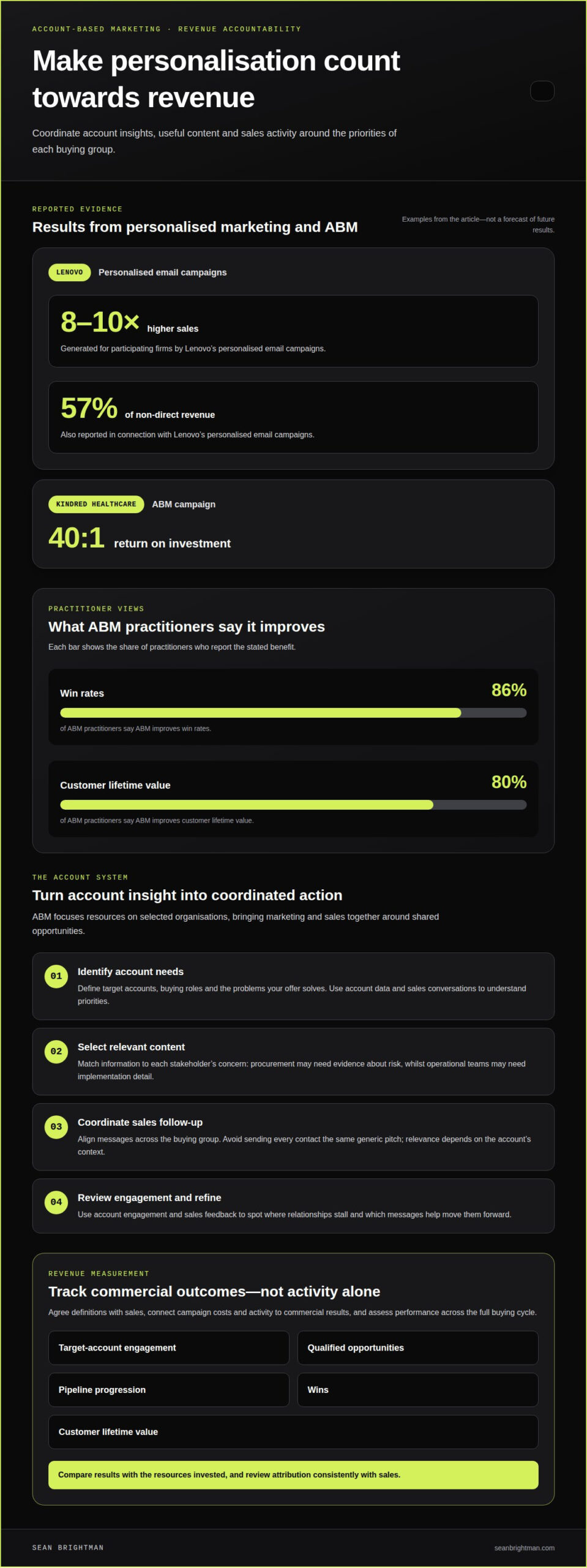
Personalisation works when it reflects an account’s priorities, not merely a contact’s first name. Account-based marketing (ABM) focuses resources on selected organisations, bringing marketing and sales together around shared opportunities. Start by defining target accounts, their buying roles and the problems your offer solves.
Use account data to shape relevant interactions. A procurement lead may need evidence about risk, while an operational stakeholder wants to understand implementation. Coordinate messages across the buying group and use sales conversations to refine them. Unified customer and account data helps teams understand engagement and improve segmentation.
ABM is also a relationship strategy. Build a useful sequence around each account: identify its needs, select suitable content, coordinate sales follow-up, then review engagement. Case studies can show how a similar organisation addressed a challenge. Avoid sending every contact the same generic pitch; relevance depends on the account’s context.
Measure performance against commercial outcomes, not activity alone. Track target-account engagement, qualified opportunities, pipeline progression, wins and customer lifetime value. Compare results with the resources invested, and review attribution consistently with sales. This gives leaders a clearer view of marketing’s contribution to revenue.
Evidence offers direction, not a forecast. Lenovo’s personalised email campaigns generated 8-10 times higher sales for participating firms and 57% of non-direct revenue. Kindred Healthcare’s ABM campaign achieved a 40:1 return on investment. Separately, 86% of ABM practitioners say it improves win rates, whilst 80% say it improves customer lifetime value.
To measure B2B marketing strategy success and ROI, connect campaign costs and activity to opportunities, revenue and account value. Agree definitions with sales first, then assess performance across the full buying cycle.
Use those measures to find where account relationships stall and which messages move them forward. A focused approach to account priorities and revenue can help turn that diagnosis into clear strategic decisions.
3. B2B content marketing and channel selection
Content should move buyers through the funnel, not just fill a publishing calendar. A three-tiered funnel gives teams a practical structure: introduce a problem, help buyers assess solutions, then support their decision. An insight article can build awareness, while a comparison guide helps an active buying group weigh options.
Choose formats around the decisions each audience needs to make. Technical documentation can answer detailed questions for IT stakeholders; a case study can help executives assess business relevance. A procurement team may need clear evidence about delivery requirements. Match each asset to a specific concern and next step.
Channel choice starts with buyer behaviour, not internal preference. Over 60% of buyers check out new professional services providers on social media, and 17% of expertise-based referrals follow social interactions. Use social posts to share useful expertise, then direct interested readers towards a deeper resource, such as a case study.
Make content modular, brand-compliant and reusable across industries, personas and buying stages. A core research report, for instance, can become an executive summary, a technical explainer and sales-team talking points. This gives the content engine more useful outputs without forcing every audience to consume the same message.
Roche Diagnostics used free resources to build trust and capture customer insights. Those resources improved engagement and gathered data to refine future strategies. The practical lesson is to offer information that helps buyers act, then use their responses to sharpen the next asset.
Choose channels by asking where each audience seeks answers, what format suits its decision, and how sales can use the material. LinkedIn may suit a professional insight; a direct sales conversation may call for a concise case study. Test the fit through engagement and follow-up, then shift effort towards channels that bring qualified conversations.
More than 3.2 billion people use social media daily, creating a broad setting for sharing relevant expertise. Yet reach alone does not show whether an asset answers a buyer’s need. Keep the focus on useful information and use audience responses to refine what comes next.
4. Systems thinking and go-to-market strategy
A go-to-market strategy is a connected operating system, not just a launch plan. Positioning shapes the message; content carries it; sales conversations test it; and customer feedback informs the next move. If these parts pull in different directions, engagement drops. A campaign promising simple implementation, for example, falls short when sales cannot explain onboarding.
Start with the market and the challenge your offer solves. Define the target audience, buying roles and reason to act. Then establish a clear position against alternatives, based on the value your business can deliver. This gives marketing and sales the same foundation for conversations, campaigns and account decisions.
Next, connect each go-to-market activity to a buyer action. A webinar might help a technical team understand a product; a follow-up conversation can uncover operational barriers. Give sales the relevant content and context, then record recurring questions. That feedback shows where messaging, product explanations or handovers need work.
Systems thinking also means tracing cause and effect. If qualified prospects engage with content but do not progress, inspect the handover to sales: timing, message and next step. If the right buyers never engage, revisit audience selection and channel fit. Diagnose the broken link rather than adding another campaign to the pile.
To build a B2B marketing strategy step by step, define the commercial goal, buyer and problem first. Align positioning, channels, content and sales responsibilities around that goal, then review performance and buyer feedback to improve the system.
Finally, make ownership clear. Marketing can track engagement and content use; sales can share buyer objections and progression barriers; leadership can resolve trade-offs. A shared roadmap turns those inputs into priorities, owners and review points. The key is to design the whole route from first contact to customer value, not just isolated campaigns.
Use strategic roadmapping to turn disconnected go-to-market activity into an aligned plan.
63% of marketers use the same CRM system. A common platform can help teams share buyer feedback and maintain continuity across marketing and sales handovers.
Sean Brightman: AI Consulting
Sean Brightman’s AI Consulting offers practical AI systems, content engines, knowledge bases and automated workflows to support your go-to-market operations. It helps you identify where AI fits, how it can support your priorities, and which decisions need to come first.
Consider this work when tools and ideas are accumulating without a clear connection to buyer needs or revenue accountability. Roadmapping creates a structured plan and ranked priorities; an Advisory CMO provides ongoing strategic input and accountability as your plans develop.
The focus is practical alignment, not adding technology for its own sake. Define the business challenge, consider how AI could address it, then connect that decision to your wider marketing direction.
Visit seanbrightman.com to contact Sean Brightman about your marketing strategy challenges.
Make the next move a strategic one
More activity won’t fix a strategy that lacks clear ownership. Choose one commercial priority, identify the decision blocking progress, and assign someone to move it forward. That creates a practical starting point for turning strategic intent into action.
A B2B marketing strategy expert can help leadership connect priorities with execution and keep decisions focused on the business goal. If your team needs senior marketing direction without adding a full-time role, Sean Brightman offers Fractional CMO support.
Start with the challenge that matters most: unclear priorities, disconnected teams or a go-to-market plan that isn’t moving. Bring that issue into the conversation and agree what progress should look like. Clear thinking comes before more activity, and the right next step can make the whole system easier to steer.
Contact Sean Brightman to discuss your strategy and take the next step with confidence.
Frequently Asked Questions
What is B2B Marketing Strategy?
B2B marketing strategy sets how a business will reach organisational buyers and support commercial goals. It helps leaders make choices about priority markets, positioning and investment. For example, a software supplier targeting finance teams might prioritise proof of integration and risk controls over broad product awareness. The strategy clarifies which buyer problem matters most and where marketing should focus.
What does a B2B marketing strategy expert do?
A B2B marketing strategy expert helps a business diagnose what is blocking growth and decide what to change. They might find that a strong offer is poorly positioned, or that sales conversations reveal objections marketing hasn’t addressed. Their value is in turning that diagnosis into clear priorities, ownership and decisions, then helping leadership connect marketing choices with the wider business direction.
Which B2B marketing channels and tactics deliver the best ROI?
The strongest return comes from channels that reach the right buyers and support measurable commercial outcomes. Compare options such as search, email, events and professional social media against qualified opportunities, sales progression and revenue contribution. Keep the audience and measurement period consistent when comparing activity. A channel that attracts attention but prompts no meaningful buyer action needs a different role or less investment.