
Tag: Revenue Growth

  • Marketing Accountability Frameworks That Connect Activity to Outcomes

    Marketing Accountability Frameworks That Connect Activity to Outcomes

    Marketing activity only earns its place when you can connect it to business results. A marketing accountability framework links what marketing does and measures to financially relevant outcomes, from revenue and retention to growth over time. It moves the conversation beyond clicks and impressions.

    That doesn’t mean every campaign must prove its value through a single headline figure. It means choosing useful measures, understanding how they relate to commercial performance and reviewing them consistently. Clear accountability gives teams a stronger basis for decisions, not just a fuller report.

    This article explains how reporting can connect activity to outcomes, what measurement standards add and how the Marketing Metric Audit Protocol (MMAP) tests the links between marketing measures and financial performance. It also explores why accountability matters during digital transformation, when teams need clear ownership and the freedom to act in alignment.

    Key Takeaways

    • Set measures that connect marketing activity to commercial outcomes, then review whether they still reflect business priorities.
    • Separate campaign performance from business-system problems, such as tracking gaps or approval delays, so teams can act on the real constraint.
    • Use MMAP to examine how marketing measures link to cash-flow drivers and test the assumptions behind those connections.
    • Make ownership and team dependencies visible during digital transformation, giving people room to act without losing alignment.

    What is a marketing accountability framework?

    A marketing accountability framework connects marketing activity to commercial outcomes, including revenue, acquisition and retention. It assigns responsibility for results, not just for reporting impressions.

    Marketing metrics and performance benchmarks

    Metrics track activity or results; benchmarks put those figures in context against a baseline, target or earlier period. Set them by starting with the business objective, choosing measures that reflect it, then assigning an owner and review point. Performance measurement frameworks report what happened; accountability frameworks also connect results to business objectives and decisions. This distinction helps teams judge whether activity merits further investment.

    Lead costs and customer acquisition

    Cost per lead compares marketing spend with the number of leads generated, while customer acquisition cost measures the cost of gaining a customer. Read them together: a low-cost lead has little value if it rarely becomes a paying customer. Assign responsibility for lead quality and track conversion through sales stages. This shows where costs rise, where prospects drop out and which changes could improve acquisition.

    Connecting metrics to business outcomes

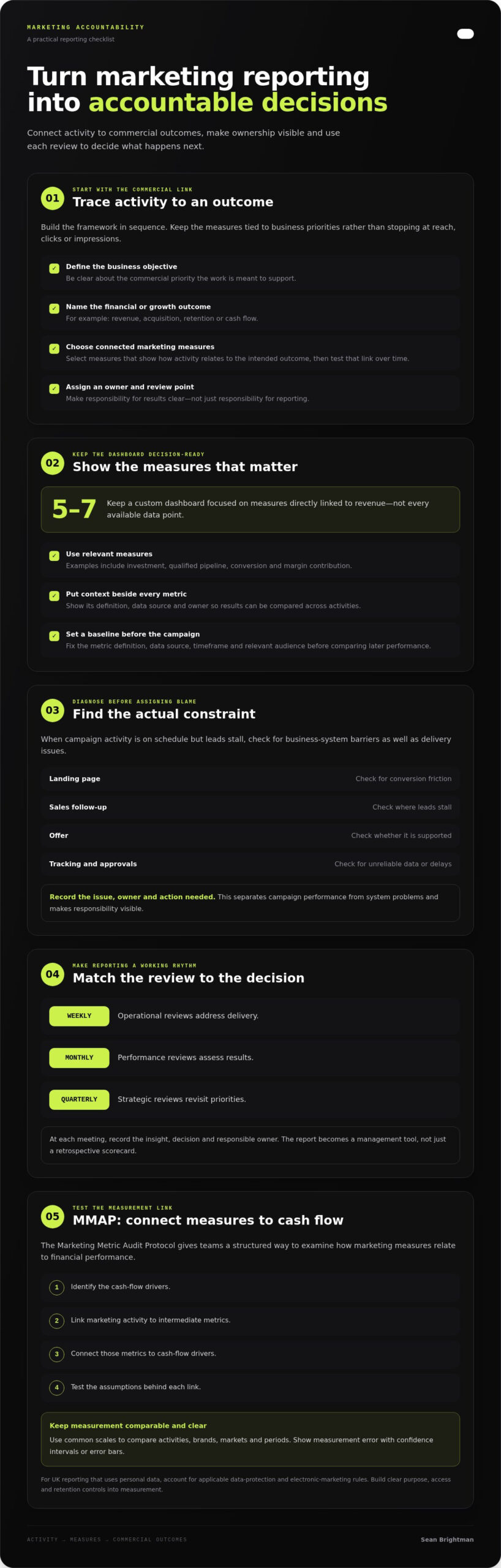
    Outcome measures show how marketing contributes to commercial performance, rather than stopping at reach or clicks. Build the framework in sequence: define the business objective, identify the cash-flow or growth outcome, select the marketing measures connected to it, then test those connections over time. Examples include return on marketing investment, acquisition cost and retention. Effective frameworks combine these measures with clear ownership and regular management reviews, so results inform the next decision.

    Sales and marketing metric alignment

    Sales and marketing alignment means both teams use shared definitions and measures across the customer journey. Agree what counts as a qualified lead, who owns follow-up and how progress is recorded. Then compare marketing’s lead and conversion measures with sales outcomes, such as new-customer revenue. This makes responsibility visible: if leads fail to progress, teams can identify the stage causing friction instead of arguing over separate dashboards.

    How should a report connect marketing activity to business outcomes?

    UK reporting that uses personal data should account for applicable data-protection and electronic-marketing rules. Build clear purpose, access and retention controls into measurement, then connect each activity to a financial outcome and an owner.

    Marketing investment and financial performance

    Linking investment to financial performance means tracing how marketing spend contributes to revenue, margin or cash flow. It matters because activity counts alone cannot show whether investment supports commercial priorities. For each programme, record its cost, the intermediate result, such as qualified demand, and the financial outcome it is expected to influence. Compare those measures over time and state the assumptions behind the link. This gives leaders insight into contribution, not just output.

    Diagnosing agency and business-system performance

    Diagnosis separates delivery issues from business-system barriers that prevent results. If campaign activity is on schedule but leads stall, examine the landing page, sales follow-up, offer and tracking before blaming the agency. Record the issue, its owner and the action needed. An agency performance review should also surface unsupported offers, conversion friction, unreliable data or approval delays while there is time to respond. This structured view makes responsibility clear and directs attention to the actual constraint.

    A custom dashboard should reflect the organisation’s strategic priorities, not every available data point. Keep it focused on five to seven measures directly linked to revenue, such as investment, qualified pipeline, conversion and margin contribution. Show definitions, data sources and owners beside each metric. That makes reporting comparable across activities and helps readers spot whether a change reflects performance or a tracking problem.

    Set a review rhythm that turns reporting into decisions: weekly operational reviews address delivery, monthly performance reviews assess results, and quarterly strategic reviews revisit priorities. Use each meeting to record the insight, decision and responsible owner. The report then becomes a working management tool, not a retrospective scorecard.
    Marketing Accountability Frameworks That Connect Activity to Outcomes

    Marketing measurement standards and MMAP

    Standards make campaign results more comparable and show how much confidence to place in them. MMAP gives teams a structured way to test how marketing measures connect to financial performance.

    Measurement standards and standardised measures

    Marketing measurement standards define consistent methods for assessing activity, outcomes and the reliability of results. The Marketing Accountability Standards Board provides the Marketing Metric Audit Protocol (MMAP), which identifies cash-flow drivers, links marketing activity to intermediate metrics, connects those metrics to cash-flow drivers and tests the assumptions behind each link. This matters because a campaign measure only supports a business decision when its meaning and relationship to financial performance are clear. Use common scales to compare activities, brands, markets and periods; show measurement error with confidence intervals or error bars.

    Establishing baseline measurements

    A baseline is a recorded starting point for comparing later performance. Establish it by fixing the metric definition, data source, timeframe and relevant audience before a campaign begins. For example, record existing customer acquisition and retention measures using the same definitions planned for evaluation. Gather outcome measures continuously over time; repeated observations help identify changes associated with marketing initiatives and shifting customer needs. A consistent baseline makes growth visible without confusing a change in measurement with a change in performance.

    Industry measurement practices

    Industry practice includes benchmarking return on investment and testing whether measurement methods produce valid results. The American Productivity and Quality Center and the Advertising Research Foundation conducted return-on-investment benchmarking surveys in 2001 and 2003. The Chief Marketing Officers Council carried out a survey on marketing accountability and measurement in 2004. The Association of National Advertisers and Forrester conducted surveys on those topics in 2002, 2004 and 2006. These examples show why shared definitions matter: comparisons need consistent measures, not merely familiar labels. For your own campaigns, document methodology and uncertainty alongside results, then compare like with like.

    Accountability frameworks and digital transformation

    Digital transformation spreads work across teams, platforms and customer-facing services. MIT Sloan Center for Information Systems Research identifies accountability as one of digital transformation’s five building blocks. Without defined ownership, teams can launch connected digital offerings but lose sight of their purpose, decisions and commercial contribution.

    An accountability framework connects leadership priorities to the people making product, data and channel decisions. For example, a team responsible for a customer portal can manage its design independently while agreeing shared service standards with sales and support. That balance protects local initiative and keeps the customer experience aligned. It also clarifies who can resolve a dependency when another team controls a required system or approval.

    RACI matrices make those relationships explicit by assigning responsibility, accountability, consultation and information-sharing roles. Apply the roles to a specific outcome, such as launching a digital service or changing its customer journey. One person or team needs clear accountability for the result; others need defined roles in delivery, input or updates. This prevents a common failure: everyone contributes, but no one can make the decision.

    Budget decisions need the same clarity. Define who can move investment between digital activities, who approves changes and which business purpose guides those choices. For example, a team running digital advertising may report campaign performance, while leadership decides whether the activity supports growth priorities. Visualising dependencies helps teams see how budget, data access and approvals affect delivery before delays become entrenched.

    Make the framework operational with shared tools that show ownership, decision rights and cross-team dependencies. Review those links as digital services or priorities change, rather than treating the structure as permanent. This turns accountability into a working system: teams can act with autonomy, leadership can see how decisions connect, and obstacles have an owner. Turn digital accountability into a practical operating plan.

    Sean Brightman: AI Consulting

    Sean Brightman’s AI Consulting helps leaders assess where AI fits their business priorities and decision-making. It’s relevant when your team is exploring AI but lacks a clear purpose, ownership or way to measure its contribution. Tie any proposed use to a defined outcome, accountable owner and agreed measure before committing resources.

    For broader planning, Roadmapping can clarify priorities and the sequence of work. An Advisory Retainer provides ongoing strategic guidance as decisions and business needs evolve. The right starting point depends on the challenge: AI Consulting for AI questions, Roadmapping for direction or an Advisory Retainer for continued advice.

    If you’d like to discuss your priorities, contact Sean Brightman or visit seanbrightman.com.

    Make accountability part of the next decision

    A marketing accountability framework should keep pace as your business priorities, teams and channels change. Treat it as a working management tool, not a dashboard you build once and leave untouched. Start by identifying where decisions still rely on activity counts, disconnected data or unclear ownership, then decide what needs to change.

    That work may call for strategic leadership as well as measurement discipline. Sean Brightman offers Fractional CMO support, AI Consulting and Roadmapping to help businesses tackle leadership, technology and planning challenges. The right focus depends on the gap: leadership direction, a clearer path forward or considered AI decisions.

    Start with the decision you need marketing to support. Make the commercial purpose clear, then give the team a way to learn and adjust as evidence changes. Contact Sean Brightman to discuss your framework, and take the next step towards marketing decisions grounded in business outcomes.

    Frequently Asked Questions

    How does a framework improve CMO tenure and team performance?

    A framework can support CMO continuity by making priorities, decision rights and progress visible to leadership and the team. It can reduce avoidable friction: a new CMO can inherit agreed definitions, reporting history and named owners instead of rebuilding the measurement system. Reviews that examine causes and next actions, rather than blame, also help teams learn from results and improve their decisions.

    How long does it take to implement the framework?

    Implementation time depends on data readiness and how much of the customer journey needs tracking. Basic tracking can take 2-3 weeks when the business has the right technology stack; comprehensive customer-journey tracking typically takes 4-6 weeks to deploy and validate. Allow time to define metrics, connect data, test outputs and train owners. A dashboard is only useful once its inputs are reliable.

    How should accountability be divided between the agency and the business?

    Divide accountability by decision and dependency, not by who appears on a report. An agency can own agreed campaign delivery, measurement quality and early warnings about tracking or conversion barriers. The business should own commercial objectives, its offer, approvals, internal data access and timely sales follow-up. If a launch stalls, record the blocker, decision-maker and next action so each party can address what it controls.

    What are the key components of a marketing accountability framework?

    Define the business objective, each metric’s calculation, its data source, an owner, a review rhythm and the decision it informs. A marketing accountability framework should also document how a measure is expected to influence customer behaviour and commercial results. For example, name who validates CRM lead stages and who can change a campaign if qualified prospects stop progressing.

    Which marketing KPIs and metrics should an accountability framework include?

    Choose KPIs that fit the business model and decision. A subscription business may focus on acquisition cost, payback and retention; a retailer may track new-customer revenue, repeat purchases and contribution margin. Pair an early signal, such as qualified enquiries, with a later result, such as revenue. Treat impressions as diagnostic context, not the sole evidence that marketing investment is working.

    How can marketing activity be linked to revenue, profit and business outcomes?

    Map each activity through a customer response to an economic driver: advertising generates qualified demand, sales converts that demand, and revenue contributes to margin after relevant costs. Use consistent time periods and account for influences such as price changes before assigning credit. The Marketing Metric Audit Protocol provides a structured way to test assumptions linking marketing measures with cash-flow drivers.

  • Sean Brightman Strategies for Growth: Building Scalable Marketing Systems in 2026

    Sean Brightman Strategies for Growth: Building Scalable Marketing Systems in 2026

    Most marketing departments aren’t engines. They’re expensive, leaky buckets. You’re likely exhausted by the cycle of hiring flashy agencies that deliver colourful slide decks but zero accountability. Activity is high, yet your revenue has hit a stubborn ceiling. You don’t need more “creative” ideas; you need a mechanical solution to a structural problem. This is where Sean Brightman strategies for growth move the needle. It’s about building systems, not just buying ads.

    You can stop guessing and start scaling. I’m going to show you the direct, AI-powered framework used to transform messy departments into high-impact growth engines. We’ll strip away the fluff to focus on what actually drives value in 2026. You’ll learn how to build a clear roadmap to exit, install senior leadership that delivers results, and integrate AI as a functional component of your machinery. It’s time to stop chasing the hype and start building the architecture for your next stage of growth.

    Key Takeaways

    • Identify why high activity often masks a lack of impact and learn to diagnose the structural symptoms of a “messy” marketing department.
    • Discover how Sean Brightman strategies for growth utilise a “Systems + AI + Brand” framework to build a scalable architecture before you waste budget on experimental channels.
    • Move beyond superficial AI hype by integrating intelligent growth engines that automate operations and close critical efficiency gaps.
    • Understand the Fractional CMO advantage for driving senior-level accountability and building a clear, results-oriented roadmap to exit.
    • Master the step-by-step transition from a growth plateau to a high-impact engine that delivers sustainable, measurable scale for 2026.

    The Growth Paradox: Why Activity Is Not the Same as Impact

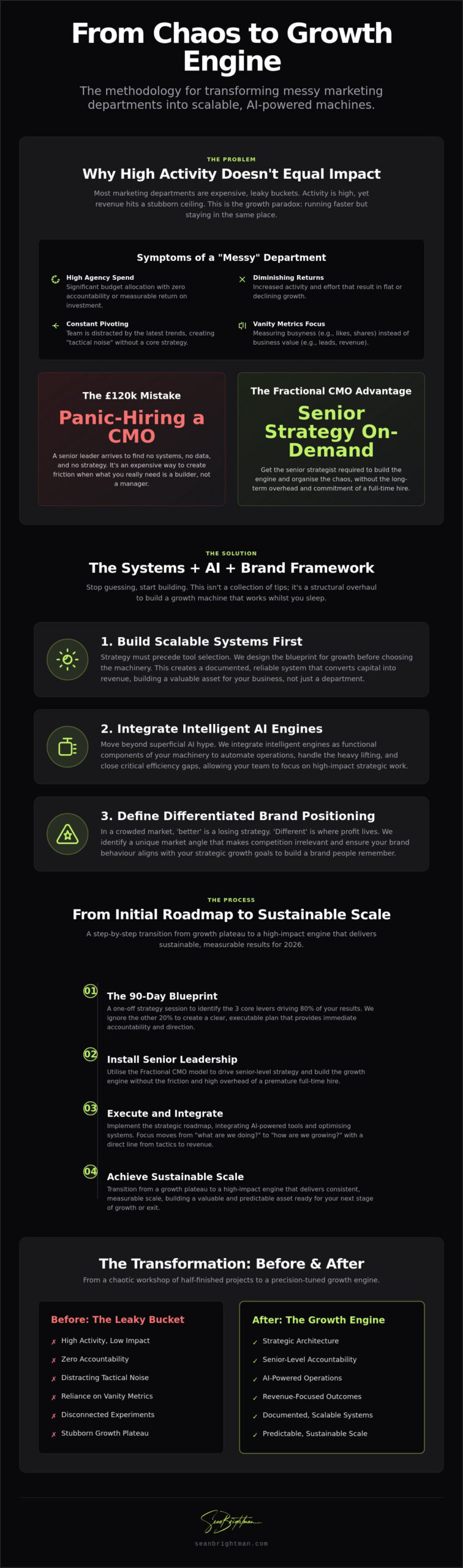
    Most scale-up CEOs fall into the same trap. They believe that more activity equals more growth. They hire more agencies, approve more campaigns, and demand more content. The result is almost always the same: diminishing returns and a burnt-out team. This is the growth paradox. You’re running faster but staying in the same place. Your marketing department becomes a chaotic workshop of half-finished projects rather than a precision-tuned engine.

    A “messy” marketing department is easy to spot. You have high agency spend with zero accountability. Your team is constantly pivoting based on the latest trend. There’s plenty of “tactical noise” but no strategic architecture to hold it together. Sean Brightman strategies for growth are designed to kill this noise. Growth is a mechanical problem of system architecture, not a creative problem of more activity. You need a machine that converts capital into revenue reliably, not a series of disconnected experiments.

    The £120k Mistake: Misunderstanding Senior Leadership

    Panic-hiring a full-time CMO is often the first step toward a growth plateau. You pay a £120k salary for a senior leader who arrives to find no systems, no data, and a team of executors waiting for instructions. It’s an expensive way to create friction. You don’t need a permanent fixture; you need a builder. This is why many UK businesses are turning to the fractional cmo model. It provides the senior strategy required to organise the chaos without the long-term overhead. You need a strategist who can build the engine, not just someone to sit in the driver’s seat of a car that won’t start.

    Activity vs Result: Centring Your Strategy on Outcomes

    Stop measuring how busy your team is. Busy is a fake metric. If your social media impressions are up but your qualified leads are flat, you’re failing. You must audit your current digital marketing strategies for actual business value. Identify the vanity metrics that disguise a lack of growth. Whilst your competitors obsess over likes and shares, you should focus on conversion architecture and customer acquisition costs. Sean Brightman strategies for growth move the focus from “what are we doing?” to “how are we growing?”. It’s about outcomes, not output. If a tactic doesn’t have a direct line to revenue, it’s just a distraction that needs to be cut from your roadmap.

    The Sean Brightman Methodology: A Roadmap to Scalable Growth

    Stop guessing. Start building. Most businesses fail to scale because they treat marketing like a series of experiments. It isn’t. It’s a mechanical process. The Sean Brightman methodology centres on a “Systems + AI + Brand” framework. This isn’t a collection of tips. It’s a structural overhaul. You need a system that works whilst you sleep. You need AI to handle the heavy lifting. You need a brand that people actually remember. If you lack any of these, your growth will eventually hit a ceiling. We build the architecture first. We install the machinery second.

    Strategy must always precede tool selection. Buying a new piece of software won’t fix a broken process. It just makes the failure faster. Sean Brightman strategies for growth prioritise the blueprint over the machinery. We define the destination before we choose the vehicle. This approach doesn’t just drive leads; it builds equity. A business with a documented, scalable marketing system is worth significantly more at exit than one that relies on the founder’s “gut feeling.” You are building an asset, not just a department.

    Strategic Roadmapping: The 90-Day Blueprint

    The noise of the market is deafening. You need a 90-day blueprint to cut through it. This one-off strategy session identifies the three core levers that drive 80% of your results. We ignore the other 20%. They’re distractions. By focusing on high-impact machinery, your team gains a plan they can actually execute. No more constant hand-holding. No more “what do we do next?” emails. This roadmap provides the accountability your department has been lacking. If you need clarity on your next move, a bespoke roadmapping session can provide the tactical precision you’re currently missing.

    Brand Positioning: Standing Out in a Crowded UK Market

    In the UK, “better” is a losing strategy. There’s always someone cheaper or faster. “Different” is where the profit lives. The Brightman methodology helps you find that unique market angle that makes competition irrelevant. It’s about ensuring your brand behaviour matches your strategic growth goals. If you claim to be premium but your marketing feels budget, you’ve already lost. Your brand must be a functional component of your growth engine, not just a logo on a website. It’s about building a reputation that acts as a force multiplier for your technical systems.

    AI-Powered Growth Engines: Integrating Intelligence into Operations

    AI is the most over-hyped and under-utilised asset in your business. Most teams are “playing with tools.” They use ChatGPT to polish an email or Midjourney to create a social post. This is a waste of time. It’s tactical play, not operational strategy. To scale in 2026, you need integrated AI systems that function as a permanent part of your machinery. We don’t just add AI on top of a messy department. We use AI to re-engineer the department itself.

    Sean Brightman strategies for growth treat AI as a functional component. It’s about building an engine that automates lead generation and customer acquisition whilst you focus on high-level decision-making. We identify the friction points in your current operations and install intelligent solutions to fix them. This isn’t about replacing people. It’s about removing the manual labour that kills your margins. You need a system that learns, adapts, and delivers results without constant human intervention.

    The Marketing Efficiency Audit: Finding Hidden Profit

    You are likely burning money on underperforming channels. Most CEOs can’t tell you exactly which ones. AI consulting changes that. By using intelligent data analysis, we can uncover exactly where your budget is leaking. This is where a Marketing operations consultant becomes essential. We audit your current output and reallocate spend from waste to high-impact, AI-driven activities. It’s about precision. We stop guessing and start investing in what the data proves is working. If a channel isn’t delivering a measurable return, the AI will find it and we will cut it.

    Building Smarter Marketing Systems

    Your tech stack is probably a graveyard of unused subscriptions. A scalable growth engine requires a lean, integrated stack where every tool talks to the others. Modern AI systems are “plug-and-play.” They should integrate seamlessly into your workflow to handle repetitive tasks. Your data is your most valuable asset in this new economy. If your data is messy, your AI will be useless. Sean Brightman strategies for growth prioritise data hygiene and system integration. We build a foundation that allows your marketing machinery to learn and improve over time. This creates a compounding effect. The smarter your system gets, the lower your acquisition costs become. It’s not magic. It’s engineering.

    Sean Brightman Strategies for Growth: Building Scalable Marketing Systems in 2026

    Senior Leadership on Demand: The Fractional CMO Advantage

    A full-time CMO is a luxury many scale-ups cannot justify. An agency is a vendor that wants to sell you more services. A Fractional CMO is a partner with skin in the game. Sean Brightman strategies for growth rely on this senior-level intervention to bridge the gap between where you are and where you need to be. It’s about accountability. It’s about having a battle-hardened expert who has seen your mess before and knows exactly which lever to pull. You don’t need a part-time consultant; you need an external force that brings order to your internal complexity.

    Traditional hiring is slow and risky. Agencies often lack a deep understanding of your business architecture. The fractional model offers the surgical precision of a senior leader without the heavy salary and corporate baggage. It is the most efficient way to scale a UK business in 2026. You get high-level strategy and practical execution in a concentrated timeframe. It’s senior leadership on demand. It’s results, not activity. This model ensures that your marketing spend is an investment in an asset, not just a monthly expense that disappears into the void.

    The Advisory Retainer: Ongoing Direction and Accountability

    Strategy is useless without execution. Many business owners have great ideas but no way to ensure they actually happen. An Advisory Retainer provides the straight-shooting perspective you need to stay on track. It’s a monthly rhythm of accountability. We don’t just talk about growth; we measure it. This model ensures that whilst the market shifts, your focus remains on the core levers identified in your roadmap. You get a sounding board that isn’t afraid to tell you when you’re making a mistake. If you’re ready for a partner who drives results, book a consultation to discuss an advisory retainer.

    Bridging the Gap: Leadership Without the Politics

    Internal politics kill growth. A Fractional CMO bypasses the corporate fluff and focuses on clinical, logical expansion. We aren’t there to climb the ladder or protect a budget. We’re there to build the engine. This “get-your-hands-dirty” attitude is what separates a strategist from a theorist. We organise your existing team for maximum output. We define roles, set KPIs, and install the systems discussed in previous sections. It’s about leadership that drives movement. We clear the path so your team can actually do their jobs. No ego. No bureaucracy. Just growth.

    Executing the Strategy: From Initial Roadmap to Sustainable Scale

    Transformation isn’t a single event. It’s a sequence. You don’t wake up with a growth engine; you build it piece by piece. The transition from a messy department to a precision machine requires a clinical approach. Sean Brightman strategies for growth provide the manual for this overhaul. We stop the leaks first. We install the sensors second. We ramp up the power last. This methodical execution ensures that when you hit the accelerator, the engine doesn’t explode. It’s about building a foundation that can actually handle the weight of your ambitions.

    Measuring success is about cold, hard data. We ignore vanity metrics. We focus on customer acquisition cost (CAC), lifetime value (LTV), and the velocity of your sales pipeline. If the system isn’t improving these numbers, it isn’t working. This clarity prepares your business for the ultimate objective. Whether you want to scale to new markets, prepare for acquisition, or engineer a clean exit, your marketing machinery must be a documented asset. A business that relies on a “magic” founder is worth less than a business that runs on a proven system.

    The biggest win for any CEO is reclaiming their focus. You shouldn’t be approving social media posts or arguing with agency account managers. A successful growth strategy removes you from the tactical weeds. It gives you back your time to lead the company whilst the marketing engine delivers predictable results. You move from being the primary driver to the owner of the fleet. That is how you achieve sustainable scale.

    Scaling Rapidly: Specific Strategies for Tech and B2B

    High-velocity tech environments demand a different architecture. You can’t wait months for brand awareness to trickle down. B2B growth requires a system built on trust and technical authority. We leverage AI to shorten sales cycles by identifying high-intent leads before they even talk to your sales team. This isn’t about more leads; it’s about better lead quality. We build a system that filters the noise so your sales engine only burns high-octane fuel. We align your tech stack to support the buyer’s journey, not just to collect data you’ll never use.

    Getting Started: The Path to Clarity

    You can’t fix everything at once. You shouldn’t try. The 90-day roadmap is the essential starting point for every engagement. It provides the clarity you’ve been missing. In the first 30 days of a Fractional CMO engagement, we audit the chaos and define the three core levers for growth. No fluff. No politics. Just a clear path to scale. We identify what to cut, what to keep, and what to automate. If you’re tired of a marketing department that feels like a liability, it’s time to build an engine. Book a strategic roadmapping session with Sean Brightman today and start the transition to sustainable growth.

    Growth isn’t a mystery; it’s a structural choice. You can continue burning budget on tactical noise or you can install a machine that delivers predictable revenue. High activity is often a mask for inefficiency. True scale requires integrated AI systems and senior-level accountability. Implementing Sean Brightman strategies for growth means moving from departmental chaos to clinical precision. It’s about creating a documented asset that prepares your business for an exit or the next stage of expansion.

    As a published author and AI strategy expert, I provide the senior leadership you need without the full-time overhead. I’ve acted as a Fractional CMO for high-growth UK businesses, stripping away the fluff to focus on what actually moves the needle. You’ve seen the roadmap. You know the framework. Now it’s time to execute. Build your growth engine with Sean Brightman today. You have the vision; now install the machinery to match it. Your future scale depends on the systems you build now.

    Frequently Asked Questions

    What is the Sean Brightman 90-day growth roadmap?

    The roadmap is a surgical strategy session designed to stop the guessing. It identifies the three core levers that drive 80% of your results. This isn’t a vague report; it’s a blueprint for execution. You get a clear, 90-day plan that your team can follow without constant hand-holding. It turns chaos into a structured growth engine.

    How does a Fractional CMO differ from a standard marketing consultant?

    A consultant tells you what’s wrong; a Fractional CMO fixes it. Consultants deliver decks whilst a Fractional CMO provides senior leadership and accountability. They act as an external force within your team to drive movement. It’s about building the machinery, not just talking about it. You get senior expertise without the full-time overhead or corporate politics.

    Can AI really replace my marketing team, or just assist them?

    AI won’t replace your team, but it will replace their manual labour. It functions as a mechanical component of your operation. It handles lead generation and data analysis whilst your people focus on strategy. Sean Brightman strategies for growth use AI to re-engineer departments for maximum efficiency. It’s about augmenting human intelligence with automated precision.

    What industries do these growth strategies work best for?

    These strategies are built for high-growth UK scale-ups, particularly in Tech and B2B sectors. These industries often suffer from complex sales cycles and messy data. The “Systems + AI + Brand” framework is designed to handle that complexity. It works best for businesses that have reached a growth plateau and need a structural overhaul to scale.

    How much time does a CEO need to commit to the advisory retainer?

    Your commitment is concentrated and high-impact. The advisory retainer involves a monthly rhythm of accountability. It’s designed to keep the strategy on track without dragging you into the tactical weeds. You act as the owner of the fleet, not the driver of the car. It’s about direction and clinical decision-making, not daily management.

    What happens if my marketing department is already “messy”?

    A messy department is the ideal candidate for a structural reset. Most scale-ups have “tactical noise” instead of an engine. We start by auditing the chaos and stopping the leaks in your budget. We then install the architecture needed for sustainable scale. Mess is simply a symptom of missing systems; we provide the cure.

    Is the Sean Brightman methodology suitable for small businesses or just scale-ups?

    The methodology is specifically engineered for scale-ups. Small businesses often lack the complexity or the budget to justify a Fractional CMO. Scale-ups, however, have reached a point where “doing more” no longer works. They need the mechanical precision of Sean Brightman strategies for growth to transition from a messy department to a high-impact engine.

    How does the AI consulting process actually work in practice?

    It starts with a marketing efficiency audit to find hidden profit. We identify where your data is leaking and where manual tasks are killing your margins. We then design a “plug-and-play” tech stack where tools actually talk to each other. It’s a clinical process of integrating intelligence into your daily operations to lower acquisition costs.