
Tag: SaaS management

  • Creating a Cohesive Martech Stack: The Operational Blueprint for 2026

    Creating a Cohesive Martech Stack: The Operational Blueprint for 2026

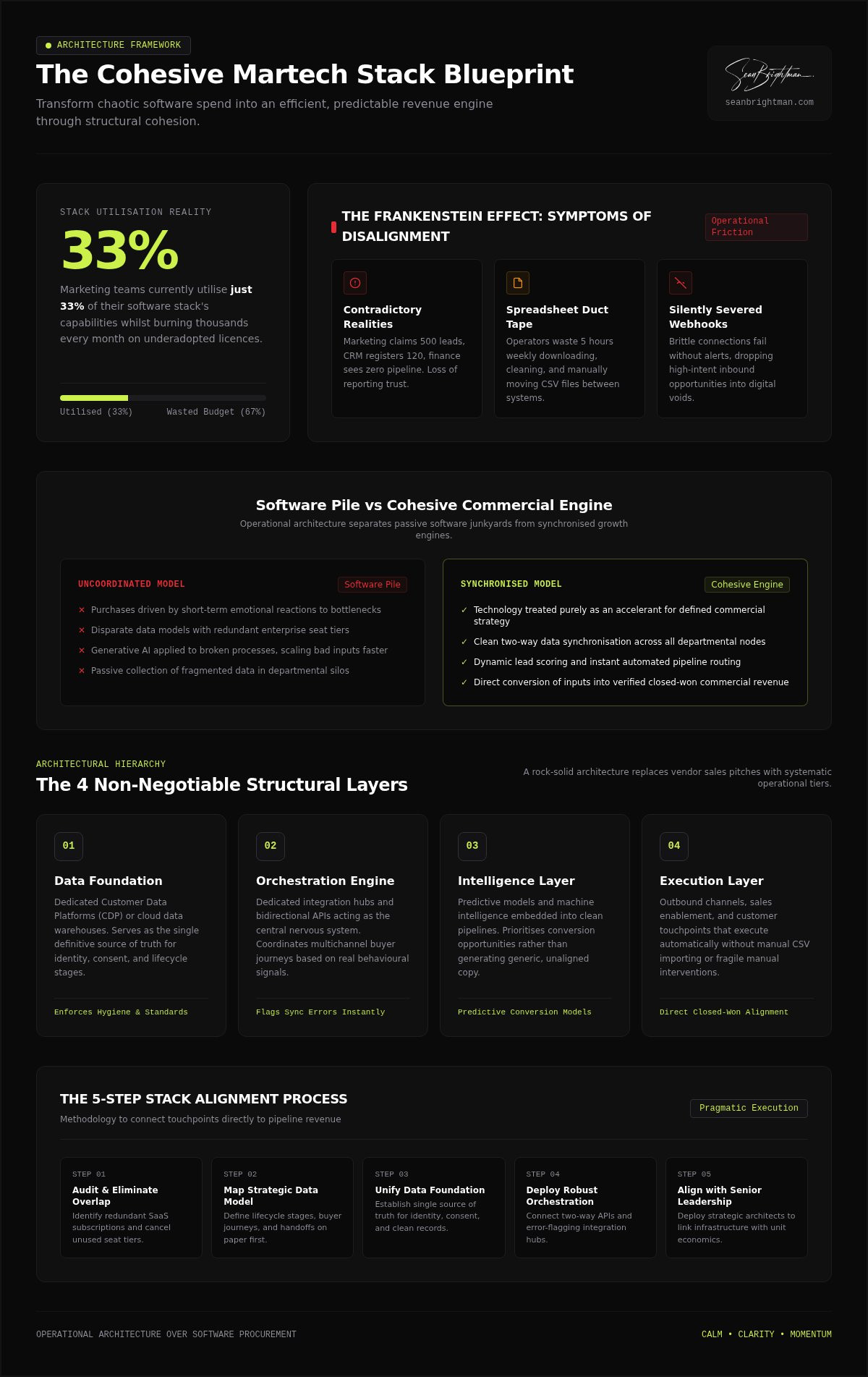
    Marketing teams currently utilise just 33% of their software stack’s capabilities, whilst burning thousands of pounds every month on subscriptions nobody adopts. Stack cohesion isn’t a software procurement problem; it’s an operational architecture failure. You already feel the daily friction. Customer data remains trapped in isolated departmental silos, commercial forecasting is crippled by inaccurate attribution, and your team wastes valuable hours manually moving CSV files between disconnected platforms. Creating a cohesive martech stack demands operational discipline, not another software demo.

    You don’t need more tools; you need a system that actually speaks to itself. In this guide, you’ll discover how to eliminate expensive bloat, unify customer data across every touchpoint, and architect a high-converting tech stack that drives measurable commercial revenue. We will map the operational blueprint for clean two-way data synchronisation, rigorous attribution from first engagement through to closed-won deals, and intelligent automations that execute without human intervention. Here is how you turn chaotic software spend into an efficient, predictable revenue engine.

    Key Takeaways

    • Pinpoint and eliminate SaaS subscription overlap to stop burning budget on underutilised software licences.
    • Establish an unshakeable architectural blueprint across data, orchestration, execution, and analytics layers to eliminate operational friction.
    • Execute a pragmatic five-step methodology for creating a cohesive martech stack that connects customer touchpoints directly to pipeline revenue.
    • Resolve the monolithic suite versus composable stack dilemma based on your internal capabilities and commercial growth velocity.
    • Deploy senior strategic leadership rather than junior operators to align marketing infrastructure directly with unit economics.

    The Anatomy of Martech Bloat: Why Modern Stacks Break Down

    Most commercial organisations do not possess a technology architecture. They possess a software junkyard. Creating a cohesive martech stack means building a synchronised commercial engine where data flows bidirectionally between systems to drive measurable revenue, not collecting point solutions to soothe short-term operational anxiety.

    Modern marketing stacks break down because procurement is treated as an emotional reaction rather than an architectural discipline. A team member encounters a workflow bottleneck, submits an expense request for a point solution, and leaves the company twelve months later. The subscription renews automatically. Multiply this across five departments, and you are bleeding thousands of pounds on redundant licences, unused enterprise seat tiers, and unmanaged integrations that generate fatal data silos.

    Worse, slapping generative AI platforms onto disjointed pipelines only accelerates the damage. AI does not fix broken foundational processes; it scales bad inputs faster. Without architectural cohesion, you are simply automating chaos at an enterprise scale.

    The Frankenstein Effect: Symptoms of an Unaligned Stack

    When software is stitched together haphazardly, operational friction turns lethal to commercial growth. Look for these clear warning signals within your daily operations:

    • Contradictory realities: Marketing dashboards claim 500 qualified leads, sales CRM records 120, and finance sees zero pipeline impact. Nobody trusts the reporting.
    • Spreadsheet duct tape: Highly paid operators spend five hours every week manually downloading, cleaning, and uploading CSV files because two core databases refuse to talk to each other.
    • Silently severed webhooks: Brittle, multi-step connections break without alerting anyone, dropping high-intent inbound opportunities into a digital black hole between systems.

    Software Pile vs Cohesive Engine: The Critical Difference

    A software pile collects passive inputs. An engine converts inputs into closed-won revenue through tight operational synchronisation.

    When you purchase point solutions in isolation, you inherit disparate data models, overlapping feature sets, and fragile integrations. Conversely, creating a cohesive martech stack relies on a unified data layer that powers foundational marketing automation, dynamic lead scoring, and instant pipeline routing. Technology is purely an accelerant for commercial strategy. If the strategic data model, buyer journey stages, and commercial handoffs are undefined on paper, purchasing another software licence will merely amplify your operational dysfunction.

    The 4 Structural Layers of a High-Performing Martech Architecture

    Stop looking for a single silver-bullet tool. High-growth organisations build on operational architecture, not software vendor sales pitches. Creating a cohesive martech stack requires four distinct, non-negotiable structural layers: data foundation, orchestration, execution, and intelligence. When these components connect properly, customer data flows freely, attribution becomes undeniable, and pipeline converts predictably.

    The Data Foundation: Warehouses, CDPs, and Clean Records

    Your CRM is not the centre of the universe. The foundational layer belongs to a centralised data store, whether a dedicated Customer Data Platform (CDP) or a structured cloud data warehouse. This layer acts as the definitive single source of truth for customer identity, regulatory consent, and lifecycle stages. It strips out duplicate records, enforces property standards across systems, and ensures pristine data hygiene before records feed into downstream commercial tools. If this foundation is cracked, your entire stack crumbles.

    The Orchestration Engine: Workflow Automation and Integration Hubs

    Orchestration operates as the central nervous system of your business. It connects raw records to active customer-facing campaigns. High-performing architectures abandon brittle, consumer-grade zaps in favour of dedicated integration hubs and bidirectional APIs. This layer coordinates multichannel buyer journeys based on verified behavioural signals, manages data mapping protocols, and flags sync errors immediately. When an enterprise prospect requests pricing, sales enablement and email sequences trigger in lockstep, zero manual imports required.

    The Intelligence Layer: Embedding AI and Predictive Models

    Generic generative copy tools do not create commercial leverage. True competitive advantage comes from embedding predictive models directly into your clean operational data. This layer handles dynamic account scoring, real-time intent routing, and churn probability warnings before accounts churn.

    Operationalising this intelligence requires methodical alignment. Senior commercial teams regularly deploy targeted ai consulting to build bespoke workflows that eliminate friction rather than introducing technical debt. Done right, creating a cohesive martech stack ensures your intelligence layer drives execution automatically. If your infrastructure lacks this cohesive coordination, partnering with an experienced strategic advisor at seanbrightman.com can help map the technical blueprint your commercial engine requires.

    How to Build a Cohesive Martech Stack: The 5-Step Process

    Fixing a fragmented commercial stack is not about buying fresh software. It is a systematic teardown and rebuild. Creating a cohesive martech stack demands operational discipline across five clear phases: auditing licences, mapping buyer journeys, pruning waste, enforcing taxonomy, and securing robust API integrations.

    Steps 1 and 2: The Ruthless Systems Audit and Journey Mapping

    Start by auditing every software licence across the business. Pull credit card statements, review departmental expenses, and catalogue contract renewal dates alongside actual seat utilisation. Most leadership teams discover paid accounts untouched for months.

    Next, trace the end-to-end journey of an inbound lead from initial anonymous visit through to payment processing. Document every digital handoff between platforms:

    • Where do leads sit unassigned due to broken webhook delays?
    • Which touchpoints require an operator to manually re-enter contact fields?
    • Where does attribution tracking fail between campaign interaction and CRM deal creation?

    Mark every point of human intervention. Those friction points are where commercial pipeline leaks.

    Steps 3 and 4: Pruning Redundancy and Enforcing Data Hygiene

    With your operational bottlenecks visible, cut the excess. Identify functional overlap across platforms. Your email automation tool, CRM, and customer success platform might all offer survey functionality or lead scoring. Choose one definitive system for each capability and cancel the redundant licences.

    Once you strip away the bloat, establish ironclad data governance. Standardise UTM parameters, custom properties, and lifecycle status definitions across departments. Sales, marketing, and finance must agree on what constitutes a qualified lead and where that status updates. Without unified definitions, creating a cohesive martech stack is impossible.

    Step 5: Engineering Resilient Integrations and API Governance

    Eliminate fragile third-party automations bridging critical commercial paths. Direct, bidirectional API integrations or enterprise middleware must handle primary data pipelines between your CDP, CRM, and marketing platforms.

    Implement real-time error logging and automated failure alerts. If a sync fails between your lead capture forms and your sales queue, your operations team must know within minutes, not weeks later after missed quarterly targets. Finally, record every integration in an accessible data dictionary. When architectures are properly documented, institutional knowledge stays protected regardless of staff turnover.
    Creating a Cohesive Martech Stack: The Operational Blueprint for 2026

    All-in-One Suites vs Best-of-Breed: Choosing Your Core Strategy

    Every commercial leader hits the same architectural fork in the road. Do you buy a single monolithic suite that promises to handle everything passably, or do you assemble a composable stack of specialised tools that excel at specific tasks? The answer dictates your operating margins, integration overhead, and agility for years. When creating a cohesive martech stack, neither choice is inherently superior. The decision comes down to your internal technical maturity and commercial growth velocity.

    The Monolithic Advantage: Simplicity, Governance, and Native Sync

    Monolithic platforms win on administrative simplicity. A single contract, unified user permissions, and native data models eliminate the integration headaches that plague fragmented environments. Data moves seamlessly between marketing campaigns and sales pipelines because it lives in the same relational database. The trade-off is functionality depth. Monolithic suites provide broad operational coverage, but their individual modules frequently offer shallower capabilities than dedicated point solutions. If your commercial execution demands sophisticated multichannel orchestration, an all-in-one suite will eventually feel like a straitjacket.

    The Composable Stack: Custom Depth, Modularity, and API Freedom

    Composable architectures give you absolute tactical freedom. Your growth team can select the best analytics engine, the most capable email platform, and the sharpest enrichment software available. You avoid vendor lock-in because underperforming components can be swapped without ripping out your entire infrastructure.

    Yet freedom carries a steep price. Composable stacks incur significant hidden maintenance costs:

    • Retaining dedicated technical operators to maintain custom webhooks and API endpoints.
    • Managing vendor price escalations and overlapping feature sets across multiple software agreements.
    • Resolving data schema mismatches whenever a vendor alters its underlying database architecture.

    Solving the Human Adoption Bottleneck

    The most elegant software architecture fails if your commercial team refuses to use it. Technology does not solve execution problems; human behaviour does. Leaders routinely spend six figures on platform subscriptions, only to watch sales reps revert to personal spreadsheets because the CRM requires twenty mandatory fields per contact record.

    Operational discipline requires clear, documented standard operating procedures and simplified interfaces. Workflows must serve the revenue team, not the other way around. Engaging a battle-tested marketing operations consultant ensures your systems are engineered around frontline reality rather than theoretical ideals. If you are ready to evaluate your software architecture and align your tools with your commercial pipeline, explore strategic options at seanbrightman.com to eliminate waste and establish an engine built for measurable scale.

    Operationalising the Stack: Why Senior Architectural Leadership Wins

    You cannot delegate enterprise architecture to junior operators or generalist marketing agencies. Tactical marketers know how to build email sequences and run paid campaigns. They do not know how to design data governance models, negotiate software enterprise tier caps, or audit webhook latency across five integrated platforms. Creating a cohesive martech stack requires architectural vision tied directly to unit economics and commercial growth.

    Technology should mirror commercial reality, not shape it arbitrarily. When procurement is unguided, software decisions become reactive, leading to overlapping capabilities and runaway operational costs. Senior architectural leadership brings order to this friction. A seasoned strategist interrogates vendor proposals, strips out unused platform features before signing, and ensures that every software expenditure maps directly to accelerated pipeline velocity.

    Connecting Martech Investments to Commercial Revenue Metrics

    Stop reporting vanity metrics to your executive team. The board does not care about click-through rates, open percentages, or platform activity logs. They care about customer acquisition cost (CAC), pipeline velocity, net revenue retention, and customer lifetime value (LTV).

    Operational maturity means building real-time dashboards that connect upstream campaign engagement directly to pipeline creation and closed revenue. Achieving this level of operational cohesion demands structured alignment before touching software settings. Exploring dedicated strategic brand roadmapping enables organisations to define commercial goals clearly so their marketing infrastructure reinforces overarching business objectives.

    The Fractional Advantage: Senior Leadership Without the Full-Time Overhead

    Hiring a permanent marketing director to fix technical operations creates significant financial drag. Between executive search fees, equity packages, and recruitment delays, you are committed before seeing a single process improve.

    High-growth scale-ups bypass these bottlenecks by engaging an experienced fractional cmo. This plug-and-play model delivers decisive, battle-tested strategic oversight without the £120k+ overhead of a permanent hire. An experienced fractional leader audits current software, cuts redundant subscriptions, and restructures core integrations rapidly. When you establish veteran architectural oversight, creating a cohesive martech stack shifts from an ongoing headache into a distinct commercial advantage.

    Transform Your Disconnected Tools into a Commercial Growth Engine

    Software doesn’t generate commercial revenue; disciplined operational architecture does. Creating a cohesive martech stack requires shifting away from impulsive tool purchases toward a clean, synchronised infrastructure where customer data flows effortlessly from initial discovery to deal close.

    Fixing fractured pipelines demands strategic clarity before another software licence renews. You need an unshakeable data foundation, strict integration governance, and operational buy-in across your commercial teams. Most importantly, you need experienced architectural leadership that bridges brand strategy, data integrity, and commercial execution.

    You don’t have to carry the £120k+ overhead of a permanent executive hire to build a scalable foundation. Deploy battle-tested frameworks that eliminate tool fatigue, streamline pipeline velocity, and turn messy software into a predictable revenue system. Book a Strategic Roadmapping Session today to audit your current architecture, cut operational bloat, and engineer an integrated growth engine designed for sustained scale.

    Frequently Asked Questions

    What is the first step in creating a cohesive martech stack?

    The first step is conducting an exhaustive systems and licence audit across your entire business. Review credit card statements, software contracts, and actual seat utilisation rather than relying on departmental assumptions. Identify what you pay for versus what your team actually logs into every week. Creating a cohesive martech stack begins by stripping out redundant subscriptions, not by purchasing another tool.

    How many tools should an effective modern martech stack contain?

    An effective stack contains only as many tools as your business model requires to generate commercial pipeline. Mid-market companies typically operate efficiently with 8 to 15 core platforms covering data, orchestration, execution, and analytics. Enterprise stacks often bloat beyond 40 tools, driving unnecessary operational friction. Prioritise deep adoption and clean integration across a handful of essential engines over sheer tool volume.

    Is an all-in-one marketing platform better than a best-of-breed stack?

    Neither architecture is universally superior; the right model depends on your internal technical capability. All-in-one platforms provide administrative simplicity, native data synchronization, and unified billing, making them ideal for lean teams. Best-of-breed composable stacks offer superior feature depth but require continuous engineering maintenance to avoid data corruption. Choose an all-in-one suite for simplicity, or composable tools for custom tactical execution.

    How do you measure the return on investment of marketing technology?

    Measure return on investment through commercial pipeline velocity and customer acquisition efficiency, never through vanity engagement metrics. Calculate your total cost of ownership, including software subscriptions, implementation fees, and internal maintenance hours. Balance that expense against pipeline creation, deal cycle speed, and manual labour saved through automated workflows. If a platform doesn’t demonstrably accelerate revenue, it represents pure overhead.

    Why do marketing automation and CRM integrations frequently fail?

    Integrations fail because of conflicting lifecycle definitions and mismatched property fields, not software bugs. When marketing and sales define an opportunity differently, or when custom data fields aren’t mapped identically, records duplicate and corrupt. Relying on brittle consumer zaps without automated failure alerts guarantees silent sync breakdowns. Durable integrations require standardised data taxonomy and disciplined cross-functional governance.

    Can modern AI replace our existing marketing and sales software stack?

    No. AI functions as an intelligence layer that accelerates existing infrastructure, not a standalone replacement for core operational systems. Predictive algorithms and generative tools still require clean relational databases to deliver accurate outputs. Layering AI on top of disconnected spreadsheets simply automates bad data faster. Use AI to improve segmentation and scoring, while keeping your foundational database and orchestration tools intact.

    Who should be responsible for managing and governing the martech stack?

    Stack governance belongs to senior commercial leadership, not disconnected IT departments or junior campaign operators. Creating a cohesive martech stack requires aligning technical architecture directly with commercial unit economics. A dedicated marketing operations leader or Fractional CMO must oversee software procurement, integration health, and data standards. Without centralised executive ownership, departmental software sprawl quickly returns.

  • The Marketing Technology Stack Audit: A Ruthless 2026 Executive Checklist

    The Marketing Technology Stack Audit: A Ruthless 2026 Executive Checklist

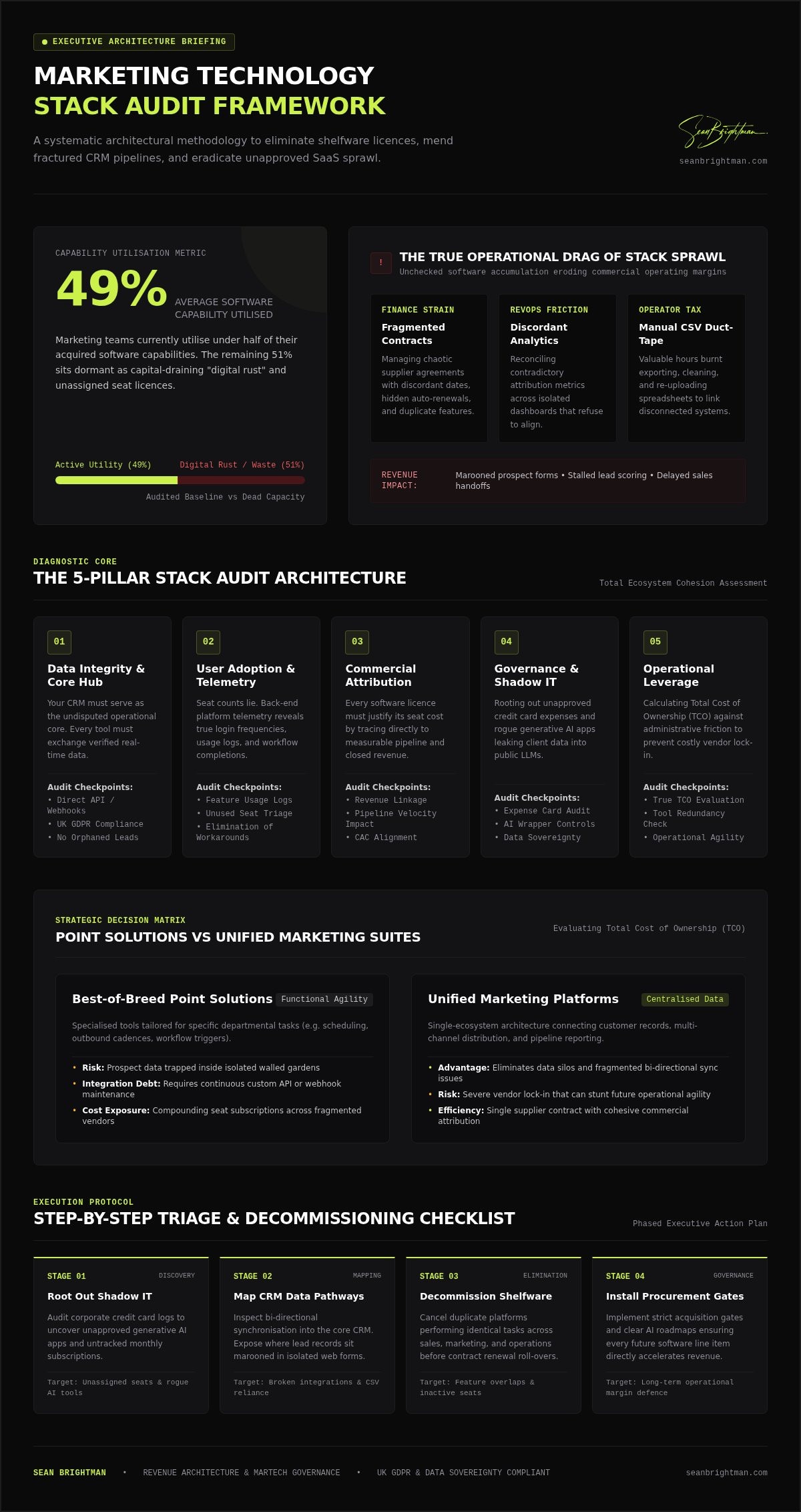
    Marketing teams currently utilise just 49% of their software capabilities, pouring thousands of pounds each month into platforms that do little more than gather digital rust. Adding another SaaS subscription will not rescue flawed revenue architecture. If your customer records sit marooned across disconnected tools whilst teams expense unapproved generative AI apps, conducting a ruthless marketing technology stack audit is no longer optional; it is urgent operational triage.

    You already recognise the symptoms. Disjointed platforms cripple your pipeline reporting, seat costs spiral out of control, and your staff spend more time duct-taping data together than driving growth. It is heavy operational drag disguised as modern marketing.

    This executive checklist shows you how to strip away the waste. You will systematically eliminate shelfware licences, mend broken data flows into your CRM, and establish a lean, tightly integrated stack where every tool directly justifies its seat cost.

    Key Takeaways

    • Conduct an objective marketing technology stack audit to eliminate shelfware, align tools with commercial architecture, and stop subscription waste from eroding operating margins.
    • Evaluate overall stack cohesion across five structural pillars rather than assessing isolated software inside departmental silos.
    • Weigh the true total cost of ownership between point solutions and unified suites to avoid vendor lock-in that stunts operational agility.
    • Execute a phased triage checklist to root out shadow IT, unapproved credit card expenses, and broken data flows into your CRM.
    • Install strict procurement governance and deliberate AI roadmaps so that every future platform directly accelerates revenue instead of adding drag.

    The Martech Sprawl Crisis: Why Enterprise Stacks Fail and Drain Capital

    Enterprise software accumulation rarely happens by design. It happens by impulse. A department hits a minor operational bottleneck, swipes a corporate credit card for a quick-fix SaaS platform, and leaves the monthly billing running indefinitely. A rigorous marketing technology stack audit isn’t a passive inventory check; it is an objective architectural and financial review designed to eliminate dead weight and force software to justify its line item. Left unchecked, subscription sprawl quietly erodes operating margins across your business, devouring capital through unassigned user seats, overlapping capabilities, and forgotten enterprise trials that silently rolled into multi-year contracts.

    The True Cost of Unused Software Licences and Feature Overlap

    Most scale-ups don’t suffer from a lack of capability; they suffer from redundant duplication. Marketing uses one platform for scheduling, sales runs another for outbound cadences, and operations buys a separate tool for workflow triggers. You end up funding three different platforms that perform identical tasks.

    The financial damage extends beyond the monthly subscription invoices. It creates immense administrative drag:

    • Finance teams burn hours managing fragmented supplier agreements with conflicting renewal dates.
    • RevOps teams waste valuable time manually reconciling discordant analytics dashboards across isolated platforms.
    • Operators spend their days exporting, cleaning, and uploading CSV files simply to bridge gaps between tools that refuse to speak to one another.

    Data Silos and the Illusion of Marketing Efficiency

    Point solutions promise functional agility, but they inevitably trap critical prospect data inside walled gardens. When your execution channels fail to sync bi-directionally with your core CRM, leadership cannot accurately track customer acquisition costs across complex digital marketing campaigns. The figures simply do not match.

    These broken data flows actively kill pipeline velocity. High-intent prospects sit marooned in isolated web forms, automated lead scoring triggers erratically, and commercial teams receive handoffs days after interest has cooled. Executing an objective marketing technology stack audit breaks open these closed ecosystems, exposing the operational friction that sits between your marketing spend and actual closed revenue.

    The 5-Pillar Architecture for a Modern Marketing Technology Stack Audit

    Auditing tools in isolation is a fool’s errand. A single platform might look brilliant on paper, yet completely sabotage your operational velocity because it refuses to sync with the rest of your systems. A modern marketing technology stack audit must evaluate total ecosystem cohesion. Taming rampant martech sprawl means grading every asset across five non-negotiable dimensions: data integrity, user adoption, commercial attribution, governance security, and operational leverage. Flashy feature sets don’t matter; stability, compliance, and revenue flow do.

    Data Integrity, Centralisation, and Analytics Infrastructure

    Your CRM is the undisputed operational core. If a platform cannot reliably exchange real-time data with this hub via direct APIs or verified webhooks, it is an active operational liability.

    • Map data pathways to eliminate orphaned lead records and contradictory customer tracking fields.
    • Verify absolute compliance with UK GDPR and relevant data sovereignty frameworks across every cloud repository.
    • Audit permissions across rogue generative AI wrappers to prevent proprietary client data leaking into public machine learning models.

    Active User Adoption and Daily Workflow Integration

    Seat counts lie. Back-end platform telemetry tells the real story. Auditing user activity means examining actual login frequencies, feature usage logs, and workflow completions rather than relying on departmental claims. When an interface is clunky, teams build brittle workarounds in spreadsheets; when a platform is properly embedded, work moves without friction. Evaluate your internal documentation honestly. If your staff require specialist external agencies just to trigger a routine campaign, you don’t have an asset; you have an anchor.

    Commercial Attribution and Real Business Impact

    Every licence must connect directly to measurable commercial output. Point solutions often spit out vanity metrics: email open rates, social impressions, or superficial video views. These figures obscure real business performance.

    Rate each tool on a blunt scale of commercial utility: does it directly accelerate pipeline velocity, reduce customer acquisition cost, or scale enterprise valuation? If an application simply produces reports that nobody reads, decommission it immediately. When untangling these cross-departmental dependencies feels overwhelming, bringing in objective Fractional CMO leadership provides the clarity needed to cut non-performing software without disrupting live revenue channels.

    Critical Evaluation Criteria: Best-of-Breed Tools vs Unified Marketing Platforms

    The eternal architectural debate pits monolithic enterprise suites against bespoke fleets of specialist applications. Inexperienced operators treat this as a simple feature comparison. Seasoned leaders evaluate it through total cost of ownership and commercial agility. A thorough marketing technology stack audit weighs this trade-off ruthlessly: unified platforms simplify data governance at the expense of cutting-edge depth, whilst best-of-breed tools offer tactical superiority that comes with heavy integration drag.

    Integration Overhead and the True Cost of Maintenance

    Specialist software rarely functions in isolation. Hooking together a dozen best-of-breed tools creates substantial technical overhead that finance teams frequently overlook when approving individual monthly subscriptions:

    • Monthly fees for intermediate middleware and integration platforms scale rapidly alongside record volume.
    • Premium API tier charges quietly escalate as data synchronisation frequencies increase.
    • Unannounced third-party platform updates break custom webhooks, silently terminating automated revenue workflows mid-campaign.
    • Every external integration point expands your attack surface, compounding security vulnerabilities across distinct cloud environments.

    If your developers spend dozens of hours every month patching fragile data pipelines between disparate vendors, your best-of-breed stack is leaking capital instead of driving growth.

    Vendor Lock-in and Strategic Flexibility in 2026

    Unified platforms promise seamless harmony, but they frequently construct golden cages. Monolithic vendors bundle mediocre point solutions around a central CRM, secure multi-year agreements through initial discounts, and then enforce punishing renewal fee increases once your organisation is entirely dependent on their ecosystem. Moving away becomes an operational nightmare.

    Proprietary data schemas and punitive extraction fees make platform migration deliberately painful. When your software provider stifles your operational agility, your go-to-market speed stalls. During a marketing technology stack audit, establish clear boundaries between your core and your edge: consolidate commoditised functions into your central database, but isolate specialist software to functions that directly produce a competitive advantage. Never sign a renewal without a documented contingency exit roadmap and total ownership of your raw customer data.

    The Marketing Technology Stack Audit: A Ruthless 2026 Executive Checklist

    The Martech Stack Audit Execution Checklist: Step-by-Step Triage and Decommissioning

    Executing an objective marketing technology stack audit requires clinical discipline, not committee consensus. Internal teams form emotional attachments to platforms they spent weeks configuring, even when those tools actively bleed capital. You need a phased, vendor-agnostic process to uncover hidden software, classify your inventory, and decommission shelfware without snapping critical revenue connections. Partnering with a seasoned marketing operations consultant cuts through internal bias and ensures an aggressive, revenue-led restructuring.

    Discovery and Financial Inventory Gathering

    Begin with the money. Marketing leaders often guess their software footprint; finance ledgers tell the unvarnished truth.

    • Pull twelve months of general ledger accounts payable statements, corporate credit card logs, and expense submissions.
    • Catalogue renewal dates, notice windows, billing cadences, and total allocated seat licences across all departments.
    • Interview front-line revenue contributors to isolate the applications that actually drive prospect conversion versus tools bought for speculative projects.
    • Identify unapproved shadow IT, including ungoverned generative AI accounts, team-level graphic tools, and contractor portals running on personal subscriptions.

    The Triage Decision Matrix: Keep, Consolidate, or Kill

    Grade every identified application against strict operational criteria:

    • Keep: Core platforms demonstrating high daily adoption, tight CRM integration, and verifiable attribution to closed pipeline.
    • Consolidate: Redundant tools whose functional scope can be absorbed by your central systems without sacrificing performance.
    • Replace: Fragile legacy point solutions creating excessive developer overhead or presenting unacceptable security risks.
    • Kill: Inactive shelfware, underutilised seat tiers, and vanity platforms that generate zero commercial leverage.

    Issue formal non-renewal notices immediately for any software marked for elimination. Do not let vendors trap you in rolling thirty-day contract extensions.

    Safe Software Decommissioning and Data Migration

    Never simply cancel a subscription and walk away. Unwinding a platform without a structured protocol creates operational chaos. First, run complete exports of historical engagement data, contact attributes, and reporting records, storing them in compliant, encrypted local archives. Next, audit all live customer touchpoints: update tracking scripts, redirect lead capture webhooks, and map active form endpoints into your primary database.

    Finally, revoke all API credentials, terminate SSO connections, and purge system admin permissions. Leaving abandoned tokens active creates massive security vulnerabilities. If you want an objective diagnostic of your current infrastructure, book a strategic Roadmapping session to dismantle software bloat and realign your operational engine around scalable growth.

    Rebuilding Your Revenue Engine: Governance, AI Integration, and Strategic Advisory

    Decommissioning obsolete platforms is only half the battle. If your procurement culture remains untouched, software sprawl will creep right back in within six months. Completing a marketing technology stack audit creates a clean operational slate; installing ironclad governance ensures it stays that way. Tactical experiments without strategic guardrails drain profit margins. You must replace reactive credit card sign-ups with purposeful systems architecture, backing your tools with executive accountability and targeted ai consulting to construct unified growth engines rather than stockpiling disjointed widgets.

    Establishing Strict Software Procurement and AI Governance

    Ungoverned technology adoption is a direct security and financial risk. Your organisation needs a formal procurement gate that stops subscription creep before an invoice is ever generated:

    • Enforce mandatory business cases: Require teams to prove clear commercial attribution and complete CRM integration compatibility before purchasing any new seat or service.
    • Implement strict data privacy rules: Prohibit employees from pasting customer records, pricing files, or proprietary strategies into external, public AI platforms.
    • Standardise lifecycles: Establish rigorous onboarding procedures and immediate offboarding protocols to cut unused seats the minute team members depart.

    Continuous Optimisation via Fractional Marketing Leadership

    Technology stacks do not run themselves; they drift without authoritative steering. Mid-market scale-ups rarely need an expensive, permanent executive suite simply to maintain architectural hygiene. Bringing in an objective fractional cmo injects battle-tested leadership into your commercial engine without full-time payroll bloat.

    This level of outside oversight challenges departmental comfort zones, ensuring your marketing technology stack audit translates into measurable pipeline acceleration rather than theoretical slide decks. By establishing an ongoing marketing advisory retainer, leadership gains a relentless accountability layer. Your systems remain lean, data flows stay unbroken, and every software asset continues to pull its weight in revenue.

    Turn Your Software Stack Into a Lean Commercial Engine

    Software alone doesn’t generate revenue; architecture does. Leaving underutilised apps to accumulate unchecked silently guts your operating margins and suffocates your team with manual workarounds. A ruthless marketing technology stack audit breaks this cycle. It strips away redundant shelfware, heals severed data pipelines into your CRM, and ensures every single licence directly pulls its weight on your bottom line.

    Achieving that clarity demands objective, senior-level oversight. Drawing on the proven strategic framework published in my acclaimed book on brand architecture and AI integration, I deliver hands-on fractional marketing leadership focused entirely on building profitable revenue systems. No vendor kickbacks. No agency bloat. Just independent, battle-tested execution.

    Ready to eliminate the drag? Audit your marketing systems and strip out operational bloat with Sean Brightman to engineer a lean stack that scales.

    Frequently Asked Questions

    How often should a growing business conduct a marketing technology stack audit?

    Fast-growing businesses should conduct a full marketing technology stack audit annually, backed by focused quarterly checks prior to vendor contract renewal windows. Rapid headcount expansion and shifting campaigns inevitably introduce unmonitored tools. A quarterly sweep catches abandoned seat licences and unauthorised departmental subscriptions before rolling contracts renew. An annual deep dive reassesses foundational integrations, database performance, and strategic alignment with board-level commercial revenue goals.

    What is the fastest way to identify unused software licences across our marketing team?

    Pull your single sign-on (SSO) activity logs and accounts payable ledger simultaneously. Administrative dashboards expose the truth: user accounts with zero logins over the past thirty days represent immediate waste. Cross-reference these activity reports against your corporate credit card statements. This instant reconciliation flags rogue departmental trials, zombie seats belonging to former contractors, and unassigned licences that finance continues to pay for without question.

    How much budget can an organisation typically recover through a thorough martech audit?

    Most businesses reclaim between 15% and 30% of their overall software spend by cutting redundant platforms, consolidating overlapping tools, and right-sizing seat tiers. The financial return extends beyond subscription invoices. Eliminating fragmented systems dramatically lowers internal developer maintenance costs, cuts intermediate middleware expenses, and frees up operational hours previously lost to manual data manipulation between incompatible applications.

    Can an internal marketing team conduct an objective tech stack audit on themselves?

    Rarely. Internal teams naturally protect platforms they spent months mastering, even when those systems fail to drive commercial growth. Departmental politics and sunk-cost fallacies blind managers to operational waste. Bringing in an external fractional strategist delivers total objectivity. An outside specialist reviews your marketing technology stack audit through a clinical lens, judging software purely on revenue generation, compliance, and systems integration rather than emotional attachment.

    What happens if we cancel a marketing tool before properly migrating our legacy data?

    Cancelling abruptly causes permanent data loss, breaks live lead capture, and halts running campaigns. Proprietary vendor ecosystems often purge contact records and activity histories immediately upon account closure. Broken webhooks leave web forms failing silently, stranding high-intent leads in limbo. Always extract full historical archives, remap active forms into your central CRM, and verify tracking endpoints before submitting a formal termination notice.

    How do we evaluate whether an AI marketing tool provides genuine commercial utility?

    Disregard novelty and measure operational output. A viable AI tool must demonstrably reduce production time, enrich prospect data accuracy, or accelerate qualified pipeline. If an application merely generates generic copy that demands hours of manual editing, it creates operational drag. Demand clear API connectivity with your core systems and ensure the platform complies with UK data privacy standards before introducing it to your stack.

    Is it better to replace multiple marketing point solutions with a single all-in-one suite?

    Neither model is universally superior. All-in-one suites simplify governance, minimise API failures, and centralise customer records, but their secondary tools often lack depth. Best-of-breed software delivers unmatched tactical performance, yet demands constant developer maintenance and expensive middleware. The ideal architecture keeps customer data locked inside a robust core CRM, surrounding it only with specialist tools that provide an undeniable competitive edge.