
Unpredictable lead flow is usually a system failure, not a channel failure. If you’re searching for how to solve unpredictable lead flow, the answer probably isn’t to pour more money into the latest tactic and hope next month looks better.
The pattern is familiar: enquiries surge, then dry up. The team can’t tell which activities generate qualified opportunities, and forecasts shift whenever the pipeline changes. That makes it difficult to decide where to focus time and budget.
You can build a steadier acquisition system, but first find where it’s breaking. More activity won’t fix unclear tracking, dependence on one source or follow-up that drops the ball.
This guide will help you diagnose the causes of lead volatility, measure how prospects move from first contact to sales conversation, and strengthen the parts of your system that need attention. You’ll leave with a practical way to prioritise fixes, improve follow-up and make better decisions before spending more. No guesswork or channel-hopping, just a system your team can measure, own and improve.
Key Takeaways
- Measure qualified opportunities, not traffic alone, to see whether lead flow is truly unstable.
- Separate shifts in market demand from problems with positioning, conversion or follow-up before changing tactics.
- Use consistent time periods and definitions to distinguish a temporary dip from a structural pipeline issue.
- To learn how to solve unpredictable lead flow, follow a 30-day sequence: establish a baseline, diagnose the gaps, prioritise fixes and review progress.
- Give each stage of the marketing-to-sales handover a clear owner, so opportunities don’t disappear between teams.
How to solve unpredictable lead flow by finding where the system breaks
One month, the team is fielding enquiries. The next, the calendar looks bare and the forecast starts wobbling. That feast-or-famine pattern is frustrating, but website visits alone won’t tell you what’s wrong. To work out how to solve unpredictable lead flow, track whether the business consistently creates qualified opportunities, not just attention.
Lead generation involves capturing interest and moving potential customers towards a purchase. A dependable pipeline, though, depends on more than generating enquiries. You need a clear path from market need and positioning through to enquiry, qualification and sales follow-up. A weak link anywhere along that route can make revenue unpredictable.
What counts as unpredictable lead flow?
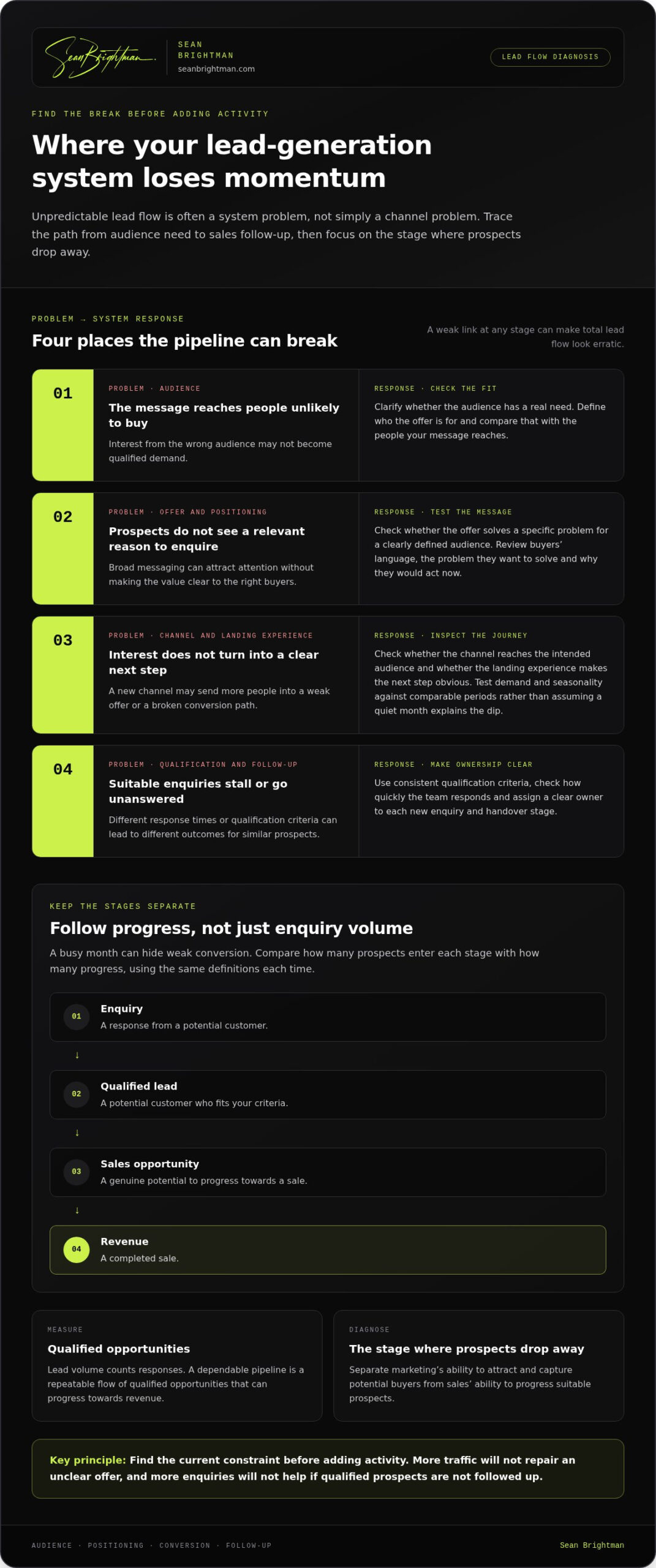
Keep the stages separate: an enquiry is a response; a qualified lead fits your criteria; a sales opportunity has a genuine potential to progress; revenue is a completed sale. A busy month can hide weak conversion if lots of people enquire but few are qualified or reach a sales conversation.
Lead volume counts responses. Dependable pipeline means a repeatable flow of qualified opportunities that can progress towards revenue.
For example, a consultancy might receive a burst of enquiries after a webinar, then see little movement because most prospects aren’t a fit. The enquiry count rises, but the opportunity pipeline doesn’t. Your pattern may differ, so compare each stage rather than treating every contact as equal.
Where the lead-generation system can lose momentum
Trace the route a potential customer takes. Does the audience have a real need? Does the positioning make the value clear? Does the offer give the right people a reason to act? Then check whether the channel reaches them, the landing experience makes the next step obvious, and follow-up happens promptly and consistently.
- Audience: the message reaches people unlikely to buy.
- Offer and positioning: prospects don’t see a relevant reason to enquire.
- Channel and landing experience: interest doesn’t turn into a clear next step.
- Qualification and follow-up: suitable enquiries stall or go unanswered.
Any one of these breaks can make total lead flow look erratic. A channel may deliver attention in bursts, while unclear qualification or inconsistent follow-up makes the number of genuine opportunities swing even more.
Start with the stage where prospects drop away. Compare how many enter each step with how many progress, using the same definitions each time. That gives you a working diagnosis before you add activity. More traffic won’t repair an offer people don’t understand, and more enquiries won’t help if qualified prospects aren’t followed up.
Why lead flow becomes inconsistent: demand, positioning and conversion
Lead volatility rarely has one neat cause. Market demand can shift, positioning can miss the buyer’s real concern, and sales follow-up can let good enquiries cool off. Connected weaknesses often drive lead volatility: a change in demand can expose gaps in positioning, channel reliance or conversion. Treating every dip as a channel problem can send the team fixing the wrong thing.
When positioning and demand do not line up
Ask whether the offer solves a specific problem for a clearly defined audience, and whether that problem matters enough for people to act. Broad messaging may attract interest from several groups, but if none sees a precise fit, that attention may not become qualified demand. Review the language buyers use, the problem they’re trying to solve and the reason they’d choose to act now.
Buying cycles and seasonality matter, but they’re context to test, not automatic explanations. Compare similar periods and look for evidence: did enquiries fall across the market, or only for your offer? Did a usual buying window shift, or did the message stop resonating? A like-for-like comparison is more useful than blaming a quiet month on the calendar.
How gaps between marketing and sales compound volatility
Marketing can generate steady interest while opportunities still arrive unevenly. The handover is often where the pattern changes. Check how quickly the team responds, whether everyone uses the same qualification criteria, and who owns each new enquiry. If one person follows up promptly and another waits, similar prospects can have very different outcomes.
Separate the measures. Lead-generation performance shows whether marketing attracts and captures potential buyers; sales conversion shows whether suitable prospects progress. A drop in opportunities could point to fewer qualified leads, slow responses or inconsistent sales conversations. The new B2B sales playbook is a useful prompt to think beyond lead capture and connect marketing activity to how buyers make decisions.
Why adding another channel may not fix the cause
A new channel can broaden reach, but it can also amplify a weak offer or send more people into a broken conversion path. Concentrating on one source creates exposure too: if a campaign pauses or execution becomes inconsistent, enquiries can drop with it. The answer isn’t automatically to be everywhere. Find the current constraint first, then decide whether channel concentration is genuinely part of the problem.
For a wider view of how processes, people and tools fit together, explore the marketing operations growth engine. If the diagnosis points to a gap in strategic direction, strategic marketing guidance can help turn the findings into clear priorities. That’s the practical starting point for how to solve unpredictable lead flow: fix the cause, not just the visible dip.
How to tell a temporary lead dip from a structural pipeline problem
A quiet period deserves attention, but it doesn’t prove the system has failed. The useful question is whether the dip has a clear, limited cause or whether the same weak points keep showing up. Before deciding how to solve unpredictable lead flow, make sure you’re comparing like with like.
| Temporary fluctuation | Possible structural problem |
|---|---|
| A campaign ended, paused or changed its timing. | Results repeatedly depend on one channel or campaign. |
| Enquiry levels shifted during a known buying cycle or seasonal period. | Qualified demand stays weak across comparable periods. |
| A one-off interruption affected marketing or sales capacity. | Follow-up or qualification gaps recur, even when enquiries arrive. |
| A reporting change explains an apparent movement in the numbers. | Forecasts repeatedly miss actual opportunities and outcomes. |
Signals of a temporary fluctuation
Look for a specific event that lines up with the dip: a campaign pause, a change in buying cycles, seasonal timing or a short-lived capacity issue. Then compare equivalent periods and check whether lead definitions or tracking changed. Don’t alter several channels at once. That muddies the evidence and makes it harder to identify what actually shifted.
Signals of a structural pipeline problem
Look for repetition, not just a low total. Are qualified leads declining across comparable periods? Does one channel supply most opportunities, while others contribute little? Are leads arriving but failing to convert, or waiting too long for follow-up? Compare lead quality and channel contribution alongside enquiry counts. If forecasts repeatedly diverge from actual opportunities and sales, the issue may sit deeper than a temporary dip.
Use evidence before making the next move
Choose a review period that fits your sales cycle and the amount of data you have. A short-cycle business may spot a pattern sooner than one whose buyers take longer to decide. Track lagging results, such as qualified opportunities and sales, alongside leading indicators that help explain them:
- How many enquiries receive a response?
- How many progress through qualification and into a sales conversation?
- How consistently does the team complete planned follow-up?
Record campaign changes, sales-team capacity and assumptions beside the results. That context helps distinguish a genuine trend from a reporting blip. One quiet period is a signal to investigate, not a verdict.
Once the evidence points to a pattern, turn it into priorities rather than a list of disconnected fixes. The strategic brand roadmapping guide offers useful planning context for translating diagnosis into a focused direction.
A practical 30-day plan to make lead generation more consistent
Knowing how to solve unpredictable lead flow starts with resisting the urge to change everything at once. Use the next 30 days to build a clear baseline, find the main constraint, make one focused change and review the evidence. The goal isn’t a quick spike in enquiries. It’s a system the team can understand and improve.
Week one: establish a trustworthy baseline
Agree what counts as a lead, a qualified lead and a sales opportunity. Then record what you can reliably measure: source, volume, quality, progression, conversion and response behaviour. Keep the definitions consistent across marketing and sales. If tracking is incomplete, flag the gap rather than filling it with assumptions.
Assign an owner to each handover stage, from capturing an enquiry to qualifying it and following up. A clear name beside each step makes missed actions easier to spot.
Weeks two and three: fix the highest-impact constraint
Use the baseline to choose one bottleneck with evidence. It might be unclear positioning, a landing page that doesn’t prompt action, or inconsistent follow-up. Set one focused change, name the person responsible and agree what signal would suggest it’s working, such as more suitable enquiries progressing to a sales conversation.
Record when you’ll review the change and what else could affect the result, including campaign activity or sales capacity. Don’t launch several unrelated experiments at once. You need to know what changed and what happened next.
Week four: review, learn and set the next priority
Compare the agreed measures with your baseline, allowing for the length of your sales cycle. Review both outcomes, such as qualified opportunities, and leading indicators, such as response and follow-up completion. A concise dashboard should show what moved, where prospects dropped away and who owns the next action.
Keep the change, adapt it or stop it based on evidence, not how busy the team felt. Thirty days may reveal an early signal rather than a complete sales outcome, so note what still needs monitoring.
Measure first. Fix the constraint. Then scale what works. That’s a practical way to build momentum without adding activity blindly. Sean Brightman’s marketing roadmapping can turn a diagnosis into an owned, prioritised plan. Explore strategic marketing guidance.
When strategic marketing leadership can turn lead flow into a managed system
Not every uneven pipeline needs outside help. If your team can identify the main constraint, has the authority to fix it and can review the results consistently, assign an owner and act. But if marketing priorities keep changing, no one owns the whole journey, or activity isn’t tied to qualified opportunities, the problem may be a lack of direction rather than a lack of effort.
That’s where strategic oversight can help. The question of how to solve unpredictable lead flow isn’t answered by automatically buying another campaign or adding a full-time executive. First, clarify what the evidence says, what decision needs to be made and who will carry it through.
When a roadmap is the right next step
Use a focused roadmap when the diagnosis is clear enough to expose the gaps, but priorities, ownership or the route to growth remain unsettled. A roadmap turns findings into sequenced decisions: what to address first, who is responsible and how progress will be reviewed. It gives the team practical direction instead of another list of disconnected tasks.
Sean Brightman provides strategic roadmapping to help businesses set a clear marketing and brand direction. For context on the leadership model that can support this work, read the fractional CMO leadership guide.
When ongoing senior marketing oversight can help
Fractional CMO leadership provides senior marketing direction on a part-time basis. Sean Brightman’s Fractional CMO service can help when the business needs someone to connect marketing priorities to commercial goals, align teams and keep decisions moving, without making a full-time executive hire. An advisory retainer provides ongoing direction and accountability as the team puts its priorities into practice.
Be explicit about responsibilities. Strategic oversight should clarify priorities, decisions and measures; the team still needs named owners for day-to-day execution, enquiry handling and reporting. A clear handover prevents accountability from disappearing between strategy and action.
The next decision: diagnose, assign or get strategic support
Write down the main constraint and the evidence behind it. Name the person responsible for addressing it, agree what progress will look like and set a review date. If the team can do that and has the capacity to follow through, start there. If the diagnosis or direction remains contested, strategic support can help turn the evidence into a plan the business can own.
Stabilise the system before you scale activity. To explore strategic marketing direction shaped around your business’s priorities, start a strategic conversation.
Build a pipeline your team can rely on
Unpredictable lead flow isn’t fixed by chasing every new channel. Start by defining what a qualified opportunity looks like, then trace where prospects stall between first enquiry and sales follow-up. Compare consistent measures over time, and use the evidence to choose one constraint to address before scaling activity.
That’s the practical answer to how to solve unpredictable lead flow: make the system visible, assign clear ownership and keep reviewing what moves opportunities forward. If priorities or accountability remain unclear, strategic roadmapping can turn diagnosis into a structured direction for marketing and brand growth. Fractional CMO support adds part-time senior marketing leadership when the team needs experienced direction without a full-time executive.
Explore strategic marketing support to discuss the next step for your business. You don’t need to fix everything at once. Find the constraint, make a focused change and build from what you learn. A steadier pipeline starts with a system your team can understand and improve.
Frequently Asked Questions
Why is my lead flow so inconsistent?
Lead flow often varies because several parts of the acquisition system are out of sync. Demand may change, your offer may not speak clearly to a specific audience, or one channel may supply most enquiries. Even steady interest can turn into uneven opportunities if qualification and follow-up vary. Compare qualified leads and sales opportunities, not just enquiry totals, then trace where prospects stop progressing.
How can I get more consistent leads for my business?
Start by defining a qualified lead and a sales opportunity, then track how prospects move from first enquiry to sales conversation. Look for the weakest step, such as unclear positioning, low conversion or inconsistent follow-up, and assign someone to address it. If you’re working out how to solve unpredictable lead flow, measure first, fix one evidenced constraint, then review before scaling activity.
Can one marketing channel create a reliable flow of leads?
It can produce a steady flow for a time, particularly if it reliably reaches the right audience and converts interest into suitable opportunities. But relying on one source creates exposure: a campaign pause, changing buyer behaviour or weaker performance can quickly affect the pipeline. Track the channel’s contribution and lead quality, while building a broader system deliberately rather than adding channels before the existing journey works.
How do I know whether a drop in leads is temporary?
A single quiet period is a reason to investigate, not proof that your marketing has failed. Check for a specific cause, such as a campaign pause, seasonal timing, a buying-cycle shift or a change in tracking. Compare like-for-like periods using consistent lead definitions. If qualified demand, conversion or follow-up keeps weakening across comparable periods, you may be seeing a structural issue rather than a short-term fluctuation.
What metrics should I track to improve lead flow?
Track a small set of measures across the journey: enquiries by source, qualified leads, sales opportunities, progression between stages, and outcomes. Add response behaviour, such as how quickly enquiries receive attention and whether planned follow-up is completed. These leading indicators help explain later results. Use consistent definitions and review periods, and note gaps in tracking rather than filling them with assumptions.
Will hiring an agency fix unpredictable lead generation?
Not automatically. More activity won’t solve unclear positioning, weak conversion or inconsistent follow-up if those are the real constraints. First identify the problem and decide whether the team needs execution capacity, strategic direction or clearer ownership. A roadmap can turn diagnosis into prioritised decisions; fractional CMO support provides part-time senior marketing leadership. Make responsibilities explicit so strategy connects to action and results can be reviewed.