
Tag: scaling a business

  • Problems with Founder-Led Marketing: Why Your Heroics are Stalling Growth

    Problems with Founder-Led Marketing: Why Your Heroics are Stalling Growth

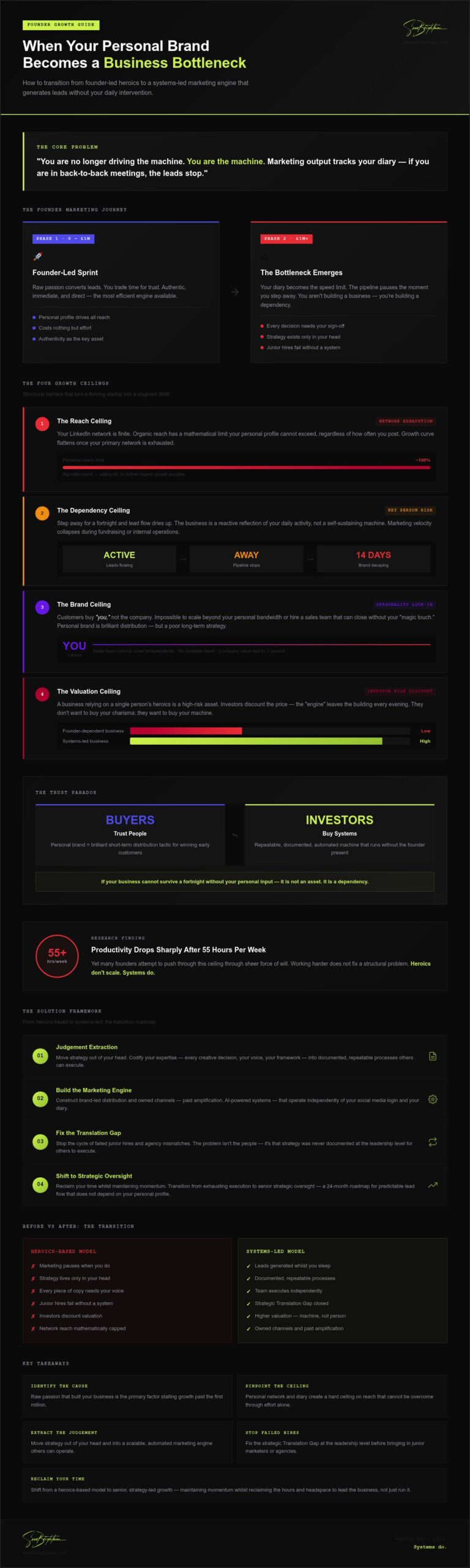
    Your personal brand isn’t an asset anymore. It is an anchor. You have built a business on grit and a LinkedIn profile, but the engine is stalling because you are the only one who knows how to drive it. Marketing output currently tracks your diary. If you are in back to back meetings, the leads stop. This is not a growth strategy. It is a survival tactic that has reached its expiry date.

    The underlying problems with founder-led marketing emerge when your personal heroics become a business bottleneck. You likely realised that hiring a junior marketer didn’t solve the issue. They cannot execute because the strategy only exists inside your head. It is a frustrating cycle where you trade your time for visibility, whilst the scalable systems you actually need remain unbuilt.

    This guide shows you how to transition to a systems-led marketing engine that runs without your daily intervention. We will outline how to codify your expertise into a clear 24-month roadmap. You will discover how to build predictable lead flow that isn’t dependent on your personal profile, moving you from exhausting execution to senior strategic oversight.

    Key Takeaways

    • Identify why the raw passion that built your business is now the primary factor stalling your growth past the first million.
    • Pinpoint the structural problems with founder-led marketing, specifically how your personal network and diary create a hard ceiling on reach.
    • Master the process of “judgement extraction” to move strategy out of your head and into a scalable, automated marketing engine.
    • Stop the cycle of failed junior hires and agency mismatches by fixing the strategic “Translation Gap” at the leadership level.
    • Reclaim your time whilst maintaining momentum by shifting from a heroics-based model to a senior, strategy-led growth system.

    The Trap of Early Success: Why Founder-Led Marketing Breaks at Scale

    Founder-led marketing is a high-octane sprint. You are the face, the strategist, and the manual labour. For a startup scaling toward its first £1M, it is the most efficient growth engine available. You trade your time for trust. It costs nothing but sweat. People buy from people, and your raw passion is the highest-converting asset in the business. It works because it is authentic, immediate, and direct.

    Success eventually creates a ceiling. Your diary becomes the speed limit for your brand. If you aren’t active on LinkedIn, the pipeline stops. If you aren’t recording the podcast, the reach vanishes. You aren’t building a business; you are building a job that requires your constant presence to function. This is where the core problems with founder-led marketing begin to choke your growth. You are no longer driving the machine. You are the machine.

    The “Founder Bottleneck” Phenomenon

    Marketing velocity usually collapses the moment you focus on fundraising or internal operations. This “Content Silence” is expensive. Whilst you’re in board meetings, your brand visibility is decaying. The issue is that your judgement hasn’t been codified. Every creative decision requires your sign-off. Every piece of copy needs your “voice” to work. Your expertise is your greatest asset in the early days, but it becomes your greatest liability when you cannot be in two places at once. You are the blockage in the pipe. Research shows that productivity drops sharply after 55 hours of work per week, yet many founders try to push through this by sheer force of will. Heroics don’t scale. Systems do.

    The Trust Paradox

    Buyers trust people. Investors buy systems. There is a fundamental conflict between a brand that relies on your personality and a company that can scale independently. If your business cannot survive a fortnight without your personal input, it isn’t an asset. It’s a dependency. You have built a reputation, but you haven’t built a repeatable process. A personal brand is a brilliant distribution tactic, but it is a poor long-term strategy. To grow, you must move from heroics to scalable marketing systems that capture and convert leads whilst you sleep. You need a business that is strategy-led, not personality-dependent.

    The Three Ceilings: Identifying Where Your Marketing Has Stalled

    Success is a deceptive metric. In the early stages, your personal momentum carries the brand. But eventually, you hit a hard limit. You reach the point where more effort no longer yields more growth. These are the structural problems with founder-led marketing that turn a thriving startup into a stagnant SME. You aren’t failing because you aren’t working hard enough; you’re failing because your current model isn’t built to scale.

    • The Reach Ceiling: Your LinkedIn network is finite. Organic reach has a mathematical limit that your personal profile cannot exceed, regardless of how often you post.
    • The Dependency Ceiling: If you step away for a fortnight, the lead flow dries up. The business is a reactive reflection of your daily activity, not a self-sustaining machine.
    • The Brand Ceiling: Customers buy “you,” not the company. This makes it impossible to scale beyond your personal bandwidth or hire a sales team that can close without your “magic touch.”
    • The Valuation Ceiling: A business that relies on a single person’s heroics is a high-risk asset. Investors discount the price because the “engine” effectively leaves the building every evening.

    The Reach Ceiling and Network Exhaustion

    You cannot out-post a bad system. Organic social reach for individual profiles is designed for connection, not massive distribution. Once you have exhausted your primary network, your growth curve flattens. You are stuck in a “one-to-many” loop that relies on your physical presence. Scalability requires a “system-to-market” approach. This means moving beyond your personal profile and investing in brand-led distribution and paid amplification. If you want to break this ceiling, you need an AI-powered growth engine that operates independently of your social media login. Relying on the algorithm’s favour is a gamble, not a strategy. You need owned channels that you control.

    Key Person Dependency and Exit Risk

    Investors are terrified of founder-dependent marketing. They don’t want to buy your charisma; they want to buy your machine. Key Person Dependency in marketing is the structural failure where a company’s lead generation and brand equity are inextricably tied to the founder’s personal presence rather than documented, repeatable processes. If you are the primary source of revenue, you aren’t selling a business. You are selling a job. Building a marketing strategy for business exit requires a ruthless shift from heroics to systems. You must build a growth engine that buyers covet because it functions perfectly without you. This is the difference between a lifestyle business and a valuable, exit-ready asset.

    From Heroics to Systems: Building an Engine That Doesn’t Need You

    Most founders try to fix the problems with founder-led marketing by hiring a “pair of hands.” They want someone to do the donkey work whilst they keep the “vision.” This is a fundamental mistake. Hands don’t have a head. If you are still approving every ad hook, checking every email subject line, or deciding which LinkedIn post goes live, you haven’t delegated anything. You have just added a management layer to your own burnout. You are still the bottleneck. The only thing that has changed is the size of your payroll.

    Real growth requires shifting from task delegation to outcome ownership. This starts with “Judgement Extraction.” You must move the strategy from your head into documented, scalable marketing systems. This isn’t about writing a list of chores. It’s about defining the logic of how you win. If your team cannot make a tactical decision in your absence, you don’t have a business. You have a very expensive hobby that relies on your constant presence to survive. Systems don’t get tired. Systems don’t take holidays.

    Codifying Your Brand Voice with AI

    AI is the mechanism that allows you to scale your perspective without scaling your hours. It isn’t about generating generic, robotic fluff that clogs up feeds. It’s about building AI-powered growth engines trained on your specific logic and “battle-hardened” experience. You can codify your unique tone and strategic frameworks into a machine that handles lead generation 24/7. This allows the business to maintain your unique point of view whilst removing you from the daily grind of production. AI roadmapping identifies exactly where your manual intervention can be replaced by high-impact automation. The machine does the heavy lifting. You provide the strategic spark.

    Judgement Extraction: The Documentation Phase

    You need to stop being the oracle and start being the architect. This requires a documentation phase that many founders find tedious but is actually the only path to freedom. You need a Brand Bible that defines your “this, not that” binary positioning. This document doesn’t sit on a shelf. It provides the guardrails for your team to make decisions with your level of precision. A strategic brand roadmapping session is the first step. It extracts the raw data from your brain and turns it into a functional, high-impact growth engine. You aren’t just telling people what to do. You are giving them the logic to think like you.
    Problems with Founder-Led Marketing: Why Your Heroics are Stalling Growth

    The False Fix: Why Junior Hires and Agencies Often Fail Founders

    When you hit the ceiling, the instinct is to throw money at the problem. You hire a “Marketing Assistant” or sign a monthly agency retainer. You think you’ve bought freedom. You haven’t. You’ve bought a new set of problems with founder-led marketing that will actually drain more of your time. You are trying to solve a capability issue with a capacity solution. It never works. You are adding weight to a car with a broken engine, hoping it will go faster.

    The hidden cost of these fixes is your own focus. Every junior hire requires training. Every agency requires a brief. If the strategy only exists in your head, you become the full-time manager of people who cannot function without your input. You trade the “doing” for “managing the doing,” but the strategic weight remains firmly on your shoulders. You are still the primary driver of growth, just with a more expensive passenger seat.

    The Capacity vs. Capability Debate

    Your first marketing hire shouldn’t be a social media manager. Why? Because they lack the strategic depth to own a revenue goal. They execute tactics; they don’t build engines. You end up babysitting them, checking their captions, and fixing their mistakes. You wanted a head; you bought hands. Capacity is having more people to do the work. Capability is having the expertise to know which work matters. If the strategy is still locked in your head, a junior hire is just a human-shaped bottleneck. You are still the one doing the thinking. They are just the ones doing the typing. This isn’t delegation. It’s just outsourcing your admin whilst you remain the sole source of strategic value.

    The Agency Disconnect

    Agencies are vendors, not partners. They default to “safe” content because they are terrified of getting it wrong. They lack your “battle-hardened” edge. They don’t live in your P&L. They care about their deliverables, not your long-term growth. This creates a “Translation Gap” where your vision gets diluted into generic corporate noise. You spend your weekends rewriting their copy because it “doesn’t sound like us.” They are focused on vanity metrics whilst you are focused on survival. To fix this, you need senior leadership that can bridge the gap between your vision and the team’s execution. You don’t need another vendor; you need a Fractional CMO who can build the machine. If you are ready to stop babysitting and start scaling, contact Sean Brightman to codify your strategy today.

    The Fractional Shift: Reclaiming Your Time whilst Scaling Your Brand

    The final solution for the problems with founder-led marketing isn’t more hands. It is better leadership. You don’t need a full-time CMO at a £150k salary plus benefits to fix a broken process. You need a Fractional CMO. This is a battle-hardened strategist who installs the engine, trains the crew, and ensures the machine runs without your daily intervention. It is about moving from founder-led heroics to strategy-led growth. You trade your role as the primary engine for a role as the strategic architect.

    This transition requires a shift in how you view marketing. It is no longer a series of tasks you perform. It is a system you oversee. A Marketing Advisory Retainer provides the accountability you’ve been missing. It stops you from drifting back into the weeds. It keeps you focused on the high-level roadmap whilst a senior professional manages the tactical execution. You get the velocity of a corporate marketing department with the agility of a startup.

    Senior Leadership on Demand

    Your team is likely stalling because they lack clear direction. They are waiting for your “magic touch” because you haven’t given them a framework to succeed without it. A Fractional CMO is a plug-and-play component for high-growth engines. We provide the senior leadership and accountability your junior hires or agencies are currently missing. We don’t just suggest ideas; we install the systems that allow you to step back. This isn’t a consulting report that sits in a drawer. It is a functional component of your business machinery that delivers predictable lead flow whilst you sleep.

    Your New Role: From Content Creator to Strategic Asset

    When the engine runs itself, your value to the business changes. You move from being the “Hands” of the marketing to being the “Face” of the brand. This allows you to focus on high-level partnerships, fundraising, and product innovation. You remain the visionary whilst the system handles the distribution. The transition starts with a 90-day plan to extract your judgement and codify it into a repeatable programme. You stop being the bottleneck. You start being the strategic asset your business actually needs to scale. The first step is simple. Book a strategy roadmapping session to identify exactly where your heroics are stalling your growth and build a machine that doesn’t need you.

    Build a Machine That Outlasts Your Heroics

    You’ve seen why your personal momentum has eventually become a drag on your business. The problems with founder-led marketing are structural, not personal. You cannot solve a system failure with more caffeine or a faster typing speed. It is time to extract your judgement, codify your strategy, and install a growth engine that runs without your daily permission. Heroics got you to where you are, but systems will get you to where you want to be.

    Real scale happens when you stop being the “hands” of the business and reclaim your role as the visionary. This isn’t about doing less; it’s about doing what only you can do. As a published author on marketing strategy and an expert in AI-powered growth engines, I provide the strategic advisory UK scale-ups need to break through their ceilings. You deserve a business that functions as a high-impact asset rather than a demanding job.

    The transition from bottleneck to strategist starts today. You can stop being the bottleneck and build a growth engine with a Fractional CMO. Reclaim your time and watch your brand scale with the precision of a well-oiled machine. Your business is ready for its next chapter. Let’s make sure you are too.

    Frequently Asked Questions

    What is the founder bottleneck in marketing?

    The founder bottleneck occurs when all marketing decisions and execution rely on the founder’s personal input. This creates a hard ceiling on growth because marketing velocity is limited by the founder’s diary. When the founder is busy with fundraising or operations, the pipeline dries up. It is a failure of systemisation where the business cannot function as a separate entity from the creator’s daily effort.

    When does founder-led marketing stop working for a scale-up?

    It typically breaks when a business attempts to scale beyond its first £1M or when the founder’s immediate network is exhausted. At this point, organic reach plateaus and the manual “one-to-many” model fails. You will notice the problems with founder-led marketing when you can no longer out-hustle the lack of a repeatable system. If your presence is required for every lead to close, you have reached the limits of this model.

    Should a founder stop doing marketing completely as they grow?

    No, but your role must shift from being the “hands” to being the “strategic architect.” You should remain the face of the brand whilst the execution engine runs independently. This allows you to focus on high-level partnerships and fundraising without the pipeline collapsing. The goal is to move from manual content creation to providing the strategic spark that a system then amplifies across the market.

    How can I delegate marketing without losing my unique brand voice?

    You do this through “Judgement Extraction” and codifying your brand logic into a Brand Bible. Instead of delegating tasks, you delegate the logic behind your decisions. This involves creating binary “this, not that” guidelines that allow your team to think like you. By documenting your strategic frameworks, you ensure that the output remains authentic whilst removing yourself as the sole creator and editor of every piece of copy.

    Is a Fractional CMO better than a full-time marketing director for a founder?

    For scale-ups, a Fractional CMO offers senior leadership without the £150k+ salary and long-term overhead. It provides a plug-and-play strategic head rather than just another manager. A full-time hire often becomes another person for the founder to babysit if systems aren’t in place. A fractional expert focuses on building those systems and providing high-level accountability, ensuring the marketing department operates with tactical precision from day one.

    What is key person dependency and why does it affect business valuation?

    Key person dependency is the structural risk where a company’s revenue and brand equity are tied to the founder’s personal presence. Investors and buyers discount the valuation of such businesses because the engine effectively leaves the building every night. If the marketing stops when you take a holiday, the business is a high-risk asset. Building a systems-led engine creates a growth machine that buyers actually covet.

    How does AI help in scaling a founder-led marketing strategy?

    AI acts as the mechanism to codify and scale your unique perspective without increasing your working hours. By training AI-powered growth engines on your specific strategic frameworks, you can automate lead generation and content distribution. It allows you to maintain your battle-hardened tone across multiple channels simultaneously. AI roadmapping identifies exactly where manual tasks can be replaced by automated systems, turning your expertise into a 24/7 machine.

    How much does a Fractional CMO cost compared to a full-time hire in the UK?

    A Fractional CMO typically costs a fraction of a full-time executive’s salary whilst delivering the same strategic impact. In the UK, a full-time Marketing Director or CMO often requires a six-figure salary plus benefits and equity. A fractional engagement allows you to access that same senior-level expertise on a retainer basis. This model provides the senior leadership your business needs to fix the problems with founder-led marketing without the heavy financial burden of a C-suite headcount.

  • Marketing Strategy Consultant: Why You Need a Growth Engine, Not Just a Plan

    Marketing Strategy Consultant: Why You Need a Growth Engine, Not Just a Plan

    Your last strategy deck is likely rotting in a shared drive folder. It cost fifty grand, looked beautiful, and changed absolutely nothing. Hiring a traditional marketing strategy consultant often feels like paying for a map but never getting the car. You’re tired of the AI hype and the lack of accountability from a team that stays busy but delivers stagnant results. It’s frustrating to watch your capital vanish into a black hole whilst you wait for a breakthrough that never arrives.

    You don’t need another plan; you need a growth engine. You’ve likely realised that strategy without a system is just a hallucination. This article will show you how to distinguish between dusty PDFs and high-impact systems that actually drive revenue as we approach 2026. We’ll preview a clear, actionable roadmap to scale that doesn’t require your constant supervision. You’ll learn how to install senior leadership on demand and turn marketing from a cost centre into a mechanical certainty. It’s about building an asset, not just buying advice.

    Key Takeaways

    • Stop paying for strategy decks that collect dust. Learn how to build a functional growth engine that drives revenue whilst you focus on scaling.
    • Understand the critical difference between a traditional agency and a marketing strategy consultant who prioritises accountability and system-building over spending your budget.
    • Integrate AI as a mechanical component of your operations rather than chasing hype. Get a practical roadmap for 2026.
    • Apply the “Battle-Hardened Test” to vet advisors. Ensure your strategist has real-world experience in fixing messy departments and scaling revenue.
    • Discover how a structured roadmapping session can replace months of aimless planning with a clear, actionable path to exit or expansion.

    Why Most Marketing Strategy Consulting is a Waste of Capital

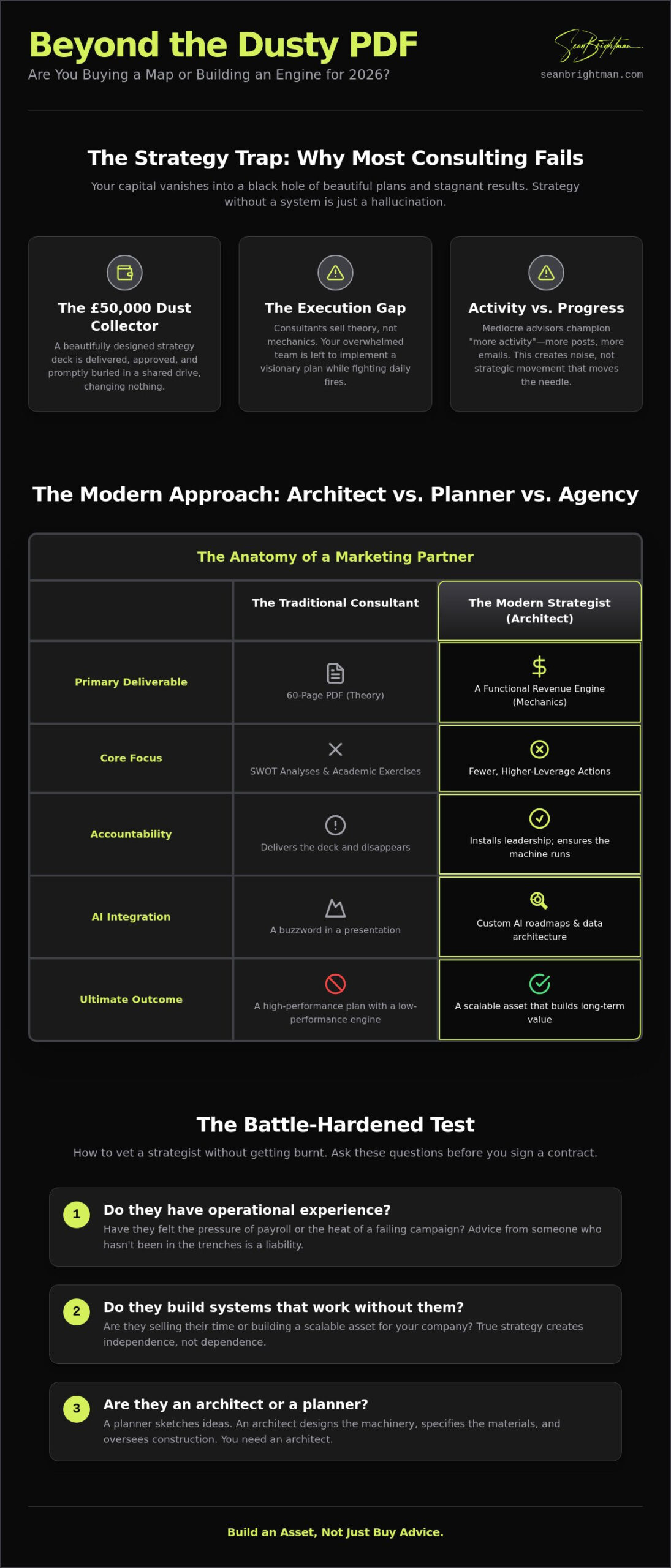
    Your board just approved a sixty-page strategy deck. It’s full of SWOT analyses and colourful graphs. Three months later, it’s buried in a digital drawer. This is the “Dusty PDF” syndrome. It happens because most consultants sell theory, not mechanics. They provide a map but leave you with a broken vehicle. Marketing strategy is often treated as an academic exercise rather than a functional blueprint for growth. You don’t need more slides. You need a way to turn intent into income.

    Hiring a marketing strategy consultant who has never operated a business is a fatal flaw. You’re buying advice from someone who hasn’t felt the pressure of a payroll or the heat of a failing campaign. They’ll tell you to “increase brand awareness” or “optimise your funnel” without explaining how to build the infrastructure to sustain it. Mediocre advisors love “more activity.” They want you to post more, email more, and spend more. Activity is noise. Strategic movement is progress. One keeps you busy; the other moves the needle. You don’t need more tasks. You need fewer, higher-leverage actions that actually result in revenue.

    The Execution Gap: Where Strategy Goes to Die

    Your current team is likely overwhelmed. They can’t implement a visionary plan whilst managing daily fires. Most consulting contracts lack accountability. The consultant delivers the deck and disappears. You’re left with the bill and the same stagnant results. Traditional advisors focus on the “what,” but they ignore the “who” and the “how.” Ask yourself: is your marketing strategy consultant building a system that works without them, or are they just selling their time? If they aren’t installing senior leadership and oversight, the strategy will fail. You need a partner who sticks around to ensure the machinery actually turns.

    The Cost of Strategy Without Systems

    Misaligned marketing spend is a silent killer. A £10,000 strategy is worthless if it requires a £100,000 team you don’t have. You end up with a high-performance plan and a low-performance engine. This is particularly true for high-growth sectors. Developing a marketing strategy for tech companies requires operational rigour, not just creative ideas. You need systems that scale with you. Without them, you’re just throwing capital into a black hole. Real strategy is about resource allocation. It’s about ensuring every pound spent is a deposit into a repeatable growth machine, not a gamble on a vague promise.

    Defining the Modern Marketing Strategy Consultant in 2026

    By 2026, the distinction between a “planner” and an “architect” has become absolute. You don’t need a consultant to tell you what your brand colours should be. You need a strategist to design the machinery that delivers your message at scale. A modern marketing strategy consultant acts as a lead architect. They don’t just sketch the building; they specify the materials, the structural load, and the maintenance schedule. They build engines, not just guidelines.

    Brand positioning must be mechanised to survive. In a crowded market, consistency is a mechanical problem, not a creative one. If your message relies on individual brilliance every Tuesday morning, your process is broken. You need a system that ensures your positioning is delivered automatically across every touchpoint. This is about designing the systems your team will run. It’s about creating a plug-and-play infrastructure that produces results regardless of who is pulling the levers.

    AI Implementation: The New Strategic Pillar

    Forget basic ChatGPT prompts. That’s entry-level. A modern strategist builds custom AI roadmaps that integrate directly into your core operations. They organise your data so AI-driven growth isn’t a theory, but a functional component. In 2026, your strategy must be “AI-first” to remain competitive. This involves using AI to handle the heavy lifting of data analysis and content distribution whilst your team focuses on high-level decision-making. If your consultant isn’t talking about data architecture, they aren’t prepared for the current year.

    Systems Architecture vs. Creative Flair

    Success isn’t about “flair.” It’s about structural integrity. This is where the role of a marketing operations consultant becomes vital to your strategic success. Your “brand” is actually the mechanical output of consistent systems. It’s the feeling your customers get when your engine works perfectly every time. When vetting these architects, look at how they position their own expertise. Insightful Personal Branding Tips often highlight that authority comes from demonstrated systems, not just loud claims.

    You want a department organised for maximum output with minimum headcount. This requires a shift from hiring “doers” to building “systems.” Implementing this level of change often requires the steady hand of a Fractional CMO who understands how to assemble these parts into a cohesive, revenue-generating whole. It’s about building an asset that increases in value, rather than a department that just increases in cost.

    The Ultimate Comparison: Strategy Consultant vs. Agency vs. Fractional CMO

    You’re likely looking for help because your growth has stalled. But choosing the wrong partner is a six-figure mistake. You have three main archetypes: the agency, the traditional consultant, and the fractional leader. They are not interchangeable. They solve different problems and, more importantly, they have different reasons for wanting your money. Understanding these incentives is the only way to protect your capital whilst building a functional engine.

    A traditional marketing strategy consultant sells a map. They provide a comprehensive marketing strategy that outlines your market position and competitive landscape. It’s high-level. It’s intellectual. But it’s often passive. Agencies, on the other hand, sell the hands. They want to execute. They want more campaigns, more creative, and more ad spend because that’s how they scale their own revenue. They are doers, not architects. The Fractional CMO is the hybrid. They provide the senior leadership of a consultant with the operational accountability of an internal hire.

    Which Model Fits Your Revenue Stage?

    Your choice depends on your current machinery. At Seed or Series A, you need foundational systems. A one-off roadmapping session is often enough to set the direction without unnecessary overhead. You need the blueprint before you start buying the bricks. Once you hit the Scale-up phase, the fractional cmo is the most efficient hire. You get a battle-hardened expert for a fraction of the £150,000+ overhead required for a full-time senior hire. Traditional consulting firms like Bain only make sense at the Enterprise level, where you’re paying for the brand name to satisfy a board of directors rather than for agile growth.

    The Incentive Problem: Who Owns Your Growth?

    Agencies sell execution; consultants sell advice; fractional CMOs sell results. This is a vital distinction. Agencies are incentivised to spend your budget, not save it. They profit from the volume of work, not necessarily the efficiency of the outcome. You should never outsource your strategy to the people who profit from the ads. It’s a conflict of interest that kills margins. You have a binary choice: do you want a partner who challenges your assumptions or a vendor who obeys your instructions? A marketing strategy consultant or Fractional CMO should act as an external force that brings order to internal complexity, even if that means telling you to stop spending money on a failing channel.

    Marketing Strategy Consultant: Why You Need a Growth Engine, Not Just a Plan

    How to Vet a Marketing Strategist Without Getting Burnt

    Most consultants are theorists. They’ve spent their careers in boardrooms, not in the trenches. To avoid wasting capital, you must apply the “Battle-Hardened” test. Don’t ask to see their previous strategy decks; they’re just polished fiction. Ask to see the growth engines they’ve actually built and scaled for businesses at your revenue level. If they haven’t operated a department under pressure, they aren’t a marketing strategy consultant; they’re a technical writer with a high day rate.

    Vetting for AI literacy is your next priority. In 2026, “we use AI” is a meaningless statement. You need to see their specific AI marketing roadmap methodology. A real expert will explain how they organise your data architecture and automate your distribution. They should treat AI as a mechanical component of your operations, not a magic wand. If they can’t explain the structural integration of these tools, they’ll just add more noise to your system whilst charging you for the privilege.

    Watch out for the “Agency in Disguise.” These are consultants who provide “independent” advice that conveniently requires hiring their own execution team. This is a conflict of interest. A pure strategist should be objective. They should design the system and then audit the people running it. They measure success by your P&L and your progress toward an exit, not by how many billable hours their junior staff can clock on your account.

    The Five Questions Every CEO Must Ask

    • Show me the engine: Can you demonstrate a functional system you built for a similar-sized firm?
    • Execution oversight: How specifically will you ensure my internal team or agencies actually execute this plan?
    • AI Methodology: What is your specific stance on AI-powered growth engines for my niche?
    • Accountability: How do we define a “fail” in the first ninety days of this engagement?
    • Operations focus: How much of your strategy focuses on my internal processes versus external creative?

    Red Flags in Marketing Strategy Consulting

    Vague promises of “brand awareness” are a massive red flag. If they don’t talk about your P&L, customer acquisition cost, or lifetime value, they don’t understand business. A marketing strategy consultant who ignores your operations is just selling you a dream you can’t afford to build. They should be obsessed with systems, not just logos. If the conversation doesn’t feel like a high-level briefing on mechanical efficiency, it’s time to walk away. You can book a roadmapping session to see what a direct, results-oriented approach looks like before you commit to a long-term retainer.

    Building Your Growth Engine: The Strategic Roadmapping Approach

    Effective planning shouldn’t take months. If your marketing strategy consultant needs ninety days to tell you where to go, they’re stalling. Real clarity happens in ninety minutes. A roadmapping session strips away the noise and focuses on the mechanical levers of your business. It’s about defining the objective, identifying the bottlenecks, and designing the system to bypass them. You need a blueprint, not a biography. Your strategy must be a living system. It needs to evolve with AI and market shifts whilst maintaining a core focus on revenue. This isn’t about a fixed document; it’s about a functional framework.

    Once the map is drawn, you need an Advisory Retainer to ensure it’s followed. This isn’t about paying for a monthly chat or a polite check-in. It’s about senior-level accountability. It’s the difference between a plan that sits on a shelf and an engine that powers your growth. You’re building an asset that makes your business exit-ready. A scalable marketing function operates without your constant input. It’s a machine that produces predictable results. It turns marketing from a speculative cost into a mechanical certainty. You want to own a system, not a series of tasks.

    From Chaos to Order: The 90-Day Transformation

    Transformation happens in stages. You can’t fix everything at once, but you can fix the right things in order. We move from identifying the damage to installing the upgrades. It’s a methodical process that replaces internal chaos with strategic order. It requires a “get-your-hands-dirty” approach to fix the plumbing before you turn on the taps.

    • Month 1: Audit and Architecture. We find the leaks in your current funnel. We fix the data gaps and prepare the structural infrastructure for scale. This is about stopping the bleed and ensuring your foundation is solid.
    • Month 2: Implementation and AI Integration. We build the actual engine. We integrate AI-powered growth tools into your core operations to drive efficiency. This is where the machinery starts to turn and automation takes over the heavy lifting.
    • Month 3: Optimisation and Accountability. We drive the results. We audit the output and ensure your team is hitting the benchmarks required for growth. This is where we verify the engine works and calibrate for maximum output.

    Ready to Stop Playing with Tools and Start Growing?

    You’ve spent enough time chasing shiny objects and new platforms. It’s time to install a professional who has seen it all before. A Fractional CMO acts as your strategic partner, bringing the battle-hardened methodology from “The Book” directly into your business operations. They provide the senior leadership you need without the full-time overhead of a £150k hire. You don’t need another agency trying to sell you more ads. You need a marketing strategy consultant who understands how to build a self-sustaining growth machine. Stop guessing and start scaling. The first step is simple. You can book a Roadmapping Session today to fix your marketing department and take control of your revenue.

    Install Your Growth Engine Today

    A strategy deck that sits in a drawer is just an expensive hallucination. To scale in 2026, you need a system that works whilst you focus on the bigger picture. This means moving beyond tactical noise and building a functional, AI-powered engine. Your choice of a marketing strategy consultant must be based on their ability to architect these systems, not just their creative flair. You now have the framework to vet advisors and choose the right leadership model for your revenue stage.

    Stop hiring for “activity” and start hiring for mechanical certainty. Sean Brightman brings battle-hardened Fractional CMO expertise to high-growth tech firms. As the author of the definitive guide to marketing strategy and an AI growth engine specialist, he replaces internal chaos with clinical precision. You don’t need more tools; you need a partner who knows how to use them to drive a P&L. If you’re a CEO ready to stop treating marketing as a cost centre, the strategic marketing for CEOs framework shows exactly how to transform fragmented tactics into a predictable revenue engine.

    Don’t let another quarter slip away with stagnant results. It’s time to turn your marketing department into a high-performance asset. Book Your Strategic Roadmapping Session with Sean Brightman and start building your engine. Your future exit depends on the systems you install today. You’ve got this.

    Frequently Asked Questions

    What exactly does a marketing strategy consultant do?

    A marketing strategy consultant architects the systems that drive your revenue. They don’t just deliver a document; they design the growth engine your team will operate. This involves identifying structural bottlenecks, defining market positioning, and specifying the tactical machinery required to scale. They provide the blueprint so you stop guessing and start building.

    How much does a marketing strategy consultant cost in the UK?

    The cost varies based on the complexity of your business machinery. However, engaging a consultant or Fractional CMO typically saves you over £100,000 compared to the total overhead of a full-time senior hire. You’re paying for high-impact expertise without the long-term liability of a massive salary. It’s an investment in a functional asset rather than a sunk cost in payroll.

    What is the difference between a marketing consultant and a Fractional CMO?

    A consultant provides the map; a Fractional CMO drives the vehicle. Traditional consulting is often a one-off advisory engagement focused on the plan. A Fractional CMO provides ongoing senior leadership and direct accountability for results. One tells you what to do; the other ensures it actually gets done. It’s the difference between advice and execution.

    How long does it take to see results from a new marketing strategy?

    Expect a ninety-day window for a full transformation. You’ll often see quick wins and increased clarity within the first thirty days. However, building a repeatable growth engine requires a full quarter to audit the architecture, integrate systems like AI, and calibrate the output for maximum revenue. Real growth is a mechanical process, not a magic trick.

    Do I need a strategy consultant if I already have a marketing agency?

    You almost certainly do. Agencies are execution vendors; they are incentivised to spend your budget, not necessarily to save it. A strategist acts as the architect who manages those vendors. They ensure your agency is building the right house rather than just laying bricks in a random field. You need someone on your side of the table who owns the results.

    Can a marketing consultant help with AI implementation?

    A modern marketing strategy consultant must treat AI as a core mechanical component. They help you move beyond basic prompts to build custom AI roadmaps that integrate with your data architecture. This isn’t about chasing hype; it’s about installing functional efficiency into your daily marketing operations to reduce headcount and increase output.

    What should be included in a marketing strategy roadmap?

    A roadmap must be a functional manual, not a brand story. It should include a clear revenue objective, an audit of current bottlenecks, a data architecture plan, and a specific execution timeline. It defines exactly who does what and when. If it doesn’t provide a clear, actionable path to an exit or scale, it’s just a dusty PDF.

    How do I know if my business is ready for a Fractional CMO?

    You’re ready when your marketing feels like a black hole for capital. If your team is staying busy but revenue remains stagnant, you have a leadership gap. You need a Fractional CMO when you require senior-level authority and systems-building expertise but aren’t yet ready for the heavy commitment of a full-time hire. It’s about getting senior results on demand.